
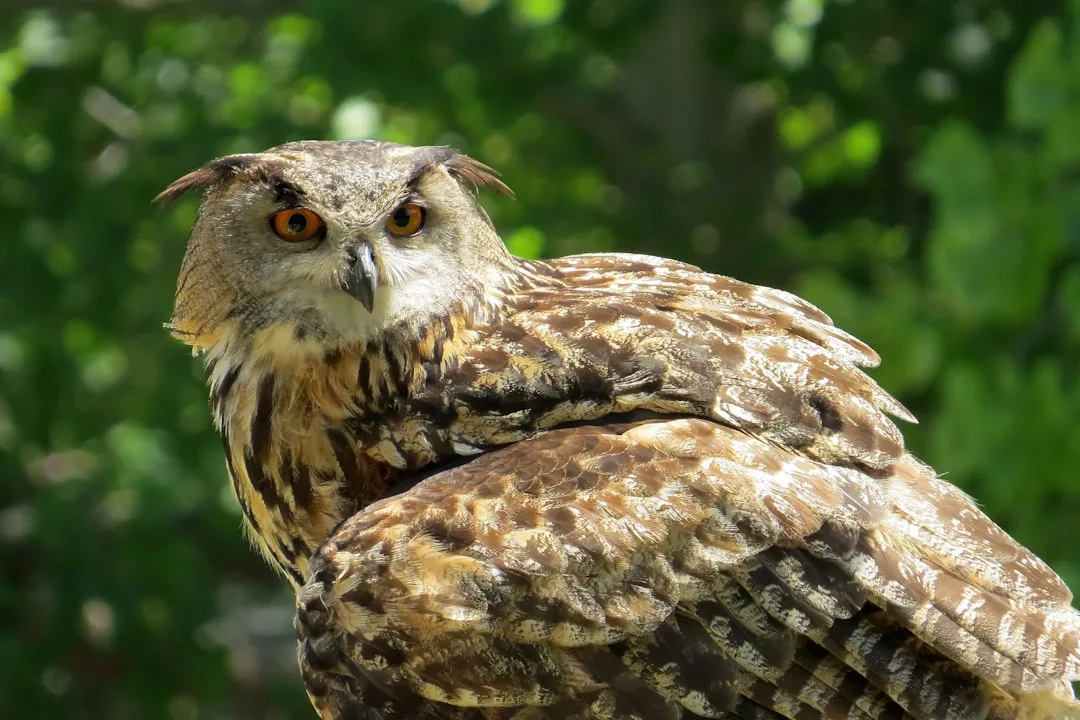
The Eurasian eagle-owl is the largest owl species on Earth by wingspan and one of the most powerful nocturnal predators in the northern hemisphere. Bubo bubo holds cliffs, forest edges, and mountain slopes across more than forty countries, from the Atlantic coast of Iberia to the Pacific shores of the Russian Far East, and from Arctic Scandinavia to the deserts of North Africa.
It hunts mammals as large as foxes and roe deer fawns, calls across valleys that are four kilometres wide, and sits at the very top of the owl branch of the food web - no other owl regularly preys upon it, and adult birds have essentially no natural predators apart from humans.
This guide covers the full biology and ecology of the Eurasian eagle-owl: size and anatomy, the strange function of its famous ear tufts, hunting behaviour, diet breadth, vocalisations, reproduction, movement, populations, and one of the most celebrated raptor reintroduction success stories in Europe. It is a reference entry, not a summary, so expect specifics - kilograms, decibels, kilometres, and verified records.
Etymology and Classification
The scientific name Bubo bubo is a doubled Latin word meaning, quite simply, 'owl-owl'. The root bubo is onomatopoeic, imitating the deep territorial hoot of the male, and was used by Roman naturalists including Pliny the Elder to describe any large horned owl. Carl Linnaeus adopted the name in his 1758 Systema Naturae, and it has survived unchanged since.
In German the species is Uhu, another onomatopoeic name, as is the French hibou grand-duc (literally 'grand-duke owl', referring to the species' imposing size). Russian calls it filin, Turkish puhu kusu, and Arabic al-bum al-nasri ('eagle-like owl'). The English common name 'eagle-owl' reflects both the bird's eagle-like size and its habit of hunting diurnal raptors.
Taxonomically, the Eurasian eagle-owl sits in the true owl family Strigidae, order Strigiformes. It is the type species of the genus Bubo, which also contains the great horned owl of the Americas, the snowy owl, the Cape eagle-owl of southern Africa, and Blakiston's fish owl.
Current authorities recognise between 10 and 16 subspecies of Bubo bubo across the Palaearctic, differing in size, colour saturation, and habitat preference. The nominate B. b. bubo occupies central and northern Europe; B. b. omissus inhabits Turkestan; B. b. hemachalana the Himalayas; and B. b. kiautschensis northern China.
Genetic studies indicate that Bubo bubo diverged from its sister species - the great horned owl - roughly 4 million years ago, with subsequent isolation on either side of the Bering Strait. Fossil eagle-owls are known from European deposits at least 2 million years old, meaning the lineage has survived multiple glacial cycles with little morphological change.
Size and Physical Description
The Eurasian eagle-owl is the largest owl in the world by wingspan. Its only rival for the title of largest owl overall is Blakiston's fish owl, which is slightly heavier on average but has a shorter wingspan.
Males:
- Length: 58-70 cm from bill tip to tail tip
- Wingspan: 155-180 cm
- Weight: 1.5-3.0 kg
Females:
- Length: 63-75 cm
- Wingspan: 170-188 cm, exceptionally close to 200 cm
- Weight: 2.3-4.2 kg
Juveniles at fledging:
- Weight: 1.8-2.5 kg
- Full adult size reached within the first year, though full plumage may take until the third year
Reverse sexual dimorphism - females larger than males - is pronounced. A large female may weigh nearly twice what a small male weighs. The functional explanation remains debated, but the leading hypothesis is that larger females defend nests more effectively against mammalian predators while smaller, more agile males bring in prey.
The body plan is a compact, barrel-chested raptor built for powered flapping flight rather than sustained gliding. The wings are broad and rounded, optimised for manoeuvring through forest edges and cliff faces at low speeds. The flight feathers carry a fine comb-like leading edge and a velvety upper surface, two structural features that muffle the sound of flight and allow the bird to approach prey almost silently.
Plumage is cryptic: the upper body is mottled dark brown and buff, the underparts are paler with heavy streaking on the breast and fine barring lower down. The back and wings provide excellent camouflage against tree bark and rocky cliffs. Striking features include:
- Enormous orange-red eyes, unusually pigmented among owls, where yellow or dark brown is far more common
- Prominent ear tufts up to 8 cm long, raised in alertness, lowered in flight or relaxation
- A broad, heavy, hooked black bill
- Feathered legs extending down to the toes
- Large, powerful feet armed with black talons reaching 4 cm in length
- A gripping force estimated at 500 newtons - comparable to a golden eagle
The facial disc is wider and less pronounced than in barn owls or long-eared owls. It functions as a sound-collecting parabolic dish but is not as acoustically optimised as the barn owl's heart-shaped disc. This is consistent with the eagle-owl's mixed reliance on vision and hearing during hunting, rather than the near-pure acoustic targeting of barn owls.
The Truth About Ear Tufts
The feature most casual observers notice first is the pair of prominent feathered 'horns' on top of the head. These are ear tufts, known technically as plumicorns, and despite the name they have absolutely nothing to do with hearing.
Ear tufts are clusters of elongated feathers with three demonstrated functions:
- Camouflage. An eagle-owl roosting against a tree trunk with its tufts raised produces a broken, asymmetric silhouette that resembles a snapped branch. Smaller songbirds, which mob roosting owls aggressively, have more difficulty recognising the shape.
- Visual signalling. Tufts are raised in threat displays and during territorial encounters. Flattened tufts indicate relaxation, flight, or submission.
- Individual and species recognition. Tuft shape and length help eagle-owls recognise conspecifics at distance, especially during the crepuscular hours when colour vision is poor.
The actual ear openings are vertical slits hidden beneath feathers on either side of the facial disc. Crucially, the openings are asymmetric in height - the right ear is positioned slightly higher than the left on most individuals.
This asymmetry means a sound reaches one ear a fraction of a millisecond before the other in the vertical axis as well as the horizontal, letting the brain triangulate elevation and direction simultaneously. The result is a hearing system accurate enough to locate a mouse under 30 cm of snow with the eyes closed.
This separation of visual ear tufts from auditory ear openings is one of the most persistently misunderstood features in popular bird writing. The tufts are feathers on top. The ears are slits on the sides. They are two different organs serving entirely different purposes.
Built for Silent, Low-Light Hunting
The Eurasian eagle-owl is adapted to hunt in conditions that would be completely disabling to humans - dim twilight, moonless nights, and deep winter forests. Every feature of its sensory apparatus serves one of two goals: see enough in low light to locate prey, or hear enough to pinpoint it when sight fails.
Visual adaptations:
- Tubular eyes almost as large as human eyes, locked in the skull and unable to rotate
- Retina dominated by rod cells for low-light sensitivity, with modest cone counts for limited colour vision
- Estimated light sensitivity roughly 100 times greater than humans in dim conditions
- Forward-facing eyes providing binocular vision for depth perception over about 70 degrees of overlap
- Neck mobility allowing 270-degree rotation to compensate for immobile eyes
Auditory adaptations:
- Asymmetric ear openings for vertical sound localisation
- Large, mobile facial disc funnelling sound toward the ears
- Brain regions dedicated to auditory processing proportionally larger than in diurnal raptors
Flight adaptations:
- Comb-like leading edge on primary flight feathers breaks up turbulence
- Velvety upper wing surface absorbs sound of feathers rubbing in flight
- Broad wing area gives low wing loading, permitting slow, controlled approach
- Serrated trailing edges reduce whistle sounds common in most birds of prey
The combination produces a bird that can see in near-total darkness, hear prey movements from dozens of metres away, and close the distance in flight quiet enough that most prey never registers the approach.
Hunting and Diet
The Eurasian eagle-owl is the most catholic predator of any European owl. Across its range, prey records include more than 450 species of mammals, birds, reptiles, amphibians, fish, and large invertebrates. The diet is regionally flexible, tracking whatever small to medium-sized animals are locally abundant.
Primary mammalian prey:
- Voles, rats, and other small rodents - the staple diet in most regions
- Hedgehogs - taken readily despite the spines, which are consumed along with the flesh
- European rabbit and mountain hare
- Red squirrel, marmots, and ground squirrels
- Juvenile foxes and mature adult foxes in some populations
- Roe deer fawns and young chamois
- Domestic cats, occasionally
Primary avian prey:
- Pigeons, crows, jays, and magpies
- Gamebirds including partridge, pheasant, and capercaillie
- Ducks and coots from waterbodies
- Other raptors: buzzards, goshawks, kestrels, sparrowhawks
- Other owls: tawny owls, long-eared owls, little owls, even young eagle-owls from neighbouring territories
Other prey categories:
- Snakes and lizards
- Frogs and toads
- Fish caught by snatching from shallow water
- Large beetles, moths, and grasshoppers during summer
Typical consumption is roughly 300 to 400 grams of meat per night. A breeding pair feeding young may kill prey totalling over a kilogram per day. Surplus carcasses are cached at or near the nest, and piles of 20 or more dead animals have been recorded at active nest sites during spring.
Hunting techniques:
- Perch-and-pounce. The dominant method. The owl sits motionless on a prominent perch - cliff edge, dead tree, utility pole - scanning and listening. When prey is located it glides down silently and takes it on the ground.
- Quartering flight. Low-altitude flight over open terrain at dusk, especially in steppe and meadow habitats, similar to a harrier.
- Aerial interception. Eagle-owls occasionally catch bats and birds in flight, striking them from above or behind.
- Water-surface snatch. Coastal and riparian birds such as ducks and coots are seized from the water surface.
Prey is killed by a crushing strike with the feet, driving the talons deep into the body. Smaller animals are swallowed whole; larger prey is torn apart at the nest or a nearby plucking post. Bones, fur, and feathers are compacted in the gizzard and regurgitated as cylindrical pellets, which form distinctive heaps beneath regular roost sites and are widely used by researchers to reconstruct local diet.
The Deep Booming Call
The male Eurasian eagle-owl's territorial call is among the loudest, lowest-pitched, and furthest-carrying vocalisations of any European bird. The call is a two-note 'ooh-hu' with the first syllable longer and slightly higher, the second dropping into a resonant boom. The fundamental frequency sits around 350 hertz, low enough to propagate efficiently through still night air and around obstacles.
Under calm conditions with no wind and low background noise, human listeners can identify the call clearly at distances of 3 to 4 kilometres, and specialists working at night have reported detection at over 5 kilometres. Eagle-owls themselves can likely hear each other at even greater ranges.
Calling is concentrated in late winter and early spring, when pairs re-establish territories, and in autumn when young birds disperse. A calling male selects prominent perches - rocky outcrops, cliff tops, tall dead trees - that maximise acoustic range. Females answer with a hoot roughly a whole tone higher, producing a distinctive duetted pattern that pairs use to maintain contact across large territories.
Other vocalisations include:
- A harsh 'kveck-kveck' alarm call
- Bill-snapping during threat displays
- Wheezy juvenile begging calls given by nestlings and recently fledged young
- A variety of growls, barks, and hisses during close-range encounters
Vocal analyses show that individual males have stable, recognisable call signatures. Researchers monitoring Swiss and German populations use recorded hoots to identify individuals year after year without capturing or marking them.
Life Cycle and Reproduction
Eurasian eagle-owls are long-lived, site-faithful, and slow to reproduce. Pairs typically mate for life and defend the same territory across multiple decades.
Breeding schedule:
- Pair formation and territorial hooting: December to February
- Courtship feeding and mating: February to March
- Egg-laying: late February to April, depending on latitude
- Incubation: 31-36 days, performed entirely by the female
- Hatching: late March to May
- Fledging: 50-60 days after hatching
- Independence: 5-6 months after hatching, usually autumn
Nests are simple scrapes on cliff ledges, in rocky crevices, at the base of large trees, in abandoned raptor stick nests, and occasionally on the ground in remote steppe. The female does not build a structure but may line the scrape with feathers and prey remains. Clutches contain 1 to 4 eggs, typically 2 or 3, laid 3 to 4 days apart. Eggs are round, white, and weigh about 75 grams each.
Incubation begins with the first egg, so chicks hatch asynchronously over several days. In lean years the youngest chick often dies of starvation or is outcompeted at feedings - a built-in brood-reduction mechanism that allows the parents to match brood size to available food. In good years all chicks fledge successfully.
The male hunts for the entire family throughout incubation and the early nestling stage, delivering prey to the nest several times per night. Once chicks are 3 to 4 weeks old the female resumes hunting alongside him. Fledglings climb and hop around the nest site for several weeks before making their first sustained flights.
Young eagle-owls remain with their parents into early autumn, learning to hunt and recognise prey. Dispersal typically occurs between September and December of the hatching year, with juveniles moving 50 to 500 kilometres before settling. First breeding occurs at 2 to 3 years of age.
Movement, Territory, and Home Range
Eagle-owls are largely sedentary across most of their range. Established pairs hold the same territory for life and rarely travel more than a few kilometres from the core breeding area. Only juveniles undertake long-distance movement.
Territorial scale:
| Metric | Value |
|---|---|
| Typical territory size | 15-80 km^2 |
| Minimum territory size (rich habitat) | ~5 km^2 |
| Home range in sparse habitat | Up to 200 km^2 |
| Typical juvenile dispersal | 50-500 km |
| Longest recorded dispersal | Over 1,500 km (ringed bird recovery) |
Territories are advertised acoustically rather than defended physically. Neighbouring males respond to each other's hoots, and direct aggression is rare except at territory boundaries during peak spring calling. Intruding subadults are usually tolerated at the edges but driven off if they approach active nests.
Northern populations occasionally undertake facultative southward movements in severe winters, especially when prey becomes scarce due to deep snow. These movements are not true migrations but irregular displacements.
Populations and Distribution
The Eurasian eagle-owl has one of the largest geographic ranges of any raptor. Estimates place the global population between 250,000 and 2.5 million mature individuals, distributed across roughly 44 million square kilometres.
Regional distribution:
| Region | Approximate population | Trend |
|---|---|---|
| European Union | 18,000-36,000 pairs | Increasing |
| Russia (including Siberia) | 50,000-100,000 pairs | Stable |
| Central and East Asia | 100,000-500,000 pairs | Poorly known |
| Middle East and Caucasus | 5,000-20,000 pairs | Declining in many areas |
| North Africa | 1,000-5,000 pairs | Declining |
European populations are notable for their recovery from near-extinction in the mid-twentieth century. By the 1960s, Eurasian eagle-owls had disappeared from most of western Europe outside the Alps and parts of Scandinavia due to direct persecution, organochlorine pesticide effects, and mass electrocution on medium-voltage powerlines.
Captive-breeding reintroduction began in West Germany in the 1970s through the Aktion Zur Wiedereinburgerung des Uhus programme. Between 1976 and 2005 the project released more than 1,000 captive-bred eagle-owls across Germany, with parallel efforts in Belgium, Luxembourg, France, Sweden, and the United Kingdom. Germany now supports over 2,500 pairs - a fiftyfold recovery from its low point.
Conservation Status and Threats
The IUCN Red List currently classifies the Eurasian eagle-owl as Least Concern on the basis of its huge range, large population, and generally increasing trend in western and central Europe. However, this global assessment masks regional vulnerability.
Primary threats:
- Powerline electrocution. Medium-voltage distribution lines with poorly designed pylons kill substantial numbers of eagle-owls when the bird bridges a live conductor and an earthed structure. This was the single largest driver of the twentieth-century population crash in western Europe and remains a major ongoing threat in Spain, Italy, and parts of the Balkans.
- Vehicle collisions. Eagle-owls hunt regularly along road edges where rodent populations concentrate in verge vegetation, and collision mortality with cars and trains is significant.
- Illegal persecution. Shooting and nest destruction persist in many regions, driven by perceived competition with gamebird hunting.
- Wind turbines. Recent studies show eagle-owls are vulnerable to collision with turbine blades, especially where turbines are placed on ridgelines along their regular flight paths.
- Disturbance at nest sites. Rock climbing, quarrying, and recreational activities near cliff nests can cause breeding failure.
- Prey contamination. Secondary poisoning from rodenticides used in agriculture accumulates in eagle-owls that feed heavily on rats and voles.
Conservation measures include compulsory retrofitting of dangerous powerline pylons with insulation caps under EU Birds Directive guidance, protected area designations covering key nesting cliffs, and ongoing monitoring networks that track pairs individually across generations using vocal recognition.
The German Reintroduction Story
The Eifel mountains programme in western Germany is frequently cited as one of the most successful large raptor reintroductions in conservation history. The key factors behind its success are worth documenting because they are genuinely transferable to other species.
- High-quality captive stock. Source birds came from the surviving Alpine and Scandinavian populations, which retained full wild behaviour and genetic diversity.
- Soft-release technique. Young birds were kept in acclimatisation aviaries at release sites for weeks, fed without human contact, and released only when capable of independent hunting.
- Long project horizon. The release programme ran for more than three decades, giving populations time to become self-sustaining.
- Political and landowner buy-in. Forestry agencies, utility companies, and hunting associations were engaged early, reducing persecution and funding powerline modifications.
- Habitat was still present. Unlike many failed reintroductions, the eagle-owl's habitat - cliffs, mature forest edges, and rodent-rich farmland - had never fundamentally disappeared, only the birds themselves.
The model has since been adapted for Bonelli's eagle, white-tailed eagle, and European black vulture recovery programmes across Europe.
Eurasian Eagle-Owls and Humans
The eagle-owl has occupied a prominent place in European folklore for at least two thousand years. Classical Roman writers treated hearing one at night as a bad omen. Medieval European cultures associated the bird with witches, death, and the supernatural - a reputation driven partly by the otherworldly sound of the territorial call, partly by the bird's spectral appearance in torchlight.
In modern popular culture, the eagle-owl features prominently as a trained bird in falconry demonstrations, where its size and striking appearance make it an audience favourite. It is worth noting that in the Harry Potter films the character Hedwig is technically a snowy owl, although many popular descriptions and some international editions describe or depict 'eagle-owl' characters, and Bubo-type owls appear in several supporting roles.
Eagle-owls are also increasingly comfortable in human-modified landscapes. They breed in quarries, on abandoned industrial buildings, and along railway cuttings. Urban populations have been documented in cities including Helsinki, Tampere, Nuremberg, and Innsbruck, where they hunt hares, pigeons, and brown rats from park roofs and construction sites.
This adaptability is one of the principal reasons the species has recovered so strongly in Europe while many other large raptors continue to struggle.
Related Reading
- Owls: Silent Hunters of the Night
- Why Owls Can Turn Their Head 270 Degrees
- Snowy Owl: Arctic Hunter
- Great Horned Owl
- Barn Owl: Silent Flight
References
Relevant peer-reviewed and governmental sources consulted for this entry include the IUCN Red List species assessment for Bubo bubo, BirdLife International European Red List of Birds, the Handbook of the Birds of the World monograph on Strigidae, long-term monitoring reports from the German Federal Agency for Nature Conservation, the Swiss Ornithological Institute population studies, and published research in Journal of Raptor Research, Journal of Ornithology, and Ardea.
Population figures reflect the most recent consolidated estimates from the European Bird Census Council and national monitoring schemes as of the 2024 reporting cycle.
Frequently Asked Questions
How big is the Eurasian eagle-owl?
The Eurasian eagle-owl (Bubo bubo) is the largest owl in the world by wingspan. Body length ranges from 60 to 75 centimetres, and the wingspan typically measures 160 to 188 centimetres, with exceptional individuals reaching close to 2 metres. Females are markedly larger than males - a pattern called reverse sexual dimorphism, common among owls. Males weigh 1.5 to 3.0 kilograms while females weigh 2.3 to 4.2 kilograms.
By mass, only Blakiston’s fish owl (Bubo blakistoni) of far-eastern Russia and Hokkaido is heavier on average, and even then the difference is narrow. Standing upright, an adult eagle-owl can reach 70 centimetres in height.
Where do Eurasian eagle-owls live?
Eurasian eagle-owls have one of the largest geographic ranges of any owl, stretching across Europe, most of Asia, and parts of North Africa. They occur from Portugal and Scandinavia in the west across Russia, Mongolia, and China, south into the Middle East, the Caucasus, the Himalayan foothills, and the Atlas Mountains of Morocco and Algeria.
They are habitat generalists and have been recorded from sea level to over 4,500 metres elevation in the Tibetan Plateau. Preferred habitats include rocky cliffs, gorges, quarries, ancient forests bordering open country, mountain slopes, steppe, and semi-desert. They avoid dense uniform forest and truly open plains without cliffs or trees for roosting.
What do Eurasian eagle-owls eat?
Eurasian eagle-owls are generalist apex predators with one of the broadest prey lists of any owl. Diet varies by region but commonly includes mammals up to the size of foxes, roe deer fawns, mountain hares, marmots, and young wild boar; birds up to the size of buzzards, herons, capercaillie, and other owls including tawny and long-eared owls; reptiles including snakes and tortoises; amphibians; and occasionally large insects and fish.
European studies document more than 450 prey species across the range. A single eagle-owl consumes roughly 300 to 400 grams of meat per night on average. Surplus prey is cached at nest sites, where piles of 20 or more dead animals have been recorded during the breeding season.
What are the 'horns' on an eagle-owl's head?
The prominent tufts on top of the eagle-owl’s head are called ear tufts or plumicorns, and despite the name they have absolutely nothing to do with hearing. Ear tufts are clusters of elongated feathers used for visual communication and camouflage. When an eagle-owl sits still against a tree trunk with its ear tufts raised, its silhouette breaks up and resembles a broken branch, helping conceal the bird from mobbing smaller birds.
Tufts also convey mood - they are raised during alertness or threat displays and flattened when the bird is relaxed or flying. The actual ear openings are hidden under feathers on the side of the head and are asymmetric in height, allowing the owl to triangulate the vertical position of sound sources with extraordinary precision.
How loud is the Eurasian eagle-owl's call?
The male Eurasian eagle-owl produces a deep, resonant two-note ‘ooh-hu’ territorial call that is among the loudest and most far-carrying vocalisations of any European bird. Under calm night conditions the call can be clearly heard by human listeners at distances of 4 kilometres or more, and by other eagle-owls over even greater ranges.
The call is given from prominent perches at dusk and through the night, peaking in late winter and early spring when pairs are establishing territories. Females produce a similar but slightly higher-pitched hoot. Pairs often duet, with both birds calling in sequence. Eagle-owls also use a range of other sounds including barks, hisses, bill-snapping, and juvenile begging screeches.
How long do Eurasian eagle-owls live?
Wild Eurasian eagle-owls typically live about 20 years, with a small proportion reaching 25 or more. First-year mortality is high, with roughly 40 to 60 per cent of fledglings failing to reach breeding age, mostly due to starvation, collisions with powerlines and roads, and electrocution. Once an eagle-owl is established on a territory with a mate, annual survival rises sharply and individuals can hold the same cliff or forest edge for decades.
In captivity, with stable food, veterinary care, and no exposure to the main wild hazards, eagle-owls regularly exceed 40 years, and verified records extend past 60. This makes them one of the longest-lived owl species and one of the longest-lived birds of prey overall.
Is the Eurasian eagle-owl endangered?
The IUCN Red List classifies the Eurasian eagle-owl as Least Concern thanks to its enormous geographic range and growing populations in many areas. Global numbers are currently estimated at 250,000 to 2.5 million mature individuals. The species was, however, nearly extinct across large parts of western and central Europe by the 1960s, driven to near-zero by persecution, pesticide poisoning, and electrocution on medium-voltage powerlines.
Large-scale reintroduction and captive-breeding programmes launched in the 1970s and 1980s in Germany, Sweden, Belgium, France, and the United Kingdom have restored breeding populations across hundreds of sites. Germany alone now supports more than 2,500 pairs, up from under 50 pairs in the 1960s. Ongoing threats include powerline electrocution, vehicle strikes, illegal shooting, and disturbance at nest sites.
How does the Eurasian eagle-owl compare to other large owls?
Among the world’s largest owls, the Eurasian eagle-owl leads on wingspan and is second on body mass. Blakiston’s fish owl (Bubo blakistoni) is marginally heavier on average but has a shorter wingspan. The great grey owl (Strix nebulosa) is longer from head to tail but much lighter because most of its apparent size is fluffy plumage. The snowy owl (Bubo scandiacus) is comparable in mass but smaller in wingspan.
Within its own genus, the eagle-owl shares hunting and nesting strategies with its close relatives including the great horned owl of the Americas and the Cape eagle-owl of Africa. Unique to the Eurasian species is the combination of very large size, extremely broad habitat use, and the capacity to take prey as large as foxes and fawns, which puts it at the top of the owl predation pyramid globally.