
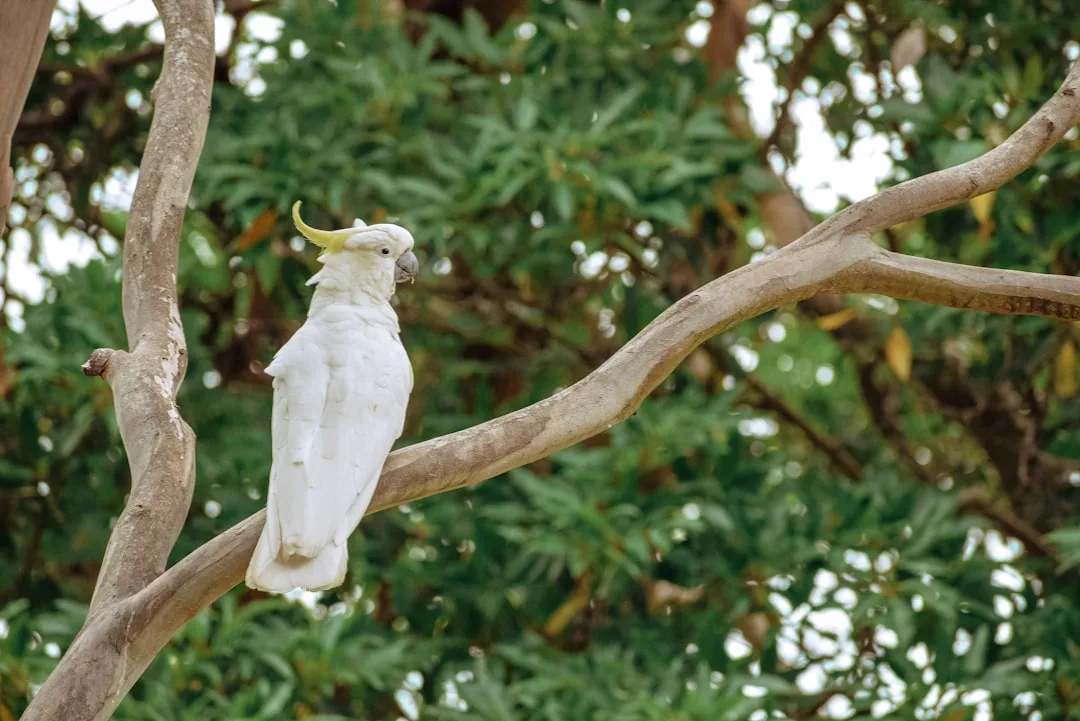
The sulphur-crested cockatoo is arguably the best-known parrot in the Southern Hemisphere and one of the most cognitively gifted birds alive on Earth today. Cacatua galerita is the species most people mean when they say 'cockatoo' - a large, noisy, brilliant-white parrot with a fan of lemon-yellow feathers folding up behind its head.
It is a flagship species of Australian woodland, a familiar suburban neighbour in Sydney and Brisbane, and - through the celebrity of Snowball the dancing cockatoo - the first non-human animal that science has firmly confirmed can keep a musical beat.
This guide covers every major aspect of sulphur-crested cockatoo biology and ecology: taxonomy, physical description, habitat, diet, intelligence, mimicry, social behaviour, reproduction, conservation status, and the extraordinary cultural transmission behaviours that have made this species a subject of high-profile peer-reviewed research. It is a reference entry, not a summary - so expect specifics: decibels, grams, kilometres, study citations, and verified longevity records.
Etymology and Classification
The scientific name Cacatua galerita combines the Malay-derived genus name Cacatua - itself the root of the English word cockatoo - with the Latin galerita, meaning 'crested' or 'helmeted'. The species was formally described by Latham in 1790 from Australian specimens. In common Australian English the bird is often called simply 'cocky', a nickname applied casually across the family.
Indigenous Australian languages contain dozens of distinct names for the species, reflecting its long cultural presence across the continent.
Sulphur-crested cockatoos belong to the family Cacatuidae within the order Psittaciformes. Cacatuidae contains 21 recognised species across 7 genera, including black cockatoos, corellas, the cockatiel, the galah, and the palm cockatoo.
All cockatoos share a characteristic erectile crest, a powder-down plumage that coats the feathers in fine white dust, and a gall bladder - a trait that distinguishes the family from the true parrots of family Psittacidae. Every one of the 21 cockatoo species is restricted to Australia, New Guinea, eastern Indonesia, and the Philippines. No cockatoo is naturally native to Africa, the Americas, or mainland Asia.
Within Cacatua galerita four subspecies are currently recognised, varying mainly in size, bill morphology, and minor plumage features. The nominate C. g. galerita is the large eastern Australian form; C. g. fitzroyi, C. g. eleonora, and C. g. triton cover northern Australia, the Aru Islands, and New Guinea respectively.
Confusion with the superficially similar but smaller yellow-crested cockatoo (Cacatua sulphurea) is a serious conservation issue, because the latter is Critically Endangered and sometimes laundered through the pet trade under the common species' name.
Size and Physical Description
Sulphur-crested cockatoos are medium-large parrots with a robust build and a striking crest. Sexual dimorphism in size is modest, but reliable in eye colour.
Adults (both sexes):
- Length: 45-55 cm from beak tip to tail tip
- Weight: 815-975 g, occasionally heavier in well-fed captive birds
- Wingspan: approximately 103 cm
- Crest length: around 14 cm, fully erectile
Key colour and structural features:
- Plumage: white overall, with pale yellow wash on under-wing and under-tail coverts
- Crest: lemon-yellow, fan-shaped, raised or folded depending on mood
- Beak: heavy, curved, blackish-grey, with a ridged upper palate for grinding seeds
- Legs and feet: grey, with zygodactyl toe arrangement (two forward, two back)
- Iris: dark brown to black in adult males, reddish-brown in adult females
The zygodactyl foot is central to how cockatoos interact with the world. The two opposing toes grip branches securely and also allow the foot to be used as a hand - passing food to the beak, holding objects steady for investigation, and manipulating unfamiliar items. A cockatoo hanging by one foot while using the other to investigate a padlock is a common sight in captivity and an increasingly common one on suburban rooftops.
The plumage carries a soft, self-replenishing layer of powder down. Specialised feathers continuously shed microscopic keratin particles that help waterproof and clean the outer plumage. This gives cockatoos their characteristic chalky smell and the faint haze of dust they leave on anything they perch on.
Habitat and Distribution
Sulphur-crested cockatoos occupy a broad range across northern and eastern Australia, all of New Guinea, and a scatter of Indonesian islands.
Native range by region:
| Region | Status | Habitat notes |
|---|---|---|
| Eastern Australia | Native, abundant | Forest, woodland, farmland, urban parks |
| Northern Australia | Native, common | Tropical savanna woodland |
| New Guinea | Native (triton subspecies) | Lowland rainforest, forest edge |
| Aru and Kai Islands | Native (eleonora subspecies) | Moist lowland forest |
| Tasmania | Introduced, self-sustaining | Forest, farmland |
| Western Australia | Introduced (small feral population) | Urban Perth |
Introduced populations also persist in New Zealand, Singapore, Hong Kong, and Palau. These feral groups typically trace back to escaped or released captive birds and are rarely large enough to raise conservation concerns in their new territories.
Within native Australia the species shows marked habitat flexibility. Traditional habitat is tall open eucalyptus forest and the fringes of woodland where old-growth trees provide nesting hollows. Clearance and agriculture have generally benefited the species by providing reliable grain and enlarging the edge habitat cockatoos prefer.
Over the last century the species has also become thoroughly urbanised along the east coast, where large roosting flocks are now a defining feature of cities like Sydney, Wollongong, Newcastle, and Canberra.
Cockatoos require tree hollows for breeding, and these hollows only form in eucalypt trees older than roughly 150 years. The loss of veteran trees to logging, firewood collection, and land clearance is the most serious long-term limitation on the species in much of its range, even though overall numbers remain high.
Diet and Foraging
Sulphur-crested cockatoos are omnivores with a strong preference for plant matter. Their wild diet is dominated by hard seeds, grains, and fruits, supplemented seasonally by flowers, buds, roots, bulbs, and invertebrates.
Typical wild diet:
- Seeds of eucalypts, casuarinas, acacias, and grasses
- Fruit, berries, and flower buds from native and introduced plants
- Cereal grain (wheat, sorghum, corn) where available
- Roots, corms, and bulbs dug up with the beak and foot
- Insects, larvae, and grubs opportunistically taken
The upper mandible is shaped into a powerful nutcracker that anchors hard seeds against a ridged palate while the lower mandible grinds them open. The tongue is thick, muscular, and sensitive, rotating each seed into position before the lower beak strikes. This tongue-assisted manipulation is also the reason sulphur-crested cockatoos are so adept at mimicking human speech - the same muscular control that positions a seed can shape outgoing air into near-consonant sounds.
In agricultural districts cockatoos can cause significant crop damage, and they are classified as a pest in some Australian states. Damage is often social rather than strictly dietary - flocks will rip open silage bags, strip bark, and chew wooden structures for reasons that appear to combine curiosity, beak maintenance, and play.
Urban foraging:
In cities the species has learned to exploit human food streams directly. Sydney cockatoos famously open domestic wheelie bins to reach the food waste inside. A 2021 study published in Science by Barbara Klump, Lucy Aplin, and colleagues mapped the spread of this bin-opening behaviour across the Sydney metropolitan area.
The researchers documented that different suburbs developed distinct 'styles' of lifting the lid - some birds gripped the handle with the beak and walked sideways, others hooked a foot under the rim - and that new individuals learned the local technique by watching their neighbours.
This was one of the first rigorous demonstrations of a socially transmitted foraging tradition in a parrot species, and it gave behavioural ecologists a working example of animal culture comparable to tool traditions in chimpanzees.
Intelligence, Mimicry, and Culture
Sulphur-crested cockatoos rank alongside African grey parrots, keas, and corvids as the most cognitively gifted birds. Their intelligence shows up across several domains: tool use, social learning, vocal mimicry, self-control, and beat perception.
Beat perception: the Snowball case.
Snowball is a captive male sulphur-crested cockatoo originally surrendered to Bird Lovers Only Rescue in Indiana. In 2008 cognitive neuroscientist Aniruddh Patel began a series of controlled studies of Snowball's apparent dancing to music.
A 2009 paper in Current Biology reported that Snowball reliably adjusted his head-bobbing and foot-lifting to match the tempo of Backstreet Boys recordings played at different speeds. The result was widely publicised because it upended a longstanding assumption that rhythmic synchronisation to music was uniquely human.
Follow-up studies documented at least fourteen distinct self-invented dance moves, including head-banging, body-rolling, and foot-lifting in patterns not modelled by any human teacher. Snowball remains the first non-human animal scientifically confirmed to entrain movement to an external musical beat.
Tool use and manufacture.
Wild sulphur-crested cockatoos have been observed using sticks to probe for insects and to scratch parts of the body that the beak cannot reach. The closely related palm cockatoo of northern Australia goes further, manufacturing drumsticks from branches and rapping them against hollow tree trunks during courtship - the only known case of a non-human animal making a tool used as a musical instrument.
Captive sulphur-crested cockatoos have been filmed spontaneously bending wire to reach food, opening complex multi-step puzzle boxes, and discovering that a key can be inserted into a lock.
Social learning and culture.
The Klump and Aplin Sydney bin-opening work represents the strongest case yet for a parrot foraging culture. The study combined citizen-science reports from hundreds of Sydney residents with controlled field trials.
Results showed that bin-opening spread outward geographically rather than appearing independently in scattered suburbs, which is the signature of social transmission rather than individual invention. This research has been cited as evidence that animal culture is not limited to mammals.
Self-control and problem solving.
In laboratory studies cockatoos have passed self-control tests - refusing an immediate reward in favour of a larger delayed one - that many primates fail. They also solve multi-step puzzle boxes that require sequenced lock-picking, and they generalise the technique to novel locks.
Vocal Behaviour and Mimicry
Sulphur-crested cockatoos are famously loud. Their contact call is a piercing, drawn-out screech that can hit 129 decibels measured at close range - comparable to a jet engine at takeoff and above the threshold of immediate hearing damage in humans.
Functions of loud calls:
- Long-distance contact. Flocks may spread across hundreds of metres while foraging. Loud calls keep pairs and family groups in contact across this distance.
- Alarm signalling. Sentinel birds perch high in the canopy and shriek when a predator - goshawk, python, introduced fox - approaches. The flock takes flight in a coordinated wheel.
- Roost-assembly. At dusk, flocks gather into large communal roosts. Arrival is accompanied by prolonged loud calling among hundreds of birds at once.
- Intraspecific display. Calls accompany crest-raising displays, courtship, and territorial disputes.
Beyond their natural vocal repertoire, sulphur-crested cockatoos are accomplished mimics. The vocal organ of a parrot is the syrinx, located at the base of the trachea, with independent muscular control of airflow through each bronchus.
Combined with the thick, mobile tongue, this enables the reproduction of sounds - including human speech, whistles, ringtones, and other bird species' calls - with surprising fidelity. Hand-raised captive birds commonly learn dozens of words and phrases and often deploy them in context, such as greeting people on entry to a room or asking for a specific food.
Social Life and Reproduction
Sulphur-crested cockatoos are highly social. Outside the breeding season they live in flocks ranging from a dozen to several hundred birds. Flocks roost communally in tall trees, fly out to feeding grounds at dawn, and return to the roost near dusk.
Pairs bond for life. Pair-bond maintenance includes mutual preening, synchronised calling, and coordinated foraging. Courtship includes crest-raising, head-bobbing, and softly vocalised contact calls. Once paired, the same two birds return to the same nest hollow year after year, often for decades.
Breeding biology:
- Nest site: a deep hollow in a mature eucalypt, typically 10-30 m above ground
- Clutch size: 2-3 eggs, rarely 4
- Incubation: 27-30 days, shared by both parents
- Fledging age: 6-9 weeks
- Parental care: chicks remain with parents for several months post-fledging
- Sexual maturity: around 3-5 years
Breeding season runs from August to January in southern Australia and May to September in the tropical north. Pairs defend the nest hollow vigorously and will drive off competitors several times their size, including goannas and larger parrots.
Because nest hollows only form in very old eucalypts, hollow availability is the primary limit on cockatoo reproduction. A single hollow may be contested by cockatoos, owls, possums, gliders, and bees. Conservation of veteran trees is therefore a key management priority even for a common species.
Lifespan and Longevity
Sulphur-crested cockatoos are among the longest-lived birds on Earth. Life expectancy varies dramatically between wild and captive conditions.
Lifespan data:
| Context | Typical lifespan | Maximum verified |
|---|---|---|
| Wild (average) | 20-40 years | 60-80 years |
| Captive (good care) | 60-80 years | 100+ years |
| Record holder | - | Cookie, 83 years (1933-2016) |
Cookie was a male sulphur-crested cockatoo kept at Brookfield Zoo in Illinois from 1933 until his death in 2016. Hatched in the early 1930s, he arrived at the zoo as part of its original animal collection and remained on display for most of his life. His verified age of 83 makes him one of the longest-lived parrots in any record, and among the longest-lived individual birds of any species for which reliable documentation exists.
Because captive cockatoos routinely outlive their first human owners, the species is frequently referenced in discussions of long-term pet commitment. Rescue centres across Australia, Europe, and North America house numerous sulphur-crested cockatoos that have been rehomed multiple times over 40-50 years of life.
The same cognitive flexibility that makes them charming companions also makes them demanding: captive cockatoos deprived of mental stimulation frequently develop stereotyped feather-plucking, screaming, and self-injurious behaviours.
Conservation Status and Threats
The IUCN Red List classifies Cacatua galerita as Least Concern with a stable or slightly increasing global population. The species has adapted well to agriculture and urbanisation in Australia, and it remains widespread across most of its native range.
Threats, where they exist:
- Hollow loss. The long-term availability of old-growth eucalypts with suitable nest cavities is in slow decline across much of eastern Australia.
- Persecution as a pest. Farmers sometimes shoot or poison cockatoos in response to crop damage. Regulated culling exists in some states.
- Illegal trade. Because the species closely resembles the Critically Endangered yellow-crested cockatoo (Cacatua sulphurea), trafficked wild-caught birds of the rarer species are sometimes laundered under the Least Concern name.
- Urban conflict. Cockatoos chew window frames, roof cables, deck timbers, and garden plants in suburbs, triggering complaints and occasional unlawful killings.
Conservation concerns within the wider cockatoo family are more urgent. The Philippine cockatoo (Cacatua haematuropygia), yellow-crested cockatoo (Cacatua sulphurea), Moluccan cockatoo (Cacatua moluccensis), and several black cockatoo species are all threatened by habitat loss and the pet trade. Regional conservation of sulphur-crested cockatoos therefore often doubles as an educational front line for the family as a whole.
Cockatoos and Humans
Sulphur-crested cockatoos have shared the Australian landscape with people for tens of thousands of years. Indigenous cultures across the continent feature the bird in song, story, and ceremony, with distinct language names in almost every region. European colonists recorded the species in their earliest natural-history writings in the late 18th century, and live birds were shipped to Europe as luxury pets from the 1790s onward.
Today the species occupies a double role in Australian culture. It is a beloved emblem of the bush - the flash of white wings and yellow crest over eucalypt woodland is instantly recognisable - and a source of domestic frustration, as flocks strip timber decks, open bins, and shred garden beds.
Municipal councils in Sydney and Brisbane have experimented with bin-lid weights, locks, and deterrents, often with limited success because the birds simply learn the new device. The arms race between Sydney councils and suburban cockatoo flocks has itself become a case study in rapid behavioural evolution.
In captivity the species is both popular and controversial. Its intelligence, longevity, and strong pair-bonding habit make it a high-maintenance companion, and responsible aviculture increasingly emphasises hand-raised stock, enriched housing, and lifetime rehoming commitments.
Related Reading
- African Grey Parrot
- Kakapo
- Scarlet Macaw
- Parrots: The Einsteins of the Bird World
- How Parrots Talk: Language Learning in Birds
References
Relevant peer-reviewed sources consulted for this entry include Patel et al.
(2009) in Current Biology on Snowball and entrainment to music; Klump, Martin, Bugnyar, Aplin, and Dutour (2021) in Science on social learning of bin-opening in Sydney sulphur-crested cockatoos; IUCN Red List assessments for Cacatua galerita and related cockatoo species; BirdLife Australia population reports; and the Australian Museum species account.
Longevity records for Cookie are sourced from Brookfield Zoo documentation and the Chicago Zoological Society archives. Vocal decibel measurements are drawn from acoustic studies of Australian parrots published in bioacoustics literature.
Frequently Asked Questions
How big is a sulphur-crested cockatoo?
Adult sulphur-crested cockatoos (Cacatua galerita) measure 45-55 cm from beak to tail and weigh 815-975 g. Wingspan averages around 103 cm. Males and females are similar in size, though males typically carry slightly heavier bodies and larger beaks. Sex is most reliably told from eye colour: adult males have very dark, almost black irises, while adult females show a reddish-brown iris in good light.
The distinctive yellow crest stretches roughly 14 cm long and can be fanned forward into a dramatic crown or folded flat against the head depending on the bird’s mood.
Where do sulphur-crested cockatoos live?
The species is native to northern and eastern Australia, all of New Guinea, and several eastern Indonesian islands including the Aru Islands and parts of the Kai archipelago. Feral populations also persist in New Zealand, Singapore, Hong Kong, Palau, and small pockets of Western Australia following introductions.
Preferred habitat is open forest, woodland, and the edges of agricultural land, but the species is highly adaptable and now thrives in suburbs and city parks across the Australian east coast. Urban Sydney, Canberra, Melbourne, and Brisbane support large resident flocks that roost communally in tall trees and forage across gardens and rubbish bins.
How intelligent are cockatoos?
Sulphur-crested cockatoos are considered among the most intelligent birds on Earth, rivalling African grey parrots and corvids on problem-solving tasks. Laboratory and field studies have documented tool use, social learning, beat perception, and self-control behaviours previously thought unique to great apes.
The most famous demonstration is Snowball, a captive male studied by Aniruddh Patel since 2008, who was the first non-human animal scientifically confirmed to synchronise movements to an external musical beat.
In 2021 a team led by Barbara Klump and Lucy Aplin published a Science paper showing that wild sulphur-crested cockatoos in Sydney learn bin-opening techniques from neighbours, and that regional ‘styles’ of opening emerge - the first strong evidence of a socially transmitted foraging culture in a parrot.
Can sulphur-crested cockatoos talk?
Yes. Like many parrots, sulphur-crested cockatoos can mimic human speech, environmental sounds, and the calls of other animals. Mimicry is enabled by their syrinx - a vocal organ with independent muscular control of each airway - combined with an unusually thick, mobile tongue that shapes sound into recognisable consonants.
Captive birds commonly learn dozens of words, whistles, and household noises and often use them in broadly appropriate contexts, such as greeting people on entry. Wild birds rarely mimic human speech but will copy other bird species and mechanical sounds. Speech mimicry is more common in hand-raised cockatoos that grow up closely bonded to human caregivers.
How long do cockatoos live?
Sulphur-crested cockatoos are among the longest-lived birds on Earth. In the wild, typical lifespans run from 20 to 40 years for most birds, with exceptional individuals reaching 60-80 years. In captivity, with veterinary care and a stable diet, they routinely pass 80 years and sometimes reach 100 or more. The record-holder is Cookie, a male kept at Brookfield Zoo in Illinois from 1933 until his death in 2016 at 83 verified years of age.
Because cockatoos pair-bond and bond with human owners for decades, the species is often mentioned in discussions of lifetime-commitment pet ownership - a hand-raised chick may outlive its first human family.
Why is the cockatoo's call so loud?
The contact and alarm call of the sulphur-crested cockatoo can reach 129 dB at close range, which is comparable to a jet engine at takeoff and above the threshold of immediate hearing damage in humans. The volume evolved to carry across open Australian landscapes, through dense eucalypt canopy, and between members of fast-moving flocks that may be separated by a kilometre or more.
Loud, piercing screeches also deter aerial predators and alert flock-mates to ground threats. Urban cockatoos have not toned their calls down in response to human neighbours, which is a well-known source of suburban complaint in eastern Australia.
Are cockatoos endangered?
The sulphur-crested cockatoo (Cacatua galerita) is listed as Least Concern by the IUCN, with a large and broadly stable global population. The species has actually expanded in parts of its range thanks to agriculture, irrigation, and successful urban adaptation. Several other cockatoo species within the family Cacatuidae are in serious trouble, however.
The Philippine cockatoo (Cacatua haematuropygia) and the yellow-crested cockatoo (Cacatua sulphurea, a separate species despite the similar name) are Critically Endangered due to trapping for the pet trade and habitat loss. Conservation concerns in the wider family make confusion between species dangerous, because collectors sometimes launder rare captured birds under the name of the common C. galerita.
What do sulphur-crested cockatoos eat?
Sulphur-crested cockatoos are omnivores with a strong bias toward plant matter. Their wild diet includes seeds, grain, fruit, berries, flower buds, nuts, roots, corms, and the occasional insect or grub. They use the upper beak as a powerful nutcracker, anchoring hard seeds against a ridged palate while the lower beak applies pressure. Flocks forage both in the canopy and on the ground.
In agricultural regions they are sometimes classified as a crop pest because of damage to wheat, sorghum, and sunflower. In cities they exploit fruit trees, spilled grain, bird feeders, and - most famously - household wheelie bins containing food waste.