
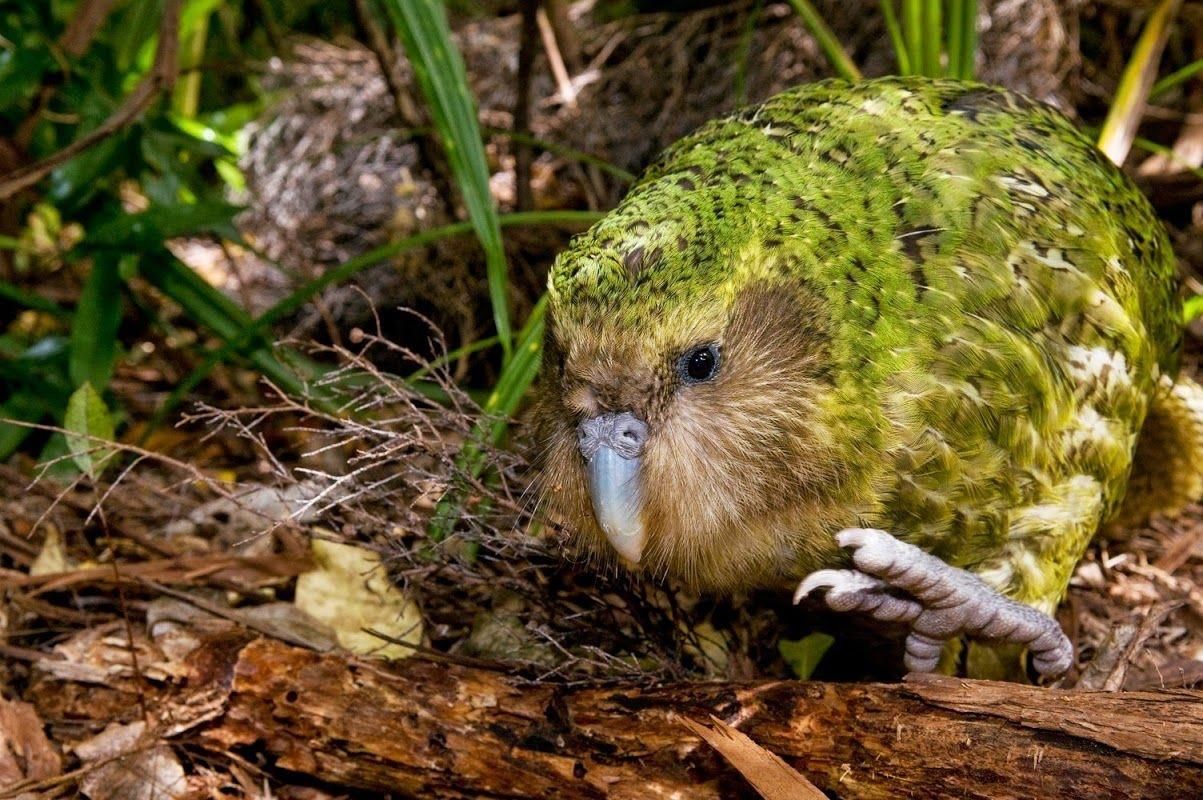
The kakapo is the strangest parrot on Earth. It is the only parrot that cannot fly. It is the heaviest parrot alive. It is the only parrot that breeds in a lek, the only parrot that is strictly nocturnal, and one of the very few birds of any kind whose entire world population is known by name.
Every living kakapo - 252 of them as of the 2024 census - wears a lightweight transmitter, answers to a human-given name, and has its location pinged several times a day by the rangers of the New Zealand Kakapo Recovery Programme. No other vertebrate on the planet is managed with that level of individual attention.
This guide covers every major dimension of kakapo biology: classification, size, flightless anatomy, nocturnal habits, the extraordinary lek breeding system, diet tied to rimu masting, conservation status, and the tangled relationship between kakapos and the humans who nearly wiped them out and are now trying to save them.
It is a reference entry, not a summary - so expect specifics: kilograms, kilometres, decibels, census counts, and the names of individual birds that have shaped the species' recovery.
Etymology and Classification
The scientific name Strigops habroptila was coined by English ornithologist George Robert Gray in 1845. Strigops derives from the Greek words for 'owl' and 'face', a reference to the bird's ring of fine facial feathers that recalls an owl's facial disc. Habroptila means 'soft-feathered', describing the unusually pliable plumage that is one of the first things a handler notices.
In everyday New Zealand English the species is called simply the kakapo, from the Maori kakapo, meaning 'night parrot'. Older English sources also call it the owl parrot or the ground parrot.
The kakapo belongs to the family Strigopidae, an ancient lineage of New Zealand parrots that diverged from all other parrots roughly 80 to 82 million years ago - around the time New Zealand itself broke away from the supercontinent Gondwana. The family today contains only three living species: the kakapo, the kea (Nestor notabilis), and the kaka (Nestor meridionalis).
Molecular phylogenetics places Strigopidae as the sister group to every other parrot on Earth. In evolutionary terms, the kakapo sits at the very root of the parrot family tree.
Within Strigopidae the kakapo is the sole surviving member of genus Strigops. Fossil evidence suggests several other ground-dwelling New Zealand parrots may have existed in the Pleistocene, but the kakapo is what remains.
Size and Physical Description
Kakapos are unmistakable. They are moss-green above with fine yellow and black barring, paler green-yellow below, and have a large pale ivory beak, short legs with big grey feet, and a distinctive round facial disc.
Males:
- Length: 58-64 cm from beak to tail
- Weight: typically 2.0-4.0 kg, with exceptional individuals slightly heavier
- Wingspan: wings present but not used for flight
- Facial disc more pronounced than in females
Females:
- Length: 58-62 cm
- Weight: typically 1.3-2.0 kg
- Noticeably smaller and slimmer than males
- Take sole responsibility for nesting and chick-rearing
Chicks:
- Hatch weight: around 40 grams
- Fledge at: 10-12 weeks
- Reach adult body mass only at 4-5 years
The kakapo is built for life on the forest floor rather than in the air. Its keel bone - the ridge of sternum that anchors flight muscles in other birds - is reduced to a shallow ridge. Its pectoral muscles are small. Its leg muscles and feet are disproportionately large. The skeleton is heavier than in flying parrots of comparable size.
Taken together these features make the kakapo the heaviest parrot on Earth, outweighing a hyacinth macaw (the heaviest flying parrot, at around 1.5 kg) by a wide margin.
The plumage is famously soft, a result of the barbules that normally interlock in flight-ready feathers being loose and pliable. The coloration is a nearly perfect match for mossy forest floor and lichen-covered trunks. A standing kakapo in a beam of torchlight can be almost invisible against wet forest moss despite its size.
Under ultraviolet light, parts of its facial disc and breast fluoresce - a feature visible to other kakapos but invisible to human predators and, critically, invisible to introduced mammals.
Flightless Anatomy and Tree Climbing
The kakapo is the only member of the 400-species parrot order Psittaciformes that cannot fly. Every other parrot - from the tiny pygmy parrots of New Guinea to the massive hyacinth macaw of Brazil - flies. The kakapo does not.
This is not a case of simply having small wings. Kakapos actively climb trees, sometimes to the tops of 30-metre rimu canopies, by gripping the bark with their beaks and hauling themselves up with their powerful legs.
Once at the top, they forage, feed on fruit, and then return to the ground - often by spreading their wings and performing a slow, controlled, parachute-like descent rather than a true flight. The wings act as brakes and stabilisers; they cannot generate lift for sustained airborne travel.
The flightless body plan is an adaptation to an environment that no longer exists. Before humans arrived, New Zealand had no mammalian predators. The only threats to adult kakapos came from large diurnal aerial predators, particularly Haast's eagle (Hieraaetus moorei, extinct around 1400 CE).
Against an aerial predator, a bird that hides under dense forest canopy at night is safer than one that flies out into the open. Flight requires enormous metabolic investment - flight muscles, light bones, small digestive tract. Losing flight freed the kakapo to grow larger, digest tougher food, and invest energy in long lifespan and occasional but heavy reproduction. It was an excellent evolutionary strategy for 80 million years. It became a catastrophic one in about 800.
Nocturnal Lifestyle and Senses
The kakapo is the only strictly nocturnal parrot. It spends the day resting motionless in dense vegetation or under tree roots and emerges at dusk to feed, walk, and display. The facial disc - the ring of fine feathers that gives the bird its owl-like look - appears to channel sound toward the ear openings, similar to the function of a true owl's facial disc.
Hearing is sharp, and kakapos respond rapidly to distant calls. Vision is adapted for low-light conditions, with large eyes relative to skull size.
Smell is unusually important for a parrot. Kakapos produce a strong, musky, sweet odour often compared to honey, beeswax, or old violin cases. Each bird has a slightly different scent signature, which helps individuals recognise each other in dark forest. The same scent is a fatal giveaway to introduced mammals such as stoats, cats, and rats, which hunt largely by smell. A bird that smells strongly of honey is easy prey for a predator that hunts at night by scent.
Kakapos are walkers, not runners. Their travel speed on the forest floor is slow but persistent. Radio-tracking shows individuals covering several kilometres in a single night during the breeding season, often along regularly used tracks between feeding trees and display grounds.
Diet and Rimu Masting
Kakapos are herbivores. They eat fruit, leaves, roots, bark, seeds, pollen, and fern rhizomes from a wide range of native New Zealand plants. Their bills are powerful enough to crush tough seeds and strip bark from saplings. A single kakapo can leave a distinctive 'chew mark' on a plant that rangers can identify and use for census purposes.
The single most important food plant in the kakapo's annual calendar is the rimu tree (Dacrydium cupressinum), a tall conifer native to New Zealand forests. Rimu does not fruit every year. Instead it 'masts' - producing huge crops every 2 to 4 years, interspersed with years of little or no fruit. Rimu masts are thought to be triggered by warm summer temperatures in the preceding year.
Kakapos have evolved to synchronise breeding with rimu masts. In non-mast years they eat, walk, maintain territories, and skip reproduction entirely. In mast years, females fatten on ripening rimu fruit, males begin to boom, and pairs breed. The link is so tight that conservation managers can predict breeding years by monitoring rimu flowering the previous summer.
Kakapo foraging in a typical year:
| Food type | Season | Notes |
|---|---|---|
| Rimu fruit | Mast years only | Triggers breeding, primary chick food |
| Fruit of other podocarps | Summer | Kahikatea, totara, miro |
| Leaves and shoots | Year-round | Base diet between fruiting events |
| Fern rhizomes | Year-round | Dug from soil with beak and feet |
| Seeds and bark | Autumn and winter | Stripped from saplings |
The Lek and the Boom
Kakapo reproduction is unlike anything else in the parrot world. Males gather on traditional hilltop sites at the start of the breeding season and establish a 'track and bowl' system - a network of narrow paths connecting shallow bowls, 10 to 50 cm wide, excavated in soil against rocks or tree bases. Each bowl is chosen, dug, and maintained by one male. The bowls act as acoustic amplifiers.
Once the arena is ready, the male begins to 'boom'. This is a deep, resonant call at roughly 50 Hz - close to the lower limit of human hearing. Each boom is followed by a higher-pitched metallic 'chinging' call. A male booms for 8 hours a night, several nights a week, for up to four months of a breeding season. He can produce 10,000 booms in a single night.
The low frequency penetrates dense forest and travels up to 5 km through New Zealand podocarp forest, far further than any parrot call in any other species.
Lek mechanics:
- Males walk from their home ranges - up to 7 km - to traditional hilltop arenas.
- Each male maintains a track system and multiple bowls.
- The best bowls are chosen by long experience and amplify the boom.
- Females travel to the arena, assess males by sound and proximity, and choose.
- Mating takes place in the bowl. The female departs alone.
- All parental care is carried out by the female.
Lek breeding exists in only a handful of bird lineages - grouse, manakins, lyrebirds, a few shorebirds - and the kakapo is the only parrot in the world that uses it. Females raise chicks alone, typically in a hollow in the base of a tree or in a rock cavity.
Life Cycle and Longevity
Kakapo life history is slow. Sexual maturity arrives at 5 to 11 years old, later than almost any other bird. Females lay one clutch of 1 to 4 eggs per breeding attempt - typically 2 or 3 - in a ground nest in a tree hollow or under a rock. Incubation takes about 30 days. The female leaves the nest nightly to feed, which in a mammal-free New Zealand was once safe and is now the single most dangerous part of the chick's life.
Chicks fledge at 10 to 12 weeks but remain dependent on their mother for another 6 months or more. By the end of their first year, surviving chicks weigh about 1.5 kg. They reach full adult size at 4 to 5 years and begin breeding several years later.
Lifespan is the kakapo's most remarkable statistic. Estimated wild lifespans range from 40 to 80 years, with some individuals believed to reach or exceed 90. Richard Henry, a wild-caught male from Fiordland, was estimated to be at least 80 years old when he died in 2010. Long life plus infrequent breeding plus complete individual monitoring combine to give the Kakapo Recovery Programme one of the best long-term life history datasets of any vertebrate.
Key life history values:
| Parameter | Value |
|---|---|
| Sexual maturity (female) | 5-6 years |
| Sexual maturity (male) | 5-11 years |
| Clutches per breeding year | 1 (occasionally re-laid) |
| Eggs per clutch | 1-4 (typically 2-3) |
| Incubation | ~30 days |
| Fledging | 10-12 weeks |
| Wild lifespan | 40-80+ years |
| Breeding frequency | Every 2-4 years (rimu-dependent) |
Range, Historic Decline, and the Near-Extinction
Before human arrival, the kakapo lived across both main islands of New Zealand, from coastal forest to subalpine tussock grassland. It was abundant. Early Polynesian and European accounts describe flocks of kakapo chewing through crops and forests in numbers that are now impossible to imagine.
Polynesian settlers arrived around 1280 CE, bringing kiore (Pacific rats, Rattus exulans) and hunting kakapos for meat and feather cloaks. European colonisers from the 1800s brought ship rats, Norway rats, cats, dogs, stoats, weasels, ferrets, and possums. The combined effect was catastrophic. Introduced mammals killed adult kakapos on the nest, raided eggs, and ate chicks.
Habitat was cleared for farming and logging. By 1900 the species was vanishing across the mainland. By 1970 it was feared extinct.
In 1977 a small population of around 200 kakapos was discovered on Stewart Island / Rakiura. Feral cats rapidly reduced this population, and by the late 1980s fewer than 100 birds remained. In 1995 the global population reached its lowest known point: 51 individuals. That same year the New Zealand Department of Conservation launched the Kakapo Recovery Programme.
The Kakapo Recovery Programme
The Kakapo Recovery Programme is one of the most intensive single-species conservation efforts ever attempted. Every living kakapo is individually named, banded, and fitted with a radio transmitter that is swapped out annually. Movements, weights, health, and breeding are recorded in a central database.
Programme interventions:
- Translocation to predator-free islands. Every wild kakapo was captured and moved to mammal-free offshore islands. The main sites are Whenua Hou (Codfish Island), Anchor Island, and Pukenui (Little Barrier Island / Hauturu).
- Supplementary feeding. Females are provided with measured nutritional supplements in non-mast years to maintain condition.
- Egg management. Every nest is inspected. Eggs at risk are artificially incubated and chicks are hand-reared or cross-fostered between mothers.
- Artificial insemination. The population descended largely from a single surviving Fiordland male, Richard Henry, creating a genetic bottleneck. Artificial insemination is used to move sperm between distant islands and maximise genetic diversity.
- Health monitoring. Routine veterinary exams, bloodwork, and disease screening are carried out on every bird.
- Genome sequencing. The kakapo is one of the first species to have every individual's genome sequenced, enabling targeted pairing decisions.
The programme works. From the low of 51 birds in 1995 the population reached 252 in 2024, with several record breeding seasons in the 2010s and 2020s. The species is still Critically Endangered and will remain dependent on island management for the foreseeable future, but extinction has been postponed and the trajectory is upward.
Sirocco, the Spokesbird
The most famous kakapo alive is Sirocco, hatched in 1997 and hand-raised after a respiratory illness left him imprinted on humans. Imprinted males do not breed with other kakapos, so Sirocco was retired from the breeding population and given a new role as the official 'spokesbird' for New Zealand conservation.
In 2009 the BBC series Last Chance to See, presented by Stephen Fry and zoologist Mark Carwardine, filmed a segment on Whenua Hou. During filming Sirocco climbed onto Carwardine's head and attempted to mate with him. Fry's laughter, the ranger's embarrassed explanation, and Sirocco's apparent confidence went viral.
The clip has been viewed many millions of times and turned Sirocco into a global ambassador for the species. He has since held the honorary title of 'Official Spokesbird for Conservation' under the New Zealand government and makes occasional public appearances to raise awareness and funding for the Recovery Programme.
Kakapos and Humans
The relationship between humans and kakapos is a story of destruction followed by one of the most determined recovery efforts in conservation history. Maori ecological knowledge documented the species in detail long before European science arrived. Kakapo feathers were used in high-status cloaks, and traditional hunting was embedded in seasonal practices.
European colonisation brought mammalian predators, firearms, and large-scale habitat clearance - a combination that nearly wiped out the species within a century.
Modern kakapo conservation is a direct response to that history. It is also expensive, demanding, and fragile. The species would not survive without continuous active management: every ranger hour, every transmitter, every supplementary feed matters. The Kakapo Recovery Programme's success depends on stable funding from the New Zealand government, private donors, and international partners. A lapse in predator management on any of the core islands would risk the species in weeks.
For visitors, direct contact is almost entirely limited to Sirocco's public appearances. The remaining islands are off-limits to tourism except under strict scientific or ranger supervision. The best way to engage with kakapo conservation for most people is through donation, adoption programmes, and public awareness of New Zealand's broader predator-free 2050 initiative, which aims to eliminate introduced mammalian predators from the entire country.
Related Reading
- African Grey Parrot: The World's Most Intelligent Bird
- Scarlet Macaw: The Rainbow of the Rainforest
- Parrots: The Einsteins of the Bird World
- How Parrots Talk: The Science of Avian Language Learning
References
Relevant peer-reviewed and governmental sources consulted for this entry include the IUCN Red List assessment for Strigops habroptila (2024), the New Zealand Department of Conservation Kakapo Recovery Programme annual reports, the Kakapo125+ genome sequencing project, and published research in Notornis, Conservation Genetics, PLOS Biology, and Animal Behaviour. Population and census figures reflect the most recent Kakapo Recovery Programme census as of 2024.
Frequently Asked Questions
How big is a kakapo?
The kakapo (Strigops habroptila) is the heaviest parrot in the world. Adult males typically weigh 2.0 to 4.0 kg, with exceptional individuals reaching 4.0 kg or slightly more. Females are smaller at 1.3 to 2.0 kg. Body length runs 58 to 64 cm from beak to tail. For comparison, an African grey parrot weighs about 400 grams, so a large male kakapo outweighs it by roughly ten to one.
Kakapos have short, broad wings relative to body size because they no longer fly; the keel bone that anchors flight muscles in other parrots is greatly reduced in Strigops.
Where do kakapos live?
Kakapos are endemic to New Zealand and once ranged across both main islands from coastal forest to subalpine shrubland. Today the species survives only on small predator-free offshore islands intensively managed by the New Zealand Department of Conservation. The main populations live on Whenua Hou (Codfish Island) off Stewart Island, Anchor Island in Fiordland, and Pukenui (Little Barrier Island / Hauturu) in the Hauraki Gulf.
These islands were chosen because they are free of stoats, rats, cats, and possums - the introduced mammals that drove the kakapo to near-extinction on the mainland. There are no wild mainland kakapos as of 2024.
Why can't kakapos fly?
Kakapos evolved in a New Zealand without land mammals, where the main threats to adult birds came from diurnal aerial predators such as the now-extinct Haast’s eagle. Flight is metabolically expensive and unnecessary when you can hide on the forest floor at night and climb trees for fruit. Over millions of years kakapos traded flight for body mass, energy efficiency, and a nocturnal lifestyle.
Their wings remain functional for balance and controlled descents - a kakapo can parachute from a tree canopy - but the keel bone and pectoral muscles required for powered flight are reduced. They are the only parrot in the world to have lost flight entirely.
What is lek breeding and why is it special in kakapos?
A lek is a breeding system where males gather at traditional display sites, compete through sound or visual performance, and females visit purely to select a mate. Males provide no parental care. Lek mating is known in grouse, manakins, and a handful of other birds - but the kakapo is the only parrot in the world that leks.
Male kakapos walk kilometres to traditional hilltop ‘track and bowl’ systems, dig shallow bowls in the earth, and boom from them through the night. The bowls act as natural amplifiers, broadcasting a low-frequency call up to 5 km through forest. Females travel to the arena, compare performances, and choose. After mating the female raises the chicks alone.
How many kakapos are left?
As of the 2024 census the global kakapo population was 252 adult individuals, each with an individual name, leg band, and GPS transmitter. The low point was 51 birds in 1995, when the species nearly went extinct.
Slow but real recovery since then has been driven by the New Zealand Kakapo Recovery Programme: intensive monitoring, artificial insemination, supplementary feeding, cross-fostering of eggs between mothers, and strict management of the predator-free islands. Every egg laid in the wild is tracked, and chicks considered at risk are hand-raised.
The IUCN lists the kakapo as Critically Endangered with a very small but increasing trend, one of the rare bright spots for a bird in that category.
How long do kakapos live?
Kakapos have the longest documented lifespan of any bird species on Earth. Estimates of average wild lifespan range from 40 to 80 years, with some individuals thought to reach 90 or more. Richard Henry, a wild-caught male who lived until 2010, was estimated to be at least 80 years old and possibly over 100.
Longevity is tied to slow life history: kakapos breed only in rimu mast years, delay sexual maturity until 5 to 11 years old, and invest heavily in single clutches rather than producing many offspring. Because every individual is named and tracked, the Kakapo Recovery Programme keeps the most detailed long-term life history records of any parrot species.
Who is Sirocco the kakapo?
Sirocco is a male kakapo hand-raised by rangers after a respiratory illness as a chick. The human-imprinting made him unable to recognise other kakapos as mates, so he was retired from the breeding programme and became an official ‘spokesbird’ for New Zealand conservation. In 2009 Sirocco attempted to mate with zoologist Mark Carwardine’s head during the filming of the BBC series Last Chance to See with Stephen Fry.
The clip went viral, turning Sirocco into one of the most recognisable conservation ambassadors in the world. He still makes occasional public appearances to raise funds and awareness for the Kakapo Recovery Programme and for native bird conservation in New Zealand.
What threats drove kakapos to near extinction?
The kakapo’s decline is a textbook case of island naivety meeting introduced predators. Before human arrival, New Zealand had no land mammals. Kakapos evolved to freeze when threatened, nest on the ground, and give off a strong scent. Polynesian settlers arrived around 1280 CE with kiore (Pacific rats), and European colonisers from the 1800s brought stoats, ship rats, cats, dogs, and possums.
These mammals preyed on adults, chicks, and eggs, and kakapos had no evolved response. Habitat loss from logging and burning accelerated the collapse. By 1970 the species was thought to be functionally extinct until a small population was rediscovered on Stewart Island. Today predator eradication on offshore islands - not habitat protection alone - is what keeps the species alive.