
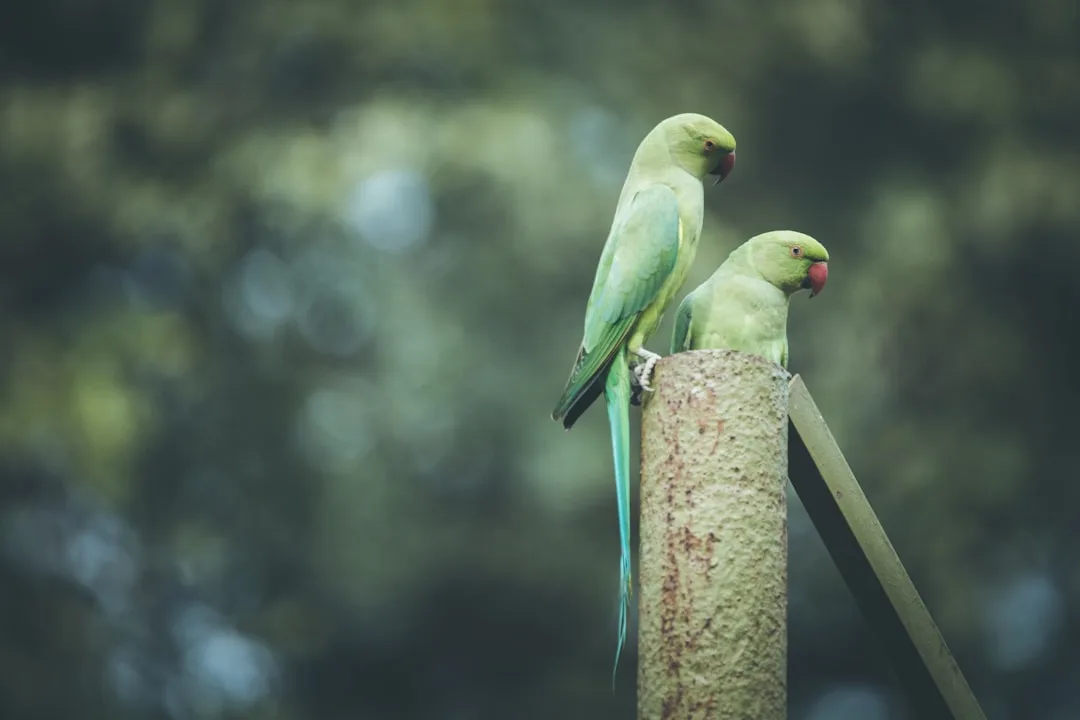
Do parrots actually understand what they're saying?
Some parrots genuinely understand the meaning of words they use, while others are simply mimicking sounds. Alex, an African Grey parrot studied by Dr. Irene Pepperberg for 30 years, demonstrated understanding of over 150 English words, seven colors, five shapes, numbers up to 8, and abstract concepts like 'same,' 'different,' and 'none.
The Alex Research That Changed Everything
On September 6, 2007, a 31-year-old African Grey parrot named Alex said his last words to the researcher who had studied him for thirty years. "You be good. I love you. See you tomorrow." The next morning, Dr. Irene Pepperberg found him dead in his cage. Cause of death: atherosclerosis. He had been healthy the previous evening.
Alex's death made international news because of what he represented. For three decades, this bird had demonstrated cognitive abilities that changed scientific understanding of animal intelligence . He could count, identify colors, understand abstract concepts like "same" and "different," grasp the concept of zero, and use human language meaningfully. His final words - whether fully understood or simply habitual - left no room for dismissive interpretations of parrot intelligence.
Alex was not a trained circus act. He was a research subject in one of the most rigorous and productive animal cognition studies ever conducted. What he demonstrated reshaped how scientists, educators, and pet owners think about birds.
The Alex Study
Dr. Irene Pepperberg began working with Alex in 1977. She had purchased a one-year-old African Grey parrot from a Chicago pet store, choosing a specific bird partly at random - the pet store owner helped select one, avoiding any possibility that Pepperberg had cherry-picked an obviously exceptional bird.
The research methodology:
Pepperberg used a training approach called the model/rival technique. Rather than directly rewarding Alex for repeating words, she had a human "rival" that appeared to compete with Alex for rewards. The rival would answer questions correctly, receive the object of interest, and demonstrate the relationship between verbal responses and desired outcomes.
This method more closely resembles how parrots learn in wild social groups - by observing and modeling other individuals. Direct conditioning was explicitly avoided because it produces mimicry without understanding.
What Alex demonstrated:
Over 30 years of study, Alex learned:
- 150+ English words used meaningfully in context
- 7 colors (red, green, blue, yellow, orange, purple, gray)
- 5 shapes (square, triangle, rectangle, pentagon, hexagon)
- Numbers up to 8 with corresponding labels and understanding
- Materials (paper, cork, wood, rawhide)
- Concepts of same and different applied to novel objects
- Categorical reasoning (grouping objects by shared features)
- Concept of zero (understanding "none")
- Object permanence (understanding hidden objects still exist)
- Simple arithmetic (recognizing quantities of 1-6 without counting)
The kind of questions Alex could answer:
Show him a tray containing 5 green blocks, 3 red blocks, 2 blue blocks, and 4 red keys. Ask: "How many green?" Alex would answer "Five." Ask: "How many red blocks?" Alex would answer "Three" - requiring him to identify color, identify shape, count, and ignore objects that were red but not blocks.
Ask him "What color is same?" while showing him two different objects of the same color. Alex would answer "Green" (the shared color). Ask "What color is different?" and he would answer correctly. This required understanding of abstract concepts (similarity, difference) applied to new situations.
The Zero Discovery
Among Alex's most remarkable achievements was his discovery of the concept of zero.
How it happened:
In a training session, Pepperberg asked Alex to identify different colored blocks. She had prepared a specific set of blocks, but Alex spontaneously asked "What color none?" - a question Pepperberg had never asked him before.
She realized Alex was indicating that he recognized when quantities of certain items were zero and wanted a word for this concept. She began using "none" in his vocabulary, and Alex quickly demonstrated understanding of zero as a quantity.
Why this matters:
Zero is abstract. Recognizing "there are no green blocks" requires abstract reasoning beyond simple counting. Human children typically develop concept of zero around age 3-4. Many non-human primates struggle with zero even with extensive training.
Alex appears to have derived the concept himself, then asked for a vocabulary word for it. This is a cognitive achievement previously thought to require human-level intelligence.
The scientific community reaction:
The zero discovery generated significant attention in animal cognition research. It was published in peer-reviewed journals and reviewed extensively by critics who attempted to explain it through simpler mechanisms. None of the critical reviews satisfactorily reduced the phenomenon to mere conditioning.
Combined with Alex's other abilities, the zero discovery established that African Grey cognition genuinely resembled human cognition in specific domains, not superficially through imitation but substantively through shared concept formation.
What Alex Could Not Do
It is equally important to understand Alex's limitations. Pepperberg's research was scrupulously honest about what Alex could and could not do.
Alex could not:
- Generate novel sentences with grammatical structure (beyond simple combinations like "Want grape" or "Where wood?")
- Use language to discuss past events or future plans
- Understand metaphors or symbolic meanings
- Read or write
- Perform math beyond simple quantity recognition
- Engage in abstract philosophy or complex reasoning chains
The linguistic limits:
Human language has specific features Alex did not demonstrate:
- Recursive grammar. Human sentences can contain other sentences ("The cat that the dog chased ran away"). Alex did not demonstrate this capability.
- Displaced reference. Talking about things not present, past events, or future plans. Alex lived largely in the present moment.
- Complex syntax. Subject-verb-object relationships with multiple modifiers. Alex used simpler constructions.
This matters because these limits define the boundary between sophisticated communication and full language. Alex had exceptional communication and concept formation, but not full language in the linguistic sense.
The honest framing:
Alex was not a human-level intelligence speaking English. He was a highly cognitive non-human bird using English as a communication tool within the range of his own cognitive capabilities. The distinction matters because it frames what his achievements actually represent: significant cognitive abilities expressed through learned human vocabulary, rather than true language acquisition.
Why African Greys?
Of all parrot species, African Greys (Psittacus erithacus) are consistently identified as the most cognitively capable. Several factors contribute to this:
Natural habitat complexity:
African Greys live in the rainforests of West and Central Africa. Their diet includes dozens of fruit and nut species, each with specific ripeness cues, seasonal availability, and extraction challenges. Finding and processing food requires substantial problem-solving.
Social complexity:
Wild African Grey flocks number 20-200 birds. Individual birds recognize each other, form long-term pair bonds, maintain alliances with specific other individuals, and navigate complex social hierarchies. This social world selects for strong individual recognition and social intelligence.
Long lifespan:
African Greys live 50-60 years in the wild, 60-80+ years in captivity. This extended life provides time for accumulating knowledge, refining skills, and developing sophisticated behavior through experience.
Brain architecture:
The parrot brain achieves cognitive sophistication through different architecture than mammalian brains. The pallium (a structure similar to the mammalian cortex) is enlarged and densely packed with neurons. Recent research shows parrots have more neurons in key forebrain regions than macaques (which have much larger brains in absolute terms).
This is an example of convergent evolution - the same cognitive abilities arising through independent evolutionary paths. Birds and mammals diverged from common ancestors approximately 300 million years ago, and parrot intelligence evolved separately from mammalian intelligence.
Vocal learning:
Parrots are vocal learners - they can reproduce sounds they hear, including sounds outside their species' natural vocalizations. This capability is rare in the animal kingdom. Most vertebrates cannot learn new vocalizations beyond their species' innate repertoire. Parrots, songbirds, hummingbirds, some bats, and humans are the primary exceptions.
Vocal learning requires specific neural machinery and may be a prerequisite for language-like communication. Parrots have the biological capability to learn words; most birds do not.
Pepperberg's Broader Findings
The Alex studies produced implications beyond a single exceptional bird.
Training methodology implications:
The model/rival technique proved more effective than operant conditioning for complex concept learning. This has influenced pedagogy for children with learning disabilities, as the technique translates well to human education contexts.
Animal cognition research:
Alex's success pushed other animal cognition researchers to test more sophisticated capabilities in their subjects. Chimpanzees, dolphins, and corvids (crows, ravens) were subsequently shown to possess abilities previously thought exclusive to humans.
Implications for human language evolution:
Alex demonstrated that complex concept formation and categorical reasoning do not require human-level brain architecture. If parrots can develop these capabilities independently, the evolutionary pathway for human language may have built on foundations more widely shared than previously thought.
Continuing research:
Pepperberg has continued working with other African Grey parrots after Alex's death. The birds Griffin and Athena have demonstrated different cognitive profiles, suggesting individual variation in parrot intelligence. No single bird has matched Alex's specific achievements, which suggests he may have been an exceptional individual within his species.
Other Famous Talking Parrots
Alex is the most scientifically documented, but several other parrots have demonstrated notable cognitive abilities.
N'kisi the African Grey. An African Grey owned by Aimee Morgana in New York who reportedly used over 950 words in context and occasionally demonstrated telepathy-like abilities in experiments with biologist Rupert Sheldrake. The telepathy research was controversial and not peer-reviewed. N'kisi's vocabulary claims were documented but without the rigorous protocols of the Alex research.
Einstein the African Grey. A parrot at the Knoxville Zoo featured on The Tonight Show. Uses over 200 words and various sound effects in context. Not the subject of formal cognitive research but well-documented behaviorally.
Sparkie Williams the Budgerigar. A 1950s budgie who reportedly learned over 550 words. Limited documentation compared to modern research but suggests even small parrot species can achieve significant vocabularies.
Puck the Budgerigar. Held Guinness World Record for largest bird vocabulary at 1,728 words in 1995. Specific understanding was not verified rigorously.
The overall pattern: many parrots can learn extensive vocabularies. The depth of understanding varies by species, individual, and training approach. Alex remains the benchmark for demonstrated cognitive sophistication because his research methodology was unusually rigorous.
Why Most Pet Parrots Do Not Demonstrate This
If African Greys are capable of Alex-level intelligence, why do most pet parrots show little of this capability?
Training requirements:
Alex received daily, structured, hours-long training sessions for 30 years. This represents approximately 25,000 hours of directed cognitive development. Most pet parrots receive orders of magnitude less focused training.
Environment requirements:
Intellectual development requires stimulation. Cages, limited toys, and minimal interaction produce bored, sometimes psychologically damaged birds rather than cognitive prodigies. Most pet parrot environments are far less stimulating than Alex's research environment.
Social requirements:
Parrots are highly social. Alex had constant human interaction during working hours. Pet parrots left alone all day often develop severe psychological issues that impair cognitive development.
Conditioning vs. learning:
Simple conditioning (reward for specific sounds) teaches mimicry without understanding. Most pet parrot "training" is actually conditioning. Teaching actual concepts requires different approaches, typically including the model/rival technique.
Individual variation:
Within any species, individual cognitive abilities vary. Pepperberg has noted that Alex was exceptional even among African Greys she has worked with. Most individual parrots have more modest capabilities.
The takeaway: cognitive potential in parrots is real but requires active cultivation. A pet parrot living in a typical home environment with typical human interaction will mimic some words and display personality, but will not develop Alex-level understanding without the kind of structured, intensive, decades-long intellectual engagement that is impractical for most owners.
The Ethical Implications
Alex's research raised serious ethical questions about parrot ownership and wildlife trade.
If parrots are cognitively sophisticated:
- Confining intelligent animals to small cages with limited stimulation constitutes significant welfare harm
- Breaking up pair bonds (separating mates, or partners that have bonded with humans) causes severe psychological damage
- Feeding inappropriate diets, common in pet environments, can impair cognitive function
- Abandonment and rehoming cause trauma proportional to bond strength
The pet parrot population:
Millions of parrots live as pets globally. Many live in conditions that animal welfare experts consider inadequate for their cognitive and social needs. Parrot sanctuaries across the United States and Europe are overwhelmed with unwanted, psychologically damaged birds whose owners underestimated the commitment.
The wild-caught trade:
Although international trade in wild-caught parrots has been restricted under CITES since 1992, illegal trade continues. Wild parrots captured for the pet trade often die during transport (mortality rates historically exceeded 50 percent). Those who survive often develop severe psychological disorders from the trauma.
The captive-bred pet market:
Even captive-bred parrots face welfare challenges. Many are sold to owners unprepared for decades of care. Impulse purchases lead to frequent rehoming. Parrots can outlive their owners, creating ongoing welfare challenges.
The animal welfare community increasingly advocates treating parrots more like complex exotic animals (closer to primates) than like traditional pets. Responsible parrot ownership requires extensive research, specialized housing, significant financial resources, and genuine readiness for a decades-long commitment.
What Alex Taught Us About Ourselves
Alex's research has implications extending well beyond parrot intelligence.
The continuity of cognition:
Abstract concepts like "same," "different," "zero," and "category" are not exclusive to human minds. They can emerge in non-mammalian brains that evolved independently. This suggests these cognitive abilities may be more fundamental biological features than uniquely human inventions.
The evolutionary deep roots of intelligence:
If parrots and humans share specific cognitive capabilities through independent evolution, these capabilities may have evolutionary roots in common ancestor species. What evolutionary pressures select for concept formation? What environmental conditions favor categorical reasoning? These questions become more tractable when we have multiple independent evolutionary examples.
The limits of behaviorism:
Alex demonstrated clearly that animal behavior cannot be fully reduced to stimulus-response conditioning. He exhibited apparent intentionality, preference, and creative problem-solving that required richer theoretical frameworks than simple behaviorism.
The question of consciousness:
Alex's research does not prove parrots are conscious in the way humans are, but it strongly suggests they have internal mental states that influence their behavior in ways similar to human internal mental states. The honest scientific position is not "parrots are conscious like humans" or "parrots are mindless automata" but rather that some cognitive capacities previously thought to require full human-style consciousness also exist in non-human animals.
The Final Words
Alex's last words deserve one more consideration.
"You be good. I love you. See you tomorrow."
Pepperberg has been careful throughout her career not to overclaim what these words meant. She acknowledges they could have been routine expressions Alex used at the end of each day, without specifically anticipating his death.
But she has also noted that Alex said these words unprompted that evening, without prior stimulus, apparently voluntarily. Whether or not he understood anything about his own mortality, the words represent a parrot using language in a way that fits human emotional contexts - even if through learned association rather than deep understanding.
Pepperberg has written: "I don't know what Alex was thinking. I don't know if he meant those words the way I meant to remember them. But I know they were there, and that mattered, and that they still matter."
This is the honest summary of Alex's legacy. We do not know exactly what was happening in his mind. We know his cognitive capabilities exceeded what the scientific community had believed parrots capable of. We know his behavior resembled human behavior in ways that resist simple mechanical explanations. We know he changed our understanding of bird intelligence, animal cognition, and evolutionary pathways to complex thought.
Alex may not have been human. But he was not a machine either. He was something else - a sophisticated non-human mind, living inside a bird's body, expressing cognition through learned human words. His kind of existence had not been properly recognized by science before his research began.
Now we recognize it. That is Alex's legacy.
Related Articles
- Parrots That Understand Language: Alex the African Grey
- Parrots: The Einsteins of the Bird World
- Can Crows Recognize Human Faces?
Frequently Asked Questions
Do parrots actually understand what they're saying?
Some parrots genuinely understand the meaning of words they use, while others are simply mimicking sounds. Alex, an African Grey parrot studied by Dr.
Irene Pepperberg for 30 years, demonstrated understanding of over 150 English words, seven colors, five shapes, numbers up to 8, and abstract concepts like ‘same,’ ‘different,’ and ‘none.’ When shown a tray of objects, Alex could correctly answer questions like ‘How many green blocks?’ - requiring him to count, identify color, and identify shape simultaneously. This level of comprehension exceeds what most dogs achieve and matches some great apes.
Other parrot species (cockatoos, macaws, Amazons) show varying degrees of understanding, but African Greys have the highest demonstrated linguistic intelligence of any bird. Most pet parrots, however, mimic without understanding - they learn that specific sounds get attention or food rewards.
How intelligent was Alex the parrot?
Alex (1976-2007) demonstrated cognitive abilities rivaling great apes and exceeding most non-human primates in specific tasks. He could identify objects by color, shape, material, and number simultaneously. He understood the concept of zero as ‘none’ - a cognitive achievement previously thought to require human-level intelligence. He could answer novel questions he had never been asked before by applying learned concepts.
He could express preferences (‘I want grape,’ ‘I want to go back’), refuse commands (‘No’), and show apparent frustration when questions were too easy. His vocabulary of 150 English words was applied with approximately 80 percent accuracy. Dr. Pepperberg’s research demonstrated that Alex’s responses were not conditioned mimicry but genuine understanding of abstract concepts.
His final words, spoken to Pepperberg the evening before his unexpected death, were ‘You be good. I love you. See you tomorrow.’ The scientific community still debates how to interpret such statements but cannot dismiss them as meaningless mimicry.
Why are African Grey parrots so smart?
African Grey parrots (Psittacus erithacus) evolved exceptional intelligence because of their complex social structures and problem-solving feeding ecology. In the wild, African Greys live in large flocks of 20-200 birds with complex social hierarchies requiring individual recognition, alliance maintenance, and political navigation.
Their diet includes many different food sources (fruits, nuts, seeds, leaves, bark) that require different feeding strategies and spatial memory. Their brain-to-body-size ratio is among the highest of any bird, and they have specialized brain structures that perform functions similar to the mammalian cortex through different neural architecture (called pallium in birds).
African Greys live 50-60 years in the wild, giving them extended time to accumulate knowledge and refine social skills. Their combination of social complexity, dietary breadth, and long lifespan created evolutionary pressure for extreme cognitive capability.
Can parrots form real bonds with humans?
Yes, parrots form genuine emotional bonds with humans, and these bonds can be among the most intense interspecies relationships documented in animal-human interactions. Parrots are social animals that typically bond with a single mate for life in the wild. When kept as pets, they often bond with a specific human member of the household as their ‘mate equivalent,’ treating other people with varying degrees of indifference or hostility.
Signs of genuine bonding include: recognizing and responding selectively to their bonded human, showing stress behavior during separation, preening their human (a mate-bonding behavior), feeding their human regurgitated food (another mate behavior), and experiencing grief when the bonded human dies or leaves permanently.
This extreme bonding capacity makes parrots challenging pets - they require enormous time investment and can live 50-80+ years, often outliving their owners.
Are parrots good pets?
Parrots are exceptionally challenging pets, and most parrots in captivity do not have appropriate living conditions. Large parrots (macaws, African greys, cockatoos) have lifespans of 40-80+ years, require several hours of daily interaction, need specialized diets, produce enormous vocal noise (including screams audible for kilometers), require extensive enrichment to prevent psychological trauma, and can inflict serious injuries with their powerful beaks.
Many parrots rehomed multiple times suffer severe psychological damage including self-mutilation (feather plucking, self-injury) and extreme aggression. Sanctuaries across North America and Europe are overwhelmed with unwanted parrots whose owners underestimated the commitment. Responsible parrot ownership requires decades of commitment, specialized knowledge, appropriate housing, and financial resources for veterinary care.
Most people considering parrot ownership are not equipped to provide what parrots need for psychological health, and pet parrot welfare is a serious concern in the animal welfare community.