
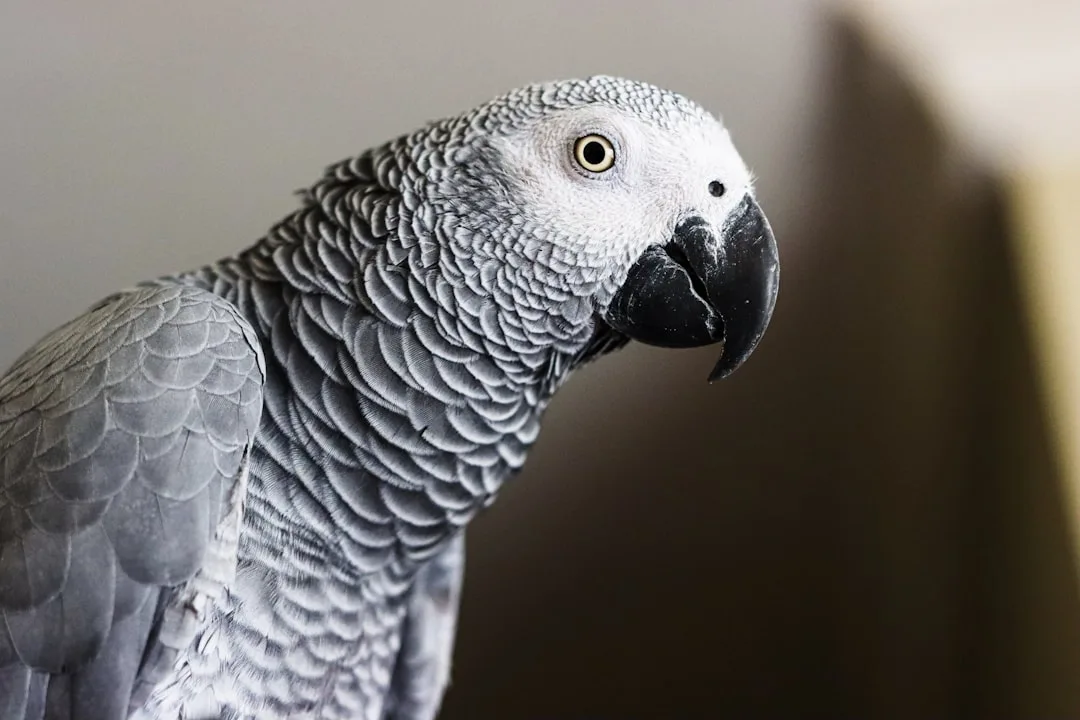
The African grey parrot is the most cognitively studied parrot on Earth and, by several measures, one of the most intelligent non-human animals ever tested under controlled laboratory conditions. Native to the rainforests and forest-savanna mosaics of equatorial Africa, Psittacus erithacus combines a large brain, a dexterous beak, a pair-bonded social system, and a vocal learning apparatus of extraordinary precision.
The species gave the world Alex - a Congo grey who demonstrated understanding of colour, shape, quantity, abstract categories, and the concept of zero - and a body of evidence that forced cognitive scientists to redraw the boundary between animal communication and genuine reference.
This guide covers every major aspect of African grey biology and ecology: taxonomy and the 2012 species split, size and plumage, habitat and range, diet and foraging, vocal mimicry, the landmark cognition studies, social structure, reproduction, longevity, conservation status after the 2017 CITES Appendix I listing, and the difficult relationship between African greys and humans.
It is a reference entry rather than a summary, so expect specifics: grams, kilometres, vocabulary counts, population estimates, and verified research.
Etymology and Classification
The genus name Psittacus is Latin, derived from the Greek psittakos meaning parrot, and has been applied to parrot-like birds since antiquity. The species epithet erithacus likewise comes from Greek, referring to an unidentified bird mentioned by Aristotle. The common English name simply describes the bird's colour and continent of origin.
West and Central African languages have dozens of local names for the species - kusu in parts of the Democratic Republic of the Congo, ako among the Yoruba, nkese in several Bantu languages - many of which carry cultural weight linked to the bird's perceived wisdom.
For most of the twentieth century ornithologists recognised two subspecies: the larger, lighter-plumaged Congo African grey (P. e. erithacus) and the smaller, darker Timneh (P. e. timneh). In 2012, a combined analysis of morphology, vocalisations, plumage, and genetics led the IUCN and BirdLife International to elevate the Timneh to full species status as Psittacus timneh.
The two species share the same genus and broadly similar biology, but they do not overlap in range and show consistent differences sufficient to be treated separately in conservation assessments and captive management.
African greys sit within the order Psittaciformes alongside cockatoos, lorikeets, macaws, and more than 390 other parrot species. Within Psittacidae they are most closely related to the Poicephalus parrots of sub-Saharan Africa. The lineage that produced Psittacus diverged from other African parrots an estimated 15-20 million years ago.
Size and Physical Description
African greys are medium-sized parrots - smaller than macaws, larger than budgerigars, roughly the size of a pigeon. Unlike many tropical parrots, they avoid bright colour. Their palette is almost entirely greyscale, lifted only by a scarlet tail and, in some individuals, by the pink flush of the bare facial skin during moments of excitement.
Congo African grey (P. erithacus):
- Length: 28-39 cm from beak tip to tail tip
- Wingspan: 46-52 cm
- Weight: 400-500 g, with females slightly smaller on average
- Plumage: light silver-grey body, paler scalloping on the chest, bright scarlet tail
- Bare skin: white facial patch around the eye, often flushing pink with arousal
- Beak: solid black
- Eyes: pale yellow in adults, grey in juveniles
Timneh African grey (P. timneh):
- Length: 28-33 cm
- Weight: 275-375 g
- Plumage: darker charcoal-grey body, maroon or dark-red tail
- Beak: horn-coloured upper mandible, black lower mandible
Both species share the classic parrot anatomy: a short, powerful, hooked beak suited to cracking nuts; a large skull housing a disproportionately large brain; zygodactyl feet with two toes forward and two back, allowing a firm grip and fine manipulation of food; and strong, broad wings built for manoeuvring through forest canopy rather than sustained open-country flight.
Males and females look almost identical, though sexing by eye-ring shape and tail feather pattern is possible with experience, and DNA testing is standard in captivity.
Juvenile greys are recognisable by their dark grey irises, which lighten through straw-yellow to pale gold as the bird matures over the first two to three years. Adult birds carry a fine powder-down in their plumage that they release during preening - this explains the characteristic dust cloud that rises when a grey ruffles its feathers after a long preening session.
Habitat and Range
African greys inhabit a broad band of equatorial Africa.
Congo greys occupy a range stretching from south-eastern Ivory Coast through Ghana, Togo, Benin, Nigeria, Cameroon, Equatorial Guinea, Gabon, the Republic of the Congo, the Democratic Republic of the Congo, and the Central African Republic, extending east into Uganda, Rwanda, Burundi, and western Kenya, and south into northern Angola.
Timnehs live only in the Upper Guinea forests of Guinea-Bissau, Guinea, Sierra Leone, Liberia, and western Ivory Coast.
Preferred habitats include:
- Primary lowland moist tropical rainforest
- Mature secondary forest regenerating after logging or shifting cultivation
- Gallery forest along rivers in savanna zones
- Forest-savanna mosaic with scattered emergent trees
- Mangrove stands along the Atlantic coast
- Cultivated areas adjoining forest, especially oil palm plantations
African greys are altitude-flexible, recorded from sea level to around 2,200 m. They are not obligate forest birds in the strict sense - flocks will cross clearings, travel along rivers, and exploit cultivated land that provides palm fruit, maize, and other seeds - but they rely on tall trees with deep cavities for breeding and on mature forest for most of their food.
Daily movements can cover 10 km or more between communal roosts and feeding sites. Roosts are located in the tallest emergent trees available, sometimes overhanging water for added protection against predators. Flocks can number from a handful of birds to several hundred; the largest roost counts historically exceeded a thousand individuals, though modern surveys rarely find roosts of that size outside protected areas.
Diet and Foraging
African greys are primarily frugivores and granivores, and they are keystone seed dispersers for several large-fruited tropical tree species. Field studies in Cameroon, Gabon, and the Democratic Republic of the Congo have documented them feeding on fruits, nuts, and seeds of more than 50 tree species, with local specialisation depending on what is in season.
Staple food items include:
- Oil palm (Elaeis guineensis) - fruit pulp and kernel, available much of the year
- Dacryodes species - large-seeded fruits requiring strong beaks
- Pycnanthus angolensis - African nutmeg
- Raphia palms - seeds and shoots
- Ficus species - figs of many kinds
- Khaya and Entandrophragma - mahogany family seeds
- Flowers, leaf buds, and bark at lean times of year
African greys also visit clay licks along riverbanks, where dozens to hundreds of birds gather to ingest mineral-rich soil. This geophagy is thought to serve two functions: buffering toxic secondary compounds in the fruits and seeds the parrots eat, and supplementing sodium and other minerals that are scarce in a fruit-heavy diet. Clay licks are predictable gathering points, which is one reason trappers historically targeted them so heavily.
In captivity, veterinary nutritionists recommend a formulated pellet diet as the foundation, supplemented with fresh leafy greens, cruciferous vegetables, limited fruit, soaked legumes and whole grains, and small amounts of nuts as enrichment. Seed-only diets, once standard, are now known to cause chronic hypovitaminosis A, calcium imbalance, and fatty liver disease, all of which contribute to early mortality in pet greys.
Cognition: The Alex Studies and Beyond
The most important scientific story about African greys is cognitive. For most of the twentieth century, laboratory research on animal language focused on great apes. Parrots were assumed to mimic without comprehension - the phrase 'parroting' entered English precisely to denote hollow repetition.
In 1977, a young biologist named Irene Pepperberg purchased a one-year-old Congo African grey from a Chicago pet store, named him Alex (an acronym for Avian Language Experiment), and spent the next thirty years demonstrating that the assumption was wrong.
Pepperberg used a model/rival training method adapted from linguist Dietmar Todt. Two human trainers take turns modelling the desired behaviour - one asks, the other answers and receives the reward - while the parrot watches and is motivated to compete for the reward. The method proved vastly more effective than traditional operant conditioning for teaching referential vocabulary.
By the time of his death in 2007, Alex had demonstrated:
| Skill | Evidence |
|---|---|
| Object identification | Named more than 50 common objects |
| Colour recognition | Named 7 colours and applied them correctly to novel items |
| Shape recognition | Named 5 shapes (2, 3, 4, 5, and 6-cornered objects) |
| Counting | Correctly answered 'how many?' up to six |
| Categories | Applied 'same' and 'different' to novel combinations |
| Relational reasoning | Answered 'which is bigger/smaller' for unfamiliar pairs |
| Concept of zero | Spontaneously used 'none' when no object matched the question |
| Comprehension | Refused unwanted items, corrected trainers, and answered out of turn |
| Vocabulary | Used approximately 100 English words referentially |
Alex's use of 'none' to indicate zero was documented in a 2005 paper in the Journal of Comparative Psychology. When shown a tray of objects and asked which colour was represented by a quantity that wasn't present, Alex replied 'none' - a response he had not been explicitly trained to give in that context. The finding put grey parrots in a tiny club of species (humans, chimpanzees, rhesus macaques) documented to grasp a non-quantity.
Research with Alex's successors - Griffin (hatched 1995) and Athena (hatched 2013) - has extended the findings. Studies published between 2018 and 2022 show that grey parrots pass tests of Piagetian object permanence at the level of a four-year-old human child, perform probabilistic inference on hidden-object tasks, and can refuse a smaller immediate reward in favour of a larger delayed one.
A 2020 paper demonstrated that greys will help a partner obtain food even when they get nothing in return - altruistic behaviour previously documented almost exclusively in great apes.
The neuroanatomy underlying these abilities is now partly understood. Parrot brains are dense with neurons: a 2016 study in the Proceedings of the National Academy of Sciences showed that macaws and parrots pack twice as many neurons into the pallium as primates do for a given brain mass.
African greys have proportionally one of the largest brains of any bird, and their medial spiriform nucleus - a region that routes information between cortex-equivalent areas and the cerebellum - is enlarged in ways that parallel pathways used for complex cognition in mammals.
Vocal Mimicry and Communication
African greys are among the most accomplished vocal mimics in the animal kingdom. Captive birds routinely reproduce:
- Human speech with clear pronunciation and recognisable voice of the original speaker
- Telephone ringtones and microwave beeps
- Smoke alarms and kitchen timers
- Other household pets - cats, dogs, other parrots
- Music, including whistled melodies in correct key
Wild greys mimic the calls of sympatric bird species and the ambient sounds of their environment, though the function in the wild is debated. Some researchers argue that mimicry tightens flock cohesion by allowing individuals to recognise specific neighbours; others point to evidence of context-specific calls that function almost like names.
A 2011 study of wild greys in Cameroon documented individual contact calls - stable acoustic signatures that flock members appear to use to identify one another and that are learned rather than innate.
Captive observations include anecdotes of greys using the names of deceased flock members or household companions for weeks or months after the loss, and of birds refusing to use a former partner's name at all. These observations have not been formally tested, but they are consistent enough across caregivers and rescue workers to merit investigation.
Social Life and Reproduction
African greys are obligate social animals. Outside of breeding, they travel, forage, and roost in flocks. Within flocks they form stable pair bonds that, once established, are usually maintained for life. Bonded pairs engage in synchronised flight, mutual preening of the head and neck, shared food, and coordinated calling.
The breeding season varies by region, keyed to the local rainfall pattern and the availability of fruit, but typically falls in the dry season. Pairs nest in deep natural cavities in tall emergent trees, often 10-30 m above the ground. Both birds defend the cavity aggressively.
Reproductive cycle:
- Courtship: mutual feeding, head-bobbing, and soft calling
- Clutch size: 2-5 white eggs (typically 3)
- Incubation: 28-30 days, almost exclusively by the female
- Male role: feeds the female at the nest throughout incubation and early chick-rearing
- Nestling period: 70-80 days before first flight
- Fledgling dependency: several additional weeks of parental feeding after leaving the nest
Chicks are altricial - naked, blind, and helpless at hatching. Development is slow by passerine standards but typical for large parrots. By the time they leave the nest, juveniles are roughly the size of adults but distinguishable by their dark eyes and fainter plumage contrast. Sexual maturity is reached at 3-5 years, though captive greys often do not breed reliably until later.
Nest site limitation is now a significant conservation issue. The large emergent trees greys require for breeding are exactly the species targeted by logging. Where suitable cavities persist, multiple pairs may compete for them, and some populations show evidence of reduced reproductive output driven by cavity shortage alone.
Lifespan
Wild African greys live, on average, 22-23 years. Predation - primarily by forest raptors such as the crowned eagle - disease, and nestling mortality keep actual lifespans well below theoretical maxima. In captivity, protected from predators and with veterinary care, greys routinely reach 40-60 years. Well-documented individuals have exceeded 70 years, and credible (though less well-verified) reports exist of birds approaching 80.
This longevity is a central part of responsible ownership. A grey acquired as a fledgling by a young adult may outlive that person. Rehoming older greys is difficult: the birds form deep attachments, grieve the loss of bonded humans, and can develop feather-plucking and self-mutilation when their social world collapses. Parrot rescue organisations across Europe and North America report a steady influx of greys whose original owners have aged or died.
Conservation Status and Threats
The IUCN listed African greys as Vulnerable in 2007 and upgraded them to Endangered in 2016 following evidence of catastrophic population declines across their range. In 2017, the parties to the Convention on International Trade in Endangered Species (CITES) moved both Psittacus erithacus and Psittacus timneh to Appendix I, banning all international commercial trade in wild-caught birds.
The drivers of decline are well documented:
- Pet trade capture. Between 1975 and 2013, more than 1.3 million wild African greys were legally exported for the international pet trade. Illegal captures likely matched or exceeded that figure. Trapping methods include lime-covered branches at clay licks, mist nets at roosts, and the placement of tame decoys tied near traps. Mortality between capture and export is estimated at 40-60% due to stress, injury, disease, and crowded transport. Before the 2017 CITES uplisting, an estimated 21% of the wild population was being captured annually.
- Habitat loss. Central and West African rainforest continues to be cleared for logging, oil palm, cocoa, and subsistence agriculture. Loss of tall emergent trees disproportionately affects greys because of their specific nest-cavity requirements.
- Hunting for bushmeat and traditional medicine. Greys are consumed in some regions and their feathers, heads, and feet are used in traditional rituals.
- Declining fruiting trees. Logging of oil-rich nut species and Dacryodes reduces food supply.
- Climate shifts. Changing rainfall patterns alter fruit availability and breeding success.
Recorded population collapses are severe. Ghana has lost an estimated 99% of its greys since the 1990s. Togo, Nigeria, and parts of Cameroon report declines of 90% or more. Gabon and the Republic of the Congo retain the largest intact populations but are not immune. The total global population is estimated between 0.5 million and 1.3 million birds, with uncertainty driven by the difficulty of surveying closed-canopy forest.
Conservation measures now in place include:
- CITES Appendix I listing banning commercial international trade in wild-caught birds
- National protected areas across the range (effectiveness varies)
- Captive-breeding programmes supplying legal pets in importing countries
- Community-based monitoring projects in Cameroon, Ghana, and the DRC
- Anti-trafficking enforcement at major export hubs
Captive breeding cannot compensate for wild-population losses on its own, but robust legal supply of captive-bred birds reduces incentives for illegal trapping. Demand reduction in consumer countries, particularly in the Middle East, East Asia, and Europe, is considered essential for recovery.
African Greys and Humans
The relationship between greys and humans is older than any written record. African oral traditions include stories in which greys feature as messengers, tricksters, and symbols of wisdom. Ancient Egyptians and Romans kept African parrots as luxury companions, and the bird appears in medieval European manuscripts long before European exploration of the African interior.
Today the relationship is shaped by three overlapping realities. First, greys remain among the most desirable pet parrots in the world because of their talking ability and social intimacy. Second, that demand has driven the species to the brink. Third, the cognitive science built around greys - from Alex onward - has established them as flagship subjects for non-human intelligence research, changing how philosophers and biologists think about language, number, and mind.
Responsible modern ownership involves sourcing a legally captive-bred bird with paperwork, committing to a multi-decade plan including successor caregivers, providing several hours of social interaction per day, offering a large cage and out-of-cage flight time, feeding a pellet-based balanced diet, and accepting the reality that an under-enriched grey can develop behavioural problems that are very difficult to reverse.
For most households, a different companion animal, or regular volunteering with parrot rescue organisations, is a better match than keeping a grey of one's own.
Related Reading
- Parrots of the World: Cognition, Colour, and Conservation
- How Parrots Talk: The Biology of Vocal Learning
- Alex the Parrot: What One Grey Taught Us About Animal Minds
- Macaws vs Greys: Comparing the Giants of Parrot Cognition
References
Relevant peer-reviewed and governmental sources consulted for this entry include IUCN Red List assessments for Psittacus erithacus (2016, 2018), the CITES CoP17 documentation supporting the 2017 Appendix I uplisting, BirdLife International species factsheets, and published research in the Journal of Comparative Psychology, Animal Cognition, Proceedings of the National Academy of Sciences, and Ibis.
The cognitive findings summarised here draw on Irene Pepperberg's published body of work from 1987 to 2023, including The Alex Studies (Harvard University Press, 1999), and ongoing research at the Pepperberg Lab. Population and trade figures reflect the most recent CITES trade database exports and the 2021 BirdLife International state-of-the-species review.
Frequently Asked Questions
How intelligent are African grey parrots?
African grey parrots are among the most cognitively advanced non-human animals tested in controlled experiments. The landmark studies of Alex (1976-2007) by Dr.
Irene Pepperberg at Harvard, Purdue, and Brandeis showed that a grey parrot could identify more than 50 physical objects by name, name 7 colours and 5 shapes, count up to six, understand the categories ‘same’ and ‘different’, answer abstract relational questions such as ‘which is bigger’, and use the word ‘none’ to indicate zero - a numerical concept previously documented only in humans and a few great apes.
More recent research with greys named Griffin and Athena has extended these findings to Piagetian object permanence, probabilistic reasoning, and delayed gratification comparable to a four-to-six-year-old child.
Do African grey parrots actually understand what they say?
Evidence suggests many captive greys use at least part of their vocabulary with genuine comprehension rather than pure mimicry. Alex used words to request specific objects, refuse unwanted items, answer questions about colour and quantity, and describe novel combinations (calling an apple a ‘banerry’ because it tasted like a banana and looked like a cherry).
This context-sensitive, flexible use of words meets many linguistic criteria for reference and intent. That said, most pet greys use only a fraction of their vocabulary referentially, and mimicry of sounds such as alarms or telephones is clearly non-referential. The gap between what greys can do and what they typically do depends heavily on training method and social enrichment.
How long do African grey parrots live?
In the wild, African greys live approximately 22-23 years on average - predation, disease, and food scarcity keep lifespans below their biological potential. In captivity, with veterinary care, a balanced diet, and protection from predators, greys routinely reach 40-60 years and a handful of well-documented individuals have lived beyond 70.
This extreme longevity is a major reason greys are unsuited to most households: a bird acquired when the owner is 30 may outlive them, and rehoming older greys is notoriously difficult because they form deep attachments that are painful to break.
Where do African grey parrots live in the wild?
Congo African greys (Psittacus erithacus) inhabit a broad band of equatorial Africa stretching from south-eastern Ivory Coast across Ghana, Nigeria, Cameroon, Gabon, the Democratic Republic of the Congo, and into western Kenya, Uganda, and northern Angola. They prefer lowland moist forest, mangroves, and forest-savanna edges, ranging up to around 2,200 m elevation.
The Timneh African grey (P. timneh), recognised as a separate species since 2012, lives only in the Upper Guinea forests of Guinea-Bissau, Guinea, Sierra Leone, Liberia, and western Ivory Coast. Both species travel in flocks of up to several hundred birds during non-breeding periods, roosting communally in tall emergent trees and dispersing daily to feed.
Why are African grey parrots endangered?
The IUCN upgraded African greys from Vulnerable to Endangered in 2016 after decades of population collapse. The primary driver is the international pet trade: between 1975 and 2013, more than 1.3 million wild-caught greys were exported legally from Africa, and illegal captures likely doubled that number.
Trappers use lime-covered branches, mist nets, and baited traps at roost sites and clay licks, and mortality between capture and export is estimated at 40-60%. Habitat loss through logging and agricultural conversion of Central and West African rainforest compounds the pressure. In 2017 CITES moved the species to Appendix I, banning all international commercial trade in wild-caught greys.
Ghana has lost an estimated 99% of its greys, and population declines exceed 90% in several range states.
What do African grey parrots eat?
African greys are primarily frugivores and granivores. Their wild diet centres on the fruits, nuts, and seeds of roughly 50 tree species, including oil palm (Elaeis guineensis), Dacryodes, Pycnanthus, Ficus, and Raphia palms. They also eat flowers, bark, leaf buds, and occasionally clay from riverbank licks - a behaviour believed to neutralise plant toxins and supplement minerals.
Their powerful beaks can crack hard-shelled nuts that few other forest animals access, and their dexterous feet allow them to hold food to the mouth like a hand. In captivity a healthy grey diet consists of a formulated pellet base supplemented with fresh vegetables, limited fruit, nuts, sprouted legumes, and occasional whole grains; seed-only diets cause chronic malnutrition, fatty liver disease, and premature death.
Do African grey parrots make good pets?
African greys are demanding companions and are not suited to casual ownership. A well-cared-for grey needs several hours of social interaction per day, a large cage with out-of-cage flight and foraging time, a varied diet, and consistent mental enrichment. Under-stimulated greys develop feather-plucking, self-mutilation, phobias, and screaming behaviours that can be almost impossible to reverse.
Their lifespan demands a multi-decade commitment and often a written plan for successor caregivers. Given the species’ Endangered status, responsible ownership also requires sourcing a captive-bred bird with legal documentation. For most households a different companion animal, or volunteering at a parrot rescue, is a better match than keeping an African grey.
What is the difference between Congo and Timneh African greys?
The two were considered subspecies until 2012, when morphological, vocal, and genetic evidence led to their formal split into separate species. Congo African greys (Psittacus erithacus) are larger at 28-39 cm and 400-500 g, with light silver-grey plumage and a bright scarlet tail. Timneh African greys (Psittacus timneh) are smaller at 28-33 cm and 275-375 g, with darker charcoal plumage, a maroon or dark-red tail, and a horn-coloured upper mandible.
Timnehs are often described as slightly less anxious and quicker to adapt to new environments, and they tend to begin talking earlier, though individual variation dwarfs any species-level tendency. Both species are listed on CITES Appendix I and both are Endangered.