
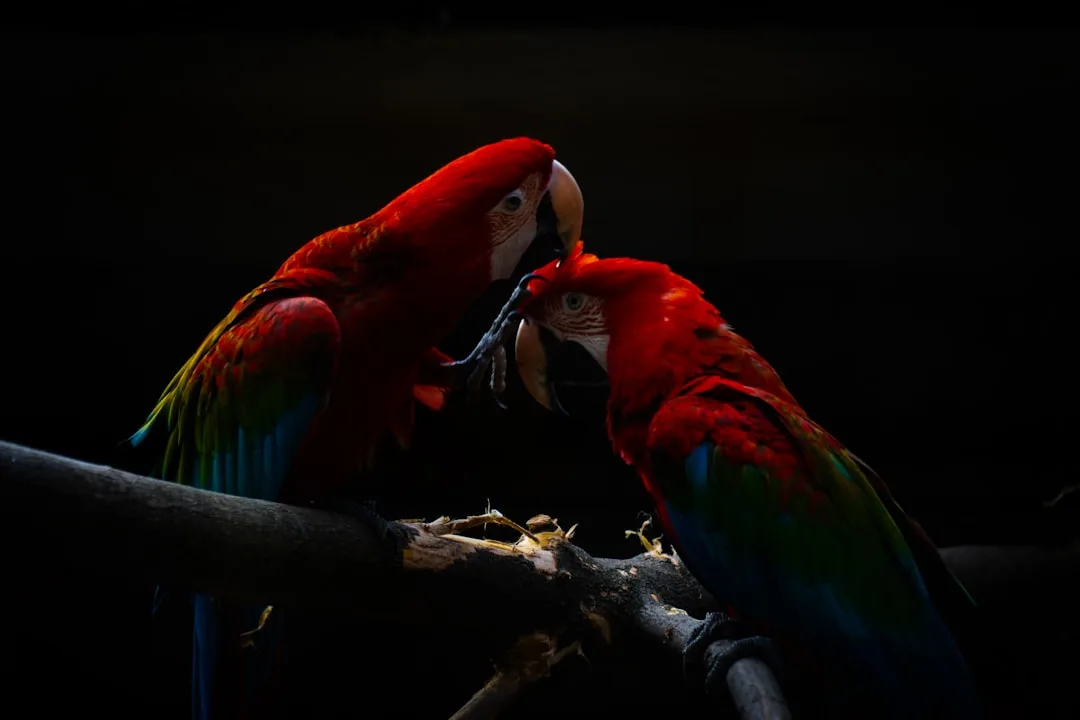
The scarlet macaw is the archetype of the Neotropical parrot - a metre-long bird painted in fire-engine red, cobalt blue, and egg-yolk yellow, screaming across the canopy of a rainforest on two-foot wings. It is one of the largest flying parrots on Earth, one of the longest-lived birds kept by humans, and one of the most heavily trafficked wild animals on the planet.
Ara macao has been traded, painted, mummified, tattooed, and tamed for at least three thousand years. It has become a cultural icon for Amazonian communities, a Mayan symbol of the sun, and, more recently, an emblem of Latin American rainforest conservation.
This guide covers every significant aspect of scarlet macaw biology and ecology: plumage and structural colour, size and flight, diet and the curious habit of eating clay, pair bonds, reproduction, vocal learning, cultural history, and the twin threats of deforestation and the pet trade. It is a reference entry, not a summary - expect kilograms, kilometres, subspecies names, and specific population numbers.
Etymology and Classification
The genus name Ara comes directly from a Tupi-Guarani word used across lowland South America for the large macaws. The species epithet macao was recorded by Linnaeus in 1758 and is believed to descend from a Carib or Arawak name. In Spanish the bird is called guacamayo escarlata or lapa roja; in Portuguese, araracanga or arara-macao; in the Mayan languages it is associated with mo and the solar deity Kinich Ahau.
English retains scarlet macaw, a name that appeared in eighteenth-century natural history volumes once the bird began appearing alive in European menageries.
Molecular work places Ara macao firmly inside the large-bodied macaw clade alongside the green-winged macaw (Ara chloropterus), blue-and-yellow macaw (Ara ararauna), and the military and great green macaws. Two subspecies are recognised:
- Ara macao cyanoptera - the northern or Central American scarlet macaw, with a broader yellow wing panel bordered by blue and a slightly larger body.
- Ara macao macao - the southern or Amazonian scarlet macaw, with green-tipped yellow wing feathers and a subtly more slender profile.
The two subspecies were split formally in 1995 after long-standing suspicions that the Central American birds were ecologically and morphologically distinct. There is no recorded natural contact zone between them, and captive hybrids between the subspecies are now monitored closely by reintroduction programmes in Mexico and Guatemala that try to use geographically correct founder stock.
Plumage and Structural Colour
Scarlet macaws are among the most brightly coloured birds alive. Their plumage is not a single pigment layered over feathers - it is a composite produced by three different mechanisms working together.
- Melanin in the deeper feather layers produces blacks, browns, and structural backgrounds that intensify the colours above.
- Carotenoids obtained from fruit, nuts, and flowers produce the intense red and yellow. Psittacofulvins - a special class of yellow-red pigments found only in parrots - are synthesised inside the bird's own feather follicles, unlike the carotenoids in flamingos or canaries that come directly from diet.
- Structural colour - microscopic spongy layers inside the feather barbs that scatter short wavelengths - produces the famous cobalt blue of the wings and lower back. There is no blue pigment in the bird. Crush a scarlet macaw's blue feather and it turns grey, because the colour depends on intact microstructure.
The combination means the scarlet macaw is effectively wearing three different types of paint at once. The exact pattern - scarlet body, yellow and blue wing, red and blue tail - appears stable across the species with only the subspecies-level difference in the yellow wing panel.
Bare facial skin is white and crisscrossed with small feathered lines unique to each individual, functioning almost like a fingerprint for researchers who photograph known birds at clay licks. Legs are dark grey, the beak two-tone - pale horn on top, black below - and the eye yellow in adults, dark in juveniles.
Size, Flight, and Body Plan
Scarlet macaws are built for two things: cracking nuts and flying long distances across rainforest canopy. Their bodies make no compromise on either.
Measurements:
- Total length: 81-96 cm, with the tail alone up to 52 cm
- Wingspan: 102-112 cm
- Body mass: 900-1,490 g, most adults near 1 kg
- Bill length: 6-7 cm, hook depth around 3 cm
- Typical flight speed: 30-40 km/h cruising, up to 56 km/h in level flight
The wings are long and pointed rather than broad, shaped for sustained powered flight over forest rather than slow manoeuvring inside it. A scarlet macaw launching from a canopy tree can reach cruising speed within a few wingbeats and cover a dozen kilometres between feeding trees without rest. The tail is a long, tapered rudder that makes up a huge fraction of total length and handles the tight banking turns required to land on a specific branch at thirty kilometres per hour.
The bill is one of the strongest in the bird world. Measurements on captive birds report around 2,000 kilopascals of bite pressure at the tip, which is more than enough to crack Brazil-nut capsules, pry open hard palm nuts, and - unfortunately for careless handlers - cleanly bite through a human finger. A scarlet macaw bill is also highly mobile.
The upper mandible hinges independently against the skull, allowing fine rotation while the tongue - thick, muscular, and containing a small supporting bone - manipulates seeds inside the mouth like a third tool.
Their feet are zygodactyl - two toes forward, two back - which allows them to grip branches from any angle and to hold food up to the beak like a hand. Scarlet macaws routinely stand on one foot while eating with the other, and habitually use the left foot more than the right, making the species measurably left-footed across populations studied so far.
Habitat and Range
Scarlet macaws inhabit humid lowland tropical forest from southern Mexico through Central America, across most of Amazonia, and down into the seasonal forests of eastern Bolivia and central Brazil. Historical range extended from roughly 23 degrees north to 15 degrees south of the equator across an almost continuous forest belt.
Preferred habitat features:
- Tall primary rainforest with emergent trees above the canopy
- River corridors with exposed clay banks
- Large, old trees containing natural cavities for nesting
- Seasonal fruiting palms, especially Attalea, Astrocaryum, and Mauritia
They are not deep-forest specialists in the way some parrots are - scarlet macaws prefer edges, river corridors, and forest-savanna mosaics where several habitats meet. This same preference makes them vulnerable to habitat fragmentation, because they need large intact tracts interspersed with open water and specific feeding trees rather than either forest or clearing alone.
Central American populations have collapsed across the twentieth century. Mexico, Guatemala, and El Salvador each hold only a few hundred individuals, concentrated inside protected areas such as Calakmul, the Maya Biosphere, and patches along the Pacific coast. Honduras, Belize, and Costa Rica retain small but genuine wild populations.
South American numbers are much larger and in some regions stable, with strongholds in Peru's Tambopata and Manu, Brazil's lower Amazon, Ecuador's eastern lowlands, and parts of Bolivia's Beni.
Diet and the Clay-Lick Phenomenon
Scarlet macaws are generalist frugivore-granivores. Their diet is broad and seasonal, shifting with whichever trees and palms are fruiting.
Typical diet items:
- Hard palm nuts (Attalea, Astrocaryum, Mauritia)
- Brazil-nut family seeds (Lecythidaceae)
- Soft fruits (figs, inga pods, guavas)
- Flower nectar and young leaf buds
- Occasional insects and insect larvae, especially during breeding
One of the defining traits of scarlet macaws is that they eat foods most rainforest animals cannot. Many unripe seeds contain alkaloids, tannins, and other secondary compounds that function as chemical defences for the plant. Scarlet macaws counter this through a behavioural adaptation: clay eating.
Every morning along the western Amazon - and less spectacularly in other parts of the range - scarlet macaws gather at exposed riverbank clay cliffs known as colpas in Peru and barreiros in Brazil. Dozens to hundreds of macaws, parrots, and parakeets congregate at these cliffs, climb onto the face, and methodically scrape and eat mouthfuls of clay. The behaviour has two confirmed functions.
- Toxin binding. Certain clay minerals, particularly smectite clays, chemically bind the plant toxins in the birds' diet so they pass through the gut without being absorbed. This allows the birds to safely consume unripe seeds and fruit that most animals cannot.
- Sodium supplementation. The Amazon interior is extraordinarily low in sodium because the nearest ocean is thousands of kilometres away and rainfall has leached salts from inland soils for millions of years. Riverbank clays rich in sodium are one of the few reliable sources of this essential electrolyte for inland wildlife.
Clay-lick visits are dangerous. Birds on an open cliff face in full morning light are exposed to hawks, eagles, and forest-falcons. Scarlet macaws minimise risk through sheer numbers - the flock serves as collective vigilance - and by the fact that several species gather simultaneously and share the alarm system.
Well-known clay licks at Tambopata in Peru are among the most spectacular wildlife tourism destinations in South America, and the economic value of these sites has become a significant argument for protecting the surrounding forest.
Life Cycle, Pair Bonds, and Reproduction
Scarlet macaws are monogamous and maintain long-term pair bonds. Once mated, a pair stays together year-round, often for decades, and in practice until one partner dies. Within a larger roosting flock of ten to fifty birds, pairs fly and perch within wingtip distance, preen each other daily, and feed each other during courtship. Social observers can identify individual pairs after a few days of watching a flock.
Breeding calendar (typical, varies by latitude):
- Courtship and pair reinforcement: late dry season
- Nest cavity selection and defence: early wet season
- Laying: 1-4 eggs, typically 2, at one- to three-day intervals
- Incubation: 24-28 days, primarily by the female
- Nestling period: 90-100 days to fledging
- Post-fledging dependency: 1-2 years of parental feeding and training
Nest sites are large natural cavities in tall trees, usually 25-40 metres above the forest floor. Good cavities are rare and frequently reused across years by the same pair. Competition for cavities is intense, and fights with toucans, other macaws, and larger parrots are routine. In parts of Central America nest-cavity shortage has become a serious bottleneck on population recovery because logging has removed the oldest and largest trees.
Both parents feed the chicks, though the female does most of the incubation. Chicks hatch blind and almost naked, weighing roughly 25-30 grams. They grow explosively on a diet of regurgitated pulp and reach adult body size by around three months. Even after fledging, chicks remain with the parents for one to two years, learning feeding routes, clay-lick timing, predator responses, and flock dynamics.
Sexual maturity is reached at 3-5 years of age. Pairs typically produce a successful clutch only every other year, and many clutches fail entirely.
This slow reproduction - two eggs every other year, long dependency, late maturity - combined with extreme longevity means a scarlet macaw population can be wiped out far faster than it can recover. A region emptied of adults through pet-trade trapping might take a century of protection to repopulate naturally.
Vocal Learning, Intelligence, and Communication
Parrots are one of only three groups of true vocal learners in the animal kingdom, alongside songbirds and hummingbirds - and humans in the mammalian line. Scarlet macaws in captivity have been documented learning more than one hundred distinct vocalisations, including human words, phrases, whistles, mechanical sounds, and the calls of other species. Some individuals clearly associate specific vocalisations with specific objects, situations, or flockmates rather than simply mimicking on cue.
Wild scarlet macaws do not generally imitate other species. They do something that is arguably more interesting. Different wild populations use different dialects - the same basic calls delivered with measurable regional variation in pitch, rhythm, and frequency modulation. Birds moved experimentally between populations gradually shift their calls to match the new flock, a bird version of an accent.
Pair bonds include duet-like calling, and individual birds have voice signatures that flockmates can recognise at distance.
Cognitive research has focused mainly on African greys and cockatoos, but the handful of studies on scarlet macaws indicates comparable problem-solving ability - tool use in captivity, novel object manipulation, self-recognition tests with mirrors, and strong individual differences in temperament. They live long enough that older birds accumulate substantial individual knowledge of their landscape, and flocks benefit from the memory of their most experienced members.
Flight and Movement
Scarlet macaws cover ground. A single bird's daily foraging loop routinely spans 15-25 kilometres between the roost, feeding trees, water sources, and a clay lick. Seasonal movement can extend ranges to hundreds of kilometres as birds track fruiting.
| Metric | Value |
|---|---|
| Cruising flight speed | 30-40 km/h |
| Maximum level flight speed | 56 km/h |
| Typical daily range | 15-25 km |
| Roosting flock size | 10-50 birds, occasionally 100+ |
| Clay-lick aggregation | up to several hundred birds per cliff |
| Flight altitude over forest | 30-100 m above canopy |
In level flight the wings produce a slow, deep beat that makes distant scarlet macaws recognisable by silhouette alone. On landing they brake sharply with the tail flared and drop onto branches with surprising softness for a one-kilogram bird. They rarely soar - flight is active and muscle-powered.
Cultural and Historical Role
Scarlet macaws occupy an extraordinary position in pre-Columbian culture. Mayan imagery associated the bird directly with the sun deity Kinich Ahau, and scarlet macaw remains have been found in ceremonial burials across the Maya world.
In Casas Grandes and Chaco Canyon in the southwestern United States, archaeologists have recovered scarlet macaw skeletons more than a thousand kilometres north of the bird's natural range - evidence that live macaws were traded, bred, and ritually used far outside the tropics centuries before European contact.
A few Chaco burials contain macaws that were clearly raised locally from hatchlings, hinting at early captive breeding in the American Southwest.
Amazonian peoples developed sophisticated traditions around live scarlet macaws. Feathers are worked into ceremonial headdresses and body ornaments across dozens of ethnic groups.
A widely reported practice called tapirage involves plucking specific feathers from a living bird, sometimes applying plant extracts or amphibian skin secretions to the plucked region, to induce differently coloured regrowth - yellow where red would have been, for example. The underlying biochemistry is still incompletely understood, but the practice is documented in historical accounts across Amazonia.
European explorers brought scarlet macaws to the Old World as early as the sixteenth century, and the species has been one of the most frequently depicted parrots in European art for five hundred years. Its image is now embedded in Costa Rican and Honduran national identity and tourism.
Conservation Status and Threats
The IUCN lists Ara macao globally as Least Concern because Amazonian populations remain large and relatively well protected. This global status hides a regional disaster.
- Central America: Populations are collapsed. Mexico, Guatemala, and El Salvador each hold only a few hundred wild individuals. Honduras, Belize, and Costa Rica hold a few thousand between them, concentrated inside protected areas.
- Amazonia: Populations run into the hundreds of thousands and appear stable within intact forest blocks, though trend data are sparse.
- CITES: Appendix I listing prohibits all commercial international trade in wild birds.
Primary threats:
- Deforestation. Soy, cattle, road infrastructure, and illegal logging continue to erode Amazonian and Central American forest. Loss of nest-cavity trees is particularly damaging because scarlet macaws cannot breed without them.
- Pet trade. Chicks are pulled from nests for local and international trade. Nest robbery rates in unprotected areas sometimes approach 100% of accessible nests. A single wild-caught chick can fetch thousands of US dollars on the black market, and even CITES enforcement has not closed domestic markets in several range countries.
- Hunting. Feathers and meat are taken in parts of the range for ceremonial and subsistence use. This is minor compared to the pet trade but locally important.
- Climate change. Shifting fruiting phenology, more severe dry seasons, and increased fire frequency all pressure rainforest ecosystems that scarlet macaws depend on.
- Hybridisation in captivity. Not a wild threat, but a management issue. Scarlet macaws hybridise readily with blue-and-yellow macaws in captivity, producing the ornamental Catalina macaw - a cross that does not occur in the wild and that complicates reintroduction programmes if captive-bred donor stock is mixed.
Recovery efforts. Reintroduction programmes in Costa Rica, Guatemala, Honduras, and Mexico have released hundreds of captive-bred and confiscated scarlet macaws over the past two decades, with measurable success in several sites. Nest-box programmes supplement scarce natural cavities.
Ecotourism around Tambopata's clay licks channels real income into local communities and provides an economic argument against trapping. Long-term recovery, however, depends on protecting large tracts of rainforest and shutting down the international pet trade - neither is assured.
Scarlet Macaws and Humans
Scarlet macaws in captivity are a double-edged species. They are intelligent, affectionate with bonded humans, long-lived, and spectacularly beautiful, which makes them popular as companions.
They are also loud enough to be heard several streets away, destructive enough to shred furniture and fingers, emotionally complex enough to develop self-harming behaviours when under-stimulated, and long-lived enough to outlive most of their owners.
Sanctuaries across Latin America and North America are full of surrendered or rescued scarlet macaws whose first owners could not or would not keep them for six or seven decades.
Responsible keepers and zoos now emphasise that scarlet macaws are lifelong commitments, that wild-caught birds should never be purchased under any circumstances, and that legal captive-bred birds still require hundreds of square metres of flight space, social companions of their own species, and mental stimulation equivalent to a small child for the entirety of their adult lives.
The species' future is bound tightly to the future of the Latin American rainforest and to the effectiveness of anti-trafficking law. Both are contested. Scarlet macaws have survived the Mayan collapse, the Spanish conquest, and a century of industrial logging. Whether they survive the twenty-first century will depend on decisions being made now in Brasilia, Mexico City, and Washington.
Related Reading
- Parrots of the Neotropics
- Clay Licks of the Amazon
- Vocal Learning in Birds
- The Illegal Pet Trade
References
Relevant peer-reviewed and governmental sources consulted for this entry include BirdLife International species assessments for Ara macao (2023, 2024), the IUCN Red List factsheet and supporting literature, Brightsmith and colleagues' long-term studies of Tambopata clay licks in Biotropica and Journal of Avian Biology, the CITES Appendix I listing and trade records, reintroduction programme reports from Costa Rica's ARA Project and Guatemala's Wildlife Conservation Society, and archaeological studies of pre-Columbian scarlet macaw use published in Proceedings of the National Academy of Sciences.
Specific population figures reflect the most recent consolidated estimates available at the time of writing.
Frequently Asked Questions
How big are scarlet macaws?
Adult scarlet macaws (Ara macao) measure 81-96 cm from beak to tail tip, making them one of the longest parrots on Earth, though roughly half of that length is tail. Body mass ranges from 900 to 1,490 grams, with most healthy adults around 1 kilogram. Wingspan reaches 102-112 cm. Males and females are nearly identical in size and colour, which is unusual among large birds - field identification of sex requires DNA testing or endoscopy.
Chicks hatch naked, blind, and weighing roughly 25-30 grams, and reach adult size around 90-100 days after hatching.
What do scarlet macaws eat?
Scarlet macaws are generalist frugivore-granivores. Their diet centres on nuts, palm fruits, hard seeds, unripe fruit, flowers, leaf buds, and occasionally insects. They are one of the few species able to crack open tough palm nuts and Brazil-nut relatives that defeat most other rainforest animals.
Unripe fruit and some seeds contain alkaloids and tannins that would poison many animals, but scarlet macaws counteract these by travelling - sometimes dozens of kilometres - to exposed clay banks along rivers. Eating clay binds dietary toxins and supplies sodium, which is otherwise scarce in the Amazon interior. A typical foraging day covers 15-25 kilometres of flight between feeding trees, clay licks, and the roost.
Where do scarlet macaws live?
Scarlet macaws inhabit humid tropical lowland forest from southern Mexico through Central America and across most of Amazonia to eastern Bolivia and central Brazil. They prefer tall primary forest near rivers, with nearby clay banks, large nest-cavity trees, and seasonal fruiting palms. Two subspecies are recognised - Ara macao cyanoptera in the north, with more yellow in the wing, and Ara macao macao in the south.
Central American populations have been drastically reduced by deforestation and pet-trade trapping. Strongholds today sit inside protected areas such as Peru’s Tambopata and Manu, Brazil’s lower Amazon reserves, and a few surviving patches in Belize, Honduras, and Costa Rica.
Are scarlet macaws endangered?
The IUCN lists Ara macao globally as Least Concern because Amazonian populations remain large and relatively well protected inside reserves. This status masks a serious regional collapse. Central American subpopulations are Critically Endangered or locally extinct - Mexico, Guatemala, and El Salvador each hold fewer than a few hundred wild birds. The main threats are deforestation, nest-tree logging, and the illegal pet trade.
Wild chicks are taken from nests for local sale and international smuggling. CITES Appendix I listing prohibits commercial international trade, and reintroduction projects in Costa Rica, Guatemala, and Mexico have restored small populations using confiscated or captive-bred birds.
How long do scarlet macaws live?
Wild scarlet macaws typically live 40-50 years when they reach breeding age, which is unusual among birds their size. In captivity, with consistent food and veterinary care, they frequently exceed 60 years, and verified individuals have lived past 80. Long lifespans come with slow reproduction - pairs lay only 1-4 eggs per clutch, typically 2, and often raise just one chick to fledging every other year.
Combined with late sexual maturity at 3-5 years old, this means scarlet macaw populations recover slowly from heavy losses. Captive lifespan records include birds still reproducing in their sixties.
Why do scarlet macaws eat clay?
Every morning along the western Amazon, scarlet macaws gather by the hundreds at exposed riverbank clay cliffs - sites known as colpas in Peru and barreiros in Brazil. The clay serves two roles. First, certain mineral-rich clays chemically bind the plant toxins the birds consume with unripe seeds and fruit, allowing them to safely eat foods that would poison most animals.
Second, these clays are rich in sodium, an essential electrolyte that is otherwise very scarce in the Amazon interior far from coastal salt sources. Clay-lick gatherings are among the most spectacular wildlife events on Earth, with parrots, parakeets, and macaws of several species congregating simultaneously.
Can scarlet macaws really talk?
Scarlet macaws are genuine vocal learners, a trait shared by only a handful of bird groups - parrots, songbirds, and hummingbirds. Captive individuals can learn more than 100 distinct words, phrases, whistles, and mechanical sounds, and some link specific vocalisations to objects or situations rather than simply mimicking on cue. Wild flocks use regional dialects; birds moved between populations show measurable accent shifts over time.
Scarlet macaws are not usually the strongest talkers among macaws - blue-and-yellow macaws and Amazon parrots tend to outperform them in mimicry - but they are expressive and highly social, learning to associate calls with flockmates, predators, and food sources.
Do scarlet macaws mate for life?
Yes. Scarlet macaws form strong, long-term pair bonds that usually last until one partner dies. Pairs fly, feed, preen, and roost together year-round, maintaining near-constant physical contact within a larger flock of 10-50 birds. Courtship involves mutual preening, beak-touching, and synchronised flight. They nest in large natural tree cavities, often 25-40 metres above the forest floor, and defend the cavity aggressively from other macaws and toucans.
Both parents incubate the eggs and feed the chicks. When a partner dies, surviving birds may remain unpaired for years before forming a new bond, and some never re-pair.