
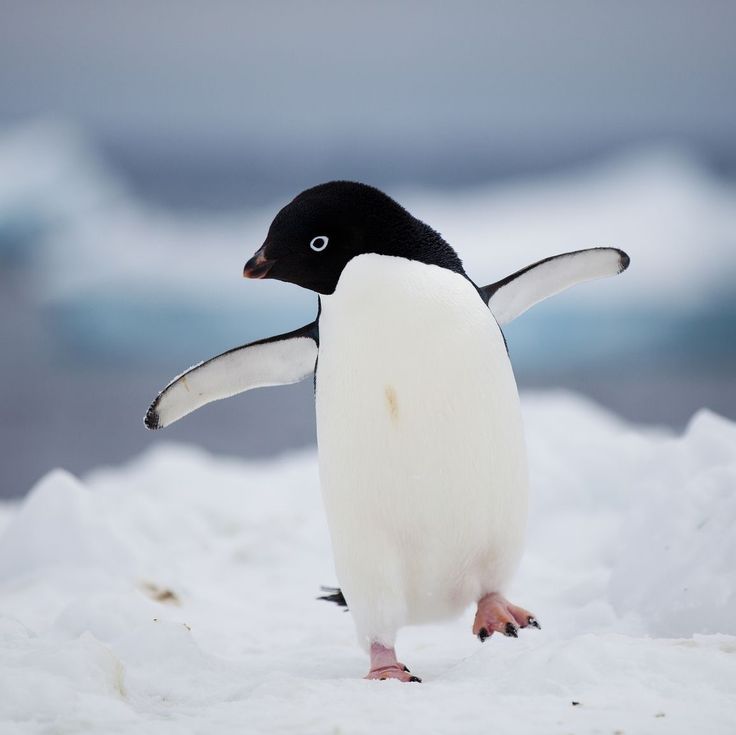
The Adelie penguin is the most abundant penguin in Antarctica, the most purely Antarctic of all penguin species, and arguably the visual template most people have in their heads when they picture a penguin at all.
Pygoscelis adeliae breeds around the entire coastline of the Antarctic continent and its offshore island arcs, nests on bare gravel in vast open rookeries, builds heaped pebble nests, and conducts courtship through an elaborate economy of stolen and re-gifted stones.
Named in 1840 after the wife of a French explorer, the species has since become one of the most intensively studied seabirds on Earth, a living indicator of Southern Ocean krill dynamics, and an accidental pop-culture icon thanks to its blue-black and white tuxedo plumage.
This guide covers every major aspect of Adelie penguin biology and ecology: size and identification, plumage and anatomy, diving and foraging, pebble courtship and breeding, colony life and long walks, the long-distance post-breeding migration along the Antarctic coast, conservation status, regional population divergence, the Cape Adare colony and its role in Antarctic exploration history, and the relationship between Adelie penguins and humans.
It is a full reference entry, not a summary - so expect specifics: metres, kilograms, kilometres per day, populations, and verified records.
Etymology and Classification
The scientific name Pygoscelis adeliae was coined in 1840 by French zoologists Jacques Hombron and Honore Jacquinot during the Antarctic expedition of Jules Dumont d'Urville.
The expedition encountered large colonies of a small black-and-white penguin while surveying a stretch of East Antarctic coast that Dumont d'Urville claimed for France and named Terre Adelie - Adelie Land - after his wife, Adele Dumont d'Urville. The spelling "Adelie" is the French form of her name. The zoologists honoured her again by attaching the feminised Latin adeliae to the new species.
Both the geography and the bird have carried her name unchanged for nearly two centuries. This is one of the very few cases in which a species has been named after the spouse of an explorer rather than a naturalist, monarch, or patron.
The genus name Pygoscelis is older, coined in 1831, and comes from Greek roots meaning "rump-legged" - a reference to the backward position of the legs and the stiff tail feathers that drag behind the bird when it walks. The genus contains three living species: the Adelie, the gentoo (Pygoscelis papua), and the chinstrap (Pygoscelis antarcticus). These three are collectively known as the "brush-tailed" penguins.
Molecular evidence places the divergence of the three species at roughly 14 to 19 million years ago, with the Adelie lineage splitting somewhat later than the gentoo branch.
No subspecies of Adelie penguin are currently recognised. Despite the huge geographic spread around the Antarctic continent, genetic differentiation between colonies is surprisingly shallow, consistent with the species' year-round movement along the pack ice edge and periodic long-distance dispersal of juveniles.
Size and Physical Description
Adelies are small to medium penguins. They are smaller than gentoos, considerably smaller than kings, and dwarfed by emperors. Within the Antarctic penguin fauna they are roughly the same size as chinstraps.
Adults:
- Height: 46-71 cm standing upright
- Weight: 3.6-6.0 kg (peaks at 5-6 kg before pre-moult foraging, drops to 3.6 kg during fasting)
- Bill length: 35-40 mm, short and stout, black with a red-pink base often hidden by feathers
- Flipper length: roughly 18-22 cm, stiff and paddle-like
Chicks at hatching:
- Weight: 80-100 grams
- Covered in short silver-grey down that darkens within a week
Chicks at fledging:
- Weight: 3.0-4.0 kg
- Juvenile plumage with a white chin patch, no eye-ring yet
The Adelie is instantly recognisable. The back, flippers, and head are pure blue-black; the belly and underside are clean white. The face is solid black with no facial markings other than a striking white eye-ring that gives the species a slightly surprised expression. Unlike gentoos there is no white head stripe; unlike chinstraps there is no black chin-strap.
The bill is mostly black with a small red-pink patch at the base, usually visible only at close range. Feet are pale pink with black soles.
The tail feathers are long, stiff, and prominent - one of the diagnostic features of the genus. On snow and ice the tail serves as a brake during tobogganing, dragging behind to slow descent on slopes and leaving a narrow groove between two lines of footprints. The overall body plan is the classic mid-size deep-diving penguin: torpedo-shaped in water, with dense bones, enormous chest muscles to power the flippers, and feet placed far back on the body so the bird stands vertically on land.
The Blue-White Tuxedo and Why It Inspired "Happy Feet"
The Adelie's plumage is the popular archetype of a penguin. A solid blue-black cap, back, and tail; a clean white front; a black face broken only by a round white eye-ring. No extra colours, no stripes, no tufts. That simplicity is exactly what cartoonists and animators have always reached for.
The central chick in the 2006 animated film Happy Feet - Mumble - is rendered as an emperor penguin chick for narrative reasons, but the adult Adelies (the fast-talking, pebble-carrying "Amigos") are modelled directly on Pygoscelis adeliae, complete with white eye-rings and short stout bills. The film's Antarctic aesthetic leans on Adelie colony behaviour more than any other species.
In the water the tuxedo acts as countershading camouflage. Seen from above against deep water, the blue-black back blends into shadow. Seen from below against surface light, the white belly disappears against sky glare. This pattern is standard across penguins but reaches its cleanest, most unbroken form in the Adelie.
Built for Antarctic Life
The Adelie penguin is the most strictly polar penguin species alive. Unlike gentoos or kings, Adelies breed almost entirely on the Antarctic continent itself, follow the pack ice edge year-round, and rarely venture north of 60 degrees South. Every feature of their biology is tuned to the Antarctic cycle.
Insulation layers:
- Outer waterproof feathers: short, stiff, densely overlapping, oiled by the uropygial gland
- Dense underdown: traps a still layer of warm air against the skin
- Subcutaneous fat: 2-4 cm thick in well-fed adults, providing both insulation and fasting reserves
Thermal regulation features:
- Compact body shape: favourable volume-to-surface ratio
- Small flippers relative to body mass
- Counter-current blood flow in the legs and flippers, cooling blood before it reaches the feet and reducing heat loss to ice and cold water
Adelies tolerate some of the coldest operating conditions of any bird. They nest, walk, and incubate eggs in winds that routinely exceed 100 km/h and temperatures that drop below minus 30 degrees Celsius during the shoulder seasons at the start and end of the breeding cycle. They can also enter freezing seawater repeatedly without losing body condition as long as food is available.
Pebble Nests and Pebble Theft
Adelies build open, cup-shaped pebble nests on bare gravel, typically on low rocky rises that stay free of meltwater during the brief Antarctic summer. High-quality pebbles are a genuinely limiting resource on the wind-scoured Antarctic coast. A completed Adelie nest can contain several hundred carefully chosen stones, each individually placed by the male.
During courtship and pair bonding, males search for smooth, rounded pebbles and present them to prospective or bonded females, who accept the stone and add it to the growing nest. The behaviour serves two functions at once. It signals the male's fitness and provisioning ability. And it physically contributes to a successful nest - Adelie eggs must be elevated above meltwater, mud, and snow to avoid chilling and flooding.
The most prized pebbles are the smoothest, roundest, and most uniformly sized stones. Such pebbles are repeatedly stolen from neighbouring nests, argued over loudly, and sometimes re-gifted several times across a single colony.
Pebble theft is so common that entire hours of colony activity consist of one bird carefully lifting a stone, another bird stealing it the moment the first turns away, and a third swooping in during the ensuing dispute. Pebble-related squabbles are among the defining social behaviours of an Adelie rookery.
Diet and the Pink Guano
Adelies are krill specialists. Antarctic krill (Euphausia superba) and ice krill (Euphausia crystallorophias) together make up 60-90% of the diet at most colonies, with small fish - primarily Antarctic silverfish (Pleuragramma antarctica) - and pelagic amphipods rounding out the rest. Individual diet composition varies with colony location and year, tracking local krill abundance.
Prey composition at a typical East Antarctic colony:
| Prey group | Share by mass | Notes |
|---|---|---|
| Antarctic krill | 55-75% | Dominant during pack ice peaks |
| Ice krill | 10-25% | More important under heavy fast ice |
| Antarctic silverfish | 5-15% | Higher in poor-krill years |
| Amphipods and other | 2-8% | Opportunistic |
A single adult consumes roughly 1-2 kg of prey per day during the chick-rearing period. Foraging trips are short and inshore during the guard stage - a few hours to a day or two - and lengthen to several days once chicks are old enough to creche. Adelies swim 15-40 kilometres per day at this time just to find enough krill to keep a growing pair of chicks fed.
One of the stranger consequences of this diet is the colour of Adelie guano. Krill are rich in astaxanthin, a red-orange carotenoid pigment. Digested krill produce bright pink or red droppings. Amphipod-heavy meals can push guano toward a greenish hue. Fish meals produce a paler, whiter deposit.
Colony guano stains are so large and so distinctively pink that they are routinely used to map and count Adelie colonies from satellite imagery. The Landsat and Sentinel archives have been mined to find previously unknown colonies simply by looking for the right shade of pink on the coast.
Diving and Foraging
Adelies are strong but not record-breaking divers. Typical foraging dives are 20-50 metres deep and last 1-2 minutes. Maximum recorded dive depth is approximately 175 metres, and maximum recorded dive duration is around 6 minutes, both rare extremes.
Dive data:
| Metric | Value |
|---|---|
| Typical foraging dive depth | 20-50 m |
| Maximum recorded dive depth | ~175 m |
| Typical dive duration | 1-2 minutes |
| Maximum recorded dive duration | ~6 minutes |
| Dives per foraging trip | 50-300 |
| Typical horizontal foraging range | 15-40 km from the colony per day |
Adelies hunt by sight, usually during daylight, and key their foraging to the upper water column where krill swarms concentrate. In thick pack ice conditions they use cracks, leads, and breathing holes in ways superficially similar to seals. Birds can walk long distances across fast ice to reach productive feeding leads and return to the colony on the same commuting corridors.
Long Walks to the Colony
Some Adelie colonies sit far from reliable open water. In peak fast-ice years, adults may have to walk more than 60 kilometres one way across the sea ice between the colony and the nearest productive feeding ground. On short legs designed more for swimming than walking, this is a major energetic expense and a strong selection pressure against colonies drifting too far inland.
Adelies use well-defined commuting routes across the sea ice, visible as packed paths worn by thousands of passing birds. Tobogganing on the belly with alternate flipper pushes is faster than walking on loose snow and becomes the preferred gait over longer distances. Parties of several dozen birds typically travel together, which reduces individual predation risk from leopard seals at the ice edge.
The "Ping Pong" Commute and Counter-Sharking
Leopard seals (Hydrurga leptonyx) ambush Adelie penguins at the ice edge where birds enter and leave the water. To reduce time spent in the killing zone, Adelies follow a commuting pattern ornithologists sometimes describe as "ping pong": birds leave the colony in synchronised waves, enter the water quickly and together, spend a concentrated block of time foraging, and return in another synchronised wave.
Individual time exposed at the ice edge is minimised, and the mass of bodies entering the water at once dilutes the per-bird probability of being the one a leopard seal catches.
At the moment of entry, Adelies use a collective strategy sometimes called "counter-sharking." A crowd gathers at the ice edge and nobody jumps first. The group shuffles forward, edges back, pushes, hesitates. Eventually one bird either jumps of its own accord or is nudged off the edge. If no predator surfaces within seconds, the rest of the flock cascades in. If a leopard seal appears, the remainder pull back.
The behaviour is a live example of risk-pooling in animal decision making and a favourite subject of Antarctic documentary footage.
Breeding Cycle
The Adelie breeding cycle is locked tightly to the short Antarctic summer. Adults arrive at the colony in late October, lay eggs in early-to-mid November, and the last chicks fledge by early March. The entire sequence runs against the clock of the Antarctic summer light.
Annual timeline:
- Late October: Adults arrive at the colony. Males arrive first and reclaim nest sites; returning females rejoin the same partner in most cases.
- Early-to-mid November: Pebble nests rebuilt. Pair bonding. Two eggs laid, several days apart.
- Mid-November to mid-December: Incubation, 32-34 days. Parents alternate shifts of up to two weeks while the other bird goes to sea to feed.
- Mid-December to mid-January: Guard stage. One parent always stays with the chicks while the other forages. Frequent short feeding trips.
- Mid-January to early February: Creche stage. Chicks gather in groups for warmth and safety. Both parents forage simultaneously, returning only to feed.
- Mid-February to early March: Fledging. Chicks moult into waterproof juvenile plumage and enter the sea for the first time.
- Late February to mid-March: Adults depart for a pre-moult foraging trip, return to a safe beach, undergo the catastrophic annual moult over roughly three weeks, and then leave the colony for the open pack ice.
Clutch size is two eggs. Both chicks often fledge in good krill years; in poor years the second egg commonly fails or the smaller chick starves. Lifetime reproductive success is heavily weighted toward good-krill years.
Migration Along the Pack Ice Edge
Unlike some Antarctic seabirds, Adelies do not abandon the continent for temperate waters once breeding ends. Instead they follow the expanding winter pack ice edge, often covering very long distances along the Antarctic coast. Tracked birds from Ross Sea colonies have logged over 17,000 kilometres in a single post-breeding season, spiralling west and north with the ice, foraging in productive cracks and polynyas, and returning to the same colony the following spring.
This strict tie to the pack ice edge is what makes the Adelie the "purest" Antarctic penguin. Kings and gentoos move into subantarctic waters for part of the year; emperors stay close to the ice but range less. The Adelie is the only species whose annual cycle fully tracks the seasonal ice.
Populations and Trends
Scientists currently estimate the global Adelie population at roughly 3.79 million breeding pairs distributed across more than 250 recognised colonies around the Antarctic coast and offshore islands. This makes the Adelie the most abundant penguin in Antarctica and one of the most numerous seabirds in the Southern Hemisphere.
Distribution by region:
| Region | Approximate share | Trend |
|---|---|---|
| East Antarctica | ~45% | Stable to increasing |
| Ross Sea | ~30% | Stable, some local increases |
| Antarctic Peninsula | ~15% | Decreasing |
| South Shetlands and Orkneys | ~7% | Mixed, many colonies declining |
| Other islands (e.g. Bouvet) | ~3% | Stable or lightly monitored |
Regional trends are sharply divergent. East Antarctic and most Ross Sea colonies are stable or expanding, benefiting from sea-ice conditions that remain broadly favourable.
Antarctic Peninsula colonies are in clear decline, largely because the peninsula has warmed faster than almost any other place on Earth, the pack ice season has shortened, and gentoo and chinstrap penguins are expanding south into ground that used to belong to Adelies. Some peninsula colonies have lost 70% or more of their pairs over the past forty years even as species-wide numbers remain high.
Conservation Status and Threats
The IUCN lists Adelie penguins as Least Concern with a stable overall population trend. The species is protected under the Antarctic Treaty System, which regulates all human activity on the continent, and covered by the Agreement on the Conservation of Albatrosses and Petrels in its Southern Ocean provisions.
Primary threats:
- Regional sea ice change. On the Antarctic Peninsula, reduced and later-forming pack ice has cut Adelie foraging windows and depressed krill recruitment. In East Antarctica, by contrast, some areas have seen stable or slightly expanding pack ice, and Adelie colonies there are stable or growing.
- Krill fisheries. Commercial krill fishing operates in parts of the Southern Ocean used by Adelies for foraging. Competition is currently modest but could intensify if krill catch quotas rise.
- Avian influenza. Highly pathogenic avian influenza arrived in the Southern Ocean region in the early 2020s and has been detected in subantarctic seabirds. An Antarctic Adelie outbreak would be extremely difficult to monitor or contain given colony size and remoteness.
- Tourism and research disturbance. A subset of Adelie colonies sit near frequently visited research stations and tourist landing sites. Managed well, such visits are low impact; poorly managed, they can displace nesting birds or increase exposure to pathogens.
- Oil and plastic pollution. Shipping and research activity in Antarctic waters brings low but non-zero risk of spills and plastic ingestion.
Species-wide the Adelie is not globally threatened. Regional subpopulations on the Antarctic Peninsula, however, are trending toward thresholds that could force reassessment at the regional level within the coming decades.
Cape Adare and the Scott Expedition
The Adelie penguin has a unique place in the history of Antarctic exploration. The great colony at Cape Adare, on the western side of the Ross Sea, is one of the largest and oldest known Adelie rookeries, with hundreds of thousands of pairs nesting on a narrow pebble beach under a sheer cliff. It was one of the first Antarctic sites occupied for sustained scientific work.
During the British Antarctic Expedition of 1910-1913 led by Robert Falcon Scott, a party under Victor Campbell spent months at Cape Adare studying the birds and the local geology. Their wooden expedition hut, built in 1911, still stands amongst the nesting Adelies, preserved as a historic monument under Antarctic Treaty protection. Penguin biologists have been reading and adding to the Cape Adare record ever since, making it one of the longest-studied seabird colonies on Earth.
The Wrangel Island episode is a darker footnote. A nineteenth-century specimen and field report from Wrangel Island in the Russian Arctic was variously interpreted as an Adelie or as an unknown Arctic penguin, and was used at one point to argue that Adelies might somehow have migrated around Cape Horn and across the equator.
Modern analysis of the specimen and notes shows the record is a misidentification or mislabelled collection. There is no credible evidence that any Adelie penguin has ever crossed the equator, and the species is among the most strictly polar of all penguins.
Adelie Penguins and Humans
Human contact with Adelie penguins is almost entirely scientific and logistical. There is no Indigenous hunting tradition for the species - Antarctica has no permanent Indigenous human population - and no commercial harvest has existed since an early twentieth-century collapse of Antarctic sealing and penguin oil operations left the birds alone. Today, interactions are dominated by research stations, long-running monitoring programmes, and tightly regulated tourism.
Adelie colonies are among the best-studied seabird populations in the world. Long-term banding and automated weighbridge projects at colonies like Bechervaise Island, Cape Crozier, and Petermann Island now span multiple decades. These programmes provide some of the most detailed data available for any wild bird on breeding success, adult survival, prey availability, and climate linkage.
Tourism is carefully managed under the International Association of Antarctica Tour Operators guidelines. Visitors stay at minimum distances, never touch or block birds, and follow strict biosecurity protocols to reduce the chance of introducing pathogens.
The species' cultural footprint is outsized. The name Adelie, through Terre Adelie and Happy Feet and a century of explorer diaries and National Geographic specials, is recognised by millions of people who could not name any other penguin. For a bird that lives on the edge of the world and never meets most of the humans who love it, that is an unusual reach.
Related Reading
- Gentoo Penguin: Subantarctic Brush-Tail
- King Penguin: The Subantarctic Giant
- Emperor Penguin: Antarctica's Deep-Diving Survivor
- Penguins: Flightless Birds That Conquered the Cold
References
Relevant peer-reviewed and governmental sources consulted for this entry include IUCN Red List assessments for Pygoscelis adeliae, SCAR (Scientific Committee on Antarctic Research) population reports, CCAMLR ecosystem monitoring program data, long-term monitoring publications from the Palmer LTER and Ross Sea colonies, and published research in Marine Ecology Progress Series, Polar Biology, Journal of Avian Biology, and Nature Climate Change.
Population figures reflect the most recent consolidated circumpolar estimates derived from combined ground surveys and satellite imagery analysis of colony guano extents.
Frequently Asked Questions
How big are Adelie penguins?
Adult Adelie penguins (Pygoscelis adeliae) stand 46-71 cm tall and weigh 3.6-6.0 kg. They are one of the smaller Antarctic penguins - considerably smaller than gentoos, kings, and emperors, and roughly the same size as chinstraps. Males average slightly larger than females but the sexes are almost impossible to separate visually in the field without measurement.
Body mass fluctuates sharply across the breeding cycle, peaking at around 6 kg before the pre-moult foraging trip and dropping to 3.6 kg or less during the long land-bound fast that accompanies incubation, guard duty, and the annual catastrophic moult. Chicks hatch at about 80-100 grams and fledge at 3-4 kg after roughly 50-60 days of rapid growth.
What do Adelie penguins eat?
Adelie penguins are krill specialists. Antarctic krill (Euphausia superba) and ice krill (Euphausia crystallorophias) together make up 60-90% of the diet at most colonies, with small fish - primarily Antarctic silverfish (Pleuragramma antarctica) - and pelagic amphipods rounding out the rest. A single adult consumes roughly 1-2 kg of prey per day during the chick-rearing period.
Foraging trips are short and inshore during the guard stage, lasting a few hours to a day or two, and lengthen to several days once chicks are old enough to creche. Adelies typically dive 20-50 m but can reach 175 m, and a single foraging trip can include 200 or more separate dives. The pink, red, or greenish colour of Adelie guano is a direct visual readout of the day’s menu.
Where do Adelie penguins live?
Adelie penguins breed around the entire Antarctic coastline and on nearby offshore islands, making them the most purely Antarctic of all penguin species. Major colonies sit on the Antarctic Peninsula, the South Shetlands, the South Orkneys, the South Sandwich Islands, the Ross Sea coast (including the enormous Cape Adare and Cape Crozier rookeries), Adelie Land, the East Antarctic coast, and isolated sites on Bouvet Island.
They prefer ice-free, snow-free coastal ground for nesting - typically bare gravel, pebble beaches, or low rocky outcrops - within reach of open water and reliable pack ice for foraging. Outside the breeding season they follow the pack ice edge year-round, rarely venturing north of 60 degrees South.
Are Adelie penguins endangered?
The IUCN lists Adelie penguins as Least Concern. The global population is estimated at roughly 3.79 million breeding pairs across more than 250 recognised colonies, making this the most abundant penguin in Antarctica and one of the most numerous seabirds in the Southern Hemisphere.
Overall trends are mixed and regionally divergent: populations in East Antarctica and parts of the Ross Sea are stable or increasing, while many Antarctic Peninsula colonies are in sharp decline because reduced sea ice and competition with expanding gentoo and chinstrap populations are squeezing them out. Secondary threats include krill fisheries overlap, oil spills, avian influenza, and disturbance at tourism-heavy colonies.
The species is not globally threatened but some regional subpopulations could cross threat thresholds in coming decades.
How long do Adelie penguins live?
Wild Adelie penguins typically live 10-20 years, with an average lifespan of around 11-16 years for birds that survive to breeding age. Annual adult survival runs at roughly 80-90% once individuals reach maturity at 3-6 years old. First-year survival is the most dangerous period of an Adelie’s life - only about 10-20% of fledged chicks survive their first year at sea.
Chick mortality during the breeding cycle is also significant, with 30-50% of hatched chicks failing to fledge in an average year due to starvation, predation by skuas and giant petrels, and occasional catastrophic weather events. The oldest documented banded Adelie was over 22 years old.
Why do Adelie penguins give pebbles as courtship gifts?
Adelie penguins build open pebble nests on bare ground, and high-quality pebbles are a genuinely limiting resource on the wind-scoured Antarctic coast. During courtship and pair bonding, males search for smooth, rounded stones and present them to prospective or bonded females, who accept the stone and add it to the growing nest.
The behaviour serves two functions at once: it signals the male’s ability to provide, and it physically contributes to a successful nest because Adelie eggs must be elevated above meltwater, mud, and snow to avoid chilling and flooding.
The most prized pebbles are the smoothest, roundest, and most uniformly sized stones; such pebbles are repeatedly stolen from neighbouring nests, argued over loudly, and sometimes re-gifted several times across a single colony. Pebble theft and squabbling are among the defining social behaviours of an Adelie rookery.
Who was the Adelie penguin named after?
The Adelie penguin was named in 1840 by French explorer Jules Dumont d’Urville after his wife, Adele Dumont d’Urville - spelled Adelie in French and written on maps as Terre Adelie, the stretch of East Antarctic coast he claimed for France on the same voyage.
Dumont d’Urville’s expedition encountered large colonies of the small black-and-white penguin while surveying the coast, and he honoured his wife by attaching her name to both the geography and the bird. The scientific name Pygoscelis adeliae carries the feminised Latin form of her name.
This is one of the very few cases in which an animal species has been named after the spouse of an explorer rather than a naturalist, monarch, or patron, and the name has endured unchanged for nearly two centuries.
Did Adelie penguins really migrate around Cape Horn to the Arctic?
No. A nineteenth-century report of an Adelie penguin supposedly collected near Wrangel Island in the Russian Arctic has been cited as evidence that the species could somehow swim around Cape Horn, across the equator, and all the way to the far northern Pacific.
Modern analysis of the original specimen and field notes shows the record is a misidentification or a mislabelled specimen - Adelies are highly faithful to the Antarctic pack ice edge and never occur anywhere near temperate, let alone Arctic, latitudes.
The Wrangel Island story still surfaces in older popular books and has fuelled decades of speculation, but there is no credible evidence that any Adelie penguin has ever crossed the equator under its own power. The species is among the most strictly polar of all penguins, with its entire annual cycle locked to the circumpolar Antarctic pack ice.