
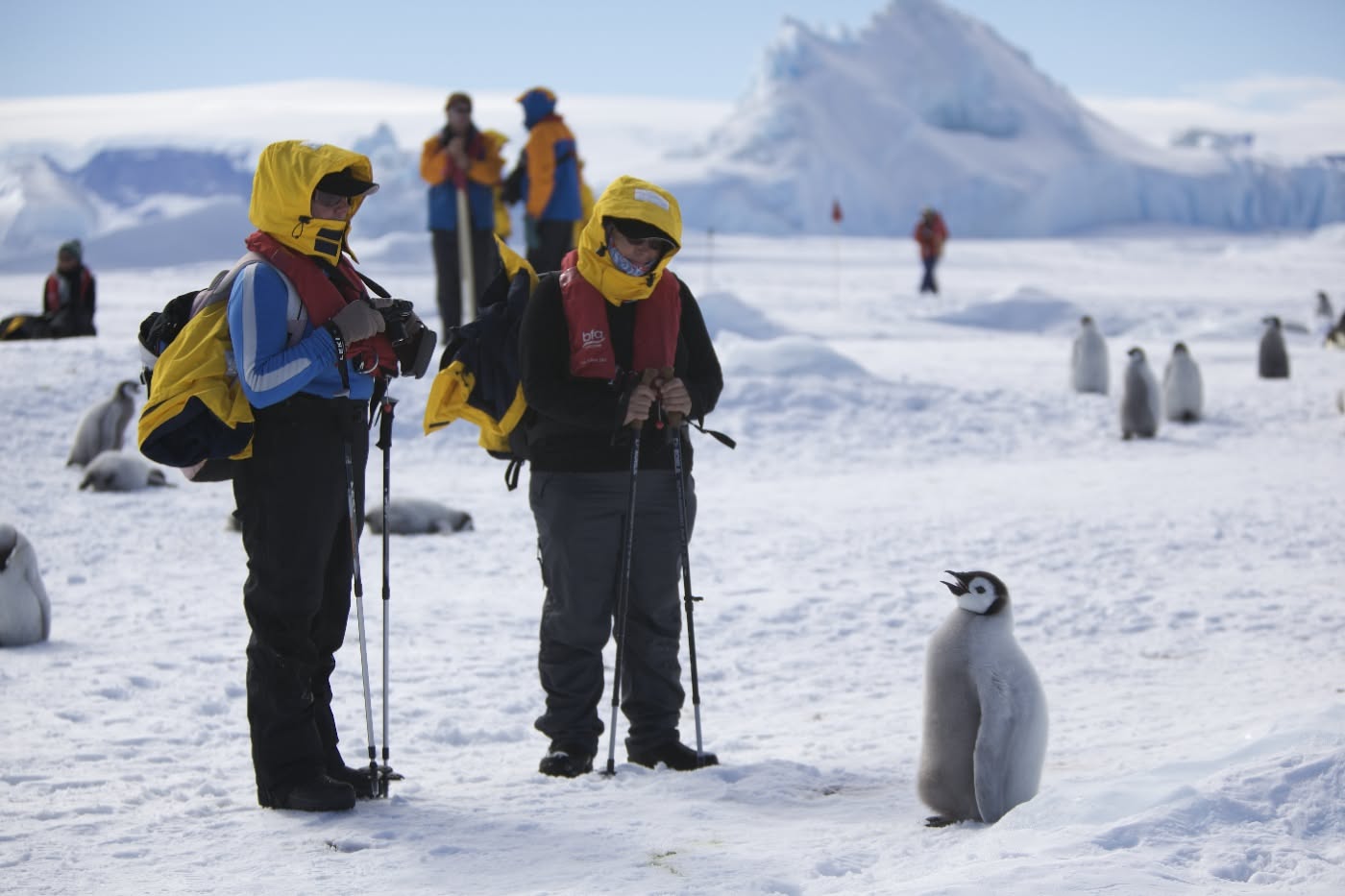
How do emperor penguins survive Antarctic winter?
Emperor penguins survive Antarctic winter temperatures down to -60°C (-76°F) through a combination of physical adaptations and social behavior. Their feather density (100 feathers per square centimeter, the highest of any bird) provides exceptional insulation. A 3 cm thick layer of subcutaneous fat adds more insulation.
The Most Extreme Parenting on Earth
No other animal raises its young in conditions remotely as extreme as emperor penguins do. Every year, approximately 600,000 emperor penguins walk inland across the Antarctic sea ice, sometimes for over 100 kilometers, to breed in temperatures reaching -60°C with winds over 200 km/h. Males spend 100 days standing on the ice without food, balancing a single egg on their feet, while winter darkness covers the continent for months.
It is, by almost any metric, the most demanding parental commitment in the animal kingdom. And somehow, every year, it works. Chicks emerge from this ordeal ready to feed in the brief Antarctic summer, and the species has repeated this extraordinary performance for at least 40 million years.
The Physical Adaptations
Emperor penguins (Aptenodytes forsteri) are the largest penguins alive, averaging 1.15 meters (3.8 feet) tall and 22-45 kg (48-99 lb) in weight. Their bodies are built for cold survival to a degree unmatched by any other bird.
Feather Density
Emperor penguins have approximately 100 feathers per square centimeter - the densest plumage of any bird species. The feathers are small, stiff, and oil-coated, forming a nearly impermeable barrier against wind and water. Each feather has a fluffy base of down feathers underneath, creating layered insulation similar to the most effective human-designed cold weather gear.
The outer feathers also overlap like roof shingles, preventing wind from reaching the skin. A penguin standing in -60°C wind maintains a body surface temperature of approximately 0°C at the skin boundary - warm enough that the bird's metabolism can maintain core body temperature at the normal 38°C.
Subcutaneous Fat
Emperor penguins accumulate a 3 cm thick layer of subcutaneous fat before breeding season. This fat provides both insulation and an energy reserve. Males entering the fasting period weigh approximately 38 kg. After 100+ days of standing on ice without food, they weigh approximately 23 kg - having lost 40 percent of their body mass.
Counter-Current Heat Exchange
The most elegant adaptation is in the feet. Emperor penguin legs contain a specialized network of arteries and veins running in parallel through the same tissue. Warm blood flowing down from the body passes heat to cold blood flowing back up, keeping core body temperature warm while allowing the feet to remain just above freezing.
The feet in an emperor penguin standing on ice at -40°C may be at 1°C. This is warm enough to prevent tissue damage but cold enough that very little body heat is lost through the feet. Humans and other mammals have partial versions of this system; penguins and arctic birds have it perfected.
Small Surface Area
Emperor penguins have unusually short beaks, small flippers, and compact bodies relative to their mass. The reduced surface area minimizes heat loss. The flippers are approximately half the length of body-to-body ratios seen in tropical seabirds.
The Huddle
Individual adaptations are not enough. A solitary emperor penguin cannot survive an Antarctic winter storm. The key social adaptation is the huddle.
When temperatures drop and winds rise, emperor penguins in a breeding colony form tight groups - sometimes numbering several thousand birds pressed together so closely that individuals cannot move their wings. In the huddle:
- Temperatures in the interior reach 20-35°C, roughly room temperature
- Exterior temperatures remain at -40 to -60°C
- Each penguin conserves approximately 50 percent of the energy it would lose standing alone
The huddle rotates continuously. Penguins on the windward edge slowly shuffle toward the leeward edge, then back into the interior, in a coordinated cycle that gives every bird time in the warm center. The rotation is not led by any dominant individual; it emerges from the behavior of all penguins, each moving in the direction of the warmer bird beside them.
Researchers at the University of Erlangen in Germany used mathematical modeling to show that the huddle rotation follows physics equivalent to fluid dynamics in a viscous liquid.
Without the huddle, no emperor penguin could survive a full Antarctic winter. The individual adaptations handle moderately cold conditions. The huddle handles the extreme conditions that would otherwise be fatal.
The Breeding Cycle
Emperor penguins breed on a schedule that looks suicidally counterintuitive. Other penguin species breed during local summer, when temperatures are mildest and food is most accessible. Emperor penguins breed during winter - the coldest, darkest part of the Antarctic year.
The reason: so chicks will be old enough to feed themselves during the brief Antarctic summer.
Emperor penguin chicks cannot feed themselves until they develop waterproof adult plumage, which takes approximately 150 days. If breeding started in summer, the chicks would still be in vulnerable down plumage when the next winter began, and they would die.
By starting the process in May, the timing works:
- May: Adults walk inland to breeding colonies.
- June: Females lay single eggs, transfer them to males, and walk back to the ocean.
- July-August: Males incubate eggs for 65 days during the worst of winter.
- September: Eggs hatch. Males have been fasting for 100 days.
- October-November: Females return with food. Males walk to the ocean to feed.
- December-February: Chicks develop rapidly during Antarctic summer, eventually feeding themselves.
- March: Young penguins molt into adult plumage and enter the ocean for the first time.
The entire cycle is synchronized to the Antarctic seasonal calendar. Breeding in winter puts the adults through extreme hardship but positions chicks for success during the brief productive season.
The 100-Day Fast
Male emperor penguins endure what is probably the longest parental fast in the animal kingdom.
The fast begins in May when the male arrives at the breeding colony. He courts a female, mates, and remains at the colony. The female lays a single egg in June and transfers it to the male's feet, where the male cradles it in a special brood pouch - a loose fold of skin that drapes over the egg and keeps it at approximately 36°C.
The female then walks 50-120 km back to the ocean to feed. The male remains at the colony with the egg balanced on his feet, unable to lie down, unable to forage, unable to leave.
During this period:
- He cannot eat - the breeding colony is far from any food source
- He cannot drink - all liquid water is frozen; he must metabolize fat reserves for water
- He must maintain the egg at body temperature while standing on ice
- He must tolerate Antarctic winter storms with temperatures reaching -60°C and winds over 200 km/h
The male loses approximately 40 percent of his body weight during the fast. By the time eggs hatch in early September, males are severely weakened. They have been standing in place, often holding eggs, for over three months.
If the female does not return in time with food: the male can feed the newly hatched chick with a crop milk - a protein-rich substance secreted from the esophagus. This gives the chick a few days of nourishment and allows the male a grace period while waiting for the female.
When the female arrives with a stomach full of fish and krill from the ocean, she regurgitates food for the chick. The male then begins his own journey back to the sea - often walking 100 km in a starved, exhausted state. Males who successfully complete the breeding cycle are depleted for weeks after, rebuilding their fat reserves for the next year.
The March to the Colony
The annual journey from sea ice edge to breeding colony was the subject of the 2005 documentary March of the Penguins, which brought emperor penguins to global cultural attention.
The walk takes several weeks. Emperor penguins move in single-file lines, with each bird following the tracks of the one ahead to minimize energy expenditure. Penguins can also slide on their bellies - "tobogganing" - which uses less energy than walking but only works on sloped terrain.
Why do the colonies exist so far from the ocean?
The breeding sites are on stable landfast sea ice, usually positioned behind ice cliffs or icebergs that block prevailing winds. Locating colonies inland provides:
- Protection from marine predators. Leopard seals and killer whales cannot reach inland colonies.
- More stable ice. Ice near the coast breaks up earlier in the season; inland ice remains solid longer.
- Shelter from storms. Natural wind barriers reduce exposure.
The specific locations have been used for generations. Penguins appear to learn colony locations culturally, with older birds leading younger ones to traditional breeding sites. Some colony locations are believed to have been used for thousands of years.
The trade-off for these protections is the enormous distance from food. Penguins must walk to and from the ocean repeatedly during the breeding season, and each trip represents enormous energy expenditure.
Do They Really Mate for Life?
The "penguins mate for life" narrative is mostly wrong for emperor penguins.
Research by biologists at the French research stations on Antarctica has shown that only about 15 percent of emperor penguin pairs reunite with the same partner the following year. Most penguins pair with new mates each breeding season.
The reasons are logistical rather than unfaithful:
Returning sequence matters. After a year spent at sea feeding in different ocean regions, penguins return to breeding colonies in different orders. By the time one bird returns and is ready to breed, its previous partner may already have paired with someone else.
Recognition is hard. In a colony of 5,000 birds, finding a specific previous mate would require extensive searching in extreme conditions. Most penguins simply pair with the first available adult they encounter who is also ready to breed.
Reproductive timing. Penguins who arrive early in the breeding season pair early. Those arriving later pair later. The matching is more about synchronization of reproductive readiness than long-term bonding.
Despite the low fidelity, emperor penguin parenting is highly invested. Both parents contribute heavily to chick-rearing during the breeding season, and the relationship, while often one-year, is intensely cooperative while it lasts.
Some other penguin species show higher fidelity - king penguins, adélie penguins, and gentoos have stronger pair-bonding patterns. Emperor penguins are the exception, with their extreme environmental pressures making long-term recognition impractical.
The Climate Change Threat
Emperor penguins are perhaps the most immediately vulnerable animal species to climate change, because they depend absolutely on stable sea ice.
How sea ice matters:
Emperor penguins breed only on landfast sea ice - ice that is attached to the continent and remains stable throughout winter. They cannot breed on ocean-based sea ice that drifts. The ice must be thick enough to support tens of thousands of adult birds and must remain intact from May through December.
If the ice breaks up early, unfledged chicks drown. Adults can swim, but chicks in down plumage die within hours if they fall into the water.
What is happening:
Since approximately 2010, Antarctic sea ice has become increasingly unstable. While the continent as a whole has shown complex ice patterns, specific regions critical to emperor penguins - the Weddell Sea, the Bellingshausen Sea - have experienced repeated catastrophic ice breakups.
Halley Bay colony collapse. The Halley Bay colony was historically the second-largest emperor penguin colony with approximately 25,000 breeding pairs. Starting in 2016, unusually strong storms broke up the sea ice before chicks could fledge. The colony attempted to breed on increasingly unstable ice in subsequent years, with near-total breeding failures.
By 2022, the colony had essentially abandoned the site, with most birds relocating to a smaller colony at Dawson-Lambton. An estimated 10,000 chicks died at Halley Bay between 2016 and 2019.
2022 mass chick mortality. Satellite imagery revealed four major emperor penguin colonies in the Bellingshausen Sea experienced complete breeding failure when sea ice broke up in November 2022, before chicks had developed waterproof plumage. Thousands of chicks drowned.
Projections:
Models developed by the British Antarctic Survey suggest that under moderate climate change scenarios, approximately 80 percent of emperor penguin colonies could be lost by 2100. Under high-emissions scenarios, the species could functionally go extinct in the wild.
The emperor penguin was formally designated as threatened under the U.S. Endangered Species Act in October 2022, recognizing that climate change threatens the species' long-term survival.
The Most Committed Parents
Emperor penguins spend months each year enduring the most extreme conditions on Earth to produce offspring. Males lose 40 percent of their body weight in a single breeding cycle. Females walk 200+ km round-trip to bring food. Both parents expose themselves to temperatures that would kill humans in minutes.
They do all this for a single chick per year - often just one chick per breeding season. The investment per offspring is among the highest in the animal kingdom.
The question of why this strategy evolved is answered by the harsh reality of Antarctic productivity. The ocean around Antarctica is enormously productive during summer, but only for a brief window. Timing chicks to feed during that window requires breeding during winter. Breeding during winter requires the entire suite of extreme adaptations - the huddle, the fasts, the inland journeys, the counter-current heat exchange in the feet.
Emperor penguins are not doing this because they are reckless or unusual. They are doing it because Antarctic ecology has selected for the one strategy that works in that environment. The strategy produces 600,000 adult emperor penguins across the continent every year, which is enough to maintain the species despite the individual hardships.
Climate change threatens to break this system. The timing that evolved over tens of millions of years depends on stable seasonal patterns that are now changing faster than penguins can adapt. Whether the species can shift to new strategies quickly enough remains uncertain.
For now, emperor penguins continue their annual cycle, the most extreme parenting in the animal kingdom, performed every year without fail, on a continent that has no witnesses most months of the year. The footage we have of their breeding season represents a tiny fraction of what happens - the majority of the work occurs during Antarctic winter darkness, when no camera can follow the birds.
Whatever the future holds for emperor penguins, what they have accomplished so far is one of the most remarkable achievements in vertebrate biology: a bird species that chose the coldest continent on Earth as its nursery, and figured out how to make it work.
Diving Physiology
Between breeding seasons, emperor penguins spend their lives in the open Southern Ocean, where their foraging dives are among the most impressive in the vertebrate world. They routinely hunt at depths that would kill most marine mammals, and they do so on a single breath.
| Diving Metric | Emperor Penguin | Elephant Seal | Human Freediver |
|---|---|---|---|
| Maximum depth (documented) | 564 m | 2,388 m | 214 m |
| Typical foraging depth | 150-250 m | 400-600 m | 20-40 m |
| Maximum dive duration | 27.6 min | 120 min | 11.54 min |
| Typical dive duration | 3-9 min | 20 min | 2-4 min |
| Lung collapse depth | ~50 m | ~30 m | ~30 m |
"Emperor penguins have the deepest and longest dives of any avian species. Their blood oxygen management is so efficient that they can shut off blood flow to non-essential organs, saving the oxygen in their muscles for the brain and heart. They effectively pause portions of their own biology to stretch the dive." - Paul Ponganis, Scripps Institution of Oceanography, Journal of Experimental Biology, 2011 [1]
The cellular tricks that make these dives possible include exceptionally high myoglobin concentrations in the flight muscles (repurposed as swimming muscles in flightless penguins), a large spleen that stores oxygen-rich blood for release during dives, and a bradycardia reflex that slows the heart from 175 beats per minute at the surface to as few as 15 during the deepest dives.
When Ponganis's team implanted telemetry in free-diving emperor penguins, they discovered that some muscle tissues drop below the usual thresholds for oxygen starvation without metabolic damage - a finding that has interested researchers studying stroke and heart-attack tolerance in humans.
Population Census and Colony Monitoring
Until the 2000s, estimating the global emperor penguin population required ships or planes to reach remote coastlines and count birds directly. Since 2009, the British Antarctic Survey has used high-resolution satellite imagery to identify and count colonies based on the tell-tale rust-colored guano stains visible from orbit. The Kalenux Team has reviewed the BAS methodology and the subsequent published census papers.
| Year | Estimated Global Population (breeding pairs) | Method |
|---|---|---|
| 2009 | 238,000 | First comprehensive satellite census |
| 2012 | 270,000 | Imagery upgrade; several new colonies found |
| 2019 | 270,000-280,000 | Stable across most monitored colonies |
| 2023 | 260,000 (preliminary) | Decline tied to Halley Bay collapse and Bellingshausen failures |
Satellite monitoring has discovered 10 previously unknown emperor penguin colonies since 2009, bringing the known total to 66. This is encouraging in some respects, but troubling in others. Many of the newly discovered colonies are small and occupy marginal ice conditions, suggesting they represent birds displaced from traditional sites.
The Halley Bay-to-Dawson-Lambton migration after the 2016 ice collapse offered the first documented example of emperor penguins relocating in response to an environmental catastrophe.
Research Stations That Made Emperor Penguin Science Possible
Emperor penguin research has been concentrated at a handful of Antarctic research stations, largely because reaching the colonies in winter is virtually impossible. The French station Dumont d'Urville, located near the Pointe Geologie colony in Terre Adelie, has supported more than 70 years of continuous emperor penguin research - the longest sustained study of any Antarctic vertebrate. British, American, Japanese, and German stations have contributed additional long-term datasets.
"Pointe Geologie is to penguin biology what the Galapagos are to evolutionary biology. We have observational continuity spanning the entire lifetime of the field, documented generation by generation." - Yvon Le Maho, French National Centre for Scientific Research, Nature, 2018 [2]
Data from Pointe Geologie have produced the definitive work on penguin fasting physiology, the huddle dynamics, and the subtle effects of climate change on colony success. The station logs every returning bird, every laid egg, every fledged chick, across decades. Without that continuity, we would not know what a normal year looks like - and therefore could not identify abnormal years caused by ice loss.
References
- Ponganis, P. J., Meir, J. U., and Williams, C. L. (2011). "In pursuit of Irving and Scholander: a review of oxygen store management in seals and penguins." Journal of Experimental Biology, 214(20), 3325-3339.
- Le Maho, Y., Whittington, J. D., Hanuise, N., Pereira, L., Boureau, M., Brucker, M., Chatelain, N., et al. (2014). "Rovers minimize human disturbance in research on wild animals." Nature Methods, 11(12), 1242-1244.
- Fretwell, P. T., and Trathan, P. N. (2009). "Penguins from space: faecal stains reveal the location of emperor penguin colonies." Global Ecology and Biogeography, 18(5), 543-552.
- Jenouvrier, S., Holland, M., Stroeve, J., Serreze, M., Barbraud, C., Weimerskirch, H., and Caswell, H. (2014). "Projected continent-wide declines of the emperor penguin under climate change." Nature Climate Change, 4(8), 715-718.
- Trathan, P. N., Fretwell, P. T., and Stonehouse, B. (2011). "First recorded loss of an emperor penguin colony in the recent period of Antarctic regional warming." PLoS ONE, 6(2), e14738.
Related Articles
- Penguins: Flightless Birds That Conquered the Cold
- Flightless Birds: When Wings Became Optional
- Arctic Foxes, Polar Bears, and the Changing Poles
Frequently Asked Questions
How do emperor penguins survive Antarctic winter?
Emperor penguins survive Antarctic winter temperatures down to -60°C (-76°F) through a combination of physical adaptations and social behavior. Their feather density (100 feathers per square centimeter, the highest of any bird) provides exceptional insulation. A 3 cm thick layer of subcutaneous fat adds more insulation.
Their feet have a counter-current heat exchange system that keeps blood warm in the legs while allowing feet to remain just above freezing without losing body heat. Most critically, they huddle together in groups of up to several thousand penguins, with birds on the outside taking turns moving to the center. Each penguin in a huddle conserves approximately 50 percent of the energy it would lose standing alone.
The huddle rotates constantly, with warmer interior birds moving outward and colder exterior birds moving inward - a coordinated system that keeps all birds alive through storms reaching -70°C with winds over 200 km/h.
Why do emperor penguins breed during winter?
Emperor penguins breed during Antarctic winter so their chicks will be old enough to fledge during the brief Antarctic summer when food is most abundant. This timing is critical - penguin chicks need to be near-adult size by December-January when sea ice breaks up and ocean food sources become accessible. To achieve this schedule, eggs must be laid in May and hatch in July, during the darkest and coldest months of the year.
The adults accept extreme hardship (a 100-day fast for males incubating eggs, extensive travel between colony and sea, and exposure to the most extreme weather on Earth) so their chicks emerge into a brief window of abundance. This backwards-timing strategy is unique among penguins - all 17 other penguin species breed during local summer when conditions are favorable.
How far do emperor penguins walk to their breeding colony?
Emperor penguins walk 50-120 km (30-75 miles) from the sea ice edge to their breeding colonies each year. The journey takes several weeks and is made in temperatures commonly reaching -40°C with constant wind. Penguins walk in single-file lines, with each bird following the tracks of the one ahead to minimize energy expenditure.
The colonies are located on stable landfast sea ice rather than on land - usually sheltered by ice cliffs or icebergs that block the prevailing winds. The choice of such remote inland locations is believed to protect the eggs and chicks from predation by leopard seals and killer whales that patrol coastal waters. This annual march was documented in the 2005 film March of the Penguins, which made the species globally famous.
The exact routes are passed culturally from one generation to the next, with older birds leading younger ones.
Do emperor penguins mate for life?
Emperor penguins do not mate for life. Contrary to the popular narrative, only about 15 percent of emperor penguin pairs reunite with the same partner the following year. Most penguins choose new mates annually, usually the first unattached adult they encounter in the dense breeding colony. This contrasts with some other penguin species (like king penguins) that have higher rates of pair fidelity.
The reason for low emperor penguin fidelity is logistical - after a year spent at sea feeding, penguins return to colonies in a specific order based on their arrival from the ocean, and locating a previous mate in a crowd of 5,000 birds during a polar storm is extraordinarily difficult. Penguins simply pair with whoever is available at the same time they are ready to mate.
Despite low fidelity, both parents contribute heavily to chick-rearing during the breeding season.
Are emperor penguins endangered?
Emperor penguins are currently listed as Near Threatened by the IUCN, with models suggesting the species may become Endangered by 2050 due to climate change. Approximately 595,000 adult emperor penguins exist across 66 known colonies. The primary threat is sea ice loss - emperor penguins breed only on stable sea ice, and Antarctic sea ice has begun breaking up earlier in the year than historical norms.
In 2022, at least four colonies experienced complete breeding failures when sea ice broke up before chicks had developed waterproof adult plumage; the chicks drowned. The Halley Bay colony, historically the second-largest emperor penguin colony, collapsed completely starting in 2016 when unstable ice forced adults to abandon breeding attempts year after year.
Climate models suggest 80 percent of current emperor penguin colonies could be lost by 2100 under moderate emissions scenarios. The species was formally designated as threatened under the U.S. Endangered Species Act in 2022.