
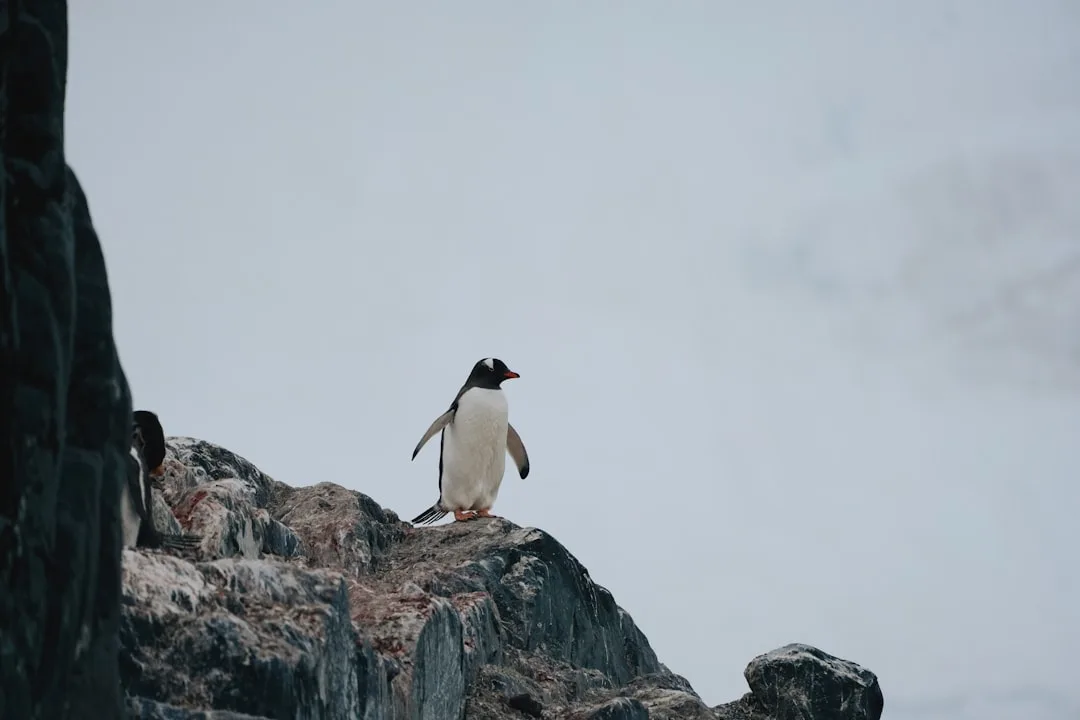
The gentoo penguin is the third-largest living penguin, the fastest underwater swimmer of any penguin species, and one of the most recognisable birds of the Southern Ocean - instantly identified by the bright white stripe that runs across the top of its head like a bandana and the long stiff tail that drags behind it as it walks.
Pygoscelis papua breeds on subantarctic islands and along the northern Antarctic Peninsula, where it nests in open colonies on bare ground, builds heaped pebble nests, and exchanges smooth stones as courtship gifts during the spring bonding season.
Unlike several of its polar relatives, the gentoo is not in decline: its populations are stable or increasing, and it is one of the few Antarctic seabirds genuinely benefiting from current climate shifts.
This guide covers every major aspect of gentoo penguin biology and ecology: size and identification, plumage and physiology, diving and foraging, the famous pebble courtship, breeding cycle and chick survival, colony dynamics, the dramatic diet differences between populations, conservation status and the 2020 proposal to split the species into four, and the relationship between gentoo penguins and humans.
It is a full reference entry, not a summary, so expect specifics: metres, kilograms, kilometres per hour, populations, and verified records.
Etymology and Classification
The scientific name Pygoscelis papua was coined by the German naturalist Johann Reinhold Forster in the late eighteenth century. Pygoscelis comes from Greek roots meaning "rump-legged," a reference to the backward position of the legs and the bird's long, stiff tail that trails behind it on land.
Papua is a historical geographic misnomer: Forster believed the species originated in the Papua region of the southwest Pacific, but gentoos have never bred there and the name stuck purely by error.
The common English name "gentoo" itself is of uncertain origin, possibly derived from an old Anglo-Indian word for a Hindu used loosely in eighteenth century maritime slang; the connection to the penguin is unclear, but the name has been attached to the species for more than two hundred years.
The genus Pygoscelis contains three living species: the gentoo, the Adelie (Pygoscelis adeliae), and the chinstrap (Pygoscelis antarcticus). These three are collectively known as the "brush-tailed" penguins because of their stiff, elongated tail feathers, and they are closely related but ecologically distinct. Molecular evidence suggests the three species diverged from a common ancestor roughly 14 to 16 million years ago, with the gentoo lineage splitting earliest.
Within Pygoscelis papua itself, traditional taxonomy recognises two subspecies. P. p. papua breeds on the northern subantarctic islands - the Falklands, South Georgia, and Kerguelen. P. p. ellsworthi breeds further south on the Antarctic Peninsula, the South Shetlands, the South Orkneys, and the South Sandwich Islands. Ellsworthi birds are noticeably smaller and lighter, a pattern consistent with colder, more krill-dependent foraging.
A 2020 study using genome-wide markers and detailed morphometric data proposed splitting the species into four: a northern gentoo on the Falklands, a South Georgia gentoo, a Kerguelen-Heard gentoo, and a southern gentoo on the Antarctic Peninsula. Divergence times between these proposed species are estimated at several hundred thousand to over a million years, with limited gene flow across the major ocean barriers.
Not every taxonomic authority has adopted the split, but several seabird bodies treat it as likely to be accepted over the coming decade.
Size and Physical Description
Gentoo penguins are medium-large penguins, clearly smaller than their emperor and king relatives but the largest of the brush-tailed Pygoscelis genus. Size varies noticeably between subantarctic and Antarctic populations.
Adults (northern populations):
- Height: 80-90 cm standing upright
- Weight: 6.0-8.5 kg
- Bill length: 55-65 mm, bright orange-red with a black ridge
- Flipper length: roughly 22-26 cm, stiff and paddle-like
Adults (Antarctic Peninsula populations):
- Height: 75-82 cm
- Weight: 4.5-6.5 kg
- Noticeably slimmer build than northern birds
Chicks at hatching:
- Weight: 90-100 grams
- Covered in short grey down that thickens rapidly over the first week
Full-grown chicks pre-fledge:
- Weight: 5.5-6.5 kg
- Grey-brown juvenile plumage replacing chick down
The gentoo is instantly recognisable among penguins. The most diagnostic feature is a broad white stripe that runs across the top of the head from one eye to the other, connecting over the crown like a headband. No other penguin wears this mark. The back, flippers, and head are otherwise blue-black; the belly is clean white. The bill is strikingly bright orange-red, unusually vivid for a penguin.
The feet are pale orange to pink. Juvenile birds show a duller version of adult plumage with a less distinct head stripe and a paler bill.
The tail is the origin of the genus name Pygoscelis, "rump-legged." Gentoo tail feathers are long, stiff, and prominent - the longest of any penguin species - and stick out noticeably behind the bird when it walks, scraping along the ground as it shuffles forward and sometimes leaving a visible trail between the two footprints. On snow and ice the tail serves as a brake during tobogganing, dragging to slow descent on slopes.
The overall body plan is a classic mid-size deep-diving penguin. The body is streamlined and torpedo-shaped in water, the bones are denser than those of flying birds, and the muscles of the chest are enormous to power the flippers. On land the posture is upright; the feet sit well back on the body and the bird stands vertically on flat feet, with the knees held high and hidden inside the body wall.
Plumage, the White Stripe, and the Orange Bill
The gentoo's plumage is dense, short, and highly waterproof, with the same general architecture as other penguin feather coats: overlapping scale-like outer feathers, a layer of insulating filoplumes, and a fine downy base next to the skin. Density is lower than in the record-holding king penguin but still extreme by bird standards, with feathers packed tightly enough that a slap of the flipper can throw off water before it penetrates to the skin.
The white head stripe is a fixed adult feature, not a seasonal marking. Its function is not fully resolved but it likely acts as a species-recognition signal in mixed-species breeding areas where gentoos share ground with Adelie and chinstrap penguins - a quick visual cue that prevents wasted displays and pairings. The shape and breadth of the stripe vary slightly between individuals and is sometimes used by researchers for manual identification in small colonies.
The orange-red bill colour is produced by carotenoid pigments deposited in the keratin of the bill sheath. Like the rare spheniscin carotenoids of king penguins, these pigments must be obtained from the diet - primarily from pink crustaceans such as krill and lobster krill - and a bird in poor foraging condition shows a duller, paler bill. Bill colour is assessed by potential mates during courtship, though research suggests the signal is less intensely policed than in kings or emperors.
Adult gentoos moult once a year, replacing every feather over roughly two to three weeks. Moult is catastrophic in the sense that the new feathers push out the old all at once rather than gradually, and the bird cannot enter the water until the replacement coat is fully waterproof. Moulting birds fast on land throughout this period and can lose up to 40% of their pre-moult body mass before returning to sea.
Habitat and Distribution
Gentoo penguins occupy a broader habitat range than most polar penguins. They breed on ice-free subantarctic and maritime Antarctic coasts, avoiding the heavy pack ice zones that emperors and Adelies depend on. The main breeding strongholds, in rough order of population size, are:
- Falkland Islands (UK) - more than 130,000 pairs at colonies including Volunteer Point, Bleaker Island, and Sea Lion Island
- South Georgia (UK) - several tens of thousands of pairs on ice-free beaches and valleys
- Antarctic Peninsula and South Shetland Islands - rapidly growing population, many tens of thousands of pairs
- Kerguelen Islands (France) - established subantarctic population
- Crozet Islands (France) - moderate population
- South Orkney Islands - stable population
- South Sandwich Islands - moderate population
- Heard Island and Macquarie Island (Australia) - smaller populations
Colonies typically sit on flat or gently sloping ground with good drainage, within walking distance of a sheltered sea entry. Gentoos are particularly associated with tussock grassland on subantarctic islands and with gravel or bare rock flats further south. Unlike Adelies, which demand snow-free bare rock for nesting, gentoos tolerate a wider variety of substrates - grass, moss, gravel, volcanic cinder - as long as the ground is stable and above the high water line.
Outside breeding, gentoos remain comparatively close to their breeding colonies. Unlike many seabirds that disperse hundreds of thousands of kilometres at sea, gentoos tend to stay within a few hundred kilometres of shore, foraging over the continental shelf and shelf break. This inshore lifestyle is one reason they are so well suited to rapid colonisation of new ice-free beaches.
Diving, Speed, and Foraging
Gentoo penguins are the fastest underwater swimmers of any penguin species. Published burst speeds reach 36 km/h, faster than a human sprinter on land and roughly three to five times the cruising speed of most other penguins. Cruising speeds are more modest, typically 6-10 km/h, but the species can accelerate dramatically when chasing fast fish or evading predators.
Diving and foraging data:
| Metric | Value |
|---|---|
| Typical foraging dive depth | 20-100 m |
| Maximum recorded dive depth | up to 200 m |
| Typical dive duration | 1-2 minutes |
| Maximum recorded dive duration | about 7 minutes |
| Burst swim speed | up to 36 km/h |
| Cruising swim speed | 6-10 km/h |
| Typical foraging trip range | 10-30 km from colony (inshore) |
| Dives per foraging day | 50-450 depending on prey density |
Gentoos are primarily shallow to mid-depth divers, targeting prey on and above the continental shelf. They do not routinely descend to king or emperor depths, but they dive repeatedly and efficiently: a feeding bird may complete more than 450 separate dives in a single day, each lasting about a minute to 90 seconds, with short surface recovery intervals. Heart rate drops during dives but the species does not execute the extreme bradycardia of deep-diving kings and emperors.
Underwater, gentoos swim with the classic penguin figure-of-eight flipper stroke, generating thrust on both the downstroke and the upstroke. The feet trail as rudders for steering. The high burst speed reflects strong flipper musculature and a hydrodynamic body shape.
The dietary picture is where gentoos become genuinely unusual. Different populations eat different things, and the differences are extreme enough to matter for conservation and taxonomy.
- Antarctic Peninsula gentoos: more than 85% of diet is Antarctic krill (Euphausia superba), with small amounts of fish as supplements.
- South Georgia gentoos: mix of krill and fish, with seasonal swings.
- Falkland Islands gentoos: diet dominated by small fish (lobster krill, rock cod, and Patagonian sprat) and squid, with only a small krill contribution.
- Kerguelen gentoos: mixed fish and crustacean diet reflecting local prey availability.
This per-colony dietary plasticity is unusual in penguins and is one of the reasons the gentoo appears more resilient than its close relatives to shifts in prey availability. When krill populations crash in one region, gentoos can switch targets in a way that more specialised species cannot.
The Pebble Nest and Courtship Gifts
Gentoo penguins are among the most visually distinctive nest-builders of any penguin species. Unlike emperors and kings, which incubate on their feet without any nest at all, gentoos construct prominent heaped nests of carefully selected pebbles, placed on bare ground or low grass. A completed gentoo nest is a circular pile 20-25 cm across and 5-10 cm high, consisting of anywhere from several hundred to more than 1,700 individual stones.
Nest building serves two functions. The raised pile elevates the eggs above ground-level meltwater, mud, and drainage channels, which matters because gentoos breed in damp spring conditions where wet ground can chill or drown an egg. Secondly, the pebble collection is a display of male fitness used in mate choice and pair-bond reinforcement.
During courtship, males search carefully for the smoothest, roundest, most uniformly sized pebbles available in their colony. Good stones are genuinely scarce in many breeding areas, and competition for them is intense. A male presents a selected pebble to a female by picking it up in his bill, approaching, and placing it on the ground at her feet.
If the female accepts, she picks up the pebble and adds it to the growing nest. The exchange is often accompanied by mutual bowing, soft vocalisations, and head-swinging displays.
Pebble theft is endemic in gentoo colonies. A nesting pair guarding their nest watches constantly for neighbours sneaking in to steal choice stones, and noisy disputes break out when a thief is caught. Some pebbles change ownership multiple times across a single season, ending up in the nest of whoever most successfully defends them. Researchers have observed the same individually marked pebbles recovered from three or four different nests within a few weeks.
The behaviour is so consistent across populations that pebble gifting is considered one of the species' defining ecological traits. It has also made gentoos an unusually accessible subject for studies of courtship, sexual selection, and resource competition in seabirds.
The Breeding Cycle
Unlike the king penguin, the gentoo operates on a manageable annual breeding cycle that fits inside a single calendar year. This is one of the reasons its populations respond more flexibly to local conditions - a pair can attempt to breed every year if conditions permit.
Breeding calendar (southern hemisphere spring/summer):
- October-November: colony arrival, pebble collection, courtship
- November-December: egg laying (typically two eggs, laid 2-4 days apart)
- Late November-January: incubation, 34-36 days, shared between parents in shifts of 1-3 days
- Late December-early February: hatching, both eggs typically hatch
- First 30 days: chicks guarded continuously by one parent
- 30-80 days: creche phase, chicks gathered in loose groups while both parents forage
- 80-100 days: fledging, juveniles head to sea
- February-March: post-breeding adult moult on land
Gentoos typically lay two eggs, unlike the emperor or king which lay one. Both eggs are normally incubated and often both hatch, though survival to fledging of both chicks depends on food availability during chick rearing. In good years many pairs raise two chicks to fledging; in lean years one or both may be lost.
Parental duties are shared between male and female. Both sexes incubate, both sexes guard and feed chicks, and both sexes undertake foraging trips. Shift length during incubation is short relative to other polar penguins - typically one to three days - reflecting the close proximity of foraging grounds. Emperor and king penguins, by contrast, switch shifts every several weeks because of their long oceanic commutes.
Courtship is elaborate but efficient. Returning birds re-establish pair bonds through mutual bowing, flipper raising, and a distinctive loud trumpet call. Pair fidelity is higher than in king penguins, with most pairs re-forming in consecutive years when both birds survive. Mate switching does occur, particularly if a pair failed the previous season.
Chicks and Creche Dynamics
Gentoo chicks hatch at 90-100 grams after 34-36 days of incubation. They are blind, helpless, and covered in short grey down that thickens rapidly over the first week. For the first 30 days or so - the "guard phase" - one parent is always on the nest, brooding the chicks under the abdominal fold, while the other forages. Chicks are fed regurgitated krill, fish, or squid several times per day during this stage, which is one of the most rapid growth periods in any penguin.
Around day 30 the chicks leave the nest and join a creche with other young from nearby nests. The creche provides protection from predators (skuas, giant petrels, sheathbills, and kelp gulls) and allows both parents to forage simultaneously, roughly doubling the food delivery rate. Creches are loose and fluid compared with king penguin creches; a gentoo chick moves between groups and may not stay with a single huddle.
Parental recognition is solved by voice. Returning adults call as they approach the creche, and their own chicks recognise the call and emerge.
Feeding is initiated with the chick chasing the parent a short distance across the ground before being fed - a phenomenon known as a "feeding chase." Researchers interpret this as a way for the parent to verify the chick's identity and to keep siblings from being fed disproportionately; older and stronger chicks that can chase harder often get fed preferentially, which can favour brood reduction in lean years.
Chicks fledge at 80-100 days of age, moulting their downy plumage for a sleeker juvenile coat and heading to sea alongside other young birds. From this point they are fully independent; parents provide no post-fledging care. First-year survival at sea is the most dangerous period of a gentoo's life, with estimated mortality of 30-50% in the first year.
Colony Life and Vocal Communication
Gentoo colonies range in size from a few dozen pairs to tens of thousands. The largest colonies on the Falkland Islands exceed 10,000 pairs at single sites; the aggregate Falkland population across many colonies exceeds 130,000 pairs. Colonies can be compact or spread out across tussock slopes and beach flats, and the spacing between individual nests is regular - roughly the reach of a sitting bird's bill - to minimise pecking disputes.
Inside the colony, social interactions are constant. Neighbours squabble over pebbles, territory edges, and incidental contact. Disputes are resolved with flipper slaps, bill jabs, and loud trumpet calls. Pair-bonded birds greet each other with mutual bowing, head-shaking, and duet calls. Returning foragers advertise their arrival with a loud trumpet that attracts chicks, signals the mate, and announces the bird's identity to watching neighbours.
Vocal individuality is strong. Each adult has a distinctive call structure shaped by the syrinx, and chicks learn their parents' calls within days of hatching. In large colonies with thousands of simultaneously trumpeting adults, the acoustic environment is chaotic, but parents and chicks still find each other reliably. The vocal system is simpler than the famous two-voice syrinx calls of king and emperor penguins, but it is sufficient for the more modest scale of a gentoo colony.
Predation pressure inside colonies comes mainly from skuas (brown and south polar skuas) and giant petrels, which target eggs and small chicks. Sheathbills and kelp gulls scavenge around the margins. Adult gentoos face almost no aerial threat, but they are vulnerable to leopard seals and killer whales as they enter or leave the water near the colony, and adult mortality near colonies is driven primarily by these marine predators.
Conservation Status and Population Trends
The IUCN Red List currently classifies gentoo penguins as Least Concern. The global population is estimated at roughly 774,000 breeding pairs, and the overall trend is stable or slightly increasing. Gentoos are one of the few polar and subantarctic seabirds that are genuinely doing well under current climate conditions - a rare positive story in Antarctic wildlife reporting.
Regional trends:
| Region | Trend |
|---|---|
| Falkland Islands | Stable to increasing |
| South Georgia | Stable |
| Antarctic Peninsula | Increasing rapidly as ice retreats |
| South Shetland Islands | Increasing |
| Kerguelen | Stable |
| Crozet | Stable with some fluctuation |
| Macquarie Island | Recovering after predator eradication |
The Antarctic Peninsula story is the most striking. Over the past half-century, rising air temperatures and retreating sea ice have opened new ice-free coastal ground at latitudes where the gentoo could not previously breed. Gentoo colonies have expanded southward and new colonies have appeared at sites that held Adelie and chinstrap penguins just decades ago.
The gentoo's flexibility - ice-free nest sites, inshore foraging, diet plasticity, annual breeding - gives it a real advantage over the more specialised ice-dependent species.
Current and emerging threats:
- Fisheries overlap, particularly the Southern Ocean krill fishery and Patagonian toothfish longline fisheries
- Oil pollution from shipping lanes near colonies
- Introduced predators - rats, cats, mice - on some island groups, with eradication programmes active
- Avian influenza, a rising concern across southern seabird populations
- Plastic ingestion and marine debris, documented in gentoo stomach samples
- Disturbance from tourism at heavily visited colonies, managed by landing protocols
- Localised disease outbreaks and harmful algal blooms
Conservation measures are active. Most breeding islands are protected reserves covered by the Antarctic Treaty System, the Agreement on the Conservation of Albatrosses and Petrels, or national park frameworks. Fisheries regulations under the Commission for the Conservation of Antarctic Marine Living Resources restrict krill harvest in ways that protect penguin foraging zones.
Pest eradication programmes on South Georgia, Macquarie Island, and other sites have restored seabird populations after the removal of introduced predators.
If the proposed 2020 taxonomic split is accepted widely, conservation reassessments for each new species would need to be recalculated separately, and some of the smaller proposed species - the Kerguelen-Heard gentoo in particular - could move up the threat categories because their populations would count as smaller stand-alone units.
Gentoo Penguins and Humans
Gentoo penguins have interacted with humans for several centuries. Early European sealers and whalers arriving on subantarctic islands in the eighteenth and nineteenth centuries harvested gentoos for meat, eggs, and oil, with several Falkland colonies and Macquarie Island populations heavily depleted before harvest declined in the early twentieth century.
Industrial harvest ended with the collapse of profitability and the rise of petroleum alternatives, and most depleted populations have since recovered.
Modern interaction is overwhelmingly benign. The species is a core attraction of expedition tourism to the Falklands, South Georgia, and the Antarctic Peninsula, with strict landing protocols - maintained distance (usually five metres minimum), biosecurity measures to prevent disease introduction, limited visitor numbers, and carefully designated walking paths - designed to prevent colony disturbance.
Tourism revenue contributes meaningfully to conservation funding for several island groups, and penguin-based ecotourism on the Falklands in particular has become a significant economic sector.
Scientific study of gentoo penguins has contributed substantially to understanding seabird physiology, diving mechanics, colony demography, sexual selection through nest material, and the ecological effects of rapid regional warming along the Antarctic Peninsula. Long-term banded-bird studies on the Falklands, South Georgia, and the peninsula now span several decades and represent some of the clearest demographic evidence for a seabird responding positively to climate change.
In public culture, the gentoo is probably the most-photographed penguin in the world after the emperor and the king, thanks to accessible Falkland and South Georgia colonies that sit on flat beaches within easy walking distance of established tourist landing sites.
The white head stripe and bright orange bill are visually unmistakable, and much of the "penguin on a grassy hill" footage in wildlife documentaries - as distinct from the ice-edge footage of emperors and Adelies - is specifically gentoo footage from the Falklands or South Georgia.
Related Reading
- King Penguin: The Subantarctic Icon
- Emperor Penguin: Antarctica's Survival Specialist
- Penguins: Flightless Birds that Conquered the Cold
References
Relevant peer-reviewed and governmental sources consulted for this entry include IUCN Red List assessments for Pygoscelis papua, BirdLife International species factsheets, the British Antarctic Survey long-term monitoring programmes on South Georgia and the Antarctic Peninsula, Falklands Conservation colony surveys, the French Polar Institute Kerguelen and Crozet datasets, the Australian Antarctic Division Macquarie and Heard Island studies, and published research in Molecular Phylogenetics and Evolution (including the 2020 study proposing the four-species split), Polar Biology, Marine Ecology Progress Series, Proceedings of the Royal Society B, Journal of Avian Biology, and Antarctic Science.
Specific population figures reflect the most recent consolidated IUCN and BirdLife International estimates.
Frequently Asked Questions
How big are gentoo penguins?
Adult gentoo penguins (Pygoscelis papua) stand 75-90 cm tall and weigh 4.5-8.5 kg. They are the third-largest living penguin after the emperor and the king, but they are considerably smaller than both - a gentoo is roughly half the mass of a king and less than a quarter the mass of an emperor. Males average slightly larger than females but the sexes are difficult to separate visually.
Body mass fluctuates significantly across the breeding cycle, peaking after heavy pre-moult foraging trips and falling sharply during land-bound fasting. Northern subantarctic populations average larger than Antarctic Peninsula populations, which is one of the reasons some taxonomists argue for splitting the species.
What do gentoo penguins eat?
Gentoo penguin diet varies dramatically by population, which is unusual for a single penguin species. Antarctic Peninsula gentoos feed almost entirely on Antarctic krill (Euphausia superba), the shrimp-like crustacean that dominates Southern Ocean food webs. Subantarctic gentoos on the Falkland Islands, South Georgia, and Kerguelen eat mostly small fish - lobster krill, rock cod, and lanternfish - together with squid and secondary crustaceans.
A single bird consumes roughly 700 g to 1 kg of prey per day during the chick-rearing period. Foraging trips are typically short and inshore, lasting a few hours to a day or two, with 50 to 450 dives per trip depending on prey density.
Where do gentoo penguins live?
Gentoo penguins breed on subantarctic islands and along the northern Antarctic Peninsula. The largest populations sit on the Falkland Islands, South Georgia, the Kerguelen Islands, the Crozet Islands, Heard Island, Macquarie Island, the South Shetlands, the South Orkneys, and the South Sandwich Islands, with increasing numbers along the Antarctic Peninsula itself.
They prefer ice-free, flat or gently sloping coastal ground within easy walking distance of the sea - gravel beaches, grassy tussock flats, and low hills. Unlike many Antarctic penguins, gentoos do not depend on pack ice for breeding and are able to colonise new beaches as peninsula ice retreats.
Are gentoo penguins endangered?
The IUCN currently lists gentoo penguins as Least Concern. The global population is estimated at roughly 774,000 breeding pairs, and the overall trend is stable or increasing. Gentoos are among the few Antarctic region penguins that appear to benefit from current climate shifts: as sea ice retreats along the Antarctic Peninsula, new ice-free breeding beaches become available and the gentoo range is expanding south.
Some subantarctic colonies show fluctuation driven by prey availability and localised disturbance, but no major subpopulation is in decline at the species level. Secondary threats include fisheries overlap for krill and toothfish, introduced predators on some islands, avian influenza, oil pollution, and plastic ingestion.
How long do gentoo penguins live?
Wild gentoo penguins typically live 13-15 years, though some banded birds have reached 20 years or more. Captive gentoos in aquariums and zoos routinely exceed 20 years under veterinary care, and the oldest recorded captive individuals have reached their late twenties. Annual adult survival in wild populations is roughly 85-90% once birds reach breeding age at 2-3 years.
Chick mortality is significant - roughly 30-50% of hatched chicks fail to fledge, mostly due to starvation during poor foraging years, predation by skuas and giant petrels, and weather events during the downy phase. First-year survival at sea is the most dangerous period of a young gentoo’s life.
Why do gentoo penguins give pebbles as gifts?
Gentoo penguins build open pebble nests on bare ground, and high-quality pebbles are a limiting resource in their breeding habitat. During courtship and pair bonding, males locate smooth, rounded stones and present them to prospective or bonded females, who accept the stone and add it to the growing nest.
The behaviour serves two functions at once: it signals the male’s ability to provide, and it physically contributes to a successful nest because gentoo eggs need to be elevated above meltwater and mud. The most prized pebbles are the smoothest, roundest, and most uniformly sized; such stones are stolen from neighbouring nests, argued over loudly, and sometimes re-gifted multiple times across a colony.
A completed gentoo nest can hold more than 1,700 individual pebbles.
Are gentoo penguins really the fastest penguin?
Yes, in underwater speed. Gentoo penguins have been clocked at up to 36 km/h in short bursts while swimming, making them the fastest underwater swimmers of any penguin species. For comparison, most other penguins cruise at 6-10 km/h and burst to around 20-25 km/h. The gentoo’s speed advantage comes from a combination of traits: a strongly muscled flipper, a hydrodynamic body shape, and feet that are proportionally large for steering at speed.
Speed helps them chase fast-moving fish in subantarctic waters and gives them an edge against leopard seals and other predators. On land, like all penguins, the gentoo is far less impressive - a brisk waddle or toboggan slide.
Could gentoo penguins be split into multiple species?
A 2020 genetic and morphometric study proposed splitting the gentoo penguin into four distinct species based on deep genetic divergence, consistent size differences, and limited gene flow between island groups. The proposed species would be a northern gentoo covering the Falkland Islands, a southern gentoo covering the Antarctic Peninsula and South Shetlands, a Kerguelen-Heard gentoo, and a South Georgia gentoo.
Divergence between these groups is estimated at hundreds of thousands to over a million years. Not all taxonomic authorities have adopted the split, and the IUCN and most field guides still treat Pygoscelis papua as a single species with multiple subspecies. If the split is accepted widely, conservation assessments for each new species would need to be recalculated separately, and some of the smaller proposed species could move up the threat categories.