
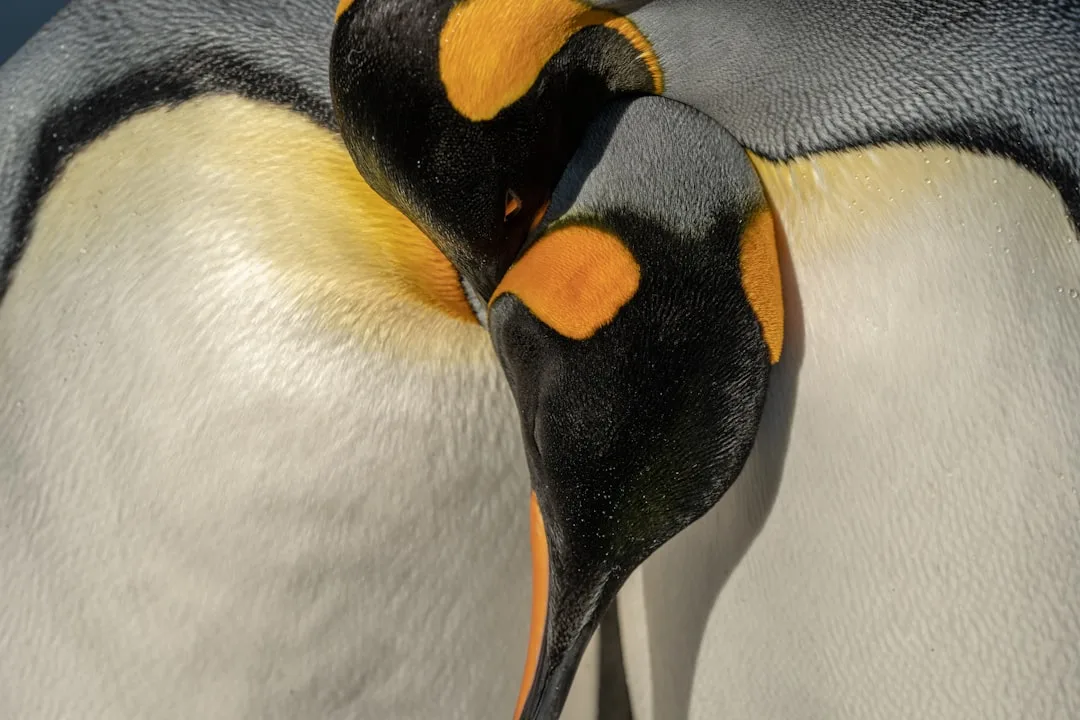
The king penguin is the second-largest living penguin, outsized only by its close relative the emperor.
Standing up to a metre tall and weighing as much as a well-fed border collie, Aptenodytes patagonicus is the iconic bird of the subantarctic: the orange-throated, silver-backed seabird of BBC documentaries, shuffling through vast brown-chick colonies on black volcanic beaches with the Southern Ocean thundering in the background.
Unlike the emperor, which breeds on continental sea ice in the dead of Antarctic winter, the king penguin breeds on the ice-free beaches of cold oceanic islands - South Georgia, Kerguelen, Crozet, Prince Edward, Macquarie - in colonies that can hold more than half a million birds at once.
This guide covers every major aspect of king penguin biology and ecology: size and physiology, plumage and colour signalling, diving and foraging, the famously strange 14-16 month breeding cycle, chick survival through the subantarctic winter, colony social structure, conservation status, and the relationship between king penguins and humans. It is a full reference entry, not a summary, so expect specifics: metres, kilograms, minutes, decibels, populations, and verified records.
Etymology and Classification
The scientific name Aptenodytes patagonicus was coined by the German naturalists Johann Reinhold Forster and Johann Friedrich Miller in the late eighteenth century. Aptenodytes comes from Greek roots meaning roughly "featherless diver," a misleading reference to the stiff, scale-like feathers of the flippers, which do not look like feathers at a glance.
Patagonicus refers to Patagonia, where the species was first described, though today the bird no longer breeds there and the main colonies sit further south on subantarctic islands.
The genus Aptenodytes contains only two living species - the king penguin and the emperor penguin (Aptenodytes forsteri) - which together form the sister lineage to all other penguins. Molecular evidence suggests the two species diverged roughly two to four million years ago, when the Southern Ocean circulation cooled and the subantarctic islands emerged as reliable ice-free breeding habitat.
Two subspecies of king penguin are recognised by most taxonomic authorities. A. p. patagonicus breeds on South Georgia and in the Falkland Islands. A. p. halli breeds on the southern Indian Ocean and southwestern Pacific islands - Crozet, Kerguelen, Prince Edward, Heard, and Macquarie. The differences are subtle: halli birds average slightly larger with minor plumage variations.
Genetic work suggests modest but real divergence between the two subspecies, and gene flow between them is limited by vast stretches of open ocean.
When early nineteenth century naturalists first encountered king penguin chicks - brown, fluffy, almost twice the volume of the sleek adult - they described them as a separate species entirely, sometimes called the "woolly penguin" (Aptenodytes woolly). It took decades of observation on breeding colonies to establish that the two forms were life stages of the same bird.
Size and Physical Description
King penguins are the second-largest living penguins, exceeded only by the emperor. They stand tall and upright, with a long, slender bill and a distinctive colour pattern that is easy to recognise even at a distance.
Adults:
- Height: 70-100 cm standing upright
- Weight: 9.3-15 kg, varying dramatically with season and breeding condition
- Bill length: 12-14 cm, long and slightly decurved
- Flipper length: roughly 30-35 cm, stiff and paddle-like
Chicks at hatching:
- Weight: 200-300 grams
- Covered in short grey-brown down that thickens rapidly
Full-grown chicks (pre-fledge):
- Weight: up to 12 kg (sometimes heavier than the returning parents)
- Dense brown down, no adult colouring yet
Sexual dimorphism is modest. Males average slightly larger and heavier than females, but the two sexes are difficult to distinguish by eye. Experienced researchers separate them by subtle differences in bill depth and call structure. Body mass fluctuates sharply within individual birds across the year: a bird returning from a long foraging trip at sea may weigh 50% more than the same bird three weeks into fasting on shore during incubation or moult.
The overall body plan is classic deep-diving penguin. The body is streamlined and torpedo-shaped, the bones are denser than those of flying birds, the musculature of the chest is enormous to power the flippers, and the feet sit well back on the body so that the bird stands upright on land. On water the posture inverts - the bird tips forward and the legs trail behind as rudders.
Plumage, Colour, and Carotenoid Signalling
The king penguin's plumage is one of the most recognisable in the animal world: silver-grey back, white belly, black head, orange auricular patches behind the eyes, and a distinctive orange-yellow flash on the lower mandible. These colours are not ornamental. They are produced by rare biochemicals and serve specific communication functions.
The orange and yellow pigments come from a class of carotenoids called spheniscins, which are found almost exclusively in penguins of the genus Aptenodytes. Carotenoids cannot be synthesised by the bird itself; they must be obtained from diet and then processed through specific enzymatic pathways. A bird that has had a good foraging season - plenty of lanternfish, efficient hunting - deposits more vivid pigment. A bird that has struggled develops duller patches.
Mate choice experiments on Crozet and South Georgia show that king penguins actively assess the brightness of potential partners' auricular patches and beak flashes. Birds with duller colour are chosen later and less often. Dye experiments that artificially dulled patches reduced reproductive success the following season. In other words, the orange patches are a reliable signal of individual quality that potential mates read in the same way humans read a CV.
Plumage density is another record-holder. King penguins carry roughly 100 feathers per square inch - the densest feather coverage of any bird species. The plumage is layered into four distinct types. Long outer contour feathers shed water. Insulating filoplumes and afterfeathers trap a stable layer of warm air against the skin. Fine downy plumules next to the skin provide baseline insulation.
Together they allow an adult to stand unmoving on a windswept beach at near-freezing temperatures for weeks while protecting an egg at body temperature.
Once a year, adults undergo a catastrophic moult: every feather is replaced over roughly three weeks, during which time the bird cannot enter the water because the replacement feathers are not yet waterproof. Moulting birds fast on land throughout this period and can lose up to half their body mass before heading back to sea.
Habitat and Distribution
King penguins are birds of the cold subantarctic, not the Antarctic continent itself. They breed on ice-free beaches and gentle coastal valleys on a ring of remote oceanic islands, each associated with a specific productive foraging zone at sea. The main breeding strongholds, in rough order of population size, are:
- South Georgia (UK Overseas Territory) - hundreds of thousands of pairs at sites including St. Andrews Bay and Salisbury Plain
- Kerguelen Islands (France) - several hundred thousand pairs
- Crozet Islands (France) - historically the largest colony in the world at Ile aux Cochons, now much reduced
- Prince Edward Islands (South Africa)
- Macquarie Island (Australia)
- Heard Island (Australia) - smaller population
- Falkland Islands (UK) - small but growing recolonisation
Colonies typically sit on flat or gently sloping ground with good drainage, within walking distance of a sheltered coastal entry to the sea. Within a colony, breeding pairs space themselves just beyond pecking distance of neighbours, producing the classic orderly pattern visible in aerial photography. Outside breeding, birds range widely at sea, with foraging trips of several hundred to more than a thousand kilometres from the colony.
The species' distribution closely tracks the position of the Antarctic Polar Front, where cold Antarctic surface waters sink beneath warmer subantarctic water. This frontal zone is biologically productive, rich in the lanternfish and squid that king penguins depend on. Shifts in the position of the front driven by climate change are a direct concern for the species.
Diving and Foraging
King penguins are among the most accomplished divers of any flying-lineage bird. Their foraging style combines long oceanic commutes with repeated deep dives at a target feeding zone.
Diving data:
| Metric | Value |
|---|---|
| Typical foraging dive depth | 100-300 m |
| Maximum recorded dive depth | 343 m |
| Typical dive duration | 4-6 minutes |
| Maximum recorded dive duration | about 9 minutes |
| Typical single-trip distance | 300-700 km from colony |
| Extreme recorded trip distance | over 1,500 km from colony |
| Cruising swim speed | 6-10 km/h |
The physiology underlying these dives is remarkable. King penguins reduce their heart rate during long dives from a surface rate around 150 beats per minute to as low as 6 beats per minute, conserving oxygen. They carry large oxygen stores in their blood and muscle, with myoglobin concentrations several times higher than those of most land birds.
Nitrogen narcosis and decompression sickness, problems for human divers, are avoided partly because penguins exhale before diving rather than holding a lung full of pressurised air.
Underwater, king penguins swim by flapping their stiff flippers in a figure-of-eight motion almost identical to the wing-stroke of an albatross in flight. The feet act as control surfaces rather than propulsion. Birds target the deep scattering layer, a dense horizontal band of mesopelagic fish and squid that rises toward the surface at night and sinks in the day.
The overwhelming dietary staple is lanternfish of the family Myctophidae - small, abundant, bioluminescent fish that rise from deep water toward the surface at night. Squid, particularly Moroteuthis and Kondakovia species, make up most of the remainder. Crustaceans and polar cod are minor seasonal supplements. A foraging adult brings back a stomach load of partly digested fish soup, which is regurgitated to the waiting chick days or weeks later when the parent finally returns to the colony.
The 14-16 Month Breeding Cycle
The king penguin's reproductive schedule is genuinely unique among birds. A single chick takes so long to raise that the cycle cannot fit inside a single calendar year. This has cascading consequences for colony behaviour, chick survival, and population dynamics.
Cycle overview:
- Courtship and pair formation: November-December (South Georgia)
- Egg laying: late November through February
- Incubation: 54-55 days, shared between parents in shifts of 6-18 days
- Chick guarded on feet of parent: about 30-40 days after hatching
- Creche phase: chick joins a crowded juvenile creche while both parents forage
- Winter fast: chicks fed rarely between April and August
- Spring feeding: parents increase feeding effort from September
- Fledging and departure at sea: November-January of the following year
- Post-breeding adult moult: January-February
- Next cycle starts: spring-summer after a short recovery
A pair that successfully raises a chick in one cycle finishes too late to re-start the full cycle the following spring. They instead either lay late and abandon, or skip a year. A simple way to summarise the consequence: a pair that successfully fledges a chick in year one cannot successfully fledge another in year two. At best they raise two chicks every three years.
Courtship is elaborate. Both sexes perform a slow upright display with the head stretched skyward, the flippers slightly raised, and a two-voice trumpet call. The call is individually distinctive and serves as a lifelong vocal signature between mates. Pair bonds are largely seasonal: most pairs re-form each cycle but do not necessarily stay together across years, with mate fidelity rates typically in the 20-30% range depending on colony.
Incubation, Chicks, and the Winter Fast
Like the emperor, the king penguin lays a single large egg and incubates it on the tops of its feet. There is no nest. The egg rests against a bare, heavily vascularised brood pouch tucked under a fold of abdominal feathers. Parents shuffle carefully across the colony without ever setting the egg down. Incubation is shared, with one parent standing fasting while the other forages at sea, switching every 6-18 days.
The chick hatches after 54-55 days, almost naked, weighing 200-300 grams. For the first 30-40 days it sits on the parent's feet in the same position the egg occupied, brooded under the abdominal fold. From about six weeks old, chicks leave the parent's feet and join a creche - a dense aggregation of thousands of juveniles packed together in the centre of the colony. The creche offers protection from predators and allows both parents to forage simultaneously.
The winter fast is the defining test of the cycle. From late autumn, sea ice expansion and low productivity at the Polar Front force parents to undertake longer and longer foraging trips. Feeding returns to the colony drop from once every few days in summer to once every several weeks in midwinter.
A chick may lose up to 70% of its peak body mass over the winter, burning fat reserves that were deliberately built up in summer to see it through. Winter mortality is very high; roughly half of chicks do not survive to spring.
Chick down is brown, thick, and insulating but not waterproof. A rainstorm can kill unattended chicks through hypothermia because water penetrates the down to the skin. Chicks in the creche huddle tightly in bad weather, using shared body heat to survive.
In spring, parents return with increasing frequency and food loads as the Polar Front becomes productive again. The chick regains body mass, moults its brown down for adult plumage, and finally leaves the colony for the sea at about 13-16 months of age, having been fed by its parents across the entirety of one subantarctic winter.
Colony Life, Communication, and Vocal Recognition
King penguin colonies are among the most densely populated breeding aggregations of any large bird. The St. Andrews Bay colony on South Georgia contains more than 150,000 breeding pairs at peak season; historically, the Ile aux Cochons colony in the Crozet archipelago exceeded half a million pairs before its collapse.
Social life inside a colony is ordered but loud. Each pair occupies a territory roughly the reach of an extended neck, spaced just beyond pecking distance of neighbours. Boundary disputes are common and resolved with flipper slaps, bill jabs, and a distinctive two-voice warning call.
The core problem of colony life is individual recognition in a sea of identical-looking birds. King penguins solve this with voice. Their calls are generated by the syrinx, a bird vocal organ that can produce two independent frequencies simultaneously. Each adult has an individually distinctive two-voice signature encoded in the harmonic structure of its call.
Chicks learn the calls of both parents within days of hatching, and parents learn the chick's call immediately after hatching. Experiments playing recorded calls back in colony conditions show that chicks correctly pick out the call of their own parent from 15 metres away through the ambient noise of 100,000 other birds.
This vocal system is under intense selection. A parent returning with a stomach full of fish after a twenty-day foraging trip has perhaps an hour to find its own chick among tens of thousands of hungry juveniles in the creche. Feeding the wrong chick would mean losing the food their own chick needs. The mistake is rare.
Conservation and Population Trends
The IUCN Red List currently classifies the king penguin as Least Concern. The global population is estimated at roughly 2.23 million breeding pairs, making the king penguin one of the more abundant large seabirds on Earth. Most of the large colonies are stable or slightly increasing, and the species has recolonised parts of its former range - notably on the Falkland Islands - after commercial exploitation ended.
Despite this reassuring headline, the picture at finer scale is mixed.
Regional trends:
| Region | Trend |
|---|---|
| South Georgia | Stable to slightly increasing |
| Kerguelen | Stable |
| Crozet (Ile aux Cochons) | Catastrophic decline (about 90% since 1980s) |
| Macquarie Island | Increasing after rat and cat eradication |
| Falkland Islands | Increasing from near-extirpation |
The Ile aux Cochons collapse is the most concerning case. Satellite imagery and field surveys documented a drop from roughly 500,000 pairs in the early 1980s to about 60,000 pairs by 2017. Multiple hypotheses have been advanced - disease, shifts in the Antarctic Polar Front driven by climate oscillations, changes in prey availability, introduced predators - but no single cause has been confirmed.
Current and emerging threats:
- Climate-driven shifts in the position of the Antarctic Polar Front, forcing longer foraging trips from some colonies
- Localised fisheries overlap, particularly for Patagonian toothfish and squid
- Oil pollution from shipping lanes that increasingly pass near colonies
- Introduced predators - rats, cats, mice - on some island groups, now removed from several key sites
- Avian influenza outbreaks, a rising concern across southern seabird populations
- Plastic ingestion and marine debris, documented in king penguin stomach samples
Conservation measures are active. Most breeding islands are protected reserves, many covered by international agreements such as the Antarctic Treaty System or the Agreement on the Conservation of Albatrosses and Petrels. Pest eradication programmes on Macquarie Island, South Georgia, and others have removed introduced predators with measurable recovery of seabird populations.
Fisheries regulations under the Commission for the Conservation of Antarctic Marine Living Resources restrict bycatch and overlap with penguin foraging zones.
The long-term outlook depends heavily on the behaviour of the Antarctic Polar Front under continued warming. Models suggest that at some colonies the front may retreat hundreds of kilometres south of its current position within decades, beyond the practical foraging range of birds based on their current breeding beaches.
King Penguins and Humans
European whalers and sealers first arrived on king penguin islands in the late eighteenth and nineteenth centuries. King penguins were harvested in enormous numbers for oil - their subcutaneous fat was rendered in boiling pots directly on colony beaches - and several colonies, particularly on Macquarie Island and the Falklands, were nearly exterminated. Industrial harvest ended in the early twentieth century with the collapse of profitability and the rise of petroleum alternatives.
Modern interaction is mostly benign. The species is a core attraction of expedition tourism to South Georgia and the other subantarctic islands, with strict landing protocols - maintained distance, biosecurity measures, limited visitor numbers - designed to prevent disturbance, trampling of vegetation, and disease introduction. Tourism revenue contributes meaningfully to conservation funding for some island groups.
Scientific study of king penguins has been central to understanding penguin physiology, diving biology, seabird communication, and the ecological effects of the Antarctic Polar Front. Long-term banded-bird studies on Kerguelen, Crozet, and South Georgia now span multiple decades and represent some of the most detailed demographic datasets for any seabird anywhere.
In culture, the king penguin sits alongside the emperor as the archetypal penguin in public imagination - the upright, dignified, orange-throated bird of wildlife documentaries, children's books, and branded mascots. Much of the footage audiences associate with "penguins" in general - the huddled mass, the chick on the feet, the orange throat glowing at sunset - is specifically king penguin footage from South Georgia rather than Antarctic emperor footage.
Related Reading
- Emperor Penguin: The Antarctic Giant
- Penguins of the World: Life in the Southern Ocean
- How Penguins Dive: Physiology of Extreme Breath-Hold
- Subantarctic Islands: The Great Seabird Strongholds
References
Relevant peer-reviewed and governmental sources consulted for this entry include IUCN Red List assessments for Aptenodytes patagonicus, BirdLife International species factsheets, the French Polar Institute long-term Crozet and Kerguelen monitoring programmes, the British Antarctic Survey South Georgia seabird datasets, the Australian Antarctic Division Macquarie Island studies, and published research in Proceedings of the Royal Society B, Marine Ecology Progress Series, Journal of Avian Biology, Polar Biology, and Antarctic Science.
Specific population figures reflect the most recent consolidated IUCN and BirdLife International estimates.
Frequently Asked Questions
How big are king penguins?
Adult king penguins (Aptenodytes patagonicus) stand 70-100 cm tall and weigh 9.3-15 kg depending on season and breeding condition. They are the second-largest living penguin species after the emperor penguin, which averages roughly 20 cm taller and 10 kg heavier. Males are slightly larger than females but the sexes look nearly identical.
Body mass fluctuates dramatically across the year: a bird returning from a long foraging trip at sea can weigh 50% more than the same bird after weeks of fasting on land during incubation or moult.
What do king penguins eat?
King penguins are specialist predators of small mesopelagic fish and squid. Their diet is dominated by lanternfish of the family Myctophidae - small, abundant, bioluminescent fish that rise from deep water toward the surface at night. Squid make up most of the remainder, with small crustaceans a minor seasonal supplement. Birds pursue prey by diving, typically to 100-300 metres, with recorded dives as deep as 343 m and as long as 9 minutes.
Parents returning to the colony regurgitate partly digested fish soup for their chick, who may receive only one meal every few days during the long subantarctic winter.
Where do king penguins live?
King penguins breed on cold subantarctic islands ringing the Southern Ocean. The largest colonies sit on South Georgia, the Crozet Islands, the Kerguelen Islands, the Prince Edward Islands, and Macquarie Island, with smaller populations on Heard Island and the Falkland Islands.
They prefer ice-free beaches and gentle coastal valleys near reliable access to productive ocean foraging zones, particularly the Antarctic Polar Front where nutrient upwelling concentrates their prey. Outside breeding they range widely at sea, sometimes travelling over a thousand kilometres from the colony on single foraging trips.
Are king penguins endangered?
The IUCN currently lists king penguins as Least Concern. The global population is estimated at roughly 2.23 million breeding pairs, and the long-term trend is stable or slightly increasing overall. However, this headline stability hides significant local instability. The massive Ile aux Cochons colony in the Crozet archipelago, once the world’s largest, has collapsed by about 90% since the 1980s for reasons that are not fully understood.
Climate shifts in the Antarctic Polar Front appear to push foraging grounds further from some colonies, increasing trip lengths and chick starvation. Oil pollution, introduced predators on some islands, and localised fisheries overlap add pressure.
How long do king penguins live?
Wild king penguins typically live 20-30 years. Recapture data from banded birds on Kerguelen and South Georgia indicate that many adults exceed 25 years and a minority reach their early thirties. Captive birds in zoos have lived beyond 35 years under veterinary care. Juvenile mortality is very high: roughly 50% of chicks die before fledging, mostly during their first subantarctic winter when food deliveries from parents become rare and weather is harsh.
Once birds reach breeding age at 3-6 years, annual adult survival is around 95%.
Why does the king penguin breeding cycle take more than a year?
A single king penguin chick takes so long to rear that the parents cannot fit the cycle inside twelve months. Incubation lasts 54-55 days, and chick rearing takes another 10-13 months, including a brutal winter fast when the chick may go weeks between meals. Add the pre-laying courtship, incubation, and post-breeding moult and the full cycle runs 14-16 months.
The practical consequence is that a pair which raises a chick successfully in one cycle starts the next cycle late in the following summer, and is forced to abandon it partway - so a given pair only raises two chicks every three years at best.
How do king penguins stay warm without a nest?
King penguins have no nest and never sit on the ground to incubate. Instead, the single egg is balanced on the tops of the parent’s feet and covered by a bare, heavily vascularised patch of skin called the brood pouch, tucked under an abdominal fold of feathers. The outer plumage does the rest.
King penguins carry roughly 100 feathers per square inch - the densest feather coverage of any bird - arranged in four layers: long contour feathers, insulating filoplumes, afterfeathers, and downy plumules. This structure traps a stable layer of warm air against the skin and sheds water on the outside, letting the bird stand on a sub-zero beach for weeks while protecting an egg at body temperature.
How do king penguin parents find their chick in a crowd of thousands?
By voice, not by sight. King penguin colonies are dense, loud, and visually chaotic, so parents and chicks identify each other using individually distinctive two-voice calls produced by the bird’s syrinx, which can generate two frequencies at once. Each chick learns its parents’ call signatures within days of hatching.
Experiments playing recorded calls show that chicks correctly identify their own parent even when the call is broadcast from fifteen metres away through the noise of a hundred thousand other birds. Parents similarly pick out their own chick’s begging call with high accuracy, which is essential because feeding the wrong chick would starve their own.