
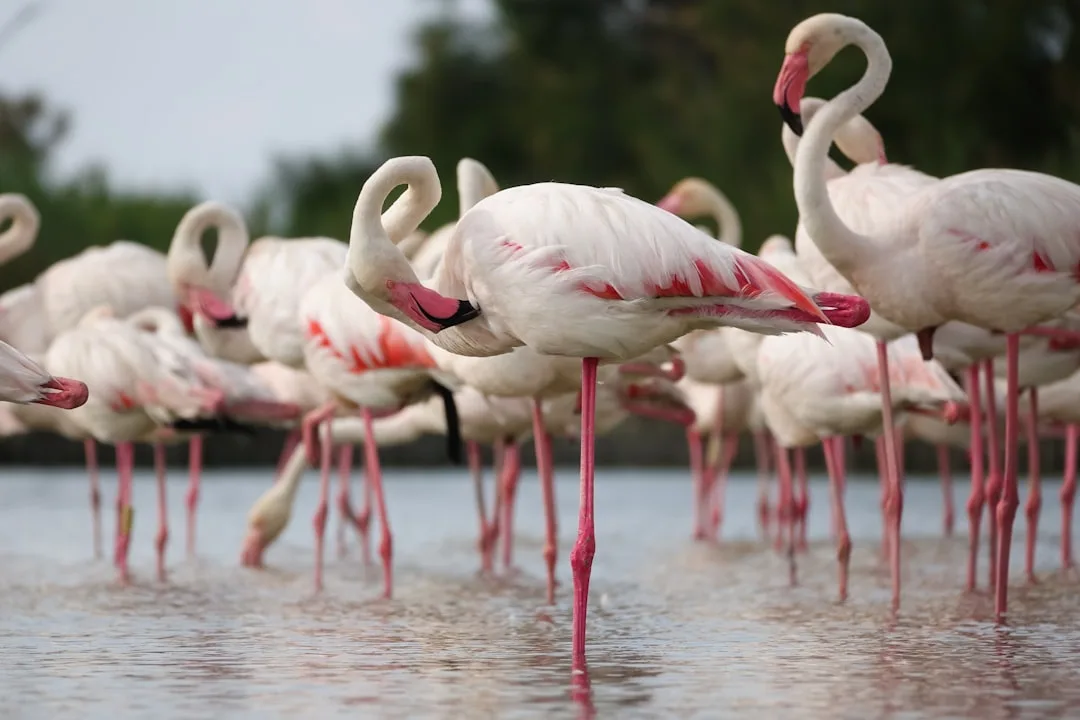
The greater flamingo is the largest and most widespread member of the flamingo family, a group of filter-feeding waterbirds whose pink plumage, inverted bills, and synchronised group dances make them unmistakable among the world's wetland fauna.
Unlike herons, egrets, or storks - all unrelated wading birds that share the same habitats - Phoenicopterus roseus belongs to its own order, Phoenicopteriformes, and represents a lineage of specialised filter-feeders whose closest living relatives are the grebes. The greater flamingo stands taller than any other flamingo species, breeds in enormous noisy colonies, and lives longer than most birds on Earth.
This guide covers every aspect of greater flamingo biology and ecology: size and anatomy, the chemistry behind their famous colour, filter-feeding mechanics, courtship and lek displays, nest construction, crop milk feeding, thermoregulation, habitat selection, population status, and the strange evolutionary features that make the species so distinctive. It is a reference entry, not a summary - so expect specifics: centimetres, kilograms, pH values, temperatures, and verified records.
Etymology and Classification
The scientific name Phoenicopterus roseus combines Greek and Latin. Phoenicopterus means "crimson-winged" or "purple-winged", from the Greek phoinix (crimson, also the mythical phoenix bird) and pteron (wing). The species epithet roseus is Latin for "rose-coloured" or "rosy". The name was formalised by Pieter Boddaert in 1783, long after Europeans had observed flamingos across the Mediterranean basin.
In various languages the bird is called flamenco (Spanish, sharing a root with the flamenco dance form), fenicottero (Italian), and flamant rose (French).
Flamingos are classified in their own bird order, Phoenicopteriformes, containing the single family Phoenicopteridae. That family holds six living species arranged in three genera:
- Phoenicopterus - the greater flamingo (P. roseus), the American flamingo (P. ruber), and the Chilean flamingo (P. chilensis)
- Phoenicoparrus - James's flamingo (P. jamesi) and the Andean flamingo (P. andinus)
- Phoeniconaias - the lesser flamingo (P. minor)
Molecular evidence places flamingos as a sister group to grebes (Podicipediformes) within a clade called Mirandornithes. That relationship was a considerable surprise when first confirmed in the 2000s because grebes are small diving birds with no obvious physical resemblance to flamingos. Both groups share feather lice genera, foot structure details, and certain anatomical traits of the pelvis that support the grouping.
Size and Physical Description
Greater flamingos are unmistakably large, long-legged, and long-necked. They rank among the tallest flying birds, rivalled only by storks and cranes within wetland habitats.
Adult measurements:
- Standing height: 1.1-1.5 metres
- Body length bill to tail: 110-150 cm
- Wingspan: 140-165 cm
- Weight: 2-4 kg (males larger than females on average)
- Leg length: up to 80-90 cm in large males
Chicks at hatching:
- Weight: 70-100 grams
- Plumage: short dense grey down
- Bill: straight, not yet hooked; pink, not yet functional for filter-feeding
Adult plumage is predominantly pale pink across the body, with vivid crimson and black flight feathers visible only when the wings are open. The neck is long, slender, and held in a sinuous S-curve or fully extended in flight. The bill is the most distinctive anatomical feature: heavy, hooked sharply downward at roughly its midpoint, and coloured pink at the base with a black tip.
When closed, a row of dark stripes runs along the bill edge, producing a zebra-like pattern. The legs are extraordinarily long, bare, and pink; the three forward toes are webbed, while a small hind toe sits high on the leg. The joint that appears halfway up the leg and bends backwards is the ankle, not the knee - the true knee is tucked against the body under the feathers.
Males and females are almost identical in plumage but males are consistently 10-20 per cent heavier and taller. Juveniles are greyish-brown for their first year, pale pink for their second, and reach full adult colouration only in their third or fourth year.
Why Flamingos Are Pink
The flamingo's pink colouration is one of the clearest examples in the animal kingdom of a trait being generated entirely by diet rather than by genetics. A flamingo chick hatches grey, and a flamingo adult deprived of carotenoid-rich food gradually fades to dirty white. The mechanism is well understood.
Brine shrimp, copepods, blue-green algae (cyanobacteria), diatoms, and certain microscopic invertebrates all contain high concentrations of carotenoid pigments. The most important for flamingos are canthaxanthin, astaxanthin, and various forms of beta-carotene. These molecules are produced by the algae and accumulated by the shrimp and copepods that graze on them.
Flamingos filter both algae and grazers in large volumes, and their liver contains enzymes that break carotenoids down and redistribute them through the bloodstream. The pigments are then deposited into growing feathers, into the skin of the face and legs, and into the bill.
Different flamingo species show different pink intensities because they eat different concentrations of carotenoids. Lesser flamingos, which feed almost exclusively on the cyanobacterium Arthrospira in east African soda lakes, are the brightest pink of all species. Chilean flamingos are pale pink with grey legs. American flamingos, which feed heavily on carotenoid-rich invertebrates in Caribbean lagoons, are the most intensely red.
In captivity the colour fades within weeks unless zoos add synthetic canthaxanthin or carotenoid-rich feed (dried shrimp, pepper meal) to the diet. The first zoos that kept flamingos in the early twentieth century routinely watched their birds turn white before the reason was understood. Modern zoo pellets are formulated specifically to maintain plumage pigment.
Carotenoid colour also functions as an honest signal of fitness. Brightly pink adults are healthier, more successful at foraging, and more attractive in courtship. During breeding the adult uses up a considerable fraction of its pigment stores producing carotenoid-loaded crop milk for chicks, and breeders often look noticeably paler than non-breeders at the same colony.
The Inverted Bill and Filter Feeding
The flamingo bill is one of the most unusual feeding structures in the bird world. It is held upside-down during feeding - the upper mandible faces the lake bed and the lower mandible faces the sky. No other bird feeds this way. The strange geometry is driven by the fact that, unlike most birds, the flamingo's upper mandible is movable and fits inside a large, rigid lower mandible, producing a mechanical system where the usual jaw relationship is reversed.
The feeding process works like this:
- The bird wades into shallow water, often up to the belly.
- The head is lowered until the top of the bill nearly touches the substrate.
- The bill opens slightly and a large, muscular, spiny tongue pumps water in and out of the mouth at up to four cycles per second.
- Water carrying food particles enters through the front of the bill.
- Rows of comb-like plates called lamellae line the inside of both mandibles. These trap food items based on size.
- The tongue expels filtered water through the back of the bill.
- Trapped food is swallowed.
Greater flamingos have relatively coarse lamellae and can filter larger prey such as brine shrimp (Artemia), small molluscs, insect larvae, and seeds. Lesser flamingos have much finer lamellae and specialise in microscopic cyanobacteria and diatoms, which is why the two species can share the same lake without directly competing.
The mechanism is comparable in principle to baleen filtration in mysticete whales: a passive filter combined with active pumping. A feeding flamingo processes roughly 20 litres of water per day through its bill, sometimes more, to extract enough food.
Standing on One Leg
The habit of standing on a single leg - often asleep, with the head tucked against the back - is the most iconic flamingo posture. Two factors explain it, and both have been confirmed experimentally.
First, thermoregulation. A flamingo's bare legs lose heat rapidly when submerged in cold or even cool water. Tucking one leg into the feathers reduces the exposed surface area by roughly half, substantially cutting heat loss. Studies of resting flamingos show that the fraction of birds standing on one leg increases as water temperature drops.
Second, muscle economy. Biomechanical work on flamingo carcasses and living birds has demonstrated a passive skeletal locking mechanism in the leg joints. When the bird shifts its weight directly over one leg, the joints lock into place and the bird remains upright with essentially zero active muscle force.
Standing on two legs, counter-intuitively, demands more continuous low-level muscular work to keep balanced. Flamingos routinely sleep for hours on one leg with fewer postural sway movements than they produce on two.
The two explanations are complementary: the one-legged stance is energetically cheaper and also thermally cheaper. The bird switches legs every few minutes to several hours to let the tucked leg rewarm before exposing the other.
Lek Courtship and Breeding Colonies
Flamingo courtship is one of the most dramatic group displays in birds. Unlike most waterbirds, which pair off privately, flamingos perform synchronised mass dances called leks, in which hundreds or thousands of birds move together through a repertoire of stereotyped postures. The sequence is highly choreographed, with several named movements:
- Head-flagging - the bird extends its neck upward and sweeps its head side to side at high speed.
- Wing salute - the wings are partially opened to expose the black and crimson flight feathers.
- Twist-preen - the bird twists its neck sharply back and rapidly mock-preens one wing.
- Marching - tightly packed groups step in unison in a single direction, often reversing direction as a mass.
- Inverted wing salute - wings held slightly below horizontal to expose the colour contrast.
Leks typically begin weeks before any actual nesting. Both sexes participate. The intensity and synchronisation of lek displays appear to accelerate hormonal readiness across the colony, effectively synchronising the entire breeding season. Flamingos are almost always monogamous within a season, and pairs form during or immediately after lekking.
Nesting follows courtship. Each pair constructs a cone-shaped nest of mud, small stones, and plant debris, built up over several weeks by scooping material with the bill. A complete nest is roughly 30 centimetres tall with a shallow depression on top. Rising the egg above ground protects it from flooding, overheated substrate, and ground predators. Greater flamingo colonies may contain thousands of nests packed closely together, and the density deters predators by sheer numbers and noise.
The female lays one egg per year. Replacement eggs are rare. Both parents incubate in shifts of several hours for 27-31 days. The egg is elongated and chalky white, roughly 90 grams in weight.
Chicks, Crop Milk, and Cresches
A newly hatched flamingo chick is greyish-white, covered in dense down, and has a small, straight, pink bill. Its legs are pink and relatively thick. It leaves the nest within days but returns to be fed.
Both parents produce a specialised secretion called crop milk, also known as flamingo milk or oesophageal milk. Pigeons, doves, and emperor penguins are the only other birds known to produce comparable substances. Flamingo crop milk is produced in the upper digestive tract and regurgitated to the chick.
It is extraordinarily rich - roughly 8-15 per cent fat and 9-12 per cent protein - and loaded with carotenoid pigments, which give it a vivid red or pink colour. Producing crop milk drains the parent's pigment reserves, which is why breeding adults often fade noticeably during the nursing period.
Chicks consume crop milk exclusively for their first month and gradually begin filter-feeding on their own around the seventh to twelfth week. Until then their bills are too straight and their lamellae too undeveloped to filter prey efficiently.
At two to three weeks old, chicks leave the nest and gather in a huge mixed-age group called a creche. Creches can contain tens of thousands of chicks at the largest colonies. A small number of adult attendants guard the creche while the remaining parents forage, sometimes flying dozens of kilometres from the breeding site. Parents locate their own chick by voice, returning specifically to feed it even within a dense creche of identical-looking birds.
Habitat, Range, and Distribution
Greater flamingos specialise in shallow, saline, alkaline, or hypersaline waters where few other vertebrates can thrive. Typical habitats include:
- Soda lakes with pH values up to 10.5 and dissolved carbonates that are corrosive to most vertebrate skin
- Salt pans and solar salt works, including managed industrial salt production sites
- Brackish lagoons and estuaries with tidal salt influx
- Alkaline inland lakes fed by volcanic or evaporite mineral springs
The global range covers parts of Africa, the Mediterranean basin, the Middle East, and the Indian subcontinent.
Key breeding and wintering sites:
| Region | Key sites | Notes |
|---|---|---|
| Western Europe | Camargue (France), Fuente de Piedra (Spain) | Major breeding colonies |
| Mediterranean | Lake Tuz (Turkey), coastal Tunisia, Sardinia | Breeding and wintering |
| East Africa | Lake Natron, Lake Bogoria, Lake Nakuru | Shared with lesser flamingos |
| Southern Africa | Etosha Pan (Namibia), Sua Pan (Botswana) | Irregular breeding after heavy rains |
| Middle East | Lake Urmia (Iran), Gulf coastlines | Important wintering areas |
| South Asia | Rann of Kutch (India), coastal Pakistan | Largest Asian breeding site |
Populations are partly migratory, partly nomadic. Birds follow water availability rather than fixed calendar routes - a lake that is excellent for breeding in one year may be dry the next. Individual flamingos ringed in the Camargue have been recovered across the western Mediterranean, in Tunisia, Mauritania, and Senegal.
Physical and Chemical Tolerance
Flamingo habitats often look hostile to life. Lake Natron in Tanzania, for example, is fed by geothermal springs and can reach surface temperatures of 60 degrees Celsius and a pH approaching 10.5 - caustic enough to strip flesh from carcasses. The salinity of some lagoons exceeds 300 grams per litre, nearly ten times seawater. Greater flamingos tolerate these conditions through a combination of adaptations:
- Tough leg skin resistant to salt, alkali, and heat
- Salt glands near the eyes that excrete excess sodium and chloride through the nostrils
- Keratinised bill surfaces that resist chemical erosion
- Heat-shedding legs that act as radiators, dumping body heat into water cooler than the air
These tolerances explain why flamingos dominate habitats almost empty of competitors. A soda lake that would kill most wading birds may host hundreds of thousands of flamingos in direct ecological peace.
Lifespan, Mortality, and Survival
Greater flamingos live longer than nearly any other bird of comparable size. Wild individuals typically reach 30 to 40 years. Several captive birds have lived more than 60 years, and one individual named Greater at Adelaide Zoo in Australia was estimated to have reached 83 years before being euthanised in 2014 due to old-age complications.
Age-related survival data:
| Life stage | Typical mortality |
|---|---|
| Egg to hatching | 10-20% loss at well-protected colonies |
| Hatchling to fledging (~2.5 months) | 20-40% loss |
| Fledgling to first year | ~50% annual mortality |
| Adult (age 4+) | ~4-7% annual mortality |
Major causes of chick mortality include starvation during colony abandonment, trampling, and predation by eagles, jackals, hyenas, and feral dogs at specific colonies. Adult predation is rare at established colonies but includes opportunistic strikes by large raptors and, historically, by big cats at drinking sites.
Conservation Status
The IUCN classifies the greater flamingo as Least Concern with a stable to slightly increasing global population of roughly 550,000 to 680,000 birds. Populations have actually expanded in several parts of Europe over the past four decades, partly due to habitat protection at key Ramsar sites such as the Camargue and Fuente de Piedra. Not all flamingo species fare as well.
The Andean flamingo (Phoenicoparrus andinus) is listed as Vulnerable, and both James's flamingo and the Chilean flamingo are Near Threatened.
Primary threats across the family:
- Habitat loss. Lake drainage, water abstraction for agriculture, and the expansion of solar salt works reduce or destroy shallow breeding habitats. Lake Urmia in Iran has shrunk dramatically in recent decades, with serious implications for the greater flamingos that depend on it.
- Lead poisoning. Spent lead shot from waterfowl hunting accumulates in shallow lake sediments. Flamingos ingest shot while filter-feeding and suffer neurological damage.
- Disturbance. Colonies are extremely sensitive to disturbance. A single aerial over-flight or boat approach during egg-laying can trigger mass nest abandonment.
- Climate change. Shifts in rainfall patterns change lake levels unpredictably. The future of Lake Natron, where the great majority of lesser flamingos breed, is especially uncertain under projected east African rainfall changes.
- Industrial development. Proposed soda-ash extraction at Lake Natron has been repeatedly challenged by conservation organisations for this reason.
- Illegal egg and adult harvesting. Still occurs at some poorly protected colonies in Africa and Asia.
James's flamingo deserves particular attention. The species was considered extinct from the mid-1920s until 1956, when a small surviving population was rediscovered at Laguna Colorada, high in the Bolivian Andes. It is now known from a handful of saline lakes above 3,500 metres elevation across Bolivia, Chile, Peru, and Argentina. The rediscovery is one of the classic twentieth-century "Lazarus species" cases.
Flamingos and Humans
Flamingos have appeared in human culture for millennia. Ancient Egyptian hieroglyphics used a flamingo pictograph to mean "red", and flamingo tongue was a notorious luxury dish in Imperial Roman banquets. The colour name "flamingo pink" and the Spanish flamenco dance form share the same etymological root, both drawing on the bird's vivid movement and colour.
Modern relationships with humans are mixed. In most range states the species is legally protected and generates meaningful ecotourism income at accessible colonies such as the Camargue in France, Lake Nakuru in Kenya, and Rann of Kutch in India. At the same time, flamingos remain vulnerable to low-frequency disturbance from infrastructure, agriculture, and mining.
The iconic status of the birds has in some cases been decisive in protecting whole wetland ecosystems that would otherwise have been developed.
The plastic pink lawn flamingo, invented in 1957 by sculptor Don Featherstone in Leominster, Massachusetts, has become one of the most recognised kitsch objects of the twentieth century. It is a testament to the bird's cultural impact that a species confined to salt lakes of Africa, southern Europe, and Asia should appear on lawns in suburbs across the world.
Related Reading
- Why Flamingos Are Pink
- Waterbirds: Flamingos, Herons, and the Masters of Wetlands
- Great Blue Heron: Statuesque Hunter of the Shallows
- Mute Swan: Grace, Power, and Territorial Aggression
References
Relevant peer-reviewed and governmental sources consulted for this entry include IUCN Red List assessments for Phoenicopterus roseus and related species, the BirdLife International State of the World's Birds reports, Ramsar Convention site descriptions for the Camargue, Fuente de Piedra, and Lake Natron, and published research in The Auk, Ibis, Waterbirds, and Journal of Avian Biology.
Specific population figures and trend data reflect the most recent consolidated estimates from the Flamingo Specialist Group of the IUCN Species Survival Commission.
Frequently Asked Questions
Why are flamingos pink?
Flamingos (Phoenicopterus roseus) are pink because of carotenoid pigments they extract from their food. Brine shrimp, blue-green algae, and diatoms all contain red and orange carotenoids such as canthaxanthin and beta-carotene. Enzymes in the flamingo’s liver break these pigments down and deposit them in the feathers, skin, and bill as the bird moults.
A flamingo fed a carotenoid-free diet in captivity gradually turns white, which is why zoos add supplements or shrimp-rich feed. The depth of pink varies with species, diet richness, age, and breeding condition - brightly coloured birds are generally healthier and more successful at attracting mates.
How do flamingos filter-feed?
Flamingos are the only birds that feed with their bills held upside-down. The bird lowers its head into shallow water, inverts the bill so the upper mandible faces the lake bed, and pumps water through the mouth using its large fleshy tongue. Rows of comb-like plates called lamellae line the inside of both mandibles, trapping brine shrimp, copepods, insect larvae, blue-green algae, diatoms, and tiny molluscs while water is expelled.
The mechanism is mechanically similar to baleen filtration in whales. Greater flamingos filter larger items and forage in slightly deeper water than lesser flamingos, which feed almost exclusively on microscopic cyanobacteria.
Why do flamingos stand on one leg?
Flamingos stand on one leg for two main reasons. First, thermoregulation: the bare legs lose considerable heat when submerged in cold, saline water, so tucking one leg against the body reduces that loss. Second, muscle efficiency: biomechanical studies show that a flamingo uses essentially no active muscle force to maintain a one-legged stance because a passive skeletal locking mechanism holds the leg in place.
Standing on two legs actually requires more continuous muscular work. Flamingos even sleep on one leg. They switch legs periodically to let the tucked leg rewarm before swapping again.
Where do flamingos live?
Greater flamingos inhabit salt lakes, alkaline lagoons, estuaries, coastal mudflats, and soda lakes across Africa, southern Europe, the Middle East, and the Indian subcontinent. Key breeding sites include the Camargue in southern France, the Fuente de Piedra lagoon in Spain, Lake Tuz in Turkey, Lake Urmia in Iran, the Rann of Kutch in India, and multiple alkaline lakes in east and southern Africa.
Flamingos tolerate water too salty, alkaline, or toxic for most other vertebrates - some sites exceed a pH of 10.5 and temperatures above 60 degrees Celsius. That tolerance is why flamingo colonies often dominate habitats with almost no competition from other wading birds.
How long do flamingos live?
Wild greater flamingos typically live 30 to 40 years, which is exceptionally long for a bird of their size. Captive individuals routinely exceed 50 years, and one bird named Greater at Adelaide Zoo reached an estimated 83 years before dying in 2014. Longevity is supported by a slow reproductive rate - a single egg per year, with many adults skipping breeding seasons altogether - and low predation pressure once the bird reaches adult size.
Cygnet-stage mortality is much higher, with predation and starvation removing a significant fraction of chicks before fledging.
How many species of flamingo are there?
There are six recognised flamingo species across three genera. The genus Phoenicopterus contains the greater flamingo (P. roseus), the American flamingo (P. ruber), and the Chilean flamingo (P. chilensis). The genus Phoenicoparrus contains James’s flamingo (P. jamesi) and the Andean flamingo (P. andinus), both high-altitude Andean specialists.
The genus Phoeniconaias contains the single lesser flamingo (P. minor), which despite its name forms the largest flamingo populations on Earth in the African Rift Valley. Greater and lesser flamingos overlap across much of Africa; the three Phoenicopterus species collectively span the Americas, Europe, Africa, and Asia.
What is crop milk and why is flamingo milk red?
Crop milk is a protein- and fat-rich secretion produced in the upper digestive tract of certain birds, used to feed chicks. Pigeons, doves, some penguins, and flamingos all produce it. Flamingo crop milk is unusual for two reasons. First, both parents produce it, not just the female. Second, it is deeply red or pink because it carries concentrated carotenoid pigments - the same compounds that colour adult feathers.
Chicks drink crop milk for roughly the first two months of life, during which time they grow rapidly while their bills slowly develop the lamellae needed to filter-feed independently. Producing crop milk drains the parent’s own pigment reserves, which is why breeding adults often look paler than non-breeders.
Are flamingos endangered?
The greater flamingo is listed as Least Concern on the IUCN Red List, with a stable or slightly increasing global population of roughly 550,000 to 680,000 birds. However, other flamingo species face greater pressure. The Andean flamingo is classified as Vulnerable, James’s flamingo as Near Threatened, and the Chilean flamingo as Near Threatened.
Key threats across the family include habitat loss from lake drainage and salt extraction, water abstraction that reduces lake levels, lead poisoning from spent hunting shot, disturbance at breeding colonies, and illegal egg collection. Climate change is altering rainfall patterns at critical lakes such as Lake Natron and Lake Urmia, with unclear long-term consequences for the species that depend on them.