
Why are flamingos pink?
Flamingos are pink because of carotenoid pigments found in their primary food sources - brine shrimp and blue-green algae. These carotenoids, particularly canthaxanthin and astaxanthin, are metabolized in the flamingo's liver and deposited into growing feathers, skin, and bill tissue. A flamingo deprived of carotenoid-rich food will gradually fade to white.
They stand in shallows where land dissolves into water, where mud becomes food and patience becomes a hunting strategy. They filter toxic lakes, spear fish with surgical precision, and perform dances so elaborate that human choreographers study them for inspiration.
Waterbirds - the flamingos, herons, pelicans, storks, cranes, ibises, spoonbills, and kingfishers of the world - are the masters of Earth's wetlands, and the wetlands they inhabit are among the most productive and most threatened ecosystems on the planet.
The term "waterbird" is not a strict taxonomic classification but rather an ecological grouping that encompasses any bird species substantially dependent on aquatic habitats. This includes species from multiple orders: Phoenicopteriformes (flamingos), Pelecaniformes (pelicans, herons, ibises), Ciconiiformes (storks), Gruiformes (cranes), and Coraciiformes (kingfishers), among others.
Collectively, waterbirds comprise over 900 species distributed across every continent, from the tropical mangroves of Southeast Asia to the sub-Antarctic shores of South Georgia Island.
What unites these birds is not ancestry but adaptation. Each lineage has independently evolved solutions to the fundamental challenges of aquatic life: how to find food in murky water, how to stand in shifting substrate, how to waterproof feathers that are constantly submerged, and how to breed in habitats that flood, dry, and flood again on seasonal cycles.
The result is a convergence of form and function that makes waterbird communities among the most visually striking and ecologically important assemblages in the avian world.
Waterbird Diversity: A Convergence of Wetland Specialists
The diversity of waterbirds reflects the diversity of wetlands themselves. Freshwater marshes, saltwater estuaries, alkaline lakes, mangrove forests, peat bogs, river deltas, and temporary rain pools all support distinct waterbird communities adapted to their specific conditions.
Globally, the Ramsar Convention on Wetlands recognizes over 2,400 Wetlands of International Importance, many designated specifically for their waterbird populations. The East Asian-Australasian Flyway alone supports over 50 million migratory waterbirds annually, connecting breeding grounds in Siberia and Alaska to wintering habitats in Australia and New Zealand [1].
These migration corridors are lifelines, and the loss of a single critical stopover site can cascade into population collapses spanning entire hemispheres.
| Waterbird Group | Approximate Species Count | Key Feeding Strategy | Notable Feature |
|---|---|---|---|
| Flamingos | 6 | Filter feeding | Carotenoid-derived pink coloration |
| Herons and Egrets | 72 | Ambush spearing | Lightning-fast neck strike |
| Pelicans | 8 | Pouch-netting / plunge diving | Expandable gular pouch (3 gallons) |
| Storks | 19 | Visual foraging in shallows | Thermal-soaring migration |
| Cranes | 15 | Omnivorous probing | Elaborate courtship dances |
| Ibises | 36 | Tactile probing in mud | Curved, sensitive bill tip |
| Spoonbills | 6 | Lateral bill-sweeping | Spatulate bill shape |
| Kingfishers | 114 | Plunge diving from perch | Biomimetic beak design |
Flamingos: Pink Architects of Alkaline Lakes
Flamingos are among the most recognizable birds on Earth, yet their biology is far stranger than their appearance suggests. The six species of flamingos (family Phoenicopteridae) are extremophiles - specialists of some of the most hostile aquatic environments on the planet, including hypersaline lagoons, caustic soda lakes, and high-altitude volcanic pools where few other vertebrates survive.
The Chemistry of Pink
The flamingo's iconic pink-to-crimson coloration is not genetic. It is dietary. Flamingos are born with grey-white down and develop their color only through the accumulation of carotenoid pigments - specifically canthaxanthin and astaxanthin - found in the brine shrimp (Artemia), blue-green algae (Spirulina), and other microorganisms they consume. These carotenoids are metabolized in the liver, converted into pigment molecules, and deposited into growing feathers, leg skin, and bill tissue.
The intensity of coloration is directly correlated with diet quality and health. A well-fed Caribbean flamingo (Phoenicopterus ruber) displays deep scarlet plumage, while a malnourished individual fades toward pale pink or white.
In captive populations, flamingos historically lost their color until zookeepers began supplementing their diets with synthetic canthaxanthin or carotenoid-rich foods like paprika and carrot oil. Color also plays a role in mate selection: studies at the Camargue research station in France have demonstrated that more intensely colored flamingos pair earlier in the breeding season and produce more offspring [2].
Upside-Down Filter Feeding
Flamingos feed with their heads inverted - a posture unique among birds. The upper bill, which sits on the bottom when the head is flipped, is shallow and trough-like. The lower bill (on top during feeding) acts as a piston, pumping water and mud through rows of hair-like structures called lamellae that line both mandibles.
These lamellae function as a sieve, trapping brine shrimp, algae, insect larvae, and small mollusks while expelling water and sediment. A flamingo can filter approximately 20 liters of water per hour.
This feeding mechanism is remarkably similar to baleen whale filtration - a striking example of convergent evolution between two wildly different lineages solving the same problem of extracting small organisms from large volumes of water.
Altitude Extremes: Andean Flamingos at 4,500 Meters
The Andean flamingo (Phoenicoparrus andinus) holds the altitude record for flamingos, breeding on salt lakes in the Andes at elevations exceeding 4,500 meters (14,800 feet) - higher than many base camps on Himalayan climbing routes. At these altitudes, temperatures plummet below freezing at night, ultraviolet radiation is intense, and oxygen levels are roughly 40 percent lower than at sea level.
The Andean flamingo has evolved a larger heart and greater blood oxygen-carrying capacity to cope with these conditions.
With fewer than 34,000 individuals remaining, the Andean flamingo is classified as Vulnerable by the IUCN. Lithium mining operations expanding across the Atacama and Bolivian salt flats threaten the saline lake ecosystems these birds depend on, creating a direct conflict between electric vehicle battery supply chains and flamingo conservation.
A group of flamingos is known as a flamboyance - a name that, for once, perfectly captures the subject. Flamboyances can number in the hundreds of thousands: Lake Nakuru in Kenya has historically supported congregations of over 1.5 million lesser flamingos, creating a spectacle visible from orbit.
Great Blue Herons: The Patient Assassins
The great blue heron (Ardea herodias) is the largest heron in North America, standing up to 4.5 feet (1.4 meters) tall with a wingspan approaching 6.5 feet. It is a study in controlled violence - a bird that can remain motionless for 20 minutes, barely distinguishable from a dead branch, and then strike with a speed that few fish can escape.
The Lightning Strike
The heron's signature hunting technique is the ambush. Standing in shallow water or on a bank, the heron coils its long, S-curved neck into a compressed spring and waits. When a fish, frog, crayfish, or even a small rodent enters the strike zone, the heron fires its head forward with devastating speed.
The strike takes approximately 0.06 seconds - faster than the average fish escape reflex, which requires roughly 0.08 seconds. The heron's dagger-like bill either spears the prey directly or clamps it between the mandibles.
"The heron is not merely patient. It is calculating. Every angle of the neck, every placement of the foot, is a mathematical optimization of strike probability against energy expenditure. It is the sniper of the bird world." - Dr. James Kushlan, ornithologist and author of Heron Conservation (2000)
Great blue herons are not limited to passive ambush. They also employ active hunting techniques including foot-stirring (vibrating one foot to flush hidden prey), canopy feeding (spreading wings to create shade that attracts fish), and baiting - deliberately dropping insects, feathers, or even bread crusts onto the water surface to lure fish within striking range.
The baiting behavior is particularly notable as it represents one of the few confirmed examples of tool use in non-corvid, non-parrot birds.
Pelicans: Engineering the Expandable Pouch
The eight species of pelicans (family Pelecanidae) are among the largest flying birds, with the Dalmatian pelican reaching a wingspan of 11.5 feet (3.5 meters). But the pelican's defining feature is not its size. It is the gular pouch - an expandable skin membrane attached to the lower mandible that can hold approximately 3 gallons (11.4 liters) of water, roughly three times the volume of the pelican's stomach.
The pouch functions as a dip net. When a brown pelican (Pelecanus occidentalis) plunge-dives from heights of 60 to 70 feet, it hits the water bill-first, and the impact forces the pouch open to engulf fish and surrounding water. The pelican then surfaces, contracts the pouch to drain the water (which can weigh up to 24 pounds), and tips its head back to swallow the catch.
Gulls frequently perch on a surfacing pelican's head, attempting to steal fish directly from the draining pouch - a behavior so common it has become iconic in coastal wildlife photography.
Cooperative Fishing
American white pelicans (Pelecanus erythrorhynchos) do not dive. Instead, they practice cooperative fishing - a coordinated group behavior in which a line of pelicans swims in a horseshoe formation, herding fish into shallow water where they can be scooped up simultaneously.
Groups of 10 to 20 pelicans synchronize their movements with remarkable precision, and studies have shown that cooperative fishing yields significantly more prey per individual than solitary foraging [3]. This behavior is learned rather than instinctive, and young pelicans improve their coordination over successive breeding seasons.
Storks: Migration on Thermal Highways
The 19 species of storks (family Ciconiidae) are large, long-legged wading birds found on every continent except Antarctica. They are visual predators of shallow-water prey - frogs, fish, insects, crabs, and small mammals - and several species have become deeply embedded in human culture.
Soaring on Thermals
Storks are among the most efficient soaring birds alive. Unlike songbirds, which power their migration through continuous flapping, storks exploit thermal columns - rising currents of warm air generated by differential heating of the ground.
A white stork (Ciconia ciconia) can climb to altitudes exceeding 4,500 meters by circling within a thermal, then glide 50 to 100 kilometers to the next thermal with minimal energy expenditure. This soaring-gliding strategy reduces the metabolic cost of migration by over 90 percent compared to powered flight.
Because thermals form only over land (water surfaces heat too uniformly), storks cannot cross large bodies of open water. Their migration routes are therefore funneled through narrow land bridges. The Strait of Gibraltar and the Bosphorus in Istanbul each channel hundreds of thousands of migrating storks annually, creating one of the great wildlife spectacles of the Western Palearctic.
The White Stork and European Tradition
The white stork has been associated with human settlements for millennia. In European folklore, storks bring babies, herald spring, and bring good luck to the households on whose rooftops they nest.
This association is not arbitrary - white storks genuinely prefer to nest on human structures (chimneys, church steeples, utility poles), and their return from African wintering grounds reliably coincides with the onset of spring.
In the Netherlands, Germany, and Poland, artificial nesting platforms are erected on rooftops specifically to attract breeding storks, and the presence of a stork nest on a home is still considered a mark of good fortune.
Cranes: Dancing, Devotion, and a Conservation Miracle
The 15 species of cranes (family Gruidae) are the tallest flying birds on Earth. The sarus crane of South Asia stands up to 5.9 feet (1.8 meters) tall. But cranes are best known not for their stature but for their extraordinary courtship dances and their role in one of the most dramatic conservation recoveries in wildlife history.
The Dance
Crane courtship dances are among the most elaborate behavioral displays in the animal kingdom. Dancing involves synchronized bowing, leaping, wing-spreading, head-pumping, and tossing of grass or sticks - performances that can last for hours and involve both members of a mated pair as well as unmated individuals.
The dances serve multiple functions: pair bonding, mate assessment, territorial display, and stress reduction. Cranes are monogamous and typically mate for life, with pair bonds reinforced by frequent synchronized calling - a resonant, trumpeting duet audible from over a mile away.
Japanese red-crowned cranes have inspired art, poetry, and dance in Japanese culture for over a thousand years. The crane dance is considered a symbol of fidelity, longevity, and grace, and it has directly influenced Japanese traditional dance forms.
The Whooping Crane: From 21 to 800
The whooping crane (Grus americana) is the tallest bird in North America, standing 5 feet tall with a wingspan of 7.5 feet. It is also the bird that came closer to total extinction than almost any species that subsequently recovered.
By 1941, the entire world population of whooping cranes had been reduced to 21 individuals - 15 in the wild migratory flock and 6 in a small captive group. Habitat destruction, unregulated hunting, and egg collection had reduced a species that once numbered in the thousands to a population so small that a single hurricane could have ended it permanently.
The recovery effort that followed is one of the most intensive and prolonged in conservation history. The U.S. Fish and Wildlife Service and the Canadian Wildlife Service implemented a captive breeding program at the Patuxent Wildlife Research Center in Maryland. Eggs were collected from wild nests (whooping cranes typically lay two eggs but rarely raise more than one chick) and artificially incubated.
Cross-fostering experiments were attempted using sandhill cranes as surrogate parents. Ultralight aircraft were employed to teach captive-raised cranes a migration route from Wisconsin to Florida - a technique that captured worldwide media attention.
"The whooping crane teaches us that 21 is not zero. Twenty-one can become 800 if the commitment is sustained across decades and the science is allowed to lead." - Dr. George Archibald, co-founder of the International Crane Foundation (2018)
As of 2024, the whooping crane population has grown to over 800 individuals, including approximately 530 in the wild Aransas-Wood Buffalo flock that migrates between northern Alberta, Canada, and the Texas Gulf Coast [4].
The population is still classified as Endangered, and threats from powerline collisions, habitat loss in the Platte River corridor, and climate-driven changes to breeding habitat in Wood Buffalo National Park remain active concerns. But the trajectory is upward, and the whooping crane stands as proof that even the most critically endangered species can recover when sustained effort is applied.
Ibises: Sacred Birds and Modern Colonizers
The 36 species of ibises (subfamily Threskiornithinae) are distinguished by their long, downcurved bills, which they use to probe soft mud and shallow water for invertebrates, crustaceans, and small fish. Unlike herons, which hunt by sight, ibises hunt primarily by touch - sweeping the sensitive tip of the bill through substrate and snapping it shut on any prey item detected by tactile receptors.
The Sacred Ibis in Egyptian Mythology
The African sacred ibis (Threskiornis aethiopicus) was revered in ancient Egypt as a living manifestation of Thoth, the god of wisdom, writing, and knowledge. Millions of ibises were mummified as votive offerings, and archaeological excavations at Saqqara have uncovered ibis catacombs containing an estimated 1.5 million mummified ibises. The bird's curved bill was associated with the crescent moon, and Thoth was often depicted with an ibis head in temple inscriptions and papyrus texts.
Ironically, the sacred ibis is now extinct in Egypt, having disappeared from the Nile region by the mid-19th century, likely due to habitat conversion and drainage of wetlands for agriculture. It remains widespread across sub-Saharan Africa.
Glossy Ibis: A Range Expansion Story
The glossy ibis (Plegadis falcinellus) is one of the most widely distributed waterbird species on Earth and is currently expanding its range across multiple continents. Originally native to southern Europe, Africa, and Asia, the glossy ibis colonized the Americas in the 19th century and has been expanding northward through the United States at a remarkable pace.
It now breeds as far north as Maine and southern Ontario, having been virtually unknown in North America before the 1800s. This range expansion appears to be driven by a combination of wetland creation (including agricultural rice paddies and stormwater retention ponds) and warming temperatures extending the suitable breeding season northward.
Spoonbills: Feeding by Feel
The six species of spoonbills (genus Platalea) are close relatives of the ibises but have evolved a radically different bill shape - a long, flattened, spatula-shaped structure that they sweep side to side through shallow water in a distinctive motion.
This lateral sweeping technique is entirely tactile: the bill is held slightly open and swept rhythmically through the water column, and when nerve-rich receptors along the bill margins detect a fish, shrimp, or insect, the bill snaps shut reflexively in under 30 milliseconds.
The roseate spoonbill (Platalea ajaja) of the Americas gets its vivid pink plumage from the same carotenoid mechanism as flamingos - a dietary source of astaxanthin and canthaxanthin from crustaceans. Like flamingos, a spoonbill deprived of carotenoid-rich food will fade to white.
The roseate spoonbill was hunted nearly to extinction in the late 19th century for the millinery trade - its feathers were prized for decorating women's hats - but populations have recovered following legal protections.
Kingfishers: Nature's Blueprint for the Bullet Train
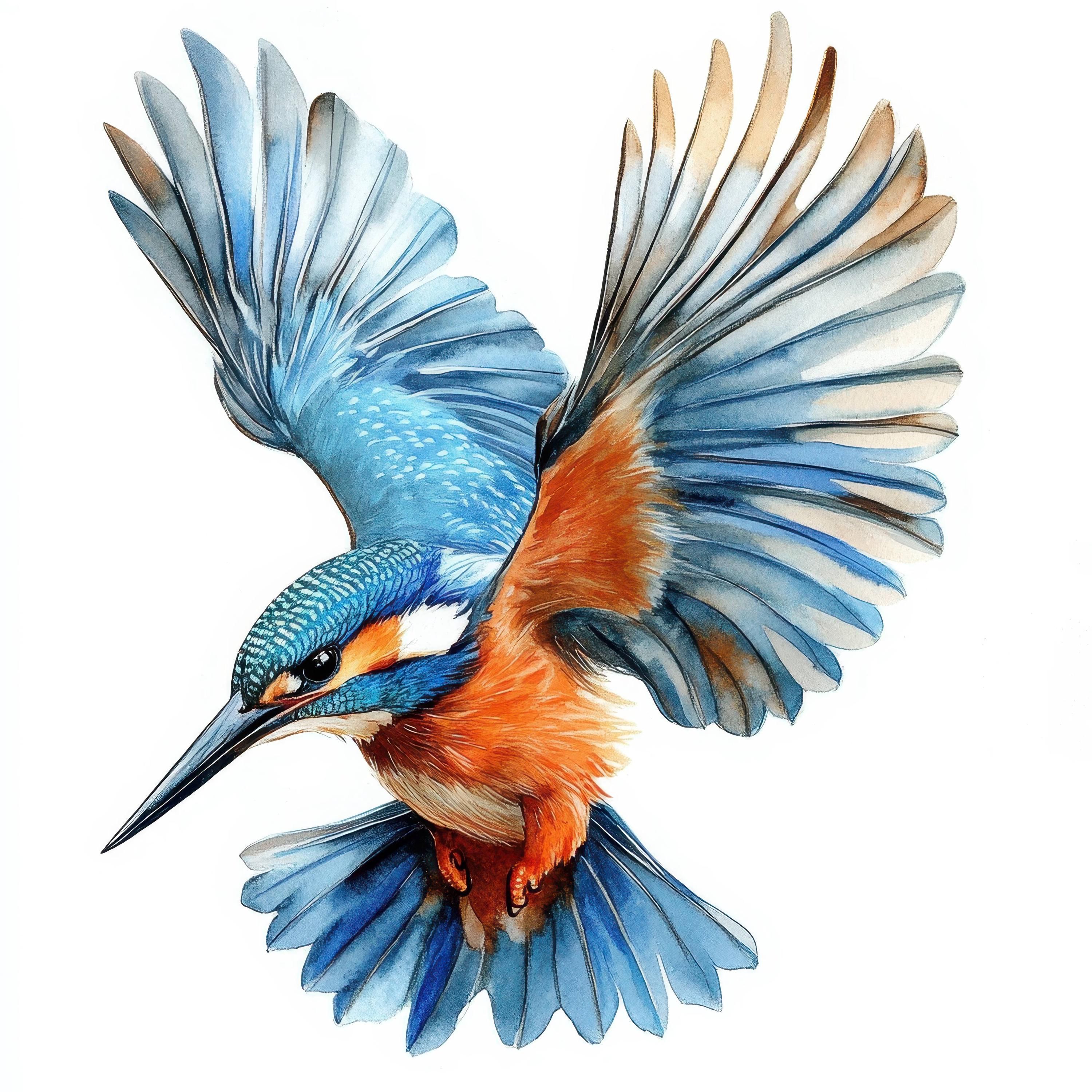
The 114 species of kingfishers (families Alcedinidae, Halcyonidae, and Cerylidae) are compact, powerfully built birds with oversized heads and dagger-like bills adapted for plunge-diving. The common kingfisher (Alcedo atthis) of Europe and Asia is a jewel of river ecosystems - an iridescent flash of blue and orange that strikes the water from overhanging perches with pinpoint accuracy.
But the kingfisher's greatest contribution to human civilization may not be ecological. It is engineering.
The Shinkansen Problem
In the 1990s, Japan's bullet train network faced a persistent noise problem. When the Shinkansen trains exited tunnels at speeds exceeding 300 km/h, they generated a phenomenon called tunnel boom - a thunderous pressure wave caused by air compressed ahead of the train's blunt nose suddenly expanding at the tunnel exit. The booms disturbed residential neighborhoods near tunnel portings and violated noise regulations.
Engineer Eiji Nakatsu, a birdwatcher and member of the Wild Bird Society of Japan, recognized that the kingfisher solves an analogous problem every time it dives. A kingfisher transitions from air (a low-density medium) to water (a high-density medium) at high speed with almost no splash - the avian equivalent of moving from a tunnel into open air without a pressure wave.
The secret is the kingfisher's bill: a long, tapered, wedge-shaped structure that gradually displaces the medium rather than hitting it as a blunt surface.
Nakatsu redesigned the front profile of the 500 Series Shinkansen to mimic the kingfisher's bill geometry. The resulting train was not only quieter but also 10 percent faster and consumed 15 percent less electricity than its predecessor [5]. This is one of the most celebrated examples of biomimicry - engineering solutions derived from biological designs refined by millions of years of natural selection.
The Wetland Crisis: Losing the Habitat That Sustains Them
Waterbirds are only as resilient as the wetlands they depend on, and wetlands are disappearing at an alarming rate. According to the Ramsar Convention's Global Wetland Outlook, the world has lost approximately 64 percent of its wetlands since 1900, with losses accelerating in the 21st century in tropical and subtropical regions due to agricultural conversion, urban development, and dam construction [6].
The consequences for waterbird populations are direct and measurable. The Waterbird Population Estimates report, compiled by Wetlands International, tracks population trends for over 800 waterbird populations globally. Of those, 38 percent are declining, while only 16 percent are increasing. Species dependent on intertidal mudflats - such as the spoon-billed sandpiper, with fewer than 500 individuals remaining - are among the most critically affected.
Wetland loss is not merely a waterbird problem. Wetlands provide ecosystem services valued at an estimated $47 trillion annually - including water purification, flood control, carbon sequestration, and fisheries support. Mangrove forests alone protect coastlines from storm surges with an effectiveness equivalent to engineered seawalls at a fraction of the cost.
When wetlands are drained, these services are lost, and the economic costs of replacement infrastructure frequently exceed the value of whatever development replaced the wetland.
Key Threats to Waterbirds
- Habitat loss: Drainage of wetlands for agriculture remains the primary threat globally, particularly in Asia and South America.
- Pollution: Agricultural runoff introduces nitrogen and phosphorus that trigger algal blooms, depleting oxygen and creating dead zones that eliminate fish populations waterbirds rely on.
- Climate change: Altered precipitation patterns are shifting the timing and extent of seasonal flooding, disrupting breeding cycles for species that depend on predictable water levels.
- Invasive species: Introduced predators (rats, cats, foxes) devastate ground-nesting waterbird colonies on islands and coastal areas.
- Powerline collisions: Large, heavy waterbirds such as cranes and storks are disproportionately killed by collisions with overhead power lines, which are difficult for soaring birds to detect.
Looking Forward: Conservation in an Era of Wetland Loss
The conservation of waterbirds requires the conservation of wetlands, and the conservation of wetlands requires a fundamental shift in how societies value these ecosystems. Encouragingly, that shift is underway. The Ramsar Convention now has 172 contracting parties, and international frameworks such as the African-Eurasian Migratory Waterbird Agreement (AEWA) coordinate cross-border protections for migratory species that no single nation can conserve alone.
Restoration efforts are also accelerating. In the Florida Everglades, the Comprehensive Everglades Restoration Plan - the largest hydrological restoration project in history, with an estimated cost exceeding $23 billion - is working to reverse decades of drainage and re-establish natural water flow patterns that support wading bird rookeries, spoonbill populations, and the entire wetland food web.
In China, the conversion of the Dongting Lake floodplain from farmland back to wetland habitat has resulted in the return of wintering populations of Siberian cranes and oriental white storks.
The waterbirds of the world are not merely decorative inhabitants of marshes and shorelines. They are indicators of ecosystem health, engineers of nutrient cycling, and keystone species in some of the most productive habitats on Earth. Their decline signals the degradation of systems that human economies depend on. Their recovery signals that those systems can be repaired.
The flamingo standing in its alkaline lake, the heron frozen in its hunting pose, the crane dancing on its breeding ground - these are not postcards. They are barometers, and what they measure matters to all of us.
References
[1] Bamford, M., Watkins, D., Bancroft, W., Tischler, G., & Wahl, J. (2008). Migratory Shorebirds of the East Asian-Australasian Flyway: Population Estimates and Internationally Important Sites. Wetlands International-Oceania, Canberra.
[2] Rendón, M. A., Garrido, A., Ramírez, J. M., Rendón-Martos, M., & Amat, J. A. (2001). "Despotic establishment of breeding colonies of greater flamingos, Phoenicopterus ruber, in southern Spain." Behavioral Ecology and Sociobiology, 50(1), 55-60.
[3] Anderson, J. G. T. (1991). "Foraging behavior of the American White Pelican (Pelecanus erythrorhynchos) in western Nevada." Colonial Waterbirds, 14(2), 166-172.
[4] Canadian Wildlife Service & U.S. Fish and Wildlife Service. (2024). Whooping Crane Recovery Activities: 2023-2024 Breeding Season Report. Aransas National Wildlife Refuge, Texas.
[5] McKeag, T. (2012). "Shinkansen Train." In Biomimicry Resource Handbook: A Seed Bank of Best Practices, Biomimicry 3.8, Missoula, Montana. pp. 108-112.
[6] Ramsar Convention on Wetlands. (2018). Global Wetland Outlook: State of the World's Wetlands and Their Services to People. Ramsar Convention Secretariat, Gland, Switzerland.
Frequently Asked Questions
Why are flamingos pink?
Flamingos are pink because of carotenoid pigments found in their primary food sources - brine shrimp and blue-green algae. These carotenoids, particularly canthaxanthin and astaxanthin, are metabolized in the flamingo’s liver and deposited into growing feathers, skin, and bill tissue. A flamingo deprived of carotenoid-rich food will gradually fade to white.
Chicks are born with grey-white down and only develop pink coloration as they begin eating carotenoid-containing foods. The intensity of pink varies by species and diet quality, with Caribbean flamingos typically displaying the deepest coloration.
How do herons catch fish so effectively?
Great blue herons and other heron species use a patience-based ambush strategy that is remarkably effective. They stand motionless in shallow water for extended periods, sometimes 20 minutes or more, waiting for fish to swim within striking range. When prey is close enough, the heron launches a lightning-fast strike with its spear-like bill, covering the distance in approximately 0.06 seconds - faster than most fish escape reflexes.
Some species also employ active techniques such as foot-stirring to flush prey, wing-spreading to create shade that attracts fish, and even dropping bait such as insects or bread on the water surface to lure fish closer.
How much can a pelican's pouch hold?
A pelican’s gular pouch can hold approximately 3 gallons (11.4 liters) of water - roughly three times the capacity of its stomach. The pouch is made of highly elastic skin that stretches to form a large dip net during feeding. When a pelican plunges its bill into the water, the pouch expands to engulf fish along with surrounding water.
The pelican then contracts the pouch to drain the water out through the sides of the bill before tipping its head back to swallow the fish. Brown pelicans dive from heights of 60 to 70 feet to catch fish, while white pelicans use cooperative surface-herding techniques instead.