
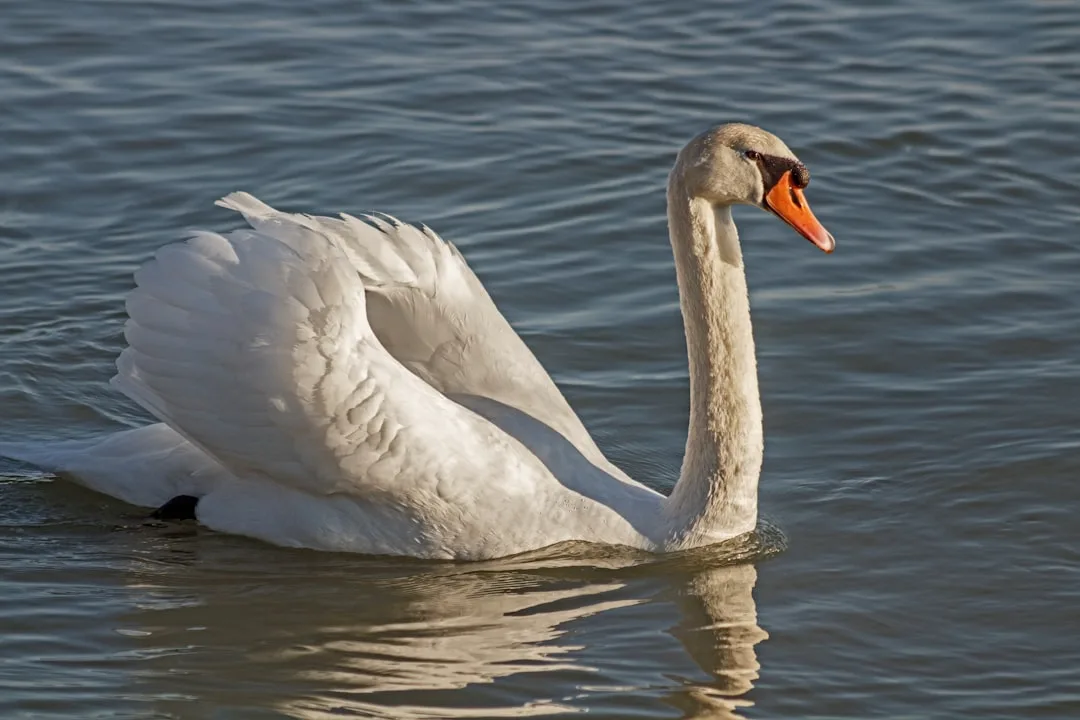
The mute swan is the large white swan that most people in Europe picture when they hear the word "swan". It is the heraldic bird of English rivers, the property of the British Crown, the star of a thousand park postcards, and - behind the postcard image - one of the most physically imposing flying birds alive today.
Cygnus olor is a member of the duck family Anatidae, a lifelong pair-bonder, a surprisingly violent territorial defender, and a creature whose wings sing loudly enough in flight to be heard a kilometre away despite its famously quiet voice.
This guide covers every significant aspect of mute swan biology and ecology: size and physical form, habitat, diet, breeding, vocal and non-vocal communication, conservation status, the remarkable legal history tying the species to the British monarchy, and the strange facts that make Cygnus olor stand out even in a family full of spectacular birds. This is a reference entry, not a summary - so expect specifics: grams, kilometres, vertebrae counts, clutch sizes, and verified records.
Etymology and Classification
The scientific name Cygnus olor combines the Greek kyknos (swan) with the Latin olor (also swan). The species was formally described by Johann Friedrich Gmelin in 1789, although the bird had been familiar to European naturalists for centuries before that under a variety of regional names. The English word "swan" derives from Proto-Germanic swanaz, thought to share a root with words meaning "to sound" - an irony given that this particular species is the quietest of the group.
The mute swan sits inside the order Anseriformes, which contains all ducks, geese, and swans, and specifically within the family Anatidae.
The genus Cygnus includes six or seven species depending on taxonomic authority - the mute swan, whooper swan (Cygnus cygnus), trumpeter swan (Cygnus buccinator), tundra swan (Cygnus columbianus), black swan (Cygnus atratus), black-necked swan (Cygnus melancoryphus), and sometimes the whistling swan treated as a separate species.
Mute swans are genetically closer to the black swan of Australia than to the whooper or trumpeter, despite sharing the northern hemisphere with the latter two.
Common names across its range reflect both the species' prominence and its legal status. Traditional English sources distinguish cob (adult male), pen (adult female), and cygnet (juvenile). German speakers call it Hockerschwan (knob-swan) after the bill protrusion; French cygne tubercule; Russian lebed-shipun (hissing swan).
Size and Physical Description
Mute swans are among the largest flying birds in the world and the heaviest native waterbird in most of their European range. They sit near the physical ceiling of powered flight - any heavier and they would struggle to take off at all.
Males (cobs):
- Length: 140-170 cm from bill tip to tail
- Wingspan: 2.1-2.4 m
- Weight: typically 10-14 kg, record 15-17 kg
- Visibly larger basal knob on bill
Females (pens):
- Length: 125-155 cm
- Wingspan: 2.0-2.3 m
- Weight: typically 8-12 kg
- Smaller, flatter basal knob
Cygnets at hatching:
- Weight: 200-240 g
- Length: roughly 25 cm
- Greyish-brown down, pale grey bill
The plumage of adult mute swans is uniformly white, with a faint cream or rust tint sometimes caused by iron-rich water staining the head and neck. The bill is bright orange with black edges and a distinctive black fleshy knob - the basal knob - sitting over the nostrils.
This knob swells during the breeding season and is consistently larger and higher in males, making it one of the most reliable field marks for sexing adults. Legs and feet are black. Juveniles retain grey-brown plumage and a dull grey-pink bill until roughly their second year.
The neck of a mute swan is proportionally the longest of any British bird and contains up to 24 cervical vertebrae, compared with just seven in mammals such as humans and giraffes. That extra flexibility is what allows a swan to upend and forage up to a metre below the water surface without diving. The neck is usually held in a distinctive S-curve, unlike the straight-necked whooper and trumpeter swans - another reliable field identification cue.
Habitat and Range
Mute swans occupy shallow, calm, nutrient-rich fresh water and sheltered coastal environments. Ideal habitat includes lakes, slow rivers, reservoirs, ornamental park lakes, gravel pits, coastal lagoons, and estuaries with beds of submerged vegetation. They avoid deep, fast, or heavily wooded waters and are rarely found far from reeds, rushes, or similar cover for nesting.
Native range:
- Core: the United Kingdom, Ireland, Scandinavia, the Low Countries, France, Germany, Poland, the Baltic states, Ukraine, and Russia west of the Urals
- Secondary: patches of central Asia into Mongolia, with isolated breeding as far east as Primorye
Introduced range:
- North America (Atlantic seaboard from Massachusetts to Virginia, the Great Lakes, parts of the Pacific Northwest) - now classified as invasive
- Southern Africa (small populations)
- Australia (Perth region)
- New Zealand (small populations)
- Japan (feral urban populations)
Northern European populations are partially migratory. Birds breeding in Scandinavia, the Baltic, and Russia typically move south or west in autumn to ice-free waters along the North Sea, the Baltic coast, the Black Sea, and occasionally as far south as the eastern Mediterranean. British, Irish, and continental temperate populations are largely sedentary, though individual birds move in response to local freezing.
Urban mute swans are a special case. Populations in central London, Stockholm, Copenhagen, Prague, and Amsterdam have become so habituated to humans that they feed from hand at canal edges. These urban populations have higher survival rates than most rural ones - no hunting, regular supplementary feeding, few predators - but also elevated rates of obesity, lead poisoning from ingested fishing weights, and collisions with boats.
Diet and Feeding Behaviour
Mute swans are primarily herbivores, though they are not rigid dietary specialists. Their daily intake of plant material is substantial - up to 4 kg of wet vegetation per day for an adult cob - and feeding flocks can strip shallow bays of submerged plants within a single season, which is part of what makes the species ecologically contentious in its introduced range.
Primary foods:
- Submerged aquatic plants: pondweeds (Potamogeton), stoneworts (Chara), water milfoil, hornwort
- Floating plants: duckweed, water lily leaves
- Brackish-water plants: eelgrass (Zostera), widgeon grass
- Riverbank grasses and sedges
- Agricultural crops: winter wheat, oilseed rape, potatoes (when accessible)
Incidental foods:
- Aquatic insects and larvae
- Tadpoles and small fish
- Molluscs, especially small snails
- Frog spawn
Feeding techniques:
- Upending. The classic posture: head and neck extended underwater, tail pointing straight up. The long neck allows the bill to reach roughly a metre below the surface.
- Surface skimming. The swan sweeps its bill along the water surface to collect floating vegetation.
- Grazing. On land, swans walk along riverbanks, park lawns, and agricultural fields pulling up grass and shoots. This behaviour is responsible for most swan-farmer conflicts.
- Tipping young plants. Mothers often pull up underwater plants and let floating fragments be grabbed by cygnets who cannot yet reach the bottom.
Cygnets are fed entirely on animal protein for their first weeks - mainly invertebrates stirred up by the parents' feet - before transitioning to the adult herbivorous diet by about six weeks. This high-protein early diet supports the rapid feather and muscle growth that has to be complete before their first winter.
Breeding and Life Cycle
Mute swans have one of the most tightly choreographed breeding cycles of any European waterbird, shaped by the long cygnet growth period and the species' commitment to a single territory defended by a single pair.
Annual cycle:
- Late February to April: pair returns to breeding territory, aggressive boundary displays
- April to May: nest construction and egg laying
- May to June: incubation
- Mid-June to August: cygnet rearing on water
- September to October: cygnets fledge, family structure loosens
- November to February: flocking on ice-free waters, courtship of new pairs
Nests are enormous - up to 2 metres across and 60 cm high - built almost entirely from reeds, rushes, grasses, and sticks gathered by both parents. The pen does most of the shaping; the cob does most of the material transport. Nests are typically placed on raised ground near water, occasionally on floating platforms or small islands, and are re-used for multiple seasons with annual additions.
Clutch size is 4 to 8 eggs, typically 5 or 6. Eggs are pale grey-green, roughly 115 mm long and 300 grams in weight - among the largest of any European bird. Incubation is 34 to 41 days, performed almost entirely by the pen, with the cob standing guard nearby. Cygnets hatch synchronously over 24 to 48 hours. They are precocial, able to swim and feed themselves within a day, but are brooded under the pen's wings for the first week and ride on her back for the first two to three weeks.
Cygnets grow rapidly. By 8 weeks they weigh 4 to 5 kg. By 16 weeks they can fly, though they rarely do so before autumn. Cygnet mortality is substantial - around 40% die in the first month, mainly to predation by pike, fox, otter, crow, and gull, and to hypothermia in cold wet weather.
Juveniles typically remain with their parents for up to 8 months after hatching, then are driven off when the parents prepare for the next breeding season. Young birds gather in non-breeding flocks of dozens to hundreds on larger lakes and coastal lagoons, where they spend 2 to 4 years before forming their first pair bond.
Pair bonds and "divorce":
Mute swans are famously monogamous. Studies of ringed populations in Britain, Sweden, and Denmark confirm that most pairs remain together until one partner dies. However, divorce rates of approximately 3% per year have been documented, usually following two or more consecutive breeding failures or after loss of a territory to a rival pair. Widowed birds typically re-pair within one or two seasons.
Same-sex pair bonds have been observed in captive flocks and occasionally in the wild, where they may incubate unfertilised eggs or adopt eggs displaced from neighbouring nests.
Flight and the Singing Wings
For a bird this heavy, takeoff is a serious engineering problem. Mute swans run along the water surface for 20 to 30 metres, flapping vigorously, before becoming airborne. In small ponds they cannot take off at all - one of the reasons moulting birds that lose their flight feathers during an annual three-week flightless period tend to gather on larger waters.
Once airborne, the mute swan flies strongly and straight at cruising speeds of 50 to 80 km/h, with heart rates of 450+ beats per minute. They fly with their necks fully extended and rarely soar, instead beating continuously. The wingbeat frequency is slower than most ducks but each stroke moves far more air.
The species is best known in flight for a non-vocal sound: the singing wings. Each wingbeat produces a distinctive rhythmic whoosh, whoosh, whoosh audible from more than a kilometre away in still air. The sound comes from air passing over specialised primary flight feathers that vibrate at a characteristic frequency unique to the species.
Whooper and trumpeter swans, despite their similar size, do not produce this sound. Mute swans appear to use the singing wings as a long-range social signal: other swans reliably orient toward an incoming bird they can hear but not see. The sound also serves as a warning to potential intruders on a breeding territory.
Communication, "Muteness", and Busking
The name "mute swan" is a historical comparison, not an accurate description. The species produces a rich repertoire of calls:
- Hiss. The classic threat call, louder and longer than any goose hiss. Directed at intruders near nests or cygnets.
- Snort / grunt. Contact call between pair members and between parents and cygnets.
- Trumpet. Softer than whooper or trumpeter swans but still audible; used in greeting, courtship, and nest relief.
- Cygnet cheeps. High-pitched whistling contact calls from young, used throughout the first summer.
- Bill clack. A sharp percussive snap of the bill during close-range aggression.
The most famous visual display is busking, in which a threatened cob raises both wings into a full arch above its back, lowers its head along its neck, and paddles rapidly toward the intruder. This doubles the apparent size of the bird and displays the quivering, hissing primary feathers. Busking is almost always directed at other swans or boats, and it functions both as a warning and as a prelude to physical combat.
Fights between rival cobs are violent and occasionally fatal. Males grip each other by the base of the neck with the bill, climb onto each other's backs, and beat with the bony leading edge of the wings. Broken wings, dislocated necks, and drownings have all been recorded in contested territories.
Conservation Status and Population
The IUCN Red List classifies the mute swan as Least Concern with an increasing or stable population trend. The global population is estimated at more than 500,000 individuals, split roughly evenly between native Europe and introduced or expanding populations elsewhere.
Approximate regional populations:
| Region | Estimated adults | Trend |
|---|---|---|
| United Kingdom and Ireland | 70,000-80,000 | Increasing |
| Continental Europe | 250,000-350,000 | Stable |
| Russia and Asia | 50,000-100,000 | Stable |
| North America (introduced) | 20,000-25,000 | Increasing |
| Rest of introduced range | 5,000-10,000 | Mixed |
Recovery from historical lows is a 20th-century success story in parts of western Europe. British populations crashed in the 1960s to 1980s because of lead poisoning from discarded anglers' weights; swans picked the weights up as grit. Legislation banning small lead fishing weights in the UK in 1987 led to a rapid rebound, and breeding numbers roughly doubled within a decade.
Remaining threats:
- Lead poisoning. Still significant where lead shot and older fishing weights persist in sediments.
- Collisions. With power lines, bridges, vehicles, and wind turbines; these kill thousands of flying swans annually.
- Avian influenza. Major outbreaks since 2020 have killed thousands of individuals across Europe.
- Habitat loss. Canalisation of rivers, drainage of shallow lakes, and disturbance of nesting sites.
- Illegal persecution. Anglers and some farmers occasionally kill swans over perceived fishery or crop damage.
- Human interference at nests. Disturbance by walkers, dogs, and boats during incubation causes abandonment.
In the introduced range, the mute swan is controversial. In parts of the northeastern United States, state wildlife agencies actively manage populations through egg addling and culling, on the grounds that dense mute swan populations damage submerged aquatic vegetation used by native waterfowl and by juvenile fish. Conservationists disagree sharply about whether mute swans should be removed, tolerated, or even protected in their introduced range.
The Swans and the Crown
The legal status of mute swans in Britain is unique among birds. From at least the 12th century, all unmarked mute swans on open waters in England and Wales have been the personal property of the reigning monarch under a royal prerogative confirmed in the medieval Crown Act.
In 1473, the Crown granted limited ownership rights to two London livery companies - the Worshipful Company of Vintners and the Worshipful Company of Dyers - who marked their birds with distinctive bill nicks. A swan with no bill nick still belongs to the sovereign today.
The practical expression of this royal prerogative is the annual Swan Upping ceremony. Each July, six traditional rowing skiffs travel 79 miles up the Thames from Sunbury-on-Thames to Abingdon in a five-day census.
The Swan Uppers - led by the King's Swan Marker and accompanied by uniformed representatives of the Vintners and Dyers - catch each cygnet they encounter, weigh it, ring it, check it for injuries, and release it. Swan Upping is one of the oldest continuously running wildlife surveys in the world and provides essential population data for the middle Thames population.
Mute swans were formerly a prestige food at royal banquets. Roast swan appeared at English coronation feasts, Christmas feasts, and major state occasions into the Tudor era. The practice declined in the 18th century and disappeared entirely by the 20th. Today the Crown exercises its ownership purely for welfare and census purposes; the swans are no longer eaten, hunted, or harvested.
Elsewhere, similar ancient ownership rights have existed locally - in Denmark, the mute swan was declared the national bird in 1984; in parts of France, ornamental populations on royal estates were traditionally managed by court ornithologists. None of these rivals the British Crown's prerogative in formal legal status.
Mute Swans and Humans
Mute swans are the waterbird most people in their range have seen closest up. Urban populations feed from the hand in central European capitals; park flocks in London, Copenhagen, and Stockholm are national tourist fixtures; weddings, heraldry, literature, and ballet (Swan Lake, 1877) have enshrined the bird as a symbol of grace, loyalty, and beauty.
The other side of the relationship is less picturesque. Mute swans are the most aggressive European waterbird at the nest. Documented injuries to humans include:
- Bruises and welts from wing strikes
- Lacerations from bill jabs
- Broken fingers and at least one broken arm
- A 2012 fatal kayaker drowning in Illinois after repeated territorial attacks capsized the boat
- Repeated attacks on swimmers, rowers, and paddleboarders
Attacks on dogs are common, particularly when dogs approach a nest or cygnet group. Small children are at disproportionate risk because they are at eye level with a defensive cob. Wildlife authorities in the UK and continental Europe advise keeping at least 20 metres distance from any visible nest, leashing dogs near water, and retreating immediately if a swan begins busking or hissing.
Despite these risks, the species remains one of the most beloved birds in its range. The mute swan features on the coat of arms of dozens of European towns, on British pub signs, on Danish currency, and on the logos of countless rowing clubs, conservation charities, and ornithological societies.
Related Reading
- Whooper Swan: The Loud Northern Cousin
- Trumpeter Swan: North America's Largest Waterfowl
- Black Swan: Australia's Inverted Icon
- Canada Goose: The Continent's Most Successful Waterfowl
References
Relevant peer-reviewed and governmental sources consulted for this entry include the IUCN Red List assessment for Cygnus olor, the Wildfowl & Wetlands Trust annual population surveys, the British Trust for Ornithology BirdFacts database, the Royal Swan Upping records held by the Royal Household, and published research in Wildfowl, Ibis, Bird Study, and Journal of Avian Biology.
Specific population figures reflect Wetlands International waterbird population estimates as of the most recent International Waterbird Census data compilations.
Frequently Asked Questions
How big are mute swans?
Adult mute swans (Cygnus olor) measure 125 to 170 cm from bill tip to tail, with a wingspan of 2.0 to 2.4 metres. Males, called cobs, weigh 9 to 14 kg and can exceed 15 kg in peak condition; females, called pens, are slightly smaller at 8 to 12 kg. This makes the mute swan one of the heaviest flying birds in the world, sitting at or near the upper mass limit for powered avian flight.
Cygnets hatch weighing around 200 to 240 grams and reach full adult size by their second year, though their bone growth continues into their third.
What do mute swans eat?
Mute swans are primarily herbivores. More than 90% of their diet consists of submerged aquatic plants such as pondweed, stonewort, water milfoil, and eelgrass, which they reach by upending their bodies and extending their long necks up to a metre below the surface.
They also graze on riverbank grasses, agricultural crops including winter wheat and oilseed rape, and occasionally consume insects, tadpoles, small fish, and molluscs - usually by accident while feeding on plants. An adult swan eats up to 4 kg of vegetation per day, and dense feeding flocks can strip aquatic vegetation from shallow bays in a single season.
Why are mute swans called 'mute' if they make sounds?
The name is misleading. Mute swans are not silent - they hiss aggressively when threatened, produce soft grunts and snorts in family groups, and give a throaty trumpeting call during courtship and nest defence. They are called ‘mute’ because they are noticeably quieter than the two species naturalists compared them to historically: the whooper swan (Cygnus cygnus) and the trumpeter swan (Cygnus buccinator), both of which produce loud, far-carrying calls.
A more accurate name would be ‘quiet swan’, but ‘mute’ stuck. Strikingly, the species compensates acoustically through its wings: the singing whoosh of mute swan flight feathers is one of the loudest non-vocal sounds in European birdlife.
Do mute swans really belong to the British monarch?
Legally, yes - to a point. Under a royal prerogative dating to the 12th century, all unmarked mute swans swimming on open waters in England and Wales are technically the property of the Crown. The Crown shares this ownership with two ancient London livery companies, the Vintners and the Dyers, who were granted rights to mark swans with bill nicks in 1473.
Every July, the Queen’s (now King’s) Swan Marker leads the Swan Upping ceremony on a 79-mile stretch of the River Thames, catching and examining cygnets as a population census. The monarch does not eat or harvest these birds today; modern Swan Upping is purely a welfare and conservation exercise.
How long do mute swans live?
Wild mute swans typically live 15 to 20 years, with many dying in their first winter. Survival rates improve dramatically once a bird reaches breeding age. Captive mute swans routinely live past 30 years, and the oldest documented individual lived to 40 years in a British wildfowl collection.
Wild longevity is constrained by predation of cygnets, territorial fights between adult cobs, collisions with power lines and vehicles, lead poisoning from ingested fishing weights, and viral diseases such as avian influenza. Pair-bonded adults that hold a stable territory can breed successfully for 15 consecutive seasons or more.
Are mute swans dangerous?
Yes, mute swans can be genuinely dangerous, particularly during the nesting season from April to July. A breeding cob defending its pen and cygnets will charge intruders - humans, dogs, kayaks, and rowing shells included - striking with its bill and, more damagingly, with the bony leading edge of its wings. Documented injuries include bruises, lacerations, broken fingers, and at least one broken arm when a jogger stumbled near a riverbank nest.
A 2012 fatality in Illinois involved a kayaker who capsized after a territorial attack and could not reach shore. Attacks on adults are rare but not mythological; attacks on dogs and small children are reported every breeding season across Europe. The safest policy is to maintain at least 20 metres of distance from any visible nest or cygnet group.
Where do mute swans live?
Mute swans are native to temperate Europe and parts of western and central Asia, breeding as far east as Mongolia and the Russian Far East. Their preferred habitats are shallow freshwater lakes, slow-moving rivers, estuaries, coastal lagoons, and ornamental park lakes. They have been deliberately introduced to North America (where they are now considered invasive in many states), South Africa, Australia, New Zealand, and parts of Japan.
Most European populations are partially migratory, with northern breeders moving to ice-free coasts in winter; southern populations are largely sedentary. Urban mute swans in cities such as London, Prague, Stockholm, and Copenhagen have become habituated to people and are among the most photographed wild birds in Europe.
Do mute swans really mate for life?
Mostly, but not absolutely. Long-term studies of ringed British and Swedish populations show that the vast majority of mute swan pairs remain together until one partner dies, which is where the ‘mate for life’ reputation comes from. However, a ‘divorce’ rate of roughly 3% per year has been documented, almost always following repeated breeding failures or loss of a territory. Widowed swans usually re-pair within one or two breeding seasons.
Young birds typically form their first pair bonds at 2 to 4 years of age, often spending a non-breeding season together before attempting to raise cygnets. Same-sex pair bonds have been observed in captive flocks and occasionally in the wild, though they do not produce cygnets unless a displaced fertile egg is adopted.