
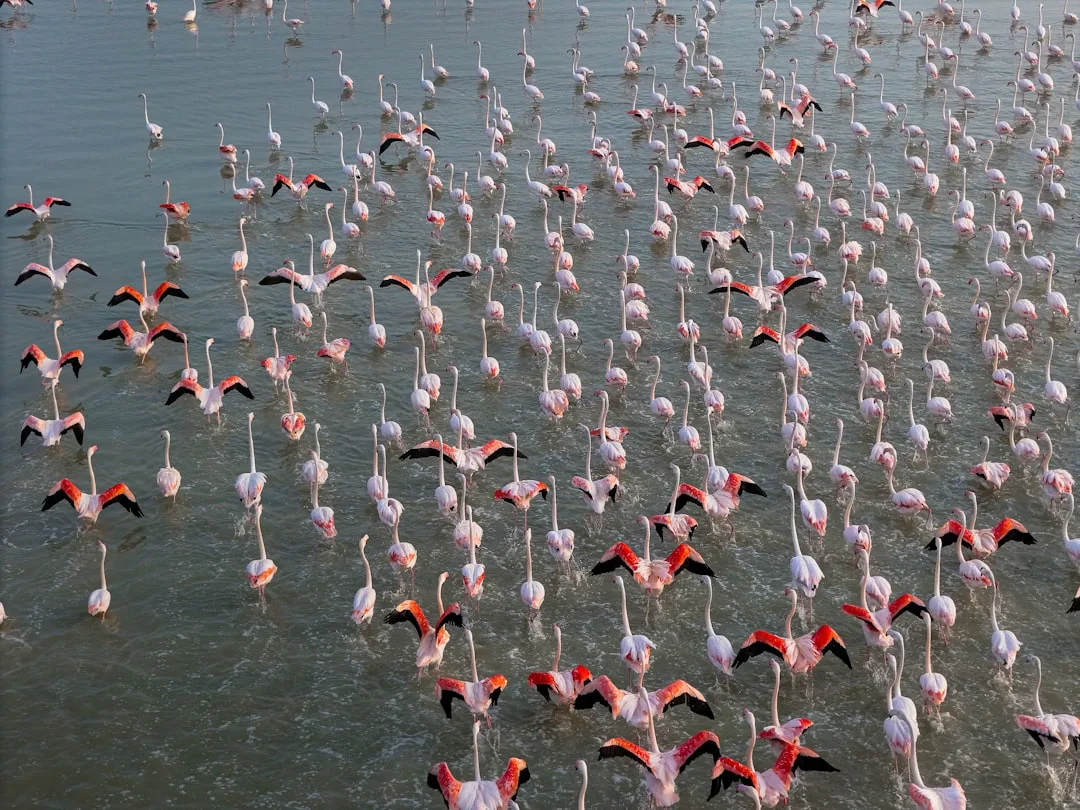
Why are flamingos pink?
Flamingos are pink because of pigments called carotenoids in their diet. They eat brine shrimp and blue-green algae that contain high concentrations of beta-carotene and canthaxanthin - the same orange-red pigments that make carrots orange and tomatoes red. As flamingos digest their food, they metabolize the carotenoids and deposit them in their feathers and skin, producing the characteristic pink to.
You Are What You Eat
Feed a flamingo a normal bird diet and it gradually turns white. Not pale pink, not faded pink - actually white, the color of a seagull. Switch the food back to its natural prey and the pink returns over weeks and months.
Flamingos are pink because of what they eat. Their extraordinary color is not encoded in their DNA but assembled from chemical pigments they harvest from their food. Every pink flamingo is a walking demonstration of a principle that sounds like a cliché but happens to be literally true for them: you are what you eat.
The Chemistry
Carotenoid pigments:
Carotenoids are natural pigments produced by plants, algae, and some microorganisms. They include:
- Beta-carotene: makes carrots orange, leafy greens yellow when cooked
- Canthaxanthin: produces red coloration in salmon and shrimp
- Astaxanthin: gives lobsters and prawns their cooked red color
These pigments are produced by algae and other photosynthetic organisms as part of their normal biology. Many animals consume carotenoid-containing foods but cannot use the pigments for coloration. Flamingos can.
The deposition process:
Flamingo physiology transfers dietary carotenoids to feathers and skin:
- Flamingo eats brine shrimp and algae containing carotenoids
- Digestive system absorbs the pigments
- Liver processes and sometimes modifies them
- Pigments circulate in bloodstream
- Pigments deposit in developing feathers and skin
- Accumulated pigment produces pink to red color
Color variations:
Different flamingo populations show different color intensities based on local diets:
- Caribbean flamingos: brilliant red-orange (extremely pigment-rich food)
- Chilean flamingos: soft pink (different food composition)
- Lesser flamingos: deep pink (high canthaxanthin algae)
- Captive flamingos: often pale without supplementation
The Filter-Feeding System
Flamingos get their food through one of the most specialized feeding systems in the bird world.
The upside-down beak:
When feeding, flamingos hold their heads upside down in the water. Their beaks are specifically shaped for this position:
- Upper bill acts as the "floor"
- Lower bill acts as the "roof"
- Curved shape positions the bill for optimal filtering
- Serrated edges strain food from water
Lamellae:
Tiny hair-like structures called lamellae line the bill interior. These:
- Trap food particles
- Allow water to pass through
- Function like baleen plates in whales
- Are refreshed regularly as they wear
Tongue pump:
The flamingo tongue acts as a pump:
- Moves water in and out of mouth 20 times per second
- Creates continuous flow through lamellae
- Filters 20+ liters of water per hour
- Operates during entire feeding periods
Convergent evolution with whales:
Flamingo filter-feeding strongly resembles baleen whale feeding despite flamingos being birds and whales being mammals. This is convergent evolution - two unrelated lineages developing similar solutions to the same problem (extracting small food particles from water).
What They Eat
Flamingo diets vary by species and location.
Primary prey:
- Brine shrimp (Artemia): small crustaceans rich in carotenoids
- Blue-green algae: microscopic photosynthetic organisms
- Diatoms: single-celled algae with silica shells
- Small crustaceans: various small prey
- Insect larvae: aquatic larvae of midges and other insects
Species differences:
- Greater flamingo: larger prey like shrimp
- Lesser flamingo: primarily cyanobacteria and algae
- James's flamingo: microscopic diatoms specifically
- Chilean flamingo: intermediate diet
Filtering size:
Different species have different lamellae spacing, filtering different sized prey. This allows multiple flamingo species to coexist at the same lakes without competing for identical food.
One-Legged Standing
Flamingos are famous for standing on one leg.
Why they do it:
Recent research has clarified the reasons:
Muscle conservation: Standing on one leg requires less muscular effort than standing on two. This is counterintuitive but explained by the "passive gravitational stay mechanism" - a flamingo's leg locks into position when loaded, requiring no active muscle control.
Heat conservation: When standing in cold water, an exposed leg loses significant body heat. Tucking one leg against the warm body cuts heat loss in half.
Rest: Alternating legs allows each leg to rest while remaining ready for quick movement if needed.
Balance: Contrary to popular belief, balance is not a primary challenge for flamingos. Their passive mechanism means they can stand on one leg essentially indefinitely without effort.
Research evidence:
- Dead flamingos can balance on one leg due to the locking mechanism (tested in lab studies)
- Flamingos in warm water stand on two legs more often
- Flamingos in cold water almost always stand on one leg
- Alternation between legs occurs regularly
Habitat Specialization
Flamingos thrive in environments that exclude most other birds.
Extreme habitats:
Soda lakes. Alkaline lakes with pH 10+ (comparable to ammonia). Water is caustic enough to burn exposed human skin. Few organisms survive here.
Salt pans. Extremely saline waters where salinity exceeds ocean levels multiple times.
Brine pools. Concentrated salt water in shallow coastal areas.
Why flamingos thrive:
- Food sources (brine shrimp, specific algae) are abundant in extreme waters
- Predators avoid these environments
- Alkaline tolerance through specialized skin and respiratory systems
- Legs and feet protected by specialized tissues from caustic water
Famous locations:
Lake Natron, Tanzania. Hosts millions of breeding lesser flamingos. The lake's water can reach pH 10.5 and temperatures of 60°C (140°F). Videos have shown calcified bodies of animals that died after falling into the water - yet flamingos thrive there.
Laguna Colorada, Bolivia. High-altitude salt lake (4,278 m elevation) hosting James's flamingos. Temperatures regularly drop below freezing.
Great Rift Valley lakes. Multiple alkaline lakes across East Africa support enormous flamingo populations.
Social Life
Flamingos are highly social birds.
Flock sizes:
Flamingo flocks range from small groups to enormous aggregations:
- Small flocks: 20-50 individuals
- Typical colonies: hundreds to thousands
- Mass aggregations: millions (lesser flamingos at East African soda lakes)
A single breeding colony at Lake Natron can contain 2.5 million flamingos - among the largest bird concentrations on Earth.
Group behaviors:
Flamingos coordinate many activities:
- Synchronized head movements during courtship
- Collective flight during movements
- Communal defense against predators
- Communal nesting in dense colonies
- Group feeding in lines or circles
Courtship dances:
Breeding flamingos perform elaborate synchronized courtship displays:
- Head flagging (rapid side-to-side movements)
- Wing flapping and salutes
- Twist-preen movements
- Inverted wing displays
These rituals involve entire flocks moving together, creating spectacular displays that may last hours.
Reproduction
Flamingo breeding is tied to specific conditions.
Timing:
Breeding requires:
- Appropriate water levels at nesting sites
- Sufficient food availability
- Protected locations from predators
- Multiple environmental cues
Nesting:
Flamingos build cone-shaped mud nests about 30 cm tall. The elevation protects eggs from floods and predators.
Eggs:
Each female lays a single egg per breeding season. Both parents incubate for approximately 28-31 days.
Chicks:
Chicks hatch with:
- Straight bills (not yet curved for filtering)
- Gray fluffy down (not pink)
- Ability to walk within days
- Dependence on parental feeding
Flamingo milk:
Both male and female flamingos produce "crop milk" - a nutritious secretion from their upper digestive tract. This is rich in carotenoids and feeds chicks during their early weeks, making parents visibly paler as they transfer pigments.
Maturation:
Chicks develop adult coloration over 2-3 years. They reach sexual maturity around age 6.
Longevity
Flamingos live remarkably long lives.
Typical lifespans:
- Wild: 30-40 years
- Captive: often 50-60 years
- Oldest confirmed: 83 years (Adelaide Zoo, Australia)
Why so long:
- Few natural predators attack adults
- Nutrient-rich filter-feeding supports health
- Strong social structures reduce stress
- Specialized environment protects from many threats
Slow reproduction:
Long lifespan is necessary because:
- Sexual maturity at age 6
- One egg per year maximum
- Lifetime reproduction may produce 20-30 chicks
- Populations cannot recover quickly from disturbance
Threats and Conservation
Flamingos face several modern threats.
Habitat loss:
- Wetland drainage for agriculture
- Urban development
- Industrial use of flamingo lakes
- Water diversion for human use
Climate change:
Changing rainfall patterns affect the specific wetlands flamingos need. Droughts dry up breeding lakes; floods disrupt nesting sites.
Disturbance:
Human activity near breeding colonies causes chick abandonment and colony failure. Some flamingo species require undisturbed remote sites to reproduce successfully.
Pollution:
Industrial pollution, pesticides, and heavy metals contaminate flamingo habitats. Some populations show elevated toxin levels in tissue samples.
Predation:
Natural predators (eagles, jackals) kill chicks and sometimes adults. Introduced predators in some areas have caused severe population declines.
Conservation status:
- Lesser flamingo: Near Threatened
- Andean flamingo: Vulnerable
- James's flamingo: Near Threatened
- Chilean flamingo: Near Threatened
- Greater flamingo: Least Concern
- American flamingo: Least Concern
The Living Pigment Experiment
Flamingos are something unusual - an animal whose appearance directly reflects its diet in ways normally hidden in other species.
Every pink flamingo has been assembling its color from specific chemicals in specific food. Remove the food and the color fades. Restore the food and the color returns. This direct feedback between diet and appearance is visible in few other animals at similar scale.
For humans looking at a flock of flamingos, we are not just seeing birds. We are seeing the accumulated carotenoids from millions of brine shrimp, billions of algae cells, and countless small organisms that the flamingos have filtered from water during their lifetimes. Each pink feather is a record of eating - a literal demonstration that flamingo bodies are constructed from the bodies of their prey.
This principle applies to all animals, but in most species the internal biochemistry hides the connection. In flamingos, evolution has made the connection visible. The pink color is not just aesthetic - it is biological narrative, visible to anyone looking carefully at what flamingos are and where their substance comes from.
The Six Flamingo Species: A Comparative Table
Flamingos (family Phoenicopteridae) comprise six species distributed across the Americas, Africa, southern Europe, and Asia. Though they all look broadly similar, they differ significantly in size, color intensity, diet, and conservation status. The Kalenux Team compiled the following overview from the Cornell Lab of Ornithology, the IUCN Red List, and peer-reviewed population assessments.
| Species | Height | Primary Range | Primary Food | Population (2022) | IUCN Status |
|---|---|---|---|---|---|
| Greater flamingo (Phoenicopterus roseus) | 110-150 cm | Africa, southern Europe, south Asia | Brine shrimp, blue-green algae | ~550,000 | Least Concern |
| American flamingo (P. ruber) | 120-145 cm | Caribbean, Yucatan, Galapagos | Brine shrimp, diatoms | ~330,000 | Least Concern |
| Chilean flamingo (P. chilensis) | 110-130 cm | Southern South America | Algae, invertebrates | ~200,000 | Near Threatened |
| Lesser flamingo (Phoeniconaias minor) | 80-90 cm | East Africa, west India | Blue-green algae (Spirulina) | 2.2-3.3 million | Near Threatened |
| Andean flamingo (Phoenicoparrus andinus) | 100-110 cm | High Andes | Diatoms | 40,000 | Vulnerable |
| James's flamingo (P. jamesi) | 90-100 cm | Altiplano lakes | Microscopic diatoms | 100,000 | Near Threatened |
"The evolutionary story of flamingos is the story of filter feeding taken to its absolute extreme. Six species, each optimized for slightly different filtering regimes, all sharing an upside-down bill that has no real analog anywhere else in the bird world." - Felicity Arengo, American Museum of Natural History, Waterbirds, 2017 [1]
The smallest and most abundant is the lesser flamingo; the largest and most widespread is the greater flamingo. The two high-Andean species - Andean and James's - are the rarest and face some of the harshest breeding conditions. Their nesting lakes sit at altitudes above 4,000 meters and often reach pH 10 or higher, concentrations that dissolve human skin on contact. Flamingos tolerate these conditions because their scaly legs are chemically inert to the caustic water.
Lake Natron and the Chemistry of the Soda Lakes
The lesser flamingo breeds almost exclusively on one salt lake in the world: Lake Natron, in northern Tanzania. The lake's water contains concentrations of sodium carbonate so high that it would calcify the exposed tissues of most animals, but this is precisely what makes the lake so attractive to flamingos. The toxic chemistry keeps mammalian predators away from the breeding islands, and the blue-green algae that thrive in high-pH water provide a nearly unlimited food supply.
"Lake Natron is one of the most beautiful and most deadly places on Earth. For most species, the pH of 10.5 and temperatures of 60 degrees Celsius are lethal. For flamingos, they mean safety - a nursery that nothing else can enter." - David Harper, University of Leicester, African Journal of Ecology, 2016 [2]
Up to 2.5 million lesser flamingos may gather at Lake Natron in peak breeding years, producing one of the largest single-species breeding aggregations on Earth. The lake's salt pans stretch for 56 kilometers, and the flamingo colonies are visible from space as pink streaks on satellite imagery. Researchers reach the breeding islands only by boat, wearing protective gear and working quickly to avoid the corrosive effects of the water on equipment.
Catastrophic threats remain. A proposed soda ash extraction facility at Lake Natron was shelved in 2013 after international pressure, but mining interest periodically resurfaces. Climate change is another concern: the lake depends on specific rainfall patterns to maintain breeding conditions, and drought years can force the flamingos to abandon their nests entirely.
The 2018 breeding season saw nearly complete failure at Natron due to unusual rainfall that raised water levels and submerged most of the mud-mound nests before hatching.
The Reverse Filter-Feeder
Flamingos are one of just a handful of animals in the world that filter-feed while holding their heads upside-down.
Comparative anatomical work by Mark Zweers at Leiden University in the 1990s described the bill as a mirror image of the baleen whale's mouth: lamellae line the roof of the upper mandible (which is on the bottom when inverted) and the lower mandible forms the "lid." The tongue acts as a piston, pumping water in and out at rates of up to 20 times per second. Microscopic food particles trapped on the lamellae are then swept to the throat by hair-like projections on the tongue.
The mechanics produce extraordinarily efficient filtering. A single lesser flamingo processes roughly 20 liters of water per hour through its bill, extracting up to 60 grams of algae in the same period. A flock of 500,000 lesser flamingos on a single lake, filtering at those rates, can remove the daily biomass of entire continents' worth of lower-trophic-level production - one reason flamingo flocks are sometimes described as biological vacuum cleaners for their wetlands.
References
- Arengo, F., Baldassarre, G., and Flamingo Specialist Group. (2017). "Flamingo biology and conservation: a synthesis." Waterbirds, 40(1), 1-14.
- Harper, D. M., Childress, R. B., Harper, M. M., Boar, R. R., Hickley, P., Mills, S. C., Otieno, N., et al. (2016). "Aquatic biodiversity and saline lakes: Lake Natron, Tanzania." African Journal of Ecology, 54(3), 251-265.
- Jenkin, P. M. (1957). "The filter-feeding and food of flamingos (Phoenicopteri)." Philosophical Transactions of the Royal Society B, 240(674), 401-493.
- Zweers, G., de Jong, F., Berkhoudt, H., and Berge, J. C. (1995). "Filter feeding in flamingos (Phoenicopterus ruber)." The Condor, 97(2), 297-324.
- IUCN Red List. (2022). "Family Phoenicopteridae species accounts." International Union for Conservation of Nature.
Related Articles
- Filter Feeding: How Animals Strain Food From Water
- Waterbirds: Flamingos, Herons and the Masters of Wetlands
- Lake Natron: The Deadly Lake Full of Flamingos
Frequently Asked Questions
Why are flamingos pink?
Flamingos are pink because of pigments called carotenoids in their diet. They eat brine shrimp and blue-green algae that contain high concentrations of beta-carotene and canthaxanthin - the same orange-red pigments that make carrots orange and tomatoes red. As flamingos digest their food, they metabolize the carotenoids and deposit them in their feathers and skin, producing the characteristic pink to crimson coloration.
Without these dietary pigments, flamingos would be white or gray. Captive flamingos fed generic bird diets often lose their color and turn pale unless their food is specifically supplemented with carotenoid-rich ingredients.
In the wild, different flamingo populations have different color intensities based on their local food sources - Caribbean flamingos are brilliant red-orange because of extremely carotenoid-rich algae, while Chilean flamingos tend toward softer pink because of different food compositions. The pigment transfer from food to feathers is direct and measurable, making flamingos living demonstrations of the ‘you are what you eat’ principle.
How do flamingos eat?
Flamingos are specialized filter feeders that strain tiny food particles from water using their uniquely shaped beaks. They position their heads upside down in the water with the bill pointing backward, sucking water in through the beak and expelling it through specialized filtering structures called lamellae - tiny hair-like filaments along the bill edges.
Food particles (brine shrimp, blue-green algae, small crustaceans, diatoms, and insect larvae) are trapped by the lamellae while water passes through. An adult flamingo filters approximately 20 liters of water per hour during active feeding. The tongue pumps water in and out of the mouth 20 times per second, producing continuous filtering.
This feeding method is extraordinarily similar to that of baleen whales despite the two groups being completely unrelated - a striking example of convergent evolution. Flamingos feed primarily at night when their prey are most abundant at the surface. Their filter-feeding efficiency allows them to thrive in extremely hostile environments like soda lakes where few other birds can survive.
Why do flamingos stand on one leg?
Flamingos stand on one leg primarily to conserve body heat and reduce muscle fatigue, not for balance alone as was long believed. Research published in 2009 showed that one-legged standing actually requires less muscular effort than two-legged standing due to a ‘passive gravitational stay mechanism’ in flamingo legs.
Their body weight naturally holds joints in a locked position when they stand on one leg - the bird doesn’t need to actively maintain balance. This mechanism allows them to stand on one leg essentially as long as they need without tiring. They also alternate legs to prevent heat loss - the exposed leg would lose significant body heat to cold water, so tucking one leg against the warm body conserves temperature.
When standing in warm water, flamingos stand on one leg less frequently, confirming the thermoregulation hypothesis. Similar one-legged stances are used by other wading birds for the same combination of muscle conservation and temperature regulation, though flamingos are the most famous example.
Where do flamingos live?
Flamingos live in wetland habitats across parts of the Americas, Africa, southern Europe, and western Asia. Six species exist, each with specific geographic ranges. The greater flamingo (Phoenicopterus roseus) is the most widespread, living across Africa, southern Europe, and parts of Asia. American flamingos live in the Caribbean, Galapagos, and northern South America. Chilean, Andean, and James’s flamingos inhabit different parts of South America.
The lesser flamingo is the most numerous species, with populations in East Africa often numbering in the millions at specific lakes. Many flamingos live in extreme environments that exclude most other birds - highly alkaline soda lakes, salt pans, and brine pools where few species can tolerate the chemistry.
Lake Natron in Tanzania, with water caustic enough to burn exposed skin, hosts millions of breeding lesser flamingos that thrive in conditions deadly to their predators. This habitat specialization protects flamingos from many threats. Their wetland preferences make them vulnerable to habitat loss as humans drain or develop wetlands for agriculture.
How long do flamingos live?
Flamingos live surprisingly long lives for birds - typically 30-40 years in the wild, with captive individuals reaching 60+ years. The oldest confirmed flamingo was 83 years old when it died at Adelaide Zoo in Australia in 2014, making it one of the oldest captive birds ever recorded.
Their longevity reflects several factors: few natural predators attack adults, their nutrient-rich filter-feeding diet supports long lives, their strong social structures reduce stress, and flocks collectively defend against threats. Long lifespan is necessary for their reproductive strategy - flamingos reach sexual maturity at 6 years old, produce only one egg per year, and pair bonds last multiple years to decades.
Rapid population recovery is therefore difficult after disturbances. Wild flamingos face threats from habitat loss, pollution, egg collection, and disturbance at breeding sites. Some populations have declined significantly despite protection efforts. Conservation organizations work to protect critical wetlands and restrict human access to sensitive breeding areas. Many flamingo species are listed as Near Threatened or Vulnerable by the IUCN.