
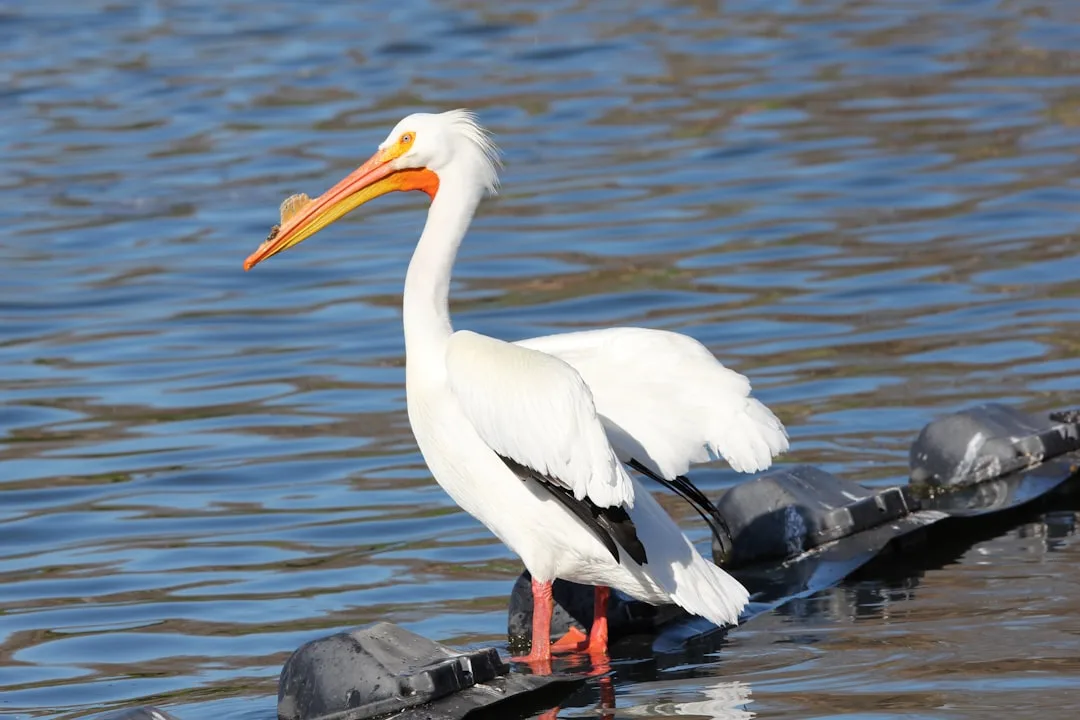
The American white pelican is one of the largest flying birds on Earth and, pound for pound, one of the strangest-looking. Pelecanus erythrorhynchos stretches nearly two metres long, spreads wings up to three metres across, and carries a bill longer than the forearm of an adult human.
Beneath that bill hangs a folded sack of skin - the gular pouch - capable of scooping up eleven litres of water in a single dip, more than three times the volume of the bird's own stomach. Despite this surreal anatomy the white pelican is a precise, cooperative, wholly modern hunter that dominates the shallow lakes of interior North America every summer and retreats to the Gulf Coast every winter.
This guide covers every part of the American white pelican's biology and ecology: size and proportions, the engineering of the pouch, cooperative fishing, breeding behaviour, the strange seasonal horn on the bill, migration flights at three thousand metres, conservation status, and the wider context of the eight pelican species found around the world. It is a reference entry, not a summary - so expect specifics: kilograms, litres, wingspans, altitudes, and verified records.
Etymology and Classification
The scientific name Pelecanus erythrorhynchos was published by German naturalist Johann Friedrich Gmelin in 1789. The genus Pelecanus is borrowed from the Ancient Greek pelekan, meaning woodpecker or axe-billed bird, and the specific epithet erythrorhynchos translates directly as "red bill" - a reference to the vivid orange-red bill and pouch of the adult during the breeding months.
Outside North America the bird is sometimes called the rough-billed pelican, a reference to the bony keratin plate that erupts on the upper mandible in spring.
The eight living pelican species together form the family Pelecanidae, which sits inside the order Pelecaniformes alongside herons, ibises, and the shoebill. Modern molecular phylogenetics has reshuffled this order repeatedly over the last two decades - cormorants, frigatebirds, and gannets were once included and are now placed in the separate order Suliformes.
The genus Pelecanus itself is remarkably uniform: all eight species share the same basic body plan, the same expandable gular pouch, and the same piscivorous habit, differing mainly in size, colour, and fishing style.
The eight living pelican species:
| Species | Scientific name | Primary range |
|---|---|---|
| American white pelican | Pelecanus erythrorhynchos | Interior North America, Gulf Coast |
| Brown pelican | Pelecanus occidentalis | Coastal Americas |
| Peruvian pelican | Pelecanus thagus | Pacific coast of South America |
| Great white pelican | Pelecanus onocrotalus | Africa, southeast Europe, south Asia |
| Dalmatian pelican | Pelecanus crispus | Southeast Europe to central Asia |
| Pink-backed pelican | Pelecanus rufescens | Sub-Saharan Africa, southwest Arabia |
| Spot-billed pelican | Pelecanus philippensis | South and southeast Asia |
| Australian pelican | Pelecanus conspicillatus | Australia, New Guinea, western Indonesia |
The American white pelican and the brown pelican are the only two species native to North America. Everything that follows applies specifically to P. erythrorhynchos unless noted.
Size and Physical Description
American white pelicans are among the largest flying birds on Earth today. Only the trumpeter swan, whooping crane, California condor, and Andean condor match or exceed them in total mass among North American species, and none of those has a longer bill.
Adults (both sexes):
- Length: 1.3-1.8 metres from bill tip to tail
- Wingspan: 2.4-3.0 metres
- Height standing: roughly 70 centimetres
- Weight: 4.5-11 kg (males are consistently heavier than females)
- Bill length: 26-35 cm
- Pouch capacity: up to 11 litres
Chicks and juveniles:
- Hatchling weight: roughly 150 grams, naked and pink
- Fledging age: 10-11 weeks
- First-year plumage: dull grey-brown, gradually moulting to adult white by year two
Plumage is a clean white overall with black primaries and outer secondaries that are only visible in flight. The feet and legs are orange-yellow, the iris is pale blue-grey, and during the breeding months the bill, pouch, bare facial skin, and legs all flush to a saturated orange. The strange upward-pointing keratin "horn" that adorns the upper bill from March through June is unique among birds and is covered in its own section below.
Despite their bulk, pelicans are built for flight. The skeleton is pneumatic - hollow, air-filled bones reinforced with internal struts - and accounts for only about ten per cent of body mass. The sternum carries a deep keel for powerful flight muscles. The pouch, seemingly a handicap in the air, folds flat against the throat and adds almost no aerodynamic drag in cruise flight.
The Gular Pouch
The pouch is the anatomical feature everyone thinks of first when they picture a pelican, and it is stranger and more specific than the cartoons suggest. It is a thin flexible membrane of skin suspended between the two elastic halves of the lower mandible. At rest it folds flat, almost invisible from a distance. When the pelican dips its open bill into water, the lower mandible bows outward like the ribs of an opening umbrella and the pouch inflates into a loose sack.
Pouch specifications:
| Metric | Value |
|---|---|
| Maximum capacity | approximately 11 litres |
| Stomach capacity | roughly 3-4 litres |
| Pouch:stomach ratio | ~3:1 |
| Material | thin vascularised skin, little fat |
| Colour (breeding) | bright orange in P. erythrorhynchos |
| Colour (non-breeding) | pale yellow or flesh-coloured |
The pouch is a scoop, not a basket. Fish are not stored in it. The moment a pelican surfaces with a catch it partially opens its bill just above the waterline, lets the eleven litres of water drain through the gap, tips its head back, and swallows whatever fish remain - all within a few seconds. Any attempt to fly with a pouch full of water would be catastrophic; a litre of water weighs a kilogram, and eleven kilograms of sloshing cargo under the jaw would unbalance even a bird this large.
The pouch also works as a radiator. On hot breeding-colony days pelicans perform gular panting - a rapid fluttering of the pouch membrane that moves air across its thin, blood-rich walls and dumps body heat by evaporation. This is the same basic mechanism used by cormorants, nightjars, and owls, but a pelican's enormous pouch makes it unusually effective.
Cooperative Fishing
American white pelicans are famous for their cooperative fishing behaviour, which is rare among birds and almost unheard of on this scale. Unlike the closely related brown pelican, which plunge-dives on solitary fish from ten metres up, Pelecanus erythrorhynchos never dives from the air. Every foraging bout takes place on the surface.
A typical cooperative drive:
- A loose flock of five to forty birds swims out from a colony or roosting beach.
- The flock forms a curved line, then bends into a shallow U or V with the open mouth facing shore.
- Beating their wings on the water and paddling hard, the pelicans drive schooling fish ahead of them toward shallow water.
- When the school is corralled into knee-deep water, the entire line plunges bills in unison.
- Each bird scoops, drains, and swallows independently; successful birds take off and circle back to rejoin the line.
The behaviour is observed at staging lakes across the northern Great Plains and in shallow Gulf Coast estuaries in winter. Biologists classify it as true cooperative foraging because individual success clearly depends on coordinated group effort: a lone pelican cannot herd a fish school, but twenty working together reliably can. Occasional opportunistic associations with double-crested cormorants, which dive underneath and panic fish upward, have also been documented.
In shallower wetlands and on calm mornings pelicans also fish alone, simply swimming slowly and sweeping the bill sideways through dense schools of minnows or crayfish. In all cases the diet is dominated by "rough" fish species that are not commercially targeted - carp, shiners, chubs, suckers, tui chubs - plus tadpoles, larval salamanders, and crayfish. A foraging adult consumes roughly 1.5 kilograms of fish per day.
Migration at Three Thousand Metres
American white pelicans are obligate long-distance migrants. The entire population vacates the northern breeding lakes by late October and winters along the Gulf Coast, the Pacific coast of Mexico, Florida, and parts of Central America. Round-trip migration distance can exceed 4,000 kilometres for birds breeding in Alberta or Saskatchewan.
Migration is a slow, soaring journey rather than a direct flapping flight. Flocks of ten to several hundred birds form precise V formations, climb into rising thermals during the warm part of the day, and glide from one thermal to the next. Altitude records for migrating flocks exceed 3,000 metres above ground level - high enough that the birds are invisible to the naked eye even though their wingspans approach three metres.
Migration profile:
| Phase | Period | Notes |
|---|---|---|
| Northbound | mid-March to early May | tracks central flyways |
| Breeding residency | April to September | interior lakes, prairie Canada, Dakotas |
| Southbound | September to November | soaring migration, high altitudes |
| Wintering residency | October to March | Gulf Coast, Mexico, Florida |
V formation flight is not just for show. Wind-tunnel studies and GPS tracking of migrating flocks show that each bird except the leader rides upwash from the wing tip of the bird ahead, reducing induced drag and lowering the cost of flight by an estimated 15 to 20 per cent. Heart-rate data from instrumented pelicans confirm that birds trailing in formation work measurably less hard than those flying alone. The lead position rotates over the course of a long flight.
Because pelicans depend on thermals, migration largely pauses on overcast days and on the occasional cold front with strong headwinds. In good weather a migrating flock can cover 400 to 500 kilometres in a single day with minimal flapping.
Breeding and the Seasonal Horn
American white pelicans are colonial breeders. They nest exclusively on islands and isolated peninsulas in shallow lakes, where mammalian predators cannot easily reach. A single colony can host anywhere from a hundred pairs to more than twenty thousand. Gunnison Island in the Great Salt Lake, Chase Lake in North Dakota, and Pelican Island in Lake of the Woods are among the largest colonies in North America.
Courtship is a synchronised spectacle. Pairs form on the breeding grounds within days of arrival. Both sexes walk in tight stiff-legged paces, bow to each other, flash the bright orange bill and pouch, and perform bill-clashing duets in which the horns on their upper mandibles strike each other audibly. The seasonal horn - the single most unusual anatomical feature of this species - grows in late winter.
Breeding-horn timeline:
- Late February to March: a laterally flattened keratin plate emerges on the upper bill, roughly halfway between nostril and tip. It grows upward to five to eight centimetres in height.
- March to May: the horn is at full size during pair formation, nest building, and egg laying.
- Late May to June: after eggs hatch, the keratin plate loosens and breaks off in one or two pieces, leaving the bill smooth.
- Summer to winter: bill carries no horn; colour dulls from bright orange to muted yellow.
No other bird in the world grows a true seasonal keratin horn in this way. The structure is thought to serve partly as a visual signal of breeding readiness - both sexes grow it, and both lose it on the same schedule - and partly as a protective shield during the bill-clashing displays that punctuate pair bonding.
Nests are shallow scrapes in the ground, sometimes lined with pebbles, sticks, and feathers. Clutch size is typically two eggs, occasionally one or three. Incubation takes 29 to 36 days and is shared by both parents, who warm the eggs using the bare, warm, vascularised skin of the webbed feet rather than a brood patch.
Chicks hatch naked and pink and are fed partially digested fish regurgitated from the parents' pouches. Between ten and eleven weeks after hatching the young take their first flights.
Biologists estimate that although two eggs are laid per pair, only about one chick per pair fledges on average - siblicide in the nest is common, with the older, larger chick systematically outcompeting and often killing its younger sibling.
Lifespan, Predators, and Mortality
American white pelicans live roughly 16 years on average in the wild, with the longest banded individual on record exceeding 23 years. In captivity with stable food and veterinary care they commonly reach 25 years and have been recorded past 30.
Mortality falls heavily on the first year of life. Eggs and chicks are lost to gulls, ravens, coyotes, foxes, and raccoons whenever adult birds are flushed from the colony. Extreme weather - sudden hailstorms, prolonged heat waves, lake-level rises that flood island colonies - can wipe out entire cohorts in a single event.
Once a juvenile completes its first southbound migration and survives one winter, annual survival climbs to roughly 85 per cent, which explains how birds that reach adulthood can live well into their second decade.
Adult pelicans have few predators. Bald eagles occasionally take injured or weakened adults, and at coastal wintering sites alligators will ambush pelicans that roost on low banks. By far the largest source of adult mortality is human activity: lead poisoning from ingested fishing weights and shot, collisions with power lines, oil spills along the Gulf, and persistent disturbance at island colonies during incubation.
Conservation Status
The IUCN Red List places Pelecanus erythrorhynchos in the Least Concern category, with a stable to slightly increasing global trend. The most recent surveys estimate about 180,000 breeding adults in North America, distributed across 55 to 60 documented colonies.
This favourable status is hard-won. The population crashed during the DDT era of the 1950s and 1960s; pesticide residues bioaccumulated in fish and then in pelicans, thinning eggshells and causing near-total reproductive failure at many colonies. After the 1972 United States ban on DDT and parallel restrictions in Canada, egg viability recovered within a decade and colonies rebounded strongly.
Among the eight living pelican species, the global picture is more mixed:
Conservation status of the eight pelicans:
- American white pelican - Least Concern (stable/increasing)
- Brown pelican - Least Concern (recovered from near-extirpation in the DDT era)
- Peruvian pelican - Near Threatened (El Nino-driven fish crashes, human harvest)
- Great white pelican - Least Concern (declining in parts of Asia, stable in Africa)
- Dalmatian pelican - Near Threatened (wetland loss, collisions with power lines)
- Pink-backed pelican - Least Concern (stable across Africa)
- Spot-billed pelican - Near Threatened (wetland drainage in south Asia)
- Australian pelican - Least Concern (stable, wide range)
Ongoing threats to American white pelicans include drainage and agricultural conversion of prairie wetlands, disturbance of island colonies by boaters and low-flying aircraft during the critical early nesting weeks, lead poisoning from fishing tackle, botulism outbreaks in shallow lakes during hot summers, and oil spills at coastal wintering sites.
Pelicans in Culture and Folklore
Pelicans have carried symbolic weight for thousands of years. European Christian iconography, drawing on an older legend of a mother pelican piercing her own breast to feed her chicks with blood, adopted the bird as an emblem of self-sacrifice and sometimes of resurrection. This motif survives on university coats of arms, royal heraldry (the pelican-in-her-piety is the state bird of Louisiana), and countless church carvings.
In south-eastern European folklore the Dalmatian pelican - a huge pale bird with a red-tinged pouch in breeding condition - contributed to old mermaid and water-spirit legends around the Danube delta and the Aegean. Fishermen who saw a flock of Dalmatian pelicans suddenly rise from the reeds at dusk reported everything from wailing spirits to slow-moving water giants.
North American Plains peoples associated the white pelican with long-distance travel, patience, and the kind of cooperative effort the birds demonstrate on the water. The species continues to figure in Lakota, Cree, and Anishinaabe oral traditions.
Related Reading
References
Relevant peer-reviewed and governmental sources consulted for this entry include the Cornell Lab of Ornithology Birds of the World species account for Pelecanus erythrorhynchos, the IUCN Red List assessments for all eight pelican species, the USGS North American Breeding Bird Survey, the Canadian Wildlife Service colonial waterbird monitoring reports, and published research on pelican foraging ecology, flight energetics, and pouch physiology in The Auk, The Condor, Waterbirds, and The Journal of Experimental Biology.
Population figures and conservation status reflect the most recent consolidated estimates available at the time of writing.
Frequently Asked Questions
How big are American white pelicans?
American white pelicans (Pelecanus erythrorhynchos) are among the largest birds in North America. Adults measure 1.3 to 1.8 metres from bill tip to tail, stand roughly 70 centimetres tall, and carry a wingspan of 2.4 to 3.0 metres - comparable to a California condor. Weight ranges from 4.5 kg in smaller females to 11 kg in the largest males. The bill alone can reach 35 centimetres and is the longest of any bird on the continent.
The expandable gular pouch beneath the lower bill holds up to 11 litres of water, which is about three times the volume of the bird’s own stomach. Only trumpeter swans routinely rival white pelicans for sheer mass among North American flying birds.
What do pelicans eat and how do they fish?
Pelecanus erythrorhynchos is a specialist piscivore, taking roughly 1.5 kilograms of fish per day. Favoured prey includes carp, shiners, chubs, suckers, and other ‘rough’ fish that commercial fisheries do not target, plus crayfish, salamanders, and tadpoles in shallower waters. American white pelicans do not plunge-dive like their brown pelican cousins.
Instead they swim on the surface and fish cooperatively, forming curved lines or U-shaped formations that slowly drive schools of fish into shallow water. On a prearranged cue the birds plunge their heads in unison, scooping fish and up to 11 litres of water into the gular pouch. Water drains out through a gap at the edge of the bill over a few seconds, then the pelican tips its head back and swallows.
A single foraging bout can yield multiple fish per bird.
Where do American white pelicans live?
American white pelicans occupy a clean split between breeding and wintering habitat. From April to September they nest on isolated islands and peninsulas in shallow inland lakes across interior western Canada (Alberta, Saskatchewan, Manitoba) and the northern United States (Minnesota, the Dakotas, Montana, northern California). Gunnison Island in Utah’s Great Salt Lake and Chase Lake in North Dakota together host tens of thousands of nesting pairs.
In September the entire population migrates south to winter along the Gulf Coast from Texas to Florida, along coastal Mexico, Central America, and occasionally inland Mexican lakes. They prefer large shallow water bodies where schools of rough fish concentrate and where predators cannot easily reach island colonies.
How does the gular pouch actually work?
The gular pouch is a loose membrane of skin stretched between the two halves of the lower mandible. At rest it folds against the throat and is barely visible. When the pelican dips its bill into water, the lower mandible bows outward and the pouch inflates into a sack that can hold roughly 11 litres - about three times the pelican’s stomach capacity. The pouch is used to scoop, not store.
The bird partially opens the bill just above the waterline to let water drain out while keeping fish inside, then tips the head back to swallow. The same pouch is also used for thermoregulation in hot weather: a fluttering action called gular panting dumps heat through the thin membrane. During breeding the pouch of the American white pelican turns bright orange, and in some other species it becomes vivid red or yellow as a sexual display.
How do pelicans migrate?
American white pelicans are long-distance migrants, making annual round trips of up to 4,000 kilometres between interior breeding lakes and Gulf Coast wintering grounds. Migration is a daytime, soaring journey rather than a direct flight. Flocks of dozens to hundreds of birds form classic V formations and climb aboard rising thermals to altitudes of 1,500 to 3,000 metres.
At that height they can glide for kilometres between thermals with minimal wing flapping, turning a bird that weighs nine kilograms into an energy-efficient sail plane. Northbound migration begins in March and concentrates along the Missouri, Mississippi, and central flyways. Southbound migration in September and October mirrors the route.
V formation flight reduces the energetic cost per bird by an estimated 15 to 20 per cent by exploiting the upwash from the wing of the bird ahead.
What is the breeding horn on a pelican's bill?
In late winter, as American white pelicans approach the breeding grounds, both sexes grow a laterally flattened keratin plate - the ‘nuptial tubercle’ or breeding horn - that projects upward from the top of the upper mandible, roughly halfway along the bill. It can reach 5 to 8 centimetres tall. No other bird grows a structure exactly like it.
The horn is thought to function in sexual display and may also shield the bird’s face during bill-clashing courtship rituals. Once eggs are laid, the horn is no longer useful; it loosens and is shed before the chicks hatch, leaving the bill smooth again for the rest of the year. The following winter the horn regrows. Outside breeding season an observer can identify an adult white pelican simply by the absence of the horn and a duller orange-yellow bill.
How long do pelicans live?
American white pelicans typically live around 16 years in the wild. The oldest documented banded individual exceeded 23 years. Captive pelicans in zoos and rehabilitation centres routinely live 25 years or more, with records past 30 under consistent veterinary care.
Chick mortality is heavy in the first weeks of life - colonial nesting sites are plagued by heat stress, flooding, and predation by coyotes, foxes, gulls, and raccoons that raid eggs when adult birds briefly leave the nest. Once a juvenile fledges and survives its first migration the annual survival rate jumps to roughly 85 per cent.
Females begin breeding at three to four years of age and typically raise one chick per year, because although two eggs are laid, aggressive sibling rivalry usually leaves only the older chick alive.
Are pelicans endangered?
The IUCN Red List classifies Pelecanus erythrorhynchos as Least Concern with a stable or increasing global population. Numbers crashed during the mid-twentieth century because of DDT bioaccumulation, which thinned eggshells and caused widespread reproductive failure. After the 1972 DDT ban populations rebounded, and today an estimated 180,000 breeding adults are counted across North America.
Among the world’s eight pelican species the picture is mixed: the Dalmatian pelican and Peruvian pelican are both listed as Near Threatened, and the spot-billed pelican is also Near Threatened, mainly due to wetland loss, disturbance at colonies, and fisheries conflict.
Primary ongoing threats to American white pelicans include drainage of breeding wetlands, lead poisoning from fishing weights and ingested shot, oil spills at coastal wintering sites, and disturbance of island colonies during the critical early nesting weeks.