
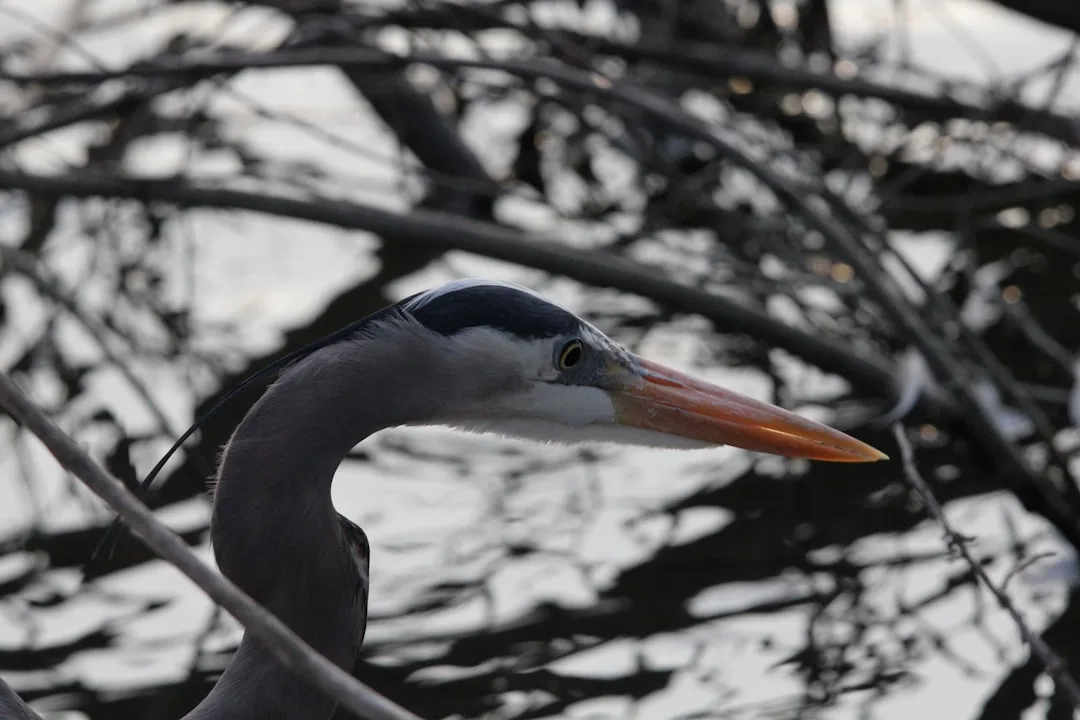
The great blue heron is the largest heron in North America and one of the most widely distributed wading birds on the continent. Standing over a metre tall on stilt-like legs, striking prey faster than the human eye can follow, and nesting in tree-top colonies that may hold hundreds of pairs, Ardea herodias combines patience, precision, and a quietly extreme lifestyle that most casual observers never fully register.
It is the bird behind the still silhouette at the edge of almost every lake, pond, marsh, and river from southern Alaska to the Galapagos.
This entry covers every aspect of great blue heron biology: size and anatomy, range and habitat, hunting mechanics, the strange powder down feathers that replace preen oil, rookery behaviour, reproduction, the famous white morph once considered its own species, hybridisation with great egrets, conservation, and the bird's long cultural and scientific history. It is a reference entry rather than a summary, so expect specifics - centimetres, grams, colony sizes, and verifiable records.
Etymology and Classification
The scientific name Ardea herodias was assigned by Carl Linnaeus in 1758 in the tenth edition of Systema Naturae. Ardea is the classical Latin word for heron; herodias is derived from the Greek erodios, which also means heron. The name is therefore a loose tautology - heron-heron - reflecting how unambiguous the bird looked to early naturalists.
The common English name "great blue" distinguishes it from the smaller little blue heron (Egretta caerulea) and from the numerous white egrets that share its habitat.
Great blue herons sit in family Ardeidae, a group of roughly 70 species of herons, egrets, and bitterns. Recent taxonomic work places Ardeidae inside order Pelecaniformes alongside pelicans, ibises, spoonbills, and the shoebill. Older classifications grouped herons in their own order, Ciconiiformes, with storks. The shift followed molecular evidence showing that herons share a more recent common ancestor with pelicans than with storks.
Within Ardea the great blue heron is part of a tight cluster of very large heron species that also includes the grey heron (Ardea cinerea) of Eurasia, the cocoi heron (Ardea cocoi) of South America, and the goliath heron (Ardea goliath) of Africa. The great blue is slightly smaller than the goliath but is the largest heron in the New World.
Size and Physical Description
Great blue herons are built tall, slim, and light. Every proportion is optimised for wading in water, striking with the bill, and flying long distances between feeding and nesting sites.
Standard measurements:
- Total length (bill to tail): 91-137 cm
- Standing height: up to 137 cm
- Wingspan: 167-201 cm
- Weight: 1.8-3.6 kg
- Bill length: 12-15 cm, dagger-shaped, yellow-orange
Plumage (breeding adult):
- Upperparts: slate blue-grey
- Neck: cinnamon-buff with black streaks down the front
- Head: white crown, black supercilium extending into long black occipital plumes
- Thighs: rufous
- Bill: yellow with an orange blush during courtship
- Legs: greenish-brown to reddish during breeding
The bill is the bird's primary tool. It is long, straight, and compressed laterally into a slightly curved dagger shape. The lower mandible is noticeably heavier than the upper, and the cutting edges are fine enough to slice through fish flesh when a strike punctures rather than simply grabs. The eyes sit slightly forward of centre to provide binocular overlap, critical for aiming the strike.
Juveniles are duller - grey-brown overall, lacking the head plumes and ornamental scapular feathers, with a dark crown instead of a white one.
The legs and feet are long but unwebbed. Herons wade through shallow water rather than swim, so webbing offers no advantage and the separated toes provide better traction on slick substrates. The middle toe of each foot carries a unique serrated claw known as the pectinate claw, which acts as a comb for distributing powder down through the plumage.
Range and Habitat
Few North American birds occupy as broad a range as the great blue heron. Breeding populations extend from southern Alaska, the southern Yukon, and central Quebec south through every contiguous US state, all of Mexico, much of Central America, and into the Caribbean. A resident population of white-morph birds inhabits the Florida Keys, the Caribbean coast, and the Yucatan. A small isolated population even breeds in the Galapagos Islands.
The species is genuinely habitat-generalist as long as two conditions are met: shallow water within foraging range and large trees within nesting range.
Habitats used for foraging:
| Habitat type | Typical prey base |
|---|---|
| Freshwater marsh | Fish, frogs, salamanders, aquatic insects |
| Lake and pond margin | Sunfish, minnows, bullfrogs, small turtles |
| River and stream edge | Trout, chub, crayfish, juvenile waterfowl |
| Saltwater estuary | Mullet, killifish, flounder, shrimp |
| Mangrove | Snapper, tarpon fry, land crabs |
| Tidal mudflat | Gobies, mud shrimp, small eels |
| Flooded agriculture | Voles, mice, frogs, grain-feeding small birds |
| Garden pond | Goldfish, koi, ornamental fish |
Northern populations migrate south to coastal areas, the southern US, Mexico, and Central America for winter. Southern populations are resident year-round. Migration occurs mainly at night, and tracked birds have moved hundreds of kilometres in a single flight, stopping to forage during daylight.
Hunting and the Lightning S-Strike
The great blue heron's hunting style is a masterclass in patience followed by violence. The bird wades into shallow water, sometimes only a few centimetres deep, and stops. The neck folds back into a tight S-curve, the head drops forward, and the bill aims downward at a precisely calibrated angle. Then nothing moves. A hunting heron can remain almost completely still for five, ten, even twenty minutes, waiting for prey to drift or swim within range.
When a fish or frog enters the strike zone, the neck releases. The folded S unloads forward like a mechanical spring, driving the bill through the water surface and onto the prey. The entire strike takes a tiny fraction of a second - measurably faster than human visual reaction time. High-speed video studies have measured strike durations in some herons below 100 milliseconds from initiation to contact.
The anatomy behind the strike:
The key adaptation is a specialised sixth cervical vertebra. In most birds all cervical vertebrae articulate in roughly the same way. In herons the sixth vertebra is elongated and its joints let the neck fold into a very tight kink. When the bird fires the strike, powerful muscles on the underside of the neck contract, straightening the kink and launching the head forward. The S-curve acts as a compressed spring. The muscles attach along lengthened cervical spines to maximise leverage.
Strike variations:
- Stab strike. Used on larger fish, frogs, and small mammals. The bill punctures the prey, which is then manipulated back to the bill tip for swallowing.
- Grab strike. Used on smaller, slippery prey. The partially opened bill closes around the prey as it contacts.
- Head-first dip. For prey just below the water surface; the head and upper neck plunge without the full-body commitment of a stab.
- Tongue thrust. After the bill closes on prey, the tongue thrusts forward from the base of the lower bill to help move the prey back into the throat and force it down.
Herons hunt day and night. The retina contains a high density of rod cells, giving them functional night vision, and there are documented records of successful fishing strikes made in near total darkness. Prey is almost always swallowed whole and head-first so that fins, spines, and gill covers fold backward rather than catch in the oesophagus.
A great blue heron eats up to one kilogram of food per day. Over a breeding season a pair feeding four chicks may catch and deliver tens of thousands of individual prey items.
Diet and Prey Range
The diet list is dramatically longer than most casual observers realise. Fish dominate, but almost anything small enough to swallow that enters shallow water is potentially prey.
Documented prey:
- Fish: minnows, sunfish, bluegill, perch, catfish, eels, mullet, killifish, carp, trout, flounder, gobies, menhaden, juvenile bass, suckers
- Amphibians: bullfrogs, leopard frogs, green frogs, tadpoles, salamanders, newts
- Reptiles: garter snakes, water snakes, juvenile turtles, small lizards
- Crustaceans: crayfish, shrimp, mud crabs
- Insects: large aquatic beetles, dragonfly larvae, grasshoppers
- Mammals: voles, mice, ground squirrels, young muskrats, occasional young rats
- Birds: ducklings, coot chicks, rail chicks, songbird fledglings, occasional kingfisher young
- Other: lampreys, pond mussels on rare occasion
The ability to eat vertebrates other than fish lets great blue herons exploit habitats where most other waders cannot survive. A flooded pasture full of voles, a roadside ditch full of small snakes, or a lawn edge next to a bird feeder are all legitimate heron hunting grounds.
Occasional prey items are larger than they should be. Documented cases include herons choked to death on fish wider than their own necks and records of herons successfully swallowing prey that took minutes of manipulation to work down the oesophagus. The species clearly pushes its upper prey-size limit, accepting occasional losses as the cost of maximising intake.
Powder Down and Self-Cleaning
Great blue herons face a grooming problem. Fish are slimy, eels coat feathers in mucus, frogs leave skin secretions, and prey blood smears across the face and upper neck after strong strikes. Most birds solve plumage contamination with preen oil from the uropygial gland at the base of the tail. For fish-feeders, preen oil alone is not enough.
Herons and a handful of related groups evolved a second system: powder down.
Powder down feathers grow in dense patches called powder down patches. Great blue herons carry three main patches: on the breast, on the flanks, and on the rump. Unlike normal feathers, powder down is never moulted. It grows continuously, and the tips disintegrate into a fine talc-like dust of keratin particles.
The bird bends down, works the bill through the patch, and rubs the resulting powder into the contaminated feathers. The powder binds to fish slime, oil, and blood, and can then be combed away.
Combing is the job of the pectinate claw - a specialised serrated claw on the middle toe of each foot. The bird draws the pectinate claw through its plumage like a comb, distributing fresh powder and pulling out the contaminated mix. The process takes several minutes per grooming session and is repeated many times per day during active feeding. Without it the plumage would lose its water-shedding and insulating properties within days.
Powder down is a rare adaptation. It is also found in some cockatoos and pigeons, but in herons and bitterns it reaches its most developed form.
Rookeries and Colonial Nesting
Despite being strict solitary hunters, great blue herons nest in large communal colonies called rookeries or heronries. A typical rookery holds 30 to 150 pairs; exceptional ones reach 500 or more. Colonies are placed in tall trees near water - often on islands or in swamps where ground predators cannot reach the nests. Some rookeries are shared with great egrets, black-crowned night-herons, and anhingas.
Rookery characteristics:
| Feature | Typical value |
|---|---|
| Colony size | 30-500 nesting pairs |
| Nest height | 6-30 metres above ground |
| Trees per rookery | 5-50 mature trees |
| Nests per tree | 1-12 |
| Nest reuse | Many rookeries occupied 20-50 consecutive years |
| Distance to foraging site | 1-25 km, occasionally farther |
Nests are bulky stick platforms that get bigger each year as returning pairs add new material. A veteran nest can reach a metre across. Some rookeries have been documented in continuous use for over 70 years.
Colonial nesting creates several advantages. Hundreds of alert adults detect approaching predators - raccoons, bald eagles, great horned owls - far earlier than a solitary pair could. Group mobbing drives off many threats.
Social information about productive foraging grounds may transfer between neighbours, and young birds appear to learn foraging behaviour partly by watching experienced neighbours leave and return with specific prey. The trade-offs include parasite and disease load, nest competition, and the visual conspicuousness of the colony itself.
Reproduction and Life Cycle
Great blue herons reach sexual maturity at two years, though many do not breed until year three. Pairs form at the rookery each spring. Males arrive first and claim nest sites, then perform elaborate displays to attract females. Displays include bill clapping, neck stretching, the spreading of scapular plumes, and aerial chases.
Breeding cycle:
- Courtship and pair formation: February-April (timing depends on latitude)
- Egg laying: March-June, clutch of 2-6 eggs, typically 3-5
- Incubation: 26-30 days, shared by both parents
- Hatching: asynchronous - first chick may emerge days before the last
- Nestling period: 7-8 weeks in the nest
- Fledging: 60 days approximately, first flights short
- Post-fledging dependence: 2-3 weeks before full independence
Eggs are pale blue-green and unmarked, roughly 65 by 45 millimetres. Both parents incubate, trading duties several times per day. Hatching is asynchronous, which means the oldest chick is always larger and stronger than the youngest. In lean seasons the youngest chick often starves because the older siblings outcompete it at feedings. In good seasons all chicks can fledge successfully.
Chicks are fed by regurgitation. Parents arrive at the nest with a crop full of prey, and chicks grab the bill or throat to trigger the adult to regurgitate onto the nest platform. Chicks squabble intensively for food and the dominant chick almost always gets the largest share. Fledglings begin flying short distances around 60 days but continue to return to the nest for feedings for another two to three weeks.
First-year mortality is roughly 70 per cent. Major causes include starvation, falls from the nest, predation, bad weather during the first migration, and collisions. Birds that reach one year typically live seven to ten additional years, and a handful reach their late teens. The longevity record for a wild banded great blue heron stands at 23 years. Captive individuals have reached 24 years and older.
White Morphs and the Great White Heron
One of the most confusing chapters in great blue heron taxonomy concerns the all-white population of southern Florida, the Florida Keys, the Caribbean, and the Yucatan coast. John James Audubon and other early ornithologists described these large white birds as a separate species - Ardea occidentalis, the great white heron - distinct from the grey great blue heron of the rest of North America.
The great white heron matches the great blue in size, bill shape, leg colour, and nesting behaviour, differing only in plumage. Detailed study in the twentieth century showed the white birds interbreed freely with grey birds where ranges overlap in the southern Everglades. The offspring of mixed pairs display intermediate plumage - mostly white body, greyish wings, pale head plumes, sometimes mottled patterns - and were informally called Wurdemann's herons.
Modern taxonomy treats the great white heron as a regional colour morph of Ardea herodias rather than a separate species. Some authorities list it as subspecies Ardea herodias occidentalis. Whether the grey-white distinction has any adaptive meaning - camouflage in bright coastal habitats, for example - remains debated. The split is genetic enough to produce a reliable colour pattern but not genetic enough to prevent interbreeding.
Hybridisation with Great Egrets
Great blue herons occasionally hybridise with great egrets (Ardea alba), producing offspring with mixed features. Hybrids are rare but documented and generally appear in colonies where both species nest in close proximity. The hybrid offspring often show the great blue's size and structural bulk with partial egret-white plumage, particularly on the body and wings.
Because great blue heron white morphs already exist in Florida, distinguishing genuine hybrids from Wurdemann-type intergrades in mixed populations can require genetic testing.
Flight and Movement
In flight, the great blue heron is unmistakable. The long neck is folded into a tight S against the body, the legs trail straight behind, and the wingbeats are slow, deep, and deliberate. Cruising speeds of 30-55 kilometres per hour are typical. Herons can soar on thermals during migration and have been tracked at altitudes exceeding one kilometre.
The folded-neck flight pose distinguishes herons from cranes, which fly with the neck fully extended. The silhouette is one of the most reliable field identification features across the whole Ardeidae family.
Conservation Status
The IUCN Red List classifies the great blue heron as Least Concern with a stable or increasing global population. Current population estimates exceed 700,000 adults in North America alone, with additional populations in Central America, the Caribbean, and the Galapagos.
Historic threats:
- Plume hunting. In the late nineteenth century herons and egrets were slaughtered across North America for ornamental feathers used in women's hats. The breeding plumes of the great blue heron were among the prizes, and several rookeries were wiped out. The outrage drove the founding of the National Audubon Society, named for John James Audubon, who painted the species as plate 211 of The Birds of America.
- DDT and pesticides. In the mid-twentieth century chlorinated pesticides thinned eggshells and reduced reproductive success. Ban on DDT in the 1970s allowed heron populations to recover.
- Wetland drainage. Historical loss of wetlands across the continent reduced foraging habitat.
Current threats:
- Human disturbance of rookeries, which can cause mass abandonment
- Power line collisions and entanglement in fishing line
- Oil spills in coastal areas
- Habitat loss in tropical wintering areas
- Localised conflict at fish hatcheries and ornamental ponds
Despite these pressures the species is one of the clearest modern conservation success stories. Rookery protections, wetland restoration under laws such as the US Clean Water Act, pesticide bans, and cultural shifts that ended plume hunting have returned great blue herons to levels that probably exceed pre-industrial populations in some regions.
Great Blue Herons and Humans
The great blue heron is one of the most recognisable birds in North America. Its silhouette appears on the logos of conservation groups, on state park signs, on fishing magazine covers, and in Indigenous art across the continent. Many coastal Indigenous peoples of the Pacific Northwest considered the heron a symbol of patience, self-reliance, and stillness.
In modern birdwatching the great blue heron is often the first large wading bird beginners identify, making it a gateway species into the broader world of waterbird observation.
The species also shows up in conflict with human interests. Anglers and fish hatchery operators sometimes treat herons as nuisance animals because a single heron can remove dozens of stocked fish from a small pond per week.
Legal protection under the Migratory Bird Treaty Act in the United States and equivalent laws elsewhere means lethal control is rarely permitted; instead, operators use netting, pond-side fences, and scare devices. Urban herons adapt surprisingly well to human presence and can be found fishing next to highways, in drainage canals, and at suburban retention ponds.
Related Reading
- Waterbirds: Flamingos, Herons, and the Masters of Wetlands
- Why Flamingos Are Pink
- Mute Swan: Elegant Icon of European Waters
- Bird Migration: The Longest Journeys in the Animal Kingdom
References
Relevant peer-reviewed and governmental sources consulted for this entry include the Cornell Lab of Ornithology Birds of the World species account for Ardea herodias, IUCN Red List assessment 2024, North American Breeding Bird Survey annual reports, the Audubon Society state-of-the-birds reports, published work on heron neck biomechanics in The Journal of Experimental Biology, and comparative plumage studies published in The Auk and The Wilson Journal of Ornithology.
Historic taxonomic references include Linnaeus's Systema Naturae (1758) and Audubon's The Birds of America (plate 211). Population and distribution figures reflect the most recent consolidated estimates available as of 2024.
Frequently Asked Questions
How big is a great blue heron?
The great blue heron (Ardea herodias) is the largest heron native to North America. Adults stand 91 to 137 centimetres tall from toe to crown, stretch to similar length from bill to tail, and spread wings 167 to 201 centimetres across. Typical body mass is 1.8 to 3.6 kilograms, with males marginally heavier than females.
Despite the imposing silhouette the bird is surprisingly light for its size - hollow bones and extensive air sacs keep mass low enough for sustained flight. Young birds reach near-adult dimensions within their first year but take two to three years to develop the full breeding plumage with long occipital plumes and ornamental scapular feathers.
Where do great blue herons live?
Great blue herons occupy wetlands across most of North America, from southern Alaska and Quebec south through Mexico and Central America, the Caribbean islands, and even the Galapagos. They are habitat generalists so long as shallow water and nearby trees are both present. Marshes, riverbanks, lake shores, estuaries, mangroves, flooded fields, garden ponds, and golf course water hazards all support feeding herons.
Northern populations migrate south in autumn while southern populations stay year-round. The species tolerates freshwater, brackish, and saltwater environments, a rare combination among wading birds.
What do great blue herons eat?
Great blue herons are opportunistic carnivores with an astonishingly broad prey list. Fish dominate the diet in most regions - minnows, sunfish, catfish, eels, perch, and any slow-moving species small enough to swallow. When fish are scarce they take frogs, tadpoles, salamanders, snakes, turtles, crayfish, shrimp, large aquatic insects, voles, mice, ground squirrels, young muskrats, ducklings, and songbird fledglings.
A single heron can consume up to a kilogram of food per day. Prey is usually swallowed whole and head-first so fins and spines fold back rather than catch in the throat.
How do great blue herons hunt?
The signature technique is the stand-and-strike. The heron wades into shallow water, freezes with its neck folded into the tight S-curve that gives the family its silhouette, and waits - sometimes for many minutes. When prey drifts within range the neck unloads like a released spring, driving the dagger-shaped bill forward faster than the human eye can follow. The specialised sixth cervical vertebra allows this explosive extension.
Most strikes are grabs rather than stabs, and larger prey is speared then manipulated back to the tip of the bill for swallowing. Herons also walk slowly through shallows, hover-hunt briefly over water, and occasionally steal fish from other birds.
What are heron rookeries and why do herons nest in colonies?
Rookeries, also called heronries, are tree-top breeding colonies where 30 to 500 pairs of great blue herons nest in close proximity. The same rookeries are used year after year and can persist for decades. Colonial nesting provides several advantages.
Predator detection is dramatically higher when hundreds of adults watch the surroundings, group mobbing can drive off raccoons and corvids, and information about productive foraging grounds seems to transfer between neighbours. The trade-off is parasite load, nest competition, and conspicuousness. Despite being solitary foragers, herons clearly benefit enough from social nesting that the behaviour has been conserved across the whole family Ardeidae.
What are powder down feathers?
Powder down feathers are a special class of down found in herons, bitterns, and a handful of other bird groups. Unlike normal feathers, powder down is never moulted. Instead it grows continuously and the tips break off into a fine talc-like dust of keratin particles. Great blue herons carry patches of powder down on the breast, flanks, and rump.
The bird works the powder into its plumage with the bill and with a specialised serrated claw - the pectinate claw - on the middle toe of each foot. The powder absorbs fish oil, slime, algae, and blood from feeding, then is combed away. Powder down effectively replaces the uropygial preen oil many other birds rely on, which is unusable on heavily slimed prey.
Is the great white heron a different species?
Not anymore. The all-white population of great blue herons found in coastal Florida, the Florida Keys, the Caribbean, and the Yucatan was originally described as a separate species, Ardea occidentalis, the great white heron. Closer study revealed the white form is a colour morph within Ardea herodias that interbreeds freely with the grey form where ranges overlap.
Offspring of mixed pairs are called Wurdemann’s herons and show intermediate plumage - white body, greyish wings, pale head plumes. Taxonomists now treat the white birds as a regional morph rather than a distinct species, though some still list them as subspecies Ardea herodias occidentalis.
How long do great blue herons live?
Wild great blue herons average about 15 years but most never reach that age. First-year mortality is especially severe - estimates put it near 70 per cent - due to starvation, predation, harsh weather, and collisions. Birds that survive the first year typically reach 7 to 10 years and a few live into their late teens. Captive individuals have reached 24 years and older thanks to consistent food, veterinary care, and the absence of migration.
Recoveries of banded wild birds include one individual banded as a chick and recovered alive 23 years later, setting the documented wild longevity record. Common natural causes of death include bald eagle attacks on nests, raccoon predation of eggs, severe cold snaps during migration, and human-related hazards such as power line collisions and fishing line entanglement.