
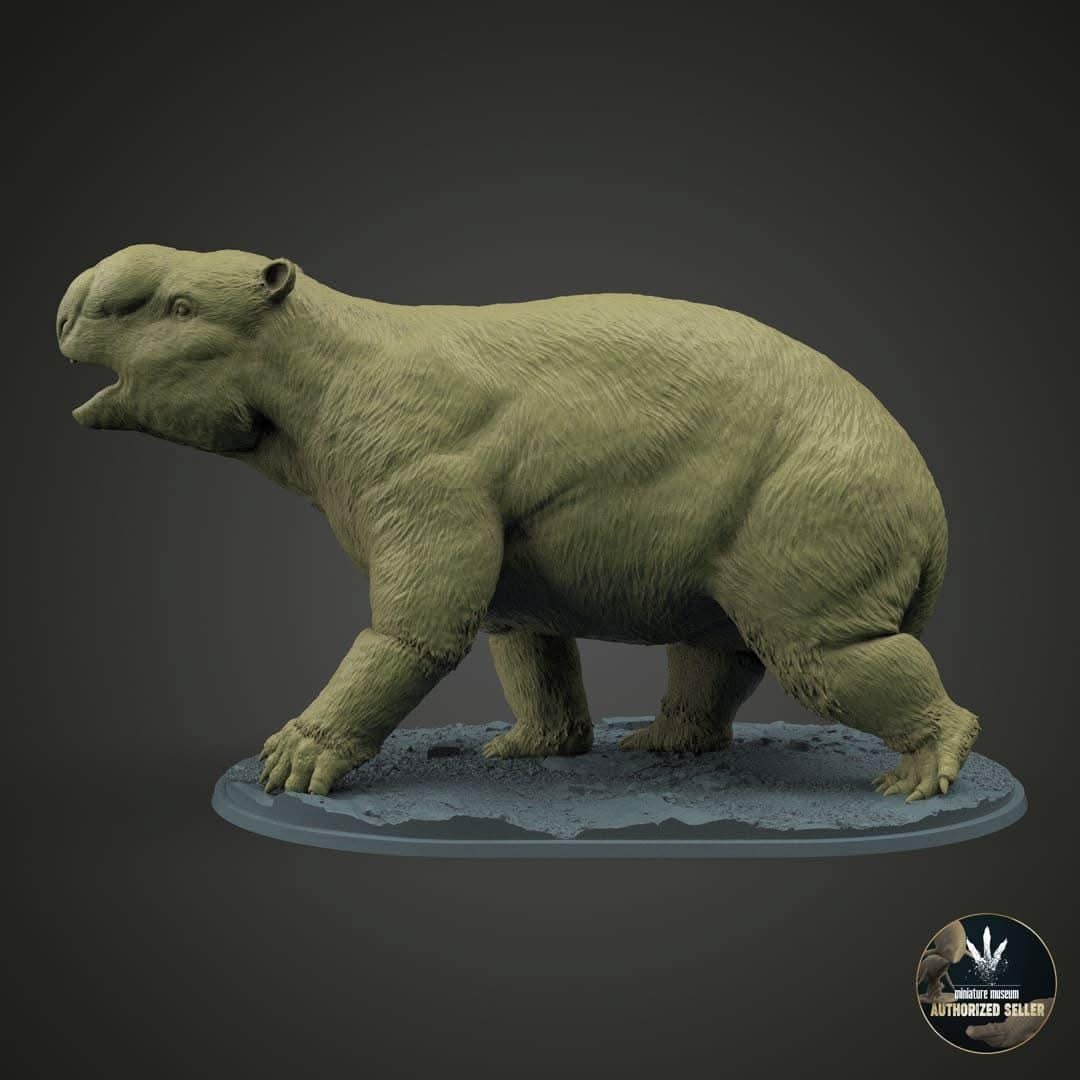
Diprotodon optatum is the largest marsupial that has ever lived. A two-tonne, barrel-bodied herbivore built along essentially the same lines as a modern wombat, it stood roughly 1.8 metres at the shoulder and stretched around 3 metres from nose to rump.
For more than a million years it was the heaviest land animal on the Australian continent, and it remains the undisputed heavyweight of pouched mammals in the fossil record. When the first people arrived in Australia, Diprotodon was still there to greet them. A few thousand years later, it was gone.
This guide covers Diprotodon in full: anatomy, size, taxonomy, ecology, reproduction, the Lake Callabonna mass-death assemblage, the possible link to the Bunyip oral tradition, the circumstances of its extinction around 46,000 years ago, and its place inside the wider story of Australian megafauna. It is a reference entry, not a summary - expect specifics: kilograms, metres, dates, sites, and named researchers.
Etymology and Discovery
The genus name Diprotodon was coined from the Greek elements meaning "two forward teeth", a reference to the pair of large, chisel-like incisors projecting from the front of the lower jaw. That tooth plan is the shared signature of the entire order Diprotodontia, which also includes living kangaroos, wombats, koalas, possums, and gliders.
The species epithet optatum is Latin for "wished for" or "hoped for", a name chosen by Sir Richard Owen in 1838 when the British Museum received its first Diprotodon fossils from New South Wales. Owen had only fragmentary teeth and jaw pieces to work with, and he was openly impatient for more complete specimens - the name records that scientific hunger.
Fossils had been noted by Australian colonists from at least the 1830s, turning up in creek banks, caves, and pastoral properties across New South Wales and Queensland. Thomas Mitchell sent material from the Wellington Caves region to Britain, where Owen identified the giant marsupial and formally described it.
Over the following decades Diprotodon bones accumulated in museum collections in Sydney, Melbourne, Adelaide, and London, but the scientific community had to wait until 1893 and the drying of Lake Callabonna before complete articulated skeletons became available.
Classification and Closest Living Relatives
Diprotodon sits deep inside the marsupial tree. Its taxonomic placement runs from the kingdom Animalia through the phylum Chordata and the class Mammalia, then into the infraclass Marsupialia, the order Diprotodontia, and the family Diprotodontidae. The genus is Diprotodon and the only widely recognised species is Diprotodon optatum, after a long 20th century history of over-splitting in which minor size differences led to the erection of multiple nominal species that were later synonymised.
The closest living relatives of Diprotodon are the wombats, family Vombatidae. Diprotodontidae and Vombatidae form a sister-group pair inside the sub-order Vombatiformes, and this relationship is supported by dental morphology, skull anatomy, and molecular data from closely related groups. Koalas (family Phascolarctidae) belong to the same sub-order and are the next closest living relatives. Kangaroos and wallabies, although also members of the order Diprotodontia, are more distantly related.
The practical implication is that Diprotodon can reasonably be described as a giant cousin of the modern wombat. The family line was not ancestral to today's wombats - the two families diverged many millions of years before Diprotodon evolved - but the body plan and dental architecture of a modern wombat offer a surprisingly close template for visualising Diprotodon. Take a 30-kilogram wombat.
Scale it by a factor of about seventy. Raise its shoulder to chest height on a tall adult human. That is roughly Diprotodon.
Size and Physical Description
Diprotodon optatum was a large, heavy, short-legged quadruped with a deep barrel body, a broad skull, and a relatively short tail.
Adult males:
- Length: up to 3 metres from nose to rump
- Shoulder height: up to 1.8 metres (around 180 cm)
- Weight: 2,500-2,800 kilograms in the largest individuals, typically around 2 tonnes
Adult females:
- Length: approximately 2.4-2.7 metres
- Shoulder height: approximately 1.5 metres
- Weight: estimated 1,500-2,000 kilograms
Sexual dimorphism in the species is marked. Detailed osteological work on the Lake Callabonna assemblage identified two overlapping size clusters, with males substantially larger than females in both linear dimensions and mass. This is a familiar pattern in large modern marsupials - red kangaroos, for example, show similar dimorphism - and suggests that adult male Diprotodon competed for mating access to females.
The skull of a large adult could exceed a metre in length. It was broad, arched across the top, and dominated by massive cheek teeth with broad, low-crowned grinding surfaces. The lower jaw carried the pair of forward-projecting incisors that give the genus its name. There were no canine teeth. Behind the incisors the jaw curved up into a deep body where the chewing muscles attached. The eyes and ears sat high on the skull, well away from the feeding zone.
The limbs were columnar and plantigrade, meaning the animal walked on the full surface of the foot rather than on toe tips. The forefeet and hindfeet were broad and five-toed. Preserved footprints in the Willandra Lakes region and elsewhere in the Australian interior show slightly inward-turned hind feet and a measured, flat-footed gait consistent with a slow, heavy walker rather than a runner.
Soft Tissue and the Callabonna Specimens
Direct evidence for Diprotodon soft tissue is unusual but not absent. The 1893 Lake Callabonna material, collected and studied by the South Australian Museum, includes specimens that preserved hair impressions and body outlines in the fine clay surrounding the bones.
The best of these show a dense covering of coarse hair on the back and flanks, suggesting a pelage similar in overall appearance to that of a modern wombat. At least one female specimen preserved what has been interpreted as an unborn joey in the pouch region, which is among the strongest direct evidence anywhere in the world for pouch reproduction in an extinct giant marsupial.
Other specimens preserved stomach or gut contents, with recognisable fragments of saltbush and other chenopod shrubs. Together with tooth wear, microwear, and isotopic data, these gut contents anchor the reconstruction of Diprotodon as a bulk browser of tough, drought-tolerant vegetation.
Ecology and Diet
Diprotodon was a herbivore specialised for processing large quantities of fibrous plant material. The dental evidence is clear. The cheek teeth have broad, low-crowned surfaces with transverse ridges that would have operated as grinding plates when the jaw moved side to side. The muscles anchoring the jaw were massive, and the skull was braced to withstand repeated high bite forces.
Microwear analysis of the enamel surfaces shows a mixed pattern of pitting and scratching consistent with a browser taking leafy and woody plant material rather than a pure grass-grazer.
Stable isotope ratios of carbon and nitrogen in tooth enamel add further detail. The carbon values indicate a diet dominated by C3 plants - trees, shrubs, and many temperate grasses - with a particular emphasis on saltbush (Atriplex) and related chenopod shrubs in the arid interior. Nitrogen values show elevated levels consistent with animals feeding in arid, salt-rich environments.
The Lake Callabonna gut contents directly confirm that animals feeding near that lake were consuming saltbush in the days before death.
Primary dietary items:
- Saltbush and other chenopod shrubs (Atriplex, Maireana, Sclerolaena)
- Coarse grasses of open woodland and savanna
- Leaves, twigs, and soft bark from low trees and shrubs
- Herbaceous plants associated with lake margins and ephemeral wetlands
Feeding posture: Diprotodon fed with the head lowered, cropping vegetation with the forward-projecting lower incisors and pulling mouthfuls back into the grinding cheek teeth. The plantigrade, four-limbed body plan and the absence of any strong evidence for rearing up suggest that nearly all feeding took place at or near ground level.
Movement, Range, and Migration
Diprotodon was not fast. The limb proportions, plantigrade gait, and massive body weight rule out any sustained running. Its locomotor niche would have been closer to that of a modern hippopotamus or rhinoceros than to a deer or a kangaroo - a heavy walker that moved deliberately and relied on size rather than speed for defence.
Isotopic work on tooth enamel has produced one of the most interesting ecological findings about the species. Tooth enamel incorporates the isotopic signature of the water and plants an animal consumes while the tooth is forming. Sampling enamel from different points along a single tooth therefore produces a time series of the animal's geochemical environment.
Several studies using this approach on Diprotodon teeth from sites in New South Wales and Queensland have detected systematic shifts in carbon and strontium ratios consistent with seasonal movement between distinct ecological zones.
In other words, individual Diprotodon appear to have migrated, travelling predictable routes between inland shrubland and richer coastal or riparian grass country on an annual cycle. Seasonal migration on that scale is otherwise unknown in marsupials, living or extinct.
Estimated travel characteristics:
| Metric | Value |
|---|---|
| Typical walking speed | Approximately 5 km/h (estimated) |
| Shoulder height | Up to 1.8 m (180 cm) |
| Body length | Up to 3 m |
| Adult body mass (large males) | 2,500-2,800 kg |
| Seasonal migration range | Hundreds of kilometres (isotope-inferred) |
| Continental range | All Australian mainland states |
Distribution Across Australia
Diprotodon fossils have been recovered from every state on the Australian mainland, which makes the species one of the most geographically widespread megafauna known from the continent. Diprotodon does not appear to have reached Tasmania, which was separated from the mainland by rising seas during much of the Late Pleistocene, nor New Guinea, which had its own distinctive diprotodontid fauna.
Key Australian Diprotodon sites:
| Site | State | Significance |
|---|---|---|
| Lake Callabonna | South Australia | Mass-death herd, articulated skeletons, soft tissue |
| Wellington Caves | New South Wales | Early 19th century finds, Owen's type material |
| Darling Downs | Queensland | Abundant fossils in fluvial sediments |
| Naracoorte Caves | South Australia | Cave-preserved remains in dated sequences |
| Cuddie Springs | New South Wales | Co-occurrence with stone tools, debated |
| Lancefield Swamp | Victoria | Late-surviving megafauna assemblage |
| Willandra Lakes / Lake Mungo | New South Wales | Footprints and fossils in dated lake sediments |
The density of sites reflects both the abundance of the species in its prime and the geological conditions that favour fossil preservation: drying lake beds, cave systems, and riverine sediments.
Reproduction and Life Cycle
Diprotodon was a marsupial, and there is no scientific reason to doubt that it reproduced the way other large members of the order Diprotodontia reproduce. A short gestation inside the uterus was followed by the birth of a tiny, embryo-like young that crawled into a pouch and attached to a teat, where the bulk of development took place over many months.
The Lake Callabonna female specimen with what appears to be a pouch young provides direct fossil evidence that the pouch existed and that it sat in the rear-opening orientation characteristic of modern wombats.
A rear-opening pouch is an adaptation to a head-down, ground-feeding lifestyle. It protects the joey from dirt, plant debris, and trampled material as the mother feeds with her nose near the ground. In wombats it also protects the joey during digging. In a 2-tonne herbivore that almost certainly did not dig extensively, the adaptation would have been purely a feeding-related carryover from ancestors that did.
Based on body size and comparisons with large modern marsupials, Diprotodon probably produced a single joey at a time, with inter-birth intervals likely measured in years rather than months. This slow reproductive pace is one of the most important ecological facts about the species. Large, slow-reproducing herbivores cannot tolerate sustained adult mortality, because their populations recover from losses too slowly.
The Lake Callabonna Assemblage
Lake Callabonna lies in the arid interior of northeastern South Australia, north of the Flinders Ranges. In 1892-1893 a severe drought dropped the lake's water level and exposed the underlying gypsum and clay sediments. Local station manager Frederick Ragless found bones projecting from the drying lakebed, and the South Australian Museum, under the direction of Edward Stirling and Alfred Zietz, organised a series of expeditions to collect the material.
What they found reset the scientific understanding of Diprotodon. Hundreds of articulated skeletons lay in the lakebed, many with the hind limbs still driven deep into the sticky clay in life position.
The interpretation favoured then and still accepted today is that during drought phases of the Late Pleistocene, thirsty animals - Diprotodon, but also giant kangaroos and other megafauna - walked out onto the drying salt crust of the lake in search of water, broke through into the soft clay beneath, and became trapped. Unable to pull themselves free, they died standing up.
The scientific value of the site is exceptional for several reasons. The articulated skeletons provide confident body-size and limb-proportion data that isolated fossils cannot. The fine-grained sediments preserve hair impressions, body outlines, and in some cases gut contents and pouch young.
The age of the assemblage is deep enough to belong to the Late Pleistocene but old enough to sample the species during a long-term drying trend that may foreshadow the environmental pressures leading up to extinction. Callabonna specimens remain the standard against which other Diprotodon finds are measured.
Diprotodon and the Bunyip
One of the most debated questions surrounding Diprotodon is whether the extinct animal lives on, in any form, inside Aboriginal oral tradition. The Bunyip is a creature widely described in the stories of several Aboriginal language groups across southeastern Australia. It is generally characterised as a heavy, dangerous, water-associated animal haunting swamps, billabongs, rivers, and lakes.
Details vary between regions, but the recurring themes include large size, association with water margins, and a cautionary function in stories that warned listeners - particularly children - to stay away from deep or unpredictable water.
Nineteenth and twentieth century naturalists who encountered Diprotodon fossils eroding from lake margins in the same landscapes where Bunyip stories circulated proposed a natural connection: the stories might preserve cultural memory of the living Diprotodon, or alternatively Aboriginal communities may have encountered large eroded bones and integrated them into existing narratives about monstrous water beings.
Both interpretations remain reasonable. Diprotodon went extinct around 46,000 years ago. That is old on a human scale but not impossibly old for cultural transmission in a continuous oral tradition spanning tens of thousands of years. And Diprotodon fossils are often exposed at exactly the kind of lake, river, and swamp margins that Bunyip stories describe, so they could plausibly have been noticed and interpreted repeatedly over millennia.
There is no single fossil, site, or named story that conclusively proves the connection. What can be said with confidence is that many archaeologists and palaeontologists regard Diprotodon and the Bunyip as the strongest candidate case anywhere in the world for very long-term cultural memory of an extinct animal, and that the stories encode genuine ecological knowledge about the dangers of salt lakes and boggy ground - the same environments in which many Diprotodon in fact died.
Extinction: Timing and Causes
Diprotodon disappears from the Australian fossil record close to 46,000 years ago, based on a combination of optically stimulated luminescence dating of enclosing sediments, uranium-series dating of cave deposits, and direct dating where possible. The 46,000 figure is the broadly accepted modern estimate. Some specific regional records extend a few thousand years earlier or later, but no widely accepted evidence places the species significantly after 40,000 years ago.
The earliest confirmed human presence in Australia is dated to at least 50,000-65,000 years ago, depending on which sites are accepted and how their ages are calibrated. The overlap between megafauna extinction and human arrival in Australia is therefore very tight - on the order of a few thousand years, in some regions less. This makes the continent one of the most important test cases for the broader question of what caused Late Quaternary megafauna extinctions worldwide.
The leading hypotheses:
Direct hunting. Large, slow-reproducing, unwary herbivores encountering skilled hunters for the first time are vulnerable. Even modest levels of sustained predation on adult females can drive a long-lived megaherbivore to extinction within a few millennia. Archaeological evidence for direct Diprotodon hunting is sparse and contested, with the Cuddie Springs site in New South Wales offering the most discussed case for co-occurrence of stone tools and megafauna remains.
Fire regime change. The arrival of humans in Australia was accompanied by substantial changes in fire frequency and intensity, inferred from charcoal records in sediment cores. Burning alters vegetation composition, shrinking fire-sensitive plant communities and expanding fire-tolerant grasses and heaths. A browser reliant on saltbush and chenopod shrubland would have been affected directly, even without being hunted.
Climatic drying. The Late Pleistocene in Australia trended drier, with shrinking lakes, advancing deserts, and reduced habitat for water-dependent species. Callabonna itself records exactly this kind of drying, and the standing-upright death posture of many skeletons is direct evidence of drought-related mortality. Climate alone, however, does not explain why Diprotodon survived many earlier drying episodes but not the one that coincided with human arrival.
The strongest current scientific position is that these three factors interacted. Climate set the stage; humans delivered the decisive additional pressure through hunting, habitat modification via fire, and possibly competitive impacts on key resources. Diprotodon, reproducing slowly and already stressed by long-term drying, could not absorb the additional adult mortality. The population collapsed over a few thousand years.
Place in the Australian Megafauna
Diprotodon was the largest member of a rich Australian megafauna that included the giant short-faced kangaroo Procoptodon goliah, the marsupial lion Thylacoleo carnifex, the giant wombat relative Phascolonus gigas, the massive terrestrial crocodile Quinkana, and the enormous goanna Varanus priscus. Most of these species disappeared within the same broad window around 40,000-50,000 years ago.
Diprotodon's size and abundance meant it was probably a keystone herbivore: its feeding, trampling, and seed dispersal shaped the composition of entire plant communities. When it vanished, those communities changed too, and Australian ecosystems have been adjusting ever since.
Related Reading
- Giant Ground Sloth (Megatherium americanum)
- Glyptodon: The Armored Giant
- Woolly Mammoth: Ice Age Giant
- Megafauna: Why the World's Largest Animals Disappeared
References
Relevant peer-reviewed and institutional sources consulted for this entry include South Australian Museum monographs on the Lake Callabonna assemblage, Richard Owen's 1838 description of the genus Diprotodon, reviews of Australian megafauna extinction chronology in Quaternary Science Reviews and Nature, stable isotope and dental microwear studies published in Palaeogeography, Palaeoclimatology, Palaeoecology, and Journal of Vertebrate Paleontology, and the Australian Museum and Museum Victoria public records on Diprotodon optatum.
Dating and extinction chronology reflect the widely accepted 46,000-year disappearance based on multiple dating techniques.
Frequently Asked Questions
How big was Diprotodon?
Diprotodon optatum is the largest marsupial known to have lived. Adult individuals reached about 3 metres from the tip of the snout to the base of the tail and stood roughly 1.7 to 1.8 metres at the shoulder - shoulder-high to a tall human. The best-supported body mass estimates place large adults at 2,500-2,800 kilograms, with typical adults around 2 tonnes. That is comparable to a modern white rhinoceros or a small hippopotamus.
Females were noticeably smaller than males, a level of sexual dimorphism similar to that seen in modern wombats and kangaroos. The skull alone could be over a metre long, dominated by the wide cheek teeth and the pair of large, forward-projecting incisors that give the genus its name.
What did Diprotodon eat?
Diprotodon was a bulk-feeding herbivore. Dental wear patterns, microwear analysis, and stable isotope ratios from tooth enamel all indicate a broad herbivorous diet dominated by saltbush (Atriplex and related chenopods), coarse grasses, leaves, and low shrubs.
Preserved stomach contents from the Lake Callabonna skeletons include recognisable saltbush fragments, confirming that these animals were actively feeding in semi-arid lake-margin vegetation when they died. The broad, low-crowned cheek teeth were well suited to grinding tough leafy material rather than hard grasses, and the massive jaw muscles generated enough force to process bulky fibrous plants.
Diprotodon probably filled a niche similar to that of modern large grazing and browsing mammals in Africa, but in an environment dominated by drought-tolerant chenopod shrublands rather than grassland savanna.
Where did Diprotodon live?
Diprotodon was distributed across almost the entire Australian mainland during the Pleistocene. Fossils have been recovered from every mainland state: in New South Wales (the Darling Downs, Wellington Caves, and Lake Mungo area), in South Australia (Lake Callabonna, Lake Eyre Basin, Naracoorte Caves region), in Queensland, in Victoria, in Western Australia, and in the Northern Territory.
The species does not appear to have reached Tasmania, which was already isolated by rising seas during much of the Late Pleistocene. Preferred habitats were open woodland, savanna, chenopod shrubland, and the margins of shallow ephemeral lakes - environments that expanded and contracted across the continent as Pleistocene climate cycled between wetter and drier phases.
When did Diprotodon go extinct and why?
Diprotodon optatum disappears from the Australian fossil record close to 46,000 years ago, based on optically stimulated luminescence dating, uranium-series dating of overlying sediments, and direct dating of fossil-bearing layers. This is within a few thousand years of the earliest confirmed human presence in Australia, usually placed at 50,000-65,000 years ago.
The leading hypothesis for the extinction combines three pressures: direct hunting by the first people to reach the continent, large-scale changes in fire regimes as humans began to burn the landscape for management, and long-term climatic drying that reduced the extent of productive lake-margin habitats.
The relative weight of these factors is still debated, but the near-synchronous disappearance of Diprotodon and most other Australian megafauna within a few thousand years of human arrival strongly implicates human impact as the decisive trigger. Diprotodon reproduced slowly, probably producing one pouch young at a time, and could not absorb sustained adult mortality.
Was Diprotodon really a giant wombat?
Not literally, but close to it. Diprotodon belongs to the family Diprotodontidae, which is the sister family to Vombatidae (modern wombats). This makes wombats the closest living relatives of Diprotodon - closer than any kangaroo, koala, or possum.
Body plan confirms the relationship: Diprotodon was barrel-bodied, short-tailed, four-limbed, and plantigrade, with rodent-like forward-pointing lower incisors and powerful grinding cheek teeth, essentially a scaled-up wombat silhouette. The scaling, however, is extreme. A common wombat weighs roughly 25-35 kilograms. Diprotodon weighed roughly 2,000-2,800 kilograms, so the lineage underwent a mass increase of roughly seventy-fold.
Unlike wombats, Diprotodon does not appear to have been an extensive burrower - adult body mass almost certainly made that impossible - but the family resemblance in skull, tooth, and limb architecture is obvious.
What is the Lake Callabonna site and why does it matter?
Lake Callabonna is a shallow salt lake in the arid interior of South Australia. In 1893 a severe drought dropped the lake’s water level and exposed the gypsum and clay sediments of the old lakebed, where station manager Frederick Ragless and later scientific parties under the South Australian Museum found hundreds of articulated Diprotodon skeletons, many still in life position with the hind limbs driven deep into the sticky clay.
The interpretation is that during drought periods of the late Pleistocene, thirsty animals walked out onto the drying lake surface, broke through a salt crust, and became trapped in the soft mud beneath, where they died standing upright. Several specimens preserved hair impressions, gut contents, and what appears to be an unborn pouch young inside one female.
Callabonna is scientifically important because it provides not only complete skeletons but also ecological context, diet evidence, reproductive biology, and a direct window into the behaviour of a megafaunal species in its last tens of thousands of years.
Is the Bunyip connected to Diprotodon?
The link is plausible but unproven. The Bunyip is a water-margin creature described in the oral traditions of several Aboriginal language groups, particularly across southeastern Australia, as a large, heavy, dangerous animal associated with swamps, billabongs, and lakes.
When European naturalists of the 19th century began describing Diprotodon fossils from similar wetland settings, some researchers suggested that Bunyip stories might preserve cultural memory of the living animal, or alternatively that Aboriginal communities encountering eroded fossils may have incorporated them into existing narratives of monstrous water beings. Both possibilities are defensible.
A 46,000-year-old extinction is arguably recent enough for transmitted memory in an oral culture with deep continuity, and Diprotodon fossils are conspicuous enough at lake margins to have been noticed and interpreted for millennia.
No single fossil, site, or narrative proves the connection, but many archaeologists and palaeontologists regard it as one of the strongest candidate examples of long-term cultural memory of an extinct animal anywhere in the world.
Did Diprotodon have a pouch like a kangaroo?
Yes. Diprotodon was a marsupial in the order Diprotodontia, and females almost certainly had a rear-opening pouch similar to that of modern wombats. The preserved Callabonna female with what appears to be an unborn joey in the pouch region provides direct fossil evidence for pouch reproduction in the genus.
A rear-opening pouch - with the opening pointing toward the tail rather than the head - makes sense for a heavy, head-down animal that browsed on low vegetation and may have dug shallow depressions, because it prevents dirt and plant debris from entering the pouch during feeding. As in other large diprotodontian marsupials, gestation was probably short, followed by many months of pouch development and a further period of at-heel dependence.
One pouch young at a time, with long inter-birth intervals, is the most likely reproductive pattern. This slow reproductive rate is one of the reasons Diprotodon was vulnerable to sustained adult mortality once humans arrived in Australia.