
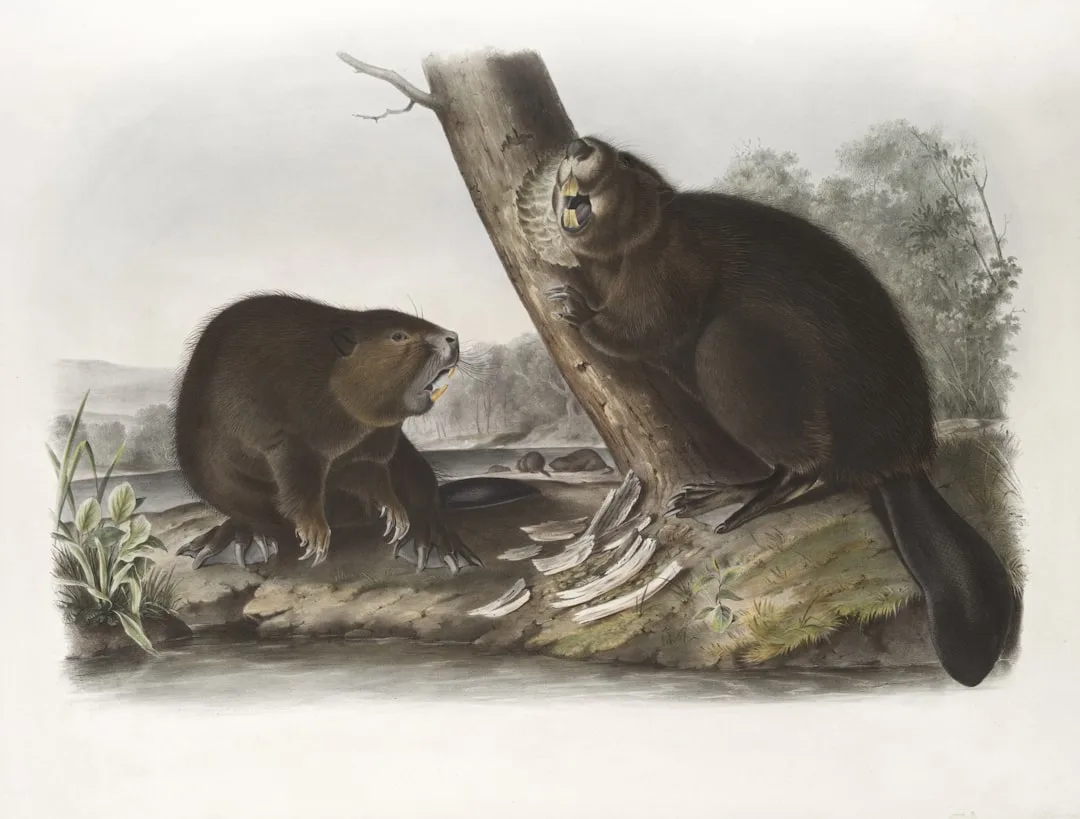
The giant beaver (Castoroides) status: Extinct. Temporal range: Pliocene to Pleistocene, roughly 3 million to 10,000 years ago.
The giant beaver, Castoroides ohioensis, was the largest rodent ever to live in North America and one of the most misunderstood members of the Ice Age megafauna. It was bear-sized, up to 2.5 metres long, weighed as much as 220 kilograms, and carried 15-centimetre incisors that grew continuously throughout life.
It survived the full depth of the last Ice Age and only disappeared around 10,000 years ago, alongside mammoths, mastodons, and giant ground sloths. And despite what almost every popular account claims, it did not build dams.
This guide is a reference entry, not a summary. It covers what Castoroides actually was - size, anatomy, habitat, distribution, diet, extinction - and what it was not. It draws on the 2019 Plint et al. stable isotope study that rewrote our picture of the species' diet, the broader paleontological record accumulated since the first skulls were described in Ohio in the 1830s, and the oral traditions of Indigenous peoples who may preserve cultural memory of the last surviving populations.
Etymology and Classification
The genus name Castoroides means "beaver-like" in Latin, a nod to the moment in the 19th century when paleontologists finally decided that the enormous skulls coming out of Ohio farmland belonged to an oversized rodent rather than to a bear. The species name ohioensis records the Ohio specimens that served as the type material.
A second, more western species - Castoroides dilophidus - was later erected for populations from Florida and the southeastern United States, though taxonomic work continues to refine the boundaries between the two.
Castoroides belongs to the family Castoridae, the beaver family. That family today contains only two surviving species: the North American beaver Castor canadensis and the Eurasian beaver Castor fiber. Castoroides and Castor share a distant common ancestor, but their lineages split more than ten million years ago. The giant beaver is not the ancestor of the modern beaver. It is a cousin whose branch of the family tree ended when the last Castoroides died around 10,000 years ago.
The full taxonomic placement is: Animalia - Chordata - Mammalia - Rodentia - Castoridae - Castoroides - C. ohioensis.
Size and Physical Description
Castoroides was large. Not large for a rodent - large in absolute terms. Adult individuals reached 2.5 metres from nose to tail and are estimated to have weighed between 90 and 220 kilograms, with the largest animals approaching the size of an American black bear. The modern North American beaver, by contrast, rarely exceeds 30 kilograms and is normally closer to 20.
Body proportions:
- Total length: up to 2.5 m nose to tail
- Estimated body mass: 90-220 kg, depending on individual and method
- Skull length: up to 30 cm in the largest specimens
- Incisor length: up to 15 cm, longer than a human hand
- Limb proportions: shorter and more aquatic than a modern beaver's
The body was long and heavy rather than compact. Limbs were relatively short with broad feet suited to paddling through dense aquatic vegetation, not to travelling overland.
The tail is not preserved in soft tissue in any known specimen, but the caudal vertebrae are long and round in cross-section rather than flattened, which strongly implies that the tail was long and cylindrical - more like a muskrat's than like the broad flat paddle most people picture when they hear the word "beaver." That one anatomical detail, small as it sounds, is a major clue that Castoroides was not simply a scaled-up modern beaver.
The head was massive. The braincase sat behind an enormous rostrum - the part of the skull that anchors the cheek teeth and houses the roots of the incisors. Those incisors, the most famous feature of the animal, were the longest ever recorded in any rodent, living or extinct. They grew throughout life, as all rodent incisors do, and were worn back by constant use.
The incisors:
- Up to 15 cm long above the gum
- Continuously growing, as in all rodents
- Rough, textured enamel surface rather than smooth chisel edge
- Designed for cropping fibrous plant material, not felling trees
The enamel texture is a crucial detail. A modern beaver's incisors carry a hard, smooth, orange-stained enamel layer on the outer face and softer dentine behind it, producing a self-sharpening chisel edge ideal for biting through hardwood. Castoroides incisors do not show that chisel architecture. Their rough, striated surface is consistent with cropping and processing fibrous aquatic plants, not with cutting down trees.
Built for Swamps, Not Rivers
The modern beaver is a cold-climate river specialist. It prefers fast, forested streams, builds lodges of sticks and mud, fells small trees for construction material and winter food, and maintains dams that flood woodland to create defensible pond habitat. Almost every popular description of the giant beaver assumes that Castoroides did the same thing, only bigger. That assumption is wrong.
Castoroides was a warm-wetland specialist. Fossil occurrences cluster overwhelmingly in environments that reconstruct as warm, slow, vegetation-choked swamps and marshes: oxbow lakes, cypress swamps, cattail marshes, and the weedy margins of larger lakes. The giant beaver needed still or slow-moving water, abundant aquatic vegetation, and mild winters that kept the marshes ice-free for most of the year. It did not live in the cold forested river systems preferred by Castor.
Preferred habitat:
- Warm, slow, lowland wetlands
- Marshes, oxbow lakes, cypress swamps
- Weedy lake margins with abundant submerged and emergent plants
- Low-relief country, often glaciated lowlands or coastal plains
Distribution:
- Ohio River valley and Great Lakes region
- Midwestern glaciated plains
- Southeastern United States including Florida
- Northern Great Plains and boreal Canada
- As far north as the Yukon
More than 150 fossil sites have produced Castoroides remains, making the giant beaver one of the better-known members of the North American Pleistocene megafauna. Richest concentrations come from Indiana, Ohio, Illinois, and southern Ontario, with important secondary concentrations in Florida and the Yukon.
Diet - The 2019 Isotope Revolution
For most of the 20th century, the working picture of Castoroides was a Volkswagen-sized beaver chewing through pine forests and building enormous dams. That picture collapsed in 2019.
Tessa Plint and colleagues, working primarily with specimens from the Great Lakes region, used stable isotope analysis of carbon and nitrogen in bone collagen to reconstruct the animal's diet. The result was unambiguous: Castoroides was eating submerged and emergent aquatic plants, not woody bark or cambium. Its isotope signature matched a strict aquatic-plant herbivore, not a tree-feller.
Implications of the 2019 study:
- Castoroides was not a dam builder. No felled-tree assemblage, no lodge, no dam has ever been attributed to the species, and the isotope data explain why: the animal was not consuming trees.
- Castoroides was behaviorally and ecologically distinct from the modern beaver, despite belonging to the same family.
- Castoroides was tightly bound to warm, vegetation-rich wetlands. When those wetlands contracted at the end of the Ice Age, the giant beaver had nowhere to go.
- The image of a giant ancestral beaver felling Ice Age forests is incorrect in every important detail.
What Castoroides probably ate:
- Cattails and other emergent marsh plants
- Pondweeds, water lilies, and other submerged aquatic plants
- Soft aquatic vegetation accessible from the water surface
- Fibrous plant material processed by cropping rather than chiseling
This narrow dietary niche helps explain the species' geographic distribution, its habitat preferences, and ultimately its extinction. An obligate warm-wetland grazer is exactly the kind of specialist that struggles when wetlands dry out and cool down.
Life Cycle and Behavior
No direct information exists about Castoroides reproductive biology. No preserved nests, no burrows attributable to the species, no fossilised juveniles in family groups. Everything inferred about its life cycle comes from comparison with other large rodents and from the animal's anatomy.
Based on those comparisons, likely features include:
- Long generation time for a rodent, on the order of several years to sexual maturity
- Small litter sizes relative to smaller rodents, possibly one to three offspring
- Long parental care compared to small rodents
- Aquatic or semi-aquatic life history spent mostly in and around water
- Slow overland movement - the limb proportions do not suggest fast terrestrial locomotion
The giant beaver was almost certainly an obligate swimmer that rarely ventured far from water. Its body plan, its habitat preference, and the inferred tail morphology all point to an animal that fed, rested, and moved within wetland systems rather than crossing open ground. Whether it lived solitarily, in pairs, or in larger family groups is genuinely unknown.
Movement, Range, and Anatomy in Water
Castoroides was built for paddling through dense aquatic vegetation, not for overland travel or fast swimming in open water. Its limbs were relatively short, its feet broad, and its body long and heavy. The round-cross-section tail would have served as a rudder and possibly a counterweight rather than as a propulsive paddle.
Anatomical comparison with the modern beaver:
| Feature | Giant beaver (Castoroides) | Modern beaver (Castor) |
|---|---|---|
| Body length | Up to 2.5 m | ~0.9-1.2 m |
| Body mass | 90-220 kg | 15-30 kg |
| Incisor length | Up to 15 cm | ~2-3 cm |
| Incisor enamel | Rough, textured | Smooth, chisel-edged |
| Tail shape | Long, round in cross-section | Broad, flat, paddle-shaped |
| Preferred habitat | Warm vegetation-rich swamps | Cold forested rivers and streams |
| Diet | Aquatic plants (Plint et al. 2019) | Bark, cambium, leaves, aquatic plants |
| Dam-building | No evidence | Yes, well-documented |
| Lodge-building | No evidence | Yes, well-documented |
| Status | Extinct ~10,000 years ago | Extant |
Every one of these differences matters for ecology. The giant beaver was not just a bigger version of the modern beaver. It was a different animal with a different lifestyle in a different habitat.
Extinction and the Late Quaternary Collapse
Castoroides disappeared approximately 10,000 years ago, at the transition between the Pleistocene and the Holocene. The latest reliably dated specimens cluster between about 11,500 and 10,000 years ago, overlapping the final window of the late Quaternary megafauna extinction.
Timeline of decline:
- ~14,000 years ago: range begins contracting as climate warms
- ~12,000 years ago: warm wetlands drying or cooling across much of the midcontinent
- ~11,500 years ago: populations clearly reduced, distribution fragmented
- ~10,000 years ago: last confirmed occurrences
Drivers of extinction:
The consensus among paleontologists is that Castoroides went extinct through a combination of pressures, with one primary and one secondary factor:
- Climate-driven habitat loss. The rapid climate shifts at the end of the last Ice Age drained, cooled, or transformed the warm wetlands Castoroides depended on. Species with narrow habitat requirements and specialized diets - exactly the profile revealed by the 2019 Plint study - are the most vulnerable in rapid environmental change. The giant beaver could not relocate to new habitat because the warm weedy swamps it needed were shrinking across its entire range.
- Human arrival and spread. The human colonisation of North America around 15,000 years ago added another stressor. Direct hunting evidence for Castoroides is limited, but humans modify wetlands, compete for aquatic resources, and act as additional pressure on populations already struggling with environmental change. Human arrival did not cause the extinction on its own, but it likely accelerated the collapse.
Castoroides vanished at the same time as mammoths, mastodons, giant ground sloths, short-faced bears, saber-toothed cats, and the American cheetah. It was part of a continent-wide collapse that reshaped North American ecosystems permanently. No Castoroides-sized rodent has taken its place. The niche remains empty.
Confusion With Bears and Other Misidentifications
The first well-preserved Castoroides fossils came out of Ohio farmland in the 1830s. They were so large that several of the paleontologists who first examined them reached briefly for a bear identification. A skull over 30 centimetres long with massive roots to anchor ever-growing incisors did not match any living rodent the scientific community was familiar with.
The bear hypothesis was short-lived. Careful examination of the dental formula - a single pair of enlarged upper and lower incisors followed by a gap and then cheek teeth, a pattern diagnostic of rodents - placed the animal firmly in Rodentia and then, on further study, in the beaver family. The genus name Castoroides, meaning "beaver-like," commemorates that eventual reclassification.
The episode is a useful historical reminder of how strange a bear-sized rodent looks. Even trained anatomists needed time to accept the evidence.
Indigenous Oral Traditions
Several Algonquian peoples, including Ojibwe communities of the western Great Lakes, preserve oral traditions that describe a very large beaver living in deep lakes - sometimes inhabiting enormous lodges, sometimes defeated by a culture hero, sometimes simply present as a supernatural being of the waters. Similar motifs appear in Innu, Mi'kmaq, and other Algonquian traditions.
Some ethnographers and paleontologists have argued that these stories preserve cultural memory of the last Castoroides populations. The argument has three parts. First, Castoroides survived in parts of North America until at least 10,000 years ago, well after the human arrival.
Second, the geographic distribution of the richest Castoroides fossil sites overlaps closely with the territories of the peoples whose traditions mention giant beavers. Third, oral traditions in preliterate societies can retain accurate memory across long timespans when the content is embedded in geography, ritual, or repeated teaching.
Other scholars caution that giant-animal motifs are extremely common in world mythology and need not reflect any specific extinct species. Bears, bison, wolves, birds, and many other animals appear in enlarged form in oral traditions without implying that giant bears or giant bison actually existed.
The debate is not fully resolved, and it probably cannot be, but the overlap between Algonquian giant-beaver traditions and the Castoroides fossil record is real, and it belongs in any serious account of the species.
Giant Beaver Versus Modern Beaver - Summary
A clean way to finish is to restate the core contrasts in one place. The giant beaver and the modern beaver share a family and a superficial body plan. Almost everything else is different.
- Castoroides was up to ten times the body mass of a modern beaver.
- Castoroides had incisors up to five times as long, with rough rather than chisel-edge enamel.
- Castoroides lived in warm weedy swamps rather than cold forested rivers.
- Castoroides ate aquatic plants rather than bark and cambium.
- Castoroides left no evidence of dam-building or lodge-building.
- Castoroides had a long round tail rather than a broad flat paddle.
- Castoroides is extinct. Castor is not.
- Castoroides is not the ancestor of the modern beaver. They are distant cousins whose lineages split more than ten million years ago.
Understanding the giant beaver is partly a matter of unlearning the intuitive comparison with its modern cousin and then seeing the animal on its own terms: a bear-sized, warm-wetland, aquatic-plant specialist that vanished when its habitat did.
Related Reading
- Woolly Mammoth: Ice Age Giant and De-Extinction
- Giant Ground Sloth
- Short-Faced Bear: The Largest Carnivore That Ever Lived in the Americas
- Glyptodon: The Car-Sized Armadillo of the Ice Age
- Megafauna: Why the World's Largest Animals Disappeared
References
Relevant peer-reviewed sources consulted for this entry include Plint, T., Longstaffe, F. J., and Zazula, G.
(2019), "Giant beaver palaeoecology inferred from stable isotopes," Scientific Reports, on the dietary reconstruction that overturned the tree-feller hypothesis; Kurten, B. and Anderson, E., Pleistocene Mammals of North America (Columbia University Press), for the foundational taxonomic and distributional framework; FAUNMAP and Paleobiology Database entries for Castoroides occurrences across more than 150 North American sites; and survey treatments of the late Quaternary megafauna extinction published in Science and Quaternary Science Reviews.
Dates for last appearance reflect calibrated radiocarbon ranges consolidated in the most recent published reviews.
Frequently Asked Questions
How big was the giant beaver?
The giant beaver (Castoroides ohioensis) was the largest rodent ever to live in North America. Adult individuals reached up to 2.5 m in length nose to tail and weighed between roughly 90 and 220 kg, placing the largest animals in the size range of a black bear. For comparison, the modern North American beaver (Castor canadensis) rarely exceeds 30 kg. Skull length alone could exceed 30 cm.
The incisors were up to 15 cm long, longer than a human hand, and grew continuously throughout life. The giant beaver was not just a scaled-up version of the modern beaver - its body was more elongated, its tail was probably round rather than paddle-shaped, and its limbs suggest a slower, more aquatic lifestyle rather than the agile dam-builder niche occupied by Castor today.
Did giant beavers build dams?
No. Despite a century of fossil collection across North America, there is no evidence that Castoroides built dams or lodges. No felled-tree assemblages, no gnawed branch piles, and no lodge structures have ever been confidently attributed to the species. A 2019 stable isotope study led by Tessa Plint demonstrated that the giant beaver’s diet was dominated by aquatic plants rather than the woody bark and cambium consumed by modern beavers.
The rough enamel of its incisors further suggests they were not used to fell trees the way a modern beaver’s chisel-like teeth are. The picture that emerges is a large, slow swamp herbivore grazing on submerged and emergent vegetation - biologically and behaviorally very different from the dam-engineering Castor that shares its family.
Where did giant beavers live?
Castoroides was a North American wetland specialist. Fossils have been recovered from more than 150 sites ranging from Florida in the south to the Yukon Territory in the north, with especially rich concentrations in the Great Lakes region, the Ohio River valley, and the glaciated plains of the upper Midwest. Its preferred habitat was warm, slow, vegetation-rich wetlands: marshes, swamps, oxbow lakes, and the shallow weedy margins of larger lakes.
This is a meaningful contrast with the modern beaver, which favors cold forested rivers and streams. Castoroides followed the retreat and advance of wetland habitat through successive glacial cycles, and its distribution shrank as wetlands dried out and cooled at the end of the Pleistocene.
When did giant beavers go extinct?
Giant beavers disappeared approximately 10,000 years ago, at the very end of the Pleistocene and the start of the Holocene, as part of the late Quaternary megafauna extinction. The latest reliably dated specimens cluster between 11,500 and 10,000 years ago. Extinction timing closely overlaps the disappearance of mammoths, mastodons, giant ground sloths, short-faced bears, and many other large North American mammals.
Two primary drivers are generally invoked: rapid climate shift at the close of the last Ice Age, which drained and cooled the warm wetlands Castoroides depended on, and the arrival and spread of human populations across North America. The current consensus is that habitat loss from drying wetlands was the dominant pressure on giant beavers, with human arrival acting as an additional stressor on an already shrinking population.
Is the modern beaver descended from the giant beaver?
No. The modern beaver is a distant cousin, not a descendant. Castoroides and Castor share the family Castoridae but belong to separate lineages that diverged more than 10 million years ago. When the giant beaver disappeared around 10,000 years ago it left no descendants - its branch of the beaver family tree ended.
The modern North American beaver (Castor canadensis) and the Eurasian beaver (Castor fiber) evolved along their own path, keeping a smaller body, a broad flat tail, chisel-edge incisors, and the tree-felling, dam-building behavior that defines beavers in the popular imagination.
The two species coexisted for at least a million years before Castoroides went extinct, occupying different ecological niches: Castor in cold forested rivers, Castoroides in warm weedy swamps.
Why were the first giant beaver fossils confused with bears?
The earliest well-preserved Castoroides fossils, described in the early 1800s from Ohio, included skulls and jaw fragments that were so large that several paleontologists of the period initially considered a bear identification. A skull more than 30 cm long with massive roots for ever-growing incisors did not match any living rodent.
Once dental features - particularly the single pair of chisel-like upper and lower incisors characteristic of rodents - were examined in detail, the bear hypothesis was abandoned and the species was placed in the beaver family. The name Castoroides, meaning ‘beaver-like,’ reflects that eventual reclassification. The early confusion is a useful reminder of just how unusual a bear-sized rodent looks in the fossil record.
Do Indigenous oral traditions remember the giant beaver?
Several Algonquian peoples, including Ojibwe communities around the Great Lakes, preserve oral traditions describing a very large beaver living in deep lakes, sometimes said to occupy enormous lodges or to have been hunted by a culture hero.
Some ethnographers and paleontologists have argued that these stories may preserve cultural memory of late-surviving Castoroides populations, since the species persisted in parts of North America until roughly 10,000 years ago, well after humans arrived. Others caution that giant-animal motifs are common in oral traditions worldwide and need not reflect a specific extinct species.
The debate is not fully resolved, but the geographic overlap between Algonquian oral traditions and the richest Castoroides fossil sites is striking.
What did the giant beaver actually eat?
The 2019 stable isotope study by Plint and colleagues found that the giant beaver’s diet was dominated by submerged and emergent aquatic plants rather than bark, twigs, and cambium. This finding overturned more than a century of assumption that Castoroides was simply a large tree-feller like its modern cousin.
The rough, textured enamel of its 15 cm incisors is consistent with cropping and processing fibrous aquatic vegetation rather than chiseling through hardwood. Its preferred habitat - warm, weedy wetlands - supports this reconstruction. Giant beavers probably grazed on cattails, pondweeds, water lilies, and similar soft aquatic plants.
When the warm wetlands they depended on contracted at the end of the Ice Age, this dietary specialization likely contributed to their disappearance.