
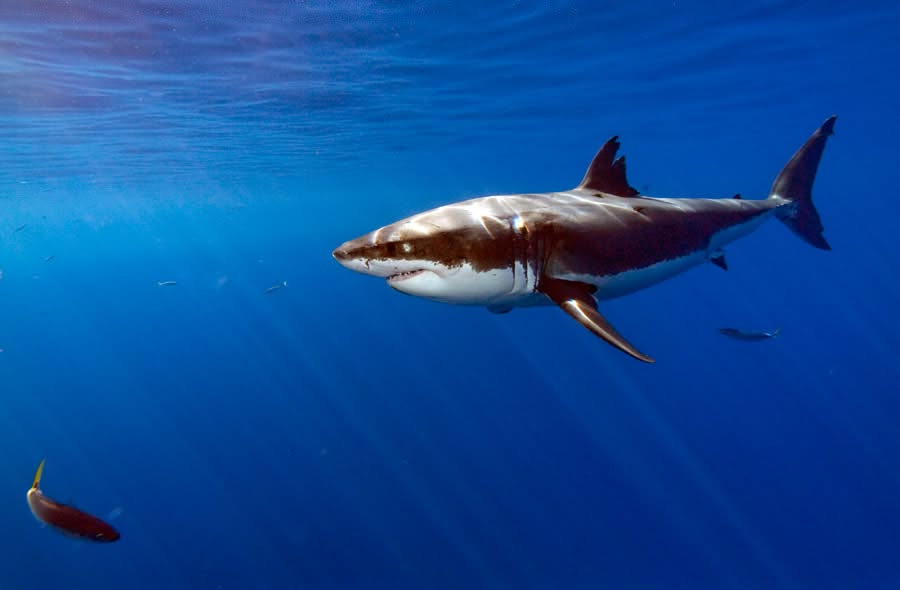
The great white shark is the largest predatory fish alive today and one of the most misunderstood animals on Earth. Carcharodon carcharias occupies the top of coastal marine food chains from South Africa to California, hunts with a combination of overwhelming sensory equipment and explosive ambush tactics, and does something almost no other fish does: it keeps its body substantially warmer than the water around it.
For a species burned into popular culture by a single 1975 film, the scientific reality is stranger, slower, and more vulnerable than the Jaws-era image suggests.
This guide covers every aspect of great white shark biology and ecology: size and anatomy, sensory systems, hunting strategy, diet, reproduction, migration, conservation status, and the relationship between the species and the humans who fear, fish, and film it. It is a reference entry, not a summary - so expect specifics: metres, kilograms, temperatures, population numbers, and verified records. Where scientific consensus has shifted in the last two decades, those shifts are flagged.
Etymology and Classification
The scientific name Carcharodon carcharias derives from Greek roots meaning "jagged tooth", a reference to the species' signature serrated, triangular dentition. Andrew Smith coined the modern binomial in 1838, consolidating earlier descriptions going back to Linnaeus. Common names across languages tend to emphasise colour, size, or menace: white shark, white pointer, white death, grand requin blanc, squalo bianco, tiburon blanco.
Great white sharks belong to the order Lamniformes, the mackerel sharks, a lineage that also contains shortfin and longfin makos, porbeagles, salmon sharks, and the filter-feeding basking shark. Within Lamniformes they sit in the family Lamnidae alongside the makos and porbeagle - the warm-bodied, high-performance predators of the shark world.
Fossil evidence places the genus Carcharodon in the ocean for at least sixteen million years. The extinct megalodon (Otodus megalodon) was once grouped in the same genus but most modern researchers place it in a separate lineage that went extinct roughly 3.6 million years ago.
Genetic work over the last fifteen years has resolved long-standing questions about great white population structure. Pacific, Atlantic, Australian, and South African populations show measurable genetic differentiation, with matrilineal isolation driven by female site fidelity to specific nursery and aggregation areas. Males, by contrast, roam freely and transport gene flow between populations.
Size and Physical Description
Great whites are the largest predatory fish alive today. They are not the largest shark - that title belongs to the filter-feeding whale shark - but among predators that actively hunt, nothing in the ocean is larger.
Typical adults:
- Length: 3.5-6.0 metres
- Weight: 680-2,270 kilograms
- Bite force: estimated up to 1,800 kilograms per square centimetre at the rear teeth
Largest verified individuals:
- Deep Blue, female, estimated 6.1 metres, repeatedly filmed at Guadalupe Island and Hawaii
- Historical records of 6.4-7.0 metre specimens exist but fail modern verification standards
- The largest reliably weighed specimen tipped scales above 2,200 kilograms
Newborn pups:
- Length: 1.2-1.5 metres
- Weight: 20-25 kilograms
- Fully independent predators from the moment of birth
Females grow larger than males, a pattern common across lamniform sharks and linked to the enormous energetic demand of producing large, fully formed live young. The body is torpedo-shaped - a classic thunniform hydrodynamic profile shared with tuna, makos, and billfish - optimised for sustained cruising punctuated by short bursts of extreme acceleration. The caudal (tail) fin is nearly symmetrical top-to-bottom, another hallmark of high-speed pelagic swimmers.
The countershaded coloration is distinctive and functional: a dark grey, slate, or brown dorsal surface matches the seafloor or open water when viewed from above, while a stark white belly dissolves into sky-light when viewed from below. A prey animal swimming beneath a great white sees white against bright water; a prey animal swimming above sees dark against dark. This is the visual basis of the shark's preferred ambush from below.
Dentition and Jaws
Great white teeth are the species' most iconic feature and its most important predatory tool. Each tooth is serrated along both edges like a steak knife, triangular, and up to 6.6 centimetres tall in a large adult. The serrations allow the shark to cleanly saw through skin, blubber, and bone in a single shearing bite rather than relying on grip strength alone.
Teeth are arranged in multiple rows inside the jaw, typically five to seven rows deep. Only the outermost row is functional at any given time. When a tooth is lost or broken - which happens routinely during feeding - the next row rotates forward conveyor-belt style to replace it within days. Across a seventy-year lifespan a single great white cycles through thousands of teeth, which is why fossil and beach-washed shark teeth are so common compared with whole skeletons.
The jaw itself is not rigidly fixed to the skull. Instead it protrudes forward during a bite, pushing the upper teeth out past the snout while simultaneously rotating down against the lower jaw. This gives the shark a wider, deeper bite than cranial anatomy would otherwise allow, and it isolates the shock of impact from the braincase.
Warm Blood in Cold Water
Almost every other fish in the ocean is ectothermic - body temperature tracks water temperature. Great whites are different. Along with their lamnid relatives, the species possesses a biological heat exchanger called the rete mirabile, a dense mesh of intertwined arteries and veins that traps metabolic heat generated by swimming muscles.
Venous blood returning from the core is warmed further by arterial blood flowing the other way, keeping heat inside the body cavity instead of losing it to cold water across the gills.
Core body temperature measurements on great whites show sustained readings up to 14 degrees Celsius above ambient water temperature. A shark hunting in 12-degree California water can maintain a core of 25 or 26 degrees, comparable to a warm room.
This confers several advantages over cold-blooded competitors: faster muscle contraction, higher sustained cruising speed, sharper nervous system response, improved digestion of high-fat prey, and tolerance of a far wider geographic range than ectothermic predators could occupy.
The metabolic cost is steep. Great whites need enormous amounts of calorie-dense prey to sustain endothermy, which is why pinniped blubber - almost pure fat - is the preferred food for adults. It is also why juveniles, whose rete mirabile is not yet fully efficient, stick to fish-dominated diets in warmer water until they grow into their endothermy.
Senses
Great whites possess arguably the most complete sensory toolkit of any marine predator. Each system covers a different range, and together they triangulate on prey from kilometres away to centimetres.
Vision. Large eyes with a reflective tapetum lucidum behind the retina maximise light collection in murky or dim water. Stereoscopic overlap in the forward visual field supports depth perception during close strikes. Recent research suggests great whites are colour-blind, but exceptionally sensitive to contrast and motion.
Hearing and lateral line. Low-frequency sounds - especially the irregular thrashing of an injured fish or struggling seal - attract great whites from more than a kilometre away. A mechanosensory lateral line running the length of the body detects water displacement, giving the shark a kind of touch-at-a-distance as it closes on prey.
Olfaction. The olfactory organs can detect blood and bodily fluids at concentrations of roughly one part in ten billion under favourable current conditions. Great whites can follow a scent trail through open water for hours.
Ampullae of Lorenzini. Clusters of jelly-filled pores on the snout function as biological electrometers, detecting electrical fields as weak as one billionth of a volt per centimetre.
Every muscle contraction in every prey animal generates a small electrical field, and the ampullae allow a great white to pinpoint a hidden seal's heartbeat through sand, detect a fish's gill movements in zero visibility, and even orient to Earth's magnetic field during long migrations.
This system is so effective that it has inspired a generation of biomimetic sensors used in underwater robotics and medical imaging research.
Hunting and Diet
Great whites are opportunistic apex predators whose hunting behaviour shifts dramatically with age and location. Juveniles under about 2.5 metres feed mostly on fish, rays, and smaller sharks. Their teeth at this stage are narrower and more pointed, optimised for gripping slippery fish rather than shearing blubber. As they grow, their jaw broadens, their teeth shift to the signature wide triangular shape, and their diet transitions toward marine mammals.
Adult diet (by region):
- Cape fur seals (southern Africa)
- California sea lions and northern elephant seals (California)
- Guadalupe fur seals (Guadalupe Island, Mexico)
- Australian and New Zealand fur seals (Neptune Islands, Stewart Island)
- Grey and harbour seals (Cape Cod, northeast United States)
- Harbour porpoises and short-beaked common dolphins
- Whale carcasses, especially during baleen whale mortality events
- Occasional seabirds, tuna, and large rays
Signature hunting behaviours:
- Vertical ambush breach. At Seal Island in South Africa's False Bay, great whites hunt Cape fur seals by accelerating from depth and striking seals silhouetted against the surface, often launching the entire shark body up to three metres clear of the water in the process. This behaviour has been filmed thousands of times and is the textbook image of the species' hunting style.
- Bite-and-spit. The shark delivers one powerful strike, then withdraws several metres to let the prey bleed out. Seals and sea lions are dangerous when struggling - they have claws and teeth of their own - and waiting minimises the risk of injury to the shark.
- Scavenging. Whale carcasses attract great whites in numbers. Multiple sharks can feed simultaneously on a single dead whale, establishing a temporary dominance hierarchy based on size and demonstrated aggression. This is one of the few contexts in which wild great whites interact socially at close range.
Hunting success rates vary with prey and method. Studies at Seal Island record roughly 55 per cent success on initial breach strikes during optimal light conditions, dropping to under 10 per cent when visibility degrades.
Reproduction and Life Cycle
Great white reproduction is extraordinarily slow by fish standards and places enormous energy demands on the female. The species is ovoviviparous - fertilised eggs develop inside the mother's uterus, hatch internally, and continue developing as live embryos before being born fully formed.
Reproductive timeline:
- Female sexual maturity: approximately age 33
- Male sexual maturity: approximately age 26
- Mating: poorly documented, likely occurring during brief pelagic rendezvous
- Gestation: 12-18 months
- Litter size: 2-14 pups
- Interbirth interval: 2-3 years minimum
- Weaning: none; pups are independent predators from birth
Embryos hatch inside the mother and continue to develop for months, sustained by oophagy - the consumption of unfertilised eggs that the mother continues to produce throughout gestation. In some cases, larger embryos also consume smaller siblings, a practice known as adelphophagy or in-utero cannibalism. By the time they are born, pups have been eating for months and emerge as active predators.
Pupping grounds are typically shallow, temperate coastal waters where juveniles can feed on abundant fish without competition from adults and without becoming prey themselves. Known or strongly suspected nurseries include the Southern California Bight, the New York Bight off Long Island, portions of the southern African coast, and parts of southeastern Australia.
The combination of late maturity, long gestation, small litter sizes, and multi-year gaps between litters means a female great white produces on the order of dozens of pups across her entire reproductive life - not thousands, as is common in bony fishes. This reproductive arithmetic is the core reason the species cannot quickly recover from population loss.
Lifespan and Growth
Until roughly 2014 the scientific consensus placed great white lifespan at around thirty years, based on counts of paired growth bands in vertebral cartilage. That consensus collapsed when researchers led by Li Ling Hamady applied bomb radiocarbon dating to archived vertebrae, using the mid-twentieth-century spike in atmospheric carbon-14 from nuclear weapons testing as a biological timestamp.
The revised estimates are dramatic. The oldest male in the 2014 study was at least 73 years old, and adult females were comparable. Growth band deposition turned out to be irregular, particularly in older individuals. The ecological consequences of the longer lifespan estimate are substantial: great whites accumulate decades of experience, reproduce over a long window, and bioaccumulate pollutants for far longer than previously assumed.
No great white has ever survived long-term in captivity. The longest-surviving captive individual was a juvenile female held at the Monterey Bay Aquarium for 198 days in 2004-2005 before being successfully released. Subsequent captive attempts have ended within days or weeks, typically due to the animals refusing to feed or colliding with tank walls because their navigation systems are calibrated to open ocean.
Migration and Range
Great whites are wide-ranging coastal and pelagic predators. Satellite tagging over the last two decades has transformed understanding of their movement patterns, revealing regular trans-oceanic migrations that no one suspected before.
Documented long-distance movements:
| Route | Distance | Duration |
|---|---|---|
| South Africa to Western Australia (shark "Nicole") | ~20,000 km round trip | ~9 months |
| California coast to the "White Shark Cafe" (mid-Pacific) | ~4,000 km one way | 3-4 months |
| Northeast US to the Sargasso Sea | ~3,000-4,000 km | variable |
Many Pacific great whites make regular seasonal migrations from coastal feeding grounds to a mid-ocean area between Hawaii and Baja California informally called the White Shark Cafe. The ecological purpose of the Cafe remains debated; hypotheses include deepwater foraging on mesopelagic fish, mating, or thermoregulation in a region of unusually stable water column structure.
Within coastal zones, individual great whites show strong site fidelity to specific aggregation areas during predictable seasons: Gansbaai in South African winter, the Farallon Islands in California autumn, Guadalupe Island in late summer and autumn, Cape Cod in the northeast US summer.
Global Population and Conservation
Global population estimates for great whites are difficult because individuals range over thousands of kilometres and no closed census is possible. Regional estimates from photo identification and genetic mark-recapture put major populations in the low thousands of mature adults:
Regional estimates (approximate, recent):
| Region | Estimated mature adults |
|---|---|
| Northeastern Pacific (California, Guadalupe) | 300-500 |
| Southwestern Pacific (Australia, New Zealand) | 500-1,500 |
| Southern Africa | 300-900 |
| Northwest Atlantic | 800-1,500 (rising) |
| Mediterranean | Critically low, possibly under 300 |
The IUCN Red List classifies the great white as Vulnerable globally, with Mediterranean populations closer to Critically Endangered. The species is listed on CITES Appendix II, regulating international trade in fins, teeth, and jaws.
Primary threats:
- Bycatch in commercial longline, gillnet, and drumline fisheries targeting tuna, swordfish, and other sharks
- Directed fishing for fins, jaws, and teeth in illegal markets
- Beach protection programmes historically killed hundreds annually in Australia and South Africa; modern programmes increasingly use non-lethal alternatives
- Coastal development that degrades shallow pupping and nursery habitat
- Pollution accumulation in blubber-rich prey that great whites consume
- Climate change shifting prey distributions and thermal ranges
Protection varies by jurisdiction. The United States (1997), South Africa (1991), Australia (various state and federal dates), Namibia, and Mediterranean signatories to the Barcelona Convention all prohibit targeted fishing for great whites. Enforcement is uneven, particularly in international waters and in countries with active fin trade.
Several populations show signs of stabilisation or recovery. Northwest Atlantic great whites have rebounded meaningfully since Cape Cod seal populations recovered after the US Marine Mammal Protection Act of 1972. Australian and New Zealand populations appear stable. South African populations at Gansbaai and Mossel Bay, however, have crashed since 2017.
The Orca Problem
Starting in 2017, cage-diving operators and researchers on the South African coast began documenting a stunning reversal of the local food chain. Two male orcas known as Port and Starboard - named for their distinctively collapsed dorsal fins - began systematically hunting great white sharks at Gansbaai, Mossel Bay, and nearby sites.
Carcasses washed ashore showing a characteristic signature: the shark flipped upside down, the pectoral girdle torn open, and the liver surgically removed. The rest of the body was intact.
The hunting technique exploits a shark reflex called tonic immobility. When held upside down, a shark's nervous system triggers a temporary paralysis that makes it incapable of defending itself. Orcas take advantage of this by ramming the shark from the side, rolling it over, then biting between the pectoral fins to access the liver. Shark liver in lamnid species is enormous - up to 25 per cent of body mass - and extraordinarily rich in squalene and lipids, making it a prized high-calorie meal.
The behavioural consequences have been dramatic. At Gansbaai, long-term cage diving operators documented a near-total disappearance of great whites from historical aggregation sites between 2017 and 2020. Similar orca-shark predation has since been recorded in California, Australia, and New Zealand.
Researchers now regard orcas as a locally significant predator on the world's largest predatory fish, which among other things explains why an animal as formidable as a great white evolved a flight response at all.
Great Whites and Humans
No animal has a more distorted cultural footprint than the great white shark. Peter Benchley's 1974 novel Jaws and Steven Spielberg's 1975 film adaptation made the species shorthand for oceanic menace, seeded a generation of irrational fear, and arguably enabled decades of targeted killing. Benchley later became one of the species' most vocal advocates for conservation.
The forensic reality of shark-human encounters is far less dramatic. The International Shark Attack File records roughly ten unprovoked great white bites per year globally, with fewer than a quarter fatal. In almost every documented case the shark bit once, found the human lean and unsatisfying compared to a blubber-rich seal, and left. Fatalities usually result from blood loss rather than consumption.
Surfers in wetsuits at seal colonies - whose silhouette from below resembles a seal - account for a disproportionate share of incidents.
Active conservation measures include:
- Shark-spotter programmes on South African beaches
- Electronic deterrent devices for surfers and divers
- Drone-based aerial monitoring in Australia and the United States
- Catch-and-release tagging programmes that contribute data to OCEARCH, CSIRO, and regional research groups
- Cage diving ecotourism that monetises living sharks, providing economic incentives for protection
Cage diving, run responsibly, has transformed public perception of the species. Millions of people who would once have supported culling programmes now see great whites as intelligent, curious, and essential. Done badly, cage diving can habituate sharks to human presence and associated food reward with boats, which may increase risk. The industry is regulated to varying degrees across jurisdictions.
Related Reading
- Sharks of the World: Anatomy, Senses, and Survival
- Inside the Ampullae of Lorenzini: Shark Electroreception
- Orca Intelligence and Learned Hunting Behaviour
- How Deep Can Sharks Swim?
References
Relevant peer-reviewed and governmental sources consulted for this entry include IUCN Shark Specialist Group status reports, the International Shark Attack File annual summaries, NOAA Fisheries white shark stock assessments, published research in Marine Ecology Progress Series, Journal of Fish Biology, Proceedings of the Royal Society B, and Nature Communications, and long-term data from OCEARCH, the South African White Shark Research Institute, the Monterey Bay Aquarium white shark program, and the CSIRO Australian white shark tagging project.
Radiocarbon-dating lifespan revisions follow Hamady et al. (2014) and subsequent refinements. Orca-shark interaction records draw on work by Towner, Micarelli, and collaborators from 2017 onward.
Frequently Asked Questions
How big do great white sharks get?
Adult great white sharks (Carcharodon carcharias) typically measure 3.5 to 6 metres in length and weigh 680 to 2,270 kilograms. Females grow noticeably larger than males, reaching sexual maturity at a greater size and continuing to grow throughout life.
The largest reliably measured living great white, a female known as Deep Blue, is estimated at approximately 6.1 metres and over 2,000 kilograms, filmed repeatedly off Guadalupe Island and in Hawaiian waters. Historical claims of seven-metre-plus individuals exist but remain scientifically unverified. Newborn pups are already 1.2 to 1.5 metres long and around 25 kilograms - fully independent predators from birth.
What do great white sharks eat?
Great whites are opportunistic apex predators whose diet shifts sharply with age. Juveniles under about 2.5 metres eat mostly fish, rays, and smaller sharks, because their jaw structure and teeth cannot yet handle large marine mammals. Once they reach subadult size, great whites transition to a diet dominated by pinnipeds - seals and sea lions - which provide the calorie-dense blubber needed to support their warm-blooded metabolism.
Adults also take small cetaceans such as harbour porpoises and dolphins, and they readily scavenge whale carcasses, sometimes congregating at a single dead whale for days. Despite sensationalist reputation, forensic bite analysis shows human prey is not preferred or targeted.
Where do great white sharks live?
Great white sharks inhabit temperate and subtropical coastal waters worldwide, following seasonal temperatures between roughly 12 and 24 degrees Celsius.
Major aggregation hotspots include South Africa (Gansbaai, Mossel Bay, False Bay before the 2017 orca incidents), California (the Farallon Islands, Monterey Bay, the Southern California Bight), Guadalupe Island off Mexico, the Neptune Islands of South Australia, Stewart Island in New Zealand, and the Northeast United States around Cape Cod. The species occurs but is scarce in the Mediterranean.
Tagging data confirm trans-oceanic migrations between continents. Great whites are found from the surf zone to depths of more than a thousand metres.
Are great white sharks endangered?
The IUCN Red List classifies the great white shark as Vulnerable with a decreasing population trend. Global population estimates are difficult because individuals range across thousands of kilometres, but regional assessments suggest tens of thousands rather than millions.
Primary threats include bycatch in longline and gillnet fisheries, targeted fin trade, beach protection net and drumline programmes that historically killed hundreds per year in Australia and South Africa, coastal development that degrades pupping grounds, and slow reproductive rate.
A female that does not reach maturity until age thirty-three cannot recover quickly from population loss, which is why the species is protected by law in the United States, South Africa, Australia, Namibia, and the Mediterranean signatories to the Barcelona Convention.
How long do great white sharks live?
Radiocarbon dating of great white shark vertebrae, first published in 2014 and refined since, established that great whites live substantially longer than previously thought. Adult males reach at least seventy years and adult females are likely comparable. Before this work, scientific consensus placed the lifespan at around thirty years based on vertebral growth band counts, which turned out to be deposited at irregular intervals.
The revised lifespan has major conservation implications: great whites grow slowly, mature late, and reproduce infrequently, meaning populations recover from losses over decades rather than years. No great white has ever survived long-term in captivity; the record is 198 days at the Monterey Bay Aquarium in 2004-2005.
How do great white sharks hunt?
Great whites combine overwhelming sensory acuity with a signature ambush strike. Approaching from below and behind against the dark bottom or the silhouette of the surface, a hunting shark accelerates vertically and often launches its entire body clear of the water in a breach attack, striking prey with up to four tonnes of bite force.
Once the initial bite is delivered, the shark frequently withdraws and waits for the prey to bleed out before returning to feed, a strategy called bite-and-spit that minimises injury from struggling seals and sea lions.
Their sensory toolkit includes stereoscopic vision, acute hearing tuned to low-frequency struggling sounds, olfaction capable of detecting one part per ten billion of blood in water, mechanosensory lateral lines running the length of the body, and the electroreceptive ampullae of Lorenzini.
Do great white sharks really attack humans?
Great whites are responsible for more unprovoked attacks on humans than any other shark species, but the absolute numbers remain small. Globally, the International Shark Attack File records roughly ten unprovoked bites by great whites per year, of which fewer than a quarter are fatal.
Forensic analysis of bite patterns and behavioural observation suggest most bites are exploratory rather than predatory: the shark bites once, finds a human bony and thin rather than the fat-rich seal it expected, and leaves. Surfers and divers in wetsuits at seal colonies face the highest risk because their silhouette resembles a seal from below.
The 1975 film Jaws created a cultural perception of the species as a man-eater that is not supported by evidence.
Why do orcas hunt great white sharks?
Since around 2017, at least two male killer whales known as Port and Starboard have been systematically hunting great white sharks along the South African coast, most notably at Gansbaai and Mossel Bay. The orcas flip the sharks onto their backs, which induces tonic immobility, then tear out and eat only the nutrient-rich liver, leaving the rest of the carcass to sink.
The behaviour has measurably displaced great whites from historical aggregation sites - cage diving operators at Gansbaai documented a sharp drop in shark sightings between 2017 and 2020. Similar orca-shark liver predation has been recorded off California, Australia, and New Zealand, and researchers now view orcas as a locally significant predator on the world’s largest predatory fish.