
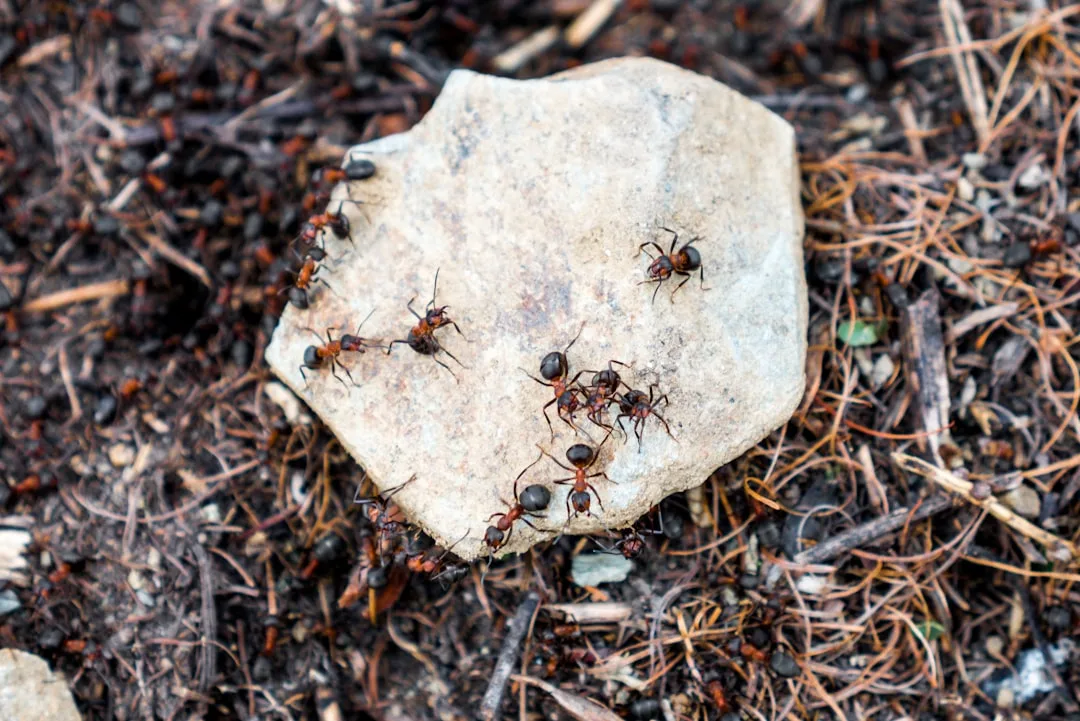
The army ant is a social predator unlike any other insect on Earth.
Where most ants live in fixed nests and send out scouts to forage, army ants are obligately nomadic: they have no permanent home, they travel as a colony of hundreds of thousands to more than two million individuals, and they hunt in coordinated swarm raids that can sweep an entire hectare of rainforest floor clean of living arthropods in a single afternoon.
The representative species Eciton burchellii of the Neotropical rainforest is among the most studied and most ecologically important social predators in tropical biology.
This guide covers every major dimension of army ant biology and ecology: taxonomy and the convergent evolution of "army" behaviour across three continents, colony structure and caste system, the mechanics of swarm raids, the living "bivouac" nest made entirely of ant bodies, the extraordinary community of birds and other animals that follow the raids, reproduction by colony fission, and the strange collective behaviours - including the notorious "circle of death" - that emerge from a colony of blind workers organised only by pheromones.
It is a reference entry, not a summary, so expect specifics: counts, distances, phase durations, and species associations.
Etymology and Classification
The name "army ant" is an ecological label rather than a taxonomic one. It describes any ant species that exhibits three linked traits: obligate group predation in large swarms, nomadic movement with no permanent nest, and a queen morphology known as dichthadiiform - wingless, large-bodied, and highly fecund. Historically, ants with this syndrome were split across three separate subfamilies.
Molecular phylogenetics in the early twenty-first century reorganised them into a single monophyletic subfamily, the Dorylinae, which unites the Neotropical army ants (including the genus Eciton), the African driver ants (genus Dorylus), and the Asian army ants.
This grouping is scientifically important because the three geographic lineages independently evolved the same general lifestyle - mass raiding, nomadism, and dichthadiiform queens - across more than 100 million years of evolutionary history. Army ant behaviour is one of the clearest and most dramatic cases of convergent evolution in the insect world, comparable to the parallel evolution of flight in insects, birds, and bats.
Eciton burchellii was first formally described by John Obadiah Westwood in 1842, although Indigenous peoples of Central and South America had recognised and named the species for millennia. Common regional names include "marabunta" in parts of Mexico and Central America, "tauoca" in the Amazon basin, and "corrections" or "correctors" in folk usage, a reference to the belief that the ants "correct" houses of pests.
Size, Castes, and Physical Description
Army ants are polymorphic, meaning that workers in a single colony come in several distinct sizes and shapes, each specialised for a particular role. A colony of Eciton burchellii contains a single reproductive queen, a small number of winged males produced only during reproductive cycles, and hundreds of thousands to millions of sterile female workers divided across four principal castes.
Queen:
- Length: 20-25 mm
- Wingless, dichthadiiform body plan
- Abdomen swollen and white during egg-laying, contracted when walking
- Lifespan 3-6 years
Soldier (major worker):
- Length: up to 14 mm
- Massive hooked sabre-like mandibles, used for defence
- Cannot feed itself - must be fed by minor workers
- Functions: colony defence, trail perimeter guard
Porter (submajor worker):
- Length: 9-12 mm
- Enlarged mandibles suited for gripping and dragging prey
- Functions: transport of prey and brood, logistics
Media worker:
- Length: 5-8 mm
- The bulk of raid labour
- Functions: swarm raid participation, prey subduing
Minor worker:
- Length: 3-5 mm
- Slender mandibles
- Functions: brood care, queen attendance, bivouac maintenance
Every worker is female and functionally sterile. Every worker is also completely blind; the compound eyes are reduced to a single facet or lost entirely. This is a striking feature given that army ants conduct the largest coordinated raids of any insect on the planet. All of that coordination is chemical and tactile.
Males are the only winged ants in the colony. They are produced once per colony cycle, typically 1,500 to 3,000 per reproductive brood, and emerge with robust wings, large eyes, and simple mandibles. Their sole function is to fly out of the natal colony, locate a reproductive colony preparing to split, and mate with a virgin queen. They die within days.
The Colony as a Superorganism
Biologists often describe an army ant colony as a "superorganism" because the functional unit of selection is the colony as a whole, not the individual ant. A single worker cannot reproduce. A queen cannot forage or raise her own brood. Even the colony itself cannot survive without the full cast of castes arranged into a working whole.
Colony composition at maturity:
| Caste | Approximate count | Role |
|---|---|---|
| Queen | 1 | Sole reproductive female |
| Males | 0-3,000 (reproductive) | Mating dispersal |
| Virgin queens | 0-6 (reproductive only) | Colony fission daughters |
| Soldiers | 5,000-20,000 | Perimeter defence |
| Porters | 20,000-60,000 | Prey and brood transport |
| Media workers | 200,000-600,000 | Raid bulk, prey subduing |
| Minor workers | 300,000-1,300,000 | Brood care, bivouac support |
A mature Eciton burchellii colony typically weighs about 25 kilograms of ant biomass in total. That is more than a typical house cat, assembled out of up to two million individual bodies moving in coordinated patterns.
The Bivouac: A Nest Made of Ants
Perhaps the most astonishing physical feature of army ants is that they have no nest in the ordinary sense. A fixed soil nest is incompatible with nomadic predation - a colony that eats 30,000 prey items per day would exhaust any local area within a week. Instead, every evening the entire colony forms a bivouac, a three-dimensional living structure made entirely of ants clinging to each other with their legs.
Bivouac structure:
- External wall: interlocked workers hanging by hooked claws from a log, tree root, or hollow
- Internal chambers: passages and rooms formed by living ants standing as pillars
- Core: queen and brood held in the most thermally stable interior
- Entrances: maintained guard gates with soldier castes
A mature bivouac is roughly one metre across. The outer layer of ants acts as insulation and as a physical barrier. Inner layers are organised so that temperature remains within about 2 degrees Celsius of an optimal range, even as tropical nights cool or rains arrive. When rain threatens, the bivouac contracts and the outer walls thicken. When the colony is ready to march, the structure disassembles from the bottom up as individual ants rejoin the active trail.
The bivouac is not a static structure. Workers continually shift position. A given worker may spend hours holding a load, then rotate out to forage, then return. The colony has no architect. The structure assembles and disassembles through local rules followed by individual ants.
The Nomadic and Statary Phases
Eciton burchellii colonies alternate between two precisely timed phases that track the developmental state of the brood. Each complete cycle lasts about 35 days.
Nomadic phase (approximately 14 days):
- Brood consists of active larvae requiring constant feeding
- Colony emigrates every single evening, sometimes hundreds of metres
- Large swarm raids occur daily to feed larvae
- Bivouac reforms in a new location each night
Statary phase (approximately 20 days):
- Brood pupating inside silk cocoons, requires no feeding
- Colony remains at a single bivouac site for the full phase
- Queen swells enormously and lays 3-4 million eggs in a single burst
- Raids continue but are smaller and shorter, for workforce sustenance
The shift between phases is triggered by signals from the brood. When the previous larval cohort pupates, the colony stops migrating. When new larvae hatch from the queen's egg mass, the colony resumes nightly emigrations. This tight coupling between brood state and colony behaviour is one of the cleanest known examples of chemical signalling driving large-scale animal movement.
Swarm Raids
The swarm raid is the defining behaviour of Eciton burchellii. Unlike most army ants, which raid along columns, E. burchellii produces a true swarm - a broad, continuous front of tens of thousands of workers advancing as a wave across the forest floor and understory.
Raid metrics:
| Metric | Value |
|---|---|
| Advance speed | approximately 200 m/hour |
| Swarm front width | up to 20 m |
| Participating workers | up to 200,000 per raid |
| Prey captured per day | approximately 30,000 items |
| Raid duration | dawn to dusk (8-12 hours) |
| Forest area covered per raid | 1,500-3,000 m^2 |
A raid begins at dawn. Scouts lay pheromone trails out of the bivouac into previously unswept forest. Within minutes, thousands of workers follow these trails, and the front widens as flanking ants pour outward. Prey flushed from leaf litter - cockroaches, crickets, spiders, other ants - attempt to escape and are caught, dismembered, and passed back along the porter chain to the bivouac.
By late afternoon, the raid has covered a fan-shaped area of up to 3,000 square metres. The return trail of porters carrying prey is one of the most studied examples of collective transport in the animal kingdom.
A single E. burchellii colony, by conducting one such raid every day of its nomadic phase, functions as the dominant arthropod predator of its territory. Populations of ants, wasps, and spiders in the raided area collapse for days afterward, then recolonise from surrounding patches. This cycle makes army ants a keystone species in Neotropical forests.
The Community That Follows the Raid
One of the most remarkable aspects of Eciton burchellii ecology is that the raid creates a mobile ecosystem of its own. Animals that could never catch the raid's prey on their own follow the swarm to exploit fleeing arthropods.
Ant-following birds:
Over 100 bird species across the Neotropical region follow army ant raids. A handful are obligate followers, meaning they cannot survive without army ants. Key species include:
- Ocellated antbird (Phaenostictus mcleannani) - obligate follower
- Bicolored antbird (Gymnopithys bicolor) - obligate follower
- Spotted antbird (Hylophylax naevioides) - facultative
- Plain-brown woodcreeper (Dendrocincla fuliginosa)
- Grey-headed tanager (Eucometis penicillata)
- Many antshrikes, woodcreepers, and tanagers
These birds perch low above the advancing swarm and snap up katydids, cockroaches, and spiders flushed from the ground. They do not eat the ants themselves.
Other followers:
- Ithomiine and morpho butterflies feed on bird droppings produced during raids
- Parasitic conopid and phorid flies lay eggs on flushed insects
- Mites of many species ride on the ants as phoretic passengers
- Staphylinid beetles mimic ants and live inside the bivouac
- Army ant antbutterflies follow raids for exclusive forage rights
In total, more than 300 animal species and well over 500 associated arthropod and microbial taxa have been documented in regular association with Eciton burchellii raids. No other ant species on Earth supports such a large biotic community. The army ant is effectively a walking keystone.
Reproduction and Colony Fission
Army ant reproduction is nothing like the familiar model of a small ant colony sending out flying queens in mating flights. Eciton burchellii colonies reproduce by fission, a process that resembles cellular division more than sexual reproduction.
Reproductive cycle:
- The queen produces a rare reproductive brood containing 1,500-3,000 winged males and roughly 6 virgin queens, instead of the usual worker brood.
- Winged males leave the colony, fly through the forest at night guided by pheromone plumes from other reproductive colonies, enter those colonies, and mate with virgin queens.
- Once multiple virgin queens are present in the natal colony, the workers begin to split along two competing pheromone trails laid by two of the virgin queens.
- The old queen departs with one half of the colony down one trail; a chosen new queen takes the other half down a second trail.
- All unchosen virgin queens are abandoned and die.
- Within days the original colony exists as two functional colonies, each with a queen and roughly half the original workforce.
A single queen mates with as many as 15 males during her reproductive window and stores sperm for the rest of her life, which may last 3 to 6 years. Across her lifetime she can produce tens of millions of offspring. This extreme fecundity is necessary to sustain daily raids of 200,000 workers and nightly emigrations that expose the colony to continual predation and accidents.
Collective Behaviours and the Circle of Death
The sheer scale of an Eciton colony, combined with the blindness of every worker and the simplicity of the individual decision rules, produces a set of emergent behaviours that are among the most studied phenomena in behavioural biology.
The most famous is the ant mill or circle of death. When a segment of a raid or an emigration column loses its connection to the main pheromone trail, the ants at the head of the group end up following the trail laid by the ants behind them. Because each ant lays pheromone as it walks, and each ant follows the strongest nearby trail, the situation becomes self-reinforcing. The group walks in a closed loop. Every lap deepens the trail. The ants cannot exit.
Documented ant mills include loops of several metres across and, in one classic case described by William Beebe in 1921, a circle 360 metres in circumference that persisted for more than two days before every ant in it had died of exhaustion and dehydration. Modern researchers have reproduced smaller mills under controlled conditions to study how simple local rules can lock into pathological global patterns.
Other emergent behaviours include:
- Self-assembling bridges of ants across gaps, with bridge length optimised to traffic density
- Pothole-filling, in which workers lie flat across gaps in the march trail so porters can walk across their bodies
- Living scaffolding during emigration, where workers arrange themselves to guide brood-carriers around obstacles
All of these structures assemble and disassemble without any central coordination.
Range and Habitat
Eciton burchellii occupies lowland tropical and subtropical rainforest from southern Mexico through Central America into most of tropical South America as far south as northern Argentina. The species requires warm, humid, relatively intact forest with deep leaf litter and abundant arthropod prey.
Known range countries:
Mexico, Belize, Guatemala, Honduras, Nicaragua, Costa Rica, Panama, Colombia, Venezuela, Ecuador, Peru, Brazil, Bolivia, Paraguay, northern Argentina, the Guianas.
Army ants are forest-floor specialists but do raid into the understory up to perhaps 10 metres above ground. They are sensitive to habitat fragmentation because a colony's territory can span many hectares, and forest patches smaller than about 100 hectares cannot sustain a colony over time. The decline of Eciton burchellii in fragmented landscapes cascades into declines of obligate ant-following birds, several of which are among the first species to disappear from fragmented Neotropical forests.
Conservation Status and Threats
The IUCN has not formally evaluated Eciton burchellii. Regional assessments describe the species as widespread but forest-dependent. Population-level trends are not systematically monitored.
Main threats:
- Deforestation. Rainforest clearance is the dominant threat. A colony needs continuous forest of meaningful size to complete its nomadic cycle.
- Forest fragmentation. Even when total forest cover persists, breaking the forest into small patches eliminates colonies, because a raid cannot sustain itself in a small patch.
- Insecticide drift. Agricultural pesticides at the forest edge can kill raids outright or contaminate prey.
- Climate change. Warmer and drier conditions reduce arthropod prey biomass, and extreme rains disrupt raids and flood bivouacs.
- Loss of obligate associates. Declines in ant-following birds are a secondary ecological loss whenever army ant colonies disappear.
Ecologically, army ants are so central to rainforest arthropod dynamics that their loss reshapes entire communities. Where army ants disappear, populations of ants, cockroaches, and other ground arthropods rise, and a dozen or more specialist species collapse with them.
Army Ants and Humans
Indigenous peoples across Central and South America have lived with Eciton for thousands of years. Traditional ecological knowledge across many cultures treats army ant visits as beneficial. A raid passing through a village or a house clears the building of cockroaches, scorpions, biting centipedes, and other pests in a single sweep.
People temporarily vacate their homes, let the colony pass, and return to a pest-free structure. Various folk names for the ants reflect this - "correctors", "cleaners", and "housekeepers" all appear in regional usage.
Modern agricultural and suburban expansion has complicated this relationship. Confined livestock, chickens in small enclosures, and immobile pets can be killed by a passing raid. However, documented human fatalities from army ants are essentially unknown; free-moving people can easily walk away from a raid that advances at 200 metres per hour.
Scientific interest in army ants is enormous and disproportionate to their visibility outside tropical biology. Theodore Schneirla, William Gotwald, Carl Rettenmeyer, Nigel Franks, and more recently a generation of researchers equipped with RFID tracking, high-speed video, and pheromone chemistry have made Eciton burchellii one of the best-understood social insects on Earth, rivalling honey bees and leaf-cutter ants as a model system for collective behaviour.
Related Reading
- Leafcutter Ants: Rainforest Fungus Farmers
- Bullet Ant: The Most Painful Sting in the World
- Driver Ants of Africa: Eciton's Old World Counterpart
- How Ant Colonies Self-Organise
References
Relevant peer-reviewed and monographic sources consulted for this entry include Rettenmeyer's foundational work on Eciton burchellii ecology at the University of Connecticut, Gotwald's monograph "Army Ants: The Biology of Social Predation" (Cornell University Press), Schneirla's mid-twentieth-century studies of the colony cycle, Franks and colleagues' work on collective behaviour and self-assembly in Journal of Experimental Biology and Behavioral Ecology and Sociobiology, and Brady et al. phylogenetic analyses confirming Dorylinae as a monophyletic army ant subfamily published in PNAS and Current Biology.
Natural history records follow Kaspari, O'Donnell, and Willson's studies of ant-following bird communities across the Neotropics.
Frequently Asked Questions
How large is an army ant colony?
A mature Eciton burchellii colony contains between 500,000 and 2,000,000 workers, a single reproductive queen, and during the reproductive phase up to 3,000 winged males and a handful of virgin daughter queens. The colony weighs roughly 25 kilograms in total ant biomass.
Worker castes are polymorphic, meaning workers come in several sizes - minors around 3 millimetres for brood care, medium workers for raid labour, porters specialised for carrying prey, and soldiers up to 14 millimetres with hooked sabre-like mandibles. The queen is visibly different: 20 to 25 millimetres long with an enormously swollen abdomen during egg-laying phases.
Colonies at this scale can consume the entire arthropod biomass of a hectare of rainforest in a matter of days.
Do army ants really have no nest?
Correct. Army ants are obligately nomadic and do not construct soil nests or carton structures the way most ants do. Instead, the colony forms a bivouac each evening - a living cluster of hundreds of thousands of ants hanging by their legs from a log, tree trunk, or hollow, their bodies interlinked into walls, chambers, and corridors. The queen and brood are held in the thermally stable core.
During a colony’s 15-day ‘statary’ phase, the bivouac remains in one place while the queen lays eggs and larvae pupate. During the 14-day ‘nomadic’ phase, the colony relocates every single night, sometimes hundreds of metres, with porters carrying larvae between bivouac sites.
How do blind ants coordinate raids of 200,000 ants?
Eciton burchellii workers have extremely reduced eyes and are functionally blind. Coordination of mass raids involving 200,000 ants happens entirely through chemical pheromone trails laid by scout ants, reinforced by successful foragers, and amplified into broad swarm fronts up to 20 metres wide. Each worker lays a scent trail as it advances, follows the strongest trail ahead of it, and responds to short-range tactile signals from neighbours.
This produces a self-organising ‘swarm front’ that sweeps the forest floor at approximately 200 metres per hour. No individual ant directs the raid; the pattern emerges from thousands of simple local interactions, one of the most studied examples of emergent intelligence in biology.
What do army ants eat?
Army ants are opportunistic carnivores, and Eciton burchellii specifically is one of the most voracious arthropod predators on Earth. A single raid captures approximately 30,000 prey items per day, dominated by other ants, wasp larvae, spiders, scorpions, centipedes, crickets, cockroaches, and beetle larvae. Smaller vertebrates - snakes, lizards, frogs, nestling birds - that cannot escape are also killed and dismembered.
Unlike most predators, army ants rarely eat their prey on the spot; porters carry dismembered pieces back to the bivouac to feed the larvae. The colony itself survives primarily on fluid exchange and on the captured insects, with larvae consuming the bulk of the protein.
What is the relationship between army ants and antbirds?
Over 100 species of tropical birds - collectively called antbirds or ant-following birds, including the ocellated antbird, bicolored antbird, and spotted antbird - specialise in tracking army ant raids to feed on insects that flee in panic from the advancing swarm. These birds are ‘obligate ant-followers’ that could not survive without army ants, making the ants a keystone species in Neotropical rainforests.
The birds do not eat the ants themselves; they catch the katydids, cockroaches, and spiders flushed into the air and onto leaves. Butterflies feed on the birds’ droppings, parasitic flies lay eggs on flushed prey, and mites ride the ants. An Eciton raid effectively functions as a mobile rainforest ecosystem.
What is the 'circle of death' or ant mill?
The circle of death, more formally called an ant mill or death spiral, occurs when a group of army ants becomes separated from the colony’s master pheromone trail and the lead ants end up following the trail of the ants behind them. Because every ant lays pheromone as it moves and follows the strongest nearby trail, the detached group forms a closed loop.
The ants march around the loop continuously, reinforcing the circle with each lap, until they die of exhaustion or dehydration. Circles up to 360 metres around and lasting more than two days have been documented. It is one of the clearest natural demonstrations of how a simple rule - ‘follow the pheromone’ - can fail catastrophically without a correcting signal.
How do army ants reproduce?
Reproduction in Eciton burchellii is concentrated into a single dramatic event per generation of the colony. The queen lays 3 to 4 million worker eggs in a concentrated burst during the statary phase, producing the labour supply for the next cycle. Every few years she produces a reproductive brood of 1,500 to 3,000 winged males and roughly six virgin daughter queens. The winged males fly to find other colonies, mate once with a virgin queen, and die.
Virgin queens never fly; instead, the old colony splits by fission. Workers choose two new queens along competing pheromone trails and the colony physically divides. Queens that are not chosen are abandoned and die. Queens can live 3 to 6 years and mate with as many as 15 males.
Are army ants dangerous to humans?
Army ants are potentially dangerous but only in very specific circumstances. Eciton burchellii workers bite with sharp mandibles and some castes can sting, producing painful but not medically serious wounds. A human who stands in the path of a raiding swarm will be bitten by thousands of ants simultaneously, which is extremely unpleasant and can trigger anaphylaxis in allergic individuals.
However, army ants are slow - 200 metres per hour - and any healthy person can simply step aside. Documented human deaths are essentially unknown and almost always involve incapacitated individuals unable to move. The real danger is to livestock tethered in a raid path, to caged poultry, and to small immobile animals.
Indigenous peoples across Central and South America have traditionally regarded army ant visits as beneficial, since the colony clears households of cockroaches, scorpions, and other pests in a single sweep.