
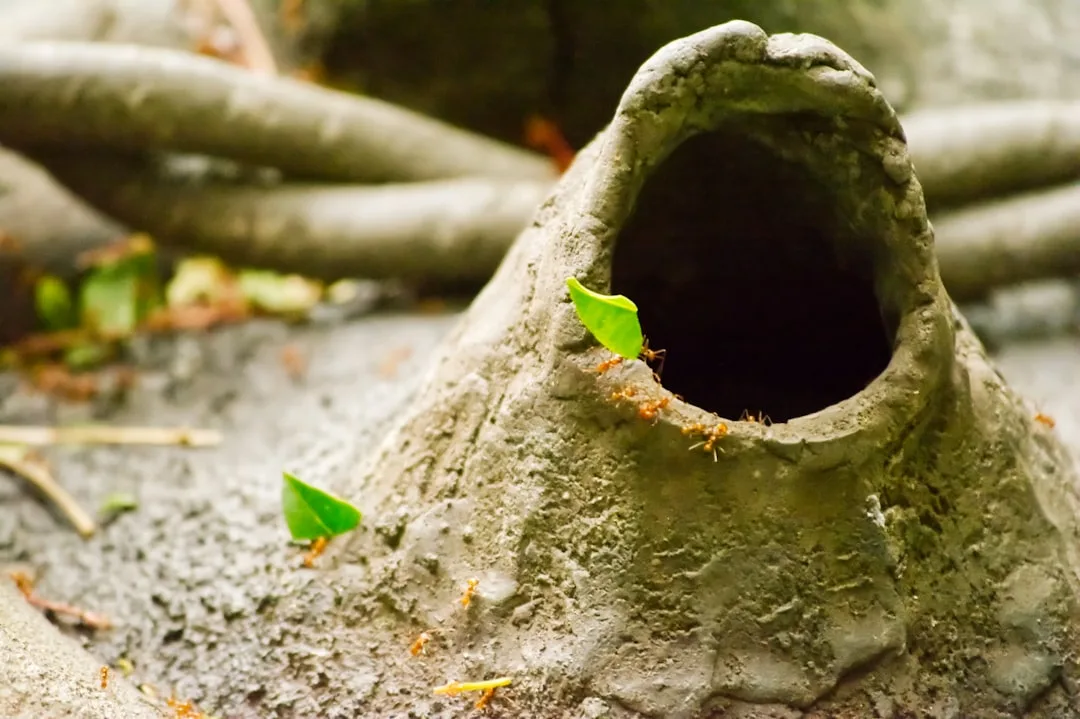
Leafcutter ants are not one species but a collection of roughly fifty, grouped under two closely related genera - Atta and Acromyrmex - and defined by a single extraordinary behaviour: they are farmers. Not metaphorical farmers. Literal, obligate, fungus-cultivating farmers that have been tending crops continuously for about fifty million years, tens of millions of years before any primate walked upright.
They do not eat the leaves they cut. They eat a fungus they grow on the leaves, in climate-controlled underground gardens, using antibiotics they produce from bacteria living on their skin, with waste disposal protocols, quarantine procedures, and a caste system that spans a 200-fold range of body size. A mature colony contains up to eight million sterile sisters and processes plant biomass on the scale of a cow.
This guide covers the biology and ecology of leafcutter ants in detail: taxonomy, anatomy, caste structure, the fungus-farming system, the antibiotic symbiosis that protects it, colony architecture, reproduction, foraging mechanics, ecological impact, and the reasons entomologists frequently describe Atta nests as the most complex non-human societies on Earth. It is a reference entry, not a summary - so expect specifics: millimetres, millions, tonnes of excavated soil, and documented records.
Etymology and Classification
The name "leafcutter ant" is a purely descriptive English label that has been applied since the nineteenth century to any Neotropical ant seen carrying cut leaf fragments. In scientific usage the name refers specifically to the two genera whose workers cut fresh vegetation for use as fungal substrate: Atta, comprising about seventeen described species, and Acromyrmex, comprising about thirty-one.
Both belong to the tribe Attini within the subfamily Myrmicinae. The Attini as a whole contains many fungus-farming ants, but only Atta and Acromyrmex cut and process fresh leaves at industrial scale - the rest of the tribe uses dead plant fragments, insect frass, or seeds as substrate.
Atta cephalotes, the representative species for this entry, was first described by Linnaeus in 1758. The generic name Atta appears to derive from a shortening of earlier Latinised names; cephalotes refers to the prominent head of the major worker caste.
Common regional names in Spanish and Portuguese include hormiga arriera, zompopo, bachaco, and sauva - all reflecting long cultural familiarity with these ants across Latin America, where they were pests and curiosities long before any European described them scientifically.
Molecular phylogenetics places the origin of fungus farming within the Attini at roughly 55-60 million years ago, with the specialised "higher attines" - including Atta and Acromyrmex - diversifying from about 20 million years ago.
The cultivated fungus, Leucoagaricus gongylophorus, is a basidiomycete that has been separated from free-living relatives for so long that it no longer produces functional spores in nature. It reproduces clonally, transmitted between generations of ants as living cultures carried by queens on their mating flights.
Size, Anatomy, and the Caste System
Leafcutter ants are among the best examples of extreme polymorphism in the insect world. Within a single mature Atta colony, workers vary in size from tiny minims weighing less than a milligram to massive majors weighing 300 milligrams or more - a range of roughly 200-fold in body mass.
All of these workers are sterile females, sisters, born from the same queen and the same sperm reservoir she has carried since her mating flight. Size is determined almost entirely by how much food a larva receives and which growth-regulating cues it encounters during development.
A simplified breakdown of the caste system in Atta cephalotes follows.
Minim workers (head width ~0.8 mm):
- Tend the fungus garden, prune hyphae, remove contaminants
- Groom eggs and larvae
- Ride on leaf fragments carried by larger workers, defending them from parasitoid flies
Minor workers (head width ~1.0-1.5 mm):
- Patrol trails
- Perform close-quarters defence inside the nest
- Process cut leaves inside the chambers
Media workers (head width ~1.6-2.2 mm):
- The classic leaf-cutters seen on foraging trails
- Climb vegetation, cut fragments with mandibles
- Carry fragments back to the nest, often with a minim hitchhiker
Major workers or soldiers (head width 3-5+ mm):
- Defend the nest against vertebrates, army ants, and large invertebrates
- Excavate large tunnels
- Their massive heads contain equally massive mandibular muscles that can cleave human skin
Queen (length 20-25 mm):
- Sole reproductive individual
- Lives 10-20 years
- Lays up to 30,000 eggs per day at peak output
Males (alates):
- Produced seasonally for mating flights
- Live only hours to days
- Die shortly after mating
This is a functional division of labour, not a hierarchy. There is no supervising worker, no manager, no queen giving orders. Coordination emerges from pheromone trails, local contact, and the stimulus-response behaviour of each ant. The result is a superorganism that behaves more like an organ system than a committee.
The Fungus Garden
The defining feature of leafcutter ants is the fungus garden. A mature Atta nest contains hundreds to thousands of chambers, many filled with a spongy grey-white mass that is the active crop: colonies of Leucoagaricus gongylophorus growing on a porous matrix of pre-processed leaf pulp.
The process of cultivation runs through several specialised steps.
- Harvesting. Media workers climb vegetation and cut leaf fragments - typically 5-20 mm across - using their mandibles as pivot-cutting shears. They cut by anchoring one mandible and pivoting the other through the leaf.
- Transport. Workers carry fragments back along established trails, often for 10-20 metres but sometimes much further. A hitchhiking minim often rides the fragment and defends it against phorid flies that attempt to lay eggs on the carrier.
- Reception. Inside the nest, smaller workers receive fragments and trim them into smaller pieces.
- Processing. Workers chew the pieces into a wet pulp, add saliva and faecal droplets rich in enzymes, and press the pulp into existing fungus mats.
- Inoculation. The pulp is seeded with hyphal fragments drawn from active gardens.
- Tending. Minims continuously groom the gardens, removing alien fungi, bacteria, and senescent hyphae.
- Harvest. The fungus produces specialised nutrient-rich swellings called gongylidia, which the ants pluck and eat.
The fungus cannot survive without the ants. Decades of experimental work have shown that separated Leucoagaricus cultures are quickly overgrown by competitors. The ants cannot survive without the fungus either. Their guts have lost the enzymatic capacity to digest complex plant polymers directly. Obligate symbiosis means mutual dependence so deep that neither partner is a complete organism on its own.
Antibiotic Symbiosis and Disease Management
The fungus garden faces constant threat from a specialised parasite: Escovopsis, a genus of fungi that infects only attine fungus gardens and can destroy a colony's crop within days if unchecked. Leafcutter ants combat this threat with a second symbiosis, one with bacteria.
On specialised patches of their cuticle - often white, waxy-looking areas on the underside of the head and thorax - leafcutter ants carry living colonies of actinomycete bacteria, principally in the genus Pseudonocardia. These bacteria produce antibiotic compounds that suppress Escovopsis while leaving the crop fungus largely unharmed. Specialised glands secrete nutrients that feed the bacteria, effectively paying them to stay on the ant and continue producing antibiotics.
This system is ancient. Molecular evidence suggests the ant-bacterium partnership originated tens of millions of years ago, making it one of the oldest known cases of antibiotic use in any organism. The compounds produced have attracted the attention of pharmaceutical researchers looking for novel antibiotic chemistries in an era of rising human antibiotic resistance.
Defence does not stop with chemistry. Leafcutter ants also run a sophisticated hygiene regime inside the nest.
- Gardens are continuously groomed by minim workers.
- Contaminated material is actively removed and transported to dedicated waste chambers.
- A specialised sanitation caste carries out waste-handling duties and does not re-enter the gardens.
- In some species, workers that have been in contact with contaminated material are refused entry to clean areas and are effectively quarantined.
- Severely infected or contaminated individuals are killed by nestmates to prevent spread.
This is not metaphor. It is an insect society performing triage, quarantine, and sanitation at a functional level comparable to a small hospital - with the important caveat that no individual ant "understands" the system. The behaviour is genetic and self-organising.
Colony Architecture
A full-grown Atta nest is an engineering marvel. Researchers at the University of Sao Paulo famously cast an abandoned Atta laevigata nest with concrete, excavated it, and mapped the result: more than 40 tonnes of soil had been removed to construct the chambers, and the nest extended 8 metres deep with roughly 8 million total cells of varying size, connected by a network of tunnels and ventilation shafts totalling kilometres of passage length.
Typical features of a mature Atta nest:
| Feature | Typical value |
|---|---|
| Number of workers | 1-8 million |
| Surface footprint | Up to a football field |
| Depth | 4-8 metres |
| Number of chambers | Hundreds to low thousands |
| Excavated soil | 20-40+ tonnes |
| Foraging trail radius | 50-200 metres from central mound |
| Persistence of trails | Years to decades |
Chambers are not random. There are fungus garden chambers (the majority), brood chambers, waste chambers (often placed deliberately below or downwind from gardens), and large queen chambers. Ventilation is passive: the mound topography and the layout of shafts exploit convection to move air, regulating temperature and carbon dioxide at levels the fungus can tolerate. Colonies adjust ventilation behaviourally by opening and sealing entrance holes over the course of a day.
Foraging trails radiating from the main mound are kept clear of vegetation by continuous worker maintenance. Well-established trails may be tens of centimetres wide, straight, and persistent enough to remain visible for years - and in some cases detectable from air or satellite.
Foraging and the Movement of Biomass
A large Atta colony is an extraordinary consumer of plant material. Estimates from field studies suggest that a mature colony can harvest 500-1,000 kg of fresh leaf material per year, with peak daily consumption comparable in biomass terms to a medium-sized herbivorous mammal. In some Neotropical forests, leafcutter ants account for more plant biomass removal than all vertebrate herbivores combined.
The transport system is logistics at small scale.
- Trail network. Colonies establish persistent trails leading to productive foraging trees. Chemical trail pheromones guide traffic.
- Load selection. Individual workers assess leaf quality. They reject leaves with high concentrations of fungicidal compounds or secondary metabolites that threaten the crop.
- Carrying capacity. A media worker commonly carries a fragment 10-20 times its own body mass. Scaled to a human this is equivalent to sprinting with a compact car.
- Trail speed. Laden workers travel about 0.15 metres per second - slow in absolute terms, but efficient for the load, and the trail operates continuously day and night.
- Round trips. A typical foraging round trip covers 10-40 metres but can exceed 100 metres during dry-season scarcity.
Phorid flies parasitoid leafcutter workers by depositing eggs on a carrier's head while she is loaded and unable to defend herself. The hitchhiking minim rides the leaf specifically to repel these flies, biting at them with disproportionately large mandibles. A leaf fragment with a hitchhiker is essentially a ship with a marine.
Reproduction and Colony Founding
Leafcutter ant reproduction is seasonal and synchronous. At the start of the rainy season across much of the Neotropics, mature colonies produce large numbers of winged reproductives - virgin queens and males - and release them in mass nuptial flights, often triggered by a specific combination of temperature, humidity, and atmospheric pressure.
During these flights, thousands or millions of winged ants from multiple colonies rise together and mate in the air. Each queen mates with several males and stores the received sperm in a specialised organ called the spermatheca. This single stored supply must last her entire 10-20 year reproductive life. No additional mating occurs.
Before leaving her natal colony, a virgin queen performs one of the most remarkable acts in insect biology: she loads a pellet of the colony's living Leucoagaricus culture into her infrabuccal pocket, a small pouch under her mouthparts. The culture travels with her as a living seed.
After mating she lands, breaks off her wings, excavates a small starter chamber in the soil, and spits out the fungus pellet. She begins laying eggs and feeds the young garden with her own faeces, gradually growing both the garden and the first brood of workers from her own metabolic reserves.
Survival rates are brutal.
- Vast majority of founding queens die from predation, desiccation, competitor ants, or failure of the fungus culture.
- A successful founding queen emerges into sight again only when her first workers leave the chamber months later.
- Colonies grow slowly at first. Several years pass before a new colony produces its own mating flight.
- Fully mature, reproductively productive colonies may require 5-10 years to develop.
The reward for the rare successful queen is decades of reproductive dominance. Her pheromones suppress reproduction in her daughter workers, and her egg output may exceed several million over her life. When she finally dies, the colony usually collapses within weeks to months because no replacement can be produced.
Ecological Role
Leafcutter ants are ecological engineers in the fullest sense. Their activities reshape the soil, the chemistry, the plant community, and the broader food web of the ecosystems they inhabit.
Soil effects:
- Excavation of tens of tonnes per colony aerates and mixes deep soil with surface soil.
- Waste chambers concentrate nutrients, producing long-lasting local enrichment.
- Abandoned nests create patches of altered soil that persist for decades.
Plant community effects:
- Selective harvesting pressures trees to evolve chemical defences, influencing forest composition.
- Seedlings grow more vigorously in soil enriched by old leafcutter waste dumps.
- Leaves harvested for fungus substrate are effectively transported from canopy to subsurface, shifting carbon flows.
Food web effects:
- Leafcutter ants are eaten by armadillos, anteaters, specialised beetles, army ants, and other predators.
- Colonies host extensive communities of inquilines - beetles, mites, springtails, and specialised fungi - adapted to life inside Atta and Acromyrmex nests.
In many Neotropical ecosystems, removing leafcutter ants would drive significant changes in forest composition and nutrient cycling. They are keystone species across much of their range.
Leafcutter Ants and Humans
Human responses to leafcutter ants vary sharply by context.
As pests. Leafcutter ants are consistently ranked among the most economically damaging insects in Latin American agriculture. A mature Atta colony near a coffee plantation or eucalyptus farm can strip trees repeatedly and cause substantial losses. Brazilian forestry alone has invested heavily in control methods. Common approaches include slow-acting baits carried by workers into the nest, targeted fumigation of main entrances, and in some cases the deliberate disruption of fungus gardens.
As food. Winged queens are traditionally harvested and eaten in parts of Colombia, Mexico, and Brazil. The fat-rich abdomens are fried or roasted and considered a delicacy. Mating flights are local events, and in some towns seasonal queen harvests have a market value comparable to moderately priced meat.
As research subjects. Leafcutter ants are model organisms for questions about superorganisms, cooperative behaviour, symbiosis, agricultural evolution, and antibiotic discovery. The Pseudonocardia antibiotics have drawn pharmaceutical interest. Molecular work on the fungus gardens has produced insights into plant-polymer digestion relevant to biofuel research.
As icons. The sight of a long column of workers carrying green flags of foliage has become one of the defining images of Neotropical natural history. Any visitor to a tropical American forest who stops and looks at the ground will, sooner rather than later, cross a leafcutter trail.
Conservation Status
No species of Atta or Acromyrmex is currently considered endangered. The superorganisms are resilient, adaptable to disturbed habitats, and in some cases favoured by moderate human land use. Threats exist at the colony level - intensive pesticide application, deforestation that removes foraging trees, and habitat conversion - but the two genera as a whole are in no near-term danger.
Population-level research is limited because colonies are difficult to census and persist for decades. What evidence exists suggests that leafcutter ants are among the winners of human-modified Neotropical landscapes, expanding in some regions as secondary forest and edge habitat increase. This is both a conservation success and an agronomic problem, depending on who is asked.
Related Reading
- Ants of the World: Societies, Intelligence, and Scale
- How Ant Colonies Coordinate Without Leaders
- Army Ants: The Nomadic Raiders
- Fire Ants: Invasive Superorganisms
References
Relevant peer-reviewed sources consulted for this entry include long-running studies by the Wilson and Holldobler research programmes summarised in The Leafcutter Ants: Civilization by Instinct (2011), molecular phylogenetic work on the Attini published in Proceedings of the National Academy of Sciences and Molecular Ecology, fieldwork on colony architecture published by Forti and colleagues at the University of Sao Paulo, studies of Pseudonocardia antibiotic chemistry in Science and Nature Chemical Biology, and ongoing reviews of attine agricultural ecology in the Annual Review of Ecology, Evolution, and Systematics.
Colony size, excavation, and biomass figures reflect consolidated published estimates from Neotropical field studies.
Frequently Asked Questions
Do leafcutter ants eat leaves?
No. Leafcutter ants (Atta and Acromyrmex) cannot digest leaves directly. Cellulose is too tough for their guts. Instead, workers cut and carry leaf fragments back to the nest, where smaller workers chew the leaves into a pulp and inoculate it with a specific cultivated fungus - Leucoagaricus gongylophorus. The fungus breaks down the plant material and produces nutrient-rich swellings called gongylidia, which the ants harvest and eat.
The entire colony, including the queen and larvae, feeds almost exclusively on this fungal crop. The leaves are farming substrate, not food.
How big do leafcutter ant colonies get?
Mature Atta colonies are among the largest insect societies on Earth. A fully established nest can contain up to 8 million workers and cover a surface area comparable to a football field, with underground chambers descending 6 metres or more. The excavated soil from a single large colony can exceed 40 tonnes. Acromyrmex colonies are generally smaller, typically tens of thousands to a few hundred thousand workers.
Colonies reach full size over 5-10 years and can persist for two decades under a single long-lived queen. The superorganism processes plant biomass on a scale comparable to a cow or deer.
Where do leafcutter ants live?
Leafcutter ants are native to the Neotropics: Central America, South America, and parts of the Caribbean. They are most diverse in tropical and subtropical forests but also thrive in savannas, grasslands, and agricultural landscapes. Two species push well into the United States - Atta texana in Texas and Louisiana, and Atta mexicana in parts of the southwest. Acromyrmex versicolor reaches the Sonoran Desert.
They require warm temperatures, sufficient rainfall to maintain fungus garden humidity, and a reliable supply of fresh plant material. Colonies avoid waterlogged soils because flooding destroys fungus chambers.
How do leafcutter ant castes work?
A single Atta colony contains workers that differ by as much as 200 times in body mass, all sisters from the same queen. Minims are tiny workers that tend the fungus garden and groom larvae. Minors patrol trails and defend foraging columns. Media workers are the classic leaf-cutters seen on trails. Majors (soldiers) have massive heads and mandibles and defend the nest against vertebrates and army ants.
The queen lays all eggs and can produce millions of offspring over her life. Caste is determined mainly by larval nutrition - more food produces larger workers. The system is a functional division of labour, not a hierarchy.
How long do leafcutter ants live?
Lifespan depends heavily on caste. Workers typically live 2-6 months, with media workers and soldiers occasionally reaching a year. The queen is extraordinarily long-lived for an insect: 10-20 years is typical, with documented cases exceeding 20. A single queen is the reproductive heart of a colony, and when she dies the colony collapses within weeks because no replacement is produced.
Males exist only briefly, flying from the nest to mate and dying within hours or days. The combination of a very long-lived queen and short-lived but continuously replaced workers allows the superorganism as a whole to persist for decades.
What is the Pseudonocardia antibiotic symbiosis?
Leafcutter ants carry specific strains of Pseudonocardia bacteria on patches of their cuticle, particularly on the underside of the body and around specialised glands. These bacteria produce antibiotic compounds that suppress Escovopsis, a parasitic fungus that specialises in attacking the ants’ Leucoagaricus crop. Without this microbial defence, Escovopsis outbreaks could destroy a fungus garden in days.
The relationship is ancient - molecular evidence dates it to tens of millions of years - making it one of the oldest documented antibiotic-based defences in nature. Researchers study these bacteria as sources of novel antibiotic compounds for human medicine.
How does a new leafcutter colony start?
New colonies begin with a single young queen. During a synchronised mating flight, virgin queens and males from many colonies emerge, fly up, and mate in the air. Each queen mates with multiple males and stores enough sperm to last her entire 10-20 year reproductive life. Before leaving her natal colony she loads a pellet of living fungus culture into a pouch in her mouth called the infrabuccal pocket.
After landing and shedding her wings, she digs a small chamber, spits out the fungus pellet to seed a new garden, and begins laying eggs. She tends the starter garden alone, feeding it with her own faeces, until the first workers mature and take over. Most founding queens fail; the few that succeed may live for decades.
Are leafcutter ants pests?
In parts of Latin America leafcutter ants are significant agricultural pests. Atta species can defoliate citrus, coffee, cacao, eucalyptus plantations, and row crops, sometimes causing economic losses that rank them among the most damaging insects in the Neotropics. A single mature colony can strip a mature tree of leaves in a few days.
At the same time, leafcutter ants are ecologically essential: they turn over enormous volumes of soil, recycle nutrients, and create habitat used by many other species. Control methods include targeted baits, but most ecologists argue that eliminating leafcutter ants would damage ecosystems far more than tolerating their impact.