
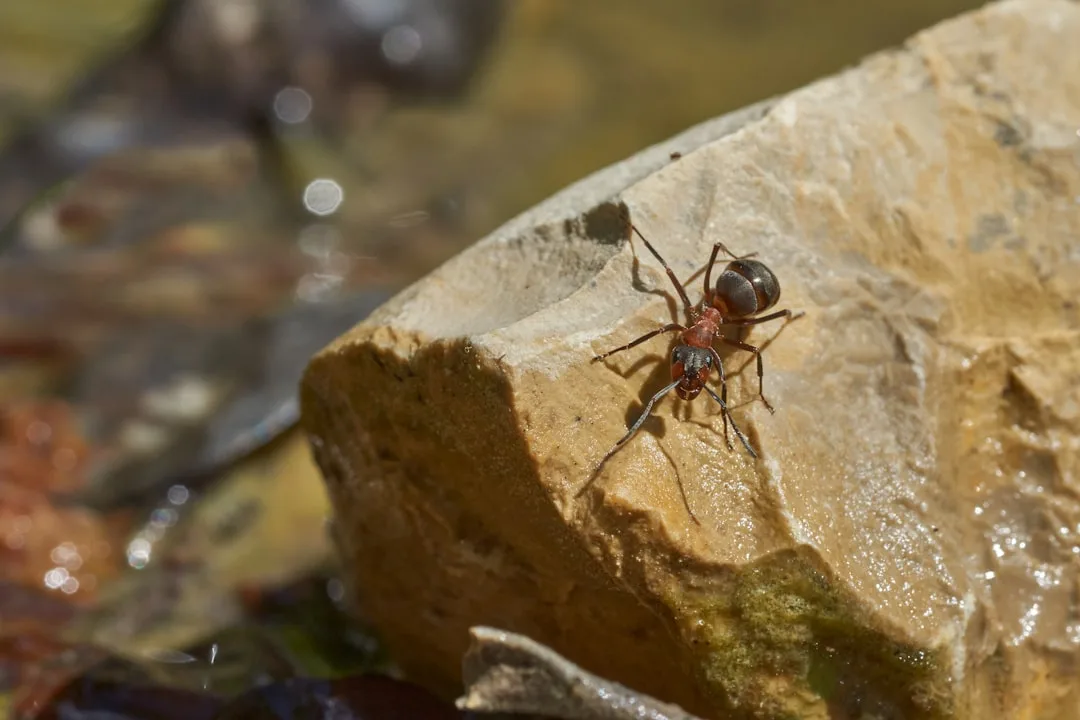
The bullet ant is a large, reddish-black rainforest ant best known for delivering what entomologists and victims agree is the most painful sting of any insect on Earth.
Paraponera clavata sits at the very top of the Schmidt Sting Pain Index with a rating of 4.0-plus, and the pain produced by a single sting is famously described as "pure, intense, brilliant pain - like walking over burning coals with a 3-inch rusty nail in your heel".
Locals across the Amazon call the species hormiga veinticuatro - the 24-hour ant - because one sting can produce waves of burning, throbbing pain that last a full day.
This guide covers every aspect of bullet ant biology and ecology: taxonomy, anatomy, the chemistry of poneratoxin venom, colony life, foraging and diet, nesting behaviour, geographic range, the extraordinary Satere-Mawe glove initiation, pharmaceutical research inspired by the venom, and the strange facts that distinguish this species from every other ant in the world.
It is a reference entry, not a summary - so expect specifics: millimetres, milliseconds, pain-index numbers, amino-acid counts, and verified population figures.
Etymology and Classification
The genus name Paraponera combines the Greek para (beside, near) and poneros (wicked, painful), a linguistic nod to the closely related stinging subfamily Ponerinae. The species epithet clavata is Latin for "club-shaped" and describes the slightly swollen tibial spurs visible on the ant's legs.
The common English name "bullet ant" comes from the comparison of the sting to being shot by a gun - a description offered by numerous travellers, naturalists, and researchers stung over the past two centuries. Spanish speakers know it as hormiga veinticuatro, the 24-hour ant, a reference to how long the pain persists.
In parts of Brazil the species is called tocandira or formiga-cabo-verde, and in some Central American regions it is simply la bala - the bullet.
Bullet ants belong to the subfamily Paraponerinae, a small and ancient group within the family Formicidae. What makes the group unusual is that Paraponera clavata is the sole living species of its subfamily and the sole living species of its genus - there are no close evolutionary relatives.
Molecular studies place Paraponerinae on a lineage that diverged early in the diversification of ants, somewhere in the Cretaceous, and the group has persisted as a kind of evolutionary relic. The next-nearest relatives are in the subfamily Ponerinae, but the genetic distance is substantial.
This isolated phylogenetic position helps explain why bullet ants are so different from other large ants in body plan, venom chemistry, colony structure, and foraging ecology. They are, in a real sense, a window into an older style of ant that has mostly been outcompeted by more modern, mass-recruiting lineages.
Size and Physical Description
Bullet ants are among the largest ants on Earth. The only ants that routinely match or exceed them in size are the giant Dinoponera species of South America and a handful of African driver ant queens.
Workers:
- Length: 18-30 mm from head to tip of gaster
- Colour: dark reddish-brown to black with a slight metallic sheen
- Head: large, with powerful mandibles used for carrying prey and chewing wood
- Thorax: robust, with strong leg musculature for climbing large tree trunks
- Gaster: distinctly segmented, ending in a prominent sting
- Sting: among the largest in the ant world, clearly visible to the naked eye
Queens:
- Length: 25-30 mm
- Colour: similar to workers, sometimes slightly darker
- Size relative to workers: only marginally larger - unusual for ants
- Wings: present until the nuptial flight, then shed
- Role: continuous egg production for the life of the colony
Males:
- Length: similar to workers, around 20-25 mm
- Colour: darker with a lighter thoracic region
- Wings: always fully developed
- Role: mating only; die shortly after nuptial flights
The relative similarity in size between queens and workers is diagnostic for the species. In most ants, especially species with large colonies, the queen is physically much larger than a worker because she needs an enormous abdomen to hold eggs and fat reserves. In bullet ants, the modest size difference reflects the small colony size - a bullet ant queen does not need to produce the millions of eggs per year required to run a leafcutter or fire ant colony.
The cuticle is thick, rigid, and sculptured with fine pits that reduce reflection in the dim rainforest understory. Large compound eyes give bullet ants relatively good vision for an ant, useful for solitary foraging in complex three-dimensional habitats. Long legs and strong claws allow vertical movement along smooth tropical tree bark. At a distance, a bullet ant moving along a trunk resembles a small wasp more than a typical ant.
The Sting and Poneratoxin
The bullet ant is famous for one reason above all others: its sting. Entomologist Justin Schmidt, who built his career on deliberately allowing himself to be stung by roughly 150 species of Hymenoptera so that he could rate each sting on a 0 to 4 scale, placed the bullet ant at the absolute top of the Schmidt Sting Pain Index. His published description reads: "Pure, intense, brilliant pain.
Like walking over flaming charcoal with a 3-inch nail embedded in your heel." Many revised editions of the index use a 4.0-plus rating for this species specifically, because the intensity exceeds that of even other 4.0-rated stings such as the tarantula hawk wasp.
Schmidt Sting Pain Index context:
| Rating | Example species | Duration of peak pain |
|---|---|---|
| 1.0 | Sweat bee (Halictidae) | Seconds |
| 2.0 | Honey bee (Apis mellifera) | About 10 minutes |
| 3.0 | Paper wasp (Polistes spp.) | 5-10 minutes peak |
| 4.0 | Tarantula hawk (Pepsis spp.) | 3-5 minutes peak |
| 4.0+ | Bullet ant (Paraponera clavata) | 12-24 hours of waves |
What separates the bullet ant from other top-rated stingers is not the peak intensity in the first seconds but the duration. A tarantula hawk delivers blinding pain that fades within minutes. A bullet ant sting fades slightly, then returns in waves - sometimes described as "electric" or "throbbing" - that continue for the rest of the day.
Victims frequently report sweating, shaking, nausea, and involuntary muscle tremors in the stung limb, along with lymph node pain as the venom spreads along nerve pathways.
The active compound is poneratoxin, a 25-amino-acid neurotoxic peptide unique to the species. Poneratoxin binds to voltage-gated sodium channels in nerve and muscle membranes and prevents them from closing normally after firing. The practical effect is that affected neurons fire continuously when they would normally reset, overloading pain pathways and causing muscle twitching.
Because the target - voltage-gated sodium channels - is a key regulator of insect nervous system function, poneratoxin is exceptionally effective against prey as well as vertebrate predators. The venom is also heat-stable and structurally simple enough to be synthesised in the laboratory, which is why it has become a major focus of pharmaceutical and agricultural research.
Research applications of poneratoxin:
- Template for novel insecticidal peptides that target insect sodium channels with minimal effect on mammals
- Model compound for understanding sodium channel pharmacology in general
- Lead structure for synthetic muscle-relaxant drugs
- Potential lead for analgesic agents that could block pain signalling at a different molecular target than opioids
Despite the ferocity of the pain, systemic danger from a bullet ant sting is limited. Anaphylaxis is rare, and lethal reactions have not been clearly documented in the scientific literature. This is one reason traditional cultures have been able to incorporate the species into ritual exposures without a pattern of deaths. The venom is designed to drive vertebrate attackers away by inflicting unbearable pain, not to kill them.
Stridulation and "Screaming"
A second feature that makes the bullet ant unusual among ants is its ability to produce a clearly audible stridulating sound when disturbed in or near the nest. The mechanism is mechanical: a ridged file on the petiole rubs against a scraper on the anterior surface of the gaster, producing a high-pitched buzzing or chirping tone that some observers describe as a scream. The sound is loud enough to be heard from several metres away in quiet forest.
Stridulation seems to serve two main functions. First, it is a distress signal that recruits nestmates to a disturbance, much as alarm pheromones do in other ant species. Second, it may function as a warning to vertebrate predators - a kind of acoustic "do not touch" signal reinforcing the visible threat of a 25-millimetre ant with a prominent sting.
Whether the sound has any role in normal colony coordination is not fully established, but researchers have observed stridulation primarily in threat contexts.
Colony Structure and Social Life
Bullet ant colonies are small. A mature colony typically contains between several hundred and around 2,500 workers, with most field surveys reporting 1,000 to 1,500. This is remarkable for an ant of this size - most large-bodied ants have larger colonies, not smaller ones, because bigger workers need more coordinated support.
The small colony size in Paraponera clavata appears to reflect the combination of high per-worker energy cost, solitary foraging (no mass recruitment means colonies do not scale the way fire ant or army ant colonies do), and the modest energy return available from scattered rainforest prey.
Colony features:
- Population: typically 1,000-2,500 workers at maturity
- Queens: single functional queen per colony, with occasional replacement
- Foraging mode: solitary (no pheromone trails, no mass raids)
- Recruitment: only for specific purposes such as defence or very large prey
- Colony lifespan: potentially decades, with queen replacement extending it
- Defensive behaviour: stinging swarms only when the nest is disturbed directly
The absence of mass foraging trails is one of the most striking differences between bullet ants and more typical tropical ants such as leafcutters or army ants. A bullet ant worker leaving the nest walks alone, climbs the host tree trunk alone, hunts alone, and returns alone. Encounters between workers from the same colony appear incidental rather than coordinated.
When a worker discovers a particularly large food item, limited recruitment can occur, but the colony does not generate the great living rivers of ants characteristic of army ants or the persistent highways of leafcutters.
Replacement of a lost queen is biologically possible because a colony can rear new reproductive females from existing larvae if conditions allow. This is unusual in ants with highly dimorphic queens, but makes sense in a species where the size difference between queen and worker is modest. Colony lifespan can therefore extend well beyond the active reproductive life of any individual queen, which has been measured at roughly 90 days of peak egg production per active cycle.
Nesting and Habitat
Bullet ant nests are almost always built at the base of a large rainforest tree, typically a mature canopy emergent with buttressed roots. The main entrance is usually hidden among the root buttresses or at the soil-root interface. Below ground, the nest consists of a branching network of chambers that extend up to a metre deep, housing brood, food stores, and the queen in a central chamber.
Nest characteristics:
- Typical location: buttressed base of a large mature tree, below 750 m elevation
- Depth: roughly 0.5-1.0 m below soil surface
- Chamber structure: several interconnected galleries, typically small
- Entrance: often inconspicuous, usually a single primary opening with secondary emergency exits
- Host tree: any of several large canopy species; no tight species specificity
- Use of the tree: foragers ascend the same trunk to hunt and collect nectar
The close association with a specific host tree is central to bullet ant ecology. A single tree can host one colony for decades, with generations of foragers climbing the same bark to forage in the same upper canopy. The vertical range of a typical colony covers the full height of the host tree, meaning individual workers regularly travel 20 to 40 metres up and down the trunk as part of daily foraging.
Researchers marking workers and tracking their movements have documented round trips of more than an hour per foraging excursion.
Because the species requires mature forest with large trees, conversion of lowland tropical forest to pasture or short-cycle agriculture removes bullet ants from the landscape quickly. Selective logging can reduce colony density without eliminating the species, but clear-cut habitat loss appears to be the main long-term threat to local populations.
Diet and Foraging
Bullet ants are opportunistic predators and important nectar feeders. Their diet combines animal prey - providing protein and lipids for the brood - with substantial quantities of plant sugars that fuel adult workers during long foraging excursions.
Animal prey:
- Other insects (beetles, caterpillars, termites, other smaller ants)
- Spiders and other arachnids
- Small arthropods in leaf litter and on bark
- Occasional scavenging of dead invertebrates
Plant and liquid food:
- Nectar from extrafloral nectaries on trees and vines
- Flower nectar when accessible
- Plant exudates and honeydew in small quantities
- Fruit juice from over-ripe fallen fruit
Foraging behaviour:
- Solitary: no trails, no mass recruitment
- Vertical: most foraging conducted up on the host tree and adjacent foliage
- Diurnal and nocturnal: active across the 24-hour cycle, with cooler hours favoured
- Territorial: workers defend foraging routes from competing ants
A single bullet ant can carry prey several times its own body mass. Workers climbing down a tree trunk with a large caterpillar clamped in their mandibles are a common sight in quality rainforest habitat. Foraging success depends on individual worker ability, not colony coordination, which places an evolutionary premium on large body size and powerful mandibles. Foragers appear to use a combination of scent, vision, and tactile cues to locate prey.
The absence of fungal agriculture, large honeydew-farming herds, and mass-raiding behaviour places bullet ants toward the more generalist end of tropical ant ecology. They are not specialists, and they are not mass-action foragers. They are large, capable individual hunters that depend on rainforest structural complexity.
Life Cycle and Reproduction
Bullet ant reproduction follows the general Hymenoptera pattern: single nuptial flights produce mated queens, which found or rejoin colonies and enter long periods of egg-laying.
Nuptial flight:
- Timing: typically in the wet season, when humidity and temperature support alate survival
- Participants: winged virgin queens and males from mature colonies
- Mating: in flight or on vegetation, generally within a limited window of hours
- Post-flight: males die shortly after; mated queens seek a nest site or rejoin colonies
Because queen size is close to worker size, the once-and-done founding model typical of leafcutter or fire ant queens is less rigid. Field observations suggest that some mated bullet ant queens may be adopted into existing colonies as replacement or secondary reproductives rather than founding solitary new colonies, though the details are still being studied.
Life stages (approximate at rainforest temperatures):
- Egg: approximately 2 weeks
- Larva: 2-3 weeks across multiple instars
- Pupa: 2-3 weeks in a cocoon
- Adult worker: emerges ready to work after a short callow period
Individual worker lifespan is not as tightly documented as in fire ants or honeybees, but marked-worker studies suggest that active workers live for several months to roughly a year under good conditions. Queens undergo active egg-production cycles of roughly 90 days interspersed with periods of lower output; a productive queen can sustain a colony for many years.
Colony maturity is reached slowly: several years from founding to peak worker numbers, which is consistent with the long-lived, low-turnover style of the species.
The Satere-Mawe Glove Initiation
The best-known cultural fact about bullet ants concerns the Satere-Mawe people of the lower Amazon basin in Brazil. Satere-Mawe men traditionally undergo a coming-of-age ritual in which live bullet ants are woven into ceremonial gloves that the initiate must wear.
Ritual sequence (as documented in ethnographic research):
- Elders locate a bullet ant nest and gather hundreds of workers using leaves.
- The ants are sedated in a plant-based infusion.
- Sedated ants are woven into a pair of palm-leaf gloves with their stingers pointing inward.
- When the initiate inserts his hands into the gloves, the ants revive and sting continuously.
- The ordeal lasts roughly ten minutes per glove session.
- The initiate must endure the stings while dancing and singing with the community.
- The full ritual is repeated 20 or more times over adolescence before a boy is considered fully initiated.
The ceremony is extraordinarily demanding. The venom causes intense waves of pain, muscle tremors, lymph node swelling, and sometimes temporary partial paralysis of the arms. Initiates frequently vomit, sweat profusely, and experience hours of shaking after the gloves are removed. Satere-Mawe traditional medicine offers herbal remedies to dull the after-effects, though the core of the ritual is the unmedicated endurance itself.
Anthropologists classify the Satere-Mawe glove ritual among the most physically demanding initiation ceremonies in the worldwide ethnographic record. Within Satere-Mawe culture, repeated successful completion is understood as a demonstration of self-mastery, community belonging, and adult responsibility. The ritual remains active in at least some Satere-Mawe communities in the state of Amazonas.
Conservation Status and Threats
The IUCN Red List has not formally assessed Paraponera clavata. Across most of its extensive Central and South American range the species remains relatively common in suitable mature forest. Because it occurs from Nicaragua to Paraguay and across the Amazon basin, total range and total population are large.
Main threats at the local and regional scale:
- Habitat loss. Conversion of lowland rainforest to cattle pasture, soy, oil palm, and short-cycle agriculture removes the large host trees bullet ants depend on.
- Selective logging. Removing canopy emergents reduces the density of suitable nesting trees even where forest cover remains.
- Climate change. Shifts in rainfall and drought frequency in the Amazon basin may alter the humidity and temperature regimes the species tolerates.
- Fire. Fires in fragmented forest edges, especially in drought years, can destroy nests at the base of host trees.
- Fragmentation. Small forest patches isolated from larger intact forest may not support long-term colony persistence.
Because bullet ants are tightly associated with mature forest structure, they are a reasonable indicator species for rainforest integrity. Areas where bullet ants remain common generally retain functional canopy ecosystems; areas where they have disappeared tend to have lost much of their structural complexity.
Bullet Ants and Humans
Apart from the Satere-Mawe ritual, bullet ants feature in multiple Indigenous and traditional cultures across the neotropics. Several Amazonian communities have used the ants in shorter, less formalised initiation or courage-testing practices. Traditional medicine in parts of Brazil has employed bullet ant venom or whole ants in folk treatments for rheumatism and nerve pain, though clinical evidence for any therapeutic benefit remains limited.
In modern rainforest research and ecotourism, bullet ants are treated as an occupational hazard. Field stations in Costa Rica, Panama, Ecuador, and Brazil routinely warn visitors and students about the species, and most experienced guides can identify active nest trees on sight.
Stings are more common than many visitors expect because a worker walking along a log or handrail can deliver a sting with the lightest touch. Medical protocols after a sting are simple: immobilise the limb, treat for shock symptoms, provide analgesia, and wait out the 12 to 24 hours of pain. Anti-venoms do not exist and are not considered necessary.
Pharmaceutical and agricultural interest in poneratoxin has grown substantially since the peptide was first fully characterised in the 1990s. Laboratories in Brazil, France, the United Kingdom, and the United States have explored poneratoxin as a lead compound for new analgesics, muscle-relaxants, and selective insect-targeting biopesticides.
Whether any commercial product will eventually result is still uncertain, but the research underscores how a compound evolved to cause extreme pain in vertebrates can, with the right molecular engineering, become the basis for medicines that relieve it.
Related Reading
- Red Imported Fire Ant
- Leafcutter Ant
- Ants: The Superorganisms That Conquered the Planet
- How Much Do All Ants Weigh Combined?
References
Relevant peer-reviewed and governmental sources consulted for this entry include Justin Schmidt's published work on the Schmidt Sting Pain Index, research on poneratoxin pharmacology published in Toxicon, Journal of Biological Chemistry, and FEBS Letters, ethnographic reports on Satere-Mawe ritual practice, field studies of Paraponera clavata colony biology published in Insectes Sociaux and Biotropica, and regional neotropical ant surveys conducted by research stations in Costa Rica, Panama, Ecuador, and Brazil.
Specific figures on colony size, worker length, and sting pharmacology reflect consolidated estimates from peer-reviewed literature through 2024.
See also: Bullet Ant vs Asian Giant Hornet
Frequently Asked Questions
How big is a bullet ant?
Bullet ant (Paraponera clavata) workers measure 18 to 30 millimetres from head to gaster, placing them among the largest ants on Earth and visibly dwarfing the European wood ants or North American carpenter ants most readers will have seen. A large worker is roughly the length of an American penny diameter, longer than a grain of rice, and noticeably heavier than most ants of any species.
Queens are only slightly larger than workers at 25 to 30 millimetres - a striking contrast with species like leafcutter ants or honeypot ants where the queen dwarfs her workers. Males are similar in size to workers but with smaller heads and fully developed wings.
Why is the bullet ant sting rated the most painful in the world?
The bullet ant earns the top slot on the Schmidt Sting Pain Index, rated 4.0 or 4.0-plus depending on the edition. Entomologist Justin Schmidt, who personally endured stings from roughly 150 Hymenoptera species, described the sensation as ‘pure, intense, brilliant pain - like walking over burning coals with a 3-inch rusty nail in your heel’. The pain is not just sharp in the instant of the sting.
It arrives in rolling waves, often triggering involuntary shaking, sweating, nausea, and temporary partial paralysis of the stung limb. Unlike wasp or bee stings, which peak in minutes and fade in hours, bullet ant pain regularly persists for 12 to 24 hours. The sensation is driven by poneratoxin, a peptide that causes sustained firing of pain-signalling nerves.
What is poneratoxin and how does it work?
Poneratoxin is a 25-amino-acid neurotoxic peptide unique to bullet ant venom. Chemically it is small, heat-stable, and easily synthesised in the laboratory. Its target is the voltage-gated sodium channel, the molecular gate that controls how nerve and muscle cells fire electrical signals.
Poneratoxin wedges the channel open so that affected neurons cannot reset between signals - the result is sustained firing of pain pathways and muscle twitching in both insects and mammals. Because the peptide is so selective, pharmacologists are studying it as a template for novel analgesics and muscle-relaxant drugs, and agricultural chemists are exploring it as a model for insect-selective biopesticides.
The irony is real: the compound that produces the world’s most painful sting may become the basis for a new generation of pain medicines.
What is the Satere-Mawe bullet ant initiation?
The Satere-Mawe people of the Brazilian Amazon practise a coming-of-age ritual in which adolescent boys wear gloves lined with live bullet ants. Elders collect the ants from a nearby nest, sedate them with a natural plant infusion, then weave them into a pair of palm-leaf gloves with their stingers facing inward.
When the boy’s hands enter the gloves, hundreds of ants revive and sting continuously for roughly ten minutes while he endures the pain, often dancing through the ordeal with the community watching. The ritual is repeated 20 or more times over adolescence before a boy is considered fully initiated. Anthropologists describe the practice as one of the most demanding recorded initiation ceremonies in any human culture.
Medical complications are uncommon; severe local reactions and temporary partial paralysis of the arms are routine.
Where do bullet ants live?
Paraponera clavata inhabits lowland tropical rainforests of Central and South America. The core range extends from Nicaragua and Honduras in the north, through Costa Rica, Panama, Colombia, Venezuela, Ecuador, Peru, and Bolivia, into northern Paraguay and the Amazon and Atlantic forests of Brazil. The species prefers humid primary forest below roughly 750 metres elevation and is rare to absent in highland or disturbed habitats.
Nests are almost always built at the base of a large tree, typically with the main entrance in the buttress root system or at the interface between root and soil. Foragers climb the same tree to the upper canopy, where they hunt small arthropods and collect nectar, then return to the nest along the trunk. Colonies are generally well spaced and not found in the dense clusters typical of smaller ants.
How big are bullet ant colonies?
Bullet ant colonies are strikingly small for ants of their size. A mature colony typically contains between a few hundred and around 2,500 workers, with most field surveys finding 1,000 to 1,500. This is a fraction of the population found in a mature leafcutter, army, or fire ant colony, which can contain hundreds of thousands to millions of individuals.
The small colony size is thought to reflect the high cost of producing such large-bodied workers and the energy demands of hunting in a dispersed rainforest environment. Foragers operate alone rather than along pheromone trails, meaning colony-level foraging output depends on individual success rather than mass recruitment.
One productive queen sustains the entire colony, and replacement of a lost queen is possible within an established nest, giving colonies potential lifespans measured in decades.
What do bullet ants eat?
Bullet ants are opportunistic predators and nectar feeders. Workers hunt small arthropods - including other ants, caterpillars, spiders, small beetles, and termites - on the forest floor, along tree trunks, and up into the canopy. Nectar is a critical second food source: bullet ants spend substantial foraging time at extrafloral nectaries on host trees and at flowers, carrying droplets of sugary liquid back to the nest in their crops.
The nectar fuels adult workers while captured prey provides protein and lipids for developing larvae. Unlike many tropical ants, bullet ants do not cultivate fungus, do not herd honeydew-producing insects in large numbers, and do not conduct mass raids. A single forager can carry a caterpillar or beetle larva several times its own mass, sometimes climbing dozens of metres down a tree trunk to deliver it to the nest.
Are bullet ants dangerous or endangered?
Bullet ants are dangerous to humans only in the narrow sense that a sting is extraordinarily painful. Anaphylaxis is rare, and lethal systemic reactions have not been clearly documented in the medical literature, which is why traditional cultures can use the species in repeated ritual exposures without a pattern of fatalities.
The greatest risks are temporary paralysis of the stung limb, intense 24-hour pain that can cause shock-like symptoms, and secondary infection at the sting site. Conservation status has not been formally assessed by the IUCN Red List.
The species is not considered threatened across most of its range, but habitat loss from Amazon deforestation, selective logging, and conversion of lowland forest to pasture is a local concern in parts of Central America and southern Brazil. Because bullet ants depend on mature forest with large trees, clear-cut agriculture removes them from the landscape within a few years.