
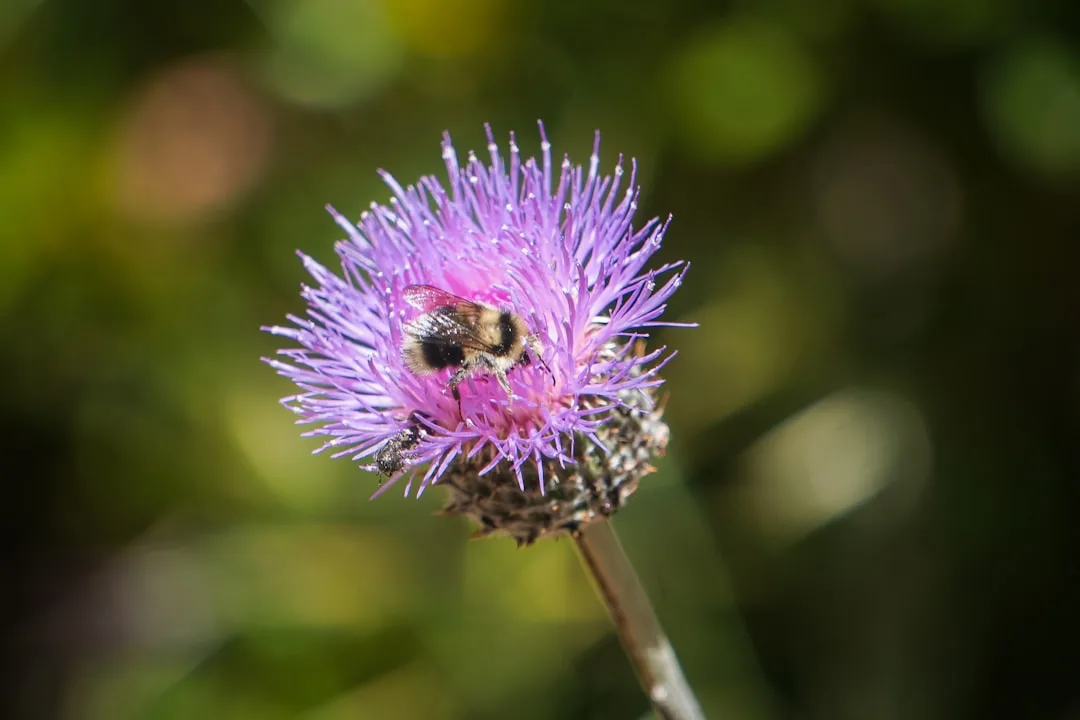
The bumblebee is the large, furry, slow-flying relative of the honey bee - instantly recognisable, globally beloved, and in many places quietly disappearing. The genus Bombus contains roughly 250 described species distributed across the cool temperate zones of Europe, the Americas, and Asia.
Unlike the honey bee, which is a single domesticated lineage spread worldwide by humans, bumblebees are a radiation of wild cold-climate specialists whose biology is built around maintaining a warm body in cold weather, founding new colonies from a solitary overwintering queen each spring, and performing a unique pollination trick - buzz pollination - that underwrites tens of billions of dollars of modern agriculture.
This guide covers the bumblebee from the level of individual physiology up to the whole annual colony cycle, the species' surprising cognitive abilities, the economic value of managed bumblebee pollination, and the steep declines that have placed some members of the genus on national endangered species lists. Throughout, Bombus terrestris - the buff-tailed bumblebee, the most commercially important and scientifically studied bumblebee species - serves as the representative example.
Etymology and Classification
The genus name Bombus comes from the Latin for a booming or humming sound, a direct nod to the characteristic buzz of a bumblebee in flight. The English word "bumblebee" itself is old - Shakespeare uses "humble-bee" in A Midsummer Night's Dream in the 1590s, and the two forms competed until "bumblebee" became standard in the nineteenth century.
The buff-tailed bumblebee Bombus terrestris was named by Carl Linnaeus in 1758; its species epithet terrestris means "of the earth", reflecting the species' habit of nesting in old rodent burrows underground.
Bumblebees belong to the order Hymenoptera alongside honey bees, wasps, and ants, and to the family Apidae alongside honey bees, carpenter bees, and orchid bees. Within Apidae they form their own tribe, Bombini, containing the single extant genus Bombus. Molecular phylogenetics dates the split between bumblebees and honey bees to roughly 50-100 million years ago.
The genus contains about 250 described species, with new ones still being split off as genetic tools refine old taxonomic assumptions. Subgenera within Bombus include Bombus sensu stricto (the buff-tailed group), Psithyrus (the cuckoo bumblebees, social parasites that invade other bumblebees' nests), Thoracobombus, Megabombus, and others. The deepest diversity is in the mountains of central and eastern Asia, which appear to be the genus's ancestral home.
Size and Physical Description
Bumblebees are medium-sized to large bees with a rounded, compact body, a dense coat of branched setae, and striking colour patterns usually combining black with yellow, orange, white, or red bands. Size depends on caste and species.
Typical measurements for Bombus terrestris:
- Worker length: 11-17 mm
- Male length: 14-16 mm
- Queen length: 20-22 mm
- Wingspan: up to about 35 mm in queens
- Body mass: 0.2 g (small worker) to 0.6 g (queen)
Across the genus, workers range from about 7 mm in the smallest tropical species to 25 mm in the largest. Queens of some alpine and tundra species exceed 2.5 centimetres.
The most distinctive visual feature of a bumblebee is the dense coat. What looks like fur is actually a thick pile of branched setae - hair-like structures that trap pollen electrostatically, insulate the body against cold, and confuse visual predators. Pollen picked up on the body is combed into specialised pollen baskets called corbiculae on the hind legs, where it is packed into bright yellow or orange balls for transport back to the nest.
The wings are two pairs, coupled in flight by tiny hooks (hamuli) so that the forewings and hindwings beat together. Wing-beat frequency is lower than a honey bee's - roughly 150-200 beats per second compared with about 230. The body is divided into head, thorax, and abdomen, with large compound eyes, three simple eyes (ocelli), and a pair of antennae carrying thousands of olfactory receptors.
Built for the Cold
The bumblebee's defining physiological feature is its ability to maintain an elevated body temperature - approximately 30 degrees Celsius in the thorax - regardless of ambient conditions. This is vanishingly rare among insects, which are otherwise almost universally ectothermic (dependent on external warmth).
The mechanism is mechanical rather than chemical. A bumblebee can decouple her wings from her flight muscles - a clutch-like arrangement of the thoracic musculature - and then contract those muscles rapidly without moving the wings. The effect is identical to human shivering: repeated contractions generate heat as a byproduct of metabolism. A bumblebee can raise her thoracic temperature from near freezing to operational flight temperature in just a few minutes of shivering.
The fuzzy pile that covers the thorax and abdomen then traps that warmth. Microscopic branched setae hold a layer of still air against the body, functioning as insulation in exactly the same way down feathers do for a bird. The combined effect is that some bumblebee species continue foraging in air temperatures just above freezing, at altitudes over 5,000 metres in the Himalayas, and inside the Arctic Circle. No honey bee, and very few other insects, can do any of this.
The same thermal regulation makes bumblebees vulnerable at the opposite extreme. Warm summers - particularly the increasingly common heatwaves driven by climate change - push cold-adapted species toward heat stress and constrain their foraging windows to early morning and late evening.
Colony Structure and Caste
Bumblebee societies are eusocial but dramatically smaller and shorter-lived than honey bee societies. A typical colony of Bombus terrestris contains one queen and 50-400 workers, compared with tens of thousands for a honey bee. Some species run colonies of just a dozen workers; a few tropical species occasionally exceed a thousand.
The queen. A single reproductive female who founded the colony alone. She lays all the eggs for the season. She also does much of the early-season work herself - building the first wax cells, incubating the first brood, and foraging - until her first daughters emerge as workers. Once the colony is established she concentrates on egg laying.
She lives roughly one year across her entire life: emerging from hibernation in spring, founding and running the colony through summer, producing daughter queens and males in late summer, and dying in autumn.
Workers. Sterile (or near-sterile) daughters of the queen. They forage, build and maintain wax pots for nectar and pollen, tend brood, defend the nest, and thermoregulate the colony. Worker lifespan is short - two to six weeks on average - and worker size varies substantially within a single colony, from tiny "minor" workers weighing a fraction of a gram to much larger individuals approaching queen size.
Males (drones). Produced late in the season. They have no sting, do no work in the nest, and leave the colony after a few days to patrol for virgin queens. Males are fed by workers until they disperse, then live perhaps one or two weeks in the wild before dying.
New queens (gynes). The colony's reproductive output. Produced toward the end of the season alongside males, they are fed extra pollen and grow substantially larger than workers. After mating they leave the nest, feed heavily, build fat reserves, and find a place to hibernate through winter.
The caste system in bumblebees is determined largely by nutrition rather than genetics. A female larva fed a rich pollen diet at the right developmental window becomes a queen; a less-fed larva becomes a worker. This flexibility is a key adaptation for an annual colony cycle.
The Annual Colony Cycle
The full life cycle of a bumblebee colony runs a single season. The schedule shifts with latitude, but the general pattern is robust.
| Phase | Timing (temperate zone) | What happens |
|---|---|---|
| Emergence | Early to mid spring | Overwintered queens emerge, feed on early flowers |
| Nest founding | Mid spring | Queen finds nest site, builds first wax pots |
| Solitary phase | Mid to late spring | Queen lays eggs, incubates brood, forages alone |
| First workers | Late spring | First batch emerges; queen stops foraging |
| Colony growth | Early to mid summer | Workers build out the nest, brood output increases |
| Peak colony | Mid to late summer | 50-400 workers; queen lays reproductives |
| Reproductive output | Late summer | New queens and males produced; males leave to patrol |
| Mating and senescence | Early autumn | New queens mate, feed, disperse; old colony dies |
| Hibernation | Late autumn to spring | Mated queens overwinter underground, everyone else dies |
This annual boom-and-bust cycle contrasts sharply with the honey bee colony, which persists for years, overwinters as a large cluster, and produces new colonies by swarming rather than by sending individual queens into solitary hibernation.
The bumblebee pattern means the entire species is funnelled each year through the survival of mated queens over the winter - a vulnerable bottleneck that makes bumblebee populations especially sensitive to habitat loss, pesticide contamination of overwintering sites, and climate disruption of flowering phenology.
Foraging and Buzz Pollination
A bumblebee's working day begins with a warm-up: shivering in place until thoracic temperature is high enough for flight. She then leaves the nest and forages within a range that varies by species and by habitat quality - typically 100 metres to 3 kilometres from the nest, though some species have been tracked over 10 kilometres.
Bumblebees specialise on particular flower species across a foraging trip, a fidelity known as flower constancy, which makes them highly effective pollinators. Tongue length is a critical trait: short-tongued species such as Bombus terrestris and B. lucorum exploit shallow flowers, while long-tongued species such as B. hortorum reach deep into tubular flowers that short-tongued bees cannot access.
The diversity of tongue lengths across a bumblebee community lets different species partition flower resources without competing head-on.
Buzz pollination (sonication) is the bumblebee's signature technique and a major reason the genus matters economically. Some flowers - notably tomatoes, eggplants, blueberries, cranberries, and kiwifruit - store pollen inside tightly closed anthers that release grains only when vibrated at the right frequency.
A bumblebee grips the flower with her mandibles, decouples her wings, and vibrates her flight muscles at around 400 hertz. The flower shakes like a tuning fork and releases a cloud of pollen onto the bee's body.
Honey bees cannot do this. Before commercial bumblebee production began in the late 1980s, greenhouse tomato growers had to pollinate flowers by hand, vibrating each one with an electric wand. The introduction of managed Bombus terrestris hives transformed greenhouse agriculture and now underpins a commercial sector worth tens of billions of dollars per year worldwide, with roughly 55 billion US dollars of crops dependent on or significantly improved by bumblebee pollination.
Foraging data for Bombus terrestris:
| Metric | Value |
|---|---|
| Typical foraging range | 100 m to 3 km |
| Flight speed | ~15 km/h |
| Flowers visited per trip | 30-100 |
| Wing-beat frequency | ~150-200 Hz |
| Buzz-pollination frequency | ~400 Hz |
| Trips per day per forager | 5-15 |
Cognition and Play
For a long time bumblebees were treated, like most insects, as instinct machines. Work from the laboratory of Lars Chittka at Queen Mary University of London has comprehensively overturned that picture.
Puzzle solving. Chittka and colleagues have trained bumblebees to pull strings, push blocks, and rotate discs to reveal sugar rewards. Bumblebees solve these problems not by trial and error alone but by observing trained demonstrators and copying successful techniques. This form of social learning - acquiring a novel behaviour from another individual - was considered vertebrate-only until bumblebee research caught up.
Play. In a 2022 paper and follow-up work published in Animal Behaviour in 2023, Chittka's group reported bumblebees rolling small wooden balls. Crucially, the bees performed the behaviour with no food reward attached. Individual bees returned to roll balls repeatedly, younger bees rolled balls more than older ones, and the behaviour met five formal criteria widely used to define play in vertebrates. It remains the clearest published case of play-like behaviour in an insect.
Tool-like use. Other Chittka lab experiments have shown bumblebees using objects as aids - pulling strings, pushing tabs, and manipulating their environment in ways that approach tool use by a strict operational definition.
Number sense. Related work shows bumblebees can distinguish between small quantities and have rudimentary grasp of zero, placing them alongside honey bees and a handful of vertebrates in that narrow category.
The bumblebee brain contains roughly one million neurons - about the same order of magnitude as the honey bee and roughly 100,000 times fewer than a human. The computational efficiency per neuron implied by these results has drawn interest well beyond ecology, including from neuroscientists and AI researchers studying minimal intelligence.
Ecological Role
Bumblebees are keystone pollinators in cold and temperate ecosystems worldwide. Many alpine, Arctic, and northern forest plant communities depend heavily on Bombus pollination because honey bees and most other bees cannot operate at the temperatures these plants flower in.
Wild crop pollination. Bumblebees pollinate a large share of temperate fruit and seed crops. Estimates suggest that wild bumblebees, rather than managed honey bees, perform the majority of pollination for blueberries, cranberries, some tomato varieties, squashes, and many tree fruits.
Managed crop pollination. Commercial Bombus terrestris colonies are shipped into greenhouses worldwide to pollinate tomatoes, peppers, and other sonication-dependent crops. In 2020 the global commercial bumblebee industry shipped more than two million colonies.
This trade has underwritten the economic rise of greenhouse agriculture but has also spread pathogens to wild bumblebee populations, and escape of non-native B. terrestris in South America has produced a conservation problem for native Bombus dahlbomii.
Pest suppression. Bumblebees visiting potato crops feed opportunistically on Colorado potato beetle larvae, and some studies have documented measurable pest reduction in fields with bumblebee activity. This is an unusual dual ecological service - pollination and predation by the same species - for a bee.
Conservation and Decline
Conservation status varies dramatically across the genus, and the picture is worse than the general public understands because the species most people recognise as "a bumblebee" are usually the few that remain common.
Documented declines. Across Europe and North America, multiple bumblebee species have lost 30-50 per cent of their historical range since the 1970s. Some losses are catastrophic. Franklin's bumblebee (Bombus franklini), historically endemic to a small area of southern Oregon and northern California, has not been confirmed alive since 2006 and is widely presumed extinct.
The rusty-patched bumblebee (Bombus affinis) once inhabited the entire northeastern and midwestern United States and is now restricted to scattered remnant populations; in 2017 it became the first bee species listed as Endangered under the US Endangered Species Act.
The Pacific crisis. The western bumblebee (Bombus occidentalis) was once one of the commonest bumblebees of western North America. Between the mid-1990s and the 2010s it vanished from most of its range. The collapse coincided with the introduction of commercial B. occidentalis rearing - and the spread of the fungal pathogen Nosema bombi from managed colonies to wild populations. This episode is one of the clearest examples of pathogen spillover from commercial pollination into wild bees.
Drivers of decline.
- Habitat loss: meadows, hedgerows, and flower-rich grasslands converted to monoculture cropland and urban development
- Pesticide exposure: neonicotinoid insecticides impair queen survival, colony growth, and foraging performance at sub-lethal doses
- Pathogens: Nosema bombi, Crithidia bombi, deformed wing virus, and other diseases amplified by commercial bee trade
- Climate change: warming compresses the thermal niche of cold-adapted species and shifts flowering schedules out of sync with colony cycles
- Homogenisation of forage: agricultural landscapes that flower briefly and intensely then provide "floral deserts" during the rest of the colony cycle
- Competition with managed honey bees for nectar in some regions
IUCN status. The IUCN has assessed roughly half the world's bumblebee species. Of those assessed, a substantial fraction are Near Threatened, Vulnerable, or Endangered. Data deficient species include many in poorly surveyed parts of Asia, which is the genus's centre of diversity.
Bumblebees and Humans
Human attitudes toward bumblebees are unusually positive for an insect. They are widely regarded as charismatic, friendly, and symbolically attached to gardens, meadows, and the traditional countryside. This public goodwill has translated into meaningful political support for pollinator conservation, though far less funding and policy attention than the same problems attract for honey bees.
Commercial rearing. Industrial production of Bombus terrestris colonies began in Europe in the late 1980s and scaled rapidly to serve greenhouse tomato growers. The same species is now reared and shipped worldwide - a practice that has caused serious ecological problems in countries where B. terrestris is non-native, most notoriously in Chile and Argentina where escaped B. terrestris has displaced the giant native B. dahlbomii.
Citizen science. Bumblebee monitoring programs have become some of the most successful invertebrate citizen-science projects anywhere. The Bumblebee Conservation Trust in the UK, the Bumble Bee Watch program in North America, and similar schemes in continental Europe have produced long-term datasets that underpin modern conservation assessments.
Gardens. Domestic gardens collectively provide an enormous area of bumblebee habitat, especially in countries where agriculture has become hostile to pollinators. Single-flowered varieties, native wildflowers, minimal pesticide use, undisturbed tussocks of grass for nesting, and a long flowering season from March to October make ordinary gardens valuable bumblebee refuges.
Related Reading
- Honey Bee: Colony, Communication, and Collapse
- Bees and Wasps: Pollinators, Architects, and Warriors
- The Honey Bee Waggle Dance: Communication in the Hive
- Why Are Bees Dying? Inside Colony Collapse
References
This entry draws on peer-reviewed sources including work by Lars Chittka (The Mind of a Bee, 2022) and his laboratory's papers in Animal Behaviour (2022, 2023) on play and social learning in bumblebees; Dave Goulson's ecological monographs and peer-reviewed studies on bumblebee decline; IUCN Bumblebee Specialist Group assessments; US Fish and Wildlife Service documentation of the Bombus affinis listing; and ongoing research in Apidologie, Journal of Apicultural Research, Proceedings of the Royal Society B, and Current Biology.
Population and distribution figures reflect the most recent consolidated regional assessments through 2024.
Frequently Asked Questions
How is a bumblebee different from a honey bee?
Bumblebees and honey bees share a family (Apidae) but belong to different tribes - Bombini and Apini - and diverged tens of millions of years ago. Bumblebees are larger, rounder, and noticeably fuzzier, with body lengths of 1-2 centimetres compared to about 1.5 for a honey bee worker. Bumblebees form small annual colonies of 50-400 workers that die off each autumn, while honey bee colonies persist for years with 20,000-80,000 workers.
Bumblebees perform buzz pollination; honey bees do not. Bumblebees do not store meaningful amounts of honey; honey bees store tens of kilograms. Bumblebees can sting repeatedly without dying; honey bee workers die after a single sting of a mammal.
What is buzz pollination and why does it matter?
Buzz pollination, formally known as sonication, is a technique in which a bumblebee grips a flower, decouples her wings, and vibrates her flight muscles at roughly 400 hertz. The vibration travels through the flower and shakes loose pollen that is locked inside tightly closed anthers. Honey bees cannot do this.
Roughly 8 per cent of flowering plants, including many of the most economically important crops - tomatoes, blueberries, cranberries, eggplants, kiwifruit, and some peppers - require or strongly benefit from buzz pollination. This is why commercial greenhouse tomato production almost universally uses managed bumblebee colonies of Bombus terrestris.
How do bumblebees stay warm in cold weather?
Bumblebees are one of the very few insects that maintain a near-constant body temperature well above ambient. They achieve it by decoupling their wings from the flight muscles and shivering - rapidly contracting the same muscles that normally drive flight. This generates metabolic heat that raises the thoracic temperature to around 30 degrees Celsius even when the air outside is near freezing.
The thick fuzzy pile (called pile or fur but structurally made of branched setae) acts as insulation, trapping a layer of warm air against the body. These two adaptations let Arctic and alpine bumblebees forage at temperatures where most other insects are grounded.
Are bumblebees really intelligent?
Work from Lars Chittka’s laboratory at Queen Mary University of London has transformed the scientific understanding of bumblebee cognition. His group has shown that bumblebees can solve multi-step puzzle boxes to reach a reward, learn solutions by watching trained demonstrators, remember individual humans and landmarks, and discriminate between abstract visual patterns.
A 2023 paper in Animal Behaviour documented bumblebees voluntarily rolling small wooden balls with no food reward attached, meeting five formal criteria used to define play behaviour in vertebrates. These results do not prove that bumblebees are conscious, but they do place the species among a small set of invertebrates capable of flexible, apparently motivated learning.
Why are bumblebees declining?
Bumblebee declines are documented most clearly in Europe and North America. Many species have lost 30-50 per cent of their historical range since the 1970s.
The drivers are interacting rather than single-cause: habitat loss as meadows and hedgerows are converted to monoculture cropland or urban development, pesticide exposure (particularly neonicotinoid insecticides that impair navigation and colony growth at sub-lethal doses), diseases spilling over from commercial bumblebee and honey bee operations, and climate change that shifts flowering times out of sync with colony cycles.
Cold-adapted species are particularly exposed to warming, as rising temperatures compress their thermal niche from the south faster than they can shift northward.
How long does a bumblebee colony last?
A bumblebee colony is strictly annual in most species. A young queen emerges from hibernation in spring, finds a nest site - often an abandoned rodent burrow or a tussock of grass - and raises the first batch of workers alone. Through summer the colony grows to 50-400 workers. Late in the season the queen shifts from producing workers to producing new queens and males. These young queens and males leave the nest, mate, and the males die.
New queens drink heavily, build fat reserves, dig into soft soil, and overwinter alone. By late autumn every worker, male, and the founding queen are dead. The overwintering queens re-emerge the following spring and start the cycle again. Some tropical bumblebee species are exceptions and may run colonies longer.
Which bumblebee species are endangered?
Conservation status varies sharply between species. The rusty-patched bumblebee (Bombus affinis) was once common across the northeastern and midwestern United States and is now federally Endangered under the US Endangered Species Act, listed in 2017 as the first bee species given that protection.
Franklin’s bumblebee (Bombus franklini), historically restricted to a small area of southern Oregon and northern California, has not been seen since 2006 and may already be extinct. The western bumblebee (Bombus occidentalis) has collapsed across much of its Pacific range. Several European species - including the great yellow bumblebee and the shrill carder bee - are IUCN Vulnerable or Endangered.
Other common species such as the buff-tailed bumblebee remain widespread and stable.
Can bumblebees sting?
Yes, but it is uncommon. Worker and queen bumblebees have a smooth, unbarbed sting and can theoretically sting repeatedly without tearing out their abdomen, unlike a honey bee worker. In practice bumblebees are docile and rarely sting unless a nest is disturbed or an individual is physically trapped. Males (drones) cannot sting at all because the sting is a modified ovipositor present only in females.
The sting venom is mild for most people but can cause a serious allergic reaction in sensitive individuals. Bumblebees defending a nest may also bite and release alarm pheromones, but compared with honey bees, hornets, or social wasps they are among the least aggressive stinging insects.