
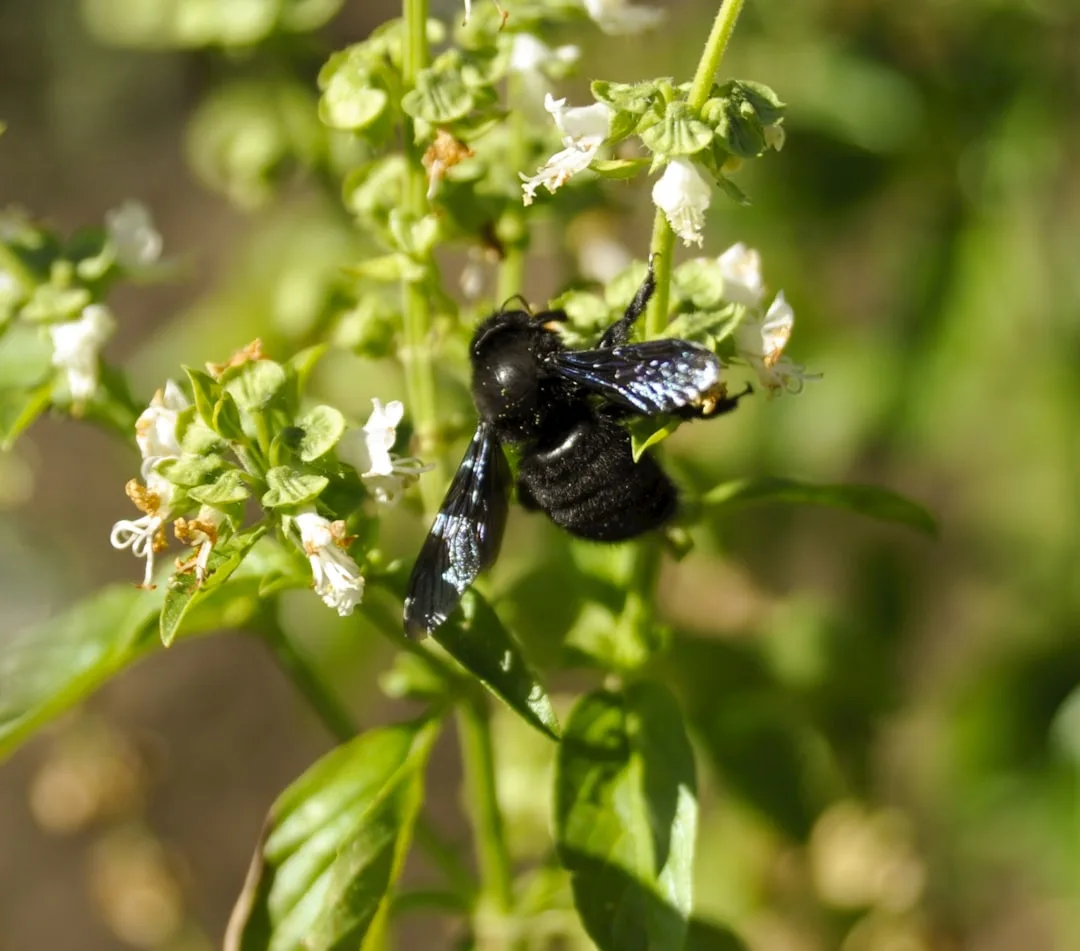
The eastern carpenter bee is the largest native bee across much of eastern North America and one of the only insects on the continent capable of carving working tunnels into solid wood. At first glance Xylocopa virginica looks like an unusually glossy bumblebee - plump, dark, and loud on the wing - but everything about its life history is different. It is solitary. It does not make honey. Its males cannot sting.
Its females build their nests not from wax or paper but by chewing galleries into pine rafters, cedar fence posts, and untreated deck boards. It robs flowers of nectar through back-door slits, pollinates crops that honeybees cannot, and lives out a compact one-year life cycle that can nevertheless stack three generations inside a single tunnel.
This guide covers every major aspect of eastern carpenter bee biology and ecology: size and anatomy, wood-boring behaviour, the solitary life cycle, male territoriality, buzz pollination, nectar robbery, relationships with native plants and with human structures, and the place of X. virginica inside the remarkable global genus Xylocopa.
It is a reference entry, not a summary - so expect specifics: millimetres, hertz, flower species, nest dimensions, and behavioural detail documented in the field literature.
Etymology and Classification
The genus name Xylocopa derives from the Greek xylokopos, meaning 'wood-cutter'. The specific epithet virginica refers to the colonial state of Virginia, from which the first scientific specimens were described in the eighteenth century. In common English the insect is known as the carpenter bee, and in many parts of the American South it is simply called the 'wood bee' or, during its noisy territorial season, the 'dive-bomber bee'.
Xylocopa virginica sits inside the family Apidae, the same broad family that contains honeybees, bumblebees, stingless bees, orchid bees, and cuckoo bees. Within Apidae, carpenter bees occupy the subfamily Xylocopinae together with the small carpenter bees of the genus Ceratina.
The genus Xylocopa contains roughly 500 described species distributed across every continent except Antarctica - from the massive tropical blue carpenter bees of Southeast Asia (Xylocopa caerulea) to the compact Mediterranean species that nest in dry reed stems. The eastern carpenter bee is the dominant large Xylocopa across the eastern half of North America and one of the most studied species in the genus.
Close relatives in North America include the southern carpenter bee (Xylocopa micans), found on the Gulf Coast, and the valley carpenter bee (Xylocopa varipuncta), a California species in which males are famously golden and have given rise to the nickname 'teddy bear bee'. Despite superficial resemblance to bumblebees, carpenter bees and bumblebees are not sister groups - their similar body plan reflects convergent evolution toward large, buzz-pollinating, cold-tolerant bees.
Size and Physical Description
Eastern carpenter bees are among the largest bees in North America. Sexual dimorphism is modest in size but obvious in colour and in behaviour.
Females:
- Body length: 2.0-2.3 cm
- Body mass: 0.6-0.9 g
- Head: broad, with powerful black mandibles
- Face: entirely black
- Abdomen: shiny, nearly hairless, often appearing metallic black or faintly blue-black in sunlight
- Stinger: present but rarely used
Males:
- Body length: 1.9-2.1 cm
- Body mass: 0.4-0.7 g
- Face: marked with a distinctive pale yellow or ivory patch on the clypeus
- Abdomen: shiny, similar to the female
- Eyes: larger than the female's, used for visual tracking during territorial flights
- Stinger: absent - males are incapable of stinging
The single most reliable way to tell a carpenter bee from a bumblebee in the field is the abdomen. Bumblebees are densely furry across the entire body including the rear. Carpenter bees have a dense ruff of hair on the thorax but a shiny, nearly hairless abdomen that reflects light like lacquered metal. This difference is visible from several metres away.
Females carry a dense scopa - a brush of stiff hairs on the hind tibiae - used to transport pollen back to the nest. Males lack a functional scopa because they neither collect pollen nor provision brood cells. The mouthparts include both a long tongue for nectar drinking and large mandibles that articulate like pruning shears for wood excavation.
Wood-Boring Behaviour
The defining behaviour of the eastern carpenter bee is the excavation of nests into solid wood. No other large North American bee does this to anything like the same extent. The process is mechanical rather than chemical - the female does not eat the wood or digest it, she simply chews it out with her mandibles and discards the sawdust.
Preferred nesting woods:
- Pine (especially weathered, unpainted pine)
- Cedar
- Cypress
- Redwood
- Fir
- Oak (occasionally, in softer aged sections)
Untreated and unpainted softwood is strongly preferred. Pressure-treated lumber and well-painted hardwood are usually rejected. Horizontal surfaces and underhangs - fascia boards, soffits, deck railings, porch ceilings, eaves - are favoured because they are sheltered from rain while still being accessible from below. Standing deadwood in natural settings serves the same role.
Typical nest dimensions:
| Feature | Value |
|---|---|
| Entrance hole diameter | 1.2-1.3 cm - strikingly round |
| Initial straight shaft length | 2-3 cm, cut across the grain |
| Main gallery length (one year) | 15-30 cm, parallel to the grain |
| Multi-year gallery length | Up to 1-3 m with branching |
| Brood cell length | ~1.5-2 cm per cell |
| Cells per primary gallery | 6-10 |
| Excavation rate | ~2.5 cm of new tunnel per day |
The entrance hole is distinctive enough to identify at a glance. It is not ragged or oval - it is a clean circle cut with the bee's mandibles. Fresh nests are often marked by a small pile of coarse sawdust directly beneath the entrance and sometimes by yellow pollen staining around the hole. An active nest is usually accompanied by one or more hovering males nearby.
Once excavation is complete the female begins provisioning brood cells. She gathers a ball of pollen mixed with nectar (a 'bee loaf'), lays a single egg on it, and seals the cell with a partition wall made of chewed wood pulp cemented with saliva and secretions. Cell after cell is stacked in a linear row along the gallery. This is why older nests are long and branching - the female cannot expand sideways without damaging sealed brood cells, so expansion runs along or around the existing gallery.
Life Cycle and Reproduction
The eastern carpenter bee runs on a single annual cycle with overlapping generations. Unlike honeybees and many bumblebees, there is no queen and no worker caste - every adult female is reproductively active, and every adult female is potentially a nest founder.
Spring: emergence and mating. Overwintered adults emerge from old tunnels once daytime temperatures rise reliably above roughly 18 C, usually April through early May depending on latitude. Males appear first and immediately establish territories near known nest sites. Mating occurs in flight. Fertilised females then either recondition their natal tunnel, extend it, or excavate a new gallery nearby.
Late spring to early summer: provisioning. Each female builds a series of brood cells along her gallery, provisioning each with a pollen-and-nectar loaf and laying a single egg on it before sealing the cell with a wood-pulp partition. A typical female produces 6-10 eggs in a linear row.
Summer: brood development. Inside the sealed cells, eggs hatch into larvae that consume the provision ball over the following weeks. They then pupate inside the cell. Development from egg to adult takes roughly seven to eight weeks.
Late summer: emergence of the new generation. New adults chew out of their natal cells in August or September. They do not reproduce immediately. Instead, they feed intensively on late-summer flowers to build fat reserves and then return to the tunnel, or to a nearby one, to overwinter.
Autumn and winter: overwintering. Multiple adults - mothers, daughters, and occasionally more distant relatives - overwinter together inside the natal or nearby tunnels. This is a dormant but not truly hibernating state; warm winter days can trigger brief activity.
During peak summer, three overlapping cohorts can share the same tunnel system: the overwintered founder female, her developing brood, and newly emerged young adults. This overlap explains why old nest sites - a barn rafter, a fence post - remain colonised year after year: the overwintering young simply reuse the parental tunnel each spring.
Males, Territories, and the Stingless Bluff
One of the strangest features of carpenter bee biology is the behaviour of the males. Male eastern carpenter bees do not have a stinger. Any appearance of aggression is entirely a bluff, because the sting in bees is evolutionarily derived from the ovipositor - an organ males never had to begin with.
Despite this, males are intensely territorial. A patrolling male establishes an airspace in front of female nest entrances or along common flight paths and defends it against rivals. Defence consists of:
- Hovering motionless at head height, orienting toward any movement
- Dive-bombing anything that enters the territory - other male carpenter bees, wasps, butterflies, small birds, and sometimes human faces
- Loud wing buzz during dives, which carries deliberate acoustic weight
- Chasing intruders across a radius of several metres before returning to the hover point
To a human standing on a deck, this display can be unnerving. It is also completely harmless. The male cannot sting, cannot bite effectively, and will not make physical contact. Once the rival or curious onlooker moves away from the territory, the male returns to his hover point.
Females, by contrast, ignore almost everything. A provisioning female is focused on flower visits and nest construction. She has a stinger but rarely uses it - documented stings usually involve handling or crushing, not territorial behaviour.
This split - harmless noisy males, stinger-bearing but docile females - is nearly unique among large bees and underpins much of the carpenter bee's mixed reputation with humans.
Foraging, Buzz Pollination, and Nectar Robbery
Eastern carpenter bees are generalist floral visitors, recorded on hundreds of plant species. Their foraging behaviour, however, includes two specialised and well-studied mechanisms.
Buzz pollination (sonication). Many flowering plants hide their pollen inside narrow tubular anthers that release it only through small pores at the tip. Honeybees, with their gentle licking and combing technique, cannot easily extract this pollen. Carpenter bees and bumblebees can.
The bee grips the flower, disengages her wings from the flight muscles, and then contracts the indirect flight muscles rapidly - producing a high-frequency vibration near 400 Hz that travels through her body into the anthers. The anthers shake, pollen sprays out through the pores, and the bee collects it on her body hairs. Plants dependent on or strongly benefited by buzz pollination include:
- Tomato (Solanum lycopersicum)
- Eggplant (Solanum melongena)
- Blueberry (Vaccinium species)
- Cranberry (Vaccinium macrocarpon)
- Kiwifruit (Actinidia deliciosa)
- Native nightshades and many Solanaceae
- Shooting star (Dodecatheon species)
Carpenter bees' size and vibration strength make them efficient sonicators, and commercial interest in their use for greenhouse tomato pollination has grown steadily.
Nectar robbery. Many tubular flowers have evolved to restrict nectar access to pollinators with long tongues and matching body shapes - coral honeysuckle, salvias, some bean relatives. The carpenter bee, with her large body and medium-length tongue, often cannot enter the corolla legitimately.
Rather than skip the flower, she lands on the outside, uses her mandibles to chew a neat slit at the base directly over the nectar spur, and drinks through the slit. She never contacts the reproductive parts of the flower. Once the slit exists, smaller bees and honeybees readily reuse it, amplifying the pollination loss for that plant.
Nectar robbery is energetically rational for the bee and ecologically costly for the plant. On some species, particularly non-native ornamentals, carpenter bees can rob the majority of flowers on a plant in a single day.
Despite the nectar robbery habit, carpenter bees are genuinely important legitimate pollinators for a range of native plants. The passionflower (Passiflora incarnata) is a well-known example: the flower's reproductive column arcs at exactly the height of a carpenter bee's back as she feeds, dusting her with pollen that is carried to the next flower. Several other native vines and shrubs show similar adaptations.
Range, Habitat, and Density
The eastern carpenter bee is distributed across the eastern half of North America, roughly from southern Quebec and Ontario in the north to Florida in the south, and from the Atlantic coast west to the eastern edge of the Great Plains and the foothills of the Rocky Mountains. Populations drop off sharply west of the Rockies, where related species such as X. tabaniformis and X. californica replace it.
Habitat preferences:
- Forest edges and clearings with standing deadwood
- Old barns, outbuildings, and wooden fences
- Suburban gardens, decks, and cedar-clad homes
- Agricultural field margins near orchards
- Riparian woodland with weathered logs
- Parks and cemeteries with mature trees
Carpenter bees are strongly associated with human landscapes precisely because human construction provides enormous quantities of untreated softwood. A single suburban street may support more carpenter bees per hectare than the natural forest that once stood there. This is one reason the species has remained abundant while many specialist native bees have declined.
The genus as a whole is global. Xylocopa species reach their greatest diversity in the tropics, where some species are enormous - the tropical blue carpenter bee (X. caerulea) and the violet carpenter bee (X. violacea) are familiar to gardeners across Asia and southern Europe. Across this range, Xylocopa species share the same core lifestyle: solitary or weakly communal, wood-nesting, buzz-pollinating, and territorially vocal.
Ecological Role
Eastern carpenter bees play several distinct ecological roles simultaneously.
Pollinators. They are important pollinators for native plants such as passionflower, trumpet honeysuckle, rhododendron, and many woodland herbs. They are also valued for buzz pollination of tomato and eggplant.
Wood recyclers. In natural settings, carpenter bees contribute to the breakdown of standing deadwood by excavating galleries that fungi and other decomposers subsequently colonise.
Prey. Woodpeckers - particularly pileated and red-bellied - regularly tear open carpenter bee galleries to extract larvae. This adds a secondary layer of damage to wooden structures. Robber flies, crab spiders, praying mantises, and some larger birds also take adult carpenter bees.
Hosts. Carpenter bees are hosts to several specialist parasites, including cuckoo bees of the genus Coelioxys and certain mites that hitch rides on emerging adults. A notable specialist is the parasitic chalcid wasp Monodontomerus that attacks carpenter bee brood.
Propolis producers. Although they do not make honey, female carpenter bees produce a glandular secretion combined with chewed wood pulp that functions like propolis - cementing brood cell partitions and waterproofing parts of the nest. This is structurally and chemically interesting and has begun attracting research attention for its antimicrobial properties.
Conservation and Human Relations
The IUCN has not formally assessed Xylocopa virginica. Regional and national monitoring programmes generally describe the species as stable or locally abundant. Unlike honeybees, carpenter bees are immune to hive pathogens such as Varroa mites and American foulbrood because they do not live in hives. Unlike many specialist native bees, they are not dependent on a single host plant or a vanishing habitat type.
Primary threats, where they exist, are local:
- Insecticide exposure from lawn and garden treatments
- Habitat simplification that removes both flower diversity and deadwood
- Direct control by homeowners treating wooden structures
- Pressure-treating and painting of wood, which excludes them from previously usable nest sites
Carpenter bee control programmes exist primarily because of structural damage rather than any human health concern. Over decades, accumulated galleries in roof rafters, fascia boards, and cedar siding can compromise wood sufficiently to require replacement. The woodpeckers that follow the bees often do more visible damage than the bees themselves.
Management strategies usually emphasise painting or staining vulnerable wood, sealing old entrance holes in winter, and providing alternative nesting blocks rather than chemical treatment.
From the bees' perspective, human settlement has been a net positive. Suburban and agricultural landscapes with softwood structures and varied flowering plants support dense carpenter bee populations that likely exceed pre-colonisation forest densities.
Related Reading
- Bumblebee
- Honeybee
- Honeybee Waggle Dance Communication
- Why Are Bees Dying: Colony Collapse
- Bees and Wasps: Pollinators, Architects, and Warriors
References
Relevant peer-reviewed and governmental sources consulted for this entry include the Xerces Society for Invertebrate Conservation bee monitoring reports, the USDA Agricultural Research Service pollinator studies, the Annals of the Entomological Society of America, the Journal of Hymenoptera Research, Apidologie, and faunal revisions of the genus Xylocopa published through the Discover Life bee taxonomy project.
Specific behavioural and nest-architecture figures reflect consolidated field observations and published studies of Xylocopa virginica across the eastern United States.
Frequently Asked Questions
How big are eastern carpenter bees?
Adult eastern carpenter bees (Xylocopa virginica) measure 1.9 to 2.3 cm in body length - roughly three-quarters of an inch to a full inch - and weigh between 0.4 and 0.9 grams. Females are slightly larger and heavier than males. At first glance they resemble large bumblebees because of their round, plump body shape, but the shiny and nearly hairless black abdomen gives them away. Wingspan reaches about 4 cm.
The head carries powerful mandibles specialised for chewing wood, and females show a dense brush of pollen-collecting hairs (scopa) on the hind legs.
Do carpenter bees sting?
Only females have a stinger, and they almost never use it. Female eastern carpenter bees will sting only if physically grabbed, trapped against skin, or crushed. Males are completely stingless - they have no ovipositor-derived sting at all - and rely entirely on bluff and territorial dive-bombing to intimidate rivals and intruders. The conspicuous hovering male that buzzes in front of a patio is almost always harmless.
This is a useful rule in the field: if a carpenter bee is aggressively approaching you, it is almost certainly a male and therefore incapable of stinging. Females are docile and focus on provisioning their nests.
How do carpenter bees damage wood?
Carpenter bees do not eat wood - they excavate it. A female uses her mandibles to chew a near-perfect round entrance hole roughly 1.3 cm in diameter, tunnelling straight in for about 2-3 cm before turning sharply and running a gallery parallel to the grain. A fresh gallery is typically 15-30 cm long but can extend much further when multiple generations reuse the same nest.
Over years, branching networks more than a metre long have been documented inside fascia boards, roof rafters, cedar siding, deck railings, and fence posts. Preferred woods include untreated pine, cedar, cypress, fir, and redwood - particularly softwoods weathered by sun and rain. Structural damage accumulates slowly but can be substantial where nests have been ignored for a decade or more.
Are carpenter bees solitary or social?
Eastern carpenter bees are classified as solitary bees, meaning each female constructs and provisions her own nest without a worker caste. However, Xylocopa virginica shows one of the most interesting social edges in the bee world. Mother-daughter and sister-sister cohabitation is common - multiple related females may share a single tunnel system, sometimes dividing labour loosely between guarding, foraging, and nest expansion.
This is sometimes called facultative social behaviour or weakly communal nesting. It sits on the evolutionary road between strict solitary life and the highly organised eusociality of honeybees and many bumblebees, and it makes the species a favourite subject for researchers studying the origins of insect societies.
What is buzz pollination and do carpenter bees do it?
Buzz pollination, or sonication, is a specialised foraging behaviour where a bee grips a flower and vibrates her flight muscles rapidly while the wings remain folded. The resulting high-frequency buzz - around 400 Hz in carpenter bees - shakes pollen free from anthers that hold it inside tight tubes or pores. Honeybees cannot do this.
Carpenter bees, bumblebees, and several other native bee families can, and are therefore essential pollinators of crops like tomato, eggplant, blueberry, cranberry, and kiwifruit. Eastern carpenter bees are particularly efficient sonicators and are increasingly studied as commercial pollinators for greenhouse tomato production.
Why do carpenter bees steal nectar?
Carpenter bees are generalist floral visitors, but their large body size sometimes prevents them from entering flowers with long narrow corollas - the honeysuckles, salvias, and some legumes. Rather than pass the flower over, the bee lands on the outside of the blossom and uses her mandibles to chew a neat slit at the base of the corolla, directly over the nectar.
She drinks through this slit and flies off without ever touching the reproductive parts of the flower. This behaviour is called nectar robbery. Once the slit exists, honeybees and other smaller bees quickly learn to exploit it, compounding the pollination deficit for that plant. From the bee’s energetic perspective it is efficient; from the plant’s it is parasitic.
How long do carpenter bees live?
An individual eastern carpenter bee lives about one year. The annual cycle begins with adults overwintering inside old tunnels from the previous season. They emerge in spring, mate, and females begin excavating or reconditioning nests. Eggs laid in spring develop through larval and pupal stages inside sealed brood cells provisioned with pollen-and-nectar loaves.
New adults emerge in late summer, feed on flowers to build fat reserves, and then return to the natal tunnel to overwinter. Three overlapping generations can be present in a single tunnel system during peak summer: overwintering mothers, their developing brood, and newly emerged young adults. Most individuals die during or shortly after their single reproductive summer.
Are carpenter bees in decline?
The IUCN has not formally assessed Xylocopa virginica, and the species is considered locally abundant across its range in eastern North America.
Unlike honeybees and many bumblebee species, carpenter bees have not shown widespread documented declines, partly because their solitary lifestyle makes them immune to colony-collapse pathogens and partly because human construction inadvertently provides vast amounts of nesting substrate in the form of untreated softwood. Insecticide exposure, habitat simplification, and removal of standing deadwood in natural settings remain pressures at local scales.
On balance, eastern carpenter bees appear stable or increasing in suburban and agricultural landscapes, even as other wild bee species have declined sharply.