
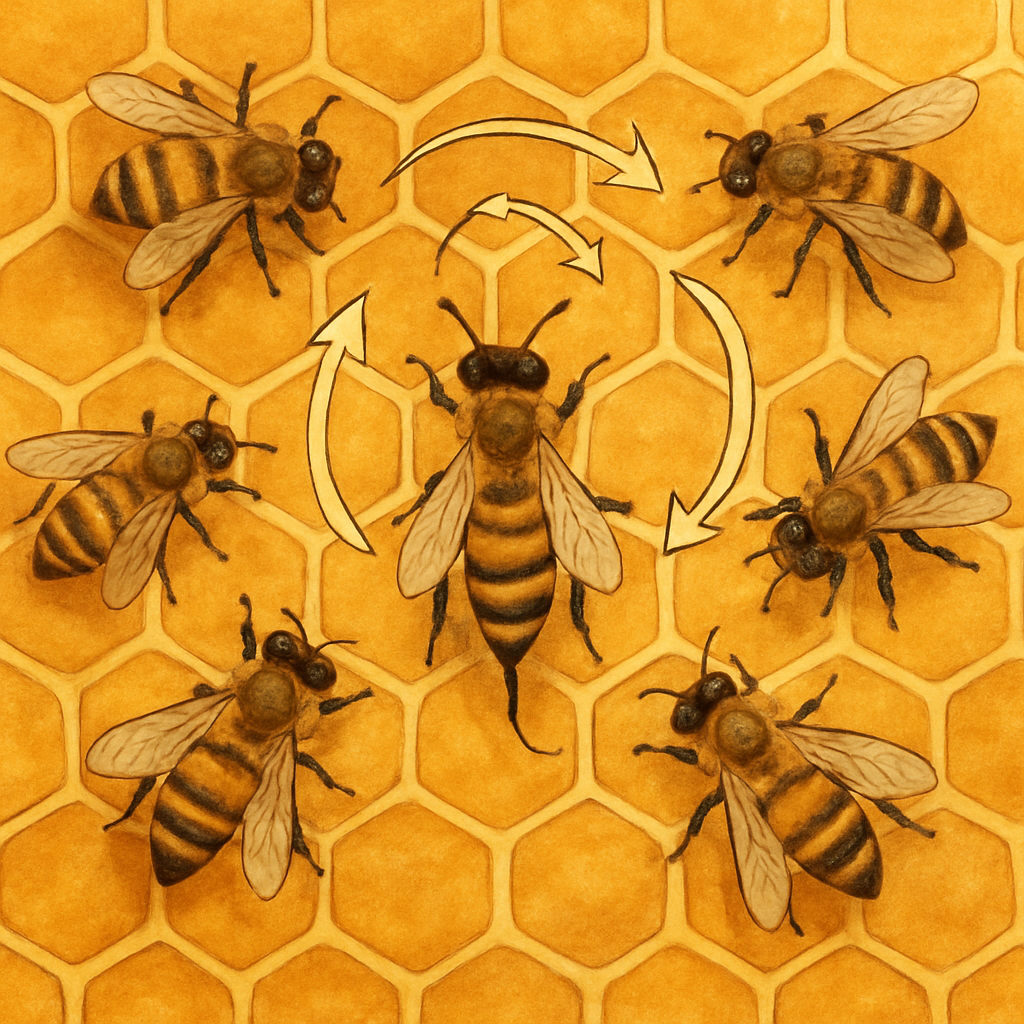
What is the honeybee waggle dance?
The waggle dance is a figure-eight movement that honeybees perform to communicate the location of food sources (and occasionally new nest sites) to other bees in the hive. A returning forager bee walks forward in a straight line while waggling her abdomen side to side, then circles back to the starting point, then repeats the straight waggle run, then circles.
A Language Inside the Hive
Deep in a dark beehive, a forager bee returns from her search for nectar. She climbs onto a vertical honeycomb and begins to dance - a figure-eight pattern with a straight segment in the middle where she waggles her abdomen rapidly side to side.
Other bees cluster around her, watching. Within minutes, dozens of bees leave the hive and fly directly to a meadow 2.3 kilometers away, heading 38 degrees to the right of the sun. None of them have been there before. They arrive accurately, land on the correct flowers, and collect nectar.
What the foraging bee communicated through her dance was remarkably specific: distance (2.3 km), direction (38 degrees right of sun), and food type (through scent traces on her body). The information density rivals human language in its own way. The bee who discovered the dance mechanism earned a Nobel Prize.
The Dance
The waggle dance has a precise structure.
The figure-eight pattern:
A dancing bee:
- Walks forward in a straight line while waggling her abdomen
- Loops back to the starting point (to one side)
- Walks forward again along the same straight line
- Loops back to the starting point (to the other side)
- Repeats the pattern multiple times
The waggle run:
The straight segment - the waggle run - carries the primary information. During this run:
- The bee waggles her abdomen at approximately 15 times per second
- She vibrates her wings
- Other bees touch her body to detect the signals
Observation:
Recruited bees (also called follower bees) press close to the dancer. They feel the waggles, detect the direction, and measure the duration. After observing several repetitions, they leave the hive and fly toward the indicated location.
The Information Encoded
Three types of information are transmitted through the dance.
Distance (through waggle duration):
The duration of the waggle run indicates distance to the food source.
- 1 second of waggling ≈ 1 km of flight distance
- 3 seconds of waggling ≈ 3 km of flight distance
- 0.5 seconds of waggling ≈ 500 m of flight distance
Exact calibration varies slightly between species and even between regions, suggesting cultural transmission of dance dialects.
Direction (through waggle angle):
The angle of the waggle run relative to vertical indicates direction relative to the sun.
- Straight up (12 o'clock): food is directly toward the sun
- Straight down (6 o'clock): food is directly away from the sun
- 30 degrees right of vertical: food is 30 degrees right of the sun
- 90 degrees left of vertical: food is 90 degrees left of the sun
Because the hive is dark and bees dance on vertical surfaces, they use gravity as a reference for "up" and "down." They translate this into sun-based directions through their internal sun compass.
Food type (through scent):
The dancer carries scent residues from the flowers she visited. Follower bees detect these scents and know what type of food to look for.
Solar Compensation
A remarkable aspect of the waggle dance is that bees compensate for the sun's movement across the sky.
The problem:
The sun moves from east to west over the course of the day. A bee that found food directly east at 9 AM would face a problem encoding that direction at 3 PM - the sun has moved significantly.
The solution:
Bees track the sun's position continuously and adjust their dances throughout the day. A bee dancing about an eastern food source at 9 AM might indicate "60 degrees right of sun." The same bee dancing about the same food source at 3 PM might indicate "90 degrees left of sun" - because the sun has moved.
The food hasn't moved. The sun has. The bees calculate the difference automatically.
Internal clock:
Bees have internal biological clocks that track the sun's position even when they can't see it. A bee who returns to the hive at night and dances in the dark (with no visible sun) still encodes directions correctly, using her internal estimate of where the sun would be.
Discovery
The waggle dance was discovered through decades of painstaking research by Karl von Frisch.
The initial observation:
In the early 20th century, von Frisch observed that when a single bee discovered a food source, many bees from her hive would arrive shortly after. This suggested that bees communicated location information somehow.
The experiments:
Through careful marking of individual bees, controlled food presentations, and systematic observation, von Frisch slowly decoded the dance:
- 1920s-1930s: identified that bees danced after finding food
- 1940s: decoded distance encoding (longer dance = farther food)
- 1950s: decoded directional encoding (angle relative to sun)
- 1960s: refined understanding through increasingly sophisticated experiments
Scientific acceptance:
Not all scientists believed von Frisch's conclusions. Some argued that bees communicated through scent or simpler cues rather than symbolic dance language. The debate continued into the 1970s.
Robot bees:
In the 1980s, researchers built small robotic bees that could perform artificial waggle dances. When real bees followed these robot dances, they arrived at the predicted locations - definitively proving that the dance genuinely communicated information.
Nobel Prize:
Karl von Frisch received the 1973 Nobel Prize in Physiology or Medicine, shared with Konrad Lorenz and Nikolaas Tinbergen, for his discovery of bee communication.
Dance Dialects
Different honeybee species and regions have slightly different dance dialects.
Species variation:
- European honeybees (Apis mellifera): 1 second per 1 km
- Asian honeybees (Apis cerana): different calibration
- African honeybees: another variation
- Giant Asian honeybees (Apis dorsata): distinctive pattern
When bees from different species are mixed experimentally, their dances become incomprehensible to each other. A European bee following an Asian bee's dance arrives at the wrong distance.
Regional dialects:
Within a single species, different regions show slight dance variations. Bees in mountainous terrain, flat plains, and forests may have subtly different calibrations - presumably adapted to local flight conditions.
Cultural transmission:
The existence of dialects suggests some form of cultural transmission. Young bees may learn their specific dance calibration from observing older bees in their hive. This kind of cultural transmission is rare in insects.
How Bees Measure Distance
To encode distance accurately in dances, bees must measure the flight distance from hive to food source.
Visual flow:
Bees measure distance primarily through visual flow - the rate at which landmarks pass below them during flight. Higher flight speed or more detailed visual environment produces more flow.
Calibration:
Individual bees calibrate their distance sense based on typical environments around their hive. Bees raised in visually complex environments (forests) have different calibrations than bees raised in simple environments (open fields).
Errors:
Bees dancing for food sources across unusual terrain sometimes miscalibrate. Food across large lakes or over featureless water can produce inflated distance estimates because visual flow is reduced over such terrain.
Beyond Dance: Other Bee Communication
The waggle dance is not the only way bees communicate.
Scent signals:
Queen bees produce pheromones that regulate hive behavior, worker bee reproduction, and collective activities. These chemical signals are essential to hive coordination.
Alarm pheromones:
When bees are threatened, they release alarm pheromones that recruit other bees to defend the hive. This is why stepping on a bee near a hive can trigger mass attacks.
Trophallaxis:
Bees exchange food mouth-to-mouth throughout the hive. This behavior transfers food and scent information about flower types currently producing nectar.
Vibrations and sounds:
Bees produce various vibrations and sounds within the hive that signal different states - distress, excitement, incoming food, threat detection.
Cognitive Implications
The waggle dance raises deep questions about insect intelligence.
Information density:
The dance encodes three distinct types of information (distance, direction, type) in a compact movement pattern. This approaches the information density of simple human utterances.
Abstraction:
The dance uses gravity as a symbol for the sun's position - an abstract mapping between two different reference systems. This is relatively sophisticated cognitive operation.
Teaching:
Dances function as teaching - experienced bees convey information to inexperienced bees who then apply it correctly. This is social learning.
Is it language?
Whether the waggle dance qualifies as "language" depends on definitions. It shares features with human language:
- Symbolic encoding of information
- Communication between individuals
- Ability to refer to things not present
- Learned variations across populations
But it lacks other language features:
- Cannot express arbitrary new content
- Fixed repertoire of signals
- No grammar or composition rules
- No emotional or relational content
Most researchers consider the waggle dance a sophisticated communication system but not language in the full human sense.
The Importance of Bee Communication
The waggle dance matters beyond its scientific interest.
Agricultural implications:
Honeybee pollination supports global agriculture. Billions of flowers are pollinated by bees annually. The waggle dance is essential to how bee colonies find and exploit nectar sources, including agricultural crops.
Colony survival:
A bee colony that could not communicate food locations efficiently would suffer. The waggle dance lets thousands of bees collectively exploit the best food sources, supporting colony nutrition and reproduction.
Evolutionary insights:
The waggle dance shows that sophisticated communication can evolve in animals with small brains and simple nervous systems. Bees have about 1 million neurons, compared to 86 billion in humans. Yet they support a communication system that rivals simple language in some respects.
This has implications for understanding how intelligence and communication can emerge from simpler neural architectures than the human brain.
The next time you watch bees moving near a hive, consider that you may be witnessing the transmission of specific geographic information - the equivalent of one bee telling another "there's a field of clover 1.2 kilometers to the east of here, go collect some before all the other bees beat you to it." And the other bee understands, flies directly there, and arrives at the correct clover field without ever having visited it before.
This is not just insect behavior. It is communication that encodes complex information with precision. It is one of the more remarkable things any animal does on Earth.
Decoding the Waggle Dance: The Math
Karl von Frisch's original observations were encoded in remarkably precise mathematical relationships. Using only direction and duration of the waggle run, a dancing bee communicates both the bearing and distance of a foraging site. The Kalenux Team compiled the relationships from published literature.
| Dance Component | Encodes | Typical Range |
|---|---|---|
| Angle of waggle run relative to vertical | Bearing relative to sun | 0-360 degrees |
| Duration of waggle run | Distance to food source | 0.5-5 seconds for 100-4000 m |
| Intensity of waggle movement | Profitability of food source | Subjective scale |
| Number of followers recruited | Urgency and quality | 1-30 per dance |
| Duration of total dance performance | Value assessment | 10 seconds to several minutes |
"A bee that waggles for one second is communicating a distance of about 750 meters. A two-second waggle means 1,500 meters. The relationship is remarkably linear across the foraging range of a honeybee colony. This is the first documented case of distance encoded by duration in any non-human animal communication system." - Karl von Frisch, Nobel Prize lecture, 1973 [1]
The angle relationship is equally precise. If a dancer performs the waggle run straight up the comb, she is indicating that the food source lies directly toward the sun. A run at 45 degrees to the left of vertical means the food source is 45 degrees to the left of the sun's current position.
Because bees use the sun as their primary compass reference, this angular system requires continuous updating as the sun moves across the sky - which the bees do automatically, using an internal circadian clock coupled to their visual sense.
Recruitment Success and Foraging Efficiency
How much does the waggle dance actually matter for colony survival? Experiments by Madeleine Beekman and colleagues at the University of Sydney tested the value of the dance by disabling it in otherwise healthy colonies. The results were dramatic.
"When we disabled the directional information in the waggle dance - by placing the hive on its back so that dancing bees could not orient to gravity - foragers became much less efficient. They still found food, but they wasted far more time searching. In landscapes with dispersed food sources, colonies without functional dance communication collected 30 to 50 percent less nectar than controls." - Madeleine Beekman, University of Sydney, Behavioral Ecology and Sociobiology, 2008 [2]
The effect was stronger in natural landscapes with scattered flower patches than in experimental setups with concentrated feeders. This makes ecological sense: when food is concentrated, any bee can find it quickly; when food is scattered, efficient communication about the best patches becomes the difference between a thriving colony and a starving one.
The dance also functions as a quality filter. Dancers perform longer, more intense dances for better food sources. A bee returning from an excellent source may waggle for several minutes and recruit dozens of followers; a bee returning from a mediocre source may dance briefly and recruit few. The colony as a whole therefore converges on the best available food without any central coordinator making that decision.
Beyond Honeybees: Dance-Like Communication in Other Insects
The waggle dance of the honeybee (Apis mellifera) is the most famous insect communication system, but related dance behaviors have been documented in other Apis species and in a few non-Apis insects. The evolutionary history of the dance is an active area of research.
| Species | Communication System | Notes |
|---|---|---|
| Apis mellifera (Western honeybee) | Full waggle dance | Most studied |
| Apis cerana (Eastern honeybee) | Full waggle dance | Similar but adapted for Asian forests |
| Apis dorsata (Giant honeybee) | Waggle dance with tactile components | Performs in open air on exposed combs |
| Apis florea (Dwarf honeybee) | Horizontal waggle dance | Uses landmarks instead of gravity |
| Trigona stingless bees | Pheromone trails and sounds | Converged communication system |
| Bombus bumblebees | Scent marking and excitement | No directional dance |
The waggle dance appears to have evolved once in the ancestor of modern Apis, but the specific "vocabulary" has been tuned by each species to its particular ecology. Dwarf honeybees, which nest in the open on single combs rather than inside cavities, use horizontal dances referenced to the sun rather than vertical dances referenced to gravity. This makes perfect sense given their exposed combs, where gravity cannot be used as a reference direction.
References
- von Frisch, K. (1967). The Dance Language and Orientation of Bees. Harvard University Press.
- Beekman, M., and Lew, J. B. (2008). "Foraging in honeybees: when does it pay to dance?" Behavioral Ecology, 19(2), 255-261.
- Seeley, T. D. (1995). The Wisdom of the Hive: The Social Physiology of Honey Bee Colonies. Harvard University Press.
- Riley, J. R., Greggers, U., Smith, A. D., Reynolds, D. R., and Menzel, R. (2005). "The flight paths of honeybees recruited by the waggle dance." Nature, 435(7039), 205-207.
- Dyer, F. C. (2002). "The biology of the dance language." Annual Review of Entomology, 47, 917-949.
Related Articles
- Why Are Bees Dying? The Colony Collapse Disorder Mystery
- Bees and Wasps: Pollinators, Architects, and Warriors
- Ant Colonies: Social Insects and Distributed Intelligence
For more on social insects and colony coordination, see our insect social behaviour guide.
Frequently Asked Questions
What is the honeybee waggle dance?
The waggle dance is a figure-eight movement that honeybees perform to communicate the location of food sources (and occasionally new nest sites) to other bees in the hive. A returning forager bee walks forward in a straight line while waggling her abdomen side to side, then circles back to the starting point, then repeats the straight waggle run, then circles back in the opposite direction. The pattern traces a figure-eight.
The direction of the waggle run (relative to gravity, since bees dance on vertical combs in darkness) indicates the direction of the food relative to the sun. The duration of the waggle run indicates the distance - longer waggles mean further targets. Other bees observing the dance learn the direction and distance information and fly directly to the food source.
This communication system was discovered by Austrian scientist Karl von Frisch in the 1940s, earning him the 1973 Nobel Prize in Physiology or Medicine.
How does the waggle dance encode distance?
The duration of the waggle run encodes distance to the food source. Each second of waggling corresponds to approximately 1 km of flight distance, though the exact rate varies slightly between honeybee species and subspecies. A 3-second waggle indicates food approximately 3 km away. A 0.5-second waggle indicates food within 500 meters. Bees measuring distance in flight use visual flow - the rate at which landmarks pass below them during flight.
This is why bees in different landscapes may have slightly different dance-distance calibration. Research has shown that bees dancing for food in unfamiliar mountain valleys or after crossing featureless water give slightly miscalibrated dances. The dance also encodes distance confidence - bees reduce dance duration when returning from more distant, uncertain food sources.
The system is sophisticated enough that other bees can fly directly to a new food source they have never visited based solely on observing a dance.
How does the waggle dance encode direction?
The angle of the waggle run relative to vertical encodes direction relative to the sun. When a bee performs the waggle run straight up (12 o’clock position on the vertical comb), she indicates the food is directly toward the sun. A waggle pointing straight down indicates food directly away from the sun. An angle 30 degrees to the right of vertical indicates food 30 degrees to the right of the sun’s direction.
Bees track the sun’s position throughout the day and adjust their dances continuously. A bee dancing in the morning about a food source to the east will perform the dance differently in the afternoon when the sun has moved to the south - even though the food location hasn’t changed. Observing bees translate the gravity-based dance direction into sun-based flight direction using their internal sun compass.
This coordinate system conversion happens automatically and allows bees to navigate accurately despite the sun’s movement across the sky.
Who discovered the bee waggle dance?
Austrian zoologist Karl von Frisch discovered that bees communicated through dance in the 1940s, though he had begun studying bee behavior decades earlier. Von Frisch initially suspected bees communicated when he observed that after a single bee discovered sugar water in an experimental feeder, many other bees from the same hive would quickly arrive - suggesting the first bee had somehow communicated the food’s location.
Through painstaking experiments over 30+ years, he demonstrated the dance language and decoded how it encoded direction and distance. His work was initially controversial - many scientists doubted that insects could communicate such complex information. Experiments in the 1960s using robot bees that performed artificial waggle dances convinced skeptics that the dance genuinely communicated information.
Von Frisch received the Nobel Prize in Physiology or Medicine in 1973, shared with Konrad Lorenz and Nikolaas Tinbergen, for his discovery of bee communication. His work fundamentally changed how scientists thought about insect intelligence and animal communication.
Can other bees understand the waggle dance from different hives?
Generally no - bees from different honeybee species have different dance dialects and cannot reliably interpret each other’s dances. Research has shown that European honeybees (Apis mellifera), Asian honeybees (Apis cerana), and African honeybees have different waggle-to-distance ratios in their dances.
When bees from different species are mixed in laboratory experiments, they can attempt to follow each other’s dances but arrive at incorrect locations because the distance encoding differs. Within a single honeybee species, dance dialects vary slightly by geographic region, suggesting cultural transmission of specific dance calibrations.
Different species of stingless bees (closely related to honeybees) use different communication methods - some lay scent trails rather than dancing. The evolutionary origin of the waggle dance is still debated. It may have arisen from ancestral movement patterns related to flight direction, gradually refined into the sophisticated communication system seen today.
Waggle dance complexity is unusual for insects and has been compared to human language in terms of information density and abstraction.