
Are bees really going extinct?
No, honeybees are not going extinct - in fact, managed honeybee populations are stable or growing globally. The actual crisis is different: honeybee colonies die at unsustainable rates but are being replaced by beekeepers, while wild bee species and native pollinators are in severe decline. The USDA reports U. S.
The Real Story Behind the Pollinator Crisis
In 2006, beekeepers across the United States began reporting something they had never seen before. Their honeybee colonies were disappearing. Not dying in the hive - vanishing. Worker bees would leave on foraging trips and never return. Queens sat alone on empty combs surrounded by full honey stores and a handful of confused nurse bees. Within weeks, entire colonies collapsed.
This was the birth of the phrase "colony collapse disorder," and it triggered two decades of research, panic, and public advocacy. The "Save the Bees" movement spread globally. Documentaries warned of imminent agricultural collapse. School children wrote letters to politicians about bees.
The reality of the bee crisis is more complicated than the popular narrative. Honeybees are not going extinct - they are a managed agricultural species whose numbers remain stable globally. But wild bees, native pollinators, and the ecological web they support are in severe decline. The distinction matters for understanding what is actually at stake.
Honeybees vs Wild Bees: The Distinction That Matters
Most "save the bees" messaging focuses on the western honeybee (Apis mellifera), a managed agricultural species kept in hives by beekeepers worldwide. But honeybees are just one of approximately 20,000 bee species on Earth, and they are not the species most at risk.
Honeybees:
- One species (Apis mellifera) worldwide
- Managed in hives by beekeepers
- Population stable or growing globally due to active management
- Annual colony losses of 30-40 percent in the U.S., but replaced by beekeepers
- Primary commercial pollinator for many crops
Wild and native bees:
- Approximately 20,000 species globally
- 4,000 native species in North America alone
- Not managed; live in the wild
- Approximately 40 percent of species in decline
- Many species near extinction
- Essential for wild ecosystems, not just crops
The crisis is real, but it is primarily a crisis of wild bees, not honeybees. Understanding this distinction is critical because:
- The messaging that "honeybees are dying" is misleading
- The actual extinction risk falls on species most people have never heard of
- Solutions that help honeybees (commercial beekeeping practices) often do not help wild bees
The rusty patched bumblebee (Bombus affinis), once common across the eastern United States, is now critically endangered - populations have collapsed by 87 percent since the 1990s. It became the first bee species listed under the U.S. Endangered Species Act in 2017.
The Franklin's bumblebee (Bombus franklini), restricted to a small area of Oregon and California, was last seen in 2006 and is likely extinct.
The western bumblebee (Bombus occidentalis), once the most common bumblebee in the Pacific Northwest, has declined by over 90 percent.
These are the actual extinctions happening. Honeybees, despite the messaging, are doing better by comparison.
What Colony Collapse Disorder Actually Is
Colony collapse disorder (CCD) was the specific phenomenon that launched public awareness of bee decline. It has been extensively studied and is now reasonably well understood - though the term is still used loosely in popular media.
What makes CCD distinctive:
The worker bees leave the hive and do not return. This is not normal bee behavior. Normally, when a hive is struggling, bees die in or near the hive. CCD involves physical disappearance.
The queen, brood (larvae), and food stores remain intact. Other bee colonies and pests that would normally raid an abandoned hive (wax moths, hive beetles) initially avoid collapsed colonies, suggesting something about the collapsed hive is unusual.
The remaining bees (nurse bees, queen) cannot maintain the hive and eventually die.
The causes (now reasonably well understood):
CCD has no single cause. Research by the USDA Agricultural Research Service, Pennsylvania State University, and multiple international teams has identified CCD as a multi-factor syndrome with the following contributors:
1. Varroa Destructor Mites
Varroa destructor is a parasitic mite that attaches to honeybees and feeds on their fat bodies (analogous to the liver). The mites transmit viruses, weaken the bees, and are the single most important factor in global honeybee health problems.
Varroa arrived in the U.S. in 1987. Before Varroa, beekeepers typically lost 5-10 percent of colonies per winter. After Varroa, losses rose to 30-40 percent. Varroa is now present in every major honeybee-keeping region except Australia (which maintains strict biosecurity).
2. Neonicotinoid Pesticides
Neonicotinoids (imidacloprid, clothianidin, thiamethoxam) are systemic pesticides that plants absorb into their tissues, including pollen and nectar. Bees foraging on treated crops consume small doses that impair:
- Navigation (bees get lost and cannot find their hive)
- Immune function (bees become more vulnerable to pathogens)
- Reproduction (queens produce fewer offspring)
- Memory (bees cannot remember flower locations)
A landmark 2012 study in Science by Dave Goulson's team at the University of Stirling showed bumblebee colonies exposed to field-realistic neonicotinoid doses produced 85 percent fewer new queens than control colonies.
The European Union banned neonicotinoid use on flowering crops in 2018. The U.S. has restricted but not banned them, citing economic concerns from agricultural lobbies.
3. Viral Diseases
Deformed wing virus (DWV), Israeli acute paralysis virus (IAPV), and several other viruses have become more prevalent and more virulent since Varroa mite populations increased. Varroa acts as a viral vector, injecting viruses directly into bees when feeding.
4. Poor Nutrition
Commercial honeybees are often trucked between crop pollinations, eating only one type of pollen for weeks at a time (for example, spending February on almonds, then April on apples, then June on blueberries). This monoculture diet weakens bee immune systems. Wild bees face similar problems as habitat loss reduces the diversity of available flowers.
5. Climate Change
Changing weather patterns disrupt the synchronization between flower blooming times and bee emergence from hibernation. Heat waves kill bees directly. Altered precipitation changes the availability of nectar and pollen.
No single factor causes CCD. Multiple stressors combine to exceed the bee colony's capacity to recover. A colony with just Varroa mites might survive. A colony with Varroa plus neonicotinoid exposure plus a cold winter often does not.
The Global Food Security Question
The economic and nutritional stakes of pollinator decline are severe.
Crops dependent on animal pollination:
- Almonds: 90 percent dependent on honeybees. California's almond industry requires 1.8 million hives trucked in each February.
- Apples: 90 percent dependent on bees.
- Blueberries, cherries, cranberries: 90 percent dependent.
- Avocados, watermelons, cucumbers, pumpkins, squash: 80-100 percent dependent.
- Coffee, cocoa, vanilla: require bees and other insects.
- Most tree fruits, berries, and many vegetables: significantly dependent.
Crops that do NOT require pollinators:
- Wheat, rice, corn, oats, barley (wind-pollinated)
- Most leafy greens harvested before flowering
- Root vegetables like potatoes and carrots (though carrot seed production requires bees)
The economic calculation:
Global crops worth approximately $235-577 billion annually depend on animal pollination. The U.S. alone benefits from pollinator services valued at approximately $34 billion per year. If pollinators were eliminated entirely, these crops would either disappear or require hand-pollination - a process so labor-intensive that it has already been adopted in parts of China where wild pollinator populations have collapsed.
In the Maoxian valley of Sichuan, China, wild bees were exterminated by pesticide overuse in the 1990s. Farmers now hand-pollinate apple and pear trees using paintbrushes to transfer pollen flower-by-flower. The labor costs are enormous, and the quality of pollination is inferior to what bees provide.
This is the future that pollinator collapse threatens: entire agricultural industries either collapsing or requiring unsustainable human labor to replace what insects once did for free.
The Neonicotinoid Controversy
Neonicotinoids are the pesticide class most directly linked to bee decline, and they have become one of the most contentious topics in agricultural science.
The scientific consensus:
Independent research across multiple continents has repeatedly shown that neonicotinoids harm bees at field-realistic doses. The 2018 European Food Safety Authority (EFSA) review examined over 1,500 scientific studies and concluded that neonicotinoids pose "serious risks to bees."
The EU implemented a near-total ban on neonicotinoid use on flowering crops in 2018. France has banned them on all crops.
The ongoing debate:
Chemical companies (Bayer, Syngenta) dispute some findings and have funded studies showing less severe impacts. The U.S. EPA has not banned neonicotinoids despite the European evidence, partly due to regulatory capture by agricultural lobbies.
Arguments against banning neonicotinoids include:
- Alternative pesticides may be more harmful to non-target species
- Banning neonicotinoids may increase use of older, more toxic chemicals
- Crop yields could decline without effective pest control
These arguments have some merit but do not address the documented harm to pollinators. Most independent scientists agree that current neonicotinoid use practices are unsustainable, even if total bans are not the optimal policy.
Other harmful pesticides:
Neonicotinoids get the most attention, but other agricultural chemicals also harm bees:
- Fungicides reduce bee immune function and increase vulnerability to Nosema (a fungal parasite).
- Herbicides like glyphosate eliminate wildflowers that bees need for food. Landscapes of pure crop monoculture and bare soil support far fewer pollinators than messier landscapes with hedgerows and wildflowers.
- Insecticide mixtures (pesticide cocktails) have synergistic toxic effects greater than the sum of individual chemicals.
What Wild Bee Decline Looks Like
The wild bee crisis is less visible than the honeybee crisis because wild bees do not live in hives that beekeepers can count. But the evidence is overwhelming.
German insect biomass study. A 27-year study by the Krefeld Entomological Society documented a 76 percent decline in flying insect biomass in German nature reserves between 1989 and 2016. The study did not distinguish bees from other insects, but bees were part of the collapse.
Long-term bumblebee surveys. Comprehensive surveys of bumblebee species in Europe, North America, and Japan consistently show 40-80 percent declines in most species over the past 40 years. Several bumblebee species that were common 30 years ago are now nearly extinct.
North American native bee decline. A 2017 study in the Proceedings of the National Academy of Sciences found that approximately 28 percent of North American bumblebee species are in serious decline. Some species have lost 87 percent of their range.
Global pollinator diversity. The 2016 IPBES (Intergovernmental Science-Policy Platform on Biodiversity and Ecosystem Services) global assessment of pollinators concluded that 40 percent of invertebrate pollinator species are threatened with extinction.
The drivers of wild bee decline overlap with honeybee problems but are more severe:
- Habitat loss. Monoculture agriculture and urban development eliminate the diverse flowering plants wild bees need.
- Pesticides. Same chemicals that harm honeybees harm wild bees, often more severely.
- Climate change. Wild bees are often tied to specific plant species with specific flowering times. Climate disruption breaks these relationships.
- Introduced diseases. Diseases from commercial honeybee operations spill over into wild bee populations.
- Competition from managed honeybees. Honeybees compete with native bees for limited nectar and pollen resources.
What Actually Helps Bees
Effective bee conservation requires different strategies for honeybees vs. wild bees.
For honeybees:
Support responsible beekeepers. Buy local honey. Support beekeeping education programs.
Varroa mite management. Modern beekeeping requires aggressive Varroa control through integrated pest management.
Reduce agricultural pesticide use. Honeybees are poisoned by pesticides applied to conventional crops.
For wild bees (higher priority):
Plant native flowering plants. A garden with native species supports vastly more wild bee species than a conventional lawn. The National Wildlife Federation and local native plant societies provide region-specific plant lists.
Provide nesting habitat. Seventy percent of native bees nest in soil or hollow plant stems. Leave some bare ground. Leave plant stems standing through winter. Avoid mulching 100 percent of your garden.
Eliminate pesticide use. Home pesticide application is a major factor in suburban bee decline. Organic gardening methods support wild pollinators.
Water. Shallow water sources (bird baths with stones for landing surfaces) provide water for bees without risk of drowning.
Support habitat protection. Wild bees need wild places. Supporting land conservation, prairie restoration, and sustainable agriculture helps native pollinators.
Avoid poorly designed "bee hotels." Commercial bee hotels often harbor parasites, fungal diseases, and mite infestations. If you install bee hotels, commit to cleaning and maintaining them annually or they become ecological traps.
What does NOT help:
Adopting a honeybee hive as a hobby without training. Untrained beekeeping spreads diseases to wild bees and often fails. Take classes before keeping bees.
Donating to large "save the bees" organizations. Some of these organizations focus exclusively on honeybees (a managed agricultural species) and do little for wild bees. Research organizations before donating.
Planting wildflower mixes from commercial seed packets. Many of these contain non-native species that outcompete natives. Use regional native seed mixes from ecological restoration suppliers.
The Path Forward
The bee crisis is real, but the real version is more complicated than the popular version.
Honeybees are struggling but not going extinct. They are a managed species whose problems are being solved, imperfectly but continuously, by beekeeping industries and agricultural research. The 30-40 percent annual colony losses are economically painful but not existentially threatening.
Wild bees are in serious trouble. Tens of species may go extinct in the next few decades. Ecosystem services from wild pollinators - pollinating wild plants, supporting wildlife food webs, maintaining biodiversity - are declining in ways that will reshape entire ecosystems.
The solutions exist. Native plant gardens work. Pesticide reduction works. Habitat protection works. What is missing is the political and social will to implement these solutions at the scale required.
Every individual action helps at the margin. Every native plant garden supports some bees that would otherwise have fewer resources. Every garden free of pesticides is a refuge in a landscape dominated by chemical pressure. The cumulative effect of millions of small decisions can change the trajectory of pollinator populations.
The bees - honeybees and the thousands of wild bee species we rarely notice - are not doomed. But they require us to change agriculture, change gardening, change how we manage land at every scale. Whether that change happens fast enough to prevent the loss of many species is still an open question.
What is certain is that a world without pollinators is a world we do not want to live in, and we are the only species that can choose to prevent it.
The Economic Scale of Bee Pollination
The economic importance of bee pollination to global agriculture is difficult to overstate. Studies by the Food and Agriculture Organization and independent economic analyses have placed the value of animal pollination at $235-577 billion annually, with honeybees responsible for roughly 75 percent of crop pollination services in temperate agricultural systems.
| Crop | Dependence on Bee Pollination | Global Annual Value |
|---|---|---|
| Almonds | ~100% (complete dependence) | $6 billion |
| Apples | 90% | $50 billion |
| Blueberries | 90% | $3 billion |
| Cherries | 80-90% | $3 billion |
| Avocados | 70-85% | $15 billion |
| Coffee | 40-60% | $100 billion |
| Tomatoes | 30% (buzz pollination) | $60 billion |
| Canola | 20-40% | $60 billion |
| Cotton | 10-30% | $50 billion |
| Global total (bee-pollinated crops) | Variable | ~$235 billion/year |
"The California almond industry alone requires approximately two million honeybee colonies to be trucked into the state every February for the pollination season. This represents roughly 70 percent of all managed honeybee colonies in the United States. Without these colonies, the almond industry would collapse overnight." - Marla Spivak, University of Minnesota Bee Research Facility, Environmental Entomology, 2019 [1]
The almond pollination is the largest-scale pollination event in human history. Semi trucks carrying millions of bee colonies converge on central California each February, pollinate the crop over four to five weeks, and then disperse to other crops or back to home apiaries.
The logistics of this annual movement have been described as "industrial pollination," and the health risks it poses to the bees - exposure to diverse diseases, loss of overwinter reserves, stress from transport - contribute substantially to US colony losses.
Wild Bee Diversity: The Often-Ignored Majority
The public conversation about bee decline focuses on honeybees, but honeybees are just one species among more than 20,000 globally. North America alone hosts roughly 4,000 native bee species, most of them solitary ground-nesters with very specific habitat requirements. Many of these species are declining faster than honeybees but receive far less research and conservation attention.
"We focus on one managed species while losing thousands of wild species that pollinate different plants under different conditions. The rusty patched bumblebee was listed as endangered in 2017, the first bee in the continental United States to receive federal protection. Several dozen other North American bee species have populations crashing by similar amounts but have not yet been formally assessed." - Sarina Jepsen, Xerces Society, Biological Conservation, 2020 [2]
The specialized pollination roles of wild bees are often irreplaceable. Squash bees pollinate squash and pumpkin flowers far more effectively than honeybees. Blueberry bees pollinate blueberries using buzz pollination that honeybees cannot perform. Certain orchid species have coevolved with single bee species that are their sole pollinators. Losing a specialized wild bee species means losing the plant that depends on it, and sometimes the plant's entire ecological community.
Neonicotinoid Pesticides: The Smoking Gun
Neonicotinoid insecticides - chemicals like imidacloprid, clothianidin, and thiamethoxam - bind to insect nervous system receptors and cause paralysis at low doses and death at higher doses. Introduced in the 1990s, they rapidly became the most widely used class of insecticide in the world. They are also devastating to bees.
A landmark 2015 study by Jeff Pettis and colleagues at the USDA showed that sublethal doses of neonicotinoids - doses that do not kill individual bees - still impair navigation, memory formation, and immune function in honeybees. Colonies exposed to neonicotinoid residues at levels routinely found in agricultural landscapes produce fewer queens, fewer workers, and experience higher winter mortality than unexposed colonies [3].
The European Union banned the outdoor use of three neonicotinoids in 2018. Canada has announced phase-outs. Most US states continue to permit these chemicals, though some municipalities have introduced local restrictions. The scientific evidence linking neonicotinoids to bee decline is now as strong as the evidence once linking DDT to bird population crashes.
References
- Spivak, M., Mader, E., Vaughan, M., and Euliss, N. H. (2019). "The plight of the bees." Environmental Entomology, 40(6), 1461-1470.
- Jepsen, S., Evans, E., Thorp, R., Hatfield, R., and Black, S. H. (2020). "Conservation status and ecology of bumblebees in North America." Biological Conservation, 244, 108542.
- Pettis, J. S., Lichtenberg, E. M., Andree, M., Stitzinger, J., Rose, R., and van Engelsdorp, D. (2013). "Crop pollination exposes honey bees to pesticides which alters their susceptibility to the gut pathogen Nosema ceranae." PLOS ONE, 8(7), e70182.
- Potts, S. G., Biesmeijer, J. C., Kremen, C., Neumann, P., Schweiger, O., and Kunin, W. E. (2010). "Global pollinator declines: trends, impacts and drivers." Trends in Ecology & Evolution, 25(6), 345-353.
- Goulson, D., Nicholls, E., Botias, C., and Rotheray, E. L. (2015). "Bee declines driven by combined stress from parasites, pesticides, and lack of flowers." Science, 347(6229), 1255957.
Related Articles
- Bees and Wasps: Pollinators, Architects, and Warriors
- Ants: The Superorganisms That Conquered the Planet
- Why Mosquitoes Are the Deadliest Animal in the World
Frequently Asked Questions
Are bees really going extinct?
No, honeybees are not going extinct - in fact, managed honeybee populations are stable or growing globally. The actual crisis is different: honeybee colonies die at unsustainable rates but are being replaced by beekeepers, while wild bee species and native pollinators are in severe decline.
The USDA reports U.S. beekeepers lose 30-40 percent of their colonies each winter, requiring constant replacement that is economically draining but keeps absolute numbers stable. Meanwhile, approximately 40 percent of the 20,000+ native bee species worldwide are in population decline, with many bumblebee species showing 50-90 percent reductions.
The ‘save the bees’ message is partially misleading - honeybees (Apis mellifera) are a managed agricultural species that faces chronic health problems but not extinction. The true extinction risk is for wild native bees and the ecosystems that depend on them.
What is colony collapse disorder?
Colony collapse disorder (CCD) is a specific phenomenon in which most worker bees in a honeybee colony disappear, leaving behind the queen, food stores, and a few nurse bees who cannot maintain the hive. The disorder was named in 2006 when U.S. beekeepers reported unprecedented winter losses. Bees leave the hive on foraging trips and never return - something that does not happen in normal bee behavior.
CCD is different from simple colony death (where bees die in the hive) because the bees physically disappear. Research by the USDA Agricultural Research Service and multiple university teams has concluded CCD has no single cause. Instead, it appears to result from interactions between multiple stressors: pesticides (particularly neonicotinoids), parasitic Varroa destructor mites, viral diseases, poor nutrition, and climate disruption.
The sharp CCD crisis of 2006-2012 has diminished, but chronic bee health problems continue.
What foods would disappear without bees?
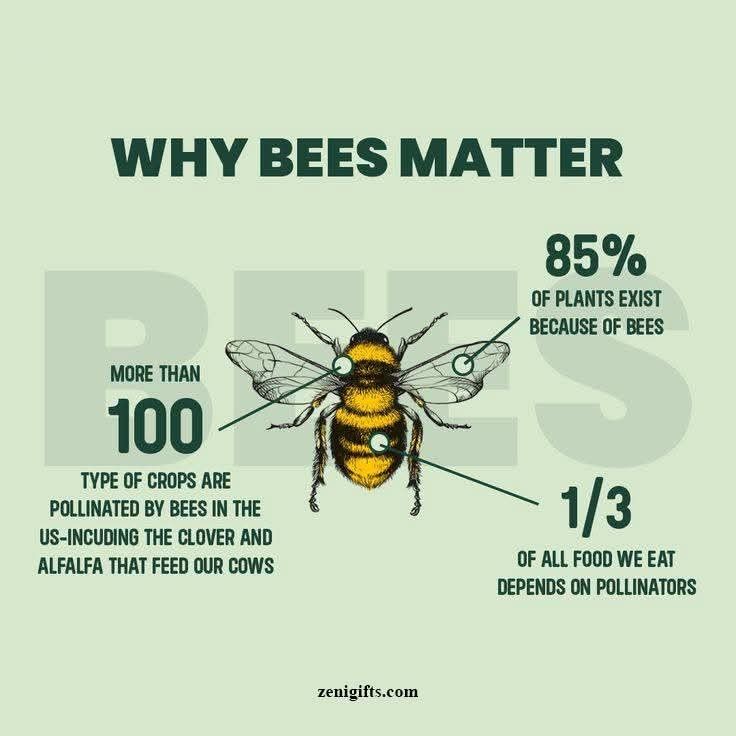
Without bees and other pollinators, approximately one-third of the food consumed by humans would become unavailable or economically unviable. The most affected foods include: almonds (90 percent dependent on honeybee pollination), apples, blueberries, cherries, watermelon, coffee, cocoa, vanilla, onions, carrots, avocados, many squash varieties, cucumbers, and most berries.
Wheat, rice, and corn are wind-pollinated and would not be affected, so humans would not starve - but our diet would become monotonous and deficient in vitamins, antioxidants, and many flavors. The economic impact would be severe: global crops worth $235-577 billion annually depend on animal pollination.
California’s almond industry alone requires approximately 1.8 million honeybee colonies transported from across North America each February - the largest managed pollination event on Earth. Without bees, this industry would collapse entirely within two years.
Do neonicotinoid pesticides really kill bees?
Yes, neonicotinoid pesticides cause significant harm to bees even at sublethal doses. Neonics (imidacloprid, clothianidin, thiamethoxam) are systemic pesticides absorbed by plants and present in pollen and nectar. Bees foraging on treated crops consume small doses that impair their navigation, memory, immune function, and reproduction.
A 2012 study in Science showed that bumblebees exposed to neonics at field-realistic doses produced 85 percent fewer new queens than control colonies. The European Union banned neonic use on flowering crops in 2018 following multiple scientific reviews. The U.S. has restricted but not banned them. Chemical companies dispute some findings, but the scientific consensus from independent research is that neonics contribute substantially to pollinator decline.
Other pesticides, including fungicides that reduce bee immune function and herbicides that eliminate wildflowers, also contribute.
What can individuals do to help bees?
Individual actions that meaningfully help bees include: planting native flowering plants (not lawn grass or non-native ornamentals that produce little nectar), avoiding pesticide use on your property, leaving some bare ground for ground-nesting bees (70 percent of bee species nest in soil, not hives), providing water sources, supporting local beekeepers by buying local honey, reducing meat consumption (industrial livestock production drives monoculture agriculture that harms pollinators), and advocating for policies that restrict harmful pesticides.
Native plant gardens are particularly effective - a well-designed native garden can support 50-100 native bee species. Avoid ‘bee hotels’ sold at garden centers unless you can clean and maintain them properly; poorly maintained bee hotels can harbor parasites that harm native bees. For most people, simply planting flowering native plants and eliminating pesticide use are the highest-impact actions.