
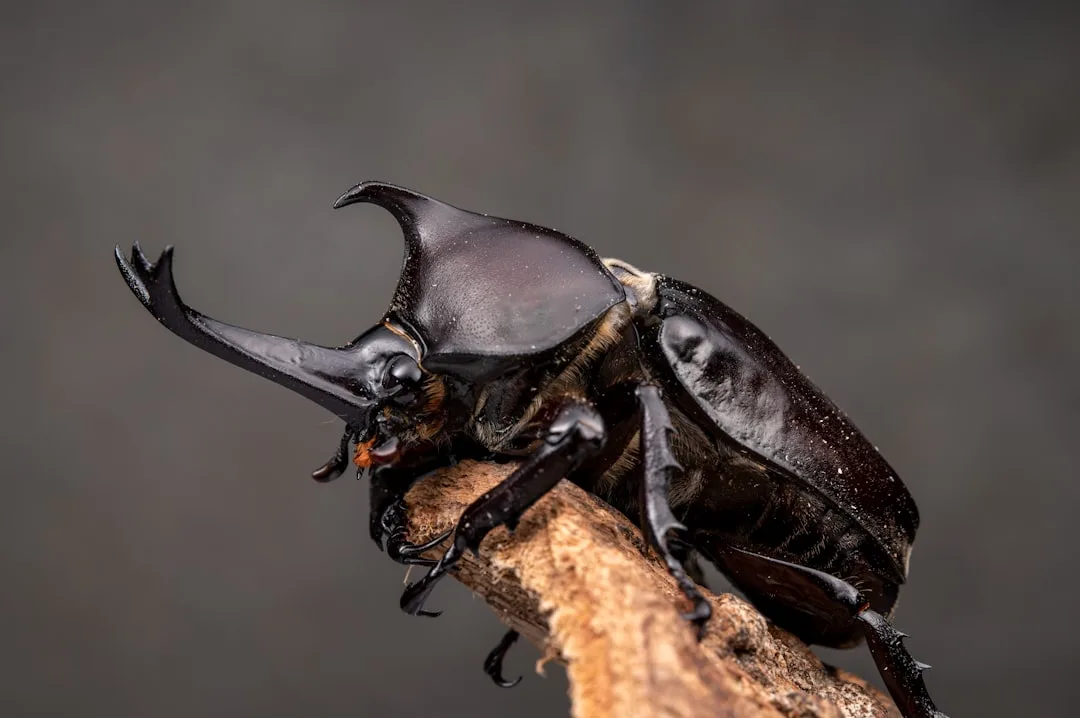
The rhinoceros beetle is not a single species. It is a common name for any large, horned member of the subfamily Dynastinae within the scarab family (Scarabaeidae), an assemblage of more than 1,500 described species spread across every continent except Antarctica.
The name refers to the curved thoracic horn carried by the males of most species - a structural echo of the rhinoceros horn that dominates the face of each male and defines his role in mating combat.
This entry focuses on the group as a whole, with the coconut rhinoceros beetle (Oryctes rhinoceros) used throughout as the representative species because it is the best-studied, most economically important, and most widespread of the true rhinoceros beetles. Other genera referenced include Xyloryctes in North America, Allomyrina in East Asia, and Dynastes and Megasoma in the Neotropics.
Rhinoceros beetles are a short-hand for insect extremes. They include the longest beetles ever measured, some of the heaviest flying insects in the world, and the strongest animals on Earth when lifting power is scaled to body mass. They also include one of the most destructive invasive pests of tropical agriculture.
This guide covers anatomy, combat, diet, lifecycle, invasive behaviour, conservation, and the strange biological angles that make Dynastinae a subfamily worth a dedicated entry rather than a footnote under "beetles".
Etymology and Classification
The subfamily name Dynastinae comes from the Greek dynastes, meaning "ruler" or "lord" - a label applied by nineteenth-century entomologists impressed by the size, armour, and apparent dominance of the horned males over every other insect in their forest microhabitat.
The English common name "rhinoceros beetle" refers specifically to the curved cephalic or thoracic horn, which is visually analogous to the horn of a rhinoceros.
Different regions have different common species: in the Pacific and Indian Ocean islands "rhinoceros beetle" almost always means Oryctes rhinoceros; in North America it typically means Xyloryctes jamaicensis; in Japan the native giant is Allomyrina dichotoma; in Central and South America the name is sometimes used loosely for Dynastes or Megasoma, which are usually distinguished as Hercules or Elephant beetles.
Taxonomically, Dynastinae is nested inside Scarabaeidae, which in turn sits within the order Coleoptera - the largest order of animal life on Earth, with over 400,000 described species. Beetles collectively account for roughly one in five named species on the planet. Dynastinae itself contributes more than 1,500 species and an unknown number of undescribed lineages in tropical rainforest canopy and soil.
The classification used for the headline species in this entry is:
- Kingdom: Animalia
- Phylum: Arthropoda
- Class: Insecta
- Order: Coleoptera
- Family: Scarabaeidae
- Subfamily: Dynastinae
- Genus: Oryctes
- Species: O. rhinoceros
Size and Physical Description
Rhinoceros beetle size varies widely across the subfamily. The coconut rhinoceros beetle Oryctes rhinoceros measures 30 to 60 millimetres as an adult, weighing 5 to 35 grams. Xyloryctes jamaicensis falls in the 25 to 35 millimetre range.
At the opposite end of the spectrum, Dynastes hercules can exceed 175 millimetres including horns and outweigh a house mouse, while Megasoma actaeon can tip past 70 grams as a solid block of glossy armour. For this entry we take the 25 to 60 millimetre range as typical of the rhinoceros beetles in the strict sense.
Males:
- Length: 25-60 mm body, plus curved horn projecting forward
- Weight: 5-35 g depending on species and condition
- Armour: heavy, glossy, often dark brown to black with bronze or green sheen
- Horn: single large curved thoracic horn, sometimes paired with a smaller cephalic horn
Females:
- Length: similar or slightly smaller than males
- Weight: comparable but often less due to absence of horn mass
- Horn: reduced to a small bump or absent entirely
- Body: rounder, broader abdomen adapted for carrying eggs
Larvae (all instars combined):
- Length: up to 90 mm in Oryctes, far larger in the neotropical giants
- Weight: routinely 20-60 g; some Megasoma grubs exceed 100 g
- Shape: pale, C-curved, with a prominent brown head capsule and stout legs
Rhinoceros beetles are built for force, not flight. Their bodies are thick and heavily sclerotised, with massive femora and tibiae that anchor the muscles used during combat. The elytra (wing covers) are fused-looking but actually hinged - they lift during flight to expose the long membranous hind wings, which beat with an audible hum.
Flight is laboured: a large rhinoceros beetle in the air sounds like a distant helicopter and rarely covers long distances in one go. The legs end in heavy tarsal claws that can hook into bark hard enough that a startled beetle will sometimes hold on rather than fly away.
The horn is the feature that defines the group. In Oryctes rhinoceros it is a single curved spike rising from the pronotum (the plate behind the head). In Dynastes and some other genera the horn is a long paired structure that works like a pair of forceps. In Allomyrina dichotoma the horn is forked at the tip like a Y.
Across the subfamily, horn size scales with body size in a steep nonlinear way - the biggest males carry disproportionately large horns, producing the extreme sexual dimorphism that makes these beetles popular with collectors and natural historians.
The Horn and Combat
Rhinoceros beetle horns are not ornaments. They are purpose-built weapons for male-on-male combat over access to feeding sites where females congregate. Most mating takes place at sap flows, wounded tree trunks, or the damaged crowns of palms, where sugary fluids draw both sexes at night. A male that controls the sap has a high chance of mating with every female that arrives. The horns exist to secure and defend these sap stations.
Combat proceeds in a stereotyped sequence. Two males face each other on the sap-laden bark or branch, orient so that their horns point forward, and push. If one male can slide his horn underneath the opponent's body, he levers the rival upward, lifts him off the surface, and throws him backward off the branch.
The loser falls - often a couple of metres to the forest floor - and either climbs back up or cedes the territory. Physical injuries are rare despite the force involved; rhinoceros beetle armour absorbs torsional loads extraordinarily well and the horns are blunt at the tip rather than sharp.
The horn is hollow. This is one of the subfamily's most interesting engineering details. A solid horn of the same size would be far heavier and would shift the beetle's centre of mass forward, compromising balance and flight. Instead, Dynastinae horns have thin cuticular walls stiffened by internal ribbing and laminated composite layers of chitin.
The result is a structure that is extremely stiff against the specific loading patterns of lifting and levering rivals, yet light enough to carry in flight. Materials scientists have studied horn cross-sections as natural templates for low-mass high-strength composite design.
Strength and the 850x Claim
The rhinoceros beetle appears in every list of "strongest animals on Earth" because of a number: 850 times its own body weight. That figure has been repeated in textbooks, nature documentaries, and museum placards for more than half a century. It is also contested.
The 850x figure comes from early experiments in which beetles were loaded with weights and the maximum load they could resist or very briefly lift was recorded. Modern force-plate and gait analysis techniques produce lower numbers for sustained carrying: generally around 100 times body weight for loads the beetle can actually move across a surface.
The two numbers are not contradictory - resistance to a downward load is always higher than the load that can be carried over distance. The 850x claim likely reflects a brief resistance measurement rather than a true carried weight.
Either figure is remarkable. Scaled to human proportions, a 100-kilogram man lifting 100 times his body weight would shoulder a loaded shipping container. At 850x he would lift a small house. No vertebrate approaches these ratios. The muscles responsible are the wing levator and depressor system in the thorax, which in large Dynastinae are disproportionately massive compared with body mass.
Combined with stiff cuticle anchoring points, the insect can deliver the entire muscle output through the horn with almost no energy lost to flex.
In everyday biology this strength is applied almost exclusively to combat. It does not translate into anything like carrying food or digging. Digging is handled by different muscle groups in the legs and is far less spectacular in output.
Lifecycle: From Egg to Adult
Rhinoceros beetle lifecycles follow the standard holometabolous pattern - egg, three larval instars, pupa, adult - but the time spent in each stage is extreme compared with most insects. The vast majority of a rhinoceros beetle's existence is underground, buried in rotting wood, compost, or palm crown debris.
Egg stage (1-2 weeks):
Females lay 50 to 150 eggs in decomposing wood, leaf litter, or compost piles. Each egg is roughly 3 millimetres long, pale yellow, and smooth. In coconut plantations, Oryctes rhinoceros preferentially lays eggs in dead standing palms, palm log stockpiles, and decaying coconut husk heaps, which is why plantation sanitation is the primary prevention method.
Larval stage (8 months to 5 years):
This is where rhinoceros beetles spend most of their lives. Larvae feed continuously on decomposing plant material, passing through three instars and growing from a few millimetres to sometimes more than 90 millimetres in Oryctes or over 120 millimetres in the largest neotropical Dynastinae.
In tropical species with warm consistent temperatures the larval stage runs 8 to 12 months; in temperate or high-altitude species it can stretch to 3 to 5 years, with individual grubs remaining active in soil chambers for longer than many small mammals live in total.
A fully grown larva of Oryctes rhinoceros weighs 20 to 60 grams - often heavier than the adult it will eventually become. The grub is pale, legless-looking but in fact equipped with six small thoracic legs, curved into a C-shape, and crowned with a prominent brown sclerotised head capsule. It feeds head-down in a tunnel system it carves with its mandibles.
Pupal stage (2-6 weeks):
At the end of the third instar the larva builds a smooth-walled earthen cell about the size of a lemon, sheds its skin, and transforms into a pupa. Pupation is a dangerous time - the insect cannot defend itself. The pupa gradually develops adult features including horn buds, which are soft and white until the cuticle hardens in the final days.
Adult stage (4-9 months):
The emerging adult rests in its earthen cell for another week or two while the cuticle hardens and darkens, then digs to the surface and takes flight. Adult life is short compared with the larval stage, typically 4 to 9 months in the wild and up to a year in stable captive conditions. During this window the beetle feeds, disperses, finds mates, and reproduces. Death follows quickly after egg laying.
Diet: Sap Above Ground, Rotting Wood Below
Adult rhinoceros beetles are sap-drinkers. They do not chew wood, and in most species they do not eat fruit in the way fruit beetles do. Instead, they use brush-tipped mouthparts to lap up plant juices from wounds in bark, fermenting fruit on the forest floor, and leaking palm crowns.
Oryctes rhinoceros adults chew into healthy palm tissue to reach the growing shoot, drinking the sugary fluid that oozes out - this is the behaviour that makes the species a serious crop pest, because the chewing damage is collateral to the feeding.
Larvae are dedicated decomposers. They consume rotting wood, leaf litter, fallen palm fronds, coconut husk piles, cattle manure, and compost. Their guts contain bacterial and fungal symbionts that break down cellulose and lignin into digestible sugars, and some species also carry yeasts that contribute fermentation products.
In natural forest ecosystems this dietary split makes rhinoceros beetle larvae important nutrient recyclers. In agricultural settings it makes them prone to explosive population growth wherever organic waste accumulates.
The two diets prevent within-species competition. Adults and larvae never compete for the same food. The split is one reason Dynastinae can reach such large body sizes - a giant grub is not fighting its parents for calories.
Coconut Rhinoceros Beetle Invasion
Oryctes rhinoceros is one of the most destructive invasive insects in the world. Native to South and Southeast Asia, it arrived in Samoa around 1909, almost certainly carried in infested palm material. From Samoa it spread across the Pacific over the twentieth century, reaching Fiji, Palau, Guam, the Solomon Islands, Papua New Guinea, and eventually Hawaii (confirmed 2013) and the Solomon Islands biotype incursions that continue today.
The beetle attacks palms from the top down. An adult lands on a coconut or oil palm, bores into the crown, and tunnels through the unfolded spear leaf at the growing point. It feeds on the soft tissue inside, leaving a characteristic V-shaped or wedge-shaped cut that becomes visible weeks later when the damaged fronds finally unfurl. A single beetle can attack several palms per night.
Repeated attacks stunt growth, reduce nut yield by 20 to 50 per cent, and eventually kill the tree by destroying its single growing point - palms do not branch, so a destroyed crown means a dead tree.
Ecological and economic impact:
| Metric | Value |
|---|---|
| Pacific region economic loss | Hundreds of millions of US dollars per decade |
| Yield reduction on infested palms | 20-50 per cent |
| Time from heavy infestation to death | 1-3 years for young palms, longer for mature trees |
| Eggs per female per lifetime | 50-150 |
| Area under quarantine (2024) | Multiple Pacific nations with active response plans |
The beetle's historical biocontrol agent is the Oryctes nudivirus (OrNV), a pathogen that stops larval development and keeps populations at low levels in native-range habitats. For decades OrNV deployment held Pacific populations in check. Around 2007 a new biotype, known as CRB-G (coconut rhinoceros beetle Guam lineage), appeared and proved resistant to the common OrNV isolate.
CRB-G has since spread aggressively across Pacific islands and is the reason current infestations look nothing like the manageable populations of the late twentieth century. Researchers are testing alternative virus strains, sanitation intensification, pheromone trapping with the aggregation compound oryctalure, and entomopathogenic fungi such as Metarhizium as integrated management options.
Prevention focuses on breeding site sanitation. Adult beetles fly to lay eggs, and they lay in rotting wood. Removing dead standing palms, chipping palm logs, composting carefully, and covering coconut husk piles removes the nursery substrate. Monitoring networks of pheromone traps detect range expansion early, and quarantine programmes inspect cargo leaving infested islands for hitchhiking adults and grubs.
Ultraviolet Fluorescence and Structural Colour
Several rhinoceros beetle species fluoresce visibly under ultraviolet light. The effect is not bioluminescence - no chemical reaction generates the glow - but a passive photonic response. Microscopic structural layers embedded in the cuticle absorb short ultraviolet wavelengths and re-emit them in the visible range, producing green, blue, or occasionally pink fluorescence depending on species.
Because most Dynastinae are nocturnal and navigate under moonlight, starlight, and the weak UV components of twilight, the fluorescent signal could in principle play a role in mate detection or species recognition. Definitive behavioural experiments are scarce, and the adaptive function remains an open question.
What is clear is that the effect is invisible in everyday daylight - the same beetles look matte brown, glossy black, or iridescent green under normal illumination and reveal their fluorescence only to observers with UV lamps.
The broader cuticle optics of the subfamily are equally interesting. Dynastes hercules elytra change colour with humidity because porous layers fill with water and alter refraction - a trait called hygrochromism. Some species in genera like Chrysina (a related group) reflect circularly polarised light. Collectively, these optical tricks make Dynastinae a recurring case study in biophotonics and biomimetic materials research.
Cultural Roles: Japan, Pets, and Arena Combat
In Japan the rhinoceros beetle is close to a national icon. The native Allomyrina dichotoma - known locally as kabutomushi, literally "helmet beetle" - is kept as a schoolchild's summer pet on a scale that has no parallel anywhere else. Live beetles and their larvae are sold in department stores, hardware chains, and specialist insect shops.
Premium specimens, particularly imported Hercules beetles and large Chalcosoma caucasus beetles, trade for the equivalent of hundreds of US dollars. Japan supports a multi-million-dollar beetle-keeping industry with dedicated breeders, specialist substrates, fruit jelly producers, and magazines.
Organised beetle battles are held at summer festivals. Two male rhinoceros beetles are placed on a small wooden log - the arena - and allowed to wrestle under loose sumo-style rules. A beetle that pushes the other off the log, or pins it, wins. The matches are short, usually bloodless, and operate within community etiquette that treats the animals as athletes rather than disposable combatants. Champion beetles are named, photographed, and sometimes bred.
Beyond Japan, serious beetle-keeping communities exist in Taiwan, South Korea, and increasingly Europe. Commercial breeders produce Oryctes, Xylotrupes, Allomyrina, and the larger Neotropical Dynastinae under controlled humid conditions with rotting hardwood or fermented oak substrate for larvae and fruit jelly or banana for adults.
The hobby's ethical standing rests largely on captive breeding rather than wild collection - wild-caught pressure on most species is considered minor compared with habitat loss and invasive pest control.
Import rules vary widely. The United States restricts live beetle imports on biosecurity grounds, and Oryctes rhinoceros is prohibited outright because of its invasive pest status. The European Union, Canada, and Australia each run their own permit systems.
Conservation Status and Threats
The IUCN Red List has not formally assessed most rhinoceros beetles, and Dynastinae as a subfamily has no consolidated global conservation status. This is the norm for insect groups rather than the exception - IUCN coverage of insects lags far behind coverage of mammals, birds, and amphibians.
The informal status varies sharply by species.
- Habitat-sensitive forest species such as Dynastes hercules, Megasoma elephas, Chalcosoma caucasus, and several island-endemic rhinoceros beetles face steady decline as primary rainforest is cleared for cattle, oil palm, soy, and logging. Larvae depend on old rotting hardwood, and secondary forest produces far fewer viable breeding sites than primary forest.
- Island subspecies on Guadeloupe, Martinique, Dominica, and parts of the Philippines occupy tiny fragmented ranges and are considered locally threatened by regional entomologists even without formal IUCN listing.
- Invasive pest species, led by Oryctes rhinoceros, are in the opposite situation: expanding rather than declining, and actively targeted by national and international eradication and suppression programmes.
- Temperate generalists such as Xyloryctes jamaicensis in North America appear stable, benefiting from abundant hardwood deadwood and compost heaps on agricultural margins.
Climate change cuts both ways. Rising tropical temperatures accelerate larval development in some species, shortening lifecycles and increasing voltinism, which is favourable for pest species and neutral or mildly positive for generalists.
At the same time, disrupted humidity patterns damage the humid microclimates that many Neotropical and Southeast Asian Dynastinae depend on, particularly during vulnerable pupal and newly emerged adult stages. Drier forests support fewer beetles, and shifts in rainfall timing disrupt the synchronisation between egg laying and the peak nutritional window of rotting logs.
Pesticide use is a meaningful pressure for species that share agricultural landscapes with humans. Soil-applied insecticides targeting other pests incidentally kill rhinoceros beetle larvae in the upper litter layer. Broad-spectrum aerial spraying reduces adult populations.
Conversely, intensive horticulture with compost heaps, palm processing, and logging debris piles produces artificially abundant larval habitat for invasive species, accelerating the very infestations the pesticides are meant to control.
Rhinoceros Beetles and Humans
The relationship between humans and rhinoceros beetles is bimodal. On one side sits the most destructive invasive palm pest on the planet, costing Pacific island economies hundreds of millions of dollars per decade and threatening food security in coconut-dependent communities.
On the other side sits a keystone pet species in Japanese culture, a materials-science muse for composite engineers, and a category of insect that regularly appears in children's books as a symbol of strength and dignity. The same taxonomic subfamily produces both extremes.
Traditional ecological knowledge in Southeast Asia and the Pacific recognised the pest status of Oryctes rhinoceros long before modern entomology described it. Pre-colonial coconut cultivation included sanitation practices - burning old palm stumps, draining stagnant compost, maintaining dry garden perimeters - that suppressed beetle populations without any formal entomology.
The rise of industrial-scale plantations in the twentieth century eroded many of those practices and contributed to outbreak dynamics.
In contrast, Japanese cultural relationships with Allomyrina dichotoma encode a positive emotional framing that has influenced conservation attitudes. Children who grow up keeping rhinoceros beetles are more likely to support insect conservation as adults, and Japan's well-developed beetle-breeding industry has effectively eliminated commercial wild collection pressure on the native species.
Ethnoentomology in Central and South America, Southeast Asia, and parts of Africa has documented the occasional consumption of rhinoceros beetle larvae as food. The grubs are protein-rich, locally abundant where rotting wood accumulates, and accepted as a delicacy in several cultures. This dietary role is small-scale and has no measurable conservation impact.
Related Reading
- Hercules Beetle
- Stag Beetle
- Beetles: The Most Diverse Order of Life on Earth
- Why Beetles Are the Most Diverse Group of Animals
- Dung Beetles and Galactic Navigation
References
Relevant peer-reviewed and governmental sources consulted for this entry include the Pacific Community (SPC) Coconut Rhinoceros Beetle Response Plan reports, the USDA-APHIS and Hawaii Department of Agriculture Oryctes rhinoceros action plans, published research in Journal of Invertebrate Pathology, Journal of Insect Science, and Biological Invasions, and monographs on Dynastinae systematics by Ratcliffe and collaborators.
Horn mechanics figures draw on published force-plate and finite-element studies in Journal of Experimental Biology and Science. Pest status, biotype distribution, and biocontrol resistance figures reflect the most recent consolidated reports through 2024.
Frequently Asked Questions
How big is a rhinoceros beetle?
Most true rhinoceros beetles in the genus Oryctes measure 25 to 60 millimetres in body length as adults, with the coconut rhinoceros beetle (Oryctes rhinoceros) sitting near the top of that range at 30 to 60 millimetres. Weight ranges from about 5 to 35 grams depending on species and sex.
The wider Dynastinae subfamily includes much larger beetles - the Hercules beetle (Dynastes hercules) and the Elephant beetle (Megasoma elephas) can exceed 150 millimetres including horns. Males are usually larger and always heavier-horned than females, and horn length scales with body size in a steep, nonlinear way.
How strong is a rhinoceros beetle?
Rhinoceros beetles are among the strongest animals on Earth relative to their own mass. The textbook claim is that they can lift up to 850 times their body weight, a figure repeated for decades in popular science. Modern force-plate experiments place the realistic sustained lifting capacity closer to 100 times body weight, with short-duration resistance pushing higher.
Even the conservative figure is remarkable - scaled up to human size it would mean carrying a loaded shipping container. The strength is used almost exclusively during male-on-male combat for mating territory, where horn leverage and pushing power decide the outcome.
Where do rhinoceros beetles live?
Rhinoceros beetles in the broad sense live across every tropical and temperate region on Earth except Antarctica. The coconut rhinoceros beetle (Oryctes rhinoceros) is native to South and Southeast Asia - India, Sri Lanka, Indonesia, the Philippines, Malaysia, and Thailand - but has spread as an invasive pest across Pacific islands including Samoa, Fiji, Palau, Guam, the Solomon Islands, Papua New Guinea, and Hawaii since the early twentieth century.
Other genera occupy specific biomes: Xyloryctes in North American hardwood forests, Megasoma in neotropical rainforest, Allomyrina in East Asian woodland. Adults prefer mature palms, rotting logs, compost heaps, and old stumps.
What do rhinoceros beetles eat?
Adults and larvae eat completely different foods. Adult rhinoceros beetles drink sap, fermenting fruit juice, and the plant fluids that ooze from wounds in palm crowns or tree bark. They have brush-tipped mouthparts for licking rather than chewing, which is why they are often called sap-drinkers. Larvae are wood- and compost-feeders, spending months or years burrowing through rotting logs, leaf litter, coconut husk piles, and decaying plant matter.
This split diet means larvae and adults never compete for the same resource. In the case of Oryctes rhinoceros, adults also bore into healthy palm crowns to feed on the unfolded shoot, which is what makes the species economically devastating.
Why are coconut rhinoceros beetles such serious pests?
Oryctes rhinoceros kills coconut and oil palms from the top down. Adult beetles bore into the crown of a living palm and tunnel through the growing shoot at the centre, feeding on soft tissue and severing the unfolded fronds. When the damaged fronds later unfurl they carry the characteristic V-shaped or wedge-shaped cuts that make infested palms easy to identify.
Repeated attacks stunt growth, reduce nut production by 20 to 50 per cent, and eventually kill the tree. Since 2007 a new biotype, CRB-G, has spread across the Pacific because it resists the Oryctes nudivirus biocontrol that previously limited population growth. Quarantine, pheromone trapping, grub removal from breeding sites, and new biocontrol strains are deployed to protect coconut economies.
How long do rhinoceros beetles live?
Full lifecycle runs about one to two years for most rhinoceros beetle species, though some Dynastinae can stretch to five years when larval development is slow. The vast majority of that life is spent underground as a grub. After hatching, larvae feed continuously on rotting wood or compost for 8 to 12 months in tropical species, passing through three instars and reaching substantial weight. Pupation takes several weeks inside an earthen chamber.
Adult beetles then live only 4 to 9 months - long enough to feed, find mates, and lay eggs. Some captive specimens with stable humidity and unlimited fruit jelly have survived close to a full year as adults.
Do rhinoceros beetles glow under UV light?
Several rhinoceros beetle species produce visible fluorescence under ultraviolet lamps, shining green, blue, or sometimes pink. The effect is not bioluminescence - no chemical reaction generates the light. Instead, microscopic photonic layers embedded in the cuticle absorb short ultraviolet wavelengths and re-emit them in the visible range.
Because most Dynastinae are nocturnal and navigate under starlight and moonlight, the fluorescent signal may play a role in species recognition and mate detection, though experimental evidence for a direct behavioural function is still limited. Under normal daylight the same beetles look matte brown, black, or iridescent green with no hint of the glow.
Are rhinoceros beetles kept as pets?
Yes, and in parts of East Asia the hobby is mainstream. In Japan the native rhinoceros beetle Allomyrina dichotoma is sold in department stores, bred commercially, and entered into organised sumo-style battles during summer festivals. Specialist keepers in Taiwan, Korea, and increasingly Europe breed Oryctes, Xylotrupes, and larger Dynastinae species year-round.
Home care requires a tall humid enclosure, rotting hardwood or fermented compost substrate for larvae, fruit jelly or banana for adults, and stable temperatures around 22 to 26 degrees Celsius. Import rules vary by country - the United States restricts live beetle imports on biosecurity grounds, while many invasive species including Oryctes rhinoceros are illegal to move regardless of permits because of their pest status.