
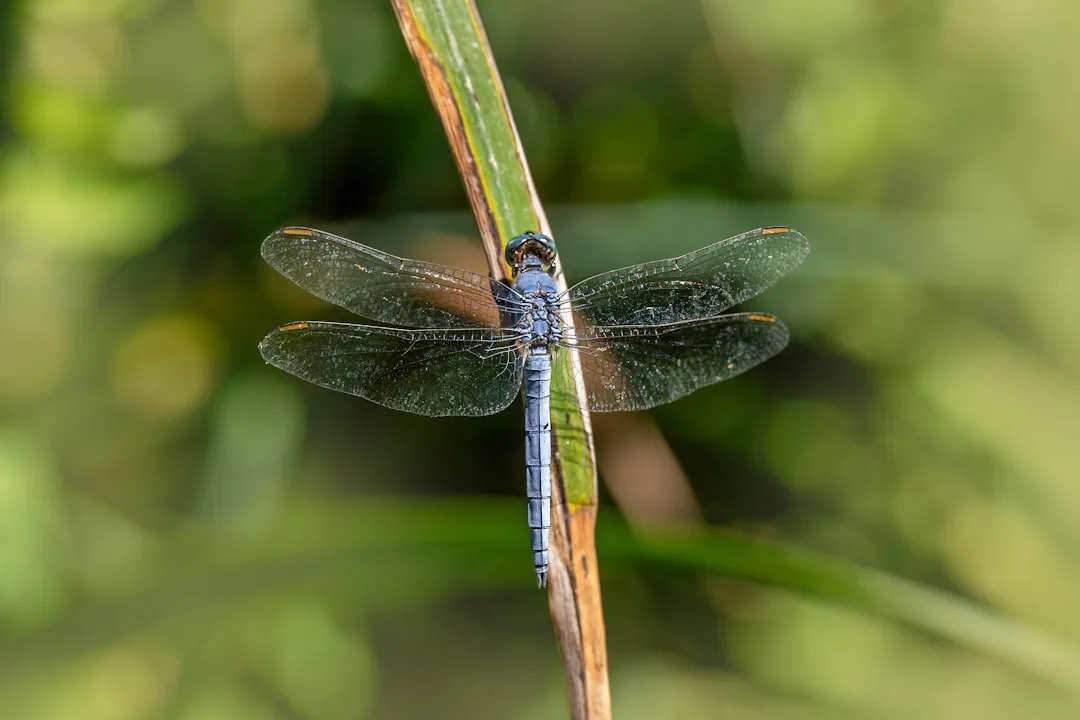
The common blue damselfly is one of the most widespread and recognisable members of the insect order Odonata across the Northern Hemisphere. At first glance it looks like a slender, miniature dragonfly, glittering cyan-and-black over a sunlit pond. A closer look reveals that it is not a dragonfly at all.
Enallagma cyathigerum belongs to the suborder Zygoptera, the damselflies, which split from the true dragonflies (Anisoptera) deep in insect evolutionary history. Everything about the animal - the way it folds its wings, the shape of its eyes, the weaker but more delicate flight, the prong-tailed nymph living in the water below - reflects that ancient split.
This guide treats the common blue damselfly as the canonical representative of its suborder.
It covers taxonomy, anatomy, the clear and under-appreciated differences between damselflies and dragonflies, the extraordinary wheel-position mating ritual, the 6-8 month underwater nymph life, hunting, vision, flight, habitat, conservation, and the strange facts that make this small blue insect interesting to read about slowly rather than skip over. This is a reference entry, not a summary - so expect specifics: millimetres, instars, wing positions, and behaviour.
Etymology and Classification
The scientific name Enallagma cyathigerum combines Greek and Latin roots. Enallagma refers to an exchange or interchange and alludes to the reversed or mirrored colour patterns typical of the genus. Cyathigerum means 'cup-bearing', a reference to the distinctive cup-like black marking on segment two of the male's blue abdomen - a feature used by generations of field guides to separate this species from its near relatives.
The full taxonomic placement is:
- Kingdom: Animalia
- Phylum: Arthropoda
- Class: Insecta
- Order: Odonata
- Suborder: Zygoptera (damselflies)
- Family: Coenagrionidae (narrow-winged damselflies)
- Genus: Enallagma
- Species: E. cyathigerum
Odonata is an ancient insect order that first appears in the fossil record more than 325 million years ago during the Carboniferous. Damselflies and dragonflies diverged within that lineage early, and the two suborders have evolved in parallel ever since.
Modern damselflies retain several features that look more primitive than their dragonfly cousins - wider-set eyes, less-fused flight muscles, a slimmer abdomen - but they are not 'less evolved'. They are simply adapted to a different ecological role: slow, precise, close-range hunters of vegetation and still-water margins.
Damselfly or Dragonfly? How to Tell Them Apart
More than any other fact, this is the one that most readers want cleared up. The common blue damselfly belongs to Zygoptera, not Anisoptera. The two groups are often confused because at a distance their silhouettes overlap. At close range, however, the differences are clear and consistent.
| Feature | Damselfly (Zygoptera) | Dragonfly (Anisoptera) |
|---|---|---|
| Wings at rest | Folded together above the body | Spread flat out to the sides |
| Body shape | Slender, thin, pencil-like abdomen | Stockier, more robust, often heavy-looking |
| Flight style | Fluttery, slow, very manoeuvrable at low speed | Powered, fast, strong cruiser |
| Eye position | Wide apart on sides of head, never meet on top | Usually meet on top of the head |
| Front vs hind wing | Similar shape and size | Hind wing broader than forewing |
| Nymph gills | Three leaf-shaped external gills at tail tip | Internal rectal gills, no tail prongs |
| Nymph body | Slender, often long-legged | Stocky, broad, often camouflaged |
The wing-at-rest test is the single easiest field-identification tool. A sunlit pond-edge insect that folds its four wings neatly together above the abdomen is a damselfly. One that holds them open like an aircraft is a dragonfly. Everything else follows from that.
Size and Physical Description
The common blue damselfly is a small, slender odonate. Males and females overlap in size, with females often slightly fuller in the abdomen:
- Body length: 29-36 mm from head to tip of abdomen
- Wingspan: 36-40 mm
- Hindwing length: 19-22 mm
- Mass: very light; fractions of a gram
Males carry the signature blue-and-black pattern that gives the species its common name. The thorax is marked with two broad blue stripes separated by black. The abdomen is predominantly sky-blue, punctuated by black segment-end rings. Segment two carries the diagnostic black 'cup' marking from which the species epithet cyathigerum derives. Eyes are bright cerulean blue in life, fading rapidly after death - one reason most museum specimens look duller than the living animal.
Females are more variably coloured. Typical forms are greenish or brownish with black markings, but a blue form (sometimes called androchrome) closely mimics the male pattern. Colour-polymorphism in female damselflies is believed to reduce male harassment in dense populations: a female that looks like a male is less likely to be grabbed mid-flight by another courting male.
In strong sunlight, males can flash a metallic iridescence across the thorax and eyes. This is not pigment but microstructural colour, produced by nanoscale layering in the cuticle that scatters blue wavelengths and reflects ultraviolet. Damselflies can see ultraviolet, so the display is probably more intense to a rival male than it is to a human observer.
Vision, Flight, and Sensory Biology
Damselfly compound eyes are smaller than dragonfly eyes and set widely apart on the sides of the head. Each eye contains several thousand ommatidia - fewer than the roughly 30,000 in a dragonfly, but still enough to deliver a nearly hemispherical view on each side. Crucially, the two eyes do not meet on top of the head.
This gives damselflies a distinctive hammer-headed profile when seen from the front, and it also means the dorsal blind spot is slightly larger than in dragonflies. In exchange, damselflies get better lateral coverage and excellent close-range vision of prey resting on vegetation.
Like dragonflies, damselflies have more opsin classes than humans and can see ultraviolet and polarised light. Polarisation sensitivity is particularly useful for identifying smooth open water at a distance: horizontally polarised reflection patterns tell an ovipositing female that she has found a pond rather than wet asphalt or a greenhouse roof.
Flight is the other great separator. Damselflies fly with four wings beating largely in parallel pairs, producing a softer, fluttery motion that cruises at modest speed but excels at slow, precise manoeuvring. They hover better than they chase, and they often pick prey directly off plants.
True dragonflies, by contrast, can beat each of their four wings independently, producing the powered, rocket-like flight that underlies their extraordinary hunting success. Damselflies trade away some of that raw speed in return for agility in cluttered vegetation.
Hunting and Diet
Both life stages of the common blue damselfly are strictly carnivorous. The adult is an active but small-prey hunter:
- Midges, mosquitoes, and small flies
- Aphids and other soft-bodied plant insects
- Small mayflies and caddisflies
- Springtails caught at the water surface
- Other tiny flying insects near emergent plants
Adults hunt by short sallies from a perch. A damselfly will sit on a reed, rotate its head to scan, launch when a target appears within a metre or two, grab the prey with spiny legs held under the body like a basket, and return to a perch to eat. Larger prey is dismembered; smaller items are swallowed whole.
Hunt success is high but not as extreme as the near-95 per cent reported in emperor dragonflies, because damselflies tend to engage slower, easier prey and rely on close-range surprise rather than high-speed interception.
The aquatic nymph is an entirely different kind of predator. It prowls slowly among submerged plants and bottom debris, ambushing mosquito larvae, small crustaceans (including water fleas and ostracods), tiny tadpoles, midge larvae, and even the nymphs of other, smaller insects. Like dragonfly nymphs, damselfly nymphs catch prey with an extensible, hinged lower jaw called the labial mask that fires forward in milliseconds. Unfolded, it can reach roughly a quarter of the nymph's body length.
Because nymphs eat large numbers of mosquito larvae, a healthy common blue population is a significant biological control on mosquito emergence from that water body. This is one of the reasons damselflies are welcomed in garden ponds and wetland restoration projects.
The Wheel Mating Position
The reproductive behaviour of damselflies is one of the strangest and most photographed in the insect world. It also requires slow explanation, because odonate genitalia are unlike those of almost every other animal.
Males have two sets of genital structures. Primary genitalia sit near the tip of the abdomen and produce sperm. Secondary genitalia - a specialised accessory organ unique to Odonata - sit on the underside of the second and third abdominal segments near the thorax. Before mating, the male bends his abdomen forward and transfers sperm from the primary to the secondary genitalia. Only then can he mate.
When a receptive female enters his territory, the male grasps her behind the head with claspers on the tip of his abdomen. This forms the tandem position, with the male in front and the female trailing below. The female then curls her abdomen forward and underneath her body to make contact with the male's secondary genitalia on his thorax.
At that moment, the two animals form a closed loop - the male's thorax, the female's curled abdomen, the male's grasp on the female's head - that draws a recognisable heart shape in the air. This is the wheel position.
Copulation in the wheel can last anywhere from a few minutes to more than an hour. During that time, the male can physically remove or displace sperm from any previous mating inside the female using scoop-like structures on his secondary genitalia. This sperm-displacement behaviour means that the last male to mate is usually the one who fertilises the majority of eggs, which in turn drives the aggressive male territoriality and mate-guarding that dominate damselfly behaviour at breeding ponds.
After copulation, common blue damselflies typically remain in the tandem position while the female lays eggs. This is called contact mate-guarding. The male stays physically attached, flying linked with the female, and physically blocks rival males from reaching her during oviposition.
In some Enallagma populations the female crawls fully underwater, carrying a silvery film of air around her body, to insert eggs deep into submerged plant stems while the male waits on the surface or, in some cases, accompanies her below.
Life Cycle and Development
A common blue damselfly lives most of its life as an aquatic nymph. The cycle goes roughly like this:
- Egg. Laid directly into living or decaying plant tissue just below the waterline, or deeper if the female has dived. Hatching takes two to five weeks, longer in colder waters.
- Nymph. The aquatic stage. Lasts 6-8 months in most populations and longer in cooler climates. The nymph passes through roughly 10-13 moults (instars), eating continuously and growing through each one.
- Pre-emergence. The final-instar nymph climbs out of the water up a plant stem in the early morning, clinging tightly while its cuticle splits open along the back.
- Emergence. The adult damselfly pulls itself free of the nymphal skin, expands its wings by pumping haemolymph through them, hardens for several hours, and makes its first tentative flight.
- Maturation. Newly emerged (teneral) adults are pale and soft. Over roughly a week they develop full adult coloration and reproductive readiness, often moving away from the breeding water to feed.
- Reproduction. Mature males return to the water, establish territories, court females, mate in the wheel position, and guard them through egg-laying.
- Death. Adults usually die within 1-4 months of emergence, often sooner. Total lifespan from egg to death is roughly one year, occasionally two when cold climates slow nymph development.
The adult stage, while the most visible, is numerically the smallest part of the animal's life. The insect that fishermen and pond-watchers recognise as a damselfly is a brief, intense reproductive phase tacked on to a much longer underwater predatory life.
Nymph Anatomy and the Three-Pronged Tail
The damselfly nymph is worth a separate look, because its body plan is different from dragonfly nymphs and from almost anything else in freshwater. The most obvious feature is a trio of leaf-shaped structures at the tip of the abdomen. These are external caudal gills (or caudal lamellae), and they serve three functions simultaneously:
- Respiration. The gills are thin-walled, heavily tracheated, and absorb dissolved oxygen directly from the water.
- Locomotion. The nymph uses the gills as paddles and the abdomen as a tail, swimming with a fish-like side-to-side motion when threatened.
- Stabilisation. Slow turns while stalking prey are steered with the gills acting as rudders.
True dragonfly nymphs have none of these external lamellae. Instead, they breathe through a rectal gill chamber and can squirt water out of the rectum for jet propulsion. Damselfly nymphs lack that jet mechanism and rely on the external gills and leg-swimming instead. A glimpse of the prong-shaped tail is one of the most reliable ways to identify a damselfly nymph when a pond sample is tipped into a white tray.
Habitat and Distribution
Enallagma cyathigerum is one of the most geographically widespread damselflies in the world. Its core range covers most of Europe and much of Asia, with populations reaching North Africa. It is absent from deep tropical latitudes, where related species take its place, but is abundant from Ireland and the British Isles east through Scandinavia, Central Europe, Russia, and across Siberia to the Pacific.
Preferred breeding habitats include:
- Large ponds and lake margins
- Canals, ditches, and slow-flowing rivers
- Gravel pits and reservoirs
- Peat bogs and upland pools
- Well-vegetated garden ponds and restored wetlands
The species tolerates slightly acidic, nutrient-poor water that excludes many other odonates, which is part of why it often dominates in upland and bog habitats. It is a classic early coloniser: a newly dug garden pond stocked only with a few native plants will typically host breeding Enallagma cyathigerum within one to two seasons, well before more specialised damselflies arrive.
Conservation
The IUCN Red List classifies the common blue damselfly as Least Concern with a stable global population. The combination of enormous range, broad habitat tolerance, and strong colonisation ability keeps the species secure even as individual wetlands are lost. That does not mean local populations are invulnerable. Documented threats include:
- Pond drainage and wetland loss for agriculture, building, or infilling.
- Water pollution from fertiliser and pesticide runoff, particularly neonicotinoids that kill nymphs at sublethal concentrations.
- Fish stocking. Introduced fish in previously fishless ponds can reduce nymph survival dramatically.
- Invasive plants that choke open water and prevent oviposition or emergence.
- Climate-driven shifts in pond hydrology, with small breeding ponds increasingly drying before nymphs can complete development.
Because damselfly nymphs are sensitive to water quality, the presence or absence of breeding common blues is frequently used as a cheap, quick biological indicator of pond and stream condition in volunteer monitoring programmes across Europe and Asia.
Damselflies and People
Damselflies have never been economically important in the way that bees, silk moths, or mosquitoes are, but they occupy a specific cultural niche. In much of Europe they are associated with calm summer water, garden ponds, and slow-paced nature-watching. Fly-fishermen imitate damselfly nymphs and adults as common prey for trout and other predatory fish.
Garden designers actively encourage common blue damselflies as a sign that a new pond is functioning as habitat. Citizen-science programmes such as the British Dragonfly Society's recording scheme rely on public sightings of the species to track climate-driven changes in distribution.
There is also a growing recognition of damselflies as mosquito controllers. A pond that supports healthy numbers of Enallagma cyathigerum nymphs is a pond in which a meaningful fraction of mosquito larvae never reach the wing. That is a quiet but genuine public-health service, provided free of charge by an insect that also happens to be beautiful.
Related Reading
- Emperor Dragonfly: Europe's Largest Aerial Predator
- Dragonflies: Ancient Aerial Predators with 360-Degree Vision
- Globe Skimmer: The Dragonfly That Crosses Oceans
- Mosquito: The Deadliest Animal to Humans
References
Relevant peer-reviewed and governmental sources consulted for this entry include the IUCN Red List assessment for Enallagma cyathigerum, the British Dragonfly Society species accounts, the European Red List of Dragonflies, and published research in Odonatologica, Ecological Entomology, and Journal of Insect Behavior. Taxonomic placement follows the World Odonata List.
Morphological measurements and life-history figures reflect standard European field-guide ranges and long-term monitoring data.
Frequently Asked Questions
What is the difference between a damselfly and a dragonfly?
Damselflies and dragonflies belong to the same insect order, Odonata, but to different suborders - Zygoptera (damselflies) and Anisoptera (true dragonflies). The fastest field test is the wing position at rest: damselflies fold their four wings together above or along the body, while dragonflies hold them spread flat out to the sides.
Damselflies are also slimmer, have weaker and more fluttery flight, wider-set compound eyes that do not meet on top of the head, and nymphs with three leaf-shaped external gills at the tail. Dragonflies are stockier, stronger fliers, have eyes that almost always meet on top of the head, and nymphs that breathe through internal rectal gills.
How big is the common blue damselfly?
The common blue damselfly (Enallagma cyathigerum) is a small odonate. Adult body length runs 29-36 millimetres from head to the tip of the abdomen, and wingspan is 36-40 millimetres - roughly the width of a large coin. Males and females overlap in size, with females sometimes slightly more robust in the abdomen. Aquatic nymphs reach about 20-25 millimetres in final instar before emerging.
The species is much smaller and more slender than true dragonflies such as the emperor, which can exceed 80 millimetres in body length.
Where do common blue damselflies live?
Enallagma cyathigerum is one of the most widespread damselflies across the Northern Hemisphere. It breeds in standing and slow-flowing fresh water throughout Europe and large parts of Asia, with populations extending into North Africa. Typical habitats include ponds, lakes, reservoirs, canals, gravel pits, peat bogs, and well-vegetated slow rivers.
The species tolerates a wider range of water chemistries than many odonates, including slightly acidic upland pools, and readily colonises garden ponds. Adults are most often seen from late spring through late summer, perching on emergent plants or hovering low over open water.
What is the 'wheel' mating position?
The wheel is the distinctive heart-shaped or circular posture that mating damselflies and dragonflies adopt. The male first grasps the female behind the head using claspers at the tip of his abdomen. The female then bends her abdomen forward and underneath her body to touch a secondary reproductive organ on the underside of the male’s thorax, where he has previously transferred sperm from his primary genitalia.
That contact forms the closed loop of the wheel. The position can last from a few minutes to more than an hour, and in many damselflies the male will then keep holding the female in a ‘tandem’ formation while she lays eggs, physically blocking rival males from replacing his sperm.
How long does a damselfly live?
Most of a common blue damselfly’s life is aquatic and unseen. Eggs hatch into predatory nymphs that live underwater for 6-8 months in most populations, passing through roughly a dozen moults as they grow. The winged adult stage that most people recognise typically lasts only 1-4 months, and in many individuals considerably less.
Total lifespan from egg to death is usually around one year, but in colder climates or slower-growing populations the nymph stage can stretch across two seasons, bringing total life to 1-2 years. The adult is a short, intense reproductive phase tacked onto a much longer underwater phase.
What do damselflies eat?
Both life stages are carnivorous. Adult damselflies pick small flying and resting insects off vegetation and out of low-level air - typically midges, aphids, small flies, mayflies, and mosquitoes. Their flight is slower than a dragonfly’s, so they rely on close-range agility and vegetation as a hunting platform rather than on open-air pursuit.
Nymphs are aquatic ambush predators, grabbing mosquito larvae, small crustaceans, tiny tadpoles, and other soft-bodied prey with an extensible lower jaw. Because nymphs eat large numbers of mosquito larvae, healthy damselfly populations quietly suppress future mosquito populations in the same water body.
Are damselflies dangerous to humans?
No. Damselflies do not sting, and although they have biting mouthparts they almost never attempt to bite and cannot meaningfully pierce human skin. They carry no venom and no disease relevant to people. The common blue damselfly is, if anything, a useful neighbour: adults consume small biting flies and midges, while nymphs eat mosquito larvae in the water.
Both life stages are sensitive to water quality, so healthy damselfly populations are often a sign of a relatively clean pond or stream.
Are common blue damselflies endangered?
The IUCN Red List classifies Enallagma cyathigerum as Least Concern. The species has a very large range across Europe and Asia, tolerates a broad variety of still and slow-flowing waters, and readily colonises new ponds, reservoirs, and restored wetlands. Local populations can be hit hard by pollution, drainage of breeding ponds, pesticide runoff, and introduction of fish that eat nymphs, but at the global level the species remains secure.
Because damselfly nymphs are sensitive to water quality, monitoring common blue populations is a useful low-cost indicator of pond and stream health.