
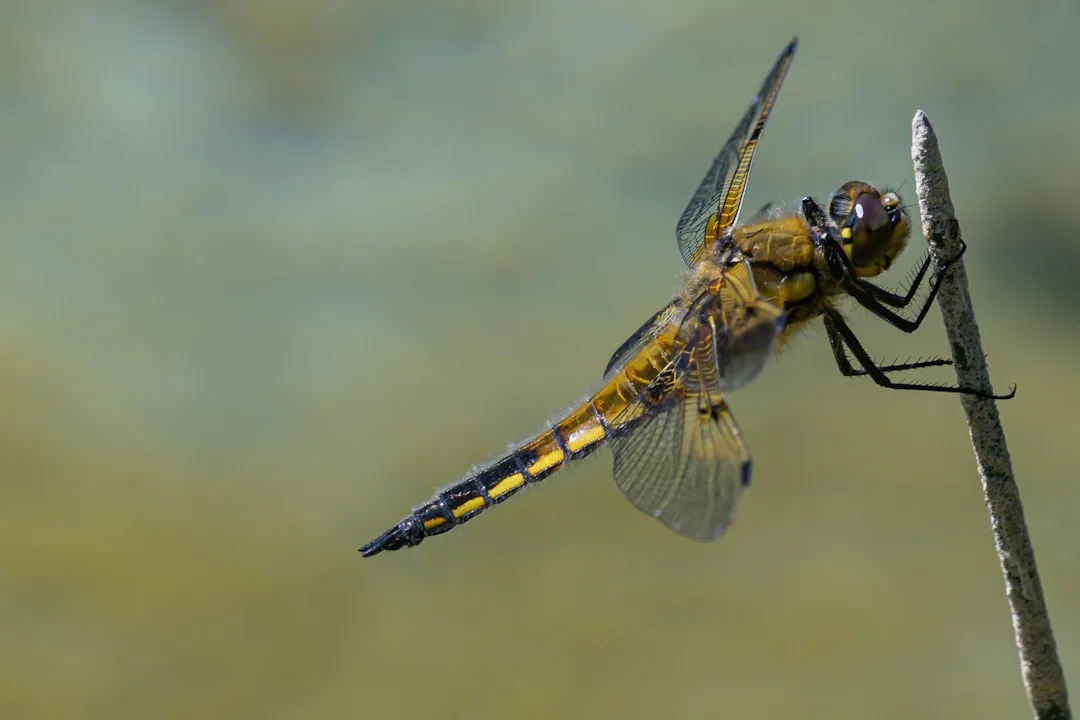
The remarkable globe skimmer is the most widely distributed dragonfly species on Earth and, by distance, the greatest migratory insect ever documented. Pantala flavescens occurs natively or as a regular seasonal visitor on every continent except Antarctica, colonises remote oceanic islands on prevailing winds, and performs an annual circuit estimated at 14,000 to 18,000 kilometres across four successive generations.
A single flight leg of that circuit can carry individual dragonflies more than 6,200 kilometres non-stop across the open Indian Ocean, from the Maldives to East Africa, with no land, no food, and no fresh water in between. No other insect is known to migrate this far, and no other dragonfly is known to breed so successfully in puddles that may not exist a month later.
This guide is a reference entry, not a summary. Expect specifics: wingspans, generation counts, pool lifespans, ocean crossings, genetic evidence, monsoon timing, and the aerodynamic reasons a 4.5-centimetre insect can out-migrate a monarch butterfly. The aim is to gather every important behavioural and ecological detail that distinguishes Pantala flavescens from other members of the dragonfly family Libellulidae and from migratory animals in general.
Etymology and Classification
The genus name Pantala is constructed from Greek roots meaning roughly "all-wings", a reference to the unusually broad hindwing that dominates the insect's silhouette in flight. The species epithet flavescens is Latin for "yellowish" and describes the pale amber-yellow tint of the body and wings - especially obvious in freshly emerged adults and in strong backlight.
English-speaking entomologists most often call the species the globe skimmer in reference to its planetary distribution, while North American odonatologists frequently use wandering glider, emphasising the soaring flight style. Both names are valid and refer to the same species.
Globe skimmers belong to the family Libellulidae, the "skimmers" or "perchers", the largest dragonfly family on Earth. Within that family Pantala contains only two species: the globe skimmer P. flavescens and the much rarer spot-winged glider P. hymenaea, which is mostly restricted to the Americas. Both share the same distinctive wide-based hindwing and the same preference for short-duration pools.
The broader order Odonata, which contains all dragonflies and damselflies, is one of the oldest insect lineages on the planet - the first recognisable odonate relatives appear in Carboniferous rocks more than 325 million years old. Pantala flavescens is a thoroughly modern member of that ancient lineage, but its migratory lifestyle is almost certainly a very old adaptation to tropical wet-and-dry seasons.
Size and Physical Description
Globe skimmers are medium-sized dragonflies, built noticeably lighter than the European emperor or the North American green darner but considerably more aerodynamically efficient.
Adults:
- Body length: approximately 4.5 centimetres from the front of the head to the tip of the abdomen
- Wingspan: 7.0-8.0 centimetres tip to tip
- Hindwing base: unusually broad for a libellulid, giving the wings a triangular "delta" silhouette
- Body mass: roughly 0.3-0.5 grams - light enough to be carried passively on winds of modest strength
Males are a clean yellow-amber on the thorax and abdomen, with a subtle reddish flush on the abdomen at maturity. Eyes are large, rounded, and meeting along the top of the head.
Females show very similar body colour, usually a slightly paler yellow-gold, without the adult male's reddish tint. Distinguishing the sexes in flight is difficult without practice, and several field guides treat them together under a single illustration.
Naiads (larvae): Grow to about 2.2-2.6 centimetres at final instar. They are stout and dusky, cryptic in muddy temporary pools. The characteristic dragonfly "labial mask" - a hinged extensible lower jaw used to seize prey - is present, just as in all Odonata.
The single most important morphological feature of Pantala flavescens is the broad, paddle-like hindwing. This shape produces high lift at low airspeeds and allows the insect to soar and glide on thermals and trade winds, extracting energy from rising air in the same way a gliding seabird or a migrating hawk does. No other common dragonfly has such a pronounced wing-loading profile, and no other common dragonfly behaves so much like a glider pilot.
The Most Widespread Dragonfly on Earth
Pantala flavescens is recorded on every continent except Antarctica. The list of land masses where it is resident, regularly migratory, or episodically abundant reads like an index of global geography.
It is common across sub-Saharan Africa, throughout the Indian subcontinent, across southern and eastern Asia to Japan and Korea, throughout South-East Asia and the Australian tropics, across most of South and Central America, and through the warmer latitudes of North America into southern Canada during favourable summers.
It colonises remote oceanic islands that no other dragonfly reaches reliably - Bermuda in the Atlantic, the Maldives in the Indian Ocean, Easter Island in the Pacific, the Galapagos, and even Iceland as a rare vagrant.
The species is also a regular vagrant in Europe. Records from the Iberian Peninsula, southern France, and occasionally the British Isles correspond to exceptional weather events that carry individuals north on warm airflows from Africa. In the Atlantic, globe skimmers have long been reported from ships hundreds of kilometres from the nearest shore; nineteenth-century mariners' journals record them simply as "wanderers", a name that survives in the North American common name "wandering glider".
This extreme range is a consequence of three reinforcing traits:
- A flight style efficient enough to cover thousands of kilometres on prevailing winds
- A larval biology tolerant enough to use almost any warm still water that holds together for a few weeks
- A seasonal life cycle flexible enough to treat migration as a routine part of the generation cycle rather than an exceptional event
Together these produce a dragonfly that effectively treats the tropical and subtropical belt of the planet as a single, continuous habitat.
The Longest Insect Migration Ever Documented
Nothing else in the insect world comes close to what Pantala flavescens does annually. The monarch butterfly's celebrated North American migration covers roughly 4,000 kilometres. The painted lady butterfly completes a multi-generational circuit of roughly 12,000 kilometres across Africa and Europe. The globe skimmer's round-trip circuit is estimated at 14,000 to 18,000 kilometres, and crosses an entire ocean basin in both directions.
The best-studied leg runs between the Indian subcontinent, the Maldives, and East Africa. Every October, after the monsoon rains of south India and Sri Lanka have produced dense breeding swarms, enormous numbers of globe skimmers arrive on the atolls of the Maldives. The Maldives have almost no standing fresh water, so the dragonflies cannot breed there; they use the atolls as a mid-ocean stopover.
Within days to weeks they continue south-west across the open Indian Ocean toward East Africa, where they arrive in time to breed in short rains pooling across the Horn of Africa and the Great Rift Valley. Subsequent generations work their way back eastward as the Inter-Tropical Convergence Zone shifts through the year, eventually seeding the next October swarm over India.
Annual migration cycle (simplified):
| Leg | Approximate distance | Wind system used |
|---|---|---|
| India to Maldives | 500-1,000 km | North-east monsoon |
| Maldives to East Africa | ~6,200 km non-stop | North-east monsoon / trade winds |
| East Africa to southern Africa | 2,000-3,000 km | Inter-Tropical Convergence Zone southward |
| Return northward across Africa | 3,000-4,000 km | ITCZ shift with boreal spring |
| Back to India | 2,000-3,000 km | South-west monsoon |
The full loop takes roughly four consecutive generations. Each generation travels one leg, breeds in temporary pools at the end of that leg, and dies; its offspring take up the next leg on the next seasonal wind. No single individual ever completes the entire 18,000-kilometre circuit. In this respect the globe skimmer's migration strategy closely parallels that of the monarch butterfly, which also uses successive generations to complete its annual round trip - only on a much larger scale.
The 2016 Genetic Evidence
For decades the globe skimmer's intercontinental migration was inferred mostly from direct observation - swarms arriving on specific winds, ships recording dragonflies far at sea, timing of seasonal appearances. Direct confirmation that these populations are genetically connected came from a landmark 2016 study by Jessica Ware and colleagues published in PLoS ONE.
The research team sampled globe skimmers from widely separated regions including India, the Maldives, North America (Texas), South America (French Guiana), and eastern Asia. They sequenced mitochondrial and nuclear genetic markers and looked for the population-structure patterns expected if the populations were isolated from one another. They found almost none.
Genetic diversity was low across all sampled sites and essentially identical between continents. The most parsimonious explanation is that globe skimmers worldwide form a single, actively interbreeding gene pool - exactly what the observational evidence predicted.
The study transformed the globe skimmer from a fascinating natural-history curiosity into one of the most compelling cases of genetic confirmation of a long-distance insect migration ever published. It also suggested that the migratory behaviour is ancient and obligate rather than opportunistic: if it were not deeply built into the species' biology, populations would have diverged long ago.
Riding the Monsoons
The globe skimmer is sometimes called the monsoon dragonfly, and with reason. The species' entire annual cycle is organised around the seasonal movement of the Inter-Tropical Convergence Zone (ITCZ), the band of rising moist air that circles the planet near the equator and drives most of the world's tropical rainfall.
As the ITCZ migrates seasonally - northward during boreal summer, southward during boreal winter - it generates the monsoon wind systems of Africa, Asia, and the Americas. Globe skimmers travel with it. When the south-west monsoon arrives in India in June, breeding pools explode into existence across the subcontinent, and the generation that has arrived from the south is ready to use them.
When the north-east monsoon reverses the winds in October, the next generation leaves India southward on the new airflow toward the Maldives and Africa.
This co-evolution with monsoon systems provides two enormous advantages:
- Free transport. Flying with the wind at even a modest airspeed produces a ground speed high enough to cover 300-500 kilometres per day at low energy cost. The broad globe skimmer hindwing is ideal for extracting even more energy from rising thermals along the way.
- Breeding sites synchronised with arrival. The same wind that carries the dragonflies is the one that produced the rain that produced the breeding pools. Arrival and habitat appear together.
No terrestrial predator and almost no other insect is this tightly integrated with a global climate system. The cost of the strategy is a species whose life depends on predictable monsoon rhythms - a potential vulnerability in a warming, rain-shifting climate.
Breeding in Temporary Pools
Almost all other dragonflies require permanent water: rivers, lakes, large ponds, or at minimum long-lasting marshes. Globe skimmers do the opposite. They specialise in ephemeral water bodies - rain pools, roadside puddles, flooded fields, water-filled cattle hoof-prints, newly flooded rice paddies - that may exist for only a few weeks.
The evolutionary challenge of exploiting a pool that will dry up soon is that the full larval development cycle must fit inside the pool's lifespan. Most dragonfly larvae take one to three years to develop. A globe skimmer larva completes development in as little as 38 to 45 days under warm conditions. Females lay hundreds of eggs per clutch directly into the shallow, often muddy water.
Larvae hatch within days, eat any smaller invertebrate they can catch, pass through about nine to twelve instars at great speed, crawl out onto emergent vegetation, and emerge as adults - all inside the brief window that monsoon rains keep the puddle wet.
The payoff is enormous. Monsoon rains produce millions of short-lived pools across tropical and subtropical landscapes, far more breeding habitat than permanent water bodies offer. Competitors are scarce because few dragonflies can complete their life cycle that fast. Predators are scarce because fish and many amphibians cannot colonise temporary water.
Globe skimmer swarms are among the most abundant dragonfly populations in the world, in part because they have found a strategy that almost nothing else in the order can execute.
The downside is volatility. A pool that dries too early produces zero recruits from that site. A monsoon that arrives late delays an entire leg of the generational migration. Globe skimmer populations fluctuate dramatically year to year in response to rainfall, but the sheer scale of the species' range smooths those fluctuations at the global level.
Flight Mechanics and Ocean Crossings
The 6,200-kilometre non-stop flight from the Maldives to East Africa is the single most extreme documented flight by an insect. For a creature weighing less than half a gram, it is approximately equivalent to a human runner crossing the Atlantic without stopping for food or water. It is possible only because of a flight style that looks, at close range, almost nothing like normal dragonfly flapping.
Instead of the rapid hovering wing-beat typical of a libellulid defending a territorial perch, a migrating globe skimmer cruises with long, efficient glides interspersed with minimal flapping. The broad, delta-shaped hindwing generates high lift at low forward airspeed, and the dragonfly steers by small adjustments of wing camber and body angle rather than by constant propulsion.
In rising air it gains altitude without flapping at all. In steady trade winds it can travel hundreds of kilometres downwind on almost no muscular effort.
Flight characteristics:
| Feature | Typical value |
|---|---|
| Cruising airspeed | 15-25 km/h |
| Migratory ground speed on winds | 40-60 km/h |
| Daily migratory distance | 300-500 km |
| Maximum documented non-stop leg | ~6,200 km (Maldives to East Africa) |
| Primary flight mode | Glide / soar |
| Preferred altitude | Up to 1,000 m for long transits |
Migrating globe skimmers have been detected on weather radar as high-altitude insect layers, and aircraft pilots occasionally report dragonflies at altitudes of a thousand metres or more above sea level. These high-altitude flights exploit steady winds and reduce the chance of predation, at some cost in lower air temperature.
Predation and Prey
Globe skimmers are aerial carnivores throughout adult life. They catch small flying insects on the wing - midges, mosquitoes, flies, small moths, winged ants - using the spiny legs held together as a mobile basket. Prey is often eaten in flight.
Because globe skimmers are themselves continent-spanning migrants, they function as a major insect-predation service across their range, and their swarms can measurably reduce local mosquito populations during and after monsoon rains. In parts of South Asia their appearance is traditionally welcomed for this reason.
Predation on globe skimmers is significant but diffuse. Birds from hobbies and bee-eaters to seabirds and even large swallows regularly take them during migration. Amur falcons in eastern Asia are known to time their own mass migrations to coincide with globe skimmer swarms, effectively refuelling on them. Spiders, mantises, and larger dragonflies catch individuals at breeding sites.
The species survives all of this by sheer abundance and by continual recolonisation of any area where local populations are reduced.
Conservation and Climate Change
The IUCN Red List classifies Pantala flavescens as Least Concern with a stable global population trend. The species is not threatened in any meaningful sense at a global scale. It benefits from three major resiliencies: a willingness to use ephemeral habitat so common that it cannot be meaningfully eliminated, a migratory capability that allows rapid recolonisation, and a warm-climate preference that aligns with regions expanding under current climate change rather than contracting.
Localised pressures do exist. Heavy pesticide use in rice paddies and monsoon-fed wetlands can suppress larval survival. Draining of seasonal wetlands for agriculture or urban development removes breeding sites. Light pollution disorients night-flying migrants. Climate change, while broadly favourable to warm-climate dragonflies, may destabilise the monsoon timing that globe skimmer generations are synchronised to.
None of these pressures appears to threaten the species at a global level, but they are worth monitoring precisely because Pantala's life cycle is so tightly coupled to monsoon climate.
The globe skimmer is, if anything, one of the best-adapted large insects for the century ahead. Species that exploit temporary pools, ride tropical winds, and are not bound to any single continent are less vulnerable to most climate-linked stressors than specialists anchored to permanent wetlands or narrow ranges.
Globe Skimmers and Humans
Globe skimmers are wholly harmless to humans. They do not sting, cannot meaningfully bite, and show no interest in people beyond briefly investigating moving objects that might be prey or rivals. They are net-beneficial insects across most of their range, consuming enormous numbers of mosquitoes and other small biting flies both as aquatic larvae and as flying adults.
In parts of Asia and Africa their seasonal arrival is woven into folk calendars. In India, coastal fishing communities traditionally noted the autumn dragonfly swarms as markers of the north-east monsoon's onset.
In the Maldives their October arrival has been documented continuously since at least the colonial era, and biologist Charles Anderson's long-term Maldives observations were a major contributor to global recognition of the migration. In parts of East Africa they are simply called the rain dragonfly, in direct acknowledgment that their appearance signals wet-season breeding pools to come.
For entomologists, Pantala flavescens occupies a special place. It is the type species of the "wanderer" ecological guild, the model insect for long-distance passive and active wind migration, and a reminder that some of the most extreme feats in the animal kingdom are performed by creatures small enough to sit on a fingertip.
Related Reading
- Dragonflies: Ancient Aerial Predators with 360-Degree Vision
- Emperor Dragonfly: Europe's Aerial Ruler
- Mosquito: The World's Deadliest Animal
References
Relevant peer-reviewed sources consulted for this entry include Charles Anderson's long-term observational work on Maldives dragonfly arrivals (Journal of Tropical Ecology, 2009), Jessica Ware and colleagues' global genetic study of Pantala flavescens (PLoS ONE, 2016), IUCN Red List assessments for Odonata, standard references on Libellulidae ecology, and published work on monsoon-driven insect migration in Biology Letters and Ecography.
Distance figures for the Indian Ocean crossing reflect consolidated estimates from these sources, and the four-generation migration cycle reflects the consensus reconstruction from combined observational, isotopic, and genetic evidence.
Frequently Asked Questions
How big is the globe skimmer?
The globe skimmer (Pantala flavescens) is a medium-sized dragonfly. Adult body length is about 4.5 centimetres from the front of the head to the tip of the abdomen, and wingspan measures 7 to 8 centimetres tip to tip.
Compared with heavyweight hawker dragonflies such as the emperor (Anax imperator, ~10 cm wingspan) it is smaller and lighter, but the hindwings are unusually broad at the base - a design that favours soaring and long-distance gliding rather than fast hovering over a territory. The broad hindwing is the single most important morphological feature behind the species’ extreme migratory capability.
Why is the globe skimmer called the most widespread dragonfly?
Pantala flavescens has been recorded on every continent except Antarctica, across tropical, subtropical, and warm-temperate latitudes. It occurs natively or as a regular migrant in Africa, Asia, Australia, Europe, North America, and South America, and reaches isolated islands such as Bermuda, the Maldives, the Galapagos, and Easter Island. No other dragonfly species comes close to this distribution.
The combination of tolerant larvae that can use any warm still water, extremely efficient gliding flight, and willingness to ride prevailing winds lets globe skimmers colonise almost any land mass within the tropical and subtropical wind belts.
How long is the globe skimmer's migration?
The full annual circuit is estimated at 14,000 to 18,000 kilometres round trip, making it the longest migration of any insect on Earth - longer in absolute distance than the famous monarch butterfly migration and longer also than many bird migrations. The circuit runs roughly between southern India, the Maldives, and East Africa, tracking the seasonal shift of the Inter-Tropical Convergence Zone and monsoon rains.
No single individual completes the entire loop. The journey takes approximately four successive generations: each generation travels one leg of the migration, breeds in temporary pools along the way, and dies, with its offspring continuing the route.
Can a globe skimmer really cross the Indian Ocean?
Yes. Scientific observations since the 1950s, consolidated by biologist Charles Anderson’s work in the Maldives, show that globe skimmers make regular non-stop crossings of over 6,200 kilometres across the open Indian Ocean between southern India, the Maldives, and East Africa.
A 2016 genetic study by Jessica Ware and colleagues compared mitochondrial and nuclear DNA from globe skimmers sampled in India, the Maldives, North America, South America, and Asia, and found that the intercontinental populations form a single, actively interbreeding gene pool - strong confirmation that the oceanic migration is not occasional but routine and continuous.
The flight is possible because globe skimmers use an energy-saving glide-dominated mode that lets them harvest lift from thermals and monsoon winds for days at a time.
Where and how do globe skimmers breed?
Unlike most dragonflies, which require permanent ponds, lakes, or rivers, globe skimmers breed in temporary rain pools, flooded fields, puddles, and ephemeral wetlands created by monsoon or seasonal rains. The females lay eggs directly into shallow fresh water that may be only days or weeks old.
The aquatic larvae (naiads) develop extremely quickly - in as little as 38 to 45 days under warm conditions - allowing the full larva-to-adult cycle to complete before the pool dries up. This reproductive strategy is an evolutionary gamble that works precisely because monsoon rains produce enormous numbers of short-lived pools across vast areas, and globe skimmers are highly efficient at finding and colonising them in swarms.
How long does a globe skimmer live?
Adult globe skimmers live about 4 to 6 weeks on the wing, a typical adult dragonfly lifespan. The larval phase is unusually short for a dragonfly - roughly 38 to 45 days, constrained by the lifespan of the temporary pools the species depends on.
Put together, a single individual’s total life from egg to death is around three months, and within that brief window many individuals will fly thousands of kilometres, breed at least once, and seed the next generation along the migration route. Because the full migratory circuit takes about four generations, no single globe skimmer ever completes the whole loop in a single lifetime.
How does the globe skimmer fly so far without tiring?
Globe skimmers use a glide-dominated flight style more similar to a soaring seabird than to a typical hawking dragonfly. Their broad-based hindwings provide lift with minimal muscular effort, and they actively exploit rising air: thermals over warm ocean and land, convergence updrafts along weather fronts, and the Inter-Tropical Convergence Zone itself, which is a band of rising moist air that circles the planet.
By riding monsoon wind systems instead of fighting them, a migrating globe skimmer can cover hundreds of kilometres per day at a fuel cost that a flapping dragonfly of comparable size could never sustain. This is why the species can cross 6,200 kilometres of open Indian Ocean with no food and no fresh water: most of the distance is flown, not flapped.
Are globe skimmers endangered?
No. The IUCN Red List classifies Pantala flavescens as Least Concern, with a stable global population and essentially global distribution.
The species benefits from several unusual resiliencies: a willingness to breed in temporary pools means it is not dependent on any single wetland; its high migratory capability lets it recolonise areas quickly after local extinctions; and its warm-climate preferences align with regions expanding under climate change rather than contracting.
That said, localised threats do exist - heavy pesticide use in rice paddies and wetlands, destruction of monsoon-fed breeding pools, and light pollution that can disorient night migrants - but none threaten the species at a global scale at present.