
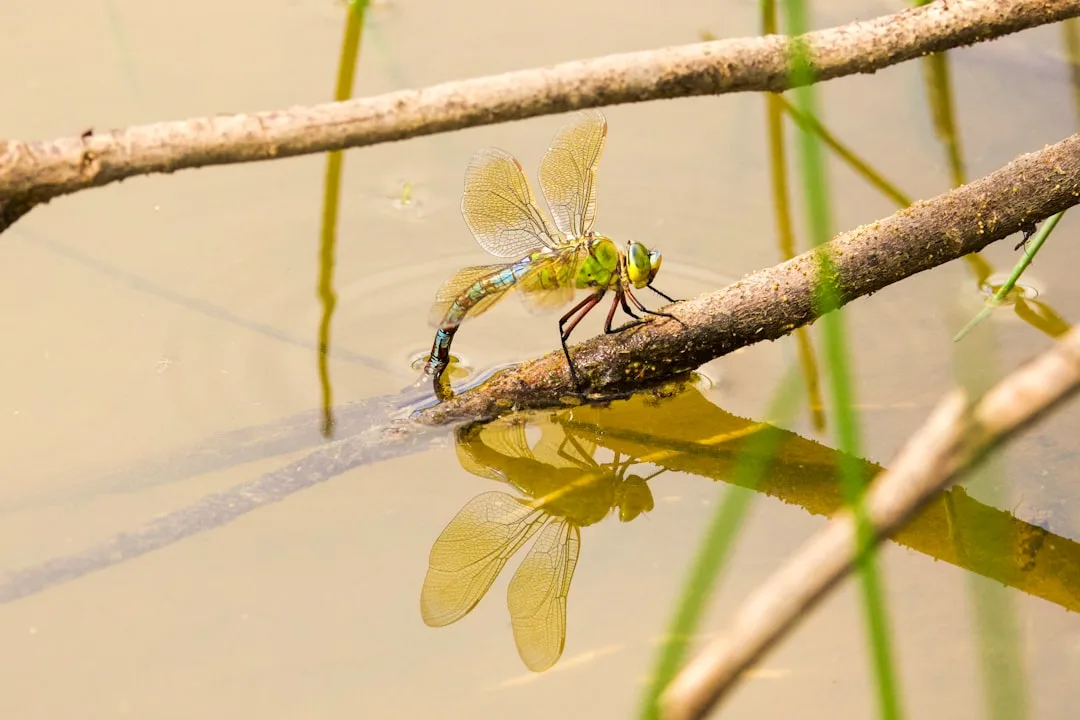
The emperor dragonfly is one of the largest and most conspicuous dragonflies in Europe, and - behaviourally - one of the most astonishing predators on the planet. Anax imperator patrols the still waters of ponds, lakes, canals, and slow rivers from Britain and Iberia through North Africa to the Middle East and parts of Central Asia.
In the air it looks almost architectural: a bright turquoise and apple-green abdomen, four glassy wings that move in apparently impossible patterns, and a head made almost entirely of eye. On behavioural measures of hunting efficiency, it outperforms nearly every vertebrate predator ever studied.
This guide is a reference entry, not a summary. Expect specifics: millimetres, ommatidia counts, opsin classes, hunt success percentages, wing beat frequencies, larval instars, and the geologic age of the order Odonata. The aim is to gather in one place every meaningful number and behavioural detail that distinguishes Anax imperator from other European dragonflies and from flying animals generally.
Etymology and Classification
The genus name Anax is Greek for "lord" or "chief", while imperator is Latin for "emperor" - both chosen to emphasise the species' size and aggressive aerial dominance. The name was published by the Danish entomologist Johan Christian Fabricius's successors in the early nineteenth century, and the name stuck because the species really does behave like an aerial ruler, defending airspace and physically ramming rivals.
Emperor dragonflies sit in the family Aeshnidae, the hawker dragonflies, a group characterised by long slender bodies, strong fliers, and a habit of hunting by patrolling along flight routes rather than perching and waiting. They share the genus Anax with several large migratory relatives including the vagrant emperor (Anax ephippiger) and the common green darner of North America (Anax junius).
The order Odonata contains dragonflies and damselflies; within that order emperor dragonflies belong to the suborder Anisoptera, "unequal wings", reflecting the fact that dragonfly hind wings are broader at the base than forewings.
Size and Physical Description
Emperor dragonflies are among the largest dragonflies in Europe. Few native species come close, and none is as heavy in sustained flight.
Adults:
- Body length: 7.8-8.4 centimetres from the front of the head to the tip of the abdomen
- Wingspan: 9.8-10.5 centimetres tip to tip
- Wing length: roughly 5.0-5.5 centimetres per wing
- Body mass: approximately 1.0-1.2 grams (significant for a flying insect)
Males are unmistakable. The thorax is apple-green, and the long abdomen is sky-blue with a continuous black dorsal stripe running the full length. In sunlight the combination is almost neon. Males perch infrequently; they are usually on the wing.
Females share the green thorax but have a predominantly green or greenish-blue abdomen with the same dark dorsal stripe. Older females may take on a duller, more turquoise cast. Females are more often seen perched or ovipositing than patrolling.
Naiads (larvae): Up to about 5.0-5.6 centimetres at final instar. Cryptic brown-green colouration blends with submerged plants and silt. The body is stout, the legs are strong, and the hinged labial mask - the defining weapon of the dragonfly larva - lies folded beneath the head like a pocketknife.
The four wings are long, narrow, and extensively veined. The pterostigma - the dark-coloured cell near the leading edge of each wing tip - helps stabilise the wing aerodynamically at high speed. The head is almost spherical and appears to be composed entirely of two enormous compound eyes that meet along the top of the skull.
The Eye That Sees Almost Everything
The compound eyes of Anax imperator are one of the most sophisticated sensory organs in the animal kingdom. Each eye contains approximately 30,000 individual optical units called ommatidia, each with its own lens, photoreceptors, and neural wiring. Two eyes of this size, meeting along the top of the head, give the emperor dragonfly an effectively spherical field of view - close to 360 degrees horizontally and roughly 270 degrees vertically. There are almost no blind spots.
More unusually, dragonfly compound eyes use four or five distinct classes of colour-sensing opsins. Humans use three (red, green, blue), which is why we see the world in the familiar trichromatic palette. Dragonflies add at least one or two additional opsins sensitive to ultraviolet wavelengths, and several more finely tuned to visible colours.
Experiments on dragonfly genomes have identified as many as fifteen to thirty opsin genes in some species, though only a subset are expressed in any given life stage.
The practical consequences of this are remarkable:
- Dragonflies can see ultraviolet reflections on flowers, water surfaces, and insect cuticles that are invisible to humans.
- They can detect the polarisation of light. Light reflecting off a water surface is strongly polarised, which helps dragonflies distinguish real water (suitable for oviposition) from shiny substrates like glass or car paint.
- Their temporal resolution (effectively the "refresh rate" of vision) reaches roughly 200-300 frames per second - about four times faster than humans. A bright flicker that we see as a continuous glow appears to a dragonfly as a series of discrete pulses.
The top part of the dragonfly eye is specialised for detecting fast-moving dark objects against a bright sky - the classic silhouette of another insect. The lower part is more colour-sensitive and helps with perching, navigation, and water detection. This functional division is built into the eye's hardware, and explains part of the species' extraordinary hunting accuracy.
Flight: Four Wings, Four Motors
Most winged insects flap their wings together or in simple phase-locked patterns. Dragonflies don't. Each of the four wings of Anax imperator is powered by a dedicated set of muscles and can be moved independently of the other three. The forewings and hindwings beat out of phase with each other in normal cruising flight, which reduces wake interference and increases lift efficiency.
Key flight statistics:
| Measure | Value |
|---|---|
| Top straight-line speed | ~40 km/h |
| Cruising speed | 10-15 km/h |
| Wing beat frequency | ~25-40 Hz |
| Hover capability | Yes, indefinitely in still air |
| Backward flight | Yes |
| Sideways flight | Yes |
| Pivot in place | Yes (turn in less than a body length) |
| Max recorded g-forces | 4-9 g during turns |
The ability to move wings independently allows manoeuvres no other flying animal can perform. A dragonfly can:
- Hover in place over a patch of water, head tracking a target while the body remains stationary.
- Reverse smoothly without turning around, useful for retreating from a lost prey pursuit.
- Accelerate sideways from a stationary hover in any direction within a single wingbeat.
- Intercept prey on a curved trajectory that meets the target where it will be, not where it is.
The last point matters most. Neuroscientific work on dragonflies (particularly the related Hemicordulia and Sympetrum) has demonstrated that the insect's brain contains identified neurons that compute prey trajectory predictions using copies of its own motor commands - a computation called efference copy or internal forward modelling. The same basic cognitive trick is found in primates and raptors. It was a real surprise to find it in an insect.
Hunting and Diet
Emperor dragonflies are hypercarnivores of the air. The adult diet consists almost exclusively of other flying insects captured in mid-flight with the legs, which the dragonfly holds in a basket-like formation beneath the thorax during pursuit. Prey is transferred to the mouth either in the air (for small prey) or at a perch (for larger prey such as butterflies or smaller dragonflies).
Typical prey:
- Midges, mosquitoes, and small flies
- Mayflies and caddisflies
- Smaller dragonflies and damselflies
- Butterflies and moths
- Occasionally honey bees and hoverflies
The emperor does not normally kill prey larger than itself, though it will tackle prey up to roughly half its own body mass. Hunting flights are fast and precise. Multiple independent studies on Anax species have measured successful capture rates of 90-97%.
For comparison, African lions succeed on roughly 25% of hunts, great white sharks on about 50%, and peregrine falcons on 40-70% depending on prey and method. On the measured numbers, emperor dragonflies are the most successful wild predator yet described.
The reasons, unpacked:
- Near-spherical vision gives the dragonfly almost no blind spot from which prey can approach unseen.
- High temporal resolution means fast-moving prey does not blur into a streak.
- Independent wing control allows an interception trajectory rather than a tail-chase.
- Predictive neural processing means the dragonfly flies toward where the prey will be, continuously updated as the prey moves.
- The leg-basket capture method presents a much larger effective capture surface than a beak or jaw.
The aquatic naiad is a different kind of hunter but just as effective in its own medium. It sits motionless in weeds or silt waiting for a tadpole, mosquito larva, small fish, or another insect naiad to pass within range. It then fires out its labial mask - a hinged, extendable mouthpart stored folded beneath the head - in roughly 10-20 milliseconds to grab the prey with hooked palps and retract it to the mandibles. This strike is faster than almost any vertebrate reflex.
Life Cycle and Reproduction
The emperor dragonfly lives its life in two radically different forms: an underwater hunter with gills and a labial mask, and a winged aerial predator with compound eyes and jet-like flight. The two stages are separated by one of the most dramatic metamorphoses in the animal kingdom.
Stage 1: Egg. After mating, the female inserts eggs directly into the tissues of floating or submerged aquatic plants using a blade-like ovipositor at the tip of her abdomen. Egg laying typically takes place on warm afternoons in sheltered, sun-warmed water. Emperor dragonfly females oviposit alone; the male does not guard her during the process, unlike some related species where the male hovers as a bodyguard.
Stage 2: Naiad (larva). Eggs hatch within a few weeks. The emerging naiad is a predatory aquatic insect that spends the next one to two years - occasionally longer in colder regions - living underwater. It passes through roughly twelve instars, moulting each time it outgrows its exoskeleton. Throughout this period it hunts more or less continuously, eating tadpoles, mosquito larvae, mayfly and caddisfly larvae, small fish, and any smaller dragonfly naiads it encounters.
The naiad breathes through internal rectal gills - folded, highly vascularised tissue inside the rectum. Water is drawn in and pushed out through the anus in a slow, continuous pumping cycle. The same mechanism can, when required, fire water out as a jet that propels the naiad forward rapidly - a biological rocket used for short escape bursts and occasional attacks.
Stage 3: Emergence. On a warm morning in late spring or early summer, the final-instar naiad climbs out of the water up a plant stem. Over the course of one or two hours, the larval skin splits along the thorax and the adult dragonfly extracts itself, pumps hemolymph into its crumpled wings to expand them, and waits for them to harden. The cast skin, called an exuvia, is often found still attached to emergent plants after the adult has flown.
Stage 4: Adult. The adult lifespan is short: typically 2-4 weeks, rarely stretching to six weeks in favourable conditions. The first week or so is a maturation phase during which the adult feeds heavily and its colours develop. Males then establish and defend territories over open water.
When a female enters the territory the male grasps her behind the head and the pair forms the "wheel" mating posture, in which the female's abdomen tip connects to a secondary set of genitalia on the underside of the male's second abdominal segment. Mating lasts from less than a minute to roughly fifteen minutes in the air or at a perch.
After oviposition the cycle restarts. Most adults die within weeks of mating, often eaten by birds, spiders, or other dragonflies.
Habitat, Range, and Climate-Driven Expansion
Anax imperator occupies a wide range of still or slow-flowing fresh water habitats across a broad Palaearctic distribution.
Preferred habitats:
- Large ponds with abundant submerged and emergent vegetation
- Lake margins, especially reed-fringed bays
- Canals and slow-flowing lowland rivers
- Flooded gravel pits, reservoirs, and well-vegetated garden ponds
- Brackish coastal lagoons (tolerated but not preferred)
Geographic range:
| Region | Status |
|---|---|
| Western Europe | Widespread and common, expanding north |
| Northern Europe | Recent colonist in Scotland, southern Scandinavia, Baltic states |
| Mediterranean | Common year-round breeder |
| North Africa | Widespread in permanent wetlands |
| Middle East | Present where fresh water persists |
| Central Asia | Present in suitable wetlands, distribution patchy |
Emperor dragonflies have been one of the clearest insect indicators of climate warming in Europe. The British range, once largely confined to southern England, has expanded steadily northward since the 1990s and the species is now a regular breeder in Scotland. Similar patterns have been documented in Sweden, Denmark, Finland, and the Baltic states. Range shifts are driven by longer warm seasons, milder winters, and the creation of new suitable ponds in industrial and agricultural landscapes.
Territorial and Social Behaviour
Emperor dragonflies are aggressively territorial. Males patrol a stretch of open water of several metres to a few tens of metres along a pond edge or over a clear patch of lake. Within that territory the male drives off rival males with physical ramming - fast interception flights that end in audible wing-clatter contact. Rival interactions can last several minutes and include stalling, chasing, and occasional tumbling falls toward the water surface.
Females generally do not defend territories. They approach water primarily to oviposit and are pursued by males when they do so. In high-density populations a female may be mated by multiple males during a single visit. Emperor dragonflies also behave aggressively toward other dragonfly species sharing their water body, particularly other large hawkers (Aeshna species) and broad-bodied chasers (Libellula depressa).
Outside the immediate area of a breeding pond, emperor dragonflies are strong long-distance fliers and can cover tens of kilometres during dispersal. Ringing studies and genetic data suggest considerable gene flow between ponds separated by many kilometres of unfavourable habitat.
Evolutionary History: 325 Million Years on the Wing
Dragonflies and their ancestors represent one of the oldest flying animal lineages on Earth. The broader group Odonatoptera appears in the fossil record about 325 million years ago, in the Carboniferous period. That places dragonflies well before the origin of dinosaurs, modern birds, mammals, and flowering plants.
The most famous Carboniferous relative is Meganeura monyi, a griffinfly with a wingspan approaching 70 centimetres - roughly the size of a crow or small hawk. Gigantism in Carboniferous insects is usually attributed to the combination of higher atmospheric oxygen levels (perhaps 30-35% compared with today's 21%) and the absence of aerial vertebrate predators.
When atmospheric oxygen dropped in the Permian and birds eventually evolved in the Jurassic, giant flying insects disappeared, but the basic odonate body plan has persisted with remarkable stability.
Modern dragonflies, including Anax imperator, retain the key innovations of their Carboniferous ancestors:
- Four large wings with direct flight musculature
- Compound eyes with extraordinary spatial and temporal resolution
- An extensible labial mask in the larval stage
- A predatory lifestyle in both larval and adult phases
Very little about the basic dragonfly design has needed to change in over 300 million years. It was already close to optimal for its niche.
Conservation Status
The IUCN Red List currently classifies Anax imperator as Least Concern. The species has a very large range, a stable-to-increasing population trend across most of that range, and high tolerance of artificial water bodies such as reservoirs, gravel pits, and garden ponds. In much of Europe it has become more common and widespread over the last three decades, in part because of new artificial wetlands and in part because of climate warming.
Known threats:
- Water pollution. Agricultural runoff, pesticides, and industrial effluent can eliminate dragonfly larvae from otherwise suitable ponds.
- Habitat drainage. Conversion of wetlands to farmland or development remains the largest historical cause of local population loss.
- Invasive aquatic predators. Introduced fish such as largemouth bass and goldfish can suppress naiad populations in small ponds.
- Light pollution. Some evidence suggests strong artificial lighting disrupts dragonfly orientation and oviposition, especially where polarised reflections from glass or wet roads mimic water.
On balance, the emperor dragonfly is among the ecological winners of the Anthropocene in Europe - adaptable, widespread, and expanding.
Emperor Dragonflies and Humans
Humans encounter emperor dragonflies mainly around ponds, lakes, and garden water features on warm summer days. Unlike wasps and bees, they do not sting, and their mandibles cannot break human skin. They will occasionally hover in front of a motionless person, investigating them briefly as a possible rival or oversized prey item, before veering off. No emperor dragonfly will attack a human.
They are strong allies in mosquito control. A single breeding pair can produce a cohort of aquatic naiads that consume thousands of mosquito larvae before metamorphosis, and the adults hunt flying mosquitoes opportunistically. Gardeners and land managers who want free pest control can encourage emperor dragonflies by maintaining permanent ponds with native aquatic vegetation, a sunny aspect, and no stocked fish.
Dragonflies have deep symbolic resonance across many cultures. In Japan they signal strength, courage, and late summer; in parts of Europe they were once associated with witches or the Devil, in folklore names like "devil's darning needle". None of those folk beliefs reflects any actual risk from dragonflies to people, livestock, or pets.
Related Reading
- Dragonflies of the World: Ancient Aerial Predators
- How Insect Vision Works
- Odonata: Dragonflies and Damselflies Compared
- Insects of Europe: A Field Reference
References
Relevant peer-reviewed sources consulted for this entry include published research in Proceedings of the Royal Society B, Current Biology, Journal of Experimental Biology, Odonatologica, and Insect Conservation and Diversity. Range and distribution data reflect IUCN Red List assessments and the European Red List of Dragonflies.
Neural and behavioural data on prey interception draw on work by researchers including Robert Olberg, Anthony Leonardo, and collaborators. Specific wing-beat, speed, and capture-rate figures reflect the most recent consolidated estimates from behavioural and biomechanical studies of Anax and closely related Aeshnidae.
Frequently Asked Questions
How big is the emperor dragonfly?
The emperor dragonfly (Anax imperator) is one of the largest dragonflies in Europe. Adult body length runs 7.8-8.4 centimetres, and wingspan stretches 9.8-10.5 centimetres - roughly the width of an adult human hand. Males are typically slightly longer and more robust than females but the sexes overlap considerably in size. The naiad (larval stage) reaches about 5-5.6 centimetres before metamorphosis.
Only a handful of European dragonflies such as the golden-ringed dragonfly rival it in length, and none is heavier in flight.
What do emperor dragonflies eat?
Adult emperor dragonflies are strict aerial carnivores. They catch and eat other flying insects, typically midges, mosquitoes, flies, butterflies, smaller dragonflies, and damselflies, all in mid-air using their spiny legs as a mobile basket. Large prey such as butterflies may be carried to a perch for dismemberment, but most prey is eaten on the wing. Hunt success rates measured in behavioural studies reach 90-95%, the highest of any known predator.
The aquatic naiad is equally predatory underwater, ambushing tadpoles, mosquito larvae, small fish, and even other dragonfly larvae using its extensible labial mask.
Where do emperor dragonflies live?
Anax imperator occupies still or slow-moving fresh water across Europe, North Africa, the Middle East, and parts of Central Asia. Typical habitats include large ponds, lake margins, canals, slow-flowing rivers, gravel pits, and well-vegetated garden ponds. The species favours open sunlit water with dense submerged and emergent plants that provide perches and egg-laying sites.
Climate warming has driven a well-documented northward range expansion - the emperor is now a regular breeder in Scotland, southern Scandinavia, and the Baltic states, areas where it was unknown a few decades ago.
Why are dragonflies such successful predators?
Three systems combine to produce the emperor dragonfly’s extraordinary hunt success. First, vision: compound eyes with around 30,000 ommatidia and four to five colour-opsin classes produce an almost full-sphere, high-frame-rate view of the world. Second, flight: four independently driven wings allow hover, reverse, side-step, and rapid pivots impossible for most other flying animals.
Third, neural prediction: the dragonfly brain appears to run an internal model that anticipates where prey will be after its own movement and the prey’s trajectory - so it intercepts rather than chases. Together these produce reported hunt success rates near 95%, far above lions (~25%) or falcons.
How long does the emperor dragonfly live?
The species’ total lifespan is mostly underwater. Eggs hatch into aquatic naiads that live one to two years (occasionally longer in colder regions), passing through roughly twelve instars while eating anything smaller than themselves. The adult winged stage - the phase most people actually see - lasts only two to four weeks.
Adults emerge in late spring or early summer, mature over about a week, defend territories and mate, lay eggs, and then die, usually before the end of summer. Most of an emperor dragonfly’s life is spent as an underwater hunter, not a flying one.
How do emperor dragonflies reproduce?
Males patrol and defend territories of open water several metres across, driving off rival males with aerial ramming. When a female enters the territory the male grasps her behind the head using claspers at the tip of his abdomen. The pair then bends into the distinctive ‘wheel’ or heart-shaped mating position, during which the female draws sperm from a secondary structure on the male’s abdomen.
After mating the female generally oviposits alone, inserting eggs directly into floating or emergent plant stems using an ovipositor. Eggs hatch within a few weeks, and the naiad phase lasts one to two years before metamorphosis.
How old is the dragonfly lineage?
Odonatoptera - the broader evolutionary group containing modern dragonflies - appears in the fossil record about 325 million years ago, in the Carboniferous period. That makes dragonflies older than dinosaurs, flowering plants, and every mammal lineage. Carboniferous relatives such as Meganeura monyi reached wingspans near 70 centimetres, roughly the size of a crow, exploiting higher atmospheric oxygen and the absence of aerial vertebrate predators.
Modern dragonflies are smaller but retain the same basic flight mechanics and predatory lifestyle as their ancient ancestors.
Are emperor dragonflies dangerous to humans?
No. Emperor dragonflies do not sting and cannot meaningfully bite through human skin. Despite their size, speed, and intimidating appearance, they have no venom, no stinger, and no interest in people. They will occasionally investigate a moving human as a possible rival or large insect but veer off as soon as they recognise a non-target.
Dragonflies are in fact useful allies in controlling mosquito populations, both as adults hunting flying mosquitoes and as naiads consuming mosquito larvae underwater. The species is currently listed as Least Concern by the IUCN.