
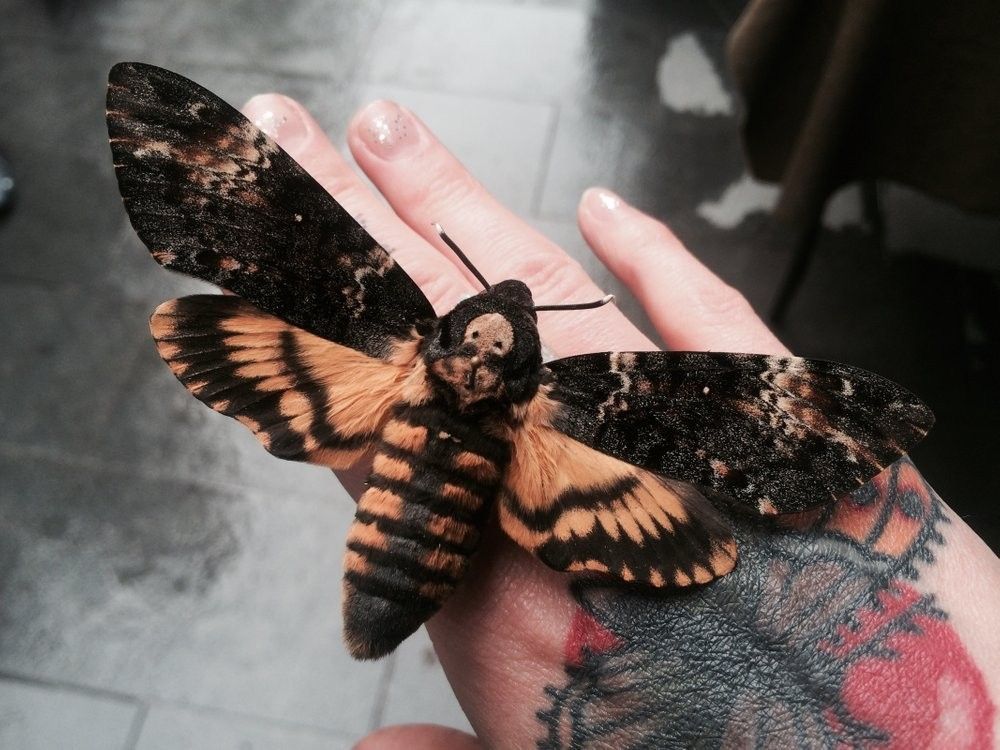
The death's-head hawkmoth is the only moth in the world that can squeak. That single fact, strange as it is, is only the second most unusual thing about Acherontia atropos. The most unusual thing is painted on its back: a pale, skull-shaped pattern so accurate that medieval Europeans treated the insect as a literal omen of death.
A hawkmoth the size of a human palm, carrying a skull on its thorax, breaking into beehives to drink honey, and crying out in a voice that may imitate a queen bee - the death's-head hawkmoth reads like folklore. It is not. Every one of those behaviours is documented, measured, and repeatable.
This guide covers the biology, ecology, behaviour, and cultural footprint of the three species that make up the genus Acherontia, with a focus on the European and African species A. atropos. It is a reference entry, so expect specifics: wingspan in centimetres, squeak frequency in hertz, caterpillar host plants by scientific name, and the verified record of the 2006 mass migration into northern Europe.
Etymology and Classification
The scientific name Acherontia atropos is one of the darkest in zoology. Acheron is the river of woe in Greek mythology, one of five rivers that flow through the underworld. Atropos is the eldest of the three Fates, the one who cuts the thread of a mortal's life. The entomologist Carl Linnaeus coined the species name in 1758, aware that the moth already carried a reputation as an omen. The genus name was added later by the German naturalist Jakob Hubner.
The genus contains exactly three species, and all three carry the skull pattern:
- Acherontia atropos - Europe, Africa, Middle East
- Acherontia styx - western and central Asia
- Acherontia lachesis - India, Southeast Asia, Japan
Styx is another underworld river. Lachesis is the middle Fate, who measures the thread. The three species together cover most of the Old World.
In English, the moth is called the death's-head hawkmoth, death's-head moth, or bee robber. Folk names across Europe include tete de mort (French, 'head of death'), totenkopfschwarmer (German, 'death's-head swarmer'), and esfinge de la muerte (Spanish, 'sphinx of death'). The 'hawkmoth' or 'sphinx' part of the name comes from the family Sphingidae, whose caterpillars often sit in a characteristic upright pose reminiscent of the Egyptian Sphinx.
Size and Physical Description
The death's-head hawkmoth is one of the larger moths in Europe and the largest member of its family (Sphingidae) in the region. It is not the biggest moth in the world - the Atlas moth of Southeast Asia dwarfs it - but among temperate hawkmoths it is near the top.
Adults:
- Wingspan: 10-13 centimetres
- Body length: approximately 6 centimetres
- Thorax width: around 1.5 centimetres
- Weight: about 1.5-2 grams
Final-instar caterpillar:
- Length: up to 15 centimetres
- Diameter: about 1.5 centimetres
- Colours: yellow-green, brown, or near-black depending on morph
- Distinguishing mark: a curved horn at the rear, purple or yellow
Pupa:
- Length: 6-8 centimetres
- Colour: rich chestnut to dark brown
- Location: underground cell 10-40 cm deep
The adult's wings are a dark, smoky brown on the forewings with pale grey and yellow streaking; the hindwings are ochre-yellow with two dark bands. The abdomen is banded in yellow and grey-blue. All of this is striking but ordinary for a hawkmoth. The thorax is the unusual part.
A pale cream or yellowish patch carries a clear resemblance to a human skull, complete with suggested eye sockets, a nasal cavity, and a jaw. The resemblance is consistent from individual to individual, produced by the regular geometry of scale colour on the thorax segments.
The proboscis is atypical for a hawkmoth. Where most hawkmoths have long, flexible proboscises - sometimes exceeding their body length - A. atropos has a short, stiff proboscis around 12-14 millimetres long. This proboscis cannot reach into deep flowers. It is instead optimised for piercing honeycomb and soft fruit skin.
The Skull Marking
The thoracic skull pattern is the feature that gave the species its name, its reputation, and its cinematic afterlife.
The pattern is produced by the arrangement of coloured scales on the mesothorax. It is present from the moment the adult emerges from the pupa and does not change through the moth's life. Both sexes carry it. Individual variation exists - the 'skull' can be sharper or blurrier depending on the individual - but the basic layout is stable enough that collectors use it to identify the species in flight.
No predator-deterrent function has been experimentally confirmed. Several hypotheses exist:
- Startle display. Bats, owls, and nocturnal mammals may briefly hesitate when confronted with what looks like a vertebrate face, giving the moth time to escape.
- Coincidental pattern. Many hawkmoth species carry geometric thorax patterns; humans pattern-match to a skull because we are wired for face recognition. The moth is not 'trying' to look like a skull.
- Sexual selection. The pattern could play a role in mate recognition at short range, though this has not been tested.
In practice, the skull is most important to humans. Medieval and early modern European folklore treated the appearance of a death's-head hawkmoth indoors as an omen of death in the household, sickness in the family, or bad harvest. The moth was killed on sight in many rural communities well into the twentieth century. The reputation persists in fiction.
The Squeak - The Only Moth That Calls Out
Death's-head hawkmoths are the only moth species known to produce a loud, vocal-like call. A disturbed moth, a moth being handled, and a moth inside a beehive will all squeak. The sound is loud enough to startle anyone hearing it for the first time and can be heard several metres away in a quiet room.
Acoustic properties:
| Metric | Value |
|---|---|
| Fundamental frequency | 280-320 Hz |
| Call duration | 80-100 milliseconds per pulse |
| Pulse pattern | 1-3 pulses per second when disturbed |
| Sound pressure (at 10 cm) | 70-80 dB |
| Audible range (human ear) | 3-5 metres in quiet conditions |
The mechanism is unusual. Most sound-producing insects rub body parts together (stridulation) or vibrate membranes. The death's-head hawkmoth does neither. Instead, it uses its short proboscis as a reed. Muscles pump air rapidly in and out of the pharynx, and the air flow past a flap-like structure inside the proboscis (the epipharynx) causes the tissue to vibrate. The inhalation phase is silent or produces a low 'huff'; the exhalation phase produces the loud whistle-like call.
The adaptive function has two main hypotheses, which are not mutually exclusive:
- Defensive startle. The sudden loud call may startle a vertebrate predator into dropping the moth. Bats, birds, and small mammals have all been observed to recoil when a handled A. atropos squeaks.
- Queen bee mimicry. Acoustic analysis shows that the squeak falls within the frequency range of 'piping' calls produced by honeybee queens. Researchers have suggested that the squeak suppresses worker bee aggression during hive raids by triggering responses normally reserved for the queen. Playback experiments support this hypothesis but have not fully resolved it.
Beehive Raids
If the skull and the squeak are the most dramatic features of the moth, its behaviour is the strangest. Adult death's-head hawkmoths are obligate raiders of honeybee colonies. They do not feed on flower nectar, and their short proboscis makes them incapable of doing so. Instead, they specialise in exploiting the most dangerous food source available to any insect: the interior of an occupied bee hive.
A raid unfolds in stages:
- Approach. The moth approaches the hive at night, when the bees are less active.
- Entry. It forces past guard bees at the entrance, using its heavy body and dense scales to resist initial stings.
- Squeak. Once inside, the moth frequently squeaks. This may pacify workers by mimicking the queen's piping.
- Feeding. It walks across the comb, pierces wax cells with its short stiff proboscis, and drinks honey directly.
- Escape. After minutes of feeding, often with several grams of honey consumed, it exits and flies away.
The moth's defences against bees are layered. Its cuticle is thick. Its scales are dense enough to obscure sting targets. It secretes chemical compounds in its body that resemble bee-like fatty acids, which may reduce detection as an intruder. Some researchers have reported that the moth's body chemistry actively mimics a bee pheromone profile.
Hive defences still kill some raiders. Dead A. atropos are regularly found entombed in propolis - the resin workers use to seal unwelcome objects - inside wild and managed hives. Successful raids, however, are common enough that beekeepers in southern Europe and North Africa routinely list A. atropos among their minor pests.
Losses per hive are small, usually a few tens of grams of honey per raid, but the sight of a skull-backed moth at the entrance is dramatic enough that the species is well known to every experienced beekeeper in its range.
Life Cycle
The life cycle of A. atropos depends heavily on latitude. In North and sub-Saharan Africa, and in the southern Mediterranean, the species breeds year-round with overlapping generations. In central and northern Europe, each year's moths are the offspring of southern migrants, with one or at most two generations completed before autumn ends the season.
Eggs. Females lay 150-200 eggs over their adult lifespan, attaching them singly to the underside of host plant leaves. Eggs are pale green, spherical, and about 1.5 millimetres across. They hatch in five to ten days.
Caterpillar. The larva passes through five instars in three to four weeks. Early instars are bright green. The final instar reaches 12-15 centimetres and comes in three colour forms: classic yellow-green with diagonal purple-blue stripes, a brown morph, and occasional dark almost-black individuals. All carry a characteristic curved horn at the rear and click their mandibles loudly when handled. Favoured host plants include:
- Potato (Solanum tuberosum)
- Tobacco (Nicotiana tabacum)
- Tomato (Solanum lycopersicum)
- Black nightshade (Solanum nigrum)
- Jasmine (Jasminum species)
- Privet (Ligustrum)
- Olive, lilac, and several other shrubs
Pupa. When fully grown, the caterpillar descends to the ground, digs 10-40 centimetres into soft soil, and forms an underground cell. Pupation lasts two to three weeks in warm summers. In autumn, pupae in warm-enough climates overwinter underground for several months before emerging in spring. In cold northern winters, pupae usually die; the species does not establish permanent populations in northern Europe.
Adult. Adults live one to two months, a long span for a moth. During that time they feed on stolen honey, tree sap, and fruit juice; migrate across continents; mate; and lay the next generation. They fly at dusk and through the first half of the night, navigating with a combination of visual landmarks and moon or star compass cues.
Migration and Distribution
Death's-head hawkmoths are strong, long-distance migrants. The core breeding range covers Africa, the Mediterranean basin, the Middle East, and the Arabian Peninsula. Each spring and summer, successive waves of migrants push north through southern Europe, across the Alps, into central Europe, and in good years as far as the British Isles, Ireland, southern Scandinavia, and occasionally Iceland.
Migration data:
| Region | Status |
|---|---|
| North Africa, southern Spain | Resident, year-round breeding |
| Italy, Balkans, Turkey | Resident and migrant |
| France, Germany, Benelux | Annual summer migrant, occasional breeder |
| United Kingdom, Ireland | Annual migrant, usually scarce |
| Scandinavia | Occasional migrant |
| Iceland | Rare vagrant |
The 2006 migration year was exceptional. An unusually warm spring and favourable wind patterns pushed hundreds of death's-head hawkmoths into the British Isles, with reports from Cornwall to the Scottish Highlands. Scotland recorded its highest-ever number of A. atropos observations that year, and potato fields across the southern UK supported locally abundant caterpillars. Similar mass migrations happened in 1956 and 1983 but less spectacularly than 2006.
Northern migrants almost never survive winter because pupae cannot tolerate sustained freezing. Each year's northern population is effectively rebuilt from scratch by the next spring's migrants.
Predators and Defences
Adult A. atropos are preyed on by bats, owls, nightjars, and a range of nocturnal mammals. The moth's defences include:
- Size and mass. At up to 2 grams, it is too heavy for many small bats to handle.
- Dense scales. Stings, beak strikes, and bites land on a thick layer of loose scales rather than the cuticle.
- Squeak. The sudden loud call often startles predators into dropping the moth.
- Rapid flight. Hawkmoths are among the fastest-flying moths, with speeds up to 50 km/h in burst.
- Erratic evasion. When attacked by bats, death's-head hawkmoths make sharp dives and turns.
Caterpillars are preyed on by birds, lizards, rodents, and a range of parasitoid wasps and flies. Larval defences include the mandible-clicking display, rearing up into a sphinx posture, and regurgitation of plant-derived toxins from nightshade hosts.
Cultural History
The cultural footprint of A. atropos is enormous for a species that is, biologically, just a large moth.
Hieronymus Bosch, around 1500. The Dutch painter included a recognisable death's-head hawkmoth in at least one panel, making it one of the first identifiable insect portraits in European art. The moth's symbolism in Bosch's work is consistent with his broader interest in death, sin, and the uncanny.
European folklore, 1600s-1900s. Across France, Germany, the Low Countries, the British Isles, and Scandinavia, entering a home was read as an omen of illness or death. Many rural communities reportedly killed every specimen they found. Handbooks of entomology from the early nineteenth century discuss the superstition and its effect on the species' popular reputation.
The Silence of the Lambs, 1988 and 1991. Thomas Harris used the death's-head hawkmoth as a central symbol in his novel, and Jonathan Demme carried it forward into the film. The 1991 poster became one of the most recognisable film images of its decade, pairing Jodie Foster's face with a moth bearing a stylised skull on its back.
That skull, in the poster, is actually a Salvador Dali photo-montage of arranged figures, not a real A. atropos marking - but the association of the species with horror cinema has been permanent ever since.
Modern use. The moth appears on black metal album covers, gothic tattoo flash, horror video game art, and Halloween imagery worldwide. Biologists occasionally grumble that the species is more famous for fictional references than for its remarkable natural history.
Conservation and Status
The death's-head hawkmoth is not listed as threatened on the IUCN Red List. It has not been formally evaluated at the global level. Populations remain common across most of the resident range in Africa and the Mediterranean, and annual migration patterns into northern Europe continue without obvious long-term decline.
Threats that could affect long-term populations include:
- Pesticide use. Broad-spectrum insecticides on potato and tobacco crops kill caterpillars directly. In some years this has caused measurable drops in locally reared generations.
- Loss of beekeeping. Reductions in managed hives in parts of North Africa and southern Europe reduce the primary adult food source.
- Light pollution. Adults are strongly attracted to lights and die disproportionately at illuminated walls, traps, and outdoor installations.
- Climate change. Shifts in seasonal temperature and rainfall affect caterpillar survival and migration timing. Warming could extend the resident breeding range northward but also disrupt existing migration cues.
- Habitat fragmentation. Loss of scrub, orchards, and mixed farmland reduces both host plants and adult shelter.
None of these is yet a crisis for the species, but population monitoring in Europe and North Africa is ongoing.
Death's-Head Hawkmoths and Humans
The relationship between humans and A. atropos is more cultural than practical. The moth is not a significant agricultural pest. Caterpillars occasionally damage potato or tobacco plants but almost never at economically meaningful levels. Adult bee raids cost honey but only in small amounts per colony. Handled carefully, the adult is harmless - no sting, no bite, no toxin on contact.
What humans mostly do with the death's-head hawkmoth is react to it. Beekeepers recognise it, sometimes with frustration, more often with a kind of grudging respect. Rural gardeners report caterpillars on potato plants and either tolerate or destroy them. Entomologists and photographers travel to see the species. Horror fans display the image as a symbol. Medieval superstition is gone, but the moth's uncanny effect on the human eye survives any amount of scientific explanation.
Related Reading
- Atlas Moth: Giant of the Moth World
- Luna Moth: Pale Green Silk-Moth of North America
- Moths: The Overlooked Majority of the Lepidoptera World
References
Relevant peer-reviewed sources and reference works consulted for this entry include Pittaway's The Hawkmoths of the Western Palaearctic (1993 and later online updates), published research in Naturwissenschaften on A. atropos acoustic communication, the UK Rothamsted Insect Survey migration records, and Sphingidae monographs in the Journal of the Lepidopterists' Society.
Squeak acoustic data reflect measurements published in entomological studies of Acherontia vocalisation mechanics. The 2006 migration figures are drawn from Butterfly Conservation UK and the national moth recording scheme.
Frequently Asked Questions
Why does the death's-head hawkmoth have a skull on its back?
The pale, skull-like pattern sits on the thorax - the segment just behind the head - and is formed by scales arranged in a stable species-specific design. No predator-mimicry function has been experimentally confirmed. Some biologists suggest the pattern may startle nocturnal predators that briefly mistake it for the face of a small vertebrate, but this is untested.
The resemblance to a human skull is essentially a coincidence of pattern formation that humans find striking because we are wired to recognise faces. All three species in the genus Acherontia (A. atropos, A. styx, A. lachesis) carry variations of the same marking.
Can the death's-head hawkmoth really squeak?
Yes. Acherontia atropos is the only moth species known to produce a loud vocal-like call. It forces air in and out through its short, stiff proboscis using muscular pumping of the pharynx. The sound sits between 280 and 320 Hz, roughly the pitch of a middle D on a piano, and can be heard several metres away in a quiet room. The moth squeaks when disturbed, when handled, and during hive raids.
Researchers using playback experiments have shown that the squeak broadly matches the acoustic profile of a piping queen honeybee, which may be why worker bees do not aggressively attack raiding moths.
How does a moth raid a beehive without getting stung?
Death’s-head hawkmoths use a combination of defences to survive hive raids. Their thick cuticle and dense body scales resist most sting attempts. They produce a chemical profile that masks their scent from guard bees, reducing detection at the entrance. Their squeak appears to mimic queen bee acoustic signals, which suppresses worker aggression during the raid.
Once inside, the moth walks across the comb, pierces cells with its proboscis, and drinks honey directly. Raids last minutes rather than hours. Bees do sometimes kill invading moths - dead A. atropos are occasionally found sealed into propolis inside hives - but a successful raid can provide enough sugar to power days of flight.
Where do death's-head hawkmoths live?
Acherontia atropos is native to Africa and the Mediterranean basin and migrates annually into central and northern Europe. It breeds year-round in North and sub-Saharan Africa and in southern Europe (Iberia, Italy, the Balkans, Greece, Turkey). In summer, migrants push north through France, Germany, the Low Countries, and into the United Kingdom, Ireland, and Scandinavia.
Northern populations generally cannot survive winter, so each year’s northern moths are the offspring of southern migrants. The species also occurs across the Middle East as far east as the Arabian Peninsula. Preferred habitats include agricultural land, gardens, vineyards, potato fields, and scrubland.
What do death's-head hawkmoths eat?
Adults do not feed on flowers. Their proboscis is only about 12-14 millimetres long - short and stiff compared with other hawkmoths - which prevents it from reaching into most flower tubes. Instead, adults exploit three unusual food sources: stolen honey from beehives, tree sap oozing from wounds in oaks and other trees, and the juice of over-ripe or rotting fruit. Caterpillars are very different.
They feed voraciously on plants in the nightshade family (Solanaceae), particularly potato, tobacco, tomato, and black nightshade, and also take jasmine, privet, and several other shrubs. A single caterpillar may consume several full potato plants before pupating.
Is the death's-head hawkmoth dangerous?
No. The species is completely harmless to humans, pets, and livestock. It cannot sting, bite with any meaningful force, or transmit disease. The caterpillar can rear up defensively and click its mandibles when handled, but it does not carry venom. Death’s-head hawkmoths are not considered agricultural pests at a significant scale - occasional caterpillars feed on potato or tobacco crops but populations are rarely dense enough to cause measurable losses.
Beekeepers lose some honey to adult raids, but a healthy colony can tolerate this easily. The moth’s sinister reputation is entirely cultural, tied to the skull pattern and to folklore that treated the moth as an omen of death.
Why is the moth in 'Silence of the Lambs'?
Thomas Harris, author of the 1988 novel, chose the death’s-head hawkmoth as a central motif because of its skull marking and its association with transformation. In the story, the antagonist places pupae of the moth in the throats of his victims.
The 1991 film poster reinforced the image globally, compositing a death’s-head hawkmoth onto Jodie Foster’s face - except that the skull pattern on the moth in the poster is actually a Salvador Dali photo-montage of naked women arranged to look like a skull, not a natural A. atropos marking. Since the film, the species has become one of the most cinematically recognisable insects in the world and frequently appears on horror and gothic imagery.
How long does a death's-head hawkmoth live?
The complete life cycle takes roughly two to three months in warm conditions. Eggs hatch in five to ten days. The caterpillar stage lasts three to four weeks and passes through five instars, reaching a final length of up to 15 centimetres. Pupation occurs underground in a cell the caterpillar digs in soft soil; the pupal stage lasts two to three weeks in summer, or several months if the insect overwinters in a warm-enough southern climate.
Adults live one to two months, which is long for a moth but short for a vertebrate. During that adult period they feed on honey, sap, and fruit, mate, and migrate. In temperate northern Europe the species rarely completes a second generation before winter.