
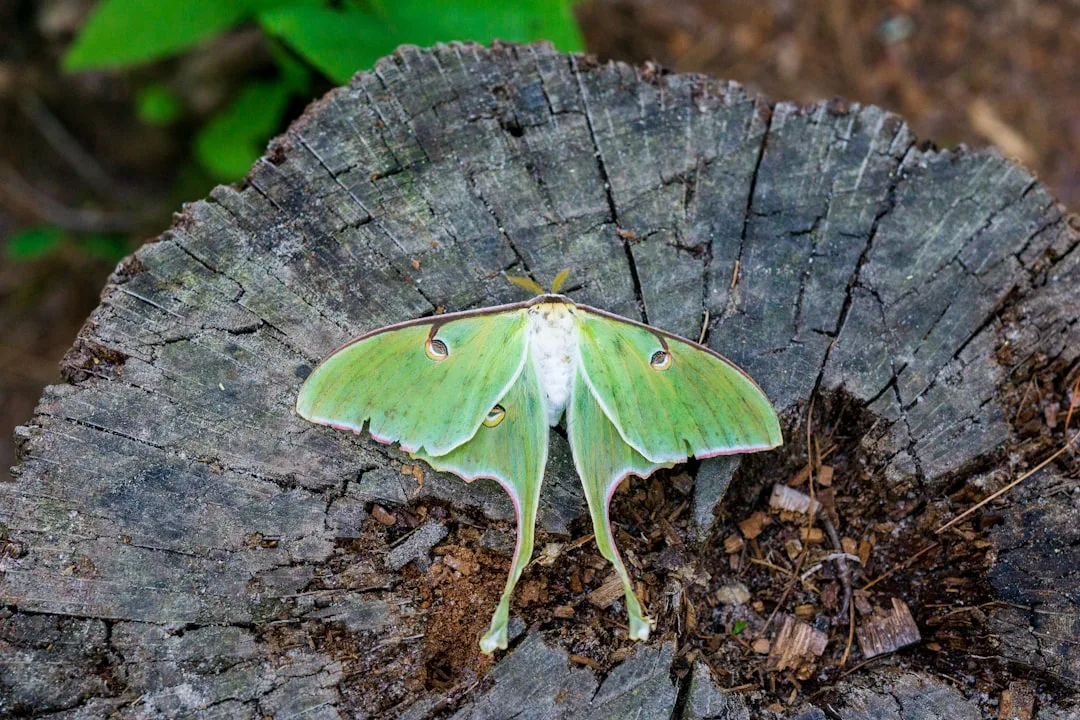
The luna moth is one of the most recognisable insects in North America and, paradoxically, one of the least often seen. Actias luna is a large, pale lime-green silkmoth that belongs to the family Saturniidae. Adults fly only at night, live only about a week, and spend that single week engaged in one uninterrupted activity: finding a mate. They do not eat. They cannot eat.
The adult has no functional mouth, no digestive system capable of processing food, and no use for either - every calorie the flying moth will ever spend was already stored in its body by the caterpillar months earlier.
This entry is a reference article covering the complete biology of the luna moth: its taxonomy and evolution, its distinctive morphology, the strange bat-evading function of its long hindwing tails, its feeding ecology as a caterpillar, its multi-stage life cycle, its geographic distribution and seasonal generations, and its conservation status in a world increasingly lit up at night.
Specific figures - wingspans, generation counts, caterpillar instars, the 2015 bat-echolocation research results - appear throughout. This is a hub page, not a summary.
Etymology and Classification
The scientific name Actias luna was established by Carl Linnaeus in 1758, in the tenth edition of Systema Naturae. The genus name Actias derives from Aktis, a Greek word for a ray or beam of light, while the species epithet luna is the Latin word for moon.
Both names point at the same feature that gives the moth its common name in English: the pale, cool, moonlight-coloured wings and the luminous eyespots that mark each forewing and hindwing. In French the moth is known as papillon lune, in Spanish as mariposa luna - literally moon butterfly - and in many parts of the rural American South simply as the moonmoth.
The genus Actias contains more than twenty described species distributed across North America, Asia, and Africa. What unites them is a shared body plan that includes large, often pale wings and long trailing tails on the hindwings. Actias luna is the only representative of the genus native to North America.
Its closest Asian relatives, such as the Indian moon moth Actias selene and the Chinese moon moth Actias dubernardi, share both the luminous colouration and the acoustic-decoy hindwing tails, strongly suggesting that these features evolved in a shared ancestor and have been maintained by the same selection pressure ever since: hunting bats.
The family Saturniidae as a whole contains roughly 2,300 species and is famous for giant silkmoths, including the atlas moth, the hercules moth, and the Io moth. Most share the luna moth's basic adult biology: no feeding, short lifespan, reliance on pheromone-driven mate finding.
The family diverged from the rest of the Lepidoptera roughly 70 million years ago, and the bat-deflecting tails appear in the fossil and phylogenetic record well before many modern insectivorous bat lineages - a reminder that moth-bat acoustic warfare is very old.
Size and Physical Description
Luna moths are large moths even by Saturniidae standards, although they are outsized by some tropical relatives. Most of the body mass and sensory equipment is concentrated on the two jobs the adult must accomplish in a week: flying and locating a mate.
Adult wingspan:
- Typical: 8-11.5 centimetres
- Large specimens: 12-14 centimetres, regularly observed
- Verified record: 17.8 centimetres
Adult body:
- Body length: roughly 4.5 centimetres
- Body colour: white to pale cream, densely furred
- Mass: only a few grams, largely hollow thorax and abdomen
- Antennae: enormously broad, feathered (males) or narrower (females)
Wings:
- Colour: pale lime green in fresh adults, fading to yellow or dull white after death
- Forewings: rounded at the tip, with a dark pink-to-maroon leading edge
- Hindwings: trailing into long twisted tails, often 5-8 centimetres long
- Eyespots: one translucent "teardrop" eyespot per wing, bordered in black and yellow
Caterpillar:
- Length when mature: 6-7 centimetres
- Colour: bright apple green with small orange or pink tubercles
- Body: plump, segmented, with faint yellow side stripes
- Instars: five before pupation
The caterpillar is much heavier than the adult that emerges from it, a pattern typical of silkmoths. During its single month of feeding it can increase body mass more than a thousandfold. By the end of the fifth instar almost all of that mass is fat and protein that will later fuel the adult's entire flight career.
The pale lime-green colour of the wings is produced partly by pigment and partly by structural scattering of light in the wing scales. It fades quickly after death, which is why museum specimens, even well-preserved ones, rarely look like a living luna moth.
The Hindwing Tails and the Bat Problem
The single most famous feature of Actias luna is the pair of long, twisting tails that trail from the hindwings. For more than a century naturalists assumed these were ornamental, sexually selected, or simply aerodynamic. The true function turned out to be far stranger and more specific.
In 2015, a research team led by Jesse Barber at Boise State University published results from experiments in which live luna moths were released into an enclosure with free-flying big brown bats (Eptesicus fuscus). Using synchronised high-speed video and ultrasonic recording, they could track every bat attack frame by frame.
Key findings from the 2015 study:
- Bats preferentially struck the hindwing tails rather than the body
- Luna moths with intact tails survived bat attacks about 47% more often than moths whose tails had been experimentally removed
- The fluttering, twisting motion of the tails produced an acoustic reflection that apparently mimicked a more valuable target
- Species across the genus Actias, on multiple continents, have independently converged on similar tail morphology - a strong signature of a shared evolutionary pressure
The tails, in other words, are an acoustic decoy. They do not hide the moth from bats and they do not make the moth harder to detect. Instead they present an extra, attractive target some distance away from the vital organs. A bat that locks on to the tail can still bite - it simply bites something the moth can afford to lose.
A luna moth missing one or both tails continues to fly and mate normally, which is one of the reasons the adaptation works: the body part is biologically cheap and acoustically expensive, the exact opposite trade-off a predator wants.
This discovery reframed a large literature on moth-bat evolution. Many Saturniidae have similar if less dramatic tails. Some lineages produce ultrasonic clicks that jam bat sonar directly. Others are covered in sound-absorbing fur scales that reduce their acoustic visibility. The luna moth sits at one extreme of a long continuum of moth strategies for surviving in the dark against animals that hunt by sound.
Life Cycle
The luna moth life cycle runs through four stages - egg, caterpillar, pupa, adult - with radically different durations and radically different ecologies at each step. Only the caterpillar feeds. Only the adult disperses and mates. Each stage exists to set up the next.
Stage 1: Egg
- Laid singly or in clusters of 4-7 on the underside of host tree leaves
- Typical clutch size: 100-300 eggs per female
- Hatch time: 8-13 days depending on temperature
Stage 2: Caterpillar (larva)
- Duration: about one month
- Five instars, each ending in a moult
- Diet: leaves of walnut, hickory, sweetgum, persimmon, sumac, birch, and related hardwoods
- Behaviour: solitary, feeding almost continuously, resting on the underside of leaves
Stage 3: Pupa
- Cocoon: papery, thin silk wrapped inside a dead leaf
- Location: on the forest floor in leaf litter, not hanging from branches
- Duration: about two weeks in summer broods, several months in the overwintering brood
Stage 4: Adult
- Emergence: usually just before dawn
- Lifespan: 7-10 days
- Activity: nocturnal, flight restricted mostly to the first half of the night
- Feeding: none - no functional mouth, no digestive tract
- Primary behaviour: females release pheromones, males locate them and mate
The cocoon stage is one of the most distinctive features of the species. Most large silkmoths spin their cocoons hanging from twigs or attached to bark. Luna moths instead drop to the forest floor, burrow lightly into leaf litter, and spin inside a dead leaf. The cocoon is loose and papery rather than hard, and relies on camouflage in the litter rather than elevation for protection. Overwintering pupae in the north survive months of cold inside their leaf-wrapped shelters.
Generations Per Year
Luna moths show one of the more dramatic latitudinal patterns of any North American moth. At the northern edge of the range - Quebec, Ontario, Nova Scotia, northern New England - the species completes only one generation per year. The adults fly in late May or June, lay eggs, and the resulting caterpillars pupate in late summer and overwinter as pupae, emerging the following spring.
In the middle of the range, roughly from Pennsylvania south to Virginia and west to the lower Midwest, two generations are typical. The first flight happens in April or May and produces a summer generation that pupates quickly and emerges again in July or August. Those moths lay eggs whose caterpillars pupate and overwinter.
At the southern edge, in the Gulf Coast states and eastern Mexico, three generations is common and occasional fourth generations have been recorded. Flight can begin as early as March and continue into October. This is one reason luna moths are far more often seen in southern yards and porch lights than northern ones, even though the species is present and apparently secure across most of the eastern half of the continent.
Regional generations per year:
| Region | Typical generations | Flight months |
|---|---|---|
| Southern Canada | 1 | Late May-June |
| Northeast / Great Lakes | 1-2 | May, August |
| Mid-Atlantic / Ohio Valley | 2 | April-May, July-Aug |
| Deep South / Gulf Coast | 2-3 | March-October |
| Eastern Mexico | 3 | Most of year |
Distribution and Habitat
The luna moth is restricted to the eastern half of North America. Its range runs from Nova Scotia and southern Quebec in the north, south through the eastern United States to Florida, and west to roughly the Great Plains, with scattered records from eastern Texas and a thin extension into eastern Mexico.
It does not occur naturally in the Rocky Mountains, the Pacific Northwest, California, or most of the arid Southwest. The species is a hardwood forest specialist and simply cannot persist where its host trees do not grow.
Within that range the preferred habitat is mature deciduous or mixed forest with a diverse understory. Hickory, walnut, sweetgum, birch, sumac, and persimmon are all locally important host trees. Luna moths also thrive in suburban neighbourhoods that retain mature trees - plenty of adult records come from well-lit front porches in small towns and rural yards. The species does not require wilderness; it requires trees, dark nights, and a leaf-littered forest floor for pupation.
Conservation Status and Threats
The IUCN Red List currently classifies the luna moth as Least Concern, reflecting its wide range, broad host-plant use, and continued abundance across much of eastern North America. But the Least Concern label hides several trends that concern specialists, and local declines have been documented even while the species as a whole remains secure.
Major pressures on luna moth populations:
- Light pollution. Luna moths navigate at night using a mixture of moonlight and polarised skylight cues that evolved over tens of millions of years in a world without electric lighting. Streetlights, porch lights, gas-station canopies, illuminated signs, and stadium lighting all disrupt this navigation. Adults become trapped orbiting a single light source for hours, burning their finite energy reserves without finding a mate. In heavily lit suburbs and along major highways, local reproductive success can collapse even when host trees remain plentiful.
- Pesticides, especially Bt sprays. Programs designed to control invasive spongy moth (formerly gypsy moth) populations often use Bacillus thuringiensis sprays that kill any caterpillar feeding on treated foliage, including luna moth caterpillars. Broad-spectrum insecticides used in agriculture and forestry add further caterpillar mortality.
- Habitat loss. Suburban development, deforestation, and the conversion of mixed hardwood forest to monocultures remove host trees and reduce leaf-litter quality for pupation. Even where adult moths fly through, a paved yard without leaf litter denies the pupa anywhere to settle.
- Parasitoid wasps and flies. Native Tachinidae flies and ichneumon wasps parasitise luna moth caterpillars at high rates in some regions. This is a natural pressure but can interact with the human pressures above to lower populations further.
- Climate change. Shifts in the timing of leaf-out, frost, and summer temperatures can desynchronise the luna moth's life cycle from its host trees, especially in regions that already run multiple generations per year.
None of these threats is imminent enough to push the species into a higher IUCN category, but together they are reshaping where luna moths thrive. The species now does best in rural and semi-rural areas with mature trees, dark skies, and low pesticide use - which is increasingly a description of specific pockets rather than the default landscape.
Luna Moths and Humans
Luna moths occupy a strange cultural position. They are simultaneously one of the most-recognised insects in North America - their silhouette appears on stamps, conservation logos, and a long-running U.S. sleep aid advertisement - and one of the least-understood. Most people who recognise the shape have never knowingly seen a living one. They are easy to admire and easy to miss.
The species is not dangerous. Adults do not bite because they do not have functional mouthparts. Caterpillars produce a soft clicking sound when disturbed and can regurgitate a small amount of unpleasant fluid, but they have no stinging spines and no significant defensive chemistry dangerous to humans. Handling a caterpillar or a freshly emerged moth is essentially risk-free for the handler, though stressful for the insect.
Rearing luna moths from eggs or cocoons has become a minor hobby, especially among educators and backyard naturalists. Eggs and cocoons are available through entomology suppliers, and with the right host foliage caterpillars are relatively forgiving to raise.
Watching the life cycle compress a summer into a few weeks of feeding, a fortnight of apparent stillness inside a leaf cocoon, and a single week of luminous nocturnal flight is one of the more dramatic demonstrations of insect metamorphosis readily available in North America.
For wild populations, the most useful thing ordinary people can do is simple. Leave mature hardwood trees standing. Leave leaf litter on the ground in autumn. Turn off unnecessary outdoor lights on summer nights, or use warm-colour bulbs with motion sensors. Avoid broad-spectrum insecticides on ornamental trees. These changes cost little and, multiplied across neighbourhoods, rebuild the dark, leafy, pesticide-light conditions in which Actias luna spent most of its evolutionary history.
Related Reading
References
Relevant peer-reviewed and institutional sources consulted for this entry include Barber et al., "Moth tails divert bat attack: evolution of acoustic deflection" (Proceedings of the National Academy of Sciences, 2015); Tuskes, Tuttle, and Collins, The Wild Silk Moths of North America (Cornell University Press); the Butterflies and Moths of North America distribution database; and IUCN Red List species assessments for Saturniidae.
Life-cycle timing figures reflect regional observations summarised across state lepidopterists' society records for the eastern United States and southern Canada.
Frequently Asked Questions
How big is a luna moth?
Adult luna moths (Actias luna) have a typical wingspan of 8 to 11.5 centimetres, with females slightly larger than males on average. Body length is roughly 4.5 centimetres. The largest verified wingspan on record for the species is 17.8 centimetres, making luna moths among the biggest moths in North America. Freshly emerged adults weigh only a few grams because their bodies are mostly hollow and built for short-distance flight, not long life.
The caterpillar, by contrast, can grow to about 7 centimetres long and becomes strikingly plump just before pupation.
What do luna moths eat?
Adult luna moths do not eat anything. They have no functional mouth and no digestive tract capable of processing food - the proboscis is vestigial. Every gram of energy the adult uses for flight and reproduction was stored during the caterpillar stage. Luna moth caterpillars feed on the leaves of a wide range of deciduous trees, most commonly walnut, hickory, sweetgum, persimmon, sumac, and paper birch.
Regional populations specialise on whichever host tree is most abundant. The caterpillar eats almost continuously for about a month, moulting four times and storing enough fat and protein to fuel the adult’s entire 7 to 10 day life.
How long do luna moths live?
The adult luna moth lives only 7 to 10 days. This is not because the adult is fragile in a general sense - it is because the adult has no mouth and cannot replenish any of the energy stored by the caterpillar. Once fat reserves run out, the moth dies.
The full life cycle is longer: the egg hatches in roughly 8 to 13 days, the caterpillar feeds for about a month through five instars, the pupa inside its silk cocoon develops for roughly two weeks in summer (or overwinters for months in autumn generations), and the adult then emerges to live out its single week of mating flight. Total life span from egg to death is therefore closer to two months in active seasons, but only the first phase involves feeding.
Where do luna moths live?
Luna moths are native to the deciduous forests of eastern North America. Their range stretches from southern Canada (as far north as Nova Scotia and parts of Quebec and Ontario) south through the eastern United States to eastern Mexico, and west roughly to the Great Plains where deciduous forest gives way to prairie. They are absent from the Rocky Mountains and the Pacific coast.
Within that range they prefer mature hardwood forests with diverse host trees, but they also turn up in suburban neighbourhoods, parks, and rural yards wherever walnut, hickory, birch, or sweetgum grows. Seeing one often feels accidental because the adult flies only at night and lives only a few days.
Why do luna moths have long tails on their wings?
The long, twisted tails trailing from a luna moth’s hindwings are an anti-bat defence. Research published in 2015 used high-speed video and free-flying bats to show that the tails generate a conspicuous acoustic target for bat echolocation. A hunting bat locks on to the tail rather than the body and strikes there, tearing off a harmless appendage while the moth escapes.
Moths with intact tails survived bat attacks roughly 47% more often than moths whose tails had been experimentally removed. The twisting and fluttering motion of the tails during flight exaggerates the acoustic signature, making them even more attractive as a false target. Several other Saturniidae in the genus Actias have independently evolved similar tails, strongly suggesting that the pressure from bat predation drove the adaptation.
Are luna moths endangered?
Luna moths are classified as Least Concern on the IUCN Red List and are not considered globally endangered. They remain widespread across eastern North America and can be locally abundant in good habitat. However, populations are vulnerable to several human pressures.
Light pollution is probably the most underappreciated threat - adults navigate by moonlight and polarised sky cues, and artificial lights disorient them, draining their tiny energy reserves before they can mate. Habitat loss from deforestation and suburban development removes host trees and pupation sites. Broad-spectrum pesticides, particularly Bacillus thuringiensis sprays intended for gypsy moth control, kill luna moth caterpillars as collateral damage.
Some regional populations have measurably declined, even though the species as a whole is still secure.
Do luna moths come to porch lights?
Yes, and this is one of the reasons most people ever see one. Luna moths are strongly attracted to artificial light at night. On warm summer evenings they will settle on porch walls, window screens, gas-station canopies, and lit exterior signs. This attraction is not a sign that the moth wants the light - it is a disruption of an ancient navigation system that evolved when the only bright points at night were celestial.
A moth drawn to a porch light may spend hours circling or clinging near it, burning fuel it cannot replace. In areas with heavy night lighting, adult luna moths often die without ever finding a mate. Turning off outdoor lights during peak flight nights in May and June, or switching to warm-toned bulbs with motion sensors, meaningfully improves local survival.
How do luna moths reproduce?
Luna moth reproduction is a compressed sprint. Shortly after emerging from the cocoon, usually within the first night or two, females climb to an elevated perch and release a species-specific pheromone from a gland near the tip of the abdomen. Males, guided by enormous feathery antennae that can detect a handful of pheromone molecules, fly upwind over distances of several kilometres to locate her.
Mating typically begins late at night and lasts several hours. Within the next one to two nights the female lays 100 to 300 eggs in small clusters on the underside of host tree leaves. Eggs hatch in 8 to 13 days. The female dies shortly after laying.
In the southern part of the range a single year can produce two or three generations, each compressed into this rapid mate-lay-die rhythm; in the north, only one generation completes before winter forces the pupa to overwinter.