
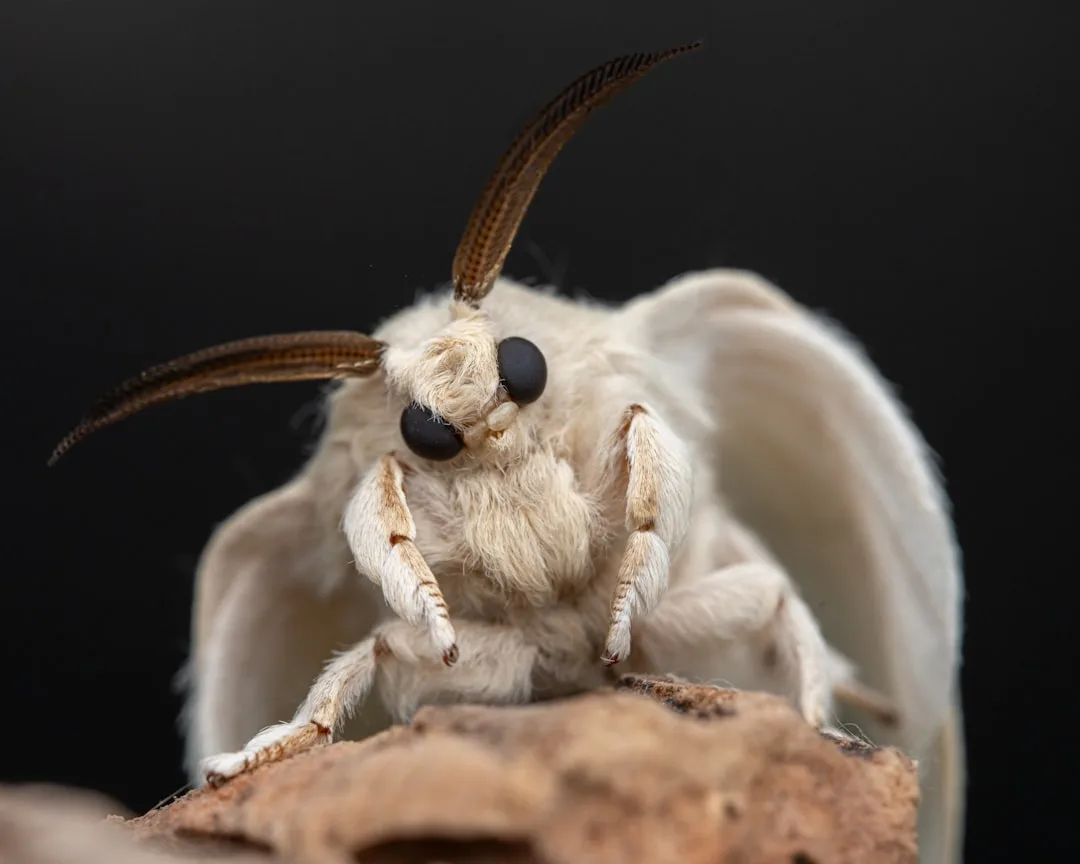
The silkworm moth is, by almost any measure, the strangest moth on Earth. Bombyx mori cannot fly. It cannot see well. It has no functional digestive system as an adult and does not eat or drink during the five to ten days of its winged existence. It lives nowhere in the wild and, if humans stopped farming it tomorrow, would go extinct within a single generation.
And yet this fragile, helpless, flightless white moth has shaped human history more than almost any other insect: for five thousand years its caterpillars have spun the silk that dressed emperors, financed empires, and named the single most famous trade route in world history.
This guide covers every aspect of silkworm moth biology, domestication, sericulture, cuisine, and modern research. It is a reference entry, not a summary - so expect specifics: metres of silk per cocoon, cocoons per kilogram of fabric, days per instar, and the genetics of a species that exists only because humans insist on keeping it alive.
Etymology and Classification
The scientific name Bombyx mori was assigned by Linnaeus in 1758, combining the Greek bombyx (meaning silkworm or silk moth) and the Latin morus (meaning mulberry, the caterpillar's only natural food). It literally translates as "silkworm of the mulberry". In Mandarin Chinese the silkworm is called can and the moth can-e; in Japanese it is kaiko; in Korean, nue.
The English word "silk" itself likely traces back through Greek serikos and Latin sericum to an old word for the Chinese - the people who kept the secret of silk production for more than two thousand years.
Taxonomically the silkworm sits in the family Bombycidae within Lepidoptera, the order that contains every moth and butterfly. Its closest living relative is the wild Chinese silkmoth Bombyx mandarina, from which it was domesticated.
The two species are so genetically similar that they remain fully interfertile, and some taxonomists argue Bombyx mori should be treated as a subspecies of Bombyx mandarina rather than a full species.
Domesticated silkworms went through a severe genetic bottleneck early in their history, and today's global population descends from a narrow founder stock repeatedly selected for silk yield, shell quality, and handling docility.
Size and Physical Description
Compared to the spectacular Atlas moth or Luna moth, Bombyx mori is physically unremarkable: a small, pale, fluffy-bodied moth that most people would not notice on a tree trunk. Everything about the adult is understated because the adult stage has been reduced, by millennia of breeding, to a pure reproductive machine.
Adult moth:
- Wingspan: 40-50 mm
- Body length: roughly 2-2.5 cm
- Wing colour: creamy white to pale ivory, sometimes with faint brown banding
- Antennae: strongly feathered in males, less so in females
- Eyes: small, compound, functionally near-blind
- Flight: none - wings too small and muscles too weak for powered flight
- Mouthparts: vestigial proboscis, non-functional
- Lifespan: 5-10 days
Caterpillar ("silkworm"):
- Newly hatched larva: ~3 mm, dark grey-brown
- Final (fifth) instar: 7-8 cm, pale grey-white, slightly translucent
- Body: 13 segments, smooth, with a small pointed horn on the rear
- Head: pale brown, small chewing mandibles
- Spinneret: single silk-emitting gland on the underside of the head
- Feeding: continuous, almost exclusively on Morus alba leaves
Cocoon:
- Shape: oval, pointed at the ends
- Size: roughly 3-4 cm long, 2 cm across
- Colour: white, yellow, golden, or pink depending on breed
- Weight: 1.5-2.5 g before reeling
The caterpillar is far more striking than the adult. It is thick-bodied, almost translucent, with a small harmless horn on its tail, and it feeds on mulberry leaves with an audible munching that can be heard across a rearing room. The cocoon it spins is small and firm, and it is the cocoon, not the moth, that has shaped human civilisation.
A Species That Cannot Survive in the Wild
There is no wild population of Bombyx mori. Anywhere. This is an unusual claim for an animal species and deserves to be spelled out clearly. Domesticated silkworms released into nature do not establish self-sustaining populations because they have lost almost every trait a moth needs to survive on its own.
What the domesticated silkworm has lost:
- Flight. Wings are too small in proportion to body mass, and flight muscles have atrophied. Adults cannot fly more than a few centimetres of clumsy flapping.
- Vision. Compound eyes still exist but have degenerated. Adults do not navigate visually and cannot locate food, shelter, or mates by sight.
- Camouflage. Selective breeding has produced caterpillars that are near-white and almost hairless. A white caterpillar on a green mulberry leaf is trivial prey for any predator.
- Feeding. Adults have a vestigial proboscis and no digestive system to speak of. Even if food were placed in front of them they could not process it.
- Predator response. Thousands of generations of sheltered rearing have eliminated most escape behaviours. A silkworm caterpillar prodded by a finger continues to chew its leaf.
If sericulture stopped, every living silkworm in the world would die within the current generation, and the species would persist only in frozen gene banks and in its wild ancestor Bombyx mandarina. This makes the silkworm one of the clearest examples of what total dependence on humans looks like in an animal species - a genetic footprint of five millennia of domestication, visible in every flightless moth.
The Life Cycle
Bombyx mori passes through four stages: egg, larva (the "silkworm"), pupa, and adult moth. The entire cycle takes 45 to 55 days under typical sericulture conditions.
Egg stage (10-14 days):
Eggs are laid in clusters on mulberry leaves or paper. Each egg is the size of a poppy seed, about 1 mm across, and changes colour from pale yellow to dark grey as the embryo develops. Fresh eggs can be chilled and stored for months, which allows sericulture operations to time hatching to match mulberry leaf availability.
Larval stage (25-30 days, 4 molts, 5 instars):
This is the stage that matters economically. The larva eats almost continuously, growing from roughly 3 mm to 7-8 cm in under a month - a more than twenty-fold increase in length and a roughly ten-thousand-fold increase in mass. The larva molts four times, shedding its old cuticle to allow growth. Each of the five stages between molts is called an instar.
| Instar | Duration (days) | Approx. length | Feeding intensity |
|---|---|---|---|
| 1st instar | 3-4 | 3-7 mm | Very active |
| 2nd instar | 2-3 | 7-15 mm | Increasing |
| 3rd instar | 3-4 | 15-25 mm | Heavy |
| 4th instar | 4-5 | 25-45 mm | Very heavy |
| 5th instar | 6-8 | 45-80 mm | Maximum; then stop |
Near the end of the fifth instar the larva stops feeding, changes colour slightly (often becoming more yellow or pink), and begins searching for a spinning site. Silkworm keepers provide wooden or paper lattice frames at this point to give each caterpillar a neat compartment in which to spin.
Cocoon and pupal stage (10-14 days):
The caterpillar waves its head in a rhythmic figure-of-eight motion for about three days, secreting liquid fibroin protein through its spinneret and laying down a single continuous filament 300 to 900 metres long. The filament is coated in sticky sericin, which glues the layers together into a firm oval cocoon. Inside the finished cocoon the larva undergoes a final molt into a pupa and metamorphoses into the adult moth.
Adult stage (5-10 days):
If allowed to complete its cycle, the pupa secretes an enzyme that dissolves one end of the cocoon and the adult moth emerges - but in commercial sericulture most cocoons are killed at this point by heat or steam to protect the continuous silk filament. Adults that are kept for breeding emerge, crawl out to dry their wings, mate within hours, lay 300 to 500 eggs, and die five to ten days later without ever eating.
How Silk Is Made
Sericulture - the cultivation of silkworms for silk - is one of the oldest continuously practiced agricultural industries in the world. The basic technique has changed less than most people expect since Han Dynasty China.
Rearing:
Caterpillars are kept on shallow trays in climate-controlled rearing rooms. Mulberry leaves are chopped and delivered several times a day; in the final instar a tray of caterpillars can consume tens of kilograms of leaf in a single night.
Humidity and temperature are carefully managed, and any diseased caterpillars are removed quickly to prevent spread of viral or bacterial infection - pebrine disease (a microsporidian infection) devastated European sericulture in the 19th century and prompted the research that founded modern microbiology.
Cocooning:
When caterpillars are ready to spin, keepers transfer them to slotted frames. Each caterpillar claims a compartment and spins a single cocoon there. After three days of spinning the cocoons are solid and can be harvested.
Stifling:
Commercial cocoons are stifled - that is, the pupa inside is killed - by steam, hot air, or sometimes brief oven heat. Without stifling, the emerging moth would chew through the cocoon and break the continuous silk filament into thousands of short pieces useless for reeling. This step is the single reason silk is ethically complicated: the cocoon is destroyed to preserve the filament.
Reeling:
Stifled cocoons are softened in hot water, which dissolves some of the sericin coating. The outer end of the filament is located and threaded onto a reel. Because a single filament is too fine to weave alone - roughly 10 to 14 micrometres thick - four to eight filaments are typically combined during reeling into a single usable silk thread. The raw thread is then spun, dyed, and woven.
Yield:
| Metric | Value |
|---|---|
| Filament per cocoon | 300-900 m |
| Cocoons per kg of raw silk | 3,000-5,000 |
| Mulberry leaves per kg of silk | ~200 kg (fresh weight) |
| Global raw silk production (yr) | ~200,000 tonnes |
| Leading producers | China, India, Uzbekistan |
China remains the dominant silk producer, supplying roughly three-quarters of world production, with India a distant second and Uzbekistan, Thailand, Vietnam, and Brazil contributing smaller volumes.
The Silk Road and 5,000 Years of Culture
Silk was cultivated in China for at least 2,500 years before the rest of the world knew how to make it. The earliest confirmed silk fragments come from archaeological sites in the Yellow River basin and date to roughly 3000 BCE, though some researchers argue for even earlier origins.
Chinese tradition places the invention around 2640 BCE and credits Empress Leizu (Lei Zu), wife of the legendary Yellow Emperor, with discovering that a cocoon falling into her hot tea could be unspooled into a continuous thread.
For most of its early history the technique of sericulture was a tightly held Chinese state secret. Exporting silkworm eggs or mulberry seeds was a capital offence under several dynasties. Silk itself, however, was traded heavily and became the prestige textile of Eurasia.
The Silk Road:
From roughly the 2nd century BCE to the 15th century CE, a network of trade routes carried silk and other goods between China and the Mediterranean. The historian Ferdinand von Richthofen gave the network the name Seidenstrassen ("Silk Roads") in the 1870s, and the name stuck.
The route was never a single road: it was a changing mesh of overland caravan tracks through Central Asia, maritime routes through Southeast Asia and the Indian Ocean, and branch routes through Persia, the Caucasus, and North Africa. Silk was only one of many goods traded, but it was the highest-value item by weight and gave the network its name.
The secret eventually leaked. Korean sources describe sericulture reaching the peninsula around 200 BCE, and Japanese records place its arrival in the 3rd to 4th century CE. India developed its own silk industries.
According to one widely repeated story, the Byzantine Emperor Justinian I sent two Nestorian monks to China in the 6th century, and they smuggled silkworm eggs back to Constantinople in hollowed bamboo canes. Whether or not the story is literally true, Byzantine sericulture did begin around that time and broke the Chinese monopoly for good.
Silkworms as Food
In sericulture regions, the pupae inside harvested cocoons are a significant by-product, and they have been eaten for centuries as a cheap, high-protein food.
Korean beondegi:
Pronounced roughly "bun-deh-gi", beondegi is boiled or steamed silkworm pupae, seasoned and sold as a street snack, canned food, and bar dish. It has a nutty, slightly earthy flavour and a soft, slightly chewy texture. Beondegi is sold from street stalls, in cans in Korean supermarkets, and even in vending machines in parts of South Korea. It is associated with older generations and with street food culture, but it remains widely available.
Chinese, Thai, and Vietnamese preparations:
In China, silkworm pupae are grilled, stir-fried, or deep-fried and served with salt and spices. In Thailand and Vietnam they appear in markets alongside other edible insects. In Korean sundae (a blood sausage), silkworm pupae sometimes accompany the main dish.
Nutrition:
Silkworm pupae are roughly 50% protein by dry weight, rich in essential amino acids, and contain useful levels of iron, zinc, and B vitamins. They have been studied as a sustainable protein source in the context of insect farming. The European Union has evaluated silkworm pupae and larvae under its novel food framework, and several Asian regulators have formally approved them for commercial human consumption.
The Only Fully Domesticated Insects
The silkworm and the honeybee are the two insects most often cited as fully domesticated by humans. The comparison is worth spelling out, because "domesticated" means more than "tamed" or "captive-bred".
Characteristics of domestication:
- Cannot or does not reliably survive without humans
- Morphology visibly altered by selective breeding
- Complete life cycle managed or influenced by humans
- Genetic bottleneck compared to wild ancestor
- Produces a commodity or service humans value
Bombyx mori checks every box. Silk yield, cocoon shell thickness, egg quantity, colour of silk, disease resistance, and handling docility have all been shaped by thousands of generations of selection. The honeybee (Apis mellifera) is less fully altered but has been managed for honey production for at least 4,500 years and is similarly dependent on human care for large-scale populations.
Other insects - cochineal scale insects, lac insects, certain crickets, black soldier flies - are cultivated commercially but are closer to wild ancestors and would survive without humans. The silkworm stands almost alone as a species that exists exclusively because people keep it alive.
Modern Research and Genetic Engineering
Bombyx mori is one of the most important insect model organisms in biology. Its complete genome was sequenced in 2004 and refined repeatedly since, and it is routinely used in molecular biology, biotechnology, and materials science.
Research uses:
- Model organism for insect physiology, development, and immunity
- Target for CRISPR and transposon-based gene editing
- Platform for producing recombinant proteins at scale
- Source of silk for medical sutures and tissue scaffolds
- Host for spider-silk gene insertion to produce hybrid fibres
Transgenic silkworms have been engineered to produce silk blended with spider dragline-silk proteins, fluorescent silks for textile applications, antimicrobial silks for wound dressings, and silks carrying human collagen or other therapeutic proteins. Large-scale commercial production from transgenic lines is still limited, but silk remains one of the most active areas of biomaterials research.
Silkworm silk is biocompatible, degradable in the body on a tunable timescale, and strong enough that it is used in medical sutures, in scaffolds for regenerating bone, skin, and cartilage, and as a drug-delivery matrix. The same protein that has clothed human bodies for five thousand years is now being used to repair them.
Related Reading
- Atlas Moth: Cobra-Wing Giant of Tropical Asia
- Luna Moth: Pale Green Ghost of the Eastern Forest
- Death's Head Hawkmoth: Skull-Backed Bee Robber
- Moths: The Overlooked Majority of the Lepidoptera World
References
Primary sources consulted for this entry include the genome publications of Xia et al. (Science, 2004) on Bombyx mori, archaeological reports on early Chinese sericulture from the Chinese Academy of Social Sciences, FAO and International Sericultural Commission production statistics, and peer-reviewed research in Insect Biochemistry and Molecular Biology, Journal of Insect Science, and Nature Biotechnology.
Historical material on the Silk Road draws on standard works including Susan Whitfield's Life Along the Silk Road and the UNESCO Silk Roads documentation programme.
Frequently Asked Questions
Why can't silkworm moths survive in the wild?
Bombyx mori has been under human cultivation for roughly 5,000 years, and selective breeding for silk yield and handling ease has stripped away almost every trait a wild moth needs. Adults cannot fly, cannot see well enough to navigate, and cannot feed themselves. The white, almost pigment-free caterpillars are easily spotted by predators and have lost the camouflage of their wild ancestor.
The species is so dependent on humans that if sericulture ended tomorrow the domesticated silkworm would go extinct within a single generation. The wild ancestor Bombyx mandarina still lives in East Asian forests, but domesticated Bombyx mori itself has no self-sustaining wild population anywhere on Earth.
How is silk made from a silkworm cocoon?
A silkworm caterpillar in its fifth instar secretes liquid fibroin through two glands on its lower lip, coated with a sticky protein called sericin. As it waves its head in a figure-of-eight pattern for about three days, it lays down a single continuous filament 300 to 900 metres long, building up the cocoon around itself.
To harvest commercial silk, cocoons are placed in boiling water or steam, which kills the pupa inside before it can chew through the filament and break it. Once softened, the sericin dissolves slightly and the outer end of the fibre is located, after which the cocoon is reeled off in one continuous strand. Several filaments are combined during reeling because a single fibre is too fine to weave on its own.
Producing one kilogram of raw silk takes roughly 3,000 to 5,000 cocoons.
What is the life cycle of Bombyx mori?
The silkworm moth passes through four stages. The egg, about the size of a poppy seed, hatches after 10 to 14 days. The caterpillar, or ‘silkworm’ proper, feeds on white mulberry (Morus alba) leaves for 25 to 30 days, molting four times and passing through five distinct instars. In the final instar it stops eating, finds a sheltered spot, and spins a cocoon of pure silk in about three days.
Inside the cocoon, the larva pupates and metamorphoses over 10 to 14 days. When fully developed the adult moth secretes an enzyme to dissolve the cocoon, emerges, mates within hours, lays 300 to 500 eggs, and dies 5 to 10 days later without ever eating. The full cycle takes roughly 45 to 55 days under optimal conditions.
How did silkworm moth domestication start?
The archaeological record points to southern and eastern China as the origin of sericulture, with the earliest known silk fragments dating to roughly 5,000 years ago. Chinese tradition credits Empress Leizu, wife of the Yellow Emperor, with discovering silk around 2640 BCE when a cocoon supposedly fell from a mulberry tree into her hot tea and the filament unspooled as she lifted it out.
Historically, the secret of how silk was made was guarded under penalty of death for more than two millennia. Silk was a prestige good traded along what came to be called the Silk Road - a network of routes connecting China to Central Asia, the Middle East, and eventually the Mediterranean.
The technique of sericulture slowly leaked out through diplomatic gifts, smuggled eggs, and defecting silk workers, reaching Korea, Japan, India, Persia, and by the 6th century CE the Byzantine Empire.
Are silkworm moths eaten by people?
Yes. After cocoons are reeled for silk, the pupae inside are a by-product of sericulture and have been eaten as food for centuries. In South Korea they are called beondegi and are sold seasoned, boiled, or canned as a cheap street snack with a nutty, earthy flavour. In China, Thailand, and Vietnam silkworm pupae appear grilled, stir-fried, or deep-fried in markets and restaurants.
Korean sundae-style preparations sometimes include silkworm pupae alongside blood sausage. The pupae are high in protein (roughly 50% by dry weight), rich in essential amino acids, and have been studied as a sustainable protein source. In recent years silkworm pupae and larvae have also been evaluated by the EU novel food framework and by several Asian regulators as a commercial edible insect.
What is the difference between Bombyx mori and Bombyx mandarina?
Bombyx mandarina is the wild Chinese silkmoth and the direct ancestor of domesticated Bombyx mori. The two species are so closely related that they remain interfertile and produce viable offspring, and some taxonomists treat Bombyx mori as a subspecies of Bombyx mandarina rather than a full species. The wild form still flies, still has functional camouflage, and still lives independently in East Asian forests.
The domesticated form is larger, paler, flightless, functionally blind, and incapable of surviving on its own. Genetic studies show domesticated silkworms went through a severe population bottleneck during early sericulture - today’s global population descends from a narrow founder stock bred repeatedly for silk quality, making the species a living example of what intense artificial selection looks like over thousands of generations.
Why is silkworm silk so valuable?
Silkworm silk combines strength, elasticity, and fineness in a way no other natural textile fibre matches. A Bombyx mori filament is about 10 to 14 micrometres thick, smoother than wool or cotton, and strong enough that, weight for weight, it rivals some steel alloys under tension. It takes dye brilliantly, drapes well, regulates temperature better than synthetics, and is biocompatible enough to be used in medical sutures and tissue scaffolds.
The length of the single continuous filament - up to 900 metres - makes it possible to weave extraordinarily smooth fabrics without the short-fibre fuzziness of cotton or wool. Modern sericulture produces roughly 200,000 tonnes of raw silk per year, most of it from China and India, and bioengineered silkworms carrying spider silk genes are now being used to produce hybrid super-silks for research and industry.
Has the silkworm moth been genetically engineered?
Yes. Bombyx mori has become one of the most important model organisms in insect biology and a target for genetic engineering. Researchers have inserted genes from spiders to produce silk fibres blended with spider silk proteins - tougher and more extensible than ordinary silkworm silk.
Others have engineered silkworms to produce human collagen, silk-biomaterial hybrids for tissue engineering, fluorescent silks for textiles, and antimicrobial fibres for medical applications. The silkworm is attractive for biotechnology because its silk glands produce protein in enormous volume, it is easy to rear in captivity, its full genome has been sequenced, and gene-editing tools (including CRISPR) work well on its embryos.
Large-scale commercial silk from transgenic lines is still limited, but research output is substantial.