
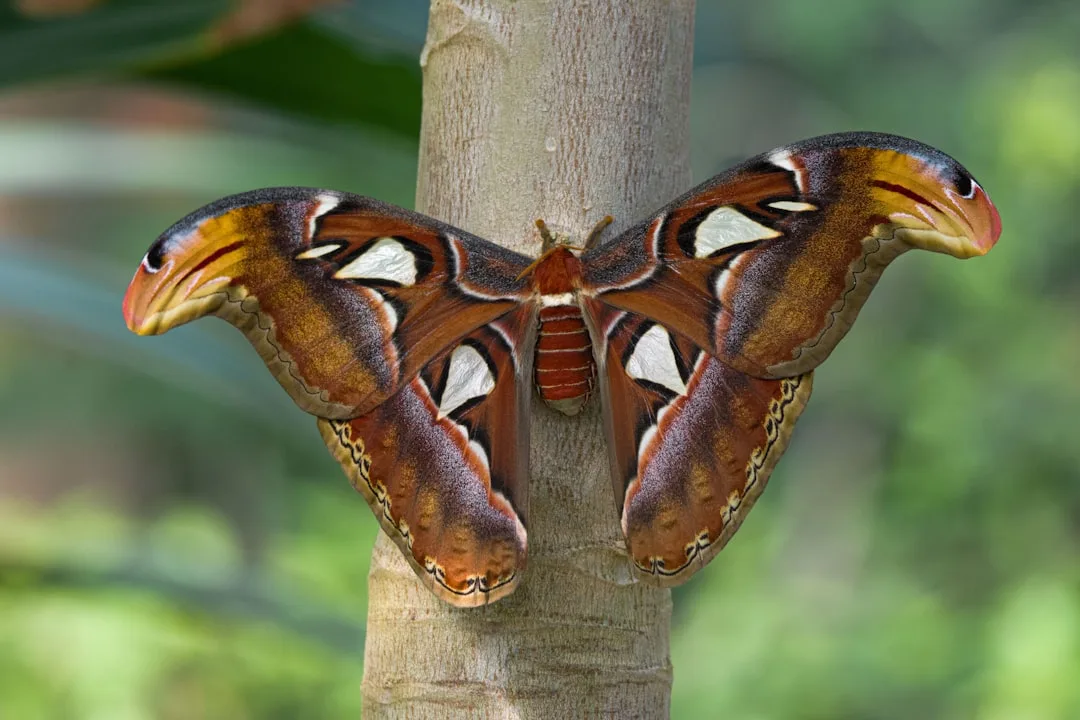
The Atlas moth is one of the largest moths on Earth, a palm-sized insect of the Asian tropics whose forewing tips carry a startling, three-dimensional impression of a cobra's head. Its biology is a series of quiet contradictions. The adult cannot eat. The caterpillar looks like a fat lime-green shrimp dusted in wax. The cocoon is harvested for a rough, durable silk most people have never heard of.
The wings span 25 to 30 centimetres yet the entire adult life lasts no longer than two weeks. Everything about Attacus atlas is either outsized or fleeting, and often both.
This guide covers every aspect of Atlas moth biology and ecology: wing size and record measurements, cobra-head mimicry, the mouthless adult stage, pheromone communication at the kilometre scale, caterpillar growth, fagara silk, habitat, and human use. It is a reference entry rather than a quick summary, so expect specifics: centimetres, grams, antenna receptor counts, and stage durations.
Etymology and Classification
The name Attacus atlas was formally described by Carl Linnaeus in the tenth edition of Systema Naturae in 1758, making it one of the earliest moth species to receive a scientific name. The genus name Attacus derives from a Greek word referring to a type of locust or large winged insect, while the species epithet atlas honours the Titan of Greek mythology who held up the sky - a reference to the moth's sheer size.
In Cantonese-speaking parts of southern China the species is called the 'snake's head moth' (She Tou E), a direct reference to the wingtip pattern. In parts of India it is informally called the 'leaf moth' because resting specimens flatten against bark and resemble dead foliage.
Atlas moths belong to Saturniidae, the giant silk moth family. The family contains roughly 2,300 described species worldwide and includes other giants such as the Hercules moth (Coscinocera hercules), the Luna moth (Actias luna), and the Cecropia moth (Hyalophora cecropia). Within Attacus there are around twenty recognised species, all from tropical Asia, and A. atlas is the most widespread and best known.
Genetically and morphologically the Atlas moth is a classic Saturniid: large body, feathered antennae, wings heavily scaled with brown, red, and yellow pigments, and transparent triangular 'windows' on each wing that scatter light. The species is not closely related to the unrelated White Witch moth (Thysania agrippina), despite the two often being compared as rivals for the title of 'largest moth'.
Size and Physical Description
Atlas moths are built like fabric kites with furred bodies. Size differences between males and females are moderate but visible: females are larger and heavier with broader wings, while males are slightly smaller with more deeply feathered antennae that give them a hairier, more architectural appearance.
Adult female:
- Wingspan: 25-30 cm
- Wing surface area: up to roughly 400 cm^2
- Body length: 4-5 cm
- Abdomen: thick, pale, egg-laden at emergence
- Antennae: feathered but narrower than male
Adult male:
- Wingspan: 24-28 cm
- Body length: 3-4 cm
- Antennae: wide, comb-like, densely feathered with roughly 70,000 chemoreceptors
Caterpillar (mature fifth instar):
- Length: up to 11 cm
- Girth: roughly the thickness of an adult human finger
- Colour: lime green with pale dorsal tubercles coated in a white waxy powder
- Mass: up to about 25 grams immediately before pupation
Cocoon:
- Length: 7-10 cm
- Colour: light brown to tan
- Texture: tough, papery, layered
- Contains: a single developing pupa
The Atlas moth's wings are the species' defining feature. The forewings are broader and carry the cobra-head pattern at their tips - a curved outline that mimics a snake's hood, a false eye-spot in the centre of the 'head', and scale-like markings radiating outward. The hindwings are rounder and less ornamented but still patterned in browns, reds, pinks, and creams.
Both pairs of wings carry four translucent triangular windows where scales are absent, a common feature of Saturniidae used to scatter light and possibly disrupt predator search images.
The body is densely covered in fur-like scales that trap heat, which is useful given that many Saturniidae are active at cool tropical night temperatures. Legs are small and relatively weak - adult Atlas moths do not walk well and rely almost entirely on flight.
Wings, Size Records, and the 'Largest Moth' Debate
The title of 'largest moth in the world' has been handed around between several species for decades, and the answer genuinely depends on which metric is used.
| Metric | Atlas moth (Attacus atlas) | White Witch (Thysania agrippina) | Hercules moth (Coscinocera hercules) |
|---|---|---|---|
| Typical wingspan | 25-30 cm | 25-28 cm | 24-27 cm |
| Record wingspan | 31 cm | ~30 cm | ~27 cm |
| Wing surface area | Up to ~400 cm^2 | Narrower wings, smaller area | Comparable to Atlas, sometimes larger |
| Body mass | Large | Moderate | Large |
By span alone, the Atlas and the White Witch are effectively tied, with specific individuals of either species occasionally claiming the record. By wing surface area, which many lepidopterists consider the more meaningful measure of 'size', the Atlas moth is generally the winner, with the Hercules moth as a close competitor. The Atlas moth therefore has the strongest claim to being the largest moth in the world, but with caveats.
The record 31 cm wingspan is documented from captive-bred specimens and from some wild females from Java and Borneo. In the field, most adults measured fall in the 24 to 27 cm range. Captive rearing under ideal humidity and food plant conditions tends to push specimens toward the upper end of the size distribution.
The Cobra-Head Wing and Aposematic Mimicry
The most striking feature of the Atlas moth is the pattern at the tips of the forewings. Seen in the correct orientation - wings held open, moth at rest - each wingtip resembles the head of a snake. The curved outer margin of the wing traces the shape of a cobra's hood, and a high-contrast eye spot sits where the snake's eye would be. The surrounding scales carry dark-and-light reticulation that looks like snake scales.
This is a textbook example of Batesian mimicry - a harmless species advertising itself as a dangerous one to frighten off predators. Several points make it especially convincing:
- The scale pattern gives a three-dimensional impression of a rounded snake head, not just a flat drawing.
- When disturbed, the moth slowly moves its wings in a way that makes the 'snakes' appear to rear up and strike.
- The pattern is symmetric, so a predator sees two snake heads at once, as if the moth were flanked by two cobras.
- The overall colour palette matches the brown and cream of common tropical Asian snake species.
Birds, lizards, and small mammals in the Atlas moth's range tend to avoid snake-like images even without prior bad experience, thanks to innate predator recognition. Field experiments with models painted with and without snake markings suggest the markings genuinely reduce predation in at least some contexts.
No Mouth - The Mouthless Adult Strategy
One of the strangest facts about the Atlas moth is that adults cannot eat. The proboscis, the coiled tube that most moths and butterflies use to drink nectar, is vestigial in Attacus atlas. It is present in a reduced form but non-functional: the moth cannot extend it, cannot drink, and has no functional gut for digesting food.
This is not a failure of biology. It is a strategy. The Atlas moth belongs to a large group of Saturniidae that have traded adult feeding for reproductive efficiency. The caterpillar eats continuously for six to eight weeks, storing massive fat reserves in its body. When the adult emerges from the cocoon, every remaining life process - flight, mate-finding, mating, egg-laying - runs on those stored fats. Once the reserves are spent, the moth dies.
Consequences of the mouthless strategy include:
- Short adult life. Most adults live 7 to 14 days.
- No feeding behaviour. Adults do not visit flowers, fruit, or sap.
- Flight is expensive. Every flight burns fat that cannot be replaced, so adults fly only when necessary (mate-searching, laying eggs, avoiding threats).
- No water intake. Dehydration, not starvation, often determines how many days the moth lasts.
- Compressed reproductive window. Females must be fertilised and lay eggs within days, or die having contributed nothing genetically.
This arrangement also means the adult Atlas moth has no ecological role as a pollinator or herbivore. Its only role, once it emerges, is to turn itself into eggs.
Life Cycle and Reproduction
Atlas moth reproduction is keyed to the availability of suitable host plants and to seasonal humidity. In much of the range there are multiple generations per year; in cooler foothills there may be only one.
Stage timing (approximate):
| Stage | Duration | Notes |
|---|---|---|
| Egg | ~10 days | Laid in clusters of 200-300 on underside of leaves |
| Larva | 6-8 weeks | Five instars, continuous feeding |
| Cocoon/pupa | 4-6 weeks | Silk cocoon attached to a twig |
| Adult | 7-14 days | No feeding, reproductive sprint |
The adult phase is the shortest and the most structured. A newly emerged female climbs to a high perch, often before her wings have fully hardened, and begins releasing pheromones from glands at the tip of her abdomen. She releases them in pulses during the early hours of the night. Males, flying with their enormous feathered antennae spread, intercept the pheromone plume downwind and track it to the source.
Each male antenna carries roughly 70,000 chemoreceptors, of which a large fraction are tuned specifically to the female pheromone molecule. Detection distances of two kilometres or more are credibly reported in related Saturniidae and are plausible in Atlas moths under still conditions.
Mating lasts several hours. Afterward the female flies short distances between suitable host plants and deposits eggs in clusters on the undersides of leaves. She typically lays 200 to 300 eggs total. Within a day or two of finishing egg-laying, both sexes die.
Eggs hatch in about ten days. The first-instar caterpillar is pale, small, and sometimes has pinkish marks. Over five instars it transforms into the fat, lime-green, wax-coated caterpillar that defines the species. Feeding is continuous: an Atlas caterpillar can strip a small host plant in a single night. Host plants include citrus, cinnamon, guava, willow, Chinese privet, cocoa, and a wide range of other broadleaf tropical trees.
The cocoon is spun at the end of the fifth instar. It is attached by strong silk threads to a twig, often dangling like a small brown pear. Inside, the larva pupates and reorganises into the adult moth over four to six weeks. Emergence happens at night, usually in the early hours, when humidity is high and predators less active.
Caterpillar and Host Plants
The Atlas moth caterpillar is worth describing in its own right. It reaches 11 centimetres in length and the thickness of an adult finger. The body is lime green, with a series of soft fleshy tubercles running along the back. Each tubercle is tipped with white, waxy, hair-like filaments, and over the entire body lies a light dusting of white powder that gives the caterpillar a frosted or sugar-coated appearance. Seen close up it looks like a bright green shrimp rolled in powdered sugar.
The caterpillar does not sting. Its main defences are camouflage, startling colour contrast against bark, and its sheer size - many predators simply cannot handle an 11-centimetre prey item. When threatened it can release a rancid-smelling defensive fluid from glands behind the head.
Host plants vary across the species range and are unusually broad for a Saturniid. Documented hosts include:
- Citrus (Citrus spp.)
- Cinnamon (Cinnamomum spp.)
- Guava (Psidium guajava)
- Willow (Salix spp.)
- Chinese privet (Ligustrum spp.)
- Cocoa (Theobroma cacao) in some regions
- Mango (Mangifera indica)
- Tea (Camellia sinensis) occasionally
Because the caterpillars are generalists, they adapt well to cultivated landscapes. This is why gardeners in parts of India, Thailand, and Indonesia sometimes find enormous green caterpillars on their citrus and cinnamon bushes.
Fagara Silk - The Atlas Moth Industry
Atlas moth cocoons produce a silk known as fagara silk. Unlike the fine, continuous filament produced by the domesticated mulberry silkworm (Bombyx mori), fagara silk is spun in broken strands, is light brown rather than white, and cannot be reeled off a cocoon in a single unbroken thread. The resulting yarn is coarser, slightly wooly, and more durable than mulberry silk.
Fagara silk has a small but genuine industry in parts of India (particularly Assam) and Taiwan, where Atlas moth cocoons are collected from the wild or from semi-cultivated rearing operations. Uses include:
- Yarn and fabric. Spun into rough but durable textiles, often blended with other silks or cotton.
- Purses and pouches. Empty cocoons are sold intact as small natural purses in rural markets.
- Decorative items. Cocoons are dyed, ornamented, and sold to tourists.
- Research and education. Cocoons are commonly used in university entomology programmes.
Fagara silk is a fraction of a fraction of the global silk market, dwarfed by mulberry silk, tussar silk, and eri silk. But it is a living tradition, and in some villages it still provides supplementary income.
Habitat and Range
Atlas moths are distributed across tropical and subtropical Asia. Their core range spans:
- South Asia: northern India, Nepal, Bhutan, Bangladesh, Sri Lanka (patchy)
- East Asia: southern China, Taiwan, Hong Kong
- Southeast Asia: Myanmar, Thailand, Laos, Vietnam, Cambodia, the Malay Peninsula, Borneo, Sumatra, Java, the Philippines
They inhabit dry tropical forests, secondary growth forest, disturbed edges, and gardens. They tolerate human-modified landscapes well, particularly orchards and plantations where host plants are abundant. Elevation range stretches from sea level up to about 1,500 metres, with optimum densities in humid lowland forests.
Atlas moths do not migrate. Individual moths spend their short adult lives close to where they emerged, limited by the energy cost of flight without feeding.
Predators, Threats, and Conservation
Despite their snake-mimicking wings, Atlas moths have many predators. Caterpillars are eaten by birds, lizards, wasps, and parasitoid flies and wasps that lay eggs directly into the larva. Cocoons are attacked by rodents and beetles. Adults are caught by bats (which ignore the snake pattern because they hunt by echolocation, not sight), nightjars, and owls.
Artificial lights in towns and cities draw Atlas moths in from surrounding forest and lead to high mortality at lit windows, walls, and insect traps.
The species is not currently listed as threatened on the IUCN Red List. It has not been formally evaluated at the global level, but national assessments in India, Malaysia, and Indonesia indicate that populations remain common. Key threats to long-term persistence include:
- Habitat loss. Clearing of tropical forest for oil palm, rubber, and agriculture reduces host plant availability.
- Pesticides. Broad-spectrum insecticides used in orchards kill caterpillars directly.
- Artificial light pollution. Attracts and kills adult moths disproportionately.
- Overcollection. Wild collection for the pet and decorative trade is locally significant but not globally threatening.
- Climate shifts. Changes in humidity and seasonal rainfall patterns affect larval survival.
Responsible captive rearing, sometimes combined with habitat protection, supports the species in parts of its range and supplies the legal trade in cocoons and specimens.
Atlas Moths and Humans
Atlas moths have a mixed but mostly positive relationship with humans. They are not pests in any significant way - caterpillars occasionally defoliate ornamental shrubs but rarely reach economically damaging numbers. They produce fagara silk, a small-scale commercial product. They are displayed in butterfly houses and live insect exhibits worldwide, where their size makes them star attractions despite their short adult lives.
In Asian cultural contexts the Atlas moth is widely admired. Its size, dramatic wing pattern, and ephemeral adult life have inspired folk stories, artwork, and textile designs. The Cantonese name 'snake's head moth' has passed into general use in southern China.
Hobbyist rearing of Atlas moths is legal in most countries with appropriate permits, though the import of live specimens is regulated in the United States, the European Union, and Australia to prevent unintended release of non-native Lepidoptera. Because the adult stage is so short and non-feeding, most of the rearing effort concentrates on caterpillars, which require fresh leaves daily and a warm, humid environment.
Related Reading
- Moths of the World: Night Fliers, Silk Makers, and Pollinators
- Silk Moths and the Insects That Clothe Us
- Why Moths Fly Toward Lights
- Luna Moth: The Pale Ghost of the Eastern Forests
References
Relevant peer-reviewed and reference sources consulted for this entry include the Natural History Museum (London) Lepidoptera collections, the Smithsonian Institution entomology records, published research in Journal of the Lepidopterists' Society, Tropical Lepidoptera Research, and Insect Science, and regional texts on Southeast Asian Saturniidae.
Specific size, antenna receptor, and life-stage figures reflect consolidated published values; the 31 cm wingspan record is documented from verified captive-bred specimens.
Frequently Asked Questions
How big is an Atlas moth?
Adult Atlas moths (Attacus atlas) typically have a wingspan of 25 to 30 centimetres, with verified records reaching 31 centimetres. By wing surface area - roughly 400 square centimetres in large females - the species is considered one of the largest moths in the world. Females are larger and heavier than males, but males have broader, more deeply feathered antennae.
The caterpillar reaches about 11 centimetres in length and the thickness of an adult human finger before pupation. The cocoon is roughly the size of a small pear.
Is the Atlas moth the biggest moth in the world?
It depends on how you measure. The Atlas moth holds the record for greatest total wing surface area among living moths, which is the most common basis for calling it the largest. The White Witch moth (Thysania agrippina) from Central and South America has a longer wingspan - up to 30 centimetres tip to tip - but much narrower wings and less overall area.
The Hercules moth (Coscinocera hercules) of Australia and New Guinea rivals Attacus atlas in area and sometimes exceeds it. All three are routinely cited as ‘the largest moth’, and which one wins depends on whether the metric is wingspan, wing area, or body mass.
Why do Atlas moths not eat?
Adult Atlas moths have no functional mouthparts. The proboscis, the coiled feeding tube typical of most moths and butterflies, is vestigial and non-functional in Attacus atlas. This is a common evolutionary pattern in the Saturniidae family. The adult stage exists solely for reproduction, and the species has redirected all adult resources into flying, finding mates, and laying eggs.
Energy for the entire one to two week adult life comes from fat reserves built up by the voracious caterpillar, which eats continuously for six to eight weeks. Once those reserves are spent, the moth dies.
What does the snake pattern on the wings do?
The wingtips of the Atlas moth carry a pattern that strongly resembles the head of a cobra or similar snake - complete with a curved hood outline, a realistic eye spot, and scale-like markings. When a resting moth is disturbed it slowly flaps its wings, and the movement makes the ‘snake heads’ appear to rear up and strike. Birds, lizards, and small mammals that have any instinct to avoid snakes tend to retreat.
This is classic Batesian mimicry: a harmless species advertising a dangerous one it doesn’t actually resemble chemically. It is one of the most developed examples of snake mimicry in any insect.
How do Atlas moths find mates?
Reproduction in Attacus atlas runs on chemistry. A newly emerged female climbs to a perch and releases species-specific pheromones from glands at the tip of her abdomen. Males, whose enormous feathered antennae carry roughly 70,000 sensory receptors, fly upwind through the pheromone plume.
Detection ranges of two kilometres or more have been documented in related Saturniidae, and there is credible evidence that Atlas males can track females at similar distances under still air. Once a male arrives, mating can last several hours. A female lays 200 to 300 eggs on the underside of a host plant leaf, then dies within days.
Where do Atlas moths live?
Atlas moths inhabit the dry tropical forests, secondary growth, and cultivated gardens of South and Southeast Asia. Their range stretches from northern India, Nepal, and southern China down through Thailand, Vietnam, the Malay Peninsula, Borneo, Sumatra, Java, and the Philippines. They prefer humid lowlands but also occur in foothills up to about 1,500 metres elevation.
The species tolerates degraded and human-modified habitat well, largely because the caterpillars feed on a wide range of plants including citrus, cinnamon, guava, cocoa, and willow, many of which grow in orchards and village gardens.
Can you keep Atlas moths as pets?
Atlas moths are legally kept as hobbyist rearings in many countries, with restrictions. The species is not listed on CITES and is not considered threatened globally, but importing live caterpillars, cocoons, or adults is regulated in the United States, the European Union, Australia, and several other regions to prevent the introduction of non-native Lepidoptera. Hobbyists feed larvae on privet, willow, or plum leaves and keep cocoons in humid enclosures.
Because the adult only lives one to two weeks and cannot eat, the ‘pet’ stage is extremely short, and most of the keeping effort focuses on the caterpillar.
What is fagara silk?
Fagara silk is a coarse, tough, light brown silk spun by the caterpillars of Attacus atlas when they construct their cocoons. Unlike the continuous filament of a mulberry silkworm (Bombyx mori), fagara silk is broken and less uniform, so it cannot be reeled off a cocoon intact. Instead it is combed or wild-reeled and spun into yarn. The resulting fabric is durable, slightly wooly, and valued in parts of India (especially Assam) and Taiwan.
Empty cocoons are also sold as small natural purses in local markets. Fagara silk is not traded in anywhere near the volume of Bombyx silk, but it represents a small, traditional wild-silk industry.