
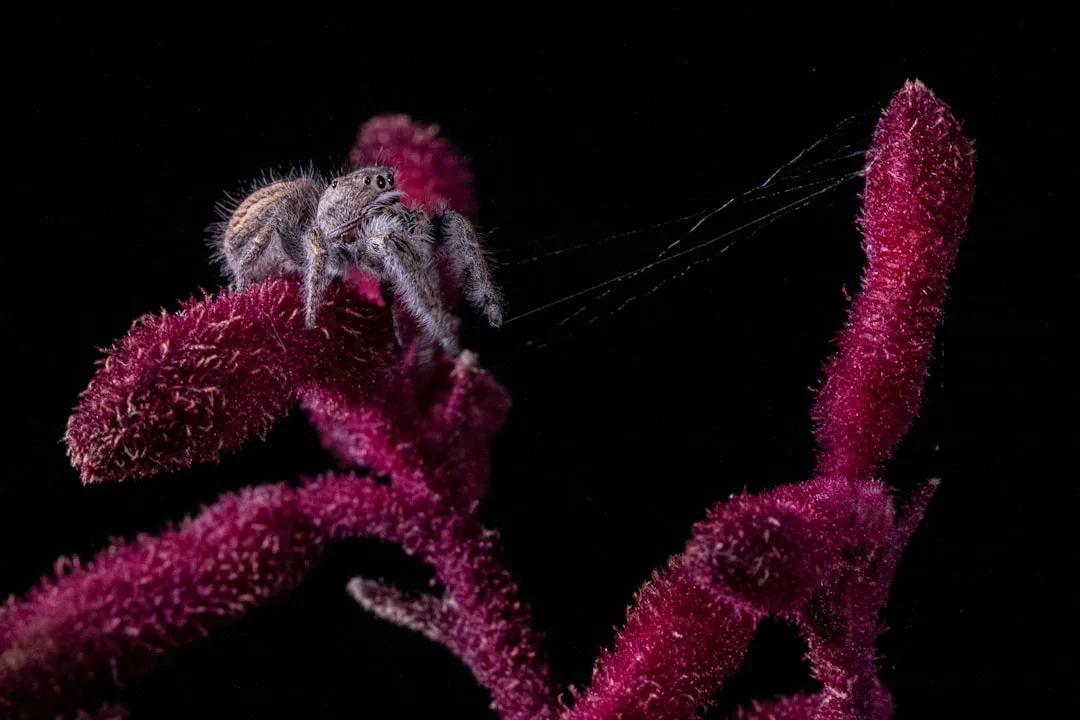
The jumping spider is the most visually sophisticated, and almost certainly the most cognitively flexible, spider on Earth. Members of the family Salticidae do not spin capture webs, do not ambush from burrows, and do not rely on vibration alone to find prey. They watch. They look. They plan.
A foraging jumping spider can sit on a leaf, rotate its body to study a distant target, adjust the retina inside each principal eye without moving its head, decide that a direct approach will fail, climb down the far side of the plant, cross to a second plant, ascend it, and drop onto the target from above - long after the prey has left its original line of sight.
Inside the family, the genus Portia has become the reference animal for studies of invertebrate cognition. Portia fimbriata, the fringed jumping spider of Queensland, Southeast Asia, and parts of Africa, hunts other spiders by sneaking onto their own webs and playing the silk like an instrument.
This guide covers jumping spiders as a group with Portia fimbriata as the focus species: the taxonomy, the astonishing eyes, the mechanics of leaping, the hunting behaviour, the courtship dances, the life cycle, conservation status, and the peculiar facts that make Salticidae the largest and strangest spider family.
Note: jumping spiders are arachnids rather than insects, but this hub lives under the site's insects/spiders section for navigation reasons. Taxonomically they sit in class Arachnida, order Araneae, family Salticidae.
Classification and Diversity
The family Salticidae was formally described by Blackwall in 1841, though jumping spiders had been noted for their unusual behaviour since the earliest European naturalists looked closely at temperate spiders. Modern catalogues recognise roughly 6,400 described species in more than 650 genera, and the number continues to climb every year.
That makes Salticidae the largest family of spiders by a comfortable margin - larger than Lycosidae, larger than Linyphiidae, larger than any web-building group.
Simplified taxonomy of Portia fimbriata:
- Kingdom: Animalia
- Phylum: Arthropoda
- Class: Arachnida
- Order: Araneae (spiders)
- Suborder: Araneomorphae
- Family: Salticidae (jumping spiders)
- Genus: Portia
- Species: P. fimbriata
The genus Portia is comparatively small, with about twenty recognised species distributed across Africa, Asia, and Australasia. Portia fimbriata is the most intensively studied member of the genus and, by extension, the best-studied spider in the world when it comes to cognition. Research groups in Australia, New Zealand, Kenya, and Sri Lanka have spent decades documenting how this single species solves problems that researchers would once have said required a vertebrate brain.
Size and Physical Description
Jumping spiders are small. The family ranges from about 2 millimetres in the tiniest adult species up to roughly 25 millimetres in the largest, with the majority of species falling between 3 and 12 millimetres in body length. Portia fimbriata adults measure 5 to 10 millimetres, with females slightly larger and bulkier than males. Leg span in Portia is usually 15 to 25 millimetres, and in the largest family members can exceed 50 millimetres.
The body is compact and high-walled rather than flat. The cephalothorax is tall and box-like, an architectural choice driven almost entirely by the need to house the long tubular principal eyes described later in this guide. The abdomen is rounded and carried close behind the cephalothorax. Legs are short and stout relative to many other spider families, giving jumping spiders their characteristic stop-and-start walking style and explosive launch capacity.
Colour patterning varies enormously across the family. Many temperate species are cryptic - mottled greys and browns that disappear against bark or leaf litter. Tropical species, especially males in display, can be metallic green, iridescent blue, crimson, or gold.
Portia fimbriata is a specialist mimic of detritus: its body is fringed with irregular tufts of hair and broken outlines that break up its silhouette and make it look like a piece of drifting organic debris. Against a backdrop of leaves or cluttered webs it effectively disappears.
Key body features:
- Box-shaped cephalothorax housing four pairs of eyes across two rows
- Four pairs of legs, the front pair often visually prominent and used in display
- Two pedipalps on the front of the body, highly developed in males and often colour-signalling
- Spinnerets at the tip of the abdomen producing silk for draglines, retreats, and egg sacs
- Two book lungs in the underside of the abdomen, as in most spiders
Vision: The Key to the Family
Everything interesting about a jumping spider, behaviourally, traces back to how it sees. Most spiders rely on vibration, chemical cues, and blurry panoramic vision. Jumping spiders invert the priority. They use sharp, central, forward-facing vision to identify, approach, and attack prey the way a small cat does.
A salticid carries eight eyes arranged in four pairs across two rows. The first row faces forward on the anterior face of the cephalothorax. The second row sits further back on top of the head.
The four pairs:
- Anterior median eyes (AME) - the large, round, forward-facing principal eyes. These are the image-forming, high-resolution eyes. Humans who stop to watch a jumping spider are usually staring straight at these.
- Anterior lateral eyes (ALE) - flanking the principal eyes, these provide a wider field of view, good motion detection, and crude colour information.
- Posterior lateral eyes (PLE) - sitting further back and wider, these extend the peripheral field almost to the sides of the head.
- Posterior median eyes (PME) - a small pair on top of the head. In many genera these are reduced and serve mainly as light-level detectors.
The anterior median eyes are where the extraordinary resolution comes from. Each AME has a fixed corneal lens at the front and a long narrow tube behind it. The retina sits at the back of this tube, and it is layered into four distinct tiers of photoreceptors.
Different wavelengths of light focus at slightly different depths, so the four-layer arrangement provides something close to true chromatic analysis within a single small eye. Image-forming spatial resolution in the AME approaches ten minutes of arc - comparable to a pigeon, and sharper than many small mammals at equivalent body size.
Because the lens is fixed, the spider cannot rotate the eye inside the socket the way a vertebrate does. Instead, the retina itself is mounted on internal muscles. When a jumping spider studies a novel object the retina moves behind the fixed lens, scanning the field piece by piece. Researchers using retinal imaging techniques have watched Portia shift the retina up, down, and rotate it in a deliberate inspection pattern when presented with unfamiliar prey.
The ultraviolet channel is equally important. Many jumping spider species reflect strongly in UV on specific body parts, especially the pedipalps of males and patches on the abdomen. These UV patterns are invisible to human observers but are critical recognition signals during courtship and territorial interactions.
Hunting and Diet
Jumping spiders are visual predators. The typical hunting sequence is a four-stage pattern that has been documented across the family with minor variations.
The general salticid hunt:
- Detect. A moving or contrasting object enters the wide visual field. The peripheral eyes trigger a turn toward the target.
- Inspect. The spider orients so the anterior median eyes point at the target, then inspects it. The retinas scan inside the eye, and the spider frequently sidesteps to view the target from a second angle. If the target does not register as prey, the sequence aborts.
- Stalk. The spider approaches in short, interrupted bursts, lowering its body and tucking its legs close. Final approach is usually silent and deliberately slow.
- Pounce. From a crouched stance, a hydraulic extension of the third and fourth pairs of legs launches the spider into a short high-arc leap. A silk dragline anchors the launch. The spider lands, bites, and holds on while venom takes effect.
Prey for most salticids is other arthropods - flies, moths, ants, small beetles, and other spiders. Venom is tuned to disable insect prey quickly. Most jumping spiders feed well above their own body weight each day in order to support a fast metabolism and active hunting.
Portia diverges from the standard pattern. It is a specialist predator of web-building spiders, which is an astonishingly dangerous lifestyle. Entering another spider's web is an excellent way to be eaten by the resident. Portia has evolved a suite of behaviours to solve this problem, summarised later in this guide under The Portia Hunt.
A third unusual pathway in the family leads to vegetarianism. Bagheera kiplingi, a Central American salticid, harvests protein-rich Beltian bodies from acacia trees and derives most of its diet from plant tissue. It is the only spider in the world known to eat a largely vegetarian diet, and its existence was confirmed through direct observation and stable isotope analysis published in 2008.
The Portia Hunt
The specific hunting behaviour of Portia fimbriata deserves its own treatment because it has been central to cognitive research on invertebrates for thirty years. Three features stand out.
1. Aggressive mimicry on webs. Portia climbs onto the web of a resident spider and produces vibrations on the silk. These are not random. The spider plucks, taps, strokes, and shakes specific lines in patterns that resemble a struggling insect, a falling leaf, or a courting male of the resident species. Different host species respond to different stimuli, so Portia must either know the correct signal in advance or work it out on the spot.
2. Trial-and-error learning. Laboratory studies, most notably by Robert Jackson and Fiona Cross in New Zealand and Kenya, have shown that on unfamiliar web species Portia runs through an active trial sequence. It tries one vibration style, waits, observes the host's response, and if the host does not move toward the signal, tries another.
Over minutes to hours the spider converges on a vibration pattern that reliably draws the host into striking range. Individual Portia remember which signals worked on which species and use that information on subsequent encounters.
3. Planned detours. Perhaps the most surprising finding: when a direct approach is too risky, Portia will leave the area, circle around through complex vegetation, and return to the prey from a different angle. In controlled experiments the researchers placed the spider on a starting platform with two paths visible, only one of which led to the prey.
The prey was then removed from view so that during the detour the spider could not see its goal. Portia consistently chose the correct path even when the wrong path appeared shorter or more direct. Internal route planning of this kind was previously considered the domain of vertebrates with much larger brains.
These behaviours together make Portia the most cognitively studied spider on Earth. The surface conclusion is that a millimetre-scale arthropod brain can support surprisingly deep behavioural flexibility when the selective pressure - in this case, safely eating other spiders - is strong enough.
Jumping Mechanics and Silk
A jumping spider is not a muscle-powered jumper. Muscle alone does not produce the accelerations observed in a typical salticid leap. Jumping spiders jump hydraulically.
How the launch works:
- Blood (haemolymph) is pumped into the rear pairs of legs by the cephalothorax.
- Internal pressure rises rapidly.
- The joints of the third and fourth pairs of legs, which lack extensor muscles, are forced open by the pressure.
- The sudden extension catapults the spider into the air.
- A silk dragline, anchored at the launch point, trails behind.
Typical leap performance:
| Metric | Typical value |
|---|---|
| Jump distance (body lengths) | 10-20 (most species); up to ~30 in Portia |
| Absolute jump distance | Up to roughly 20 cm in a 6 mm spider |
| Peak acceleration at launch | On the order of 50-400 m/s^2 depending on species |
| Launch duration | Approximately 10-20 milliseconds |
The silk dragline is as important as the launch itself. Every leap is anchored. If the spider misses, it hangs in the air on the dragline and climbs back up to try again. On unstable perches, the dragline also provides a tether while the spider shuffles around to inspect a potential target. Silk is used for several other purposes: silken retreats for moulting, overwintering, and egg-laying; small tubular nests inside rolled leaves; and sometimes short guy-lines that stabilise a hunting platform.
No jumping spider builds a capture web. That is probably the single most useful identification rule in the family.
Courtship and Display
Male jumping spiders face a problem that web-building male spiders do not. The female is a fast, sighted, lethal visual predator. A silent approach is likely to end with the approaching male as lunch. Evolution has responded with some of the most visually dramatic courtship sequences in the invertebrate world.
A male detects a female at a distance, turns to face her, and enters a display routine that is highly species-specific. The display combines three channels.
Three channels of male display:
- Visible colour. Iridescent scales on the pedipalps, legs, and abdomen flash bright colour as the male raises and waves these body parts in species-typical patterns.
- Ultraviolet reflectance. Many species carry UV-reflecting scales on parts of the body that are dull in visible light. The female's eyes read these signals clearly.
- Substrate vibration. The male drums specific patterns on the leaf, bark, or soil he is standing on. The vibrations travel through the substrate to the female's legs, where specialised slit-sensilla pick up the rhythm.
Best-studied displays include the peacock spiders of Australia (genus Maratus), the Habronattus jumping spiders of North America, and several Asian genera. Female response is graded: a receptive female signals with a specific set of leg postures; an unreceptive or hostile female may lunge. An experienced male reads the signal and either approaches carefully for mating or retreats before being taken.
Portia fimbriata follows the general salticid pattern but is less showy than peacock spiders. Its courtship relies on fringe-waving displays and leg postures rather than the extreme colour of Maratus.
Life Cycle and Reproduction
Jumping spiders have a simple life cycle by spider standards and complete a single generation in about one year in most climates. Tropical species may telescope this schedule and produce more than one generation per year; cold-climate species may stretch it across two.
Typical annual cycle in temperate species:
- Spring: spiderlings emerge from overwintered egg sacs or juvenile retreats.
- Summer: juveniles hunt and moult through a series of instars.
- Late summer to autumn: adults mature, courtship and mating occur.
- Autumn to winter: females build silken retreats, lay eggs, and often overwinter with the egg sac.
- Next spring: hatchlings emerge and the cycle restarts.
Clutch size varies with species and female body size. Small species may lay fewer than 20 eggs per clutch; larger species routinely lay 100 to 200 or more. The female builds a silken chamber, deposits the eggs, and frequently guards the sac until the spiderlings disperse. In Portia the female constructs a retreat inside a web or crevice and attends the eggs through to hatching.
Spiderlings are miniature versions of the adult, equipped from hatching with the same visual system and hunting instincts. They begin hunting tiny insects almost immediately. Moulting continues through several instars - five to nine depending on species - before maturity.
Habitat and Range
Salticidae occupies every continent except Antarctica and a remarkable range of altitudes and climates. Jumping spiders have been recorded near the summit of Mount Everest at roughly 6,700 metres - Euophrys omnisuperstes, sometimes called the Himalayan jumping spider, survives there on tiny wind-borne insects and makes the family among the highest-living predators known.
Typical habitats across the family:
- Tropical and temperate forests, on foliage and bark
- Grasslands and savannahs, on stems and flowers
- Deserts, on rocks and under stones
- Wetlands and riverbanks, on emergent vegetation
- Alpine and rocky ground, including high-altitude scree
- Gardens, orchards, and around human buildings
- Indoors, especially near windows where small insects gather
Portia fimbriata itself is a forest specialist found in northern Queensland rainforest and in analogous rainforest and scrub habitats through parts of Southeast Asia and East Africa. It hunts on and around the webs of orb-weavers, social spiders, and other web-builders, which means its distribution tracks the availability of suitable host species.
Conservation
Salticidae as a family is not assessed by the IUCN. Spiders at large are heavily under-represented on global red lists because most species have not been evaluated, and jumping spiders are no exception. A small number of individual salticid species are listed at national or regional levels where specific habitats are threatened - cave-dwelling species, for example, and some narrowly endemic island species - but family-wide population trends are unknown.
The broad pressures on jumping spiders are the same as those facing many invertebrate groups.
Principal pressures on Salticidae:
- Habitat loss. Deforestation, wetland drainage, and agricultural conversion reduce microhabitats where specific salticid species live.
- Pesticides. Broad-spectrum insecticides kill both prey and spiders, and persistent residues can reduce salticid populations in treated farmland and gardens.
- Climate change. Shifts in temperature and humidity regime change the range of prey species and the habitat suitability of many salticids, with high-altitude and narrow-endemic species most exposed.
- Invasive species. Introduced predators - some ants, some lizards - can locally reduce salticid numbers, and invasive host-plant changes can displace cryptic species.
At family scale jumping spiders remain abundant, diverse, and still poorly described, with new species named every year. Portia fimbriata itself has no current conservation concern but is dependent on continued rainforest habitat in its range.
Humans and Jumping Spiders
Jumping spiders are among the most human-friendly spider families. They are shy but not defensive, turn their principal eyes to watch people rather than flee immediately, and respond to slow hand movements by orienting rather than retreating. Their fangs are generally too small to penetrate human skin, and on the rare occasions a bite does occur the symptoms are a pinprick and mild local redness resolving in hours. No confirmed human fatalities are known from salticid bites.
A growing hobby keeper community raises the larger and more colourful species - Phidippus regius, the regal jumping spider, is the classic choice - in small enclosures. Jumping spiders in captivity tolerate gentle handling better than most other spider families, feed on a simple diet of flies and crickets, and live about a year, matching their wild life cycle.
Scientifically, jumping spiders are increasingly central to work on miniaturised vision and cognition. Studies published in journals including Current Biology, Journal of Experimental Biology, and Animal Behaviour have used Portia and other salticids to test how far complex behaviour can be pushed in small nervous systems.
The practical outcomes feed into fields as far from arachnology as robotics, where engineers study salticid jump mechanics and visual scanning strategies for small autonomous machines.
Related Reading
- Spiders: The Master Weavers of the Animal Kingdom
- Wolf Spider
- Tarantula
- Goliath Birdeater: The Largest Spider on Earth
- Most Dangerous Spiders in the World
References
Sources consulted for this entry include the World Spider Catalog family-level species counts for Salticidae, peer-reviewed publications by Robert R. Jackson and Fiona R.
Cross on Portia cognition and hunting behaviour, the work of Ximena Nelson on salticid vision and decision-making, research on salticid retinal scanning and four-layer photoreceptor organisation published in Current Biology and Vision Research, and Meehan et al. (2009) on the vegetarian diet of Bagheera kiplingi published in Current Biology.
Altitude records for Euophrys omnisuperstes follow expedition-era surveys reported by R. W. G. Hingston on the 1924 British Everest expedition.
Frequently Asked Questions
How intelligent is the jumping spider?
Jumping spiders, particularly the genus Portia, show cognitive abilities that are extraordinary for an animal with a brain smaller than a poppy seed. Portia fimbriata plans multi-step hunting routes, observes prey from a distance before committing, takes detours that remove it from direct line of sight for long periods, and still arrives at the correct attack point.
In laboratory mazes Portia will repeatedly refuse easy but wrong routes in favour of longer paths that actually lead to prey. Individuals show trial-and-error learning on unfamiliar webs, varying their vibratory signals until one works. This level of flexible problem-solving was previously associated with vertebrates and has forced researchers to rethink the cognitive limits of miniaturised nervous systems.
How good is jumping spider vision?
Jumping spiders have the sharpest vision of any spider and among the sharpest of any arthropod. They carry eight eyes in four pairs. The large forward-facing anterior median eyes are the primary image-formers and contain a layered, four-tier retina behind a fixed lens. Internal muscles move the retina itself, so the spider scans its environment without moving its head.
Resolution in the principal eyes rivals that of a pigeon and exceeds that of many small mammals relative to eye size. The remaining three pairs handle wide-field motion detection and depth cues. Together the visual system supplies the precise spatial information needed to judge pounce distance, identify prey species, and read courtship signals.
Do jumping spiders build webs?
Jumping spiders do not build capture webs. They are cursorial visual hunters that take prey with a short, high-acceleration leap from a crouched stalk. They still produce silk for several important purposes: every jump is anchored by a dragline that acts as a safety thread, females build silken retreats for moulting and egg-laying, and many species construct small silk nests inside rolled leaves or cracks where they rest overnight.
Portia is an unusual case because although it does not spin its own capture web, it routinely invades the webs of other spiders and manipulates them from within, using vibration on the silk rather than traditional prey capture.
How far can jumping spiders jump?
A typical jumping spider clears ten to twenty times its own body length in a single leap, with some Portia leaps reaching roughly thirty body lengths. For a six-millimetre spider that translates to a jump of up to about twenty centimetres - a distance disproportionate to the animal’s size. The launch is not powered by muscle alone.
Jumping spiders jump by rapidly elevating blood pressure inside the legs, which extends the joints hydraulically with explosive force. A silk dragline is always anchored at the launch point, so an unsuccessful jump ends in a controlled dangle rather than a fall, and the spider can climb back up the silk and try again.
Why do male jumping spiders dance?
Male jumping spiders dance to attract mates and, equally important, to avoid being treated as prey. Females are visual predators with fast attack reflexes, so a male that approaches silently risks death. Instead, courting males stop at a distance visible to the female, raise their front legs and pedipalps, and begin a species-specific sequence of waves, taps, and body movements.
Many species combine visible colour, ultraviolet reflectance on the palps and abdomen, and substrate vibrations transmitted through the leaf or bark the spider is standing on. The display serves as both identification - proving the male is the correct species - and quality signal, advertising the health and coordination of the dancer.
How does Portia hunt other spiders?
Portia is a specialist predator of web-building spiders. It climbs onto or beside the target web and begins producing deliberate vibrations on the silk - plucking, tapping, and stroking lines in patterns that mimic struggling prey, falling debris, or even sexual signals of the resident species.
Different web residents respond to different stimuli, so Portia varies its signal, and on unfamiliar species it does so through active trial and error until one combination draws the host within striking range. If direct vibratory attack is too risky, Portia plans a detour, sometimes leaving the web entirely and returning via a completely different route that keeps the prey out of line of sight for minutes at a time.
On arrival Portia pounces, bites, and retreats with the venom doing the work.
How long do jumping spiders live?
Most jumping spiders live about one year from hatching to adult death. Spiderlings emerge in spring or summer, pass through a series of moults over the warm months, mature in late summer or autumn, and mate before the onset of winter or a dry season. Females typically overwinter in silken retreats inside cracks, curled leaves, or under bark, and many species lay eggs in the retreat before dying.
In captivity under stable warm conditions and reliable food, individuals have lived two years and occasionally longer, but a one-year generation is the norm across the family. Portia fimbriata follows the same rough schedule, with tropical populations able to reproduce across more of the year than temperate ones.
Are jumping spiders dangerous to humans?
Jumping spiders are effectively harmless to humans. Their venom is tuned to disable insects and other small arthropods, and the fangs of most species are too small to penetrate human skin at all. On the rare occasions a bite occurs - almost always when the spider is trapped against skin under clothing - the result is a pinprick sensation and mild local redness that resolves within hours.
No confirmed deaths from jumping spider bites exist in the medical literature. The family is shy, strongly visual, and generally responds to human presence by turning to watch, sometimes walking closer to inspect, and leaping away if pressed. They are among the safest spider families to encounter, and arachnologists frequently describe them as curious rather than defensive.