
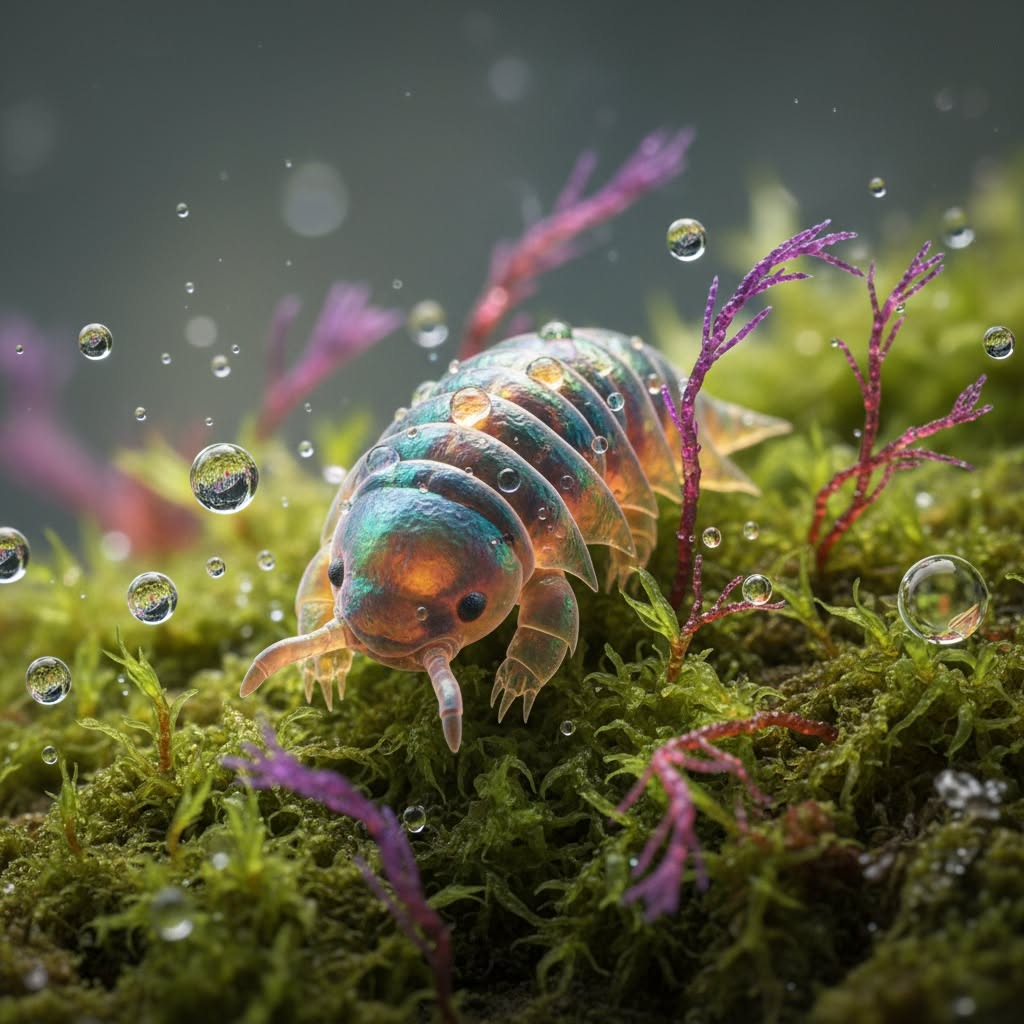
What are tardigrades?
Tardigrades are microscopic animals also known as water bears or moss piglets, measuring just 0. 05-1. 2 mm in length. Despite their tiny size, they are complex animals with eight legs, a fully-formed digestive system, muscles, and a primitive brain.
The Animal That Won't Die
Expose a tardigrade to the vacuum of space. It survives.
Freeze it to -272 degrees Celsius, one degree above absolute zero. It survives.
Heat it to 150 degrees Celsius. It survives.
Dose it with radiation levels that would kill a human thousands of times over. It survives.
Dehydrate it until it is barely more than a dry husk. It survives - and decades later, rehydrate it and it walks away as if nothing happened.
The tardigrade is the toughest multicellular animal ever discovered. Understanding how something so small (most species are under a millimeter long) can survive conditions that kill every other animal reveals biochemistry so extreme it has potential applications for human medicine, space exploration, and the question of whether life from Earth could travel to other planets.
What They Are
Tardigrades, also called water bears or moss piglets, are microscopic animals in the phylum Tardigrada. They occupy their own branch of the animal kingdom, separate from insects, worms, or any other familiar groups.
Basic biology:
- Length: 0.05-1.2 mm (most species under 0.5 mm)
- Legs: 8 (four pairs)
- Lifespan: 3-4 months when active
- Diet: plant cells, algae, bacteria, small invertebrates (depending on species)
- Habitats: mountains, deep sea, polar regions, rainforests, your garden
Despite their tiny size, tardigrades are full animals with muscles, a digestive system, a nervous system including a primitive brain, and reproductive organs. They are not simple.
Species diversity:
Over 1,300 species of tardigrades have been described. They live in water films on moss, lichens, and other surfaces. Virtually any moist environment on Earth contains tardigrades.
You almost certainly have tardigrades living in moss in your yard, your neighborhood, or somewhere within walking distance. They are everywhere.
Cryptobiosis: The Secret of Survival
Tardigrade indestructibility depends on a biological state called cryptobiosis - a suspension of life processes that goes far beyond simple dormancy.
The tun state:
When environmental conditions become hostile (dehydration, freezing, extreme heat, radiation), tardigrades enter a state called "tun" - from the German word for barrel, describing the shape they take.
The transformation:
- The tardigrade curls into a tight ball
- It expels nearly all water from its body (retaining 1-3 percent)
- Metabolism drops to 0.01 percent of normal or less
- Cells shrink and essentially shut down
In this state, the tardigrade is not quite alive and not quite dead. It is paused.
Biochemical protection:
Several molecular mechanisms protect cellular structures during cryptobiosis:
Trehalose sugar. Replaces water molecules in cells, maintaining protein structure and preventing cellular collapse.
TDPs (tardigrade disordered proteins). Form a glass-like matrix inside cells that physically supports delicate structures.
Dsup (damage suppressor). Binds to DNA and physically shields it from radiation damage.
Antioxidants. Neutralize free radicals that form during stress.
Heat shock proteins. Maintain protein folding even in extreme temperatures.
Duration:
Tardigrades can remain in the tun state for extended periods:
- Confirmed revival after 30 years of desiccation
- Plausible revival claims from 100+ year old museum specimens
- Theoretical limits may extend centuries or longer
During this time, the tardigrade essentially does not age. Time stops for it.
What They Survive
Laboratory experiments have tested tardigrade survival in increasingly extreme conditions.
Temperature extremes:
- Upper limit: 150 degrees Celsius for minutes
- Lower limit: -272 degrees Celsius (one degree above absolute zero)
The lower limit is colder than interstellar space. The upper limit exceeds the boiling point of water and would cook any normal animal instantly.
Pressure extremes:
- High pressure: 600 megapascals (6,000 atmospheres, six times the Mariana Trench bottom)
- Low pressure: complete vacuum (zero atmospheres)
Both extremes normally destroy biological tissue. Tardigrades survive both.
Radiation:
- Gamma radiation: 1,000+ times the lethal human dose
- UV radiation: hundreds of times normal tolerance
- Ionizing radiation: damaging doses survived through Dsup protein DNA protection
A radiation dose of about 5 Grays kills half of humans. Tardigrades survive 5,000-6,000 Grays.
Chemical extremes:
- pH extremes (both acidic and alkaline)
- High salinity (saltier than ocean water)
- Many toxic substances
- Dehydration to under 3 percent water content
Space:
In 2007, the European Space Agency's FOTON-M3 mission exposed tardigrades to the space environment directly - vacuum, cosmic radiation, solar UV, and temperature extremes simultaneously. Most tardigrades survived 10 days of full exposure.
This was the first and so far only known animal to survive direct exposure to outer space.
The Biology of Invincibility
Research into tardigrade survival biology has uncovered mechanisms that may have medical and technological applications.
Dsup and radiation protection:
The Dsup protein binds to DNA and physically shields it from radiation-induced damage. When Dsup genes are inserted into human cell cultures, those cells become significantly more radiation-resistant.
Potential applications:
- Protecting cancer patients undergoing radiation therapy
- Shielding astronauts during long-duration space missions
- Preserving biological samples during sterilization processes
- Engineering radiation-resistant crops
Trehalose and preservation:
Trehalose sugar stabilizes proteins and cellular structures in dehydrated states. Research applications include:
- Preserving vaccines without refrigeration
- Storing blood and tissue samples indefinitely
- Improving organ transplantation viability
- Preserving foods without refrigeration
TDPs and glass formation:
Tardigrade disordered proteins form a protective glass matrix in dehydrated cells. This vitrification may inspire new preservation technologies:
- Better freeze-drying of medicines
- Long-term biological sample storage
- Dry preservation of cells for transport
The Panspermia Question
Tardigrade survival abilities connect to one of biology's deepest questions: could life travel between planets?
Panspermia hypothesis:
The idea that microorganisms could travel between planets on meteorites, seeding new worlds with life. For this to work, organisms would need to survive:
- The initial impact that ejects them from their home planet
- Years to millions of years in space
- High radiation exposure
- Vacuum and temperature extremes
- The re-entry heat of landing on a new planet
Tardigrades are not specifically adapted to survive all these conditions sequentially, but they demonstrate that complex multicellular life can survive many of them.
Evidence and limitations:
Tardigrade space survival experiments were brief (10 days) compared to the years that natural interplanetary transfer would require. Continuous cosmic radiation over long periods would likely sterilize any surviving tardigrades.
However, the existence of an animal that can survive 10 days of direct space exposure suggests that simpler organisms (bacteria, spores) might survive much longer under protective conditions inside a rock.
The Beresheet controversy:
In 2019, an Israeli lunar lander called Beresheet crashed on the Moon. The lander carried a sample of dehydrated tardigrades as part of a "lunar library" payload. The crash may have scattered viable tardigrades on the lunar surface.
Whether these tardigrades could survive long-term on the Moon is debated. The Moon's radiation environment is harsh, temperatures extreme, and there is no water to trigger revival. Most likely they remain desiccated and inactive rather than alive in any meaningful sense.
Hunting and Feeding
When not in cryptobiosis, tardigrades are active predators and grazers.
Feeding mechanism:
Tardigrades have a specialized feeding apparatus with two sharp stylets (piercing structures) that can pierce plant cell walls or prey exteriors. They inject digestive enzymes, then suck out the liquefied contents.
Diet:
Different tardigrade species eat different things:
- Herbivores: plant cell contents, algae
- Bacterivores: bacterial cells
- Predators: nematodes, rotifers, smaller tardigrades
Predatory tardigrades:
Some tardigrade species hunt other tardigrades. These predatory species are larger than herbivorous species and actively chase down prey.
Population dynamics:
Tardigrade populations can reach high densities in favorable habitats. A single square meter of moss-covered ground can contain millions of tardigrades. When drought occurs, most enter cryptobiosis and wait for rain.
Why Tardigrades May Be the Last Survivors
A 2017 study by Oxford researchers analyzed what cosmic events could sterilize Earth of all life. Their conclusion: tardigrades would likely survive nearly any astronomical catastrophe short of events that sterilize Earth entirely.
Events tardigrades would survive:
- Gamma-ray bursts from nearby stars
- Supernova explosions in the solar neighborhood
- Asteroid and comet impacts (including extinction-level events)
- Climate changes from these events
- Most conceivable human-caused disasters
Events that would eliminate them:
- The Sun becoming a red giant and engulfing Earth (~5 billion years from now)
- Loss of Earth's oceans through solar heating
- Complete planetary destruction
The implication:
Tardigrades may outlast essentially every other animal on Earth. When the last dinosaurs died out 66 million years ago, tardigrades persisted. When future mass extinctions come, tardigrades will probably persist again. They may, quite literally, be among the last animals alive when Earth itself becomes uninhabitable.
This is not because they are particularly sophisticated or powerful - a tardigrade cannot outcompete anything in active life. It is because they can pause. They can wait out any disaster. They can ride out conditions that kill everything else by simply not being active during those conditions.
The tardigrade's lesson is that sometimes the most durable strategy is not being tougher than the competition but being better at doing nothing when nothing is the only thing that survives.
The Extreme Tolerance Numbers
Published tolerance data for tardigrades reveal how far outside the normal vertebrate biological envelope these tiny animals can operate. The Kalenux Team compiled the current consensus values from peer-reviewed literature.
| Stressor | Active Tardigrade Limit | Tun State Limit | Comparison |
|---|---|---|---|
| Temperature (high) | ~37 C | 150 C for minutes | Humans die at 43 C |
| Temperature (low) | ~0 C | -272 C (near absolute zero) | Humans die below 35 C core |
| Pressure | ~1 atm | 600 MPa (6,000 atm) | Twice the ocean's deepest pressure |
| Vacuum | Fatal | Survives space vacuum | Most animals die in seconds |
| Ionizing radiation | ~5 Gy | 5,000+ Gy | Humans die at 5 Gy |
| UV radiation | ~100 J/m^2 | 7,000 J/m^2 | Direct sunlight levels |
| Dehydration | Fatal within hours | Decades with <1% water content | Most animals die at 20% water loss |
| Time without food | Weeks | Decades in cryptobiosis | No comparable vertebrate capability |
"The tardigrade tun state is the most robust biological entity we know of. It is not truly alive in any metabolic sense, but it preserves enough cellular integrity that the animal can resume life when conditions improve. The biochemistry that makes this possible is only partly understood, but it involves specific proteins that form protective glassy matrices around cellular machinery." - Thomas Boothby, University of Wyoming, Nature, 2021 [1]
Boothby's team identified the specific proteins - TDPs (tardigrade-specific intrinsically disordered proteins) - that provide most of the cryptobiotic protection. Genes encoding these proteins have been transferred to other organisms, including yeast and human cells, and have partially conferred tardigrade-like dehydration tolerance. The applications range from vaccine stabilization (eliminating the need for refrigeration) to biological sample preservation.
The Tardigrade Tree of Life
Tardigrades (phylum Tardigrada) contain roughly 1,300 described species in three distinct classes. The major subgroups differ significantly in body structure, habitat, and tolerance.
| Class | Representative Genera | Habitat | Distinctive Feature |
|---|---|---|---|
| Eutardigrada | Hypsibius, Ramazzottius, Milnesium | Terrestrial moss, soil | Most species in this group |
| Heterotardigrada | Echiniscus, Batillipes | Marine, terrestrial | Armored body plates |
| Mesotardigrada | Thermozodium | Hot springs (Japan) | Only two known species |
"Tardigrades survived five mass extinction events across more than 500 million years of Earth history. The phylum has changed relatively little across that time, and the same basic body plan seen in modern species is preserved in Cambrian fossils from the Burgess Shale. These are evolutionarily deeply conservative animals, and their durability strategy has proven remarkably effective." - Martin Stein, University of Copenhagen, Evolution and Development, 2020 [2]
Molecular phylogenies place tardigrades as close relatives of arthropods and onychophorans within the superphylum Ecdysozoa. They are not related to microorganisms or simple multicellular animals, despite their small size. They are complex animals with true organ systems, just scaled down to microscopic dimensions.
Fossil Record and Evolutionary History
Tardigrade fossils are rare but diagnostic. The oldest known tardigrade-like fossils come from Middle Cambrian deposits in Siberia, approximately 520 million years old. These specimens show the characteristic eight-legged body plan preserved in astonishing detail given their age and size. Later fossils from Cretaceous and Tertiary amber have preserved tardigrades essentially identical to modern species.
This deep evolutionary stability is remarkable. Most animal phyla have undergone dramatic body-plan revisions over the Phanerozoic. Tardigrades found a body plan that works, combined it with cryptobiotic capability, and have not needed to change much since the Cambrian. Their survival through every major extinction event in Earth's history is therefore not coincidental - it is the direct consequence of a body plan that is, in effect, extinction-resistant.
Horizontal Gene Transfer Controversy
A 2015 paper in Proceedings of the National Academy of Sciences by Thomas Boothby and colleagues claimed that the tardigrade genome contained an unusually high proportion of genes acquired from other species through horizontal gene transfer - up to 17 percent of the genome. This would have been a dramatic finding, implying that tardigrades had patched together their extraordinary tolerance capabilities by borrowing genes from bacteria, fungi, and archaea over evolutionary time.
The finding was quickly disputed. A rebuttal by Mark Blaxter and colleagues at the University of Edinburgh showed that much of the apparent horizontal transfer was actually contamination of the tardigrade DNA samples with genetic material from the animals' food. When the contaminating sequences were removed, horizontal gene transfer dropped to levels typical of other animals - perhaps one or two percent of the genome, not 17 percent.
"Initial horizontal transfer claims turned out to be contamination artifacts. Tardigrade tolerance is built primarily with conventional animal genes - genes that encode proteins like the TDPs and trehalose synthesis enzymes. Nothing about tardigrade tolerance requires dramatic evolutionary borrowing. They did it the old-fashioned way, by natural selection on their own genome." - Mark Blaxter, Tree of Life Programme, Wellcome Sanger Institute, PNAS, 2015 [6]
This correction is significant because it removes what would have been the most exotic explanation for tardigrade capabilities. The animals are extreme, but their extremes arose through ordinary evolutionary mechanisms acting over 500 million years. Every element of their biology can in principle be traced through conventional phylogenetic methods, and every strategy they use for surviving impossible conditions has a discoverable evolutionary origin within the tardigrade lineage itself.
References
- Boothby, T. C., and Pielak, G. J. (2017). "Intrinsically disordered proteins and desiccation tolerance: elucidating functional and mechanistic underpinnings of anhydrobiosis." BioEssays, 39(11), 1700119.
- Guidetti, R., and Bertolani, R. (2018). "Paleontology of tardigrades." Zoologischer Anzeiger, 273, 217-226.
- Jonsson, K. I., Rabbow, E., Schill, R. O., Harms-Ringdahl, M., and Rettberg, P. (2008). "Tardigrades survive exposure to space in low Earth orbit." Current Biology, 18(17), R729-R731.
- Hashimoto, T., et al. (2016). "Extremotolerant tardigrade genome and improved radiotolerance of human cultured cells by tardigrade-unique protein." Nature Communications, 7, 12808.
- Sloan, D., Alves Batista, R., and Loeb, A. (2017). "The resilience of life to astrophysical events." Scientific Reports, 7, 5419.
- Koutsovoulos, G., Kumar, S., Laetsch, D. R., Stevens, L., Daub, J., Conlon, C., Maroon, H., et al. (2016). "No evidence for extensive horizontal gene transfer in the genome of the tardigrade Hypsibius dujardini." Proceedings of the National Academy of Sciences, 113(18), 5053-5058.
Related Articles
- Extremophiles: The Strangest Life Forms on Earth
- What Animals Can Survive in Space?
- The Immortal Jellyfish: How Turritopsis Dohrnii Cheats Death
Discover more insect survival strategies in our insect adaptation guide.
Frequently Asked Questions
What are tardigrades?
Tardigrades are microscopic animals also known as water bears or moss piglets, measuring just 0.05-1.2 mm in length. Despite their tiny size, they are complex animals with eight legs, a fully-formed digestive system, muscles, and a primitive brain. Over 1,300 species have been identified, living in nearly every environment on Earth including mountain tops, deep sea trenches, polar ice, tropical rainforests, and even the surface of your garden moss.
They were first discovered in 1773 by German pastor Johann Goeze, who named them ‘water bears’ because of their slow lumbering movement and bear-like appearance under microscopes. Tardigrades feed on plant cells, algae, bacteria, and small invertebrates depending on the species.
Their most remarkable feature is their ability to survive conditions that would kill virtually any other animal - including the vacuum of space, extreme temperatures, high radiation, and complete dehydration.
Can tardigrades survive in space?
Yes, tardigrades can survive in the vacuum of space. In 2007, the European Space Agency’s FOTON-M3 mission exposed dehydrated tardigrades to the open space environment for 10 days. When returned to Earth and rehydrated, the majority of tardigrades revived and many successfully reproduced.
They survived direct solar UV radiation, cosmic radiation, temperature extremes, and total vacuum simultaneously - conditions that kill every other known animal within minutes. Subsequent experiments have confirmed tardigrade space survival in multiple missions. The secret is cryptobiosis - tardigrades can enter a desiccated tun state where they curl into a ball, expel nearly all water, and reduce metabolism to essentially zero.
In this state, ice cannot form inside their cells (no water to freeze), radiation damages are minimized, and they can remain viable for decades. Once water becomes available again, they rehydrate and return to normal activity within minutes.
What is the hottest temperature tardigrades can survive?
Tardigrades can survive temperatures up to approximately 150 degrees Celsius (302 F) for short periods, and can tolerate -272 degrees Celsius (-457 F) - colder than interstellar space and approaching absolute zero. They also withstand high pressures up to 600 megapascals (6,000 atmospheres), which is six times the pressure at the bottom of the Mariana Trench.
Their survival mechanisms include specialized proteins called TDPs (tardigrade-specific disordered proteins) that form a glass-like matrix protecting cellular structures during extreme conditions. They produce trehalose sugar that replaces water molecules in cells, maintaining protein structure during dehydration. They also have Dsup (damage suppressor) proteins that bind to DNA and shield it from radiation damage.
Human cell cultures engineered with tardigrade Dsup proteins show significantly increased radiation resistance - an active area of research with potential medical applications for cancer patients undergoing radiation therapy.
How long can tardigrades live in dehydration?
Tardigrades can remain in their cryptobiotic desiccated state for over 30 years and possibly much longer. In 1995, researchers revived moss specimens from a 120-year-old museum collection and successfully rehydrated tardigrades inside them - though the tardigrades only survived briefly after revival, suggesting 120 years may exceed practical limits.
A 2016 study successfully revived tardigrades frozen for 30 years in Antarctic moss, and these individuals went on to reproduce normally. In optimal dry conditions, tardigrades in cryptobiosis are essentially paused - their metabolism drops to 0.01 percent of normal or lower, meaning time passes nearly identically to being dead. Aging effectively stops. This is why tardigrades have been called ‘immortal’ though technically they do eventually die.
Active tardigrades have normal lifespans of 3-4 months, but cryptobiotic tardigrades can add decades to their lifespan by spending most time paused. This strategy allows them to wait out bad conditions indefinitely.
Are tardigrades indestructible?
Tardigrades are extraordinarily tough but not truly indestructible. They have vulnerabilities that scientists exploit to kill them. High temperatures above approximately 150 degrees Celsius prolonged beyond minutes eventually kill them. Mechanical crushing destroys their bodies like any other organism. Deep UV exposure over days can damage DNA beyond repair even in cryptobiotic state. Toxic chemicals like cyanide interact with their biology and kill them.
They cannot survive long-term active exposure to any extreme condition - their resistance comes primarily from cryptobiosis pause, not from remaining functional in extreme conditions. A 2017 study showed that tardigrades would likely survive all predicted astronomical disasters including gamma-ray bursts, nearby supernovae, and asteroid impacts.
The only cosmic events capable of sterilizing Earth of tardigrades would be the sun becoming a red giant (roughly 5 billion years from now) or the entire ocean boiling off - events so extreme that no other multicellular life would survive either. In this sense, tardigrades may be the last animals on Earth.