
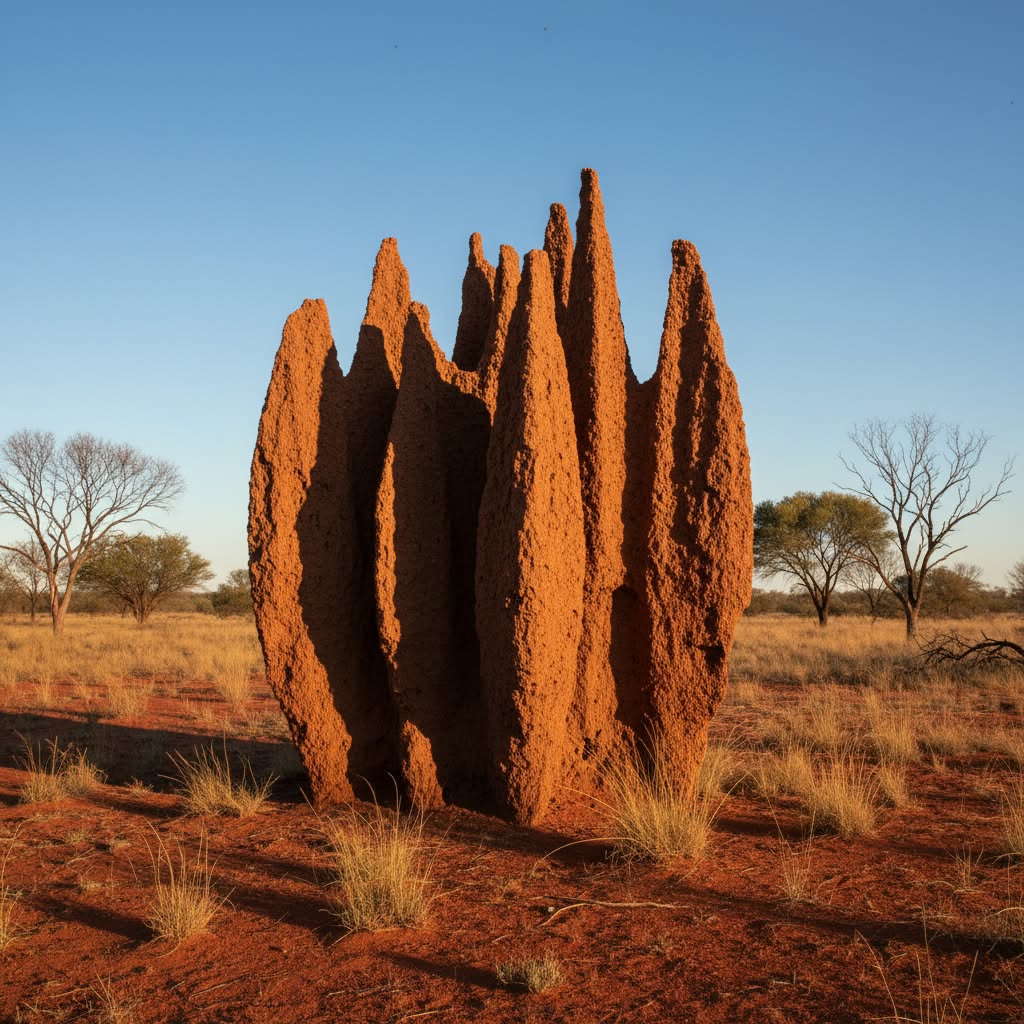
The magnetic termite is a small insect that builds one of the most extraordinary structures in the animal world. Across the flat, seasonally flooded grasslands of northern Australia, colonies of Amitermes meridionalis construct thin, wedge-shaped mounds that rise two to four metres into the air - and every one of those wedges points the same way. Their long, flat sides face east and west.
Their narrow ridges run north and south. Walk into a field of them in Litchfield National Park and you are looking at thousands of living compasses, each built by millions of blind, millimetre-scale insects following the same architectural rule.
The orientation is not random, and it is not magnetic in the geological sense. It is thermoregulation. The mounds are solar panels in reverse - geometry tuned over evolutionary time to catch weak morning and afternoon sun on broad faces and to present only a narrow edge to the brutal midday tropical sun.
That solution works so well that the same alignment has evolved in a second species thousands of kilometres away, and it has attracted formal study from some of the most respected sociobiologists of the past century.
This guide covers every practical aspect of magnetic termite biology and ecology: classification, habitat, mound architecture, the physics of their solar alignment, colony structure, diet, reproduction, range, conservation, and their relationship with human observers. It is a reference entry, not a highlights reel - so expect specifics: metres, degrees of arc, colony counts, queen lifespans, and the names of the researchers whose experiments nailed down how this behaviour actually works.
Etymology and Classification
The scientific name Amitermes meridionalis was formally described in the nineteenth century from specimens collected in northern Australia. Amitermes is the genus; meridionalis comes from the Latin meridies, meaning 'midday' or 'south', referring to the mounds' north-south orientation. In English the species is called either the magnetic termite or the compass termite.
Both common names reflect the same observation - the mounds line up - but neither name is biologically accurate. The insects are not strongly magnetic in the way that word is used for iron or lodestone. Compass is closer to the truth: the mounds point consistently, and early settlers really did use them as rough direction markers in the bush.
The species belongs to Termitidae, the so-called higher termites - the same large family that contains the African mound-builders Macrotermes and many of the world's best-known termite pests. Amitermes itself is a very large genus containing more than ninety described species worldwide, most of them small, cryptic, and unremarkable in appearance. What sets A. meridionalis apart is its engineering.
A family tree revision in 2007 moved termites out of their old order Isoptera and formally placed them inside Blattodea, the cockroaches. Termites are now best described as a deeply specialised, eusocial lineage of wood-eating cockroaches. That reclassification matters because it means termite eusociality - castes, a reproductive queen, sterile workers - evolved completely separately from the superficially similar social life of ants and bees. The resemblance is classic convergent evolution.
Within Amitermes, the magnetic termite's closest ecological analogue is Amitermes laurensis, a separate species endemic to the Cape York Peninsula in far north Queensland. A. laurensis also builds wedge-shaped mounds aligned roughly north-south on similarly flat, seasonally flooded grasslands.
Whether this shared behaviour is inherited from a common ancestor, evolved independently, or some combination of both is still an open question. Either way, it is strong evidence that the compass alignment is a real adaptive response to the habitat rather than an accident.
Range and Habitat
Magnetic termites are endemic to the Top End of the Northern Territory, Australia. They are found nowhere else on Earth. Within that narrow range they are locally abundant on a very particular kind of country - flat, open, tropical savanna with black clay soils that flood during the wet season and bake concrete-hard during the dry.
Core locations:
- Litchfield National Park - the most famous and accessible population, with a purpose-built boardwalk through a large mound field
- Kakadu National Park - significant populations across seasonally flooded floodplain margins
- Scattered sites across the greater Darwin hinterland and floodplain grasslands of the Top End
The habitat is harsh in a way that explains the mound design. The Top End runs on a monsoonal wet-dry cycle. From about November to April the land is drenched by heavy rain. Flat black-soil plains flood for weeks or months, with standing water over the whole landscape. From about May to October it barely rains at all, and surface temperatures climb sharply. Daily summer highs regularly exceed 35 degrees Celsius and overnight dry-season temperatures can drop close to 10 degrees.
A wooden termite that tried to live underground on this country would drown every wet season. A termite that tried to live on the surface would cook every dry season. Amitermes meridionalis solves both problems by building upward into a slim, tall, air-filled wedge and living mostly in the dry upper core - above the floodwaters and sheltered from direct midday sun.
Mound Architecture: Shape and Orientation
The magnetic termite mound is one of the most distinctive animal-built structures on Earth. It is not a dome, a cone, or a spire. It is a wedge - a thin vertical slab with rounded edges, much longer north to south than it is east to west.
Typical mature mound dimensions:
- Height: 2 to 4 metres (records approaching 5 metres)
- Long axis length (north-south): 2 to 4 metres at the base
- Short axis thickness (east-west): often less than 1 metre
- Wall material: mineral soil cemented with termite saliva and faeces
- Orientation: long axis within a few degrees of true north-south
The mound is built from the local black soil, mixed with termite secretions and dried into a material with the hardness of weak concrete. Walls are several centimetres thick. The surface is fluted with ridges and grooves that shed rain, and the whole structure tapers toward the top into a thin ridge that runs lengthwise.
Seen from the side - from east or west - the mound looks like a broad flat billboard. Seen from the end - from north or south - it looks like a tall, narrow fin. That contrast is the whole point of the design, and it only makes sense when you think about where the sun goes during the day.
How the Compass Design Works
The mound's alignment is solar thermoregulation expressed in geometry. Near the Top End's latitude, the sun rises roughly in the east, climbs high overhead by midday, and sets roughly in the west. A mound aligned east-west would face broad sides to the punishing noon sun. A mound aligned north-south does the opposite.
Daily heat budget on an aligned mound:
- Just after sunrise - low-angle sunlight hits the broad eastern face, gently warming the cold colony after a cool night
- Mid-morning - the sun rises in the sky and the angle of incidence on the east face becomes shallower, reducing heat gain
- Noon - the sun is nearly overhead, striking only the narrow north-south ridge almost end-on, so the mound's exposed surface area is minimised when solar intensity is maximum
- Mid-afternoon - the sun drops toward the west, and the broad western face picks up warmth again
- Sunset - low-angle sunlight warms the mound before the sharp overnight drop
- Night - the tall thin wedge radiates heat efficiently to the clear tropical sky, cooling the internal chambers
The result is a passive system that evens out daily extremes. Internal nest temperature stays within a tolerable range despite external swings between cold nights and 35-plus-degree afternoons, without a single moving part. The wedge shape also means the mound has a large surface area relative to its volume on the cooling axis and a small surface area relative to its volume on the heating axis - a trick that any solar architect would recognise.
The Jackson and Holldobler Experiments
A critical question for any piece of apparent animal design is whether the animal really chose the design or it fell into place by accident. For magnetic termite mounds, that question was seriously interrogated in a series of experiments associated with Duncan Jackson and Bert Holldobler.
The basic experiment was simple in concept. If mounds are aligned because of wind, drainage, soil structure, or some other passive by-product of the environment, then damaging or disturbing a mound should have no systematic effect on new construction. But if the termites actively use directional cues - solar, magnetic, or otherwise - to decide which way to build, disturbed or reoriented structures should be rebuilt along the same axis as the undisturbed ones.
The results consistently showed the termites rebuilding along a north-south axis after disturbance, even when the experimental setup varied local wind, slope, and soil conditions. That confirmed the compass alignment as an actively controlled behaviour of the colony, not an artefact of the environment.
Subsequent work has continued to probe which sensory cues the workers actually use to set the axis - sun position, magnetic field, thermal gradient across the construction site, and combinations of these. The practical upshot is clear: magnetic termites can tell direction, and they use that ability to build a thermally optimised shelter.
Colony Structure and Castes
Inside the wedge lives a highly organised society. A mature A. meridionalis colony contains up to approximately one million individuals, all the offspring of a single long-lived queen. They are strictly divided by caste, with each caste morphologically and behaviourally specialised.
Workers. The colony's labour force. Workers are small, pale, soft-bodied, blind, and sterile. They forage for grass and seeds, chew food, build and repair the mound, tend eggs, and care for the queen and king. Workers of both sexes exist in termites, unlike in ants where workers are all female. In a mature magnetic termite colony, hundreds of thousands of individuals are workers.
Soldiers. Colony defenders. Soldiers have heavily sclerotised heads and enlarged mandibles. They do not build or forage. Their job is to guard foraging parties and to plug breaches in the mound wall if the structure is damaged. Magnetic termite soldiers produce chemical defences alongside mechanical bites, and in some Amitermes species a distinctive frontal gland secretion has led to their group nickname 'sugar termites' elsewhere in Australia.
Primary queen and king. The reproductive core. A single mated queen and a single mated king share a central royal cell for the life of the colony. The queen becomes notably enlarged compared with workers as her ovaries develop, though she does not reach the extreme physogastry of African Macrotermes queens.
Alates (winged reproductives). Once a year, typically synchronised with early wet-season rain, colonies release thousands of winged males and females. They fly short distances, shed their wings, pair off, and attempt to found new colonies. The great majority die within hours. The small fraction that succeed are the next generation of queens and kings.
Caste fate is determined by a combination of genetics, pheromones from the queen and king, and diet during early development. Once an individual completes its final moult into a specific caste, that role is fixed for life.
The Queen and Colony Lifespan
A magnetic termite queen can live up to about fifteen years. That is not the record-breaker lifespan of African Macrotermes queens, which reach 25 years or more, but it is still an extraordinary figure for an insect the size of a grain of rice. Over her life she produces a continuous stream of eggs that sustain the colony through many generations of short-lived workers and soldiers.
Colony life table (approximate):
| Stage | Duration |
|---|---|
| Founding pair mating flight | Minutes to a few hours |
| Early colony establishment | 1-3 years to reach sustainable size |
| Mature mound construction | Gradual over 5-10 years |
| Peak colony size | Reached around 10 years |
| Queen's active laying life | Up to approximately 15 years |
| Mound occupancy (total) | Decades, sometimes 50+ years |
When the queen dies the colony faces a crisis. Some termite species can produce replacement reproductives from nymphs, rescuing the colony; how often magnetic termites manage this in the wild is an open research question. Even after a colony dies out, the mound itself can persist for many more years as a hardened shell in the landscape, and old mounds are sometimes recolonised by new founding pairs.
Diet and Foraging
Magnetic termites are detritivores, but of a specific kind. Unlike African fungus-growing termites, which indirectly eat plant matter by first cultivating a fungus, Amitermes meridionalis digests its food directly.
Primary foods:
- Dead grass blades and stems from surrounding savanna
- Grass seeds, which are abundant on floodplain grasslands
- Fine plant litter and decomposing stems
Workers forage at night and at twilight, when air temperatures are cooler and dehydration risk is lower. They travel short distances from the mound through covered runways or shallow galleries, harvest plant material, and carry it back into the colony. Inside the mound, food is chewed and fed to nestmates through trophallaxis. Cellulose is broken down by gut microbes, a partnership shared with most termite species.
The diet has two important consequences. First, magnetic termites are not significant timber pests, because they prefer grass to sound wood. That is part of why the species is famous for its mounds rather than for the damage it causes.
Second, the foraging pattern means huge quantities of dry-season litter are pulled underground each year, making the colonies important nutrient cyclers on floodplain grasslands. Nutrient-enriched mound soils, exposed when mounds erode, can be detectable signatures on the landscape for decades.
Ecological Role
Magnetic termite mounds are landscape-scale ecological features, not just insect homes. Fields of mounds alter hydrology, soil chemistry, and microhabitat structure across hectares.
Ecosystem effects:
- Soil engineering. Workers move fine mineral particles from deeper layers up into mound walls, concentrating clays, nitrogen, phosphorus, and other nutrients. When mounds erode, that material is redistributed onto the surrounding soil surface.
- Microhabitat creation. Mounds and their margins support different plant communities than the surrounding grassland, because the mound surface is drier, better-drained, and chemically distinct. Shrubs, herbs, and specific grass species that struggle on flooded black soil can persist on and near mounds.
- Refuges for other animals. Old or abandoned mounds are used by lizards, small mammals, and other insects as shelter from fire, flood, and predators. Kookaburras, kingfishers, and some monitor lizards actively excavate older mound material.
- Fire modification. The hard, mineralised walls are essentially non-flammable. Fields of mounds break up grass fuel continuity and can subtly alter fire behaviour.
Fields of these mounds are themselves large enough to be visible from the air. In Litchfield National Park, one of the most visited sites contains thousands of aligned mounds in a single floodplain, creating a landscape feature that is both ecologically important and visually striking.
Tourism and Cultural Significance
Magnetic termite mounds are one of the Northern Territory's signature natural attractions. Litchfield National Park, about 90 minutes' drive south of Darwin, includes a dedicated mound-viewing site with interpretive signage and a boardwalk that keeps foot traffic off the mounds themselves.
On a typical dry-season day hundreds of visitors walk through a field of wedges almost every one of which points within a few degrees of true north. Kakadu National Park contains similar but less densely trafficked fields.
For Indigenous Australians of the region, termite mounds have long been part of the cultural landscape. Hollowed-out trunks of trees that had previously been eaten out by related termite species - not magnetic termites specifically - are traditionally harvested and crafted into didgeridoos, and termites in general occupy a significant place in local ecological knowledge.
For ecologists and architects the mounds are a working case study in passive climate control. The same engineering principles that keep the interior of a magnetic termite mound within tolerable limits have influenced research into energy-efficient building design for tropical climates, complementing the better-known example of African Macrotermes biomimicry.
Conservation Status
Amitermes meridionalis has not been formally assessed by the IUCN Red List. Populations within Litchfield and Kakadu National Parks appear healthy, and much of the species' range is either inside protected areas or on land that is not under heavy development pressure. The species is, however, a narrow-range endemic restricted to a specific habitat type in one corner of Australia. That makes it inherently more vulnerable to regional environmental change than more widely distributed termites.
Identified long-term risks:
- Altered fire regimes. Frequency and timing of fire shape grass availability and soil condition on floodplains.
- Changes in wet-season hydrology. The species is tuned to a specific cycle of flooding and drying; shifts in rainfall patterns or drainage can change habitat suitability.
- Weed invasion. Introduced grasses such as gamba grass can change fuel loads and alter fire behaviour, potentially affecting mound longevity and forage quality.
- Land-use change outside protected areas. Conversion of floodplain grassland to grazing or development reduces available habitat.
- Climate change. Increasing extreme heat events test the limits of the mound's passive thermoregulation.
Tourism is generally well managed through boardwalks, fencing, and signage that keep foot traffic off the mounds themselves, which makes Litchfield one of the better examples of sustainable wildlife tourism in northern Australia.
Magnetic Termites and Humans
Magnetic termites are not directly dangerous. They do not sting, they are not venomous, their soldiers bite only if handled and the bite is trivial to humans, and they do not transmit disease. They are also not a significant timber pest, because they prefer grass to seasoned wood. That combination - harmless, not economically destructive, and visually spectacular - is rare among termites and is a large part of why the species is celebrated rather than fought.
The relationship runs mostly the other way. Human visitors affect magnetic termites more than the reverse. The main everyday pressures on the species are off-track foot traffic that damages mounds, deliberate vandalism by people who climb or topple them for amusement, and the larger background pressures of land-use change, altered fire regimes, and climate change.
All of those are most effectively addressed within protected areas, which is why Litchfield and Kakadu are so central to the long-term outlook for A. meridionalis.
Related Reading
References
Relevant sources consulted for this entry include peer-reviewed research on Amitermes meridionalis mound orientation and thermoregulation, including work associated with Duncan Jackson and Bert Holldobler; Northern Territory Parks and Wildlife management documents for Litchfield and Kakadu National Parks; and Australian entomological surveys of northern termite fauna. Dimensions, colony sizes, and queen lifespans reflect the most frequently reported values across those sources.
Frequently Asked Questions
Why are magnetic termite mounds aligned north-south?
The alignment is a solar thermoregulation strategy, not magnetic navigation. Each mound is shaped like a thin wedge with its long flat sides facing east and west and its narrow ridge running north-south. At sunrise the eastern face absorbs weak, low-angle sunlight that warms the cold colony after a cool tropical night. At sunset the western face does the same in reverse.
At midday, when the tropical sun is directly overhead and brutally hot, only the narrow ridge is exposed, minimising heat gain. The result is a mound that warms quickly in the morning, cools efficiently at midday, and warms again before the rapid evening drop.
Studies by researchers including Duncan Jackson and Bert Holldobler confirmed that Amitermes meridionalis actively uses directional cues to build on this axis, rather than the alignment being a passive by-product of wind or drainage.
Where do magnetic termites live?
Magnetic termites (Amitermes meridionalis) are endemic to the Top End of the Northern Territory in northern Australia. The species is found nowhere else in the world. Large, tourist-accessible fields of magnetic mounds occur in Litchfield National Park, where a dedicated boardwalk lets visitors walk among hundreds of aligned wedges. Populations also occur in Kakadu National Park and scattered sites across the Darwin hinterland.
The preferred habitat is a very specific one - flat, seasonally flooded, black-soil grasslands that are inundated during the wet season and bake hard during the dry. These flood-prone plains are too harsh for most other mound-building termites, which is part of why magnetic termites have the landscape mostly to themselves.
How tall are magnetic termite mounds and how long do they last?
Mature magnetic termite mounds are typically 2 to 4 metres tall, with occasional records approaching 5 metres. Base thickness is modest - mounds are wedges, not pyramids, often less than a metre thick east-to-west while being several metres long north-to-south. The colony inside can contain up to around 1 million individuals. Individual mounds are not short-lived.
A healthy structure is continuously repaired and extended by its colony and can stand for decades, with some mounds in Litchfield dated at more than 50 years of active occupancy. Abandoned mounds remain in the landscape for many more years before weathering back into the soil, and the compacted wall material has a near-concrete hardness that resists trampling, fire, and monsoonal rain.
What do magnetic termites eat?
Magnetic termites are detritivores. Workers forage at night and at twilight, collecting dead grass blades, fallen grass seeds, and other plant litter from the surrounding savanna, then carrying it back into the mound. Unlike the African Macrotermes and its relatives, Amitermes does not farm fungus. Magnetic termites digest grass and seeds directly using gut microbes that break down cellulose.
Their diet makes them important nutrient cyclers on floodplain grasslands, because they move dead vegetation underground and concentrate it within mound soils. The species is not a significant timber pest, which is part of why it is better known as a tourist attraction than as an economic concern in the Northern Territory.
How long does a magnetic termite queen live?
A magnetic termite queen can live up to about 15 years inside her sealed royal cell at the core of the mound. Over that lifespan she lays eggs continuously, producing the hundreds of thousands of workers, soldiers, and seasonal winged reproductives that sustain the colony. The king lives alongside her for the duration, providing continuous fertilisation.
Workers and soldiers have much shorter individual lifespans and are replaced in rolling generations, while the queen’s long life keeps colony genetics stable. When the queen finally dies the colony is usually doomed, although in some Amitermes species replacement reproductives can develop from nymphs - the exact degree to which A. meridionalis does this is still being studied.
Is the related species Amitermes laurensis the same as the magnetic termite?
No, but it is closely related and behaves similarly. Amitermes laurensis is a separate species native to Cape York Peninsula in far north Queensland, hundreds of kilometres east of Amitermes meridionalis. It also builds wedge-shaped mounds aligned with their long axis close to north-south and uses the same solar geometry to regulate internal temperature.
The shared behaviour across two divergent species on a similar habitat - flat, seasonally flooded tropical savanna - is strong ecological evidence that the compass alignment is an adaptive response to thermal stress rather than an evolutionary accident. Taken together the two species form a natural experiment in convergent or conserved engineering.
Are magnetic termites endangered?
Amitermes meridionalis has not been assessed by the IUCN Red List. Populations in Litchfield and Kakadu National Parks appear abundant and stable, and the main mound-building habitat is largely contained within protected areas.
The primary long-term risks are not direct persecution but habitat change - altered fire regimes, changes in wet-season flooding, weed invasion that shifts the available grass species, and land-use pressure on unprotected parts of the range. Because the species is endemic to a narrow band of habitat in one corner of Australia, it is inherently more vulnerable to regional change than more widespread termites.
Tourism around the mounds is generally well managed through boardwalks and signage that keep foot traffic off the mounds themselves.
Do magnetic termites actually sense magnetic fields?
The common name is slightly misleading. Early European settlers noticed the mounds all pointed the same direction and assumed the termites used the Earth’s magnetic field to navigate, hence ‘magnetic termite’. Subsequent research showed the orientation is overwhelmingly about solar geometry, not magnetism.
That said, experimental work including studies associated with Duncan Jackson and colleagues suggests the termites do use a combination of cues - possibly including magnetic sensing alongside light, temperature, and wind - to set the correct axis during construction.
The fact that colonies consistently rebuild along the same axis after being experimentally disturbed shows that the behaviour is genuinely directional, but the primary adaptive benefit of that direction is thermoregulation rather than navigation.