
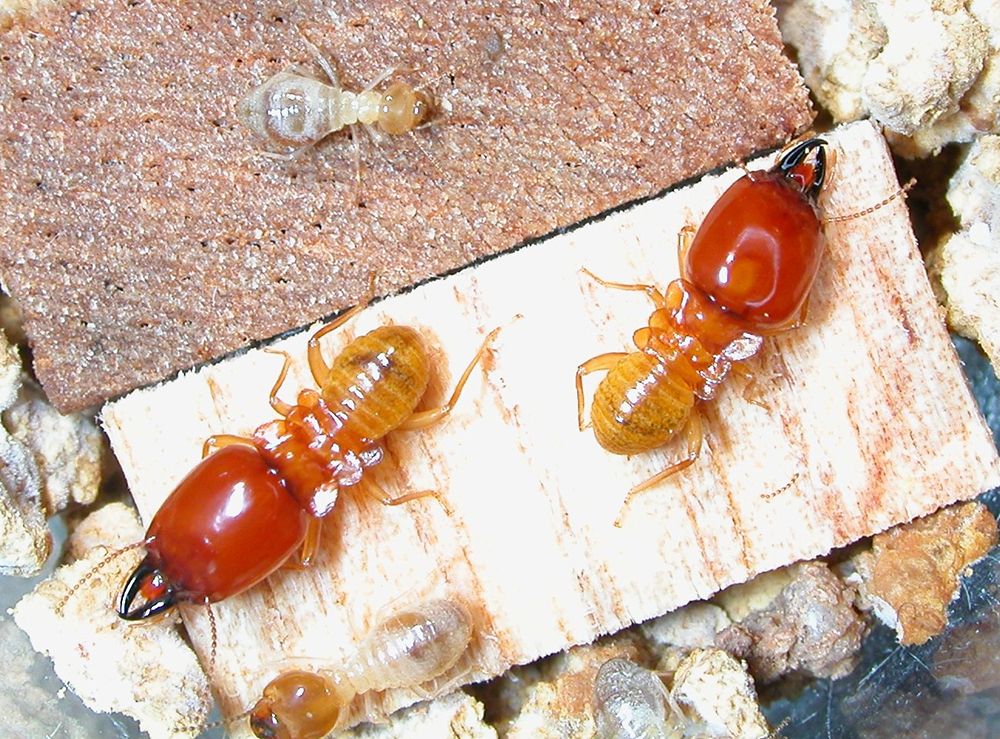
The Macrotermes termite is one of the most extraordinary animals on Earth, not because of its size - a worker is shorter than a grain of rice - but because of what millions of them build together.
A mature Macrotermes colony erects a mound up to nine metres tall, air-conditions its interior without a single moving part, farms a cultivated fungus that produces the world's largest edible mushroom, and sustains a single egg-laying queen for two or three human generations. In many African savannas Macrotermes and its close relatives hold a larger share of animal biomass than all large grazers combined.
This guide treats Macrotermes bellicosus as the representative species for the genus. It covers classification, castes, the physogastric queen, mound architecture and climate control, fungus farming, ecological impact, and the remarkable ways termite engineering has influenced human design. Expect specifics: millimetres and metres, temperatures, egg counts, mound ages, and energy numbers.
Classification and a Surprising Family Tree
Macrotermes belongs to the family Termitidae, the so-called higher termites, and within that to the subfamily Macrotermitinae, the fungus-growing termites. For most of the twentieth century termites sat in their own order, Isoptera. That changed in 2007, when combined morphological and molecular analyses formally folded termites into the order Blattodea - the cockroaches.
Termites are now best described as a deeply specialised, eusocial lineage of wood-eating cockroaches. The closest living relative outside the termite clade is the wood-roach Cryptocercus, which shares gut symbionts and parental care behaviours with primitive termites.
The revised family tree matters because it means termite eusociality - castes, sterile workers, a reproductive monarch - evolved completely independently of the ant-bee-wasp eusociality in the order Hymenoptera. The superficial similarities between an ant colony and a termite colony are one of biology's cleanest examples of convergent evolution. They solved the same problem with very different starting toolkits.
Within Macrotermitinae the genus Macrotermes contains the giants of termite architecture. Macrotermes bellicosus, described in the nineteenth century, is the most widely studied species and builds some of the tallest mounds ever recorded. Related species such as M. michaelseni, M. subhyalinus, and M. natalensis build similar mounds across different parts of sub-Saharan Africa.
Castes: Four Kinds of Termite in One Colony
Macrotermes colonies are strictly divided into castes. Each caste is morphologically distinct, produced by differential development from the same genome, and locked into its role for life.
Workers. The colony's labour force. Workers are 3-4 mm long, pale, soft-bodied, blind, and sterile. They build and repair the mound, forage for plant matter, tend the fungus gardens, feed the queen and king, care for eggs and young, and groom soldiers. The vast majority of colony members are workers. In large Macrotermes colonies there are hundreds of thousands to more than a million of them.
Soldiers. Colony defenders. Soldiers are 6-10 mm long, darker, with heavily sclerotised heads and enormous mandibles. In some Macrotermitinae the mandibles are so oversized that soldiers cannot feed themselves - workers must feed them mouth to mouth. Soldiers do not build or forage. They guard foraging columns, block breaches in the mound wall, and throw themselves at intruding ants. A mature Macrotermes colony may hold tens of thousands of soldiers.
Primary queen and king. The reproductive core. A single mated queen and a single mated king live together in a central royal chamber for the life of the colony. Both are far larger than workers. The queen becomes enormously larger over time, as described below.
Alates (winged reproductives). Once a year, typically at the start of the rainy season, colonies produce thousands of winged males and females. They swarm out, fly briefly, shed their wings, pair off, and attempt to found new colonies. Survival is very low; the tiny fraction that succeed become the next generation's queens and kings.
Workers and soldiers are produced in roughly equal numbers of both sexes in termites (unlike ants, whose workers are all female). They develop through a series of moults, and caste fate is determined partly by genetics, partly by pheromones from the queen and king, and partly by early diet.
The Queen: Physogastry and an Egg Every Three Seconds
The most extreme single organism in a Macrotermes colony is the queen. Her transformation is called physogastry, and it is one of the stranger life histories in the insect world.
A newly mated queen starts at roughly the same size as other alates, perhaps two centimetres long. Once she establishes a royal chamber and begins laying, her abdomen starts to swell. The inter-segmental membranes between her abdominal plates stretch enormously. The hard chitinous plates themselves separate into pale islands floating on a distended, soft, cream-to-yellow membrane full of developing eggs.
Over years she grows to around 11 centimetres long - far longer than any worker, longer than a human finger - and roughly 100 times a worker's mass. Most of that mass is ovaries and developing eggs.
At peak production she lays up to 30,000 eggs per day. That is roughly one egg every three seconds, continuously, year after year. Over a lifespan of 15 to 25 years a single queen can produce several hundred million offspring. A few verified queens have been recorded beyond 25 years.
The queen is physically incapable of moving. She cannot walk. She cannot feed herself. She depends completely on the colony around her. Workers feed her processed fungal material mouth to mouth, groom her, remove eggs as fast as she produces them, and maintain her chamber's temperature and humidity. The king, roughly the size of a large alate but slimmer than the queen, stays beside her for continuous fertilisation.
If the queen dies, the colony can sometimes produce a replacement reproductive from a nymph, but in Macrotermes this is less reliable than in some other termite lineages. A lost queen often means colony decline, though the mound itself may be taken over by a new founding pair or a neighbouring colony.
The Mound: Tallest Animal Architecture on Earth
A mature Macrotermes bellicosus mound is a cathedral built by creatures smaller than grains of rice. Tall mounds reach 9 metres above the savanna surface, with base diameters of 10 to 30 metres and underground chambers extending several metres below grade. For comparison, if a worker termite were the size of a human, the equivalent structure would stand more than a kilometre tall - far larger than anything in human architecture.
The mound is made of soil particles the workers carry up from the subsoil, cemented with saliva and faeces into a material that dries as hard as weak concrete. Over years and decades the mound is constantly repaired, reshaped, and extended. Old mounds are often inherited and reworked by successive colonies. Some Macrotermitinae mounds in central Africa have been continuously occupied or rebuilt for more than 2,000 years.
Approximate Macrotermes mound dimensions:
| Feature | Typical value |
|---|---|
| Height above ground | 2-9 m |
| Base diameter | 10-30 m |
| Wall thickness | up to 1 m near base |
| Underground nest depth | 2-5 m |
| Total processed soil mass | tens of tonnes |
| Colony population | up to 2 million individuals |
| Reoccupation age (oldest) | 2,000+ years |
Internally the mound is a layered structure. At the centre sits the royal chamber. Around it are the fungus-garden chambers - dozens to hundreds of roughly spherical rooms containing comb-like masses of processed plant matter and fungus. Above and around these runs a network of vertical and radial conduits that carry air between the warm nest core and the thinner, more porous outer walls.
Climate Control Without Machinery
Macrotermes mounds do something no human building does: they regulate temperature and gas composition passively, with no mechanical input. Internal nest temperature stays within roughly 1-2 degrees Celsius of a stable value throughout the year - typically around 30 degrees Celsius for Macrotermes - even as external air swings from near freezing at night to more than 40 degrees in the afternoon.
The current scientific understanding treats the mound as a combination of thermal mass, a passive convection loop, and a gas-exchange skin.
Thermal mass. The thick earthen walls absorb heat during the day and release it at night. Because they are thick and dense, they smooth short-term temperature swings. The nest core experiences something like an averaged version of the outside temperature.
Convective loop. Millions of termites and their fungus gardens generate metabolic heat continuously. Warm, humid, CO2-rich air rises out of the nest into a central chimney or network of internal shafts. As it rises it reaches cooler outer conduits just below the mound surface. There it cools, gives up heat to the walls, and sinks back down peripheral channels toward the nest.
The circulation is driven by buoyancy, not pumps. External wind, daily solar heating of different wall faces, and the mound's irregular geometry all modulate the flow.
Gas exchange. The outer walls are porous on a microscopic scale. CO2 produced inside diffuses outward through the wall material; O2 from outside diffuses inward. This gas exchange works because the thin outer conduits carry air close to the wall, maximising contact area. The mound effectively breathes.
The net result is a nest that stays thermally stable, well-oxygenated, and humid enough for fungus gardens to thrive. It does this continuously, for decades or centuries, on no power at all.
Fungus Farming, Thirty Million Years Old
Inside the mound Macrotermes runs one of the most ancient agricultural systems on Earth. In dedicated garden chambers workers build porous combs out of chewed and partly digested plant material. They inoculate these combs with spores of a specialised fungus, genus Termitomyces. The fungus grows through the comb, breaks down the cellulose and lignin that termite guts alone cannot handle, and produces small white hyphal nodules full of protein.
Workers eat the nodules. They also eat older, more thoroughly decomposed comb material once the fungus has extracted most of its value. New plant material comes in at the top; spent comb is removed from the bottom. The cycle is continuous.
The partnership is an obligate mutualism. Termitomyces cannot survive outside the mound under most conditions. Macrotermes cannot digest its food source alone. Genetic evidence places the origin of termite fungiculture at roughly 30 million years ago in Africa - older than the independent fungus farming evolved by leafcutter ants in the Neotropics.
Once a year, at the start of the rainy season, Termitomyces sends up fruiting bodies through channels in the mound wall. These are the mushrooms. In the case of Termitomyces titanicus, found associated with Macrotermes colonies in Zambia and surrounding regions, individual mushroom caps reach up to one metre across. This is the largest edible mushroom in the world.
Local communities harvest them as a seasonal delicacy. They are culturally and nutritionally significant across much of sub-Saharan Africa.
Foraging and the Invisible Extended Colony
Workers leave the mound to forage, but they try to do so without exposing themselves. Many Macrotermitinae foraging columns travel through subterranean tunnels or through temporary earthen sheeting on the surface. They collect dead grass, leaf litter, fallen branches, and bark, cut them into manageable pieces, and drag them back into the mound.
A single large colony pulls enormous quantities of plant material out of the surrounding landscape. Estimates from African savanna studies place the area significantly influenced by one mature Macrotermes colony at several hectares. Foraging is densest within 20-30 metres of the mound but can extend out to 50 metres or more.
The foraging system is coordinated without any central direction. Individual workers follow pheromone trails left by scouts. Soldiers escort the columns. If a breach opens in a surface sheeting, workers close it within minutes. The whole system is defensive-by-default against ants, which are the primary competitive threat for termites in African savannas.
Ecosystem Engineering on a Continental Scale
Macrotermes and related Macrotermitinae are not simply inhabitants of the savanna. They shape it.
Nutrient cycling. Massive quantities of surface plant litter are pulled underground and processed into fungus-digested, nutrient-dense material. Dead organic matter that would otherwise degrade slowly on the savanna surface is rapidly mineralised through the termite-fungus system. Termite activity accelerates the return of nitrogen, phosphorus, and potassium to the soil.
Soil turnover. Mound construction brings subsoil minerals to the surface. Abandoned mounds erode back into the surrounding soil over decades, spreading enriched material across the landscape.
Vegetation islands. Mound soils are consistently more fertile than surrounding savanna soils. Trees and grasses on and around mounds grow larger, denser, and often of different species. In many African landscapes mounds are biodiversity hotspots, attracting browsers, perching birds, and predators that use them as vantage points.
Landscape patterning. Across parts of Zambia, Tanzania, and Mozambique Macrotermitinae mounds are spaced in strikingly regular patterns - sometimes nearly hexagonal - visible from satellite imagery. The patterns emerge from competition between neighbouring colonies and long-term landscape dynamics.
Biomass. In many African savannas Macrotermitinae termites, taken together, account for a larger share of terrestrial animal biomass than any other group, including ungulates. Some estimates place their share at up to one third of all animal biomass in those systems.
Mounds as Inspiration for Human Buildings
Macrotermes passive climate control is one of the clearest examples of biomimicry in modern architecture. The best known example is the Eastgate Centre in Harare, Zimbabwe - a mixed-use commercial building designed by Zimbabwean architect Mick Pearce and completed in 1996. Eastgate is climate-controlled without a conventional chiller-based air-conditioning system. Instead it uses:
- Heavy thermal mass in concrete floors and walls to smooth temperature swings.
- Large chimneys that vent warm daytime air upward by buoyancy.
- Low-power fans that pull cool night air through the structure to chill its mass, storing cold for the next day.
- Strategically placed intake and exhaust vents that mimic the way mound surfaces exchange gas and heat.
The building uses roughly 90 per cent less energy for cooling than comparable conventional offices of similar size in the same city, while maintaining comfortable interior temperatures. Since Eastgate the same principles have influenced further buildings in Africa, Australia, and elsewhere, and termite-inspired passive design is an active research area in architecture, engineering, and sustainable construction.
The appeal is straightforward. Macrotermes mounds have been refining this system for tens of millions of years, run on metabolic heat alone, are built from locally sourced earth, and last for centuries. Human buildings have a lot to learn.
Reproduction and Colony Foundation
Once a year, almost always at the start of the rainy season, mature Macrotermes colonies produce thousands of alates - winged reproductive males and females. They gather near the mound surface and, at a very specific cue of temperature and humidity after the first heavy rains, pour out in a synchronised mass flight. For a few hours the air around a mound is thick with flying termites.
The flight is brief. Within minutes most alates land, break off their own wings at pre-formed fracture lines, and search for a mate. Every alate has a powerful pheromonal pairing instinct. Once paired, males and females dig a small burrow together, seal it, and begin a new colony.
Mortality is enormous. Birds, bats, ants, spiders, reptiles, and mammals converge on swarms. In many African cultures the alates themselves are a seasonal food - people collect them at mound exits, fry them, and eat them as a high-protein delicacy. Only a tiny fraction of paired founders survive to produce eggs; only a fraction of those build a colony large enough to produce their own alates a decade later.
A founding queen lays only a handful of eggs at first. She and the king tend the brood directly. As workers mature they take over foraging, brood care, and mound construction. Fungus gardens are established from spores carried in the alates' guts or acquired from soil after founding. The colony grows slowly for the first several years, then expands rapidly once it reaches a critical size. Fully mature colonies with 9-metre mounds may be decades old.
Conservation and Coexistence
Macrotermes termites are not formally threatened. Their ecological role, abundance, and wide distribution across sub-Saharan Africa make them one of the most successful animal groups on the continent. However, several pressures do affect Macrotermes and mound-building termites more broadly.
Land conversion. Expansion of agriculture, especially heavy mechanised tillage, destroys mounds that have stood for generations. Once a large mound is bulldozed and the colony wiped out, the structure and the long-term ecological enrichment it supported are lost.
Pesticide use. Broad-spectrum insecticides applied for crop or structural pest control can eliminate colonies indiscriminately, including large Macrotermitinae that are important to soil fertility rather than being pests.
Climate change. Shifts in rainfall patterns and dry-season length may affect foraging, fungus garden moisture, and alate flight timing. The full impact is not yet quantified.
Human-termite conflict. In settled areas Macrotermes and related species are also structural and crop pests. They damage wooden buildings, chew through books and stored materials, and undermine foundations and roads. Management ranges from localised targeted treatment to broader insecticidal campaigns.
At the same time, Macrotermes is a direct resource. Alates are harvested and eaten across much of Africa. Termitomyces mushrooms from mounds are prized in local markets. Mound soils are used in traditional construction and pottery. These uses are typically sustainable at local scales and embed termites into human food and material systems in ways that cultures elsewhere have largely lost.
Related Reading
- Termite Biology: Social Life of Wood-Eating Cockroaches
- Fungus-Growing Insects: Convergent Evolution of Agriculture
- Eusociality in Insects: How Colonies Outperform Individuals
- Biomimicry in Architecture: Lessons from Animal Builders
References
Sources consulted for this entry include peer-reviewed research in Journal of Insect Science, Ecological Monographs, Proceedings of the Royal Society B, and Insectes Sociaux, along with reviews of Macrotermitinae fungus farming in Molecular Ecology and Nature. Mound climate-control modelling draws on work by Scott Turner and colleagues.
Architectural biomimicry details reflect published material on the Eastgate Centre and Mick Pearce's design notes. Taxonomic placement of termites within Blattodea follows Inward, Beccaloni, and Eggleton (2007) and subsequent phylogenomic work.
Frequently Asked Questions
How big are Macrotermes termite colonies and mounds?
A mature Macrotermes bellicosus colony contains up to 2 million individuals split across strict castes: workers, soldiers, one primary queen, and one primary king, plus seasonal winged reproductives. Workers are 3-4 mm long; soldiers 6-10 mm. The queen, after years of egg laying, reaches about 11 centimetres - longer than a human finger - and weighs roughly 100 times a worker.
The mound itself can stand up to 9 metres tall with a base 10-30 metres across, and extends several metres underground into the nest chambers and fungus gardens. A single mature mound can contain many tonnes of processed soil.
How do termite mounds stay cool without air conditioning?
Macrotermes mounds work as passive heat exchangers. Metabolic heat from millions of termites and their fungus gardens warms the air in the central nest, causing it to rise through a tall chimney into the mound’s upper conduits. As it rises the air cools and its carbon dioxide diffuses out through the thin, porous outer walls; oxygen diffuses in. The cooled, freshened air sinks back down the outer channels and returns to the nest.
Combined with the thermal mass of the mound walls, this convection keeps the core nest within 1-2 degrees Celsius of a stable temperature year-round despite savanna air swinging between near-freezing nights and 40-plus-degree afternoons. No fans, no pumps, no moving parts - just geometry and wall porosity.
What do Macrotermes termites actually eat?
Macrotermes are detritivores, but indirectly. Workers collect dead grass, leaves, and woody debris from the surrounding savanna and bring it into the mound. Inside dedicated fungus-garden chambers they chew and excrete this plant matter into porous combs, onto which they seed a specialised fungus of the genus Termitomyces.
The fungus breaks down cellulose and lignin that termites cannot digest alone, producing protein-rich hyphal nodules and conditioned comb material. The termites then eat the fungal nodules and older comb tissue. The colony is essentially a farmer: the termites feed the fungus, and the fungus feeds the termites. This mutualism is roughly 30 million years old.
How long does a Macrotermes queen live and how many eggs does she lay?
A primary Macrotermes queen commonly lives 15-25 years, with verified cases pushing beyond that. During her peak years she lays up to 30,000 eggs per day - roughly one every three seconds, continuously. Over a full lifespan she can produce hundreds of millions of offspring. Her abdomen swells enormously through a process called physogastry, reaching about 11 centimetres long and 100 times the mass of a worker.
The expansion ruptures and fuses her exoskeletal plates into a soft, pale, elongated egg-production organ. She becomes physically incapable of moving. Workers feed her, clean her, carry away her eggs, and the king remains nearby for continuous fertilisation.
Why are termite mounds important to the savanna ecosystem?
Macrotermes mounds are ecosystem engineers on a landscape scale. Foraging workers pull huge quantities of dead plant matter underground, accelerating nutrient cycling and aerating soil across hectares around each nest. Mound soil itself is enriched with minerals from deeper layers, giving vegetation on and around mounds elevated nitrogen, phosphorus, and potassium.
These nutrient islands support more productive grass, denser trees, and higher animal diversity, making mounds hotspots that shape where grazers, browsers, and predators concentrate. Some Macrotermitinae landscapes are estimated to hold up to a third of all terrestrial animal biomass in African savannas. Mounds also buffer local hydrology - porous structures absorb and slowly release rainwater, supporting vegetation through dry seasons.
Are termites the same as ants?
No. Termites and ants look superficially similar - social colonies, castes, tunnels - but they evolved independently. Ants are Hymenoptera, close relatives of bees and wasps. Termites are Blattodea, meaning their closest living relatives are cockroaches. A 2007 phylogenetic revision formally moved termites inside the cockroach order based on genetic and morphological evidence, including shared features with the wood-eating cockroach Cryptocercus.
Termites are sometimes called ‘social cockroaches’ for this reason. Their eusociality, caste system, and fungus farming evolved completely separately from those of ants, making the similarities one of biology’s clearest cases of convergent evolution.
Are Macrotermes termites dangerous to humans?
Macrotermes species are not directly dangerous. Soldiers have powerful mandibles and will bite intruders, and some species release defensive chemicals, but they do not sting, are not venomous to people, and do not transmit disease. Economically, though, termites including Macrotermes can be a significant pest. Colonies damage wooden buildings, fences, furniture, and crops, and their foraging tunnels can undermine foundations and roads.
In much of sub-Saharan Africa the same species are also a resource - people harvest flying alates during mating swarms as a seasonal high-protein food, and the cultivated Termitomyces mushrooms that emerge from mounds during the rainy season are a prized delicacy sold in local markets.
How have termite mounds influenced human architecture?
Macrotermes mounds are a textbook example of biomimicry. The most famous case is the Eastgate Centre in Harare, Zimbabwe, opened in 1996 and designed by architect Mick Pearce. The building uses passive ventilation modelled on termite mound airflow - large thermal mass, strategically placed chimneys, and low-power fans that draw cool night air into the structure to chill its mass, then vent warm daytime air upward.
The result is a commercial building that uses roughly 90% less energy for climate control than comparable conventional offices in the same city, with no traditional air conditioning. Similar mound-inspired passive cooling has since been used in other African and Australian buildings, and termite-mound geometry remains an active subject in architectural and engineering research.