
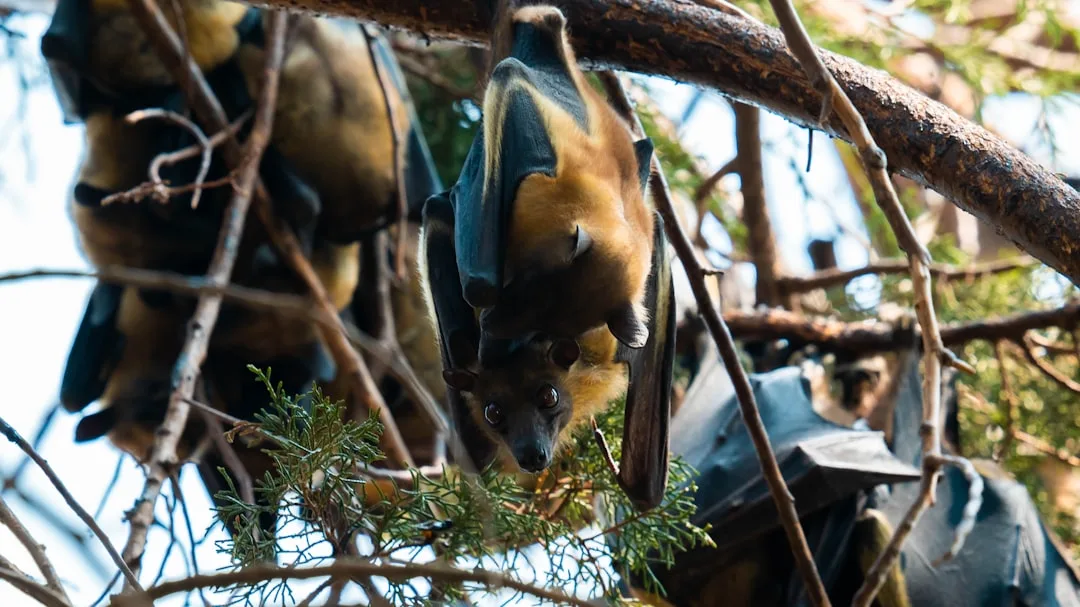
The fruit bat is not a single species. The common name covers roughly 187 species in family Pteropodidae - the so-called megabats - ranging from thumb-sized pygmy fruit bats to the giant flying foxes whose wings stretch further than a child's arm span. This guide focuses on the large flying fox, Pteropus vampyrus, the iconic representative of the group.
It is one of the largest bats alive, one of the most ecologically important mammals in Southeast Asia, and one of the most misunderstood animals on Earth.
Unlike the high-frequency, echolocating microbats that haunt caves and night skies across the rest of the world, flying foxes are daylight-tolerant, vision-driven, fruit-eating mammals that roost in vast communal camps. They pollinate durian. They disperse mangoes and figs. They are the reason many tropical forests still regenerate after logging. They are also, increasingly, under threat.
This entry covers size and anatomy, ecology, reproduction, colony life, conservation status, and the strange biology that makes Pteropus vampyrus unlike any other mammal in its range.
Etymology and Classification
The genus name Pteropus comes from the Greek for "wing-foot" - a reference to the way the wing membrane integrates with the hind legs. The species epithet vampyrus is misleading: flying foxes do not drink blood and are not related in habit or diet to the true vampire bats of Central and South America. The Latin name was assigned in an era when "vampire" was used loosely for any large, strange-looking bat.
In Malay the species is often called keluang, in Indonesian kalong, and in Thai khang khao mae kai. These names appear frequently in local place names where historic roost camps have anchored human settlements for centuries.
Family Pteropodidae sits in the suborder Yinpterochiroptera within Chiroptera. Molecular studies have rearranged the bat family tree considerably in the past two decades, and fruit bats are now understood to be more closely related to certain small echolocating bats than previously thought.
The large flying fox is one of roughly 65 species in the genus Pteropus, a group distributed across Indian Ocean islands, Southeast Asia, Australasia, and the Pacific. Several island Pteropus species have already gone extinct in historical times, and the genus overall is one of the most threatened mammalian lineages in the world.
Size and Physical Description
The large flying fox is among the heaviest and broadest-winged bats on the planet. Size is not uniform across the range - mainland populations tend to run slightly larger than island populations.
Adults:
- Wingspan: typically 1.4-1.5 metres, record individuals close to 1.7 m
- Head-and-body length: 27-32 cm
- Weight: 0.6-1.1 kg
- Forearm length: 180-220 mm
Pups at birth:
- Weight: roughly 100-150 grams - about 10-15 per cent of adult mass
- Wings: fully formed but non-functional, used to cling to the mother
The wing of a flying fox is, anatomically, a hand. The four long fingers stretch a double-layered skin membrane (the patagium) from shoulder to ankle. The thumb is free, carries a strong claw, and is used for climbing along branches. The hind feet are equipped with powerful reversed-grip tendons that lock the foot closed around a branch under the bat's own weight - a flying fox can hang from one foot, asleep, for hours without any muscular effort. Letting go requires active muscle contraction.
The fur is usually dark chocolate brown to black on the back, with a pale orange or golden mantle around the shoulders and neck that gives the animal a striking cape-like appearance at close range. The face is fox-like, with a long muzzle, large dark eyes, and forward-pointing ears. There is no tail. Males and females look broadly similar, though adult males tend to be larger and more heavily built around the shoulders.
Flight, Vision, and No Echolocation
The defining feature of fruit bat biology, from a sensory standpoint, is that this family does not echolocate. Almost every other bat in the world uses high-frequency sound pulses to locate prey and navigate. Pteropodidae - with the single exception of the genus Rousettus, which uses a crude tongue-click system in caves - rely entirely on vision and smell.
This has shaped the anatomy of the face. Flying foxes have disproportionately large, forward-facing eyes with a retina specialised for low-light vision. Experiments show they can distinguish ripe from unripe fruit by colour and shape at several metres in the dim light of dusk or moonlight. Their olfactory bulbs are well developed, and their ability to track airborne fruit and flower volatiles across kilometres of forest is substantially better than any echolocating bat's.
Flight is efficient rather than acrobatic. A flying fox cannot hover like a nectar-feeding microbat or a hummingbird. Instead, it cruises at 20-30 km/h on steady wingbeats, capable of sustained flights lasting several hours.
Foraging flights routinely cover 30 to 50 kilometres between roost and feeding trees, and some radio-tracked individuals have been recorded crossing more than 90 kilometres of open sea between islands. A flying fox that reaches a fruiting tree does not simply land on a branch - it hangs upside down from the outer twigs, balances with one foot, and uses the other foot and thumb claw to pull fruit toward its face.
Take-off is a gravity operation. Flying foxes cannot launch from a standing start with the explosive power of a small bird. Instead, they release their grip, drop into a short fall, and spread their wings mid-air. This is why all flying fox roosts are located in tall trees with clear airspace beneath - a roost tree surrounded by dense undergrowth is effectively a trap.
Diet and Feeding Behaviour
Fruit bats are obligate frugivores and nectarivores. Pteropus vampyrus feeds on ripe fruit, nectar, pollen, and flowers, with occasional leaf chewing for moisture or minerals. The diet includes:
- Fruit: figs (multiple Ficus species), mangoes, rambutan, guava, banana, papaya, longan, langsat, durian pulp, and many wild forest species
- Flowers and nectar: durian, petai, kapok, mangrove (Sonneratia, Bruguiera), eucalyptus, and coconut flowers
- Pollen: consumed incidentally while lapping nectar, and an important protein source during flowering seasons
Feeding technique is distinctive. A flying fox grips a fruit with one foot and the thumb claw, brings it to the mouth, and crushes the pulp against the palate with the tongue. Juice and soft flesh are swallowed; fibre, skin, and large seeds are spat out in a dry pellet called an ejecta. The fine structure of ejecta pellets is used by ecologists to reconstruct bat diets without ever handling a live animal.
Smaller seeds pass through the gut intact and are defecated during flight, often kilometres away from the parent tree. This is the foundation of one of the bat's most important ecological services.
A single adult eats roughly a quarter to half of its body weight in fruit each night. A colony of 10,000 bats can remove several tonnes of fruit from a single large fruiting tree in one visit, and the seed rain produced can exceed hundreds of thousands of seeds per hectare in their favoured feeding areas.
Life Cycle and Reproduction
Fruit bat reproduction is slow and tightly tied to local fruiting seasons. Pteropus vampyrus is typically monoestrous - females produce one litter per year, almost always a single pup.
Reproductive calendar (Malaysia, typical):
- Mating: dry season (roughly March-May)
- Gestation: 140-180 days
- Birth: late wet season, timed to peak fruit availability
- Nursing: 3-5 months
- Weaning: pup begins sampling fruit at 2-3 months, fully independent by 5-6 months
Mating occurs in the roost. Males display to females with wing-flapping, scent-marking, and vocalisations at a dedicated mating perch. Flying foxes are not strictly monogamous, but stable male-female associations during the breeding window are common, and some colonies show a harem-like structure with dominant males defending small groups of females.
The pup is born with a full coat of fur, open eyes, and functional claws - a precocial newborn by bat standards. For the first two to three weeks of life it clings permanently to the mother's belly, gripping her fur with its hind feet and thumbs and drinking from her paired pectoral nipples.
During this period the mother carries her pup on foraging flights, effectively flying with double her body weight. After about three weeks the pup is left at the roost while the mother feeds, and she returns before dawn to nurse.
Mother-pup recognition in a camp of thousands is remarkable. Each pup has an individually distinctive isolation call, and the mother can identify her own pup's voice from hundreds of others. Scent also plays a role: both pup and mother mark each other during nursing, and a returning female searches the roost using a combination of vocal and olfactory cues.
Sexual maturity is reached at 18 to 24 months. Females may reproduce annually for a decade or more, meaning a long-lived wild female might produce 10-12 pups in her lifetime - a low reproductive ceiling that makes the species highly vulnerable to hunting pressure.
Colony Life and Roosts
Large flying foxes are social animals. They roost in communal camps that range from a few hundred to historically more than 20,000 animals in a single grove. Camps tend to be located in tall emergent trees along rivers, on islands, in mangrove stands, or in undisturbed coastal forest. A camp can persist in the same grove for decades if the trees and the surrounding foraging landscape remain intact.
Within a camp, spatial organisation matters. Dominant adult males claim high, central roosts. Subordinate males cluster at the edges. Females and juveniles occupy the middle strata. Fights, grooming, vocal displays, and mating are all visible during daylight hours. A camp at midday is not silent - flying foxes are among the most vocally active of all bats, with a repertoire of more than 30 distinct calls documented in some studies.
Grooming occupies a substantial portion of waking time. Flying foxes are among the cleanest mammals in the world. A resting bat spends up to a third of its active roosting time licking and combing its fur, wings, and face using its tongue, teeth, and thumb claws. The wing membrane in particular is kept flexible and free of parasites through intensive grooming, and damaged wing tissue heals rapidly thanks to a dense network of blood vessels.
Predation on adult flying foxes in the roost is limited. Historically the main natural predators were large raptors - crested serpent eagles, white-bellied sea eagles, and monitor lizards raiding pups. Humans are now the primary source of mortality by a wide margin.
Ecological Role
Flying foxes are keystone species across Southeast Asia. Their ecological work falls into two categories: pollination and seed dispersal.
Pollination. Many tropical tree species have co-evolved with bats specifically. Bat-pollinated flowers tend to be large, pale, strongly scented, and open at dusk.
Durian (Durio zibethinus) is the most economically important example - Malaysian and Indonesian studies have shown that flying foxes are primary nocturnal pollinators of durian, and exclusion experiments that kept bats away from durian flowers produced dramatic drops in fruit set. Petai (stink bean), kapok, and several mangrove genera similarly depend on bats.
The economic weight of this service is difficult to calculate precisely but has been estimated in the hundreds of millions of dollars per year for durian alone.
Seed dispersal. Flying foxes spit out large seeds at the feeding tree but swallow small seeds whole. Small seeds pass through the gut in 15 to 45 minutes and are often defecated far from the parent tree during flight. In fragmented forest landscapes, flying foxes are effectively the only animals capable of moving tree genetic material across gaps greater than a few hundred metres.
Studies in Malaysia and Indonesia show that more than 90 per cent of long-distance seed dispersal for certain tree species is performed by fruit bats. Without them, many logged and secondary forests cannot regenerate their native tree community.
Dispersal data (typical Pteropus studies):
| Metric | Value |
|---|---|
| Nightly foraging range | 20-50 km typical, 90+ km recorded |
| Seeds per bat per night | 200-1,500 depending on fruit availability |
| Plant species pollinated/dispersed (Pteropidae, global) | 500+ |
| Forest dependency on Pteropus | >90% long-distance dispersal for some trees |
Range, Populations, and Subspecies
Pteropus vampyrus ranges across the Malay Peninsula, Sumatra, Borneo, Java, the Philippines, southern Thailand, and parts of Vietnam and Timor. Several subspecies have been described based on morphology and genetics. Populations are naturally fragmented across islands and large river systems.
Geographic distribution:
| Region | Status |
|---|---|
| Peninsular Malaysia | Declining; historic camps lost to development |
| Sumatra | Declining; hunting pressure and forest loss |
| Borneo | Fragmented; strongholds in undisturbed mangrove |
| Philippines | Subspecies P. v. lanensis; declining |
| Southern Thailand | Declining; small camps remaining |
| Vietnam, Timor | Very small populations, marginal range |
Global population estimates are unreliable because camps shift and hunting is largely unrecorded. The IUCN categorises the species as Near Threatened with a decreasing population trend, and several regional assessments suggest the species could move to Vulnerable within a decade if current pressures continue.
Other members of the genus Pteropus - Rodrigues flying fox, Mariana flying fox, Pemba flying fox - are already Endangered or Critically Endangered, and extinctions of island Pteropus species have been documented in historical times.
Conservation Status and Threats
Pteropus vampyrus is listed as Near Threatened by the IUCN. It is included on CITES Appendix II, which regulates but does not prohibit international trade. National protection varies - the species is fully protected in peninsular Malaysia under the Wildlife Conservation Act, partially protected in Indonesia, and hunted legally or quasi-legally in several other range states.
Primary threats:
- Habitat loss. Lowland rainforest, peat swamp, and mangrove forest across Southeast Asia have been cleared aggressively for oil palm, aquaculture, and urban expansion. Roost trees are felled directly; foraging habitat is fragmented; the connective landscape between camps and fruiting areas is broken.
- Hunting. Flying foxes are killed for bushmeat in much of the range. They are also persecuted as supposed crop pests, particularly around durian, mango, and rambutan orchards, despite their role as the primary pollinators of several of these crops. Small-arms hunting of roosts can halve a camp in a single afternoon and has caused documented local extinctions.
- Traditional medicine. In some regions flying fox meat and oil are sold as treatments for respiratory ailments. The market is not large but is difficult to regulate.
- Disease culls. After Nipah virus outbreaks, some range states have considered or attempted large-scale culling of flying fox colonies. This approach repeatedly fails as disease control and makes outbreaks worse by dispersing stressed animals into new areas.
- Climate change. Shifts in flowering and fruiting seasons decouple bat foraging from food availability. Sea-level rise threatens mangrove roost habitat directly.
Reproductive ceiling. A single pup per female per year, late maturity, and long generation time mean that Pteropus vampyrus cannot recover from heavy hunting pressure quickly. This is the same dynamic that has driven the extinction of several island Pteropus species in the past century.
Flying Foxes and Humans
The relationship between humans and flying foxes in Southeast Asia is complex. For many traditional cultures, large bat camps are landscape features - communities have organised their lives around the dawn-and-dusk flight of bats for centuries. Several indigenous belief systems treat the species as spiritual messengers or as embodiments of forest health.
At the same time, flying foxes are regarded as crop pests in fruit-producing regions. The conflict is particularly acute around durian orchards, where bats visit flowers (pollinating, helpfully) but also ripe fruit (consuming, destructively). Netting, noise-makers, and exclusion canopies are more effective long-term tools than killing, but direct persecution remains common.
Disease ecology. Pteropus vampyrus is a natural reservoir host of Nipah virus and related henipaviruses. The bats show no measurable illness from these viruses. Spillover into humans has occurred repeatedly, most notably in Malaysia in 1998-99 (via pigs that ate bat-contaminated fruit) and in Bangladesh repeatedly since 2001 (via date palm sap contaminated with bat saliva and urine).
Nipah is a serious disease, with case fatality rates of 40 to 75 per cent in outbreaks. However, the risk is narrow and contextual: routine observation of bats carries essentially no transmission risk, and the public health response in outbreak countries has focused on food-chain hygiene rather than on the bats themselves.
Conservation biologists and disease ecologists agree that killing roosts to prevent disease is counterproductive - it scatters animals, increases stress-driven viral shedding, and destroys an ecosystem service worth far more economically than the outbreak it was meant to prevent.
Tourism and research. Several flying fox camps across the range are now protected tourist sites where visitors can observe the dusk flight. When managed correctly this provides economic justification for protecting the roost. Bat rehabilitation centres in Australia and Southeast Asia rescue injured and orphaned flying foxes and return them to the wild, providing a conservation-education bridge with the public.
Related Reading
- Bats of the World: Flight, Sonar, and Survival
- How Bats Navigate Without Eyes
- Keystone Species: Why Some Animals Matter More
- Pollinators of the Tropics
References
Relevant peer-reviewed and governmental sources consulted for this entry include the IUCN Red List assessment for Pteropus vampyrus, the Malaysian Department of Wildlife and National Parks status reports, published research in Journal of Mammalogy, Biological Conservation, Acta Chiropterologica, and Ecology Letters, and long-term radio-tracking studies conducted by the University Kebangsaan Malaysia and the EcoHealth Alliance on flying fox movement and disease ecology.
Specific population figures and distribution statements reflect the most recent consolidated estimates as of the current IUCN Red List assessment cycle.
Frequently Asked Questions
How big are fruit bats?
The large flying fox (Pteropus vampyrus) is one of the largest bats in the world. Adults weigh 0.6 to 1.1 kilograms, with a head-and-body length of 27 to 32 centimetres and a wingspan typically around 1.5 metres. Record individuals have been measured at close to 1.7 metres tip to tip, giving this species a wing span comparable to a large bird of prey. Males are slightly heavier and longer-winged than females.
The family Pteropodidae contains roughly 187 species ranging from 20-gram pygmy fruit bats to these giant flying foxes, so size varies enormously across the group, but the large flying fox is consistently ranked among the heaviest and broadest-winged bats alive.
What do fruit bats eat?
Fruit bats are strict frugivores and nectarivores. Pteropus vampyrus eats ripe fruit, nectar, pollen, and flowers, with occasional leaves chewed for moisture. Favoured foods include figs, mangoes, bananas, guavas, rambutan, and the flowers of durian, mangrove, kapok, and eucalyptus trees.
A flying fox usually chews fruit pulp to extract juice and soft flesh, then spits out a dry pellet of fibre and larger seeds - this behaviour is central to their ecological role. Smaller seeds pass through the gut and are defecated during flight, often kilometres from the parent tree. A single bat eats roughly a quarter to half its body weight in fruit per night, which is why fruiting trees draw entire colonies at once.
Where do fruit bats live?
Pteropus vampyrus inhabits lowland forests, mangrove swamps, coastal forest, and peat swamp across Southeast Asia. Its range covers the Malay Peninsula, Sumatra, Borneo, Java, the Philippines, southern Thailand, and parts of Vietnam and Timor. The species prefers habitat within about 50 kilometres of the coast because mangroves provide secure roosting sites and a reliable flowering-and-fruiting calendar across the year.
Large daytime roosts (called camps) form in tall trees on islands, in mangroves, or along river margins where human disturbance is low. At night the same colonies commute inland to orchards, rainforest canopy, and plantation edges to feed, then return to the roost before dawn.
Are fruit bats endangered?
The IUCN lists Pteropus vampyrus as Near Threatened with a decreasing population trend. Several regional populations have collapsed in living memory. Two threats dominate. First, habitat loss - lowland rainforest and mangrove forest in Southeast Asia have been cleared aggressively for palm oil, urban expansion, and aquaculture, destroying roost trees and foraging habitat.
Second, hunting - flying foxes are harvested for bushmeat, traditional medicine, and crop-protection killing across much of their range, often unsustainably. Because they reproduce slowly (one pup per year per female, late sexual maturity), even modest hunting pressure can drive local extinctions. Several other Pteropus species are already Endangered or Critically Endangered, and the large flying fox is on the same trajectory if current pressures continue.
How long do fruit bats live?
Wild large flying foxes typically live around 15 years, though most animals die well before this from predation, hunting, and starvation in poor fruiting years. In captivity, where disease, predators, and food scarcity are removed, Pteropus individuals routinely exceed 30 years, with some documented zoo animals reaching their mid-thirties.
This is an unusually long lifespan for a mammal of this size - a cat-sized terrestrial mammal rarely lives past 15 years even in captivity. The combination of flight, low-predation roosting in tall trees, and generally low metabolic rate outside of active flight is thought to explain bat longevity. Females typically first reproduce at 18 to 24 months and may give birth annually for a decade or more.
Do fruit bats use echolocation?
No. Pteropus vampyrus and most members of family Pteropodidae do not echolocate. This is one of the defining traits that separates megabats from microbats. Instead, fruit bats rely on large, forward-facing eyes with high sensitivity to low-light conditions, and on an acute sense of smell developed around fruit and flower volatiles.
Their visual acuity is comparable to a small primate in dim light, and experiments show they can distinguish ripe from unripe fruit by sight at several metres. A single genus within Pteropodidae (Rousettus) has independently evolved a simple tongue-click form of echolocation for navigating dark caves, but this is the exception. The large flying fox navigates, finds food, and recognises roost-mates entirely without sonar.
Why are fruit bats important to the environment?
Flying foxes are keystone species in Southeast Asian forests. They pollinate and disperse seeds for hundreds of tree species, many of which have co-evolved to depend on bats specifically. Bat-pollinated plants tend to have large, pale, strongly scented flowers that open at dusk - classic examples include durian, petai, kapok, and many mangrove species. Bat-dispersed trees produce fruit that is soft, fragrant, and accessible at night.
Because flying foxes can travel 50 kilometres or more per night, they move pollen and seeds across fragmented landscapes in ways that no other animal in the region can match. Studies in Malaysia estimate that durian alone owes hundreds of millions of dollars in annual crop value to flying fox pollination, and the loss of bats is implicated in measurable decline of wild tree regeneration in logged forests.
Do fruit bats carry diseases dangerous to humans?
Fruit bats, including Pteropus vampyrus, are natural reservoir hosts of several viruses, most notably Nipah virus and related henipaviruses. The bats themselves show little to no illness, but spillover into humans can be severe. Documented Nipah outbreaks in Malaysia and Bangladesh have been traced to indirect transmission through date palm sap contaminated by bat saliva or urine, or through pigs that ate fruit dropped by bats.
The risk is real but narrow: routine observation of bats from a reasonable distance, and avoidance of raw palm sap or fruit with obvious bat damage in endemic areas, are effective precautions. Large-scale culling of flying foxes has repeatedly failed as a disease control measure and typically makes outbreaks worse by dispersing stressed animals.
Conservation and public health experts now favour habitat protection and food-supply hygiene over killing programs.