
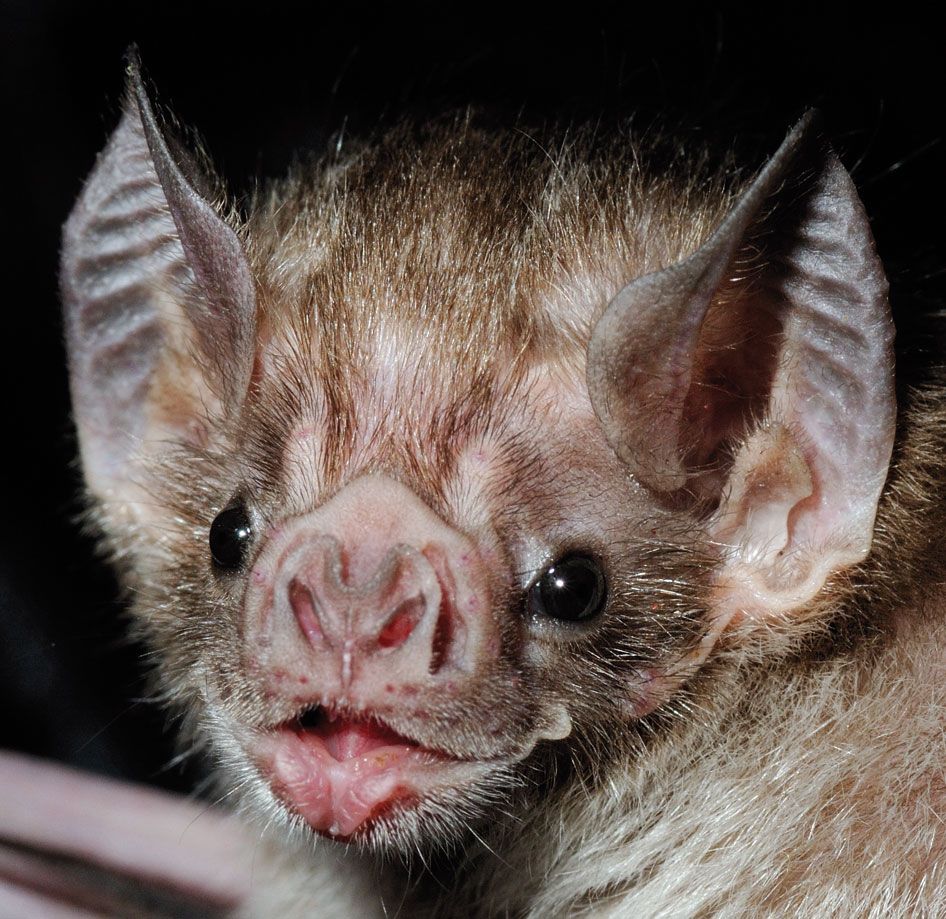
The vampire bat is the only mammal on Earth that feeds on a diet of pure blood. Three species live this way - the common vampire bat (Desmodus rotundus), the white-winged vampire bat (Diaemus youngi), and the hairy-legged vampire bat (Diphylla ecaudata) - and all three are native to the warm forests and grasslands of the Americas.
Of the more than 1,400 bat species currently described, these three, and a handful of unrelated leeches and insects, are the only vertebrates that derive all of their calories from vertebrate blood. The biology required to make that diet work is extraordinary at every level, from infrared-sensing facial pits, to anticoagulant saliva, to colony-wide food-sharing networks.
This guide covers vampire bat biology and ecology in depth: anatomy, sensory systems, hunting, feeding mechanics, social structure, reproduction, rabies ecology, medical research applications, and conservation status. Expect specifics - grams, millilitres, minutes, and the names of real researchers - rather than general claims.
Etymology and Classification
The name Desmodus rotundus was coined by Etienne Geoffroy Saint-Hilaire in 1810. Desmodus comes from the Greek for 'bundle' or 'band' and likely refers to dental features, while rotundus is Latin for 'round' and describes the bat's stocky build. European natural historians had already named the animal 'vampire' in the 17th century after reports of bats that drank blood from sleeping travellers in the New World.
That colloquial name predated Bram Stoker's 1897 novel Dracula by two centuries, though the novel cemented the association in popular imagination. Compounds in vampire bat saliva - draculin and desmoteplase - still carry echoes of both the Latin name and the gothic myth.
All three vampire bat species sit within the family Phyllostomidae, the New World leaf-nosed bats, in a subfamily called Desmodontinae. Molecular phylogenetics confirms that the three species share a single common ancestor that evolved hematophagy roughly 26 million years ago, during the Oligocene. Hematophagy appears to have arisen only once in bats, not multiple times.
The nearest non-blood-feeding relatives of vampire bats include fruit bats, nectar bats, and insect-eating bats of the broader Phyllostomidae family. Dietary evolution in this family is one of the most dramatic among mammals: from insect-feeders ancestrally, leaf-nosed bats diversified into fruit, nectar, pollen, frog, fish, and finally blood specialists.
Size and Physical Description
Vampire bats are small. A common vampire bat weighs between 25 and 40 grams - roughly the weight of a slice of bread - and measures about 7 to 9 centimetres from nose to rump. Wingspan is 15 to 18 centimetres. Males and females are similar in size, with females sometimes slightly heavier when pregnant or lactating. Their fur is short, dense, and a dark grey-brown with a paler belly. The face is short and blunt compared to other leaf-nosed bats, with a reduced nose-leaf.
Distinctive anatomical features:
- Upper incisors: large, razor-edged, triangular - effectively built-in scalpels
- Cheek teeth: reduced in size and number because blood requires little chewing
- Tongue: grooved along the underside, functioning like a drinking straw by capillary action
- Pit organs: three heat-sensitive depressions around the nose-leaf
- Thumbs: elongated and powerful, used to walk and hop on the ground
- Hind legs: proportionally strong, enabling the ground gait unique to vampires
- Stomach: elongated, tubular, highly distensible to accommodate a full blood meal
The reduction of cheek teeth is so extreme that vampire bats have fewer teeth than any other Phyllostomid bat: 20 teeth total in adults. Chewing is unnecessary when food arrives pre-liquefied. The teeth that remain are needle-sharp and kept that way by self-grooming and the natural abrasion of use. A freshly made wound is 5 to 8 millimetres long and only a few millimetres deep, not enough to damage a major vessel in a large animal, but deep enough to reach the capillary bed.
Built for a Blood-Only Diet
Blood is an energy-poor food relative to its volume. It is roughly 80 per cent water, 15 per cent protein, and only 1 per cent fat. To extract enough calories to survive, a vampire bat has to drink a truly enormous quantity relative to its size and then offload the unwanted water as fast as possible.
Feeding and digestion adaptations:
- A full feeding lasts 20 to 30 minutes and delivers up to 20 millilitres of blood.
- That volume can equal 40 to 60 per cent of the bat's pre-feeding body mass.
- Specialised kidneys produce dilute urine within 2 minutes of feeding, offloading the water fraction.
- The bat can urinate 25 per cent of its body mass in water while still at the feeding site.
- Post-feeding, the kidneys switch to producing highly concentrated urine to conserve water at the roost.
- Iron overload - a hazard of a blood-only diet - is managed by rapidly shedding iron-rich intestinal cells.
- Protein-digestion is handled by gut bacteria that break down haemoglobin and plasma proteins.
The kidney switch, documented in detail by researchers in the 1980s and 1990s, is one of the fastest functional shifts known in a vertebrate organ. Within minutes of a meal the nephrons change their hormonal response pattern, moving from ADH suppression to ADH-driven concentration, so the bat can fly home without the water weight of its meal.
Even with that trick, a fed vampire bat is a heavier, slower flier than a hungry one, and juveniles often struggle to take off at all after their first big feed.
A less obvious adaptation sits in the genome. Studies of Desmodus rotundus have identified gene losses in taste receptors for sweet and bitter flavours, as well as in insulin response pathways. The bats have effectively rewired their metabolism away from carbohydrates, which blood does not provide. Sweet taste is useless to an animal whose only food contains no sugar.
Sensing Heat, Sound, and Breath
The pit organs in a vampire bat's face are sometimes compared to those of pit vipers, but the molecular machinery is different. Vampire bats use a truncated version of TRPV1, a temperature-sensing protein that other mammals (and humans) use to feel the burn of chilli peppers. In vampire bats this protein is tuned to fire at temperatures around 30 degrees Celsius instead of the usual 43.
That makes the bats exquisitely sensitive to slight warm spots on a larger animal's skin, which correspond to blood vessels passing close to the surface. Armed with this 'blood-vessel vision', the bat can land and bite in exactly the right place without trial and error.
Vampire bats also have acute low-frequency hearing. They can identify the breathing rhythms of sleeping mammals, which likely helps them confirm that a target animal is asleep and vulnerable. Their echolocation calls are unusually quiet compared to those of insect-hunting bats - they do not need loud pulses to chase agile prey. A softer call keeps the bat acoustically inconspicuous as it closes in on a sleeping animal.
Smell and social recognition also matter. Captive experiments show that vampire bats recognise individual roost-mates by scent and by call, and they can track social history (who has shared with them, who has groomed them) over long time spans.
Hunting and Feeding Behaviour
Vampire bats emerge after full darkness has fallen and typically hunt within 5 to 8 kilometres of the day roost. They are not pursuit predators; they are stalkers and landing specialists.
Typical feeding sequence:
- Fly silently to the vicinity of a sleeping host.
- Land on the ground or on a low branch nearby.
- Walk, hop, or climb the last few metres to the host.
- Use pit organs to locate a warm vessel under the skin.
- Groom away fur or feathers from the chosen bite site.
- Shave a shallow wound with the upper incisors.
- Lap the flowing blood for 20 to 30 minutes.
- Urinate to shed water weight before taking off.
- Fly back to the roost to groom, rest, and possibly share with hungry colony members.
Common vampire bats prefer large mammalian hosts. Before European contact, their main prey were tapirs, peccaries, deer, and sleeping monkeys. The arrival of cattle, horses, and pigs in the Americas vastly expanded their food supply and their range, and most modern common vampire bats depend heavily on livestock.
White-winged vampire bats specialise on birds, including chickens, and will often hang from a branch to feed from a roosting chicken's feet. Hairy-legged vampire bats feed almost exclusively on birds, targeting the feet or the cloacal region.
Most feeding events go unnoticed by the host. The bite is nearly painless thanks to salivary anaesthetics, the bat's weight is negligible, and the wound is small. In cattle the only sign may be a small crust of dried blood on the neck or shoulders by morning. Heavy infestations in a herd, however, can leave animals anaemic, stressed, and vulnerable to infection.
Cooperative Food Sharing
The most striking thing about vampire bat social life is that they regurgitate blood to feed hungry roost-mates. Pioneering field work by Gerald Wilkinson in Costa Rica during the 1980s showed that common vampire bats preferentially share with individuals who have shared with them in the past, independent of close kinship.
Later captive and field studies by Gerald Carter and colleagues refined the picture: bats in a colony build long-term social bonds through grooming, and those grooming partners are the most likely donors of blood when one of them returns to the roost hungry.
Why food sharing matters:
| Factor | Typical value |
|---|---|
| Time to starvation | 60-70 hours without a blood meal |
| Typical nightly success | 70-90% of adults feed on a given night |
| Consequence of failure | Fatal within 2-3 nights |
| Typical shared volume | A few hundred microlitres to a few millilitres |
| Sharing partners | Grooming associates, kin, and long-term 'friends' |
Sharing behaviour persists even when bats are moved between colonies, suggesting that the bonds are individually remembered rather than tied to a physical roost. This makes vampire bat food-sharing one of the clearest and most quantifiable examples of reciprocal altruism in any mammal, and a model system for evolutionary biologists studying the emergence of cooperation.
Running, Climbing, and Flying
Most bats are extremely awkward on the ground. Their hind legs are rotated backwards to support hanging posture, and their wing bones are long and fragile. Vampire bats are a striking exception. They are one of only a few bat lineages that can locomote confidently on land, and Desmodus in particular has a unique galloping gait.
A vampire bat on the ground plants its powerful thumbs, throws its body forward, and lands on its hind legs, then repeats. Sustained speeds of about 1.2 metres per second have been measured on treadmills - slow by most standards, but remarkable for a bat.
This ability is directly linked to feeding strategy: a vampire bat often lands nearby and walks up to the animal rather than approaching on the wing, which would wake the host. Climbing up a hanging chicken's leg or a tethered cow's flank requires the same versatile limb mechanics.
In flight, vampire bats are unremarkable. They are slow, manoeuvrable fliers with broad wings, well suited to flying through cluttered vegetation at low speeds. Their flight muscles make up a smaller fraction of body mass than in high-performance aerial hawkers.
Reproduction and Life Cycle
Vampire bats breed year-round in most of their range, with peaks that vary by region and rainfall. Gestation is unusually long for such a small bat - roughly 205 to 214 days, more than seven months. Litter size is almost always one. Twins occur but are rare and rarely both survive.
Life history features:
- Gestation: 205-214 days
- Pup weight at birth: about 5-7 grams
- Lactation: 9 months, one of the longest in bats
- Weaning on blood: mother begins regurgitating blood to the pup around 3 months
- Age at first flight: 3-4 months
- Age at sexual maturity: 9-24 months (earlier in females)
- Lifespan: up to 12 years wild, 20+ in captivity
The combination of long gestation, a single pup, and 9 months of nursing results in a slow reproductive rate for such a small mammal. Females typically stay in the colony of their birth for their entire lives. Males usually disperse to other colonies at sexual maturity. This female philopatry means that groups of related females - sisters, mothers, grandmothers - form the long-term social skeleton of a roost, and food-sharing networks build on top of those multi-generational ties.
Pup survival depends heavily on adults other than the mother. Allomothering is common: non-mother females regurgitate blood to pups that are not their own, especially if the mother is injured, missing, or poorly fed. Orphaned pups that are adopted into this network can survive, which would be impossible in most bat species.
Rabies and Public Health
Vampire bats are the main wild reservoir of rabies virus in much of Latin America. The same saliva that enables their feeding style can transmit lyssaviruses to livestock and humans. Rabies outbreaks in cattle herds cost the livestock industry in countries like Brazil, Mexico, Peru, and Colombia hundreds of millions of dollars per year in lost animals, treatment costs, and vaccination programmes.
Human rabies from vampire bat bites remains rare in absolute terms but is a serious risk for remote communities in the Amazon basin, where bats sometimes bite sleeping people after livestock populations decline or are temporarily moved.
Rabies control strategies have evolved over the decades. Mass culling of vampire bat colonies is now considered counter-productive: it destabilises social structure, disperses surviving bats more widely, and kills non-target bat species that provide valuable ecosystem services. The current best practice targets individual bats with an anticoagulant paste called vampiricide.
Captured bats are smeared with the paste and released. Back at the roost, grooming behaviour transfers the paste to colony-mates. The anticoagulant kills only those bats that have been in close social contact with the treated individual, sparing non-vampire species that share the same roost.
Human cases should be treated as a medical emergency. Any bite from a bat, including a vampire bat, should prompt immediate post-exposure rabies prophylaxis. With proper treatment, rabies is preventable after exposure; without treatment, it is almost always fatal once symptoms appear.
Saliva Pharmacology and Medical Research
Because vampire bats depend on blood flowing freely from small wounds for 20 to 30 minutes at a time, their saliva contains a sophisticated pharmacology cabinet: local anaesthetics to keep the host asleep, vasodilators to keep small vessels open, and anticoagulants to prevent clotting. Researchers have identified dozens of bioactive proteins in vampire bat saliva.
Notable compounds:
- Draculin. A glycoprotein that inhibits Factor IX and Factor X in the coagulation cascade, named for its species and its folklore.
- Desmoteplase. A plasminogen activator similar to the clot-busting drug alteplase, but with greater fibrin specificity and a longer half-life. Investigated for stroke therapy with a longer treatment window.
- DSPA alpha-1, alpha-2, beta, gamma. Four variants of the plasminogen activator, each with slightly different clotting properties.
- Platelet-inhibitor peptides. Small molecules that block platelet aggregation at the wound site.
- Vasodilators. Peptides related to calcitonin gene-related peptide that widen small blood vessels.
Clinical development of desmoteplase as a stroke therapy has had a mixed trajectory. Early trials showed promise for extending the treatment window out to 9 hours after stroke onset, compared to the standard 4.5-hour window for alteplase. Later phase-three trials produced inconsistent results.
The research remains active because a safer, longer-window stroke drug would save many lives in a condition where minutes matter. Regardless of the drug's eventual fate, the work demonstrates how useful predator saliva can be as a source of pharmaceutical leads.
Conservation Status and Human Impact
The IUCN classifies all three vampire bat species as Least Concern. The common vampire bat is abundant and its range has expanded over the past century as cattle ranching spread. Climate change is pushing the northern edge of its range further into the southern United States. Small confirmed populations now exist within a hundred kilometres of the Texas border. Wildlife agencies in the southern U.S. actively monitor livestock and bats for indications of range expansion.
Population pressure on vampire bats comes almost entirely from livestock disease control rather than habitat loss. Even so, vampire bats benefit from the same forest protection that shelters thousands of other Neotropical species. Cave conservation, in particular, matters. Large vampire bat roosts in caves often coexist with insectivorous and frugivorous bat species that provide major ecosystem services, and indiscriminate cave destruction is a significant threat to bat biodiversity as a whole.
Scientific study of vampire bats has become easier as captive colonies have been established in universities in Panama, Germany, and the United States. These colonies have made it possible to run careful experiments on social behaviour, sensory biology, and physiology that would be impractical in the field. Vampire bats thrive in captivity with access to fresh cattle blood from slaughterhouses and appropriate social structure, regularly living past 20 years.
Related Reading
- Bats of the World: Echolocation, Ecology, and Myth
- How Bats Navigate in the Dark
- Fruit Bats and Flying Foxes
- The Rarest Animals on Earth
References
Primary references consulted for this entry include IUCN Red List assessments for Desmodus rotundus, Diaemus youngi, and Diphylla ecaudata; Gerald Wilkinson's foundational 1984 Nature paper on reciprocal food-sharing in vampire bats; Gerald Carter's cooperative behaviour research published in Proceedings of the Royal Society B and Current Biology; molecular phylogenetic work on Phyllostomidae in Molecular Biology and Evolution; infrared pit organ and TRPV1 research in Nature; desmoteplase clinical trial publications in The Lancet Neurology and Stroke; and Pan American Health Organization surveillance reports on vampire bat rabies in Latin America.
Frequently Asked Questions
Do vampire bats really drink blood?
Yes. Vampire bats are obligate hematophages, which means blood is their only food. Of more than 1,400 bat species, only three live this way: the common vampire bat (Desmodus rotundus), the white-winged vampire bat (Diaemus youngi), and the hairy-legged vampire bat (Diphylla ecaudata). All three are native to Central and South America.
A single bat consumes about 20 millilitres of blood per feeding - roughly 40 to 60 per cent of its own body weight - usually over a 20 to 30 minute session. They do not suck blood. Razor-sharp incisors shave a small wound in the victim’s skin and the tongue draws blood up by capillary action while salivary anticoagulants keep the wound flowing.
Where do vampire bats live?
Vampire bats live across the Neotropics, from northern Mexico through Central America and most of South America, down to central Chile and northern Argentina. They cannot tolerate cold - their northern limit tracks the winter freeze line, and climate studies show that range shifting north as the tropics expand. Day roosts include natural caves, hollow trees, mine shafts, old wells, culverts, and abandoned buildings.
A roost may hold 20 to 100 bats in a typical colony, though roosts with several thousand animals have been documented. Common vampire bats often share roosts with other bat species without aggression, but they keep to their own social clusters.
How do vampire bats find their prey?
Vampire bats use a layered sensory toolkit. Echolocation and low-frequency hearing locate a sleeping animal from the air or nearby perches - they can hear the rhythmic breathing of a sleeping mammal. Once close, they land silently, often walking or hopping the last few metres. Three heat-sensitive pit organs arranged around the nose detect infrared radiation, pinpointing spots on the skin where blood vessels run closest to the surface.
This infrared sense is unusual among mammals and relies on a modified version of the TRPV1 protein that other animals use to feel spicy heat. Common vampire bats target the neck, shoulders, ears, and hooves of livestock; hairy-legged vampire bats often bite roosting birds on the feet or around the cloaca.
Are vampire bats dangerous to humans?
The bite itself is harmless and usually painless - the victim rarely wakes. The real risk is disease. Vampire bats are the most significant wild reservoir of rabies virus in Latin America, and outbreaks in cattle cost the livestock industry hundreds of millions of dollars each year. Human rabies cases from vampire bat bites occur but are rare and concentrated in remote Amazonian communities where health care access is limited.
Any bat bite should be treated as a potential rabies exposure and reported to a medical provider for post-exposure prophylaxis. Vampire bats do not attack humans out of aggression; bites occur when sleeping people are available and livestock are not.
Why do vampire bats share food?
A vampire bat that misses two consecutive nights of feeding is close to starvation. That constant risk has driven the evolution of the most thoroughly studied food-sharing system in mammals. A fed bat returning to the roost will often regurgitate a portion of its meal into the mouth of a hungry roost-mate.
Decades of research by Gerald Wilkinson and later Gerald Carter have shown that sharing is reciprocal: bats remember who helped them and preferentially repay those individuals in future interactions. Grooming relationships predict food sharing, kinship is a weaker predictor than social bond strength, and long-term ‘friendships’ between unrelated bats can last years. This is one of the clearest non-human examples of reciprocal altruism.
How is vampire bat saliva used in medicine?
Vampire bat saliva contains a cocktail of compounds that keeps prey blood flowing: anticoagulants, vasodilators, and platelet inhibitors. The most famous is draculin, a glycoprotein named after Stoker’s Dracula. A related compound, desmoteplase, is a plasminogen activator derived from D. rotundus saliva and has been investigated in clinical trials as a stroke therapy.
Desmoteplase’s main advantage is a much longer half-life and greater clot specificity than existing stroke drugs like alteplase, potentially extending the treatment window from 4.5 hours after a stroke to as much as 9 hours. Trials have produced mixed results, but the research underscores how useful predator saliva can be as a source of novel pharmaceutical leads.
How long do vampire bats live?
Common vampire bats live up to about 12 years in the wild and well over 20 years in captivity. Documented captive longevity exceeds 25 years in some cases, which is remarkable for a mammal weighing less than 50 grams. Pups are born singly, usually, after a gestation of roughly seven months - a very long pregnancy for such a small bat. They nurse for nine months, nearly double most comparably sized bats, and take up to two years to reach adult size.
Females typically stay in their natal colony for life, while males disperse. This female philopatry is one reason long-term social relationships and food-sharing networks can persist across years and generations in a single roost.
Are vampire bats endangered?
No. The IUCN lists all three species as Least Concern. The common vampire bat in particular has expanded its range and population alongside the spread of livestock agriculture across Latin America. Cattle, horses, and pigs provide a reliable blood source that wild mammals rarely matched.
In many countries vampire bats are actively controlled because of rabies transmission to livestock, usually by capturing bats, applying an anticoagulant paste to their fur, and releasing them to transfer the paste to roost-mates through grooming. Broad-spectrum poisoning of colonies is discouraged because it kills non-target bat species that provide major ecosystem services like insect control and pollination.