
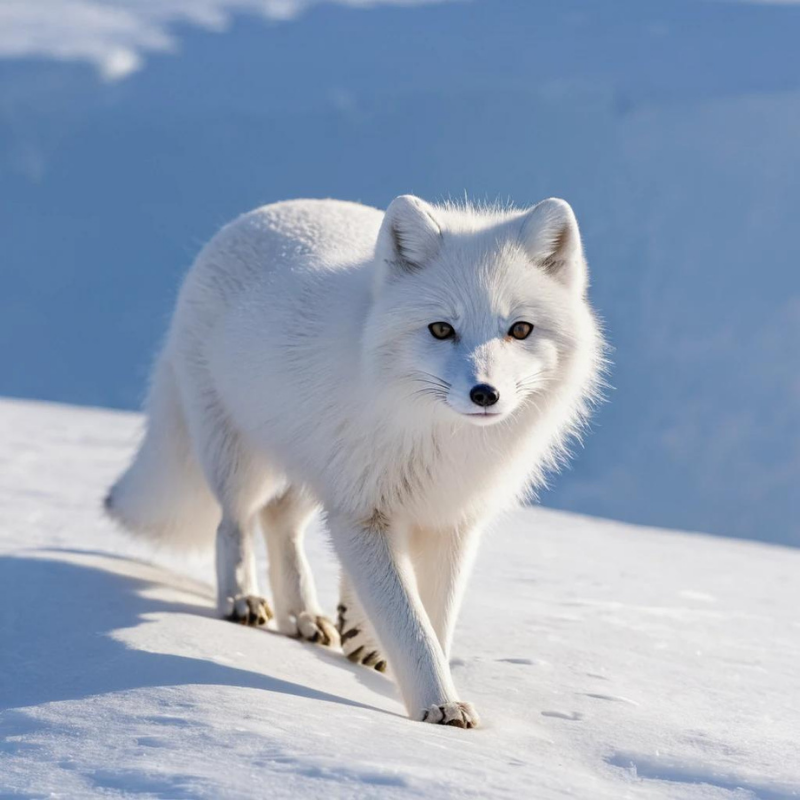
The Arctic fox is the smallest canid of the Arctic and, by several measurable standards, the most extreme cold-weather mammal on Earth. Vulpes lagopus maintains a normal core body temperature at ambient air temperatures down to minus seventy degrees Celsius - a cold tolerance unmatched in any other mammal.
It undergoes the most dramatic seasonal coat change of any species in the world, shifting from pure winter white to brown-grey summer. It walks thousands of kilometres across sea ice between continents, follows polar bears for days at a time to scavenge from their kills, and survives a climate that exterminates almost every warm-blooded animal unadapted to it.
This guide covers every important aspect of Arctic fox biology and ecology: size and anatomy, the insulation system that enables minus-seventy-Celsius activity, the seasonal moult, lemming-driven population cycles, hunting and scavenging behaviour, the partnership with polar bears, continental-scale migrations, the Scandinavian conservation crisis, the Icelandic success story, reproduction, and the strange details that set the species apart from every other member of the dog family.
It is a reference entry, not a summary - so expect specifics: kilograms, kilometres, temperatures, populations, and verified records.
Etymology and Classification
The scientific name Vulpes lagopus combines the classical Latin word for fox - vulpes - with the Greek compound lagopus, meaning "hare-footed". The species was first formally described by Carl Linnaeus in 1758 as Canis lagopus and later moved into the "true fox" genus Vulpes along with the red fox, the fennec fox, the swift fox, and the kit fox.
The "hare-footed" reference is literal: the soles of an Arctic fox's feet are completely fur-covered, pads included, a trait found on no other canid and superficially reminiscent of the fur-padded feet of Arctic hares.
The common English name "Arctic fox" has multiple alternatives in regional use, including "polar fox", "white fox", "snow fox", and - for the non-white colour morph - "blue fox". The prefix "Arctic" itself carries a strange zoological echo: the word comes from the Greek arktikos, meaning "of the bear", originally referring to the Great Bear constellation that hangs over the northern sky.
The Arctic fox is therefore etymologically "the bear-country fox" - an accidental fit for a species that spends much of its winter shadowing actual bears across the ice.
Genetic analysis places the Arctic fox firmly within the "true fox" clade but as a distinctive early-diverging member. Mitochondrial DNA suggests that Arctic foxes split from their nearest living relatives, the North American kit fox and swift fox, roughly two to three million years ago during early Pleistocene cooling.
There is no evidence of interbreeding with the red fox in the wild, although the two species overlap in several hundred kilometres of sub-Arctic tundra. Wherever red foxes push north - a process accelerating under climate change - they outcompete Arctic foxes for dens and food, and Arctic foxes retreat or disappear locally. The two species are genetically incompatible enough that no viable hybrids have been documented.
Roughly four recognised subspecies exist, all very similar in body form but differing in colour-morph frequencies and size: V. l. lagopus across most of the mainland Arctic, V. l. fuliginosus in Iceland, V. l. pribilofensis on the Pribilof Islands, and V. l. beringensis on the Commander Islands. None of these distinctions are large enough to warrant species separation under modern genetic standards.
Size and Physical Description
Arctic foxes are small. The winter coat gives a deceptive impression of a much larger animal, but underneath the fluff the skeleton is closer to a small domestic cat than to a medium dog. This is not accidental: every centimetre of extra limb length or ear size represents extra surface area that leaks heat in a minus-fifty-Celsius wind.
Males:
- Body length: 50-68 cm from nose to base of tail
- Tail length: 30-43 cm
- Shoulder height: 25-30 cm
- Weight: typically 3.2-9.4 kg
Females:
- Body length: 46-62 cm
- Tail length: 28-40 cm
- Shoulder height: 25-28 cm
- Weight: typically 2.9-5.0 kg
Kits at birth:
- Length: roughly 10-12 cm
- Weight: 80-90 grams - about the size of a tennis ball
Males run slightly larger than females, but sexual dimorphism is modest - far less pronounced than in wolves or in polar bears. The tail is exceptionally bushy in proportion to body length, often carried low behind the animal as it moves and wrapped over the face when the fox curls up to sleep. Functionally the tail serves three purposes: a balancing rudder at full sprint, a warm insulating wrap when resting, and a visual signalling flag in social encounters between foxes.
Body proportions are a textbook case of Allen's rule, which predicts that warm-blooded animals in cold climates should evolve shorter limbs and smaller extremities than relatives in warmer climates. The Arctic fox has the shortest ears of any canid, the shortest muzzle relative to skull length, the shortest legs relative to body length, and the smallest total extremity surface area of any fox.
Compared with a similarly sized red fox living two thousand kilometres south, the Arctic fox loses roughly thirty per cent less heat through its ears, muzzle, and feet combined.
The coat is the densest and most insulating fur of any mammal measured. A dense woolly underfur traps a motionless layer of air against the skin. Longer guard hairs shed water, snow, and wind. On the flanks the winter coat exceeds ten centimetres total thickness in prime adults.
Even the soles of the feet are fur-covered, pads and all, so that the fox walks silently on snow and does not lose heat through contact with frozen ground. This is the feature the species name commemorates: lagopus - hare-footed.
Eye colour is amber-brown in adults with slightly oval pupils. Vision is excellent in low light, which is essential in a habitat that spends much of the winter in continuous twilight or full polar night. Hearing is acute enough to locate lemmings moving beneath forty-five centimetres of snow, and the fox triangulates the sound precisely enough to break through the crust in a single plunging pounce.
Built for Minus Seventy Celsius
The Arctic fox is the most cold-tolerant mammal on Earth. Physiological studies published in Comparative Biochemistry and Physiology and Journal of Thermal Biology confirm that Arctic foxes do not begin to elevate their metabolism above basal levels until ambient temperatures drop below roughly minus forty Celsius, and they can maintain normal core body temperature down to minus seventy Celsius.
No other mammal comes close. A human at minus seventy Celsius is in immediate lethal danger. A polar bear at the same temperature is burning fat rapidly to stay warm. An Arctic fox at minus seventy Celsius can be sleeping in open snow.
Several adaptations stack to achieve this.
Insulation layers:
- Dense woolly underfur with the highest insulation value of any measured mammal fur
- Long guard hairs, 5-8 cm, water and wind shedding
- Complete fur coverage on feet, including pads
- Subcutaneous fat, 2-4 cm thick on flanks, building to 20-30% of body mass by late autumn
Body-form features:
- Compact rounded torso with favourable volume-to-surface ratio
- Shortest ears of any canid
- Short muzzle, short legs, small extremities
- Tail as supplementary insulator during rest
Circulatory features:
- Counter-current blood flow in the legs that cools blood on the way out and warms it on the way back, keeping the paw pads only slightly above freezing
- Constricted peripheral blood flow to reduce heat loss in extremities
- Metabolic pathways capable of rapid thermogenic response when food is abundant
Behavioural features:
- Curls into a tight ball, tucks nose and paws under the brush, and sleeps in snow hollows
- Digs shallow snow tunnels for shelter in blizzards
- Uses the same ancestral den systems - some continuously occupied for centuries - to raise successive litters
A single adaptation on its own would not be enough. What distinguishes the Arctic fox is that every one of these systems operates at an extreme calibrated to Arctic conditions. Remove any one - the fur density, the counter-current leg circulation, the fat layer, the compact body form - and the species would not survive a circumpolar winter.
An interesting side effect is that Arctic foxes can overheat in relatively mild conditions. Above roughly five degrees Celsius they begin to show visible panting, especially after exertion. This is why summer coats are so much thinner than winter coats: the same insulation that keeps a fox alive in January would cook it in July.
Hunting, Scavenging, and Diet
The Arctic fox is an opportunistic omnivore, but its diet is powerfully shaped by one prey species: the lemming. In continental tundra populations, lemmings and voles can make up sixty to ninety per cent of annual diet by bite count. Arctic fox populations rise and fall on a three-to-five-year cycle that tracks the lemming population cycle with striking precision.
In a good lemming year, Arctic foxes breed in high numbers and raise huge litters. In a crash year, many foxes fail to breed at all and some die of starvation.
Primary prey (continental populations):
- Brown lemming (Lemmus species)
- Collared lemming (Dicrostonyx species)
- Voles (various Microtus species)
- Arctic hares (occasional, large prey)
Secondary and opportunistic prey:
- Ptarmigan and other ground birds
- Seabird eggs (cached in permafrost for later)
- Waterfowl chicks and nesting adults
- Fish (coastal populations)
- Insects and larvae (brief summer windfall)
- Crowberries and other tundra fruits (autumn only)
Scavenged foods:
- Polar bear seal-kill remains
- Washed-up marine mammal carcasses
- Reindeer and caribou that die on the tundra
- Refuse near settlements and research stations
Hunting techniques:
- Snow-pounce on lemmings. The fox walks quietly across snow, stops with head tilted, and listens for rustling or scratching under the surface. Triangulating the sound, it leaps straight upward and plunges nose-first through the snow crust to grab the prey in a single motion. Success rates in Scandinavian field studies range between thirty and sixty per cent per pounce.
- Shadowing polar bears. Individual foxes track specific bears across sea ice, often for days or weeks at a time. They stay fifty to two hundred metres back, wait for the bear to kill and feed on a seal, and move in to scavenge the remains once the bear leaves. Polar bears typically eat only the blubber and skin, leaving most muscle meat and organs behind - one bear kill can sustain a fox for several days.
- Cliff-foot foraging. Coastal foxes patrol the base of seabird cliffs for fallen chicks, eggs rolled off ledges, and adult birds injured in squabbles.
- Egg caching. During summer seabird colonies, foxes may collect hundreds of eggs in a single week, burying each one individually in permafrost for retrieval in winter. Some cached eggs have been recovered nearly a year later, still edible.
Hunting success is strongly affected by snow conditions. Hard-packed, icy snow defeats the plunge-pounce and makes lemmings inaccessible even when the fox can hear them perfectly. This is one reason why thawing-and-refreezing winters, increasingly common under climate change, hit Arctic fox populations hard even when summer food is abundant.
The Seasonal Coat Change
The Arctic fox undergoes the most dramatic seasonal coat change of any mammal on Earth. No other species transforms so completely, so regularly, between two essentially different-looking animals. In winter the white-morph fox is nearly pure white from nose to tail with a faint creamy shading on the underside. In summer the same individual has moulted into a brown, grey, or chocolate coat on the back and flanks with a cream or pale belly.
The moult cycle:
- Spring moult: March to June
- Summer coat: July to August
- Autumn moult: September to November
- Winter coat: December to February
The trigger is day length rather than temperature. Melatonin signalling from the pineal gland responds to photoperiod changes and drives the cycle of follicle shutdown, shedding, and regrowth. A captive Arctic fox kept under artificial lighting can be pushed into a mid-summer white coat or a mid-winter brown coat by manipulating the light cycle, confirming that temperature plays little direct role.
A separate genetic morph, the "blue morph", does not undergo the full seasonal change. Blue-morph foxes are charcoal, dark grey, or chocolate-brown year-round, with only minor shifts in shade and texture between seasons. The blue morph is controlled by a single dominant allele at a pigment locus.
In continental tundra populations fewer than five per cent of foxes are blue, but in several island populations the frequency is much higher. On the Pribilof Islands and parts of Iceland, more than half of all Arctic foxes are blue morph, and on some small offshore islands the blue form is nearly universal.
Both morphs are genetically, reproductively, and ecologically the same species - they interbreed freely, and a white-morph pair can produce blue-morph kits.
The seasonal transition is not instantaneous. In April and May a moulting fox looks visibly patchy, with ragged clumps of winter coat still clinging to a partly emerged summer coat. This intermediate stage gives the animal an awkward, motley appearance that is rarely photographed. Photographers prefer the clean winter and summer forms.
Life Cycle and Reproduction
Arctic fox reproduction is tightly coupled to prey availability. In a good lemming year a pair may raise an enormous litter. In a bad year the same pair may skip breeding entirely.
Pair formation happens in late winter. Most Arctic foxes are socially monogamous during the breeding season, with both adults provisioning the litter. Extra adults - often unmated yearling females from the previous year's litter - sometimes help at the den, a cooperative-breeding arrangement documented particularly on Svalbard. Mating takes place in March or April.
After a gestation of forty-nine to fifty-seven days, kits are born in May or June inside a deep earth den, typically on well-drained tundra ridges or coastal cliffs. Dens are enormous, multi-entrance tunnel systems that accumulate over centuries of successive fox generations. Some Norwegian dens show evidence of continuous use for more than three hundred years.
Denning cycle:
- Late March to April: mating
- May to June: kits born
- June to August: kits emerge, learn to forage with parents
- September to October: kits disperse
- October onward: parents separate or remain together
Litter size is where the species shows its most extreme biology. Average litters run five to nine kits - already large for a canid. In lemming peak years, litters of fifteen to twenty are well documented. The verified maximum is twenty-five kits in a single den, the largest litter known for any wild canid. This reproductive elasticity is how Arctic fox populations track the lemming cycle. When food is abundant the species converts it into kits at a rate no other canid approaches.
Kits are born altricial - blind, deaf, and helpless - and weigh roughly eighty to ninety grams. They begin to emerge from the den at three to four weeks, are weaned at six to eight weeks, and start following parents on short foraging trips by ten weeks. Dispersal typically happens in early autumn, with young foxes travelling tens to hundreds of kilometres before settling in their own first-winter range.
Wild Arctic foxes rarely live past six years. Typical wild lifespan is three to six years. Mortality is heavy in the first winter - starvation during lemming crash years, predation by golden eagles, wolves, wolverines, and even other foxes. Captive Arctic foxes live dramatically longer. Individuals in European zoos have reached fourteen and fifteen years with ready food and veterinary care.
Movement, Migration, and Sea Ice
Arctic foxes are among the most mobile terrestrial mammals on Earth. Routine winter movements of one hundred to five hundred kilometres are common. Exceptional long-distance journeys have been documented that rival the great migrations of caribou or wildebeest, on a per-body-mass basis.
Movement data:
| Metric | Value |
|---|---|
| Typical daily walking range | 15-30 km |
| Peak 24-hour distance | 155 km (Svalbard tracking study) |
| Longest recorded migration | 4,415 km in 76 days (Svalbard to Ellesmere Island) |
| Typical sprint speed | 40-50 km/h over short distances |
| Lifetime range of a territorial pair | often 5-60 km^2 in productive habitat |
The record-holding Arctic fox was a young female collared by the Norwegian Polar Institute in Svalbard in July 2017.
Over the following seventy-six days she walked from Spitsbergen across the sea ice to northern Greenland, then continued across the Nares Strait ice to Ellesmere Island in the Canadian Arctic Archipelago - a straight-line displacement of roughly three thousand five hundred kilometres and a ground-track distance of four thousand four hundred and fifteen kilometres. The average pace was forty-six kilometres per day.
One twenty-four-hour period recorded a movement of one hundred and fifty-five kilometres. The journey settles, on current evidence, as one of the longest confirmed land-mammal migrations ever recorded.
Arctic foxes use sea ice as a highway between landmasses. They have been recorded more than a thousand kilometres from the nearest coast on drifting ice floes. Individuals leave one continent in winter and arrive on another several months later, sometimes permanently. This sea-ice mobility is essential to the species' long-term genetic health across the circumpolar range. It is also vanishing.
Multi-year pack ice has declined dramatically since the 1980s, and fewer bridges now exist between Arctic landmasses than at any time in at least several thousand years. Genetic isolation of island populations is already measurable.
Populations, Range, and Subpopulations
The Arctic fox is a circumpolar species. Its range includes northern Canada, Alaska, Greenland, Iceland, Svalbard, Scandinavia, and northern Russia from the Kola Peninsula east to Chukotka and the Bering Strait. Range boundaries approximately match the treeline - Arctic foxes do not persist in continuous forest. Red foxes, better suited to forested and mixed habitat, outcompete Arctic foxes wherever the two meet.
Approximate population distribution:
| Region | Estimated population | Status |
|---|---|---|
| Russia | 100,000-200,000 | Stable |
| Canada | 50,000-100,000 | Stable |
| Alaska (USA) | 10,000-30,000 | Stable |
| Greenland | 10,000-25,000 | Stable |
| Iceland | 8,000-10,000 | Stable, recovering from past culling |
| Svalbard (Norway) | 2,000-3,000 | Stable |
| Scandinavia | ~550 (120 in Norway) | Endangered, recovering |
Iceland's Arctic foxes are a unique case. They are the country's only native land mammal, having walked across sea ice at the end of the last glaciation roughly ten thousand years ago and become genetically isolated ever since. Historical persecution nearly wiped them out in the early twentieth century, but population recovery since the 1970s has been strong, and Iceland's fox population today is robust.
Scandinavia is the species' crisis zone. The mainland population of Norway, Sweden, and Finland collapsed catastrophically during the twentieth century from historical fur-trapping, habitat change, and competition from expanding red foxes. By the year 2000, fewer than forty breeding adults remained across the entire three-country region.
A coordinated conservation response - captive breeding at Saeterfjellet in Norway, supplemental feeding stations, targeted red fox culling, and cross-border monitoring - has since reversed the decline. Recent estimates put the Scandinavian total above five hundred and fifty individuals, with roughly one hundred and twenty breeding adults in Norway alone.
The programme is a significant ongoing success in Arctic conservation, although the population remains classified as Endangered at the national level.
Conservation Status and Threats
The IUCN Red List classifies the Arctic fox globally as Least Concern. The species is abundant across most of its range, with a total population of several hundred thousand animals and a stable overall trend. However, several regional populations and long-term threats warrant attention.
Primary threats:
- Climate change and red fox expansion. Warming tundra is allowing red foxes to push northward into Arctic fox habitat. Red foxes are larger, more aggressive, more omnivorous, and better competitors in mixed vegetation. Where the two species meet, red foxes take over Arctic fox dens, kill Arctic fox kits, and displace adults. This is the single most important long-term threat to the species across its mainland range.
- Sea ice loss. Multi-year Arctic pack ice has declined by roughly forty per cent since 1979. Less ice means fewer opportunities to scavenge polar bear kills, fewer bridges between landmasses, and less long-distance gene flow. Island populations are becoming more isolated.
- Lemming cycle disruption. Warmer and wetter winters create ice crusts that seal lemmings away from foraging predators and also drown lemming populations in their burrows. Several Scandinavian and Svalbard regions have seen their multi-decadal lemming cycle flatten or collapse in the past twenty years. Arctic foxes in those regions struggle to breed.
- Disease spillover. Expanding contact with red foxes and domestic dogs brings canine distemper, sarcoptic mange, and rabies. The Svalbard population is under particular rabies monitoring.
- Historical fur trapping. Once a major threat across the entire range, fur trapping is no longer significant anywhere except locally. Most range states either ban or tightly regulate Arctic fox harvest.
- Industrial development. Oil, gas, and mining infrastructure in the Russian and Alaskan Arctic creates localised disturbance to dens and migration routes.
Several conservation tools are in active use. The Scandinavian captive-breeding-and-release programme is the best-documented and most successful intervention. Supplemental feeding during lemming crash years has been shown to raise breeding rates. Targeted red fox culling near Arctic fox core habitat in Norway and Sweden has measurable positive effects on fox persistence.
Protected areas cover a meaningful fraction of core denning habitat across the range, particularly in Russia and Canada. The global polar bear agreement indirectly benefits Arctic foxes by protecting shared sea-ice habitat.
As with most cold-climate specialists, the ultimate long-term outlook depends on climate trajectory. Arctic foxes have evolved to exploit an ecological niche - the coldest land habitat on Earth - that is physically shrinking. No conservation programme can replace the climate the species evolved for.
Arctic Foxes and Humans
Arctic foxes have held a lasting place in the cultures of circumpolar peoples. Inuit, Sami, Chukchi, Yakut, and other northern communities have hunted Arctic foxes for fur, food, and ceremonial purposes for thousands of years.
The white winter pelt was a historically valuable trade item, and at the height of the North American and Russian fur trades in the late nineteenth and early twentieth century the species was hunted on an industrial scale - especially the rarer and more valuable blue morph, which was selectively trapped and in some island populations deliberately introduced to produce more pelts.
Modern relationships with human settlements are mixed. Arctic foxes are bold around research stations, field camps, and small coastal villages. They will investigate rubbish, steal boots, chew through tent guy-lines, and approach humans much more closely than red foxes do. This confidence reflects a life history evolved in a habitat with few large terrestrial predators - the fox has not learned the reflexive human-avoidance that shapes red fox behaviour in Europe.
Tourism around Arctic foxes is growing, particularly in Iceland, where dedicated observation sites allow visitors to photograph foxes at close range without disturbance. Responsible operations provide meaningful income to rural communities and create an economic incentive for conservation. Irresponsible operations habituate foxes to handouts and can draw them into fatal encounters with vehicles and domestic dogs.
Rabies is a concern in several parts of the range, particularly Svalbard and parts of Russia. Visitors are warned not to approach foxes, both for their own safety and because individual animals that seek human contact are more likely to be infected.
Related Reading
- Red Fox (Vulpes vulpes)
- Gray Wolf (Canis lupus)
- Wolves and Wild Canines: Pack Hunters of the Wild
- Polar Bear (Ursus maritimus)
- How Wolf Packs Actually Work
References
Relevant peer-reviewed and governmental sources consulted for this entry include IUCN Red List assessment for Vulpes lagopus (2022), the Norwegian Polar Institute's Svalbard fox tracking studies (2017-2019), the Norwegian Institute for Nature Research's long-running Scandinavian Arctic fox recovery monitoring programme, the Icelandic Institute of Natural History's annual fox population surveys, and published research in Polar Biology, Journal of Mammalogy, Oikos, Comparative Biochemistry and Physiology, and Journal of Thermal Biology.
Specific population figures reflect the most recent consolidated regional assessments as of 2024.
Frequently Asked Questions
How big are Arctic foxes?
Arctic foxes (Vulpes lagopus) are the smallest canid of the Arctic and substantially smaller than a red fox. Body length runs 46-68 cm from nose to base of tail, with a bushy 28-43 cm tail. Shoulder height is 25-30 cm. Weight varies between 2.9 and 9.4 kg, though most adults sit between 3 and 5 kg. Males average slightly larger than females.
The dense winter coat exaggerates apparent body size by 30-40%, which is why photographs give the impression of a much larger animal than the skinny summer form reveals. Kits are born at 80-90 grams, roughly the size of a tennis ball.
What do Arctic foxes eat?
Arctic foxes are opportunistic omnivores dominated by one prey species: the lemming. In continental tundra populations lemmings and voles can make up 60-90% of annual diet by bite count. Arctic fox populations rise and fall on a 3-5 year cycle that tracks the lemming population cycle with striking precision. Coastal populations rely more heavily on seabirds, eggs, and marine carrion, especially washed-up seals and fish.
Many individuals shadow polar bears across the pack ice for days at a time, scavenging from abandoned seal kills. Other regular foods include ptarmigan, hares, fish, crowberries, crowberry-like fruits, and insects in summer. In lean lemming years foxes cache surplus food, raid seabird colonies for eggs they bury in permafrost, and occasionally consume their own or other foxes’ faeces to recycle undigested nutrients.
Where do Arctic foxes live?
The Arctic fox is circumpolar. It occupies tundra and coastal habitats across the entire Arctic, including northern Canada, Alaska, Greenland, Iceland, Svalbard, Scandinavia, and northern Russia from the Kola Peninsula to Chukotka. The species also ranges out onto pack ice, where individuals may spend weeks or months following polar bears.
It is one of the most northerly terrestrial mammals on Earth, recorded as far north as 88 degrees on drifting ice floes. Habitat is typically treeless tundra with low shrubs, lichen mats, and permafrost, but coastal populations use sea-cliff nest colonies and beach carrion. In Iceland, Arctic foxes are the only native land mammal.
The species does not persist south of the tree line in any continuous range - red foxes outcompete Arctic foxes wherever the two meet.
How do Arctic foxes survive -70 C winters?
The Arctic fox is the most cold-tolerant mammal on Earth, capable of maintaining normal body temperature at ambient temperatures down to -70 degrees Celsius. Several adaptations stack to achieve this. The winter coat has the highest insulation value of any mammal fur measured, with a dense woolly underfur and long guard hairs that together can exceed 10 cm thickness on the flanks.
The body form is compact - short ears, short muzzle, short legs, small extremities - minimising surface area. The soles of the feet are completely fur-covered, a trait reflected in the species name lagopus (‘hare-footed’). Counter-current blood flow in the legs keeps the paw pads only slightly above freezing, conserving core heat. A layer of subcutaneous fat builds up heavily in autumn - healthy foxes arrive at winter carrying 20-30% body fat.
Behaviourally the fox curls into a ball, tucks its nose and feet under its brush, and can sleep in open snow at -50 C without visible distress.
Why do Arctic foxes change colour?
The seasonal coat change of the Arctic fox is the most dramatic in the mammal world. In winter the white-morph fox is nearly pure white from nose to tail, providing almost perfect camouflage against snow and ice. In summer the same animal moults to a brown, grey, or chocolate coat on the back and flanks with a cream or pale belly, blending into rock, lichen, and exposed soil.
The moult is triggered by day length rather than temperature and takes about three months at each transition, with the biggest visible change in late spring and late autumn. A second genetic morph - the ‘blue morph’ - does not change colour, staying a charcoal or chocolate grey year-round. Blue morphs are rare in continental tundra (under 5% of foxes) but common on Arctic islands, where some Icelandic and Aleutian populations are more than half blue.
Both morphs are the same species.
Why do Arctic foxes follow polar bears?
Arctic foxes have a long-standing ecological partnership - one-sided, from the bear’s point of view - in which individual foxes track polar bears for days or weeks at a time across sea ice. The fox hangs back at a safe distance, usually 50-200 metres, and waits for the bear to kill and feed on a seal. Polar bears typically eat only the blubber and skin of a seal, leaving most of the muscle meat and organs behind.
The fox moves in once the bear leaves and scavenges the remains. Tracking studies show that individual foxes may follow specific bears across hundreds of kilometres of pack ice. The behaviour is most important in winter, when lemmings are locked under snow and terrestrial prey becomes scarce. A single polar bear kill can feed a fox for several days.
How far do Arctic foxes migrate?
Arctic foxes are among the most mobile terrestrial mammals on Earth. Routine winter movements of 100-500 km are common, and truly exceptional journeys have been documented. The current record holder is a young female tracked by Norwegian Polar Institute researchers who walked 4,415 km in 76 days from Svalbard across the sea ice to Ellesmere Island in the Canadian Arctic Archipelago - an average of 46 km per day, with one 24-hour stretch covering 155 km.
These long movements follow ice cover and food availability rather than a fixed migration route. Arctic foxes use sea ice as a highway between landmasses and have been recorded more than 1,000 km from the nearest coast. The loss of multi-year pack ice is reducing the frequency of these long crossings and may be genetically isolating island populations.
Are Arctic foxes endangered?
Globally the Arctic fox is classified as Least Concern by the IUCN, with an estimated population of several hundred thousand and a stable overall trend. However, the Scandinavian subpopulation - covering Norway, Sweden, and Finland - is classified as Endangered at the national level and was nearly extinct by 2000, with fewer than 40 breeding adults across the entire region.
A coordinated captive-breeding-and-release programme, combined with red fox culling and supplemental feeding, has since pushed the Scandinavian total back above 550 individuals, with the most recent estimates showing roughly 120 breeding adults in Norway alone. Iceland’s population, by contrast, is healthy and abundant at around 8,000-10,000 individuals.
The main long-term threats to the species are climate change (which reduces snow cover and favours the more competitive red fox), sea-ice loss (which limits access to polar bear kills and long-distance movement), and disease spillover from red foxes and dogs.