
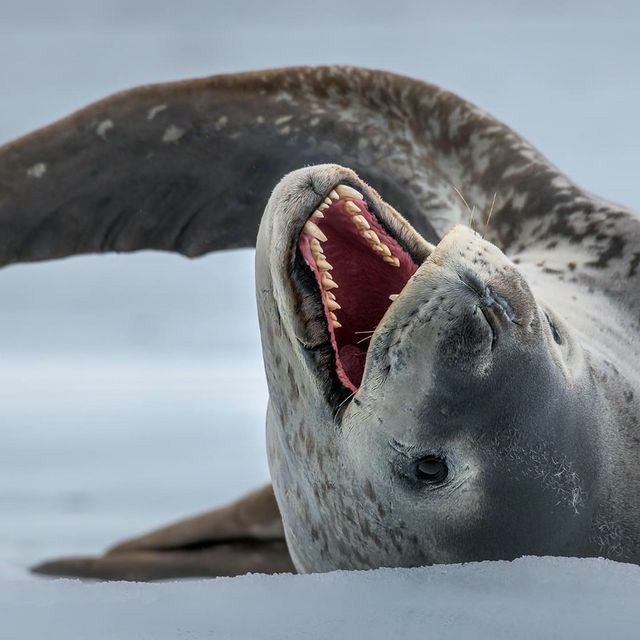
The leopard seal is the apex pinniped predator of Antarctic waters. Only the orca ranks above it in the Southern Ocean food web, and only the southern elephant seal grows larger among true seals.
Hydrurga leptonyx is a solitary, cold-adapted hunter with a long reptile-like skull, canine teeth that reach four centimetres in length, and a diet that swings between filter-fed krill and warm-blooded vertebrates - including penguins, fish, and other seals.
It is one of only two seal species that regularly kill and eat warm-blooded prey, and the only documented human fatality caused by any seal in history was a leopard seal attack in 2003.
This guide covers every aspect of leopard seal biology and ecology: size, habitat, hunting, diet, vocalisations, reproduction, conservation, and the two famous human encounters - the 2003 death of marine biologist Kirsty Brown and the 2006 photographic encounter between Paul Nicklen and a female leopard seal who tried to feed him penguins. It is a reference entry, not a summary, so expect specifics: kilograms, metres, tooth measurements, frequencies, and dates.
Etymology and Classification
The scientific name Hydrurga leptonyx was coined by French naturalist Henri Marie Ducrotay de Blainville in 1820. Hydrurga derives from the Greek for 'water worker', a nod to the species' fully aquatic hunting life, while leptonyx means 'slender-clawed', describing the unusually delicate foreclaws compared to other seals.
Early English-speaking whalers and sealers called the animal the 'sea leopard' because of the dark grey mottled spots scattered across its silver-grey flanks - a pattern that remains the species' most recognisable feature.
Leopard seals sit within the family Phocidae, the true or earless seals, distinguished from fur seals and sea lions (family Otariidae) by the absence of external ear flaps and by hind flippers that cannot rotate forward to support terrestrial locomotion. Within Phocidae they belong to the southern lineage, the Monachinae, alongside the crabeater seal, Weddell seal, Ross seal, southern elephant seal, and monk seals.
Molecular data place the leopard seal's closest living relatives among the Antarctic phocids - particularly the crabeater and Ross seals - with the lineage diverging several million years ago.
Hydrurga is a monotypic genus: H. leptonyx is the only living species. No recognised subspecies have been described, despite the enormous circumpolar range.
Size and Physical Description
Leopard seals are the second-largest seal species on Earth. Only the southern elephant seal, whose males can exceed 4,000 kg, outweighs them. Within the species, females are larger than males - a reversed sexual dimorphism that is rare among pinnipeds and unusual among large mammals generally.
Females:
- Length: 2.9-3.8 metres
- Weight: typically 260-500 kg, record individuals over 600 kg
- Sexually mature from about age 3-4
Males:
- Length: 2.8-3.3 metres
- Weight: typically 200-300 kg
- Sexually mature from about age 4-6
Pups:
- Length at birth: approximately 1.2 metres
- Weight at birth: roughly 30 kg
- Weaned at 4 weeks, at which point they may already weigh 100-120 kg
The leopard seal body plan is unmistakable once you have seen it. The torso is long and serpentine rather than barrel-shaped, the neck is notably elongated compared with other seals, and the head is large, flat, and distinctly reptilian in profile.
Many observers say a leopard seal opening its jaws looks more like a crocodile or a large snake than a mammal, and this impression is reinforced by the wide gape - roughly 160 degrees - that lets the animal swallow a king penguin in three or four gulps.
The fur is short, dense, and countershaded: a dark silver-grey dorsal surface shades into a pale silver-white belly. Scattered dark spots and blotches across the flanks give the species its common name. Individual spotting patterns are unique, and researchers use them for photographic identification in long-term population studies.
Teeth, Skull, and Jaws
The leopard seal's dentition is one of the most specialised in the mammalian world. The upper canines exceed 4 cm in total length, with roughly 2.5 cm exposed above the gum, and they are pointed, recurved, and backed by similarly long lower canines. The cheek teeth, however, are not simple carnivore shears. Each postcanine tooth is tricuspid, with three interlocking cusps that mesh with those of the opposing jaw to form a sieve - almost identical in form to the cheek teeth of the crabeater seal.
This dual-purpose dentition is the anatomical expression of the species' unusual diet. The canines grip and tear warm-blooded prey - penguins, seals, and occasionally fish - while the tricuspid sieve filters Antarctic krill from mouthfuls of seawater. Few large carnivores carry tools for both hypercarnivory and filter feeding in the same skull.
The skull itself is long, low, and flat, with an elongated muzzle and widely spaced eye sockets. The jaw hinge is positioned far back on the skull to maximise gape. X-ray and CT studies show that the bite force is modest compared with a comparably sized terrestrial carnivore; the leopard seal relies on its teeth and neck strength, not crushing power, to subdue prey.
Habitat and Range
Leopard seals are circumpolar in the Southern Ocean. Their core habitat is the seasonal pack ice that encircles Antarctica, where they haul out on ice floes between hunts and give birth in early austral summer. During the Southern Hemisphere winter they stay close to the ice edge. In summer many individuals disperse northward to sub-Antarctic islands, concentrating around penguin colonies on South Georgia, the South Shetlands, the South Orkneys, Heard Island, Kerguelen, Bouvet, and Macquarie.
Vagrants appear surprisingly far from Antarctica. Individuals have been recorded hauled out in Tasmania, southern mainland Australia, New Zealand's North Island (including Auckland Harbour), Patagonia, the Falklands, Tristan da Cunha, and the southern coast of South Africa. Most of these wandering animals are young, thin, and disoriented, and relatively few survive long enough to return south.
Seasonal pattern:
| Season (Southern Hemisphere) | Typical distribution |
|---|---|
| Spring (Sep-Nov) | Pack ice; males singing underwater for mates |
| Summer (Dec-Feb) | Pack ice and sub-Antarctic penguin colonies |
| Autumn (Mar-May) | Dispersal; juveniles sometimes vagrants northward |
| Winter (Jun-Aug) | Pack ice edge; solitary hunting under fast ice |
Unlike walruses or fur seals, leopard seals are almost entirely solitary. Aggregations form only at prey hotspots - a colony of fledging penguins, a carcass, a breach in the ice that funnels prey. Even then, individuals tolerate one another at a distance rather than socialising. Mothers with pups briefly form the only stable social unit in the species.
Hunting and Diet
Leopard seals are opportunistic apex predators, and their prey spectrum is among the broadest of any marine mammal. Stomach content studies, stable isotope analysis, and direct observation give a consistent picture of mixed feeding that shifts with season, age, and local prey availability.
Approximate dietary composition by volume:
- Antarctic krill (Euphausia superba): 45 per cent
- Penguins (Adelie, chinstrap, gentoo, king, emperor): 20-25 per cent
- Fish (Antarctic silverfish, icefish, notothenioids): 10-15 per cent
- Squid and octopus: 5-10 per cent
- Other seals (crabeater, Weddell pups, fur seal pups): 5-10 per cent
- Seabirds other than penguins, carrion: balance
Krill feeding. During krill swarms, a leopard seal swims open-mouthed through dense aggregations, closes its jaws, and forces water out between the interlocking tricuspid cheek teeth, retaining the krill inside. It is the same filter mechanism used by crabeater seals, and it is very efficient: a leopard seal can consume many thousands of krill in a single feeding bout.
Penguin hunting. The species' most famous behaviour. A leopard seal patrols the submerged edge of an ice shelf or the access channel below a fledging penguin colony, then strikes upward as birds enter or leave the water. Once caught, the penguin is usually carried back to the surface and thrashed violently from side to side.
The force peels the skin away in a single motion, leaving the carcass skinned and ready to be swallowed in several large pieces. This flaying behaviour is one of the most recognisable hunting signatures in marine mammals.
Seal hunting. Leopard seals are among the very few mammals that routinely prey on other members of their own family. The most common victims are crabeater seal pups, whose distinctive scars - often from non-fatal attacks survived in early life - can be seen on an estimated 78 per cent of crabeater adults. Weddell seal pups and young Antarctic fur seals are also taken. Adult seals are rarely targeted, presumably because the energetic cost and risk of injury are too high.
Success rates and energetics. Field observations in sub-Antarctic penguin colonies report leopard seal hunt success ranging from roughly 10 per cent on experienced adult penguins to over 50 per cent on naive fledglings. A single large female can consume 30-50 kg of food per day during peak feeding, which translates to an adult penguin every hour or two during a successful fledging event.
Vocalisations and the Underwater Song
Leopard seals are among the most vocal of all seals, and their underwater song is one of the strangest sounds in the natural world. Males sing during the austral spring, typically from late October through early January, coinciding with the female reproductive window.
A singing male hangs vertically in the water column, head down, and produces a stereotyped set of calls on repeat. Typical elements include:
- Ascending trills - rapid pulse sequences that rise several kilohertz
- Long, low moans - mournful tones that can last 15 seconds or more
- Double and triple low knocks - percussive clicks at 100-300 Hz
- High whistles - sharp, almost metallic tones at several kilohertz
A full song cycle can last five to ten minutes, and an individual male may sing for hours - sometimes more than half the day during peak season. The sound carries remarkable distances through cold, dense Antarctic water and is routinely picked up on hydrophones many kilometres from the singer.
Signature call structure is individual. Researchers can identify specific males across years from their stereotyped call order. Regional dialects exist between Antarctic populations, suggesting vocal traditions propagate locally. The function of the song is not fully resolved, but combined evidence points to mate attraction, territorial advertisement, and possibly long-distance social contact in a species that is otherwise almost entirely solitary.
Life Cycle and Reproduction
Leopard seal reproduction is tied to the Antarctic ice cycle. Females give birth on the pack ice in the late austral spring, usually from November through early January. Each female produces a single pup.
Breeding cycle:
- Nov-Jan: Pup birth on pack ice; weaning after approximately 4 weeks
- Dec-Feb: Mating occurs in water shortly after weaning
- Mar-Jul: Delayed implantation; embryo does not develop
- Jul-Nov: Active gestation (~7 months)
Total gestation is roughly 11 months including the delayed implantation phase. This reproductive pause allows the female to decouple birth timing from mating opportunity, ensuring pups arrive at the point of maximum seasonal prey abundance.
Pups are born covered in a thick natal coat and nurse from milk that is roughly 40 per cent fat. Growth is extraordinarily fast: a pup can triple in weight in its four-week nursing period, then be weaned abruptly. After weaning the mother departs; the pup is left alone to teach itself to hunt. First-year mortality is high and poorly quantified but likely exceeds 50 per cent in many populations.
Females reach sexual maturity at 3-4 years, males at 4-6 years. The sex ratio at birth appears balanced, but because females are larger and possibly longer-lived, the adult sex ratio may be slightly female-biased.
The Kirsty Brown Fatality (2003)
On 22 July 2003, British marine biologist Kirsty Brown, age 28, was snorkelling near Rothera Research Station on the Antarctic Peninsula as part of a British Antarctic Survey study. A leopard seal took her from below, pulled her to a depth of approximately 70 metres, and released her. She was recovered by colleagues but could not be resuscitated. The incident is the only documented human fatality caused by any seal species anywhere in the world.
The precise motive is unknown. The seal did not feed on Brown and released her body after the initial attack, behaviour more consistent with an investigative or mistaken-identity response than a predatory one. In the aftermath, the British Antarctic Survey, and subsequently most Antarctic research operators, revised snorkel and dive protocols near pack ice to add dedicated lookouts, larger dive teams, and shore-based spotters.
The Paul Nicklen Encounter (2006)
In 2006, National Geographic photographer Paul Nicklen was working on a story about leopard seals off the Antarctic Peninsula when a large female approached him repeatedly over four days. Instead of attacking or retreating, the seal offered him prey. She brought live penguins and released them near him. When he did not respond, she brought injured penguins.
Then freshly killed ones. Finally, near the end of the encounter, she pushed a partly eaten carcass onto the glass dome of his camera housing.
Biologists interpret the behaviour as misdirected provisioning. The seal may have read Nicklen as an incompetent conspecific or large helpless predator who could not hunt for himself, and responded with the same instinct a mother uses to teach her pup.
The episode produced some of the most widely seen wildlife photographs in recent history and changed how much of the public imagines leopard seals - no longer pure monsters, but inquisitive, intelligent, sometimes almost solicitous animals whose default response to a large slow swimmer is not always aggression.
Nicklen has publicly emphasised that his experience should not be extrapolated: leopard seals remain unpredictable large predators, and the 2003 fatality proves that the species is genuinely capable of killing a human.
Movement and Swimming
Leopard seals are fast, agile swimmers. Cruising speeds are modest - 3-5 km/h during transit - but short burst speeds of up to approximately 40 km/h have been recorded during penguin ambushes. Dive data from satellite-tagged individuals show routine hunting dives of 2-5 minutes to 20-80 m depth, with occasional longer and deeper dives exceeding 10 minutes and 250 metres when necessary.
Typical movement parameters:
| Metric | Value |
|---|---|
| Cruising swim speed | 3-5 km/h |
| Burst swim speed | Up to ~40 km/h |
| Typical hunting dive | 2-5 min to 20-80 m |
| Maximum recorded dive | Over 250 m, beyond 15 minutes |
| Daily haul-out time | 4-8 hours on ice |
They rarely swim long straight-line distances like migrating whales. Instead they range within a preferred ice or coastal area, moving as the ice edge advances and retreats with the seasons.
Predators and Mortality
Only one species routinely kills adult leopard seals: the orca. Transient orcas in Antarctic waters have been observed taking leopard seals from ice floes and in open water. Predation rates are hard to quantify but are believed to be low enough that orca predation is not a major population driver.
Natural mortality causes include:
- Injuries during prey handling (penguin bones and beaks, seal bites)
- Parasitic infections (nematodes, cestodes, acanthocephalans)
- Fungal and bacterial infections in wounds
- Shark predation at sub-Antarctic latitudes (rare)
- Ice entrapment during rapid freeze events
Humans cause minimal direct mortality. A small number of leopard seals have been killed by ship strikes and entanglement in fishing gear, particularly around sub-Antarctic fisheries, but no commercial hunt exists.
Conservation Status and Threats
The IUCN Red List classifies the leopard seal as Least Concern, reflecting a circumpolar distribution, no targeted exploitation, and a total population estimated in the tens to low hundreds of thousands. Population estimates range widely - from around 35,000 to over 220,000 individuals - because the solitary, ice-associated lifestyle of the species resists direct census.
Long-term threats:
- Sea ice loss. Antarctic sea ice is more variable than Arctic ice, but long-term declines in key regions - particularly the Antarctic Peninsula and the Bellingshausen Sea - reduce haul-out habitat and change prey distribution. Leopard seals need ice for pupping and resting.
- Krill declines. Antarctic krill populations have declined significantly in parts of the Southern Ocean since the 1970s. Because krill makes up roughly 45 per cent of the leopard seal diet, any sustained collapse would force dietary shifts and may reduce body condition.
- Krill fishery expansion. Commercial krill fishing in the Southern Ocean is regulated by CCAMLR but has expanded considerably since 2010. Concentrated fishing near predator foraging areas can deplete local prey availability.
- Penguin colony changes. Climate-driven declines in Adelie and chinstrap colonies, combined with range shifts in gentoo and king penguins, alter the geography of leopard seal foraging.
- Disease. Increased Antarctic tourism and scientific traffic carry a nonzero risk of introducing pathogens - avian influenza has already reached the Antarctic Peninsula.
- Microplastics and persistent pollutants. Top predators in any ecosystem accumulate contaminants; leopard seals are a likely sentinel species for Southern Ocean chemical load.
No species-specific conservation program currently exists. Protection flows from the Antarctic Treaty System, the Convention for the Conservation of Antarctic Seals (1972), and general Southern Ocean management under CCAMLR.
Leopard Seals and Humans
For most of human history, direct contact between leopard seals and people has been vanishingly rare. Antarctica was not inhabited until the 19th century, and even today permanent human presence on the continent is limited to research stations. Sealers of the 19th century took large numbers of fur and elephant seals but generally ignored leopard seals as uneconomic.
Modern contact falls into four categories:
- Antarctic research. Scientists work alongside leopard seals at stations like Rothera, Palmer, and McMurdo. Protocols are strict: no in-water work without spotters, mandatory distances on ice, and no approach to hauled-out animals. The 2003 Kirsty Brown fatality reshaped these protocols.
- Wildlife photography and tourism. Purpose-built expeditions take divers and photographers into the water with leopard seals. Fatalities have not occurred in these contexts, partly because tour operators select calm, habituated individuals and maintain strict rules of engagement. The 2006 Paul Nicklen story originated in this setting.
- Sub-Antarctic vagrants. Individuals hauled out on New Zealand, Australian, or South American beaches often attract public attention. Marine rescue groups have learned to treat these animals as dangerous large carnivores and keep people and dogs at a safe distance.
- Indirect human impact. Climate change, krill fishing, shipping noise, and plastic pollution reach leopard seal habitat even without direct human presence in the Southern Ocean.
The species' cultural profile has shifted considerably since the Nicklen encounter. Where early Antarctic accounts painted leopard seals as uniformly monstrous - the animal Shackleton's men feared more than any other during the Endurance expedition - current depictions tend toward complexity: a genuine apex predator capable of killing a human, but also an intelligent, curious, occasionally gentle animal that sometimes treats divers as peers rather than targets.
Related Reading
- Orca (Killer Whale): Apex Predator of the Oceans
- Marine Mammals: Giants of the Ocean
- Walrus: The Ivory-Tusked Giant of Arctic Waters
- Narwhal: The Unicorn of the Arctic
- Bottlenose Dolphin: Intelligence and Social Life
References
Relevant peer-reviewed and governmental sources consulted for this entry include the IUCN Red List assessment for Hydrurga leptonyx, publications by the British Antarctic Survey following the 2003 Rothera incident, long-term leopard seal work by Tracey Rogers and colleagues on underwater vocalisations, Paul Nicklen's reporting for National Geographic (2006), stomach content and isotope studies published in Polar Biology and the Journal of Mammalogy, and Southern Ocean monitoring reports from CCAMLR and SCAR's Antarctic Pack Ice Seals (APIS) program.
Population figures reflect the wide uncertainty inherent to surveying a solitary, ice-associated predator across the circumpolar Southern Ocean.
Frequently Asked Questions
How big is a leopard seal?
Adult female leopard seals (Hydrurga leptonyx) measure 2.9-3.8 m and weigh 260-500 kg, while males are smaller at 2.8-3.3 m and 200-300 kg. This makes the leopard seal the second-largest seal species on Earth after the southern elephant seal, and one of the few pinnipeds where females are larger than males. Record individuals have exceeded 600 kg. Pups are born at about 1.2 m and 30 kg.
What do leopard seals eat?
Leopard seals are opportunistic apex predators with an unusually broad diet. Antarctic krill (Euphausia superba) accounts for roughly 45 per cent of intake by volume, filtered through interlocking tricuspid cheek teeth. The rest includes Adelie, chinstrap, gentoo, emperor, and king penguins; Antarctic silverfish and icefish; squid; and other seals - mainly crabeater and Weddell seal pups. Young Antarctic fur seals are taken in some sub-Antarctic colonies.
A single adult can consume 5-10 per cent of its body mass per day, meaning up to 50 kg of food in 24 hours during productive seasons.
Where do leopard seals live?
Leopard seals are circumpolar in the Southern Ocean, ranging across the pack ice fringe of the Antarctic continent and scattering through sub-Antarctic waters around South Georgia, the South Shetlands, South Orkneys, Kerguelen, and Heard Island. Vagrants turn up as far north as southern Australia, New Zealand’s North Island, Patagonia, and occasionally South Africa.
They prefer loose pack ice for hauling out between hunts, and concentrate near penguin colonies during the austral spring and summer when chicks fledge and inexperienced birds are abundant.
Are leopard seals dangerous to humans?
Leopard seals can be dangerous, but fatal encounters are extremely rare. The only documented human fatality is that of British marine biologist Kirsty Brown, who was pulled under the ice and drowned while snorkelling near Rothera Research Station on 22 July 2003. Other incidents include a leopard seal repeatedly ramming an inflatable boat in 1985 and one biting explorer Gareth Wood on the leg during a 1985 Antarctic expedition.
More commonly, leopard seals show intense curiosity toward divers - most famously National Geographic photographer Paul Nicklen in 2006, who was approached by a female who spent four days attempting to feed him penguins rather than attacking him. Most researchers treat leopard seals as unpredictable rather than uniformly aggressive.
Why did the leopard seal try to feed Paul Nicklen?
Paul Nicklen’s 2006 encounter off the Antarctic Peninsula produced some of the most extraordinary wildlife photographs ever taken. Over four days a large female leopard seal repeatedly offered Nicklen live penguins, then injured penguins, then freshly killed penguins, then finally pushed a partly eaten carcass onto the dome of his camera housing.
Biologists interpret the behaviour as either misdirected provisioning instinct - the seal possibly reading Nicklen as a juvenile or inept conspecific - or a form of play and teaching directed at a large, slow, non-threatening swimmer. The episode is one of the clearest demonstrations that leopard seals are intelligent, inquisitive animals rather than pure killing machines.
How long do leopard seals live?
Wild leopard seals typically live 12-15 years, with some individuals reaching their mid-twenties. Captive animals have exceeded 26 years under consistent food supply and veterinary care. Natural mortality comes from orca predation (the only species that routinely kills adult leopard seals), injuries during prey handling, parasitic infections, and harsh winter conditions. Sexual maturity is reached at 3-4 years in females and 4-6 years in males.
Do leopard seals sing?
Yes. Male leopard seals produce elaborate underwater vocalisations during the austral spring breeding season, typically October through January. A single male can sing for hours at a time, cycling through a set of stereotyped calls - ascending trills, descending whistles, low moans, and pulsed clicks - that carry for many kilometres through cold Southern Ocean water.
The song is thought to function as a combination of territorial signal and mate advertisement. Individual males have recognisable signature call patterns that are stable across years, and regional dialects have been documented between populations.
Are leopard seals endangered?
The IUCN Red List currently classifies the leopard seal as Least Concern. Population estimates range widely - from around 35,000 to over 220,000 individuals - because the animals are solitary, hunt across a vast, difficult-to-survey pack ice habitat, and spend most of their lives in water. The species faces no major human exploitation and has no significant commercial fishery conflict.
Long-term threats include loss of Antarctic sea ice, changes in krill abundance driven by climate change and krill fisheries, and disease transmission from increasing Antarctic tourism. Because leopard seals depend on penguins and krill that themselves depend on sea ice, they are considered an indicator species for Southern Ocean ecosystem health.