
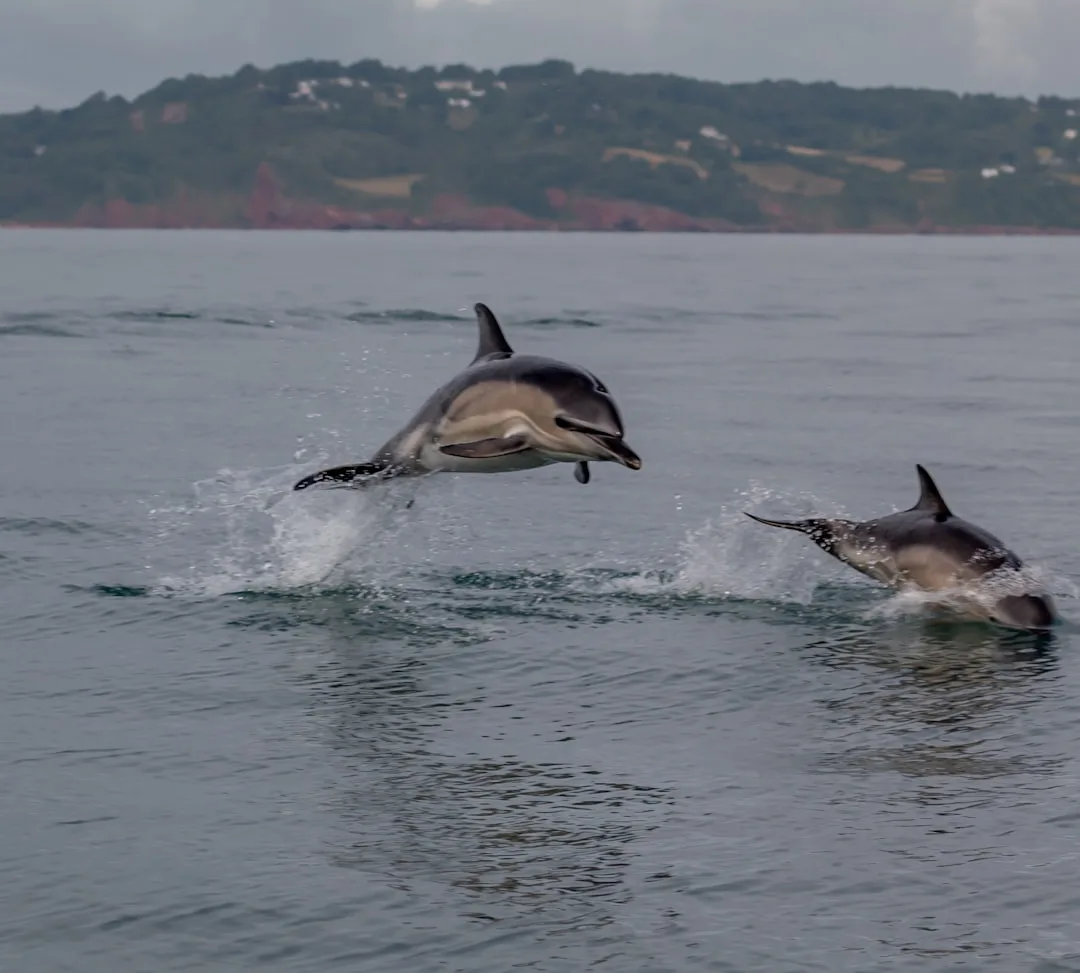
The common bottlenose dolphin is the most familiar dolphin on the planet - the animal most people picture when they hear the word 'dolphin' at all. It is also one of the most cognitively sophisticated non-human species ever studied. Tursiops truncatus uses individual names, passes mirror self-recognition tests, invents and teaches tool use, cooperates in complex multi-level alliances, and sleeps one brain hemisphere at a time so it never forgets to breathe.
This guide covers every major aspect of bottlenose dolphin biology: taxonomy, size, anatomy, habitat, diet, echolocation, cognition, communication, social life, reproduction, and conservation. It is a reference entry, not a summary, so expect specifics - kilograms, kilohertz, click rates, dive depths, and documented behaviours from named populations.
Etymology and Classification
The genus name Tursiops was coined by the British zoologist John Edward Gray in 1843, combining the Latin tursio (an older term for dolphin, used by Pliny) with the Greek suffix -ops meaning 'appearance of' - so literally 'dolphin-like'. The species name truncatus refers to the shortened, stubby shape of the rostrum ('beak') compared with other dolphin species.
Bottlenose dolphins sit deep inside the mammalian order Cetacea, which modern phylogenetics places inside Artiodactyla, the even-toed ungulates. In other words, dolphins are closer relatives of hippos, cows, and pigs than they are of seals, sea lions, or any other group of marine mammals. Cetaceans split from their terrestrial relatives roughly 50 million years ago, and the toothed whales (Odontoceti) diverged from the baleen whales (Mysticeti) about 35 million years ago.
Within Delphinidae, the oceanic dolphin family, Tursiops is the charismatic flagship genus. Recent genetic work splits Tursiops into at least two widely recognised species - the common bottlenose dolphin (T. truncatus) covered here and the Indo-Pacific bottlenose dolphin (T. aduncus) - with additional proposed species (Burrunan dolphin, T. australis) still under debate. Within T. truncatus itself there are coastal and offshore ecotypes so distinct they may eventually be split further.
Size and Physical Description
Bottlenose dolphins vary in size more than most mammals of comparable range. Cold-water offshore individuals can reach twice the mass of warm-water coastal individuals.
General adult measurements:
- Length: 2.0-4.0 metres
- Weight: 150-650 kg
- Newborn length: approximately 1 metre
- Newborn weight: 15-20 kg
Regional variation:
- Coastal Gulf of Mexico: 2.0-2.5 m, 150-250 kg
- Coastal Atlantic: 2.5-3.0 m, 200-350 kg
- Offshore Atlantic: 3.0-3.8 m, 350-550 kg
- Northeast Atlantic (Scotland, Ireland): up to 4 m, 600-650 kg
The body is fusiform - a streamlined torpedo shape that minimises drag at high speed. Skin is smooth, rubbery, and shed in sheets roughly every two hours, a turnover rate more than nine times faster than in humans, which both reduces drag and sheds parasites. Colour ranges from dark grey on the back (dorsal) to pale grey or near-white on the belly (ventral), a pattern called countershading that helps camouflage the animal from both predators above and prey below.
The signature rostrum is short and robust, giving the species its name. Inside the mouth are 18-28 conical teeth per jaw quadrant, totalling 72-112 teeth. These are not used for chewing but for grasping fish, which are then swallowed head-first and whole.
The flippers (pectoral fins) contain a skeleton homologous to the human hand, with five digits and finger-like phalanges. The dorsal fin is curved and helps with stability. The fluke (horizontal tail fin) is the propulsive organ, beating up and down rather than side to side like a fish tail.
Anatomy Built for the Sea
Several major systems have been radically rebuilt over 50 million years of marine evolution.
Blowhole and breathing:
A dolphin breathes through a single blowhole on top of the head. The nostril has completely migrated from its ancestral position on the snout. Breathing is entirely voluntary - the animal consciously decides when to surface and when to exhale. A bottlenose dolphin typically breathes three to five times a minute at rest and can exchange up to 80% of its lung volume in a single breath, compared with roughly 15% in a resting human.
Dive physiology:
- Typical dive depth: 3-46 m
- Recorded maximum: over 300 m in offshore populations
- Typical dive duration: 20-90 seconds
- Maximum recorded: approximately 10 minutes
Dolphins slow their heart rate dramatically during dives (bradycardia), shunt blood to essential organs, and store oxygen in elevated concentrations of myoglobin in muscle. Their ribs are flexible and allow the chest to collapse under pressure without injury.
Hearing:
Ears as external structures have essentially vanished. Sound enters through the lower jaw, which is fat-filled and acoustically coupled to the middle ear. This allows directional underwater hearing at frequencies up to 150 kHz - far above the human upper limit of roughly 20 kHz.
Thermoregulation:
A layer of blubber 2-8 cm thick provides insulation. Countercurrent heat exchange in the flippers, fluke, and dorsal fin recovers body heat from outgoing arterial blood before it is lost to the water. Dolphins in cold water actively shunt more blood through their extremities to dump heat when needed - they can also overheat.
Echolocation: Seeing With Sound
Echolocation (biological sonar) is the single most important sensory adaptation of toothed whales. A bottlenose dolphin using echolocation can form an acoustic image of its surroundings with precision that rivals or exceeds vision in clear water.
How it works:
- Air is forced through phonic lips - paired tissue structures inside the head.
- The clicks pass through the melon, a waxy fat organ in the forehead that acts as an acoustic lens, focusing them into a narrow forward beam.
- Clicks travel through the water, bounce off objects, and return.
- Returning echoes enter through the fat-filled lower jaw and travel to the inner ear.
- The brain reconstructs range, shape, density, texture, and motion.
Click characteristics:
| Property | Value |
|---|---|
| Click duration | approximately 50-80 microseconds |
| Peak frequency | 40-130 kHz |
| Source level | up to 228 dB re 1 uPa |
| Maximum click rate | up to 1,000 per second |
| Target resolution | 1 cm object at 50 m |
| Detection range (large) | 100 m+ for substantial targets |
At high click rates the animal is not emitting discrete signals but running a rapid probe - each echo returns before the next click is issued. Experiments have shown bottlenose dolphins can distinguish copper from aluminium targets of identical shape, identify individual fish species by swim bladder echo, and spot buried objects hidden under sediment.
Some researchers argue that echolocation also lets dolphins 'see' internal anatomy - including pregnancy, injury, and emotional arousal - in nearby dolphins, though direct evidence remains debated.
Echolocation is not always on. Dolphins stop clicking when they want to stay silent, when visual cues are sufficient, or when hunting prey that can hear and flee from clicks.
Cognition and the Dolphin Brain
The bottlenose dolphin brain weighs 1.5-1.7 kg, larger than a human brain of roughly 1.3-1.4 kg, though their body mass is also larger. Relative brain size is measured by encephalization quotient (EQ), which corrects for body mass. Bottlenose dolphins have an EQ between 4 and 5. Humans sit around 7. Chimpanzees are approximately 2.5. No other non-human mammal has been measured above dolphins.
The dolphin cortex is highly folded and densely populated with spindle neurons (von Economo neurons), which in humans are associated with social cognition, empathy, and self-awareness. Dolphins also show strong connectivity between hemispheres and rich limbic integration.
Documented cognitive abilities:
- Mirror self-recognition. Bottlenose dolphins examine marks placed on their bodies using a mirror, passing the classic mark test at around 7 months of age - earlier than most human children.
- Symbolic language comprehension. Dolphins trained in gestural or acoustic symbol systems understand word order and can respond appropriately to novel combinations of symbols.
- Theory of mind. Experiments show dolphins can understand what human partners do and do not know, adjusting communication accordingly.
- Tool use. Shark Bay dolphins carry marine sponges on their rostrums as protective tools while probing the seafloor for fish.
- Teaching. Mothers demonstrate specific hunting techniques to calves, adjusting pace and repetition based on calf performance - one of the clearer examples of active teaching in non-humans.
- Innovation. Captive and wild dolphins regularly invent novel behaviours, from bubble ring play to new foraging strategies, and spread them culturally through populations.
Communication and Signature Whistles
Bottlenose dolphin vocal communication has three main components: clicks (mostly for echolocation), burst-pulsed sounds (used in social and emotional contexts), and whistles (used for identification and coordination). The most remarkable element is the signature whistle.
Signature whistles in detail:
Each dolphin develops a unique whistle contour in the first year of life. The contour remains stable for decades. Dolphins use their own signature to announce their presence to other dolphins. Critically, they also copy the signature whistles of specific individuals, especially close associates, in ways that are clearly context-appropriate - functionally equivalent to calling someone by name.
Experimental playback research has confirmed several key points:
- Captive dolphins respond differently to their own signature whistles than to other whistles.
- Wild mothers and calves use each other's signatures to reunite after separation.
- Individuals recognise the signatures of animals they have not seen in over 20 years.
- Copying is not casual mimicry. The copier slightly modifies the signature to avoid stealing the identity, much like humans pronouncing each other's names with their own accent.
No other non-human species shows this combination of invented individual labels, long-term stability, and referential use.
Social Life and Alliances
Bottlenose dolphins live in fluid fission-fusion societies. Individuals belong to a broader community of dozens to hundreds of animals, but at any given moment they travel in smaller groups that form and reform constantly.
Group structure:
- Typical group size: 2-15 individuals
- Loose communities: 50-500 individuals
- Resident coastal communities: stable over decades
- Offshore groups: often larger (up to 100) and more transient
Male alliances:
Adult males form one of the most structurally complex social systems known outside humans. In Shark Bay, Australia, males form stable pairs or trios known as first-order alliances that cooperate to herd receptive females. Multiple first-order alliances then cooperate with each other as second-order alliances, and several second-order alliances in turn form loose third-order associations.
Individual membership in these layers is maintained across decades. Comparable multi-level male coalitions exist in very few other species.
Female networks:
Females form looser, kin-based networks focused on calf care. Related females often calve in synchrony and share babysitting duties. Cultural hunting traditions, like sponge foraging, are inherited almost entirely through the female line.
Synchrony:
Pod members synchronise surfacing, breathing, swimming, and vocal output to an extraordinary degree. Researchers consider this synchrony itself a bonding mechanism.
Diet and Hunting
Bottlenose dolphins are opportunistic carnivores whose diet reflects whatever prey is locally abundant. Coastal diets lean toward mullet, croaker, mackerel, menhaden, flounder, sea trout, and similar schooling fish. Offshore diets include more squid and deep-water fish. Crustaceans appear in smaller amounts.
Daily intake:
- Adult consumption: 10-25 kg of food per day
- Approximate share of body mass: 4-6%
- Method: swallowed whole, head-first
Cultural hunting techniques:
Different populations have entirely different traditions, typically unknown outside their local area. The clearest examples include:
- Mud-ring feeding (Florida Bay): a dolphin swims a tight circle in shallow water, creating a ring of disturbed sediment. Trapped fish jump out and are caught mid-air.
- Strand feeding (South Carolina, Georgia, Patagonia): coordinated groups chase fish up onto mud or sand banks and briefly beach themselves to grab prey before wriggling back into the water.
- Sponge foraging (Shark Bay): certain females wear sponges as nose-guards while probing the seafloor for buried prey that has no swim bladder and is therefore hard to echolocate.
- Fish-whacking (multiple regions): dolphins strike fish with their flukes, stunning them and flipping them out of the water for easy retrieval.
- Cooperative herding (global): groups corral fish against sandbars, the surface, or each other.
These behaviours are culturally transmitted. Calves learn by observation, imitation, and deliberate instruction from their mothers.
Reproduction and Life Cycle
Reproduction is slow and long-term, reflecting heavy maternal investment.
Key reproductive parameters:
| Parameter | Value |
|---|---|
| Female sexual maturity | 5-10 years |
| Male sexual maturity | 8-13 years |
| Gestation | 12 months |
| Calf length at birth | approximately 1 m |
| Calf weight at birth | 15-20 kg |
| Nursing duration | 18-20 months (up to 6 yrs) |
| Calving interval | 3-6 years |
| Typical lifespan | 40-60 years |
Mating is not strictly seasonal. Copulation occurs in almost any social context and does not require oestrus, making bottlenose dolphins one of the few non-human species with documented non-reproductive sexual behaviour across sexes and ages. Researchers have argued that sexual activity in this species functions primarily for social bonding, stress reduction, and alliance maintenance.
Calves are born tail-first underwater, assisted to the surface for their first breath by the mother or other pod members. They stay close to the mother in the 'infant position' just behind her dorsal fin for their first weeks, catching her slipstream and reducing energy cost. Weaning is gradual. Calves begin catching their own fish around 6 months but may continue to nurse occasionally for 3-6 years.
Sleep: The Unihemispheric Problem
Because dolphin breathing is voluntary, the animal cannot afford to lose consciousness. Evolution's solution is unihemispheric slow-wave sleep.
How it works:
- Only one hemisphere shows sleep waves at a time.
- The opposing eye remains open, watching for predators and debris.
- Hemispheres swap every 1-2 hours.
- Total cumulative sleep: approximately 8 hours per day.
- REM sleep, if present, is minimal and fundamentally different from terrestrial REM.
Dolphins rest in several postures: hovering horizontally near the surface, slowly swimming with the pod, or 'logging' at the surface with the blowhole exposed. Calves do not sleep conventionally at all for their first month - they swim continuously, with the mother, covering enormous distances and catching only brief microsleeps.
This system means dolphins never fully 'dream' in the terrestrial sense and never experience the full loss of vigilance that characterises mammal sleep on land.
Predators and Mortality
Adult bottlenose dolphins have few natural predators, but threats exist. Large sharks - especially tiger, bull, and great white sharks - can kill calves and injured adults. Many dolphins carry healed shark bite scars. Orcas (killer whales) occasionally prey on bottlenose dolphins in some regions, though interactions are often mutual avoidance rather than predation.
Dolphins defend themselves and each other with coordinated ramming attacks to the shark's gills or liver. Groups of dolphins have been observed killing sharks this way.
Non-predator mortality sources include disease outbreaks (morbillivirus epizootics have killed thousands at a time), harmful algal blooms, toxic exposure, entanglement in fishing gear, and boat strikes.
Conservation and Human Impact
The common bottlenose dolphin is listed as Least Concern by the IUCN globally, reflecting its wide distribution and large total population. Global numbers exceed 600,000. However, many local populations are small, isolated, and in decline.
Key threats:
- Bycatch. Entanglement in gillnets, trawls, and longlines kills thousands of dolphins per year worldwide.
- Pollution. As long-lived top predators, bottlenose dolphins accumulate persistent organic pollutants (PCBs, PFAS, mercury) and pesticides in blubber. These compounds suppress immunity and reduce calf survival through lactational transfer.
- Habitat degradation. Coastal development, dredging, and water quality loss damage inshore populations.
- Noise pollution. Shipping, sonar, and seismic surveys disrupt echolocation, communication, and navigation.
- Harmful algal blooms. Brevetoxin and domoic acid events can cause mass die-offs in Florida, Texas, and elsewhere.
- Directed hunts. Small but ongoing drive fisheries in Japan and the Faroes take bottlenose dolphins among other species.
- Live capture for display. Although declining, wild capture continues to supply some aquariums.
Several populations face population-specific crises. The Indian River Lagoon population in Florida has lost significant numbers to toxic algal blooms and environmental degradation. Mediterranean coastal populations have declined due to overfishing and habitat loss. The Moray Firth resident community in Scotland is genetically isolated and small enough that any increase in mortality could tip it into decline.
Dolphins and Humans
Few wild animals have a richer documented history with humans than the bottlenose dolphin. Cooperative fishing relationships have been recorded for more than two millennia, from Pliny the Elder describing dolphins and human fishermen in the Mediterranean to modern partnerships in Laguna, Brazil, and in Myanmar's Ayeyarwady River where dolphins and fishermen still coordinate fish drives using signals on both sides.
Bottlenose dolphins are also the species most commonly kept in marine parks, used in U.S. Navy training programs for mine detection and object recovery, and studied in long-term research programs like the Sarasota Dolphin Research Program in Florida, which has followed a resident community continuously since 1970.
The welfare debate around captive dolphins remains active. Research shows bottlenose dolphins in captivity often display abnormal behaviours, reduced lifespans, and stress indicators. Many countries have restricted or banned new captures and public displays.
Related Reading
- Common Bottlenose Dolphin: Intelligence, Culture, and Communication
- How Dolphins Sleep With Half a Brain
- Dolphin Echolocation Explained
- Marine Mammals of the World
References
Sources consulted for this entry include the IUCN Red List assessment for Tursiops truncatus, long-term data from the Sarasota Dolphin Research Program, Shark Bay Dolphin Research Project publications, and peer-reviewed studies in Proceedings of the Royal Society B, Animal Cognition, Marine Mammal Science, Current Biology, and PNAS.
Specific figures on echolocation performance, brain anatomy, and signature whistle behaviour reflect the most recent consolidated findings from these research programs.
Frequently Asked Questions
How big do bottlenose dolphins get?
Adult common bottlenose dolphins (Tursiops truncatus) range from 2 to 4 metres long and weigh between 150 and 650 kg. Size varies sharply by population. Coastal dolphins tend to be smaller - often 2.0-2.5 metres and 150-300 kg - while offshore and cold-water forms can exceed 3.5 metres and 500 kg. The largest verified individuals, from the North Atlantic, reached close to 4 metres and 650 kg. Males are modestly larger than females.
Calves are born at about 1 metre and 15-20 kg after a 12-month gestation.
How intelligent are bottlenose dolphins?
Bottlenose dolphins are among the most cognitively advanced animals on Earth. They pass the mirror self-recognition test, use tools (sponges, shells, kelp), understand symbolic and gestural language in experiments, solve novel problems through insight rather than trial and error, teach hunting techniques to their young, and maintain individual social relationships spanning decades.
Their brain mass of 1.5-1.7 kg exceeds the human brain, and their encephalization quotient of 4-5 is second only to humans among mammals. They are one of the few species known to have individual names - signature whistles they invent themselves and respond to when copied by other dolphins.
How does dolphin echolocation work?
Bottlenose dolphins produce clicks in a structure called the phonic lips inside their head, focus those clicks through a fatty lens called the melon in the forehead, and project them forward as a narrow acoustic beam. Echoes return through the lower jaw, which is fat-filled and connects directly to the inner ear.
A foraging dolphin emits up to 1,000 clicks per second and processes the returning echoes with enough precision to detect a 1 cm object at 50 metres, distinguish between metals, identify fish species by their swim bladders, and potentially even ‘see’ inside other dolphins by picking up internal tissue densities. Echolocation works in total darkness and muddy water where vision fails.
Do bottlenose dolphins really sleep with half their brain?
Yes. Bottlenose dolphins use unihemispheric slow-wave sleep, meaning only one hemisphere of the brain sleeps at a time while the other stays awake. The awake hemisphere controls breathing, keeps one eye open for predators, and maintains enough motor control to surface. Hemispheres typically swap every one to two hours. This adaptation exists because dolphin breathing is entirely voluntary - a fully unconscious dolphin would drown.
A dolphin sleeps roughly 8 hours of total cumulative sleep per day, spread across both hemispheres, without ever losing full consciousness.
What are signature whistles?
A signature whistle is a unique, individually invented vocalisation that each bottlenose dolphin develops during its first year of life and uses throughout its life as a personal identifier. Mothers expose their calves to candidate whistles, and the calf eventually settles on one that remains stable for decades.
Dolphins use their signature whistles to announce their presence and will copy another dolphin’s signature whistle specifically to address that individual - functionally equivalent to calling someone by name. This is one of only a handful of documented cases of referential, name-like communication outside humans.
Where do bottlenose dolphins live?
Common bottlenose dolphins are found in temperate and tropical seas worldwide: the entire Atlantic, Pacific, and Indian Oceans, the Mediterranean, the Black Sea, the Gulf of Mexico, the Red Sea, and the Caribbean. Two ecotypes are recognised. Coastal (inshore) dolphins live in shallow water, bays, estuaries, and lagoons and often have smaller home ranges of tens to a few hundred square kilometres.
Offshore (pelagic) dolphins inhabit deep water, travel widely, and can dive beyond 300 metres. Some populations migrate seasonally; others are year-round residents.
What do bottlenose dolphins eat?
Bottlenose dolphins are opportunistic carnivores that consume fish, squid, and crustaceans. Coastal populations target species like mullet, mackerel, croaker, sea trout, and flounder, while offshore dolphins eat more deep-water fish and squid. An adult consumes roughly 4-6% of its body weight per day - around 10-25 kg of food depending on size. Hunting techniques are culturally transmitted and population-specific.
Examples include mud-ring feeding in Florida (one dolphin stirs up a circle of mud to trap fish), strand feeding in South Carolina (dolphins herd fish onto shore and beach themselves to grab them), sponge foraging in Shark Bay, and cooperative driving in many locations.
How long do bottlenose dolphins live?
Wild bottlenose dolphins typically live 40-60 years, with females outliving males. Some individuals in well-studied populations have been documented past 65. Sarasota Bay resident ‘Nicklo’ was over 67 when last observed. Captive lifespans are usually shorter, averaging 25-30 years, though conditions vary widely. Sexual maturity is reached at 5-10 years in females and 8-13 in males.
Females give birth every 3-6 years, and calves stay with their mothers for 3-6 years, longer than in almost any other cetacean. The combination of late maturity, long inter-birth intervals, and long lifespan means populations recover slowly from declines.