
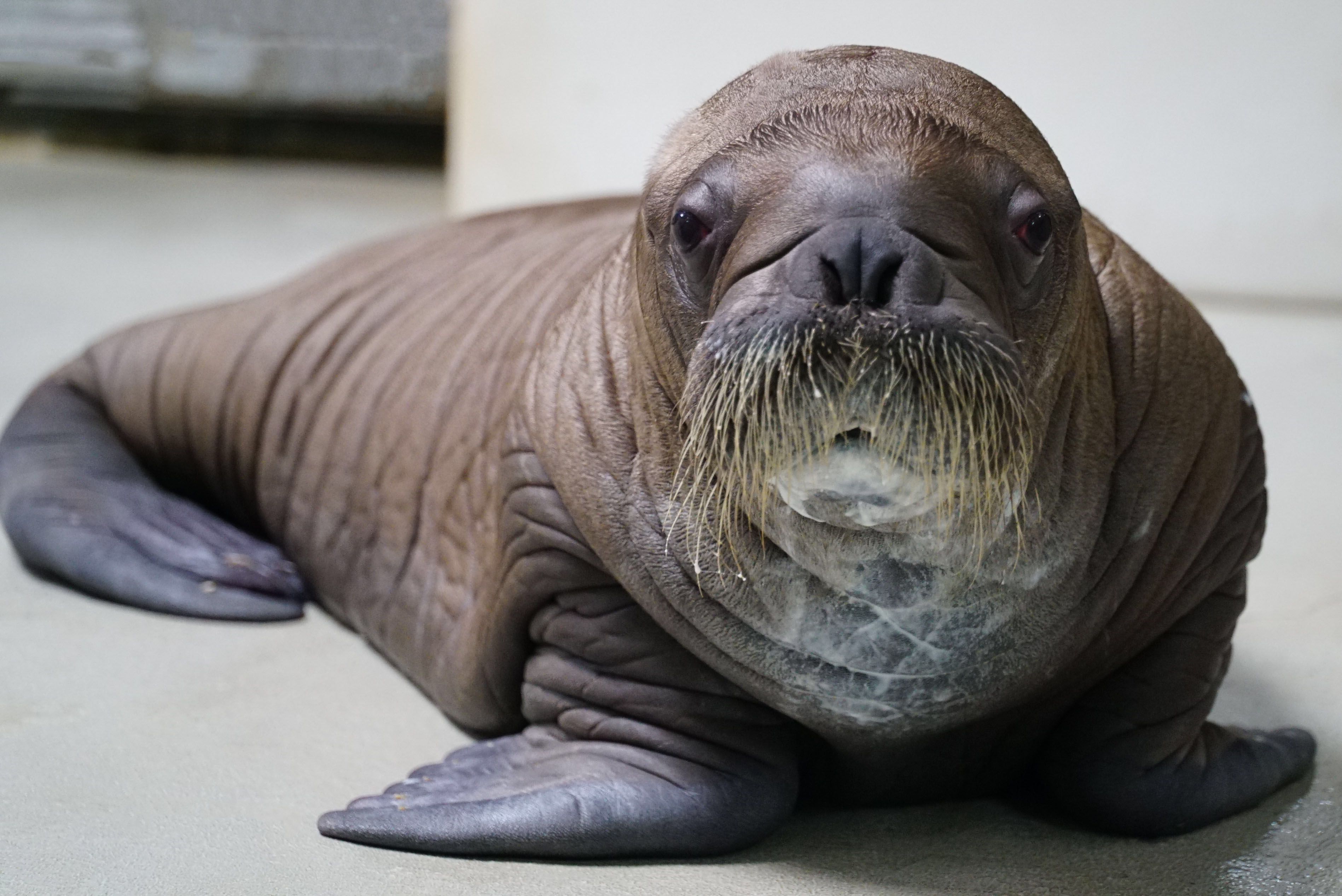
The walrus is one of the most instantly recognisable animals on the planet - a vast, wrinkled, pink-flushed Arctic giant with a bristling moustache and two long ivory tusks that curve down past its chin. It is the only living member of the family Odobenidae, a once-diverse group of North Pacific pinnipeds that flourished during the Miocene and left the walrus as their sole surviving descendant.
No other marine mammal looks like it, feeds like it, or gathers in such extravagant numbers on a single stretch of coast.
This guide covers every major aspect of walrus biology and behaviour: size and physical features, circumpolar distribution, the two (and possibly three) subspecies, the astonishing piston-suction feeding technique, the sensory role of the 450 vibrissae on the muzzle, tusks and social dominance, mass haul-outs, reproduction, the long maternal care period that sets walruses apart from other pinnipeds, conservation threats from Arctic sea ice loss, and the enduring cultural importance of the walrus in Inuit and other Arctic Indigenous societies.
It is a reference entry, not a summary, so expect specifics: measurements, population numbers, feeding mechanics, and documented behaviours from the field.
Etymology and Classification
The scientific name Odobenus rosmarus carries its own Arctic history. Odobenus comes from the Greek odous for 'tooth' and baino for 'I walk' - literally 'tooth-walker', a reference to the way walruses use their tusks to lever themselves out of the water onto ice or shore.
Rosmarus is a Latinisation of the Old Norse hrosshvalr, meaning 'horse-whale', the name Norse sailors used when they first encountered the species in the high-latitude North Atlantic. The English word 'walrus' came into the language by a similar route, filtered through Dutch and Middle English maritime vocabulary.
The walrus sits inside the order Carnivora, in the pinniped clade alongside true seals (Phocidae) and eared seals (Otariidae). Molecular and morphological work places Odobenidae as the sister group to Otariidae, meaning walruses share a more recent common ancestor with sea lions and fur seals than with true seals.
The family Odobenidae was once much larger, with at least twenty described extinct genera spread across the Miocene North Pacific, exhibiting extraordinary variation in skull shape, body size, and tusk configuration. Today only Odobenus rosmarus remains.
Taxonomic placement:
- Kingdom: Animalia
- Phylum: Chordata
- Class: Mammalia
- Order: Carnivora
- Suborder: Caniformia
- Clade: Pinnipedia
- Family: Odobenidae
- Genus: Odobenus
- Species: O. rosmarus
Two subspecies are universally accepted: the Atlantic walrus (O. r. rosmarus) and the Pacific walrus (O. r. divergens). A third proposed subspecies, the Laptev Sea walrus of the central Russian Arctic, is recognised by some Russian taxonomists but treated by most international authorities as a peripheral population of the Pacific subspecies pending further genetic work.
Size and Physical Description
Walruses are among the largest pinnipeds alive. Only elephant seals consistently exceed them in mass. Sexual dimorphism is pronounced - adult males carry significantly more bulk, thicker necks, and longer tusks than females, and the size gap widens with age.
Males (Pacific subspecies):
- Length: 2.7-3.5 metres
- Weight: 800-1,700 kilograms, occasionally over 1,800 kilograms
- Tusks: up to 1 metre in very large animals
- Neck: heavily callused and scarred from fighting
Females:
- Length: 2.3-3.1 metres
- Weight: 400-1,250 kilograms
- Tusks: slightly shorter and thinner than males but still prominent
- Neck: smoother, less callused
Calves at birth:
- Length: 1.0-1.4 metres
- Weight: 45-75 kilograms
- Coat: short silver-grey fur that is gradually lost with age
- Born tuskless, with tusks erupting around the second year
The body is cylindrical, heavily blubbered, and covered in thick, sparsely-haired skin that wrinkles into deep folds around the neck and shoulders. In older males the skin of the neck and chest becomes studded with large rounded bosses - callous-like thickenings that develop with age and seem to serve as armour during fights.
Pigmentation varies with temperature: cold walruses look pale grey as their surface vessels constrict, while warm walruses flush vivid pink as blood returns to the skin to dump heat.
The muzzle is dominated by a dense moustache of roughly 450 stiff sensory bristles called vibrissae. Each vibrissa is rooted in its own blood sinus and innervated by a bundle of nerve fibres, producing a tactile array sensitive enough to detect a single buried clam by touch alone. Walrus tusks are elongated upper canines with open pulp cavities that allow continuous growth for most of the animal's life.
Walruses are not especially fast in the water - sustained swimming speeds average around 7 kilometres per hour, with short bursts of 30 to 35 kilometres per hour when alarmed. They are capable divers, routinely reaching 80 to 100 metres on foraging dives, with recorded maxima beyond 500 metres. Most dives last 5 to 10 minutes, but the species has stayed submerged for more than 25 minutes under unusual conditions.
Global Distribution and Habitat
Walruses occupy a broken circumpolar band across the Arctic and the high subarctic. The two subspecies do not overlap and are separated by the wide, largely walrus-free central Arctic Ocean.
Atlantic walrus (O. r. rosmarus):
- Eastern Canadian Arctic and Hudson Bay
- Greenland, especially the west and northeast coasts
- Svalbard and the Barents Sea
- Franz Josef Land and Novaya Zemlya in the Russian Arctic
Pacific walrus (O. r. divergens):
- Bering Sea between Alaska and the Russian Far East
- Chukchi Sea north of the Bering Strait
- Coastal Chukotka and northwestern Alaska
- Seasonal movements far north in summer, following pack ice
Laptev population:
- Central Russian Arctic, between Taimyr and the New Siberian Islands
- Treated as a separate subspecies by some authorities, population in the low thousands
The species depends strictly on two things: shallow continental shelf waters productive enough to support dense clam beds, and accessible resting platforms - either drifting sea ice or sheltered coastal haul-outs. Walruses cannot swim indefinitely. They must haul out regularly between foraging trips to rest, digest, nurse calves, and thermoregulate. When sea ice is unavailable, they crowd onto beaches, sometimes in numbers that local shoreline cannot sustain safely.
The Two Subspecies
Atlantic and Pacific walruses look superficially alike but differ measurably in size, tusk shape, and geographic context.
| Feature | Atlantic (O. r. rosmarus) | Pacific (O. r. divergens) |
|---|---|---|
| Average body size | Smaller; males typically 800-1,200 kg | Larger; males typically 1,200-1,700 kg |
| Tusks | Shorter, straighter | Longer, often strongly divergent in large males |
| Population size | Roughly 25,000 across all Atlantic stocks | Roughly 200,000, by far the larger subspecies |
| Range | Eastern Canada, Greenland, Svalbard, Barents | Bering and Chukchi Seas, Chukotka, Alaska |
| Main threats | Historical hunting, ship traffic, pollution | Sea ice loss, stampedes at land haul-outs |
The Laptev population, numbering a few thousand animals, sits geographically and morphologically between the two recognised subspecies and may eventually be formalised as O. r. laptevi if further genetic and morphometric work supports the split.
Feeding - The Piston-Suction Technique
Walrus feeding is one of the most specialised systems in the marine world. Walruses do not catch mobile prey. They vacuum sedentary invertebrates off the sea floor, and they do it with astonishing efficiency.
On a foraging dive the walrus swims to the sea bed, orients its muzzle downward, and fans out its dense whisker pad across the sediment. The vibrissae identify buried clams through touch, sorting live bivalves from empty shells and stones with remarkable accuracy. Once a target is located, the walrus seals its mouth over the end of the clam or presses its lips against the sediment directly above it.
Water jets from the mouth blast sediment away to expose the shell. Then the tongue, enormous and muscular, is retracted rapidly inside the mouth, generating a powerful vacuum.
The suction is strong enough to rip the soft body of the clam clean out of its shell in a single pull. The empty shells are left on the sea floor and the walrus moves on. A single adult animal can extract three to six thousand clams on one foraging bout, consuming 45 to 75 kilograms of meat per day.
Primary prey:
- Clams of the genera Mya, Hiatella, Serripes, and Macoma
- Sea snails and other gastropods
- Marine worms (polychaetes)
- Amphipods and isopods
- Sea cucumbers
- Slow-moving crabs and shrimps
A small fraction of walruses - usually large males in late summer when invertebrate prey is harder to reach - become facultative predators of ringed seals, bearded seal pups, and seabirds. These individuals are sometimes recognisable by yellowish staining on their tusks and chest from blood and blubber. Seal predation by walruses remains unusual and is not characteristic of the species.
Contrary to widespread folk belief and older natural history illustrations, walruses do not use their tusks to dig clams out of the sediment. The work is performed entirely by the muzzle, the water jet, and the vibrissae. Tusks serve social and mechanical functions, not feeding ones.
Tusks, Dominance, and the 'Tooth-Walker'
Both male and female walruses grow tusks, which are elongated upper canines with open roots that allow continuous growth throughout much of life. In large males they can exceed one metre and weigh more than five kilograms each. Female tusks are slightly shorter, thinner, and often more curved.
Tusks are central to walrus social life. During the breeding season bulls use them as weapons, slashing at one another's necks and shoulders in contests for position on the ice or in the water near receptive females. The thick skin and callused bosses on a mature male's neck are partly armour against this kind of damage.
Outside the breeding season tusks are used constantly in dominance displays - a simple raise of the head with tusks exposed is often enough to settle arguments about resting space on an ice floe or a beach.
The genus name Odobenus - 'tooth-walker' - refers to the mechanical role of the tusks in hauling out. A walrus hooks its tusks over an ice edge or into a crack and levers its enormous body out of the water, pulling itself up using its neck and shoulder muscles. On sea ice, this behaviour creates characteristic double-groove marks along the edges of floes.
Tusk function summary:
- Fighting and physical combat between rival males
- Status signalling and dominance display in mixed groups
- Hauling out from water onto ice or shoreline
- Anchor point for resting in water, hooked over ice edges
- Breaking breathing holes through thin ice when necessary
Social Structure and Mass Haul-Outs
Walruses are the most social of pinnipeds. They travel, feed, and rest in dense groups at all times of year. Segregation by sex is common outside the breeding season - females, calves, and juveniles tend to form northern summer groups while mature males often congregate in separate southern summer haul-outs.
Haul-outs are the species' defining social feature. A walrus haul-out is a tightly packed assembly of animals lying physically on top of and against each other for warmth, security, and company. Small haul-outs might contain a few dozen animals. Large ones can contain many thousands. The world's largest known haul-outs, on the Chukotka coast and Point Lay in Alaska, have reached estimated counts of 35,000 walruses on a single beach.
Haul-out behaviour depends on available ice. In normal Arctic conditions, walruses rest on sea ice floes that drift with currents over productive feeding grounds. When summer ice retreats beyond the continental shelf, females and young cannot follow without losing access to food, and they are forced onto coastal beaches in enormous numbers.
These land-based mega-haul-outs carry serious risks: a stampede triggered by a polar bear, an aircraft, or a human disturbance can kill hundreds of calves crushed under panicked adults.
Communication repertoire:
- Deep bell-like underwater tones used by displaying males
- Whistles, clicks, and knocks during social interaction
- Loud barks, bellows, and roars on land
- Teeth-clacking and tusk-clashing in dominance contests
- Physical contact - leaning, draping, piling - as near-constant social signal
Reproduction and the Long Mother-Calf Bond
Walruses are slow reproducers. Females reach sexual maturity around age 6 to 10; males are physiologically mature earlier but rarely hold breeding territory until 15 years or older, when they are large enough to compete. Mating happens in the water during January and February, with receptive females gathered near ice and large males displaying and fighting nearby.
Gestation lasts 15 to 16 months, including a period of delayed implantation that synchronises birth with the following year's spring. Calves are born on ice floes in April or May, single births only, weighing 45 to 75 kilograms and already capable of swimming within minutes.
Maternal care in walruses is extraordinarily long by pinniped standards. The calf nurses for at least a year, and often two, on extremely rich milk. Even after weaning, juveniles remain closely associated with their mothers for another two to three years, with total maternal association lasting four to five years in many cases. Calves ride on their mothers' backs between feeds, are defended fiercely against predators, and learn foraging technique and social position from direct observation.
Life stages:
- Calf: 0-2 years, fully or partially dependent on mother's milk
- Juvenile: 2-5 years, still attached to mother and learning foraging
- Subadult: 5-10 years, independent but lower in social hierarchy
- Adult female: 10-40 years, produces a calf every 2-3 years
- Adult male: 15-40 years, competes for breeding access
- Reproductive interval: average 2-3 years between successful calves
This long maternal period means that reproductive output per female is very low - around a dozen calves over an entire lifetime in a best case - which makes walrus populations especially vulnerable to events that kill calves in large numbers.
Physiology - Blubber, Blush, and Thermoregulation
A walrus lives in water that hovers at or below zero degrees Celsius for most of the year. Its insulation system is built around a layer of blubber up to 15 centimetres thick that can account for a third of total body mass in large animals. The skin itself is thick, leathery, and only sparsely haired in adults, with longer bristles concentrated on the muzzle.
Thermoregulation on land is the more dangerous challenge. A warm walrus cannot sweat and has very limited ability to lose heat through panting. Instead it uses the skin as a radiator: surface blood vessels dilate, blood rushes to the surface, and heat is shed to the air. The visible consequence is the famous pink blush - walruses on sunny haul-outs can look almost rosy-red. When the animals return to cold water, vessels constrict again and the pink fades to pale grey within minutes.
Walruses can also sleep in the water. The classic method is to hook both tusks over the edge of a floating piece of ice, let the body dangle in the water, and doze while the ivory takes the weight. Calves and small juveniles sometimes sleep draped across their mothers' backs or floating on buoyant layers of air trapped in loose neck folds.
Conservation Status and Threats
The IUCN reassessed the walrus in 2016 and uplifted the species from Data Deficient to Vulnerable, reflecting concern about the long-term consequences of Arctic sea ice loss. Both subspecies face interlocking threats, though the specifics differ.
Population estimates:
| Population / subspecies | Approximate count | Trend |
|---|---|---|
| Pacific walrus | ~200,000 | Uncertain, ice-driven |
| Atlantic walrus, total | ~25,000 | Stable to increasing |
| Svalbard / Barents stock | ~5,500 | Recovering |
| East Greenland | ~1,500 | Stable |
| Canadian High Arctic | ~10,000 | Stable |
| Laptev Sea | ~5,000 (low confidence) | Poorly known |
Primary threats:
- Sea ice loss. The Pacific subspecies in particular relies on summer sea ice floating over the productive Chukchi Sea shelf as a resting platform between dives. As summer ice retreats north over the deep Arctic basin, females and calves cannot follow without losing access to food, and they crowd onto coastal haul-outs where calf mortality from stampedes can be catastrophic.
- Haul-out stampedes. A single disturbance at a mega-haul-out - a polar bear, a low-flying aircraft, a snowmobile, a barking dog, or a gunshot - can trigger a panicked rush to the water. Calves are crushed under adults, and hundreds of mortalities have been documented in single events.
- Historical commercial hunting. The Atlantic subspecies was hunted nearly to extinction across much of its range during the eighteenth and nineteenth centuries for ivory, oil, and hides. Some stocks - notably Svalbard - are recovering, but numbers remain far below pre-exploitation levels.
- Pollution. Persistent organic pollutants, heavy metals, and microplastics accumulate in walrus blubber and in the shellfish they consume. Long-term effects on immune function and reproduction are still being studied.
- Shipping and noise. Retreating ice opens new Arctic shipping lanes. Engine noise, collision risk, and underwater disturbance all increase in areas that were previously inaccessible to commercial traffic.
- Oil and gas development. Proposed and active petroleum operations in the Bering, Chukchi, and Barents Seas overlap walrus feeding grounds and migration routes.
Walruses and People
For Arctic Indigenous peoples - Inuit, Yupik, Chukchi, Sami, and others - the walrus has been a subsistence cornerstone for thousands of years.
Communities along the Bering Strait, Hudson Bay, Greenland, and Chukotka relied on walrus meat and blubber for winter calories, hides for boat covers and rope, intestines for waterproof clothing, and bone and ivory for tools, harpoon heads, sled runners, and ceremonial carvings.
Walrus ivory carving remains a living art form across the Arctic, and regulated subsistence hunting continues under national and international frameworks that exempt Indigenous users from broader ivory trade restrictions.
Commercial hunting by European and American vessels between roughly 1600 and 1950 devastated many walrus stocks, particularly in the Atlantic. Hunting for oil, ivory, and later for zoo specimens nearly wiped out the Svalbard and Iceland populations, and reduced Atlantic Canadian stocks by an order of magnitude.
Protective legislation through the twentieth century - the United States Marine Mammal Protection Act, Canadian and Russian hunting quotas, Norwegian protections in Svalbard - allowed partial recovery.
In wider culture the walrus has become an unlikely icon. Lewis Carroll's poem 'The Walrus and the Carpenter', first published in 1871 as part of Through the Looking-Glass, embedded the species in English literary imagination.
Nearly a century later John Lennon borrowed the image for the 1967 Beatles song 'I am the Walrus', and the line 'I am the eggman / I am the walrus' became one of the most quoted in twentieth-century pop music.
The disjunction between the animal's absurd public image and its extremely specialised, Arctic-dependent biology has done the real walrus few favours: many people still underestimate how much the species is threatened by climate change.
Related Reading
- Marine Mammals: Giants of the Ocean
- Orca (Killer Whale)
- Bottlenose Dolphin
- Orca: The Apex Predator of the Oceans
References
Sources consulted for this entry include the IUCN Red List assessment for Odobenus rosmarus (2016 uplift to Vulnerable), U.S.
Fish and Wildlife Service Pacific walrus stock assessments, Norwegian Polar Institute survey work on the Svalbard Atlantic walrus population, Fisheries and Oceans Canada stock reports for Canadian Arctic walrus, Russian Arctic and Antarctic Research Institute publications on Laptev Sea walrus, peer-reviewed research in Marine Mammal Science, Polar Biology, Journal of Mammalogy, and Arctic, field observations from the Chukchi Sea haul-out monitoring programmes, and ethnographic and subsistence documentation compiled by the Inuit Circumpolar Council.
Population and size figures reflect the most recent published estimates as of 2024.
Frequently Asked Questions
How big is a walrus?
Adult Pacific walrus bulls are the larger of the two subspecies and routinely weigh 800 to 1,700 kilograms and measure 2.7 to 3.5 metres from nose to tail, with exceptional individuals tipping past 1,800 kilograms. Females are smaller at 400 to 1,250 kilograms and 2.3 to 3.1 metres long. Atlantic walruses (Odobenus rosmarus rosmarus) are somewhat smaller than their Pacific cousins (O. r. divergens) and carry shorter tusks on average.
Calves are born at roughly 45 to 75 kilograms and a little over a metre long, and they pack on weight rapidly on the extremely rich milk of their mothers.
What do walruses eat?
Walruses are specialised benthic foragers, meaning they feed on the sea floor. The overwhelming majority of their diet - often more than 90 percent by mass - consists of bivalve mollusks, especially clams such as Mya, Hiatella, and Serripes species. They also eat sea snails, marine worms, amphipods, sea cucumbers, and slow-moving crabs. A single adult walrus can consume three to six thousand clams in one foraging bout.
A small number of individuals, typically large males, have been documented killing and eating ringed seals, bearded seal pups, and seabirds, but this behaviour is unusual and not representative of the species as a whole.
Where do walruses live?
Walruses are Arctic and subarctic animals, distributed in a broken circumpolar band across the Northern Hemisphere. Atlantic walruses range from eastern Canada and Greenland east to Svalbard and the western Russian Arctic. Pacific walruses range across the Bering and Chukchi Seas between Alaska and the Russian Far East. A third, smaller population in the Laptev Sea has been proposed as a separate subspecies by some biologists.
Walruses require access to shallow continental shelf waters - usually less than 80 metres deep - so they can reach the sea floor to feed, and they rely on sea ice or shoreline haul-outs as resting platforms between foraging trips.
How long do walruses live?
Wild walruses typically live around 40 years, with some individuals reaching their late forties. Females tend to outlive males, which suffer higher mortality from fighting injuries and the energetic demands of the breeding season. Age is determined from growth rings in the cementum of the teeth, much as tree rings record years of growth.
Calf mortality in the first year can be significant, particularly when mothers are separated from their young during ice break-up, stampedes, or severe storms, but juveniles that survive past age three have relatively high long-term survival because few Arctic predators attempt to take a subadult walrus.
What are walrus tusks for?
Both male and female walruses grow tusks - they are elongated upper canine teeth that continue lengthening for most of the animal’s life. In large males they can exceed one metre. Tusks serve several functions. They are formidable weapons in fights between males during the breeding season, when bulls slash at one another’s necks and shoulders.
They are status symbols used in dominance displays and mate competition, with larger-tusked males generally ranking higher. They help the walrus haul its enormous body out of the water onto slippery ice edges - the genus name Odobenus literally means ‘tooth-walker’. Contrary to a long-standing myth, walruses do not use their tusks to dig clams out of the sea floor; that work is done by the muzzle and whiskers.
Why are walruses pink?
Walrus skin colour shifts with body temperature. In cold water, the surface blood vessels constrict to conserve core heat, and the animal looks pale grey or almost white. On a warm haul-out in the sun, blood rushes back to the skin to shed excess heat, and the walrus flushes a vivid pink - sometimes almost rosy-red. The effect is most dramatic in large males lying packed together, where body heat accumulates rapidly.
The blush is a simple thermoregulation response in an animal that is thickly insulated for life in near-freezing water and has very little fur, only a sparse coat of short bristles over thick blubber.
Are walruses endangered?
The IUCN upgraded the walrus from Data Deficient to Vulnerable in 2016, reflecting concern about the long-term impact of Arctic sea ice loss on the species. Pacific walruses depend heavily on sea ice as a platform from which to rest between foraging dives over rich continental shelf feeding grounds.
As summer ice retreats far north over the deep Arctic basin, mothers and calves are forced to haul out on unfamiliar land sites where stampedes, disturbance, and predation can cause severe calf mortality.
The Atlantic subspecies was devastated by commercial hunting in the nineteenth and early twentieth centuries and is slowly recovering, with populations now stabilising or growing in Svalbard, northern Canada, and parts of the Russian Arctic, although numbers remain far below historical levels.
How are walruses connected to Inuit culture?
Walruses have been a central subsistence species for Arctic Indigenous peoples - Inuit, Yupik, Chukchi, and others - for thousands of years. Every part of a harvested walrus is used: meat, blubber, skin for rope and boat covers, intestines for waterproof clothing, and ivory for tools, harpoon heads, sled runners, buttons, and ceremonial carvings.
Walrus ivory carving is a living art form in communities across Alaska, Nunavut, Greenland, and Chukotka, and regulated subsistence hunting remains legal under frameworks that balance cultural continuity with conservation. International restrictions on commercial ivory trade coexist with Indigenous exemptions that protect traditional craft and food sovereignty.