
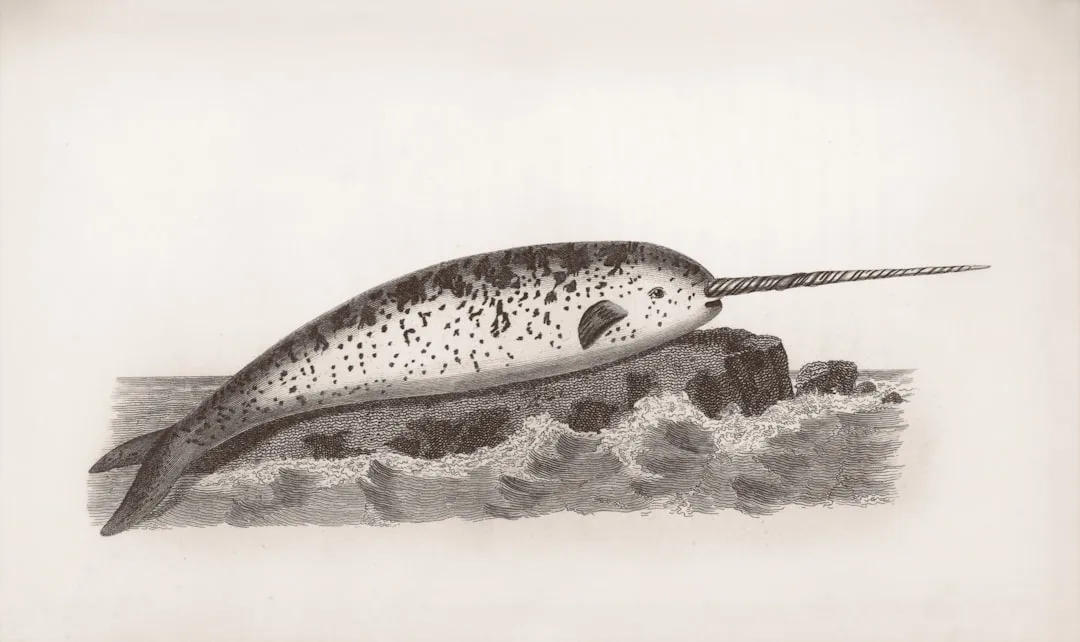
The narwhal is the only living mammal on Earth with a single long spiraled tooth projecting straight out of its upper lip, and it is the reason European medieval monarchs spent centuries convinced that unicorns were real.
Monodon monoceros is a medium-sized toothed whale of the High Arctic, an extreme deep-diver, a close relative of the beluga, and one of the few cetaceans that never willingly leaves ice-covered waters.
This guide covers every major aspect of narwhal biology and ecology - anatomy, the tusk, diving physiology, feeding, reproduction, social life, populations, conservation pressures, and the human history that turned narwhal teeth into the most valuable objects in medieval Europe.
This is a reference entry, not a summary. Expect specifics: metres, kilograms, depths, click rates, population numbers, and verified records.
Etymology and Classification
The scientific name Monodon monoceros combines the Greek roots monos (single), odon (tooth), and keras (horn), giving roughly "one-tooth one-horn". The English word narwhal derives from the Old Norse nahvalr, traditionally translated as "corpse whale" - a reference to the mottled grey-white skin of older animals that reminded Norse sailors of the pallor of a drowned body.
In Inuktitut the narwhal is called qilalugaq qernartaq ("the one that points to the sky"), a precise description of how resting narwhals at the surface often tilt their tusks upward.
The species belongs to the family Monodontidae, shared with only one other living species: the beluga whale (Delphinapterus leucas). Narwhals and belugas diverged from a common ancestor roughly five million years ago and retain enough genetic similarity to produce hybrids.
A single skull collected in Greenland in the 1980s, long kept in the Natural History Museum of Denmark, was confirmed by DNA analysis in 2019 as a first-generation narwhal-beluga hybrid - an animal popularly nicknamed the "narluga".
Both parent species are Arctic specialists, lack a true dorsal fin, and produce calves that nurse for well over a year, which suggests the hybrid zone exists because shared habitat and reproductive timing occasionally overlap.
Fossil evidence places the narwhal lineage firmly in Arctic and sub-Arctic waters throughout the Pliocene and Pleistocene. The species has no recognised subspecies, but genetic studies indicate measurable differentiation between the Baffin Bay stock (shared between Canada and west Greenland) and the smaller east Greenland and Svalbard populations.
Size and Physical Description
Narwhals are medium-sized odontocetes. Adults are stockier than their beluga relatives and more streamlined than most baleen whales.
Males:
- Body length: 4.0-5.5 metres, excluding tusk
- Tusk length: up to 3.0 metres in mature animals
- Weight: 1,000-1,600 kg
- Distinctive feature: erupted left upper canine forming the tusk
Females:
- Body length: 3.5-5.0 metres
- Weight: 800-1,200 kg
- Roughly 15 per cent grow a short tusk; most do not
Calves at birth:
- Length: around 1.5 metres
- Weight: roughly 80 kg
- Colouration: uniform blue-grey, blotching with age
Narwhals are easy to distinguish from any other Arctic cetacean. The tusk is the obvious feature, but even females or tuskless males carry several unmistakable traits. There is no dorsal fin - only a low dorsal ridge running along roughly half the back, which allows the animal to surface safely through cracks in thick pack ice without damaging anything.
The flukes of mature narwhals curve strongly forward at the tips, a unique shape rarely seen in other whales and thought to reduce drag during the species' long deep dives. The flippers are short and rounded, set well forward on the body.
Narwhal skin passes through dramatic colour changes across a lifetime. Newborn calves are nearly uniform blue-grey. Juveniles darken to almost black. Adults develop a distinctive mottled pattern of dark grey spots on a lighter background, most pronounced along the flanks.
Elderly animals - well beyond forty years of age - gradually lose pigmentation until they appear almost white, a feature that can make them superficially resemble beluga whales at a distance. Inuit hunters traditionally used skin colour to estimate the age of a hunted animal by eye, and modern biologists have since confirmed the general accuracy of the method against growth-layer counts.
The Tusk
No part of the narwhal has attracted more attention than the tusk, and no part of the animal has been more persistently misunderstood. The following is what a century of careful work - particularly the long-running research programme led by Martin Nweeia at Harvard Medical School - has established.
Basic anatomy:
- The tusk is a tooth, specifically the left upper canine
- It grows straight forward through the upper lip, without bending
- The spiral is counter-clockwise viewed from the base looking outward
- In mature males it reaches 2.5-3.0 metres and weighs up to 10 kg
- The right upper canine almost always remains embedded in the skull as a small unerupted peg
Who grows one:
- Essentially all adult males
- Approximately 15 per cent of females (shorter and thinner)
- Very rare individuals erupt both canines, producing double-tuskers; fewer than 500 confirmed specimens exist worldwide in collections
Function 1: sensory organ. The 2014 paper by Nweeia and colleagues in The Anatomical Record changed the scientific understanding of the tusk overnight. The surface of the tusk consists of open dentine tubules rather than the enamel-sealed structure of a normal tooth. These tubules connect through the tusk to a dense network of roughly ten million nerve endings that run directly to the brain.
Controlled experiments on hunted animals showed that narwhal tusks respond to changes in salinity, temperature, and dissolved chemistry. In ecological terms this means an adult male narwhal experiences the chemistry and physics of the surrounding sea water through the length of a three-metre living probe extending from its face.
Function 2: prey capture. Aerial drone footage collected in 2017 at Tremblay Sound in Nunavut, Canada, documented a new behaviour. Narwhals were observed striking Arctic cod with short precise blows of the tusk, stunning the fish, then manoeuvring their heads to swallow the prey whole.
The footage, released by the World Wildlife Fund and Fisheries and Oceans Canada, was the first direct visual evidence of the tusk being used as a feeding tool, a role long suspected but never documented. The behaviour appears to be occasional rather than routine and may account for only a small fraction of total prey capture.
Function 3: social signalling. Males frequently rise to the surface with tusks crossed or lightly rubbed together.
This behaviour was interpreted for most of the twentieth century as serious combat, but analysis of scarring patterns and observation of social context suggest most tusking is either a ritualised dominance display or a direct sensory exchange - one male sampling the chemistry around another through his tusk. Scarring and occasional broken tusks do occur, but outright lethal fighting appears to be rare.
The medieval unicorn trade. Throughout the Middle Ages and into the early modern period, narwhal tusks were harvested by Vikings and later Hanseatic merchants from the coast of Greenland and sold across Europe as genuine unicorn horns. The tusk's spiral shape, its length, and the absence of any European mammal with a comparable feature made the deception easy to maintain for centuries.
Unicorn horn was believed to detect poison, cure plague, and neutralise toxins, which made it invaluable to European royalty. Queen Elizabeth I owned the "Horn of Windsor" valued at 10,000 pounds in the sixteenth century - an amount equivalent to the cost of a castle. The Throne of Denmark at Rosenborg Castle, built between 1662 and 1671, was constructed largely from narwhal tusks and remains on display today.
The trade began to collapse in the seventeenth century as European naturalists identified the true source, but narwhal ivory retained significant ceremonial value into the nineteenth century and continues in regulated form under CITES oversight.
Diving Physiology
Narwhals are among the most extreme diving mammals on Earth, comparable in depth and duration to elephant seals and sperm whales.
Dive performance:
| Metric | Value |
|---|---|
| Routine winter foraging depth | 800-1,500 m |
| Maximum recorded dive | 1,864 m (Baffin Bay, satellite tag) |
| Typical dive duration | 15-20 minutes |
| Maximum recorded breath-hold | approximately 25 minutes |
| Deep dives per day (winter) | around 15 |
| Minimum surface interval | 1-2 minutes between deep dives |
Several physiological adaptations make this possible. Narwhals carry exceptionally high concentrations of myoglobin in their skeletal muscle, giving the muscle tissue the darkest colour of any mammal measured. The rib cage is hinged loosely and collapses at depth, preventing gas from being forced into the bloodstream and causing decompression problems.
The heart rate drops steeply during dives, from around 60 beats per minute at the surface to as low as 3-4 beats per minute at depth, while blood flow is redirected toward the brain, heart, and working dive muscles. The spleen contracts and releases oxygen-rich red blood cells into circulation.
Together these adaptations allow narwhals to work at depths where light is negligible and water pressure approaches 200 atmospheres.
Narwhals perform most of their deep feeding dives in winter, when the population is concentrated under heavy pack ice in Baffin Bay and Davis Strait. Surface breathing must often take place through narrow leads or breathing holes in the ice, which is why the combination of no dorsal fin and a highly flexible neck is so useful: the animal can surface in a space scarcely wider than its own body.
Echolocation and Vocalisation
Narwhals use echolocation both to navigate under ice and to locate prey in near-total darkness at depth. The click rates are among the highest recorded in any odontocete.
Acoustic repertoire:
- Navigation clicks: broad-band, 1-100 kHz, relatively slow rate
- Feeding buzzes: up to approximately 1,000 clicks per second as the animal closes on prey
- Whistles and tonal calls: used in social contexts, mostly below 12 kHz
- Contact calls: distinctive enough that individual narwhals have been acoustically identified
The physical source of the clicks is the melon, a fat-rich structure in the forehead that focuses sound into a directional beam. Under heavy pack ice, where visibility is functionally zero for most of the day and all of the night, echolocation is the primary sense used for finding breathing holes, navigating between leads in the ice, and locating prey at the sea floor.
Increased shipping traffic through Arctic waters is a growing acoustic threat. Even distant icebreakers generate broadband noise that overlaps the narwhal's vocal and hearing range, and studies published in the early 2020s have shown that narwhals substantially alter their diving and echolocation behaviour in response to seismic surveys and vessel passages, sometimes for days at a time.
Feeding Ecology
Narwhals are specialist carnivores with a narrow but calorie-dense diet, and their feeding ecology is strongly seasonal.
Primary prey:
- Greenland halibut (Reinhardtius hippoglossoides) - main winter prey, taken at depth
- Arctic cod (Boreogadus saida) - seasonally important at ice edges
- Polar cod (Arctogadus glacialis) - secondary
- Squid (Gonatus fabricii) - regionally important
- Deep-water shrimp - minor component
Seasonal pattern:
- Winter (November-April): intensive feeding in deep offshore basins under pack ice
- Summer (June-September): limited feeding in shallow fjords; fasting is tolerated
- Transition (May, October): moderate feeding during migration between seasonal ranges
All prey are captured whole and swallowed. Narwhals have no functional teeth inside the mouth - the tusk is the only erupted tooth in most males and females lack erupted teeth entirely. Prey capture relies on a rapid expansion of the mouth and throat that draws water and prey in through suction. This is the same mechanism used by beluga whales and many other toothed whales that feed on soft-bodied or whole-swallowed prey.
Stomach content studies from Inuit-hunted animals show smaller numbers of larger prey items compared with most other Arctic whales. A typical winter narwhal stomach may contain a few dozen intact halibut of 30-50 centimetres each, rather than hundreds of smaller fish. This matches the deep foraging pattern: each dive costs substantial energy, so the payoff per dive is relatively few but large prey items.
Reproduction and Life Cycle
Narwhal reproduction is slow and tightly tied to seasonal movement patterns.
Key reproductive parameters:
- Female sexual maturity: around 6-8 years
- Male sexual maturity: 11-13 years (later than females, common in tusked species)
- Gestation: 14-15 months
- Calves per birth: almost always 1; twins extremely rare
- Calving season: July-August
- Nursing duration: around 20 months
- Inter-birth interval: approximately 3 years
Mating takes place in April and May in the deep offshore wintering grounds. Females give birth in the shallow summer fjords the following summer after a gestation of just over a year. Calves are born tail-first, approximately 1.5 metres long and 80 kilograms - remarkably robust, which they need to be: Arctic summer water is still only a few degrees above freezing.
The calf is able to swim and surface within minutes of birth, and stays close to the mother's flank in a position that reduces drag and provides thermal protection.
Narwhal milk is among the richest of any cetacean, with fat content exceeding 30 per cent. Calves grow rapidly during the first year and begin experimenting with solid prey before weaning, though they remain dependent on milk for approximately 20 months. A female will typically produce one calf every three years over a reproductive lifespan of three to four decades, meaning a single successful female may contribute ten to fifteen calves to the population across her life.
Lifespans are long by mammalian standards. Age estimation using aspartic acid racemisation in eye lenses, cross-checked against growth layer counts in teeth, routinely yields ages of 50 years or more. Some individual narwhals have produced age estimates beyond 100 years, though these extreme ages remain contested.
Mortality is driven by killer whale predation along ice edges, ice-entrapment events called sassat that can kill hundreds of narwhals in a single freeze event, starvation during bad feeding years, and general senescence.
Range, Movement, and Populations
Narwhals are strict Arctic specialists. Unlike many whales they almost never venture into temperate waters, and reports of narwhals below the Arctic Circle are treated as vagrant records.
Regional distribution:
| Region | Approximate share | Notes |
|---|---|---|
| Baffin Bay (Canada/Greenland) | around 70% | Largest stock; main wintering ground |
| East Greenland | around 10% | Smaller, genetically distinct stock |
| Svalbard (Norway) | around 5% | Small isolated population |
| Russian Arctic | around 5% | Poorly monitored; likely small |
| Other areas | around 10% | Including Hudson Bay, Jones Sound |
The Baffin Bay stock performs an annual migration of more than 1,000 kilometres between summer fjord habitat in the Canadian Arctic Archipelago (Admiralty Inlet, Eclipse Sound, Jones Sound) and winter feeding grounds in the central and southern Baffin Bay basin. Individual narwhals show strong site fidelity to the same summer and winter locations year after year, which has been documented through multi-year satellite tagging.
Total global population is estimated at roughly 170,000 individuals based on the most recent aerial survey consolidations from Canadian, Greenlandic, and Norwegian authorities.
Conservation Status and Threats
The IUCN Red List classifies the narwhal as Least Concern, reflecting current population size and stability of the largest stocks. This assessment is not the same as a clean bill of health. Several pressures are measurable and increasing.
Primary threats:
- Climate change. Reduced sea ice alters the physical structure of narwhal habitat. Killer whales are expanding into previously ice-dominated areas, increasing predation pressure. Changes in Greenland halibut distribution may force longer migrations.
- Shipping noise. Expanding Arctic shipping routes produce underwater noise that overlaps the narwhal's vocal and hearing range. Studies show substantial behavioural disturbance during seismic surveys and icebreaker passages.
- Ice entrapment events. Rapid autumn freezes can isolate pods from open water, leading to mass mortality. These events are natural but may become more frequent under changing ice dynamics.
- Pollution. Narwhals accumulate persistent organic pollutants and mercury in their blubber through their long lifespan and position at the top of Arctic food chains. Reproductive and immune effects have been measured.
- Subsistence hunting. Inuit communities in Canada and Greenland hunt narwhals under co-management quotas. Current offtake levels are considered sustainable and compatible with the species' Least Concern status, but localised pressure on some stocks is under continued review.
- Offshore development. Oil and gas exploration generates seismic surveys that have been shown to alter narwhal movement for weeks at a time.
Several conservation measures are in place. Narwhal hunting across the range states is regulated by quota, with joint management between national governments and Inuit co-management organisations. Canada's Nunavut Wildlife Management Board sets annual community-level quotas in consultation with biologists. Greenland manages a similar national quota system.
International trade in narwhal ivory is regulated under CITES Appendix II, requiring export permits. The 1973 Agreement on the Conservation of Polar Bears and subsequent Arctic multilateral instruments include provisions relevant to narwhal habitat, though none specifically targets the species.
Narwhals and Humans
Inuit communities across the Canadian Arctic and Greenland have hunted narwhals for thousands of years and retain a deep cultural and economic relationship with the species. Muktuk - the skin and underlying blubber, usually eaten raw or lightly aged - is not only a traditional food but also an exceptional source of vitamin C, gram-for-gram higher than most fruit available in the Arctic.
This single fact explains how Inuit populations maintained nutritional health through the long Arctic winters without access to plant food. Nothing about the traditional narwhal hunt is incompatible with the species' Least Concern conservation status, provided community-level quotas are respected and enforced - which, under current co-management, they generally are.
For most of European history, narwhals were known only through their tusks. The animal itself remained a ghost - occasionally harvested by Greenland settlers, described in scattered reports, but not scientifically characterised until Martens, Scoresby, and later nineteenth-century whalers began to describe live narwhals in detail. Even today narwhals remain one of the hardest large whales to study in the wild.
Their Arctic habitat, timidity around boats, and deep-diving behaviour combine to keep field observations expensive and seasonal. Most of what is currently known about narwhal diving, feeding, and movement comes from satellite telemetry programmes run by Fisheries and Oceans Canada, the Greenland Institute of Natural Resources, and Norwegian Polar Institute collaborators.
Tourism focused on narwhals is developing slowly. Small operators in Nunavut offer summer expeditions to the floe edge in Admiralty Inlet and Eclipse Sound, where narwhals can be observed from ice platforms without entering the water. Responsible tourism has the potential to generate economic value from live animals, but poorly managed tourism risks habituation and disturbance.
The long-term trajectory of narwhal-human interaction depends on three things: the pace of Arctic climate change, the integrity of Inuit-led co-management systems, and the regulation of shipping traffic across Arctic seas.
Related Reading
- Marine Mammals: Giants of the Ocean
- Orca (Killer Whale): Apex Predator of the Seas
- Walrus: Tusks, Whiskers, and Arctic Haul-Outs
- Polar Bear: Arctic Survival
References
Relevant peer-reviewed and governmental sources consulted for this entry include IUCN Red List assessments for Monodon monoceros, Fisheries and Oceans Canada narwhal stock assessments, the Greenland Institute of Natural Resources annual reports, Nweeia et al.
(2014) in The Anatomical Record on tusk innervation, published research on narwhal diving physiology in Marine Mammal Science and Journal of Experimental Biology, satellite telemetry studies in Arctic and Polar Biology, and the 2019 DNA analysis confirming the narwhal-beluga hybrid specimen reported in Scientific Reports.
Population figures reflect the most recent consolidated estimates from the Canada-Greenland Joint Commission on Conservation and Management of Narwhal and Beluga and related assessments.
Frequently Asked Questions
What exactly is a narwhal tusk?
The narwhal tusk is an elongated canine tooth, not a horn. In almost every male it is the left upper canine that erupts straight through the upper lip and grows outward in a tight left-handed (counter-clockwise) spiral, reaching lengths of around three metres and weighing up to ten kilograms. The right canine usually remains embedded in the skull as a small unerupted peg.
Roughly fifteen per cent of females also grow a tusk, though typically shorter and thinner. Occasional individuals develop two tusks when both canines erupt - these double-tuskers are rare but well documented in museum collections. The tusk surface is open tubules rather than the enamel-sealed structure of normal teeth, which is what allows it to function as a sensory organ exposed directly to sea water.
What is the tusk used for?
The tusk has at least three documented functions. First, sensory: a 2014 study from Harvard Medical School led by Martin Nweeia mapped roughly ten million nerve endings running from the tusk surface to the brain, showing that narwhals can detect changes in temperature, pressure, and dissolved salt concentration through the tusk.
Second, feeding: drone footage recorded in 2017 at Tremblay Sound in the Canadian Arctic showed narwhals striking Arctic cod with short sharp taps of the tusk, stunning the fish before swallowing them whole. Third, social: males frequently ‘tusk’ each other by crossing tusks at the surface, a behaviour long assumed to be combat but now thought to be partly a sensory exchange and partly a ritualised display of dominance rather than serious fighting.
How deep and how long can narwhals dive?
Narwhals are among the most extreme divers of any marine mammal. Satellite-tagged individuals in Baffin Bay and along the coast of west Greenland routinely dive between 800 and 1,500 metres in pursuit of Greenland halibut, with the deepest confirmed dive exceeding 1,800 metres. Typical feeding dives last 15-20 minutes, and the maximum recorded breath-hold is approximately 25 minutes.
To achieve this, narwhals have unusually high concentrations of myoglobin in their muscles, a collapsible rib cage that minimises gas exchange at depth, and a cardiovascular system that redirects oxygen toward the brain and heart during long dives. They perform roughly 15 deep dives per day during winter feeding, a pattern of sustained effort matched by few other cetaceans.
Where do narwhals live?
Narwhals are true High Arctic specialists. Roughly three quarters of the global population spends summer in the waters of the Canadian Arctic Archipelago and the fjords of northern and eastern Greenland. In winter the bulk of the population moves into Baffin Bay and Davis Strait, where they feed under heavy pack ice with less than five per cent open water. Smaller populations live around Svalbard (Norway) and along parts of the Russian Arctic coast.
Narwhals are almost never seen below the Arctic Circle except as rare vagrants. The species prefers deep fjords, continental shelf edges, and ice-covered basins with depths of several hundred metres or more - habitats that match their deep-diving feeding ecology.
Why were narwhal tusks sold as unicorn horns?
Throughout medieval and early modern Europe, narwhal tusks were one of the most valuable commodities in circulation. Vikings and later Hanseatic traders collected tusks from the Greenland coast and sold them across Europe as genuine unicorn horns, capitalising on centuries-old belief that a unicorn horn could detect and neutralise poison, cure plague, and prolong life.
The tusks entered royal treasuries across Europe, including the ‘Horn of Windsor’ owned by Queen Elizabeth I and the Throne of Denmark constructed at Rosenborg Castle largely from narwhal ivory. At one point tusks were valued at roughly ten times their weight in gold.
The trade collapsed in the seventeenth and eighteenth centuries as European naturalists began to identify the true source of the material, though a significant ceremonial and decorative trade in narwhal ivory continues in regulated form today under CITES oversight.
What do narwhals eat?
Narwhals are specialist carnivores with a narrow but calorie-dense diet. Their primary prey is Greenland halibut (Reinhardtius hippoglossoides), a deep-water flatfish taken at depths beyond 800 metres during winter. Secondary prey includes Arctic cod, polar cod, squid (especially Gonatus fabricii), and deep-water shrimp.
The diet is strongly seasonal: narwhals feed heavily in winter when they are concentrated in deep offshore wintering grounds, and feed little during the summer ice-free period in shallow fjords. Because narwhals have no teeth in the functional sense - only the specialised tusk in males and the small unerupted canines in females - all prey is captured whole and swallowed, typically by rapid suction as the narwhal opens its mouth close to a fish.
Stomach content studies from Inuit-hunted animals consistently show fewer but larger prey items than seen in most other Arctic whales.
Are narwhals endangered?
The IUCN currently lists the narwhal as Least Concern, with a global population estimated around 170,000 individuals based on aerial surveys across Canadian and Greenlandic waters. However, this classification masks real pressures. Narwhals depend on stable sea ice for protection from killer whales, which are expanding northward as Arctic ice retreats. Rising ocean temperatures alter the distribution of Greenland halibut, the narwhal’s main winter prey.
Increasing shipping along ice-free routes produces underwater noise that disrupts echolocation and foraging. Oil and gas exploration introduces seismic surveys that have been shown to alter narwhal movement patterns for weeks. Inuit subsistence hunting in Canada and Greenland is quota-managed under co-management agreements and is considered sustainable at current levels.
The next decade of Arctic warming will determine whether the species can retain its Least Concern status.
How long do narwhals live?
Narwhals are among the longest-lived toothed whales. Ages are estimated from two complementary techniques: counting growth layers in the dentine of teeth and measuring aspartic acid racemisation in the lens of the eye. Both methods regularly produce ages of 50 years or more, with some individuals estimated beyond 100 years. Females reach sexual maturity at roughly 6-8 years and produce a single calf every three years following a 14-15 month gestation.
Calves are around 1.5 metres long at birth, weigh roughly 80 kilograms, and nurse for about 20 months on milk that can exceed 30 per cent fat. Natural mortality is driven mainly by killer whale predation at ice edges, ice entrapment events during rapid winter freezes, and age-related decline. Ice-entrapment events, called ‘sassat’ in Greenlandic, can kill hundreds of narwhals at once when a sudden freeze seals a breathing area.