
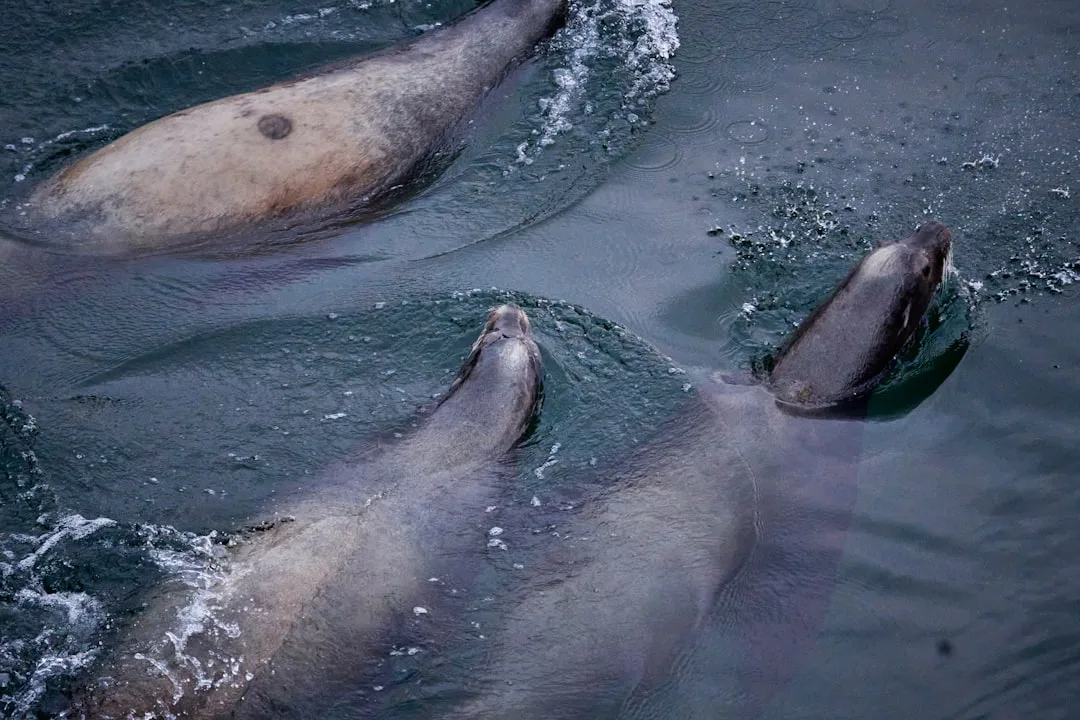
The Weddell seal is the southernmost-breeding mammal on Earth. No other warm-blooded animal - not the emperor penguin, not the elephant seal, not the polar bear's Antarctic equivalents that do not exist - raises its young as far south as this one species of true seal.
Weddell seals pup on sea ice attached to the Antarctic continent itself, in places where the winter air can drop below minus forty degrees Celsius and the sun disappears for months at a time. They spend most of their lives beneath the ice, in a dim blue-green world where they hunt silverfish and toothfish at depths where almost no other air-breathing predator can follow.
This entry covers the full biology of Leptonychotes weddellii: size and physical features, the circumpolar Antarctic distribution, the astonishing diving physiology that makes this species the pinniped record-holder for both depth and breath-hold duration, the specialised ice-gnawing habit that both sustains and eventually kills them, the rich underwater vocal repertoire of more than thirty-four distinct call types, pupping on sea ice in subzero conditions, diet and hunting behaviour, conservation status under the IUCN, and the long history of scientific study centred on McMurdo Sound since the first Operation Deep Freeze expeditions in the 1950s.
It is a reference entry, not a summary - expect measurements, behaviours, and details drawn from decades of Antarctic field research.
Etymology and Classification
The scientific name Leptonychotes weddellii combines Greek and a British dedication. Leptonychotes means "slender-clawed", from the Greek leptos ("thin") and onyx ("claw"), referring to the small, lightly-built claws on the foreflippers compared with other Antarctic seals.
The species epithet weddellii commemorates James Weddell, the British sealing captain who in February 1823 pushed his brig Jane to 74 degrees 15 minutes south in what is now called the Weddell Sea - a record southern latitude at the time. Specimens collected on that voyage were later formally described in 1826 by the French zoologist Rene-Primevere Lesson, who named the species in Weddell's honour.
The Weddell seal sits inside the order Carnivora, in the pinniped clade alongside eared seals (Otariidae) and walruses (Odobenidae), but within the true seal family Phocidae. Among the Antarctic phocids - a group that also includes the crabeater seal, leopard seal, and Ross seal - Weddell seals are placed in the subfamily Monachinae, the "southern seals" that also include monk seals and elephant seals.
The genus Leptonychotes contains only this one species; it is one of the most phylogenetically isolated seals in the Southern Ocean.
Taxonomic placement:
- Kingdom: Animalia
- Phylum: Chordata
- Class: Mammalia
- Order: Carnivora
- Suborder: Caniformia
- Clade: Pinnipedia
- Family: Phocidae
- Subfamily: Monachinae
- Genus: Leptonychotes
- Species: L. weddellii
No subspecies are currently recognised. Genetic work has shown some structure between populations from different sectors of the Antarctic coast - Ross Sea animals are measurably distinct from Weddell Sea animals in both genes and call dialects - but the differences are treated as population-level variation rather than formal subspecies.
Size and Physical Description
Weddell seals are medium-large phocids. They are not the biggest Antarctic seal - southern elephant seals dwarf them and leopard seals rival them in length - but they are robustly built, with a thick, barrel-shaped torso insulated under a heavy blanket of blubber.
Sexual dimorphism is modest compared to elephant seals or fur seals: females are actually slightly larger than males on average, a pattern unusual among pinnipeds and linked to the species' non-harem breeding system in which males compete underwater rather than through land-based bulk.
Adults (both sexes):
- Length: 2.5-3.5 metres
- Weight: 400-600 kilograms, occasionally exceeding 600 kilograms in late-gestation females
- Body plan: thickset, cylindrical, small head relative to body
- Coat: short, dense fur, dark grey to brown-black with pale silver mottling on the flanks and belly
Sexual differences:
- Females slightly longer and heavier on average
- Males show heavier scarring around the neck, jaw, and genital region from underwater fights
- Males have slightly more massive canines used both in combat and ice-gnawing
Pups at birth:
- Length: around 1.5 metres
- Weight: 25-30 kilograms
- Coat: soft, woolly lanugo fur that is shed within two to three weeks
- Born on sea ice, often directly on exposed fast ice near a tide crack or breathing hole
The head is distinctively small and cat-like, with a short muzzle, large round eyes, and a relatively gentle expression that has made the species a favourite in Antarctic wildlife documentaries. The eyes are exceptionally large for a pinniped of this size - an adaptation to hunting in the dim blue light that filters through sea ice, and in the almost lightless environment below 200 metres.
Behind the retina lies a reflective tapetum lucidum that bounces light back through the photoreceptors a second time, boosting sensitivity in low light.
Weddell seals lack external ear flaps, like all true seals. The vibrissae on the muzzle are long, beaded along their length, and extraordinarily sensitive; they pick up pressure signals from prey movement in the water column, which matters enormously when hunting in the dark.
Global Distribution and Habitat
Weddell seals are circumpolar Antarctic animals. They occur in a broken ring around the entire Antarctic continent, closely tied to fast ice - the sea ice that forms attached to the coast and remains in place for long periods, as distinct from drifting pack ice.
Main population concentrations:
- Ross Sea - McMurdo Sound, Erebus Bay, Victoria Land coast
- Weddell Sea - the original type locality, along the Filchner-Ronne Ice Shelf
- East Antarctic coast - Prydz Bay, the Davis Sea, and other coastal sectors
- Antarctic Peninsula and South Shetland / South Orkney Islands
- Scattered colonies along the Amundsen and Bellingshausen Seas
Outlying records:
- Occasional individuals reach the southern coasts of South America, Australia, and New Zealand
- Juveniles are the most likely to appear at lower latitudes, sometimes reported from the Falkland Islands, Tasmania, and the South Island of New Zealand
- These outliers are vagrants rather than a resident population
The species is the southernmost-breeding mammal on Earth, with established breeding colonies at around 77-78 degrees south in the Ross Sea and comparable latitudes on the other side of the continent. No other mammal pups this close to the South Pole. This is possible because Weddell seals have committed evolutionarily to life under fast ice: they maintain breathing holes, they hunt in the dim under-ice environment, and their pups survive the coldest birth environment of any mammal.
Life Under Fast Ice
Fast ice is the defining feature of Weddell seal ecology. Unlike pack ice, which drifts on ocean currents and opens and closes with the wind, fast ice is locked in place against the coast or an ice shelf. It can persist for many months or through the entire year. Beneath it lies a stable, sheltered, dark water column rich with Antarctic silverfish and other prey. Above it lies the harshest air environment on Earth.
Weddell seals have solved the fundamental problem of living in this environment: how to breathe. Their solution is to gnaw. Using their canines and upper incisors, they ream open cracks in the ice and maintain a network of breathing holes that they return to throughout the year. In early winter, when ice is still thin, these holes open readily.
As the ice thickens - often beyond two metres in mid-winter - the work becomes relentless. A seal may spend hours at a single hole, chewing at the refreezing rim, turning its head to grind the ice flat, breathing in short bursts between bouts of excavation.
The cost of ice-gnawing:
- Canines and incisors abrade against ice continuously from early adulthood onwards
- By the teens, many individuals show teeth ground down to stubs
- Worn teeth cannot maintain a breathing hole through thickening ice
- When teeth fail, the seal can no longer reliably surface and dies, typically by drowning
- Tooth wear is a leading intrinsic cause of death in older Weddell seals
Between dives, a seal typically rests in the water just below the hole, hanging vertically in the black under-ice space with only its nose above the surface. This posture - called "snorkelling" - conserves energy and keeps the animal close to its lifeline. Young pups, born on top of the ice, must eventually learn to dive under it and to navigate back to a hole; this transition is the most dangerous phase of a Weddell seal's life.
Diving Physiology - The Pinniped Record-Holder
No other seal dives like a Weddell seal. The species holds the pinniped record for both absolute depth and breath-hold duration among the true seals, and for several decades it was the model organism for comparative diving physiology in marine mammals.
Documented dive performance:
- Routine foraging dives: 200-400 metres, 15-25 minutes
- Maximum recorded depth: around 600 metres
- Maximum breath-hold duration: around 80 minutes
- Dive rate: up to several hundred dives per day during active foraging
- Aerobic dive limit: around 20-25 minutes for an adult
The physiology that enables this is layered. Weddell seals carry roughly twice the blood volume per kilogram of a human, and their blood is packed with haemoglobin at concentrations well above terrestrial mammal norms. Their muscles are saturated with myoglobin at concentrations ten to twenty times higher than in humans - so dense that the flesh is almost black.
During a dive, the heart rate drops from a surface rate of around 80 beats per minute to as low as 4-5 beats per minute, a profound bradycardia that routes blood almost exclusively to the brain and heart. Peripheral tissues run on local oxygen stored in myoglobin and tolerate the build-up of lactic acid for long periods.
The rib cage is flexible and collapses under pressure, forcing air from the lungs into the upper airways where it cannot be absorbed into the blood. This prevents nitrogen narcosis and decompression problems that would kill a human diver at comparable depths.
The lungs themselves are modest in size for the body, because on a deep dive the seal is not storing oxygen in the lungs - it is storing it in blood and muscle. The entire cardiovascular system reorganises the moment the seal leaves the surface.
Recovery between dives is surprisingly quick. A Weddell seal surfacing from a 25-minute dive typically breathes heavily for about five minutes and is ready to dive again. After the very longest dives - the 60-80 minute extremes - surface recovery is much longer, and these long dives appear to be pushed only when needed rather than routinely.
Diet and Under-Ice Hunting
Weddell seals are specialist mid-water and benthic predators in Antarctic coastal waters. Their diet is dominated by a handful of fish and cephalopod species that occur in dense concentrations beneath the fast ice.
Primary prey items:
- Antarctic silverfish (Pleuragramma antarctica) - a small, schooling, lipid-rich pelagic fish that dominates the Antarctic mid-trophic layer
- Antarctic toothfish (Dissostichus mawsoni) - a large, slow-growing predatory fish weighing up to 150 kilograms
- Various icefish (Channichthyidae) and notothens
- Squid, especially of the genera Psychroteuthis and Moroteuthopsis
- Octopus and other benthic cephalopods
- Small crustaceans taken opportunistically
Individual Weddell seals show strong dietary specialisation. Some animals concentrate on silverfish, making hundreds of short mid-water dives per day. Others specialise on toothfish, which requires pushing to depths beyond 400 metres and attacking a fish that may weigh nearly as much as the seal itself. The choice seems to depend on local prey availability and individual hunting skill acquired over the first several years of life.
Under-ice hunting is remarkable. Light is dim at best and absent at the depths where toothfish live. Weddell seals rely on their enormous eyes, sensitive vibrissae, and possibly on exhaled-air bubbles that flush prey out of ice cracks and crevices.
Some researchers have suggested that vocalisations may be used in echolocation-like ways, although the evidence is limited - most acoustic work interprets calls as social signals. Large prey is frequently brought back to a breathing hole and consumed at the surface, where south polar skuas and other scavengers gather to steal scraps.
Typical feeding pattern:
- Dive from a breathing hole to foraging depth (200-600 metres)
- Pursue prey in mid-water or near the bottom
- Either swallow small prey at depth or return to the surface with large prey
- Recover briefly at the hole
- Dive again, often repeating dozens or hundreds of times in a day
The 34 Call Types - Singing Under the Ice
The underwater acoustic environment beneath Antarctic fast ice is exceptional. Sound travels efficiently, background noise is very low, and a single call can be audible for many kilometres. Weddell seals have evolved one of the richest underwater vocal repertoires of any mammal to take advantage.
Researchers working at Erebus Bay and elsewhere have catalogued at least 34 distinct call types. These include:
- Descending trills, falling in pitch over several seconds
- Rising "whoop" calls, sweeping from low to high frequency
- Chirps, knocks, and guttural growls
- Long, whale-like moans and whinnies
- High-frequency whistles, sometimes ultrasonic
- Rapid click trains used in close-range interaction
Most vocalisations come from adult males during the breeding season. Males establish and defend underwater territories around a breathing hole - a valuable resource because females must use the hole to reach the pups they leave on the ice above. Vocal displays advertise the male's presence and size. Rival males may engage in extended acoustic duels, sometimes escalating to physical fights that leave the winner scarred around the neck and genital region.
Females vocalise too, particularly during mother-pup reunions when the mother returns from a foraging dive and must locate her pup on the ice above the hole. Pups produce a distinctive mother-attraction call that mothers learn to recognise individually.
Regional dialects have been documented. Weddell seals from the Ross Sea sound measurably different from those in the Weddell Sea, with the differences in call structure stable enough to be used by researchers as an acoustic population marker. Some call types appear specific to particular colonies.
Reproduction and Pups on the Ice
Weddell seals are slow, high-investment reproducers. Females reach sexual maturity at 3-6 years and typically produce a single pup per year once established. Males mature later and rarely breed until they can hold an underwater territory, which usually means age 7 or older.
Breeding cycle:
- Mating: October-December, underwater, near breathing holes
- Gestation: approximately 10-11 months, including delayed implantation
- Pupping: September-November, on fast ice close to a breathing hole
- Lactation: 6-7 weeks of extremely rich milk (up to 60 percent fat)
- Weaning: abrupt, at around 6 weeks, when the mother returns to sea and the pup takes its first dive
- Reproductive interval: usually one pup per year in prime adults
Pups are born directly onto the sea ice at Antarctic spring air temperatures that can still drop below minus thirty degrees Celsius. They weigh 25-30 kilograms at birth and are covered in a soft lanugo coat that is shed within two to three weeks. Blubber develops explosively during nursing - by weaning the layer is around 4 centimetres thick and the pup has tripled or quadrupled its birth weight.
Milestones from birth to independence:
- Days 0-3: pup lies on ice, nurses frequently, mother remains almost continuously on the ice
- Days 4-14: pup begins entering the water through the breathing hole, often encouraged by the mother
- Weeks 2-6: pup swims and dives in shallow water, rapidly accumulating blubber
- Week 6-7: abrupt weaning; the mother leaves to forage and does not return
- Weeks 7-12: weaned pup must survive on stored blubber and learn to hunt before it is exhausted
Calf mortality in the first year can reach 20-30 percent in some colonies, with first-winter survival the hardest bottleneck. Pups that make it to age two have dramatically better long-term survival rates.
Physiology of the Cold - Blubber and the Newborn Challenge
Weddell seals are born into the coldest environment faced by any newborn mammal. The physiological adaptations that make this possible are some of the most extreme in the class Mammalia.
Adult insulation is provided by a blubber layer 5-10 centimetres thick, underlaid by dense muscle and an efficient peripheral vasoconstriction response that limits heat loss through the skin when in the water. The short, dense fur contributes in air, but for an adult in freezing water, blubber does almost all the insulating work.
Newborn pups cannot rely on blubber at birth - they are born with relatively little of it. Their initial defence is behavioural and metabolic. They:
- Curl tightly against the mother's flank
- Shiver vigorously to generate heat
- Burn brown adipose tissue at very high rates
- Lie in whatever patch of sun is available on bright days
Over the first two to three weeks the rich maternal milk allows rapid blubber deposition. The 60 percent fat content of Weddell seal milk is one of the highest recorded in any mammal, comparable to hooded seal milk and far richer than most terrestrial mammals. The pup essentially trades milk directly for a fat layer, and by weaning it has enough stored energy to survive weeks of independent existence without feeding.
Adults can also thermoregulate actively in air when hauled out on ice. On rare sunny days with still air, a Weddell seal can overheat and will shift position, expose belly skin to the ice for cooling, or return to the water.
Conservation Status and Threats
The IUCN lists the Weddell seal as Least Concern, with a global population estimated at several hundred thousand animals. The species largely escaped nineteenth-century sealing pressure because its preferred habitat - fast ice attached to the Antarctic continent - was out of reach of most commercial sealing vessels, which focused on more accessible fur seals and elephant seals at South Georgia and similar sub-Antarctic sites.
Population estimates and trends:
| Region | Approximate count | Trend |
|---|---|---|
| Ross Sea | ~50,000-100,000 | Stable |
| Weddell Sea | Tens of thousands | Poorly quantified |
| East Antarctic coast | Tens of thousands | Likely stable |
| Antarctic Peninsula | Lower tens of thousands | Stable |
| Global total | Several hundred thousand | Stable overall |
Current threats:
- Antarctic sea ice change. Regional trends vary: some parts of the Antarctic are losing fast ice and others gaining it, with consequences for Weddell seal breeding habitat that differ by sector. Long-term loss of fast ice would be catastrophic for a species so tightly bound to it.
- Industrial fishing for toothfish. The Ross Sea toothfish fishery targets Antarctic toothfish, a significant Weddell seal prey item. Although the fishery is managed by the Commission for the Conservation of Antarctic Marine Living Resources (CCAMLR), indirect ecological effects on Weddell seal foraging remain a concern.
- Disturbance at research bases. Several major colonies sit close to Antarctic research stations, particularly around McMurdo Sound. Vehicle traffic, low-flying aircraft, and noise can disturb pupping females, though strict environmental protocols under the Antarctic Treaty system limit most impacts.
- Climate-driven shifts in prey. Changes in Antarctic silverfish distribution and abundance in response to sea ice change could cascade into Weddell seal foraging success.
- Tourism pressure. Growing Antarctic tourism brings ships and zodiac landings closer to some colonies, especially along the Antarctic Peninsula.
The long-term monitoring programme at Erebus Bay, started in the late 1960s and now running continuously for more than five decades, is one of the longest continuous marine mammal studies in the world. Every pup born in the study area is tagged, and thousands of individually-known animals have been tracked across their entire lives. The dataset provides exceptional baselines for detecting change.
Research History - From James Weddell to Operation Deep Freeze
The Weddell seal has a particularly rich history of scientific attention. James Weddell's 1823 voyage in the Jane brought back specimens that reached European natural historians within a few years. Richard Lesson formally described the species in 1826 and named it in Weddell's honour. Throughout the nineteenth century further specimens came in from sealing and exploration voyages, though commercial sealing never pursued the species in earnest because of its inaccessibility.
The modern research era began with Operation Deep Freeze, the United States Navy logistical operation that established permanent Antarctic research stations from 1955 onwards. McMurdo Station, founded in 1956 on Ross Island, sits directly adjacent to one of the densest Weddell seal breeding areas on Earth.
Scientists at McMurdo and at the nearby New Zealand Scott Base quickly recognised that the Weddell seal was an ideal subject for comparative physiology: large enough to carry instruments, tolerant of close approach on the ice, and present in predictable numbers each spring.
Major contributions from McMurdo-era research:
- The foundational studies of diving physiology in the 1960s-1980s that established the aerobic dive limit concept
- The first tagged dive profiles using time-depth recorders, from the late 1970s
- Long-term demographic monitoring of individually-marked animals from 1968 onwards
- Acoustic work establishing the 34+ call type repertoire
- Genetic and tracking studies showing Ross Sea / Weddell Sea population structure
The species remains one of the best-studied pinnipeds in the world. Decades of continuous data give researchers the tools to detect subtle changes and to distinguish climate signals from natural variation.
Weddell Seals and People
Unlike walruses or polar bears, Weddell seals have no historical association with indigenous human culture - the Antarctic continent has no indigenous human population. Every cultural association with the species comes from European exploration, commercial sealing, and scientific research.
Commercial sealing in the nineteenth century took some Weddell seals, but the species was not a major target. Its association with fast ice close to the continent made it inaccessible compared with the fur seals and elephant seals of South Georgia and the South Shetlands, which were hunted to near-extinction.
A small amount of Weddell seal harvesting was carried out by early expeditions for food, particularly by Ernest Shackleton's Endurance crew after their ship was crushed in the Weddell Sea in 1915; seal meat and blubber became vital to their survival during the long wait on the ice.
Today the species is fully protected under the Antarctic Treaty System and the Convention for the Conservation of Antarctic Seals. Research activities are permitted only under strict environmental protocols. Tourism in the Antarctic Peninsula area brings passengers into occasional contact with Weddell seal haul-outs, with distances regulated by the International Association of Antarctica Tour Operators.
In wider culture the Weddell seal has become a quiet icon of Antarctica. Its cat-like face and gentle expression feature in countless documentaries. The underwater recordings of its trilling, sweeping calls, played back through research station hydrophones, remain some of the most distinctive sounds of the Antarctic environment.
For a mammal living further south than any other, the Weddell seal is remarkably approachable - a function of an evolutionary history in which humans simply were not a factor.
Related Reading
- Marine Mammals: Giants of the Ocean
- Walrus
- Orca (Killer Whale)
- Narwhal
- Orca: The Apex Predator of the Oceans
References
Sources consulted for this entry include the IUCN Red List assessment for Leptonychotes weddellii (Least Concern), the long-term Weddell seal population study at Erebus Bay (Montana State University and collaborators, continuously operating since 1968), peer-reviewed work on diving physiology by Gerald Kooyman and colleagues at the Scripps Institution of Oceanography, acoustic research by Thomas and Kuechle and later investigators documenting the 34+ call types, publications in Marine Mammal Science, Polar Biology, Journal of Experimental Biology, Journal of Mammalogy, and Antarctic Science, dive profile datasets from the United States Antarctic Program, and population estimates compiled by the Scientific Committee on Antarctic Research (SCAR) and the Commission for the Conservation of Antarctic Marine Living Resources (CCAMLR).
Historical material on James Weddell's 1823 voyage draws on Weddell's own published narrative (A Voyage Towards the South Pole, 1825) and Richard Lesson's 1826 species description. All figures reflect the most recent published estimates as of 2024.
Frequently Asked Questions
How deep and how long can a Weddell seal dive?
Weddell seals are the deepest and longest-diving of all pinnipeds. Routine foraging dives go to 200-400 metres and last 15-25 minutes, but individuals have been logged at depths of around 600 metres and breath-hold durations of approximately 80 minutes.
These extremes are made possible by exceptionally high blood volume, oxygen-binding myoglobin concentrations in muscle several times higher than in terrestrial mammals, a collapsible rib cage that lets the lungs deflate under pressure to avoid nitrogen narcosis, and a capacity to lower heart rate to just a few beats per minute during deep dives. No other seal comes close to matching this combination of depth and duration.
Why are Weddell seals called the southernmost mammal?
Weddell seals breed further south than any other mammal on Earth. While transient visits by other species occur occasionally, stable breeding colonies of Weddell seals are established on fast ice directly attached to the Antarctic continent, including colonies at around 77-78 degrees south in the Ross Sea near McMurdo Sound - well within a few hundred kilometres of the South Pole. No other mammal pups or breeds at these latitudes.
The species is able to do so because of its year-round association with fast ice, its ability to maintain breathing holes through thick sea ice, and the cold tolerance of its newborn pups.
How do Weddell seals breathe under the ice?
Weddell seals live under continuous sea ice for much of the year and rely on a small number of breathing holes and tide cracks to survive. They work constantly to keep these holes open, gnawing at the ice edge with their canines and incisors to ream away refrozen layers. In winter, when the ice thickens rapidly, this maintenance becomes a major activity. Multiple seals may share a single hole, taking turns to surface.
The cost is severe tooth wear - by old age many individuals have stubs where their canines once were, and when the teeth can no longer keep the hole open, the animal cannot return to the surface and dies. Tooth wear, rather than predation, is a leading cause of death in older Weddell seals.
What do Weddell seals eat?
Weddell seals are specialist mid-water and bottom predators in the Antarctic coastal ocean. Their primary prey is Antarctic silverfish (Pleuragramma antarctica), a small, schooling, lipid-rich fish that dominates the mid-trophic layer beneath the ice.
They also take Antarctic toothfish (Dissostichus mawsoni), a large predatory fish that can exceed 100 kilograms, along with cephalopods such as squid and octopus, various icefish species, and shrimp-like crustaceans. Individual seals often show strong dietary specialisation - some concentrate on silverfish while others pursue large toothfish in repeated deep dives.
Prey is swallowed whole at depth or brought back to a breathing hole and consumed at the surface, where scavengers such as south polar skuas sometimes steal scraps.
How long do Weddell seals live?
Wild Weddell seals typically live 20 to 30 years, with the oldest verified individuals in long-term mark-recapture studies around Erebus Bay reaching their early thirties. Females tend to outlive males and produce their first pup at around age 4 to 6. Age is determined from growth rings in the cementum of the teeth, similar to other pinnipeds.
A major constraint on lifespan is the gradual wearing down of the teeth from ice-gnawing - once the canines are too short to ream open breathing holes, the seal’s ability to live under fast ice is effectively over. Younger animals enjoy high survival rates because Antarctic coastal waters have very few predators that regularly take adult seals.
What predators hunt Weddell seals?
Adult Weddell seals have very few predators. Orcas (killer whales) of the Ross Sea B1 ecotype specialise in hunting Weddell seals by creating coordinated waves to wash pups and small adults off ice floes, a strategy documented in detail by researchers in the Ross Sea. Leopard seals will take young Weddell seals at the edge of fast ice, particularly weaned pups making their first trips into open water.
On land or ice, pups are occasionally threatened by skuas, but no land predator exists on the Antarctic continent that poses a threat. For most of the year, adult Weddell seals under fast ice live in an environment almost entirely free of predators, which is one reason the species invests so heavily in very rich, fast maternal care rather than the extreme defensive behaviours seen in Arctic pinnipeds.
Why do Weddell seals sing?
Weddell seals produce an unusually rich underwater vocal repertoire - at least 34 distinct call types have been catalogued, ranging from trills and chirps to long descending whinnies and rising ‘whoop’ calls that can be heard for many kilometres under the ice. Most calls are given by adult males, who establish and defend underwater territories around breathing holes during the breeding season. Females vocalise too, particularly during mother-pup exchanges.
The acoustic environment under Antarctic fast ice carries sound exceptionally well, so vocal signalling is an efficient way to claim territory, advertise fitness, and maintain social contact in water too dark for visual display. Some call types appear to have regional dialects, with Ross Sea seals sounding measurably different from Weddell Sea seals.
Are Weddell seals endangered?
No. The IUCN lists the Weddell seal as Least Concern, with a global population estimated in the hundreds of thousands. The species avoided most of the historical Southern Ocean sealing pressure because its distribution on fast ice far south of the main sealing grounds made it difficult to reach in the nineteenth century.
Today the main concerns are indirect: Antarctic sea ice change, industrial fishing for Antarctic toothfish (which is both a Weddell seal prey species and a competitor fishery), and potential disturbance around Antarctic research bases and shipping lanes.
The long-term monitoring programme at Erebus Bay in McMurdo Sound, running continuously since the 1960s, is one of the longest-running marine mammal studies in the world and provides a detailed baseline against which future changes can be measured.