
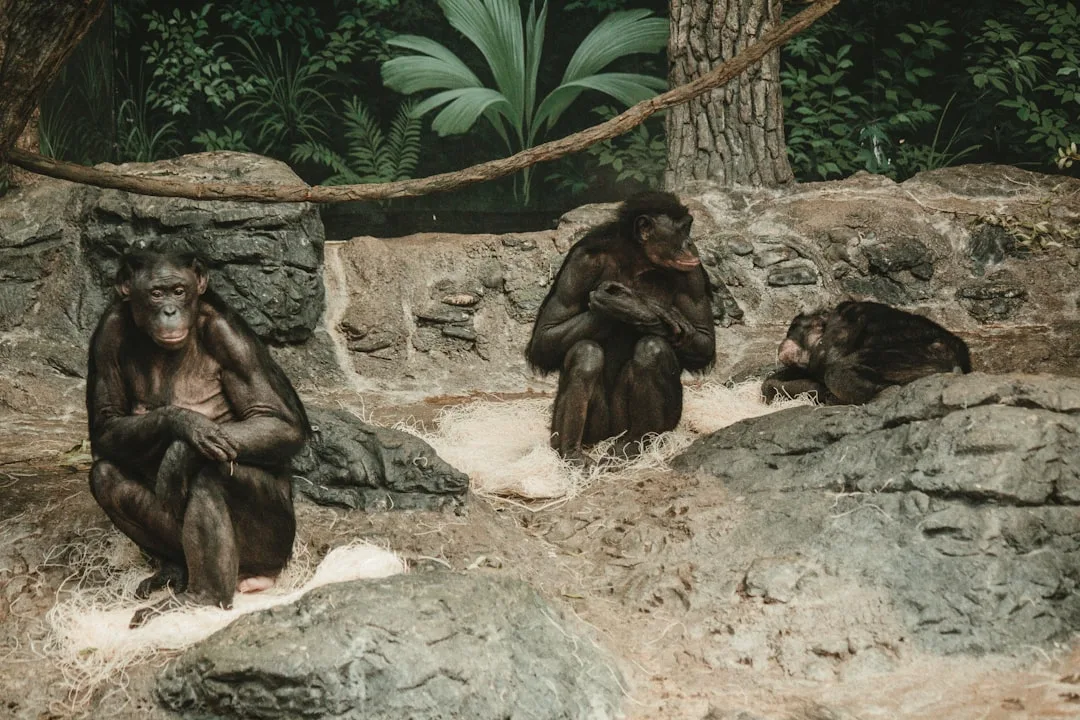
The bonobo is one of only two species in the genus Pan and, alongside the chimpanzee, the closest living relative of Homo sapiens. Both species share roughly 98.7% of their DNA with humans. Yet for a long time nobody even noticed bonobos existed as a separate kind of ape.
German anatomist Ernst Schwarz named Pan paniscus in 1929 from a single skull that had been filed as a juvenile chimpanzee in a museum drawer in Tervuren, Belgium. It took until the 1970s for serious long-term field research to begin.
Today the bonobo is recognised not just as a distinct great ape but as one of the most socially unusual mammals on Earth - female-led, largely non-violent, and famous for resolving conflict with sexual contact rather than force.
This guide covers every aspect of bonobo biology and ecology: taxonomy and naming history, physical description, habitat, diet and foraging, the female-centred social system, reproduction and development, cognition and tool use, the comparison with chimpanzees, the 1929 species description, conservation status, and the decades of Lomako and Wamba field research that built the modern scientific picture.
Etymology and Discovery
The scientific name Pan paniscus means 'small Pan' or 'Pan-like dwarf' - a reference to the misconception that bonobos were a smaller version of the common chimpanzee. The label 'pygmy chimpanzee' entered English in the early twentieth century for the same reason. Both names are biologically inaccurate. Bonobos are not significantly shorter than chimpanzees on average.
They are more slender, longer-legged, narrower-shouldered, and smaller-headed, but body length and standing height overlap considerably with chimpanzees.
The word 'bonobo' itself appears to be a twentieth-century coinage, possibly a corruption of a Congolese place name or a misspelling of 'Bolobo', a town on the Congo River. It was adopted by primatologists in the 1950s to replace the misleading 'pygmy chimpanzee' and is now the standard English common name worldwide.
Schwarz's 1929 paper, published in a short note in Revue de Zoologie et Botanique Africaines, was based on skulls and museum specimens rather than living animals. Harold Coolidge at Harvard confirmed the species status in a fuller 1933 paper.
No western scientist observed bonobos in the wild in any systematic way until the 1970s, when Japanese primatologist Takayoshi Kano began his long-term study at Wamba in 1973 and Belgian researcher Dieter Steyaert founded the Lomako project in 1974. Those two field stations remain the backbone of global bonobo knowledge.
Classification and Evolutionary Position
Bonobos sit within the family Hominidae, the great apes, alongside chimpanzees, gorillas, orangutans, and humans. The genus Pan contains only two species: Pan troglodytes (the common chimpanzee) and Pan paniscus (the bonobo). Molecular genetics places the split between bonobos and chimpanzees at roughly 1.5 to 2 million years ago, coinciding with the formation of the modern Congo River system that physically separated the two ancestral populations.
The split between the Pan lineage and the Homo lineage occurred far earlier - somewhere between 6 and 8 million years ago, depending on which calibration is used. Humans and bonobos share approximately 98.7% of their nuclear DNA. The figure is virtually identical to the human-chimpanzee comparison because bonobos and chimpanzees are more closely related to each other than either is to us.
Different regions of the genome tell slightly different stories, a phenomenon called incomplete lineage sorting: for some genes humans are closer to bonobos, for others closer to chimpanzees.
This pattern is biologically important. It means neither living ape is a simple model for ancestral human behaviour. Humans, bonobos, and chimpanzees are three cousins sharing a common ancestor, each of whom has evolved independently for millions of years since the last split.
Size and Physical Description
Bonobos are medium-sized great apes. Sexual dimorphism exists but is much less extreme than in gorillas or orangutans.
Males:
- Standing height: 73-83 cm
- Weight: typically 34-60 kg
- Arm span: up to 1.5 m tip to tip
- Canines: slightly larger than females but modest by great ape standards
Females:
- Standing height: 70-76 cm
- Weight: typically 30-40 kg
- Often slightly lighter build than males but socially dominant
Infants at birth:
- Weight: roughly 1.3 kg
- Cling to mother's belly from day one
Bonobos have darker faces than chimpanzees - uniformly black skin from infancy, compared to the pinkish faces of young chimpanzees that darken with age. The head is small relative to body size, with a higher rounded forehead, smaller brow ridges, and a noticeably shorter muzzle. A distinctive feature is the centre-parted hairstyle, where black hair on the scalp falls away from a clean midline, giving bonobos a look that some observers describe as curiously tidy.
Limbs are long and lean. Legs are longer relative to torso than in chimpanzees, which gives bonobos a more upright posture when they walk bipedally - something they do more often and for longer distances than any other non-human great ape. Hands and feet are long and narrow, with fully opposable thumbs and big toes adapted for confident arboreal movement. Bonobos spend a substantial fraction of every day in the canopy, feeding and nesting 10-30 m above the ground.
Range, Habitat, and the Congo River Barrier
Bonobos occupy a single, continuous range in central Africa. They are found only in the Democratic Republic of the Congo (DRC) and only south of the Congo River. No wild bonobo population has ever been documented on the north bank of the river or in any other country. Chimpanzees occupy the mirror image - everywhere north and west of the Congo but not south of it inside the central basin. The two species have not met in the wild for roughly two million years.
Key habitat types:
- Primary lowland tropical rainforest
- Seasonally flooded swamp forest
- Mosaic forest-savanna edges (rare, only in drier southern sections of range)
The total range covers roughly 500,000 square kilometres, but high-quality bonobo habitat is far smaller than that figure implies because of logging, roads, agriculture, and hunting pressure. Core populations survive in four officially protected areas and numerous community-based reserves.
Principal protected areas:
| Area | Approximate size (km^2) | Established |
|---|---|---|
| Salonga National Park | 36,000 | 1970 |
| Lomako-Yokokala Faunal Reserve | 3,625 | 2006 |
| Kokolopori Bonobo Reserve | 4,800 | 2009 |
| Tumba-Lediima Natural Reserve | 7,500 | 2006 |
| Sankuru Nature Reserve | 30,570 | 2007 |
Salonga is a UNESCO World Heritage Site and the largest protected rainforest block in the Congo Basin. Kokolopori and similar community reserves operate on a co-management model where local villages hold formal conservation responsibilities in exchange for schools, clinics, and sustainable livelihood support.
The Congo River is the decisive ecological boundary for the species. It is one of the widest and deepest rivers on Earth, typically 2-4 km across in its central section and up to 250 m deep. Neither bonobos nor chimpanzees have been documented to swim or otherwise cross it. This physical separation is the reason the two species diverged in the first place and the reason their ranges remain perfectly mirrored today.
Diet and Foraging
Bonobos are omnivores with a strong fruit preference. Ripe fruit typically makes up 50-60% of daily calories, though the figure varies seasonally and by site.
Core diet categories:
- Fruit - figs, Dialium species, Uapaca, Treculia, and many others
- Leaves, stems, pith, and bark - year-round fallback
- Flowers and shoots - seasonally abundant
- Aquatic plants - harvested by wading into shallow swamp water
- Fungi - locally important at several field sites
- Invertebrates - termites, ants, caterpillars, earthworms
- Small vertebrates - duikers, flying squirrels, small monkeys, rarely
Meat-eating is documented but far less frequent, less coordinated, and less calorically significant than in chimpanzees. When bonobos do hunt, individual females are often the most active hunters, and the distribution of meat tends to follow social ties including female alliances rather than strict male-dominated possession.
Foraging is a social activity. Bonobo parties move through the canopy in fluid sub-groups that split and reunite throughout the day, a pattern biologists call fission-fusion. Reunions are typically accompanied by brief sexual contact between multiple individuals - a pattern researchers at Wamba began documenting in the late 1970s and which still surprises new observers.
Social Structure: A Female-Led Ape
Bonobo social organisation is one of the most-studied features of the species and one of the clearest contrasts between the two species of Pan. Adult females form the backbone of bonobo society. They are not just socially important - they are demonstrably dominant.
Core features of bonobo society:
- Multi-male, multi-female groups of 30-100 individuals
- Fission-fusion pattern - large groups break into smaller foraging parties
- Females migrate between communities as adolescents; males remain for life
- Female-female alliances built through grooming, food sharing, and sexual contact
- Mother-son bonds remain central throughout life; a male's rank often tracks his mother's
- Highest-ranking individual is almost always an adult female
Female dominance in bonobos is surprising given that adult males are physically larger and stronger. The explanation lies in coalitions. In chimpanzee societies, adult males form coalitions and use coordinated aggression to dominate individual females. In bonobo societies, unrelated adult females form coalitions that effectively neutralise individual male aggression. A lone male who challenges a high-ranking female is rapidly confronted by multiple allied females, and he usually backs down.
Long-term research at Wamba (continuous since 1973) and Lomako (continuous since 1974) documents these alliances consistently. Newly arrived young females invest heavily in forming ties with resident females, including through genito-genital rubbing (GG-rubbing), grooming, food sharing, and nearby nesting.
Mother-son relationships are a second core feature. Adult males remain in their natal group for life and their social standing is strongly influenced by their mother's rank. Mothers actively support sons in disputes and influence their mating opportunities. The result is a society where high-ranking females hold disproportionate power over both the female and male social networks.
Conflict Resolution and Sexual Behaviour
The single most famous behaviour of bonobos is the use of sexual contact as a social and emotional lubricant. This is documented across dozens of contexts, captive and wild, and has been described by primatologists including Frans de Waal, Takayoshi Kano, Gottfried Hohmann, Barbara Fruth, and Amy Parish.
Typical contexts for sexual contact:
- Tension before feeding or at a valued food source
- Reunions after separation
- Greetings between allies
- Excitement over novelty
- Calming of an agitated individual
- Reconciliation after a minor dispute
Sexual contact in bonobos takes many forms. Females engage in genito-genital rubbing, often described by field researchers as a functional equivalent of grooming or a hug. Males mount one another, rub back-to-back, or engage in brief 'penis fencing'. Adults and juveniles engage in non-reproductive contact as well, although this has been the subject of considerable scientific and ethical discussion.
Bonobos are one of very few non-human mammals that frequently copulate face to face. Individual encounters are typically brief - often less than fifteen seconds - and low in intensity compared to reproductive mating.
Two points are frequently misunderstood. First, bonobos do not spend their day having sex. Studies at Wamba estimate that sexual episodes occupy only a small fraction of daily activity - well below the time spent feeding, resting, grooming, or travelling. Second, not all sexual behaviour is reproductive. Most is socially motivated, and most encounters occur outside of female oestrus.
The absence of lethal inter-group aggression in bonobos is the other striking contrast with chimpanzees. No scientist has ever observed a wild bonobo community conduct an organised lethal raid against a neighbouring group. Encounters between groups are tense but typically de-escalate into joint feeding, vocal display, mixed-group foraging, and cross-group sexual contact.
Infanticide, routine in chimpanzees and gorillas, has never been confirmed in wild bonobos. The ecological, social, and biological reasons for this contrast are the subject of continuing research and debate.
Reproduction and Development
Bonobo reproduction is slow. Females reach sexual maturity at about 10-13 years and give birth for the first time around age 13-15. After migrating into a new community as adolescents, females remain there for life and build social alliances that will eventually support their offspring.
Reproduction quick reference:
| Metric | Value |
|---|---|
| Gestation | 230-240 days (about 8 months) |
| Offspring per birth | 1 (twins extremely rare) |
| Inter-birth interval | 4-6 years |
| Age at first birth | 13-15 years |
| Weaning age | 4-5 years |
| Juvenile independence | 6-8 years |
| Lifespan (wild) | 30-40 years |
| Lifespan (captive) | 60+ years recorded |
Unlike most primate females, bonobos exhibit prolonged sexual swellings across much of their cycle, not just during the narrow window of ovulation. This extends the period during which sexual interaction can occur with males and may help obscure paternity, which in turn reduces the incentive for infanticide.
Infants cling to the mother's belly for the first several months and then ride on her back. They begin solid food around six months but continue to nurse for years. The mother-offspring bond is unusually prolonged.
Sons maintain an exceptionally close relationship with their mothers across their entire adult lives, travelling, foraging, and nesting near her, and receiving social support from her in disputes. Daughters migrate away from their mothers around puberty and form new alliances elsewhere.
Every individual bonobo builds a fresh sleeping nest every night by bending and weaving branches high in the canopy, usually 10-30 metres above the ground. The entire construction takes about five to ten minutes. Infants sleep with their mothers until age three or four, then begin building small practice nests and finally graduate to full independent nests.
Cognition, Communication, and Tools
Bonobos are highly intelligent primates and have been the subject of decades of cognitive research. Captive bonobos have demonstrated strong performance on tasks involving cooperation, food sharing with strangers, understanding of others' intentions, and symbolic communication.
The best-known case is Kanzi, a bonobo born in 1980 who was raised at the Language Research Center in Atlanta, Georgia. Kanzi learned to use a keyboard of lexigrams (geometric symbols standing for words) and demonstrated comprehension of several thousand spoken English words and novel spoken sentences. Kanzi also manufactured simple stone flakes by striking cores together and using the resulting flakes as cutting tools.
Wild bonobo tool use is less elaborate than that of chimpanzees. Observed behaviours include using sticks as probes, leaves as sponges and wipes, branches as projectiles during displays, and occasional digging tools. Bonobos also use leaves as shelter from rain - a behaviour recorded at Lomako and Lui Kotale.
Vocal communication is distinctive. Bonobo calls are higher-pitched than chimpanzee calls and include a characteristic 'peep' that resembles a short, high, bird-like chirp. Bonobos use peeps flexibly across contexts - feeding, travelling, nesting, and social interaction - which has led some researchers to describe the peep as functionally flexible in a way that hints at precursors of language.
Bonobos Compared to Chimpanzees
Bonobos and chimpanzees are often presented as a before-and-after pair, but the reality is more nuanced. The two species share a common ancestor roughly two million years ago, occupy different habitats on opposite sides of the Congo River, and have evolved distinct social systems in parallel.
Major contrasts:
| Trait | Bonobo (Pan paniscus) | Chimpanzee (Pan troglodytes) |
|---|---|---|
| Dominant sex | Female | Male |
| Inter-group lethal aggression | Not observed | Documented |
| Infanticide | Not confirmed | Documented |
| Hunting | Rare, often led by females | Frequent, male-coordinated |
| Sexual activity | High, socially diverse | Mostly reproductive |
| Range | South of Congo River only | North and west of Congo River |
| Face colour of infants | Black from birth | Pink, darkens with age |
| Build | More gracile, longer legs | Stockier, shorter legs |
| Vocalisation | High peeps | Deep hoots, pant-hoots |
Neither species is a model for ancestral humans. Both are specialised descendants of a shared common ancestor. Using bonobos as evidence for a peaceful human past, or chimpanzees as evidence for an inherently violent one, is an oversimplification - both behaviours exist within the Pan lineage and both are part of the evolutionary background of Homo sapiens.
For a closer look at the chimpanzee side of the comparison, see the linked chimpanzee entry below.
Conservation Status
The IUCN Red List classifies the bonobo as Endangered with a decreasing population trend. Global population estimates vary widely - from 15,000 to 50,000 individuals - because bonobos live in dense rainforest that is difficult and often dangerous to survey. Most surveys rely on nest counts combined with genetic sampling.
Primary threats:
- Poaching for bushmeat. The single largest direct cause of bonobo mortality. An estimated 98% of human-caused bonobo deaths come from hunting for meat - either for local consumption or for commercial trade. Snares set for other species also injure and kill bonobos.
- Habitat loss. Logging, shifting agriculture, mining, and road construction fragment the lowland rainforest and open previously inaccessible territory to hunters.
- Civil conflict. The DRC has experienced long periods of war and instability. Armed groups, displaced populations, and collapsed governance all intensify pressure on forest resources.
- Illegal pet trade. Infants are captured by killing the mother and sometimes other adults in the group. Most infants die before reaching a market; those that survive enter sanctuaries such as Lola ya Bonobo outside Kinshasa.
- Disease. Bonobos are susceptible to human respiratory infections, Ebola, and other emerging diseases. Contact with researchers and ecotourists is strictly controlled for this reason.
- Slow reproduction. A female gives birth once every four to six years. Populations cannot quickly recover from losses.
Conservation measures:
- Salonga, Lomako, Kokolopori, Sankuru, and Tumba-Lediima protected areas
- Community-managed reserves co-run by Congolese villages and NGOs
- Lola ya Bonobo sanctuary for confiscated orphans, founded 1994
- Long-term research and monitoring at Wamba, Lomako, Lui Kotale, and Kokolopori
- International Union for Conservation of Nature Pan African Great Ape Programme
- CITES Appendix I listing, banning international commercial trade
Community-based conservation is widely considered the most promising approach for bonobos. Projects run by Congolese organisations such as Vie Sauvage and international partners like the Bonobo Conservation Initiative link wildlife protection to schools, clinics, and sustainable income for villages inside and around bonobo habitat. Without local buy-in, remote protected areas cannot be effectively patrolled.
Bonobos and Humans
Bonobos have no tradition of co-existence with humans on the scale seen with Asian macaques or African vervets. The dense central Congo rainforest is thinly populated, and local communities have historically either avoided bonobos, hunted them, or - in several cultures of the central basin - protected them through taboos that treat bonobos as too human-like to kill.
These traditional protections have weakened in some areas and remain strong in others. In parts of the Bongandu and Mongandu cultural regions, ancient stories describe bonobos as former humans, and eating bonobo meat remains taboo. These taboos have contributed meaningfully to local bonobo survival.
Scientific contact is concentrated at a small number of long-running field stations. Wamba (founded by Takayoshi Kano in 1973), Lomako (founded 1974), Lui Kotale (founded 2002 by the Max Planck Institute), and Kokolopori (founded 2001) are the main sites. Research teams typically spend years habituating a single community before systematic behavioural data can be collected - a process that requires careful disease control and ethical protocols.
Tourism is minimal. Bonobos are difficult to observe, habituation is slow, infrastructure is limited, and the DRC has historically been a challenging travel destination. Where well-managed ecotourism exists, it channels income to local villages and strengthens the economic case for conservation.
Related Reading
- Chimpanzee: Our Closest Relative
- How Similar Are Chimpanzees to Humans
- Primates: Our Closest Relatives in the Animal Kingdom
- Mountain Gorilla
- Orangutan
- How Strong Is a Gorilla
References
Relevant peer-reviewed and governmental sources consulted for this entry include the IUCN Red List assessment of Pan paniscus (2016, updated 2023), the Action Plan for the Conservation of Bonobos (2012-2022), Ernst Schwarz's 1929 species description in Revue de Zoologie et Botanique Africaines, and published research by Takayoshi Kano, Frans de Waal, Gottfried Hohmann, Barbara Fruth, Amy Parish, and Martin Surbeck appearing in Behaviour, American Journal of Primatology, Current Biology, PNAS, and Science.
Population figures reflect the most recent consolidated estimates from the IUCN Species Survival Commission Primate Specialist Group and the Bonobo Conservation Initiative.
Frequently Asked Questions
How big are bonobos?
Adult male bonobos (Pan paniscus) weigh 34-60 kg and stand about 73-83 cm tall on two legs. Females weigh 30-40 kg and stand 70-76 cm tall. Arm span exceeds standing height by roughly 30%, and an adult male’s outstretched arms can reach 1.5 m tip to tip. Bonobos have longer legs relative to body size than chimpanzees, narrower shoulders, smaller heads, darker faces, and a distinctive centre-parted hairstyle. Newborns weigh about 1.3 kg.
The ‘pygmy chimpanzee’ label is misleading - bonobos are not meaningfully shorter than chimpanzees, just more gracile in build.
Where do bonobos live?
Bonobos live in exactly one country: the Democratic Republic of the Congo, and only south of the Congo River. Their range covers roughly 500,000 square kilometres of lowland tropical rainforest and seasonally flooded swamp forest in the central Congo Basin. Core populations occur in Salonga National Park, the Lomako-Yokokala Faunal Reserve, the Kokolopori Bonobo Reserve, and the Tumba-Lediima Natural Reserve.
No wild bonobo has ever been documented north of the Congo River, and the species is not found in any other country on Earth. The Congo River acts as a biogeographic barrier - bonobos do not swim across it.
What do bonobos eat?
Bonobos are omnivores with a diet dominated by ripe fruit, which can exceed 50% of daily intake. They supplement fruit with leaves, pith, stems, flowers, seeds, fungi, bark, and aquatic plants gathered by wading in shallow swamp water. Invertebrates - particularly termites, caterpillars, and earthworms - provide protein year-round.
Bonobos occasionally hunt and eat small mammals such as duikers, flying squirrels, and young monkeys, but meat-eating is far rarer and less coordinated than among chimpanzees. Research at Lomako and Wamba indicates bonobos spend 6-8 hours foraging per day and travel 2-4 km through the forest canopy.
Are bonobos really humanity's closest living relative?
Yes, alongside the chimpanzee. Bonobos and chimpanzees are tied as the closest living species to humans, with both sharing approximately 98.7% of their DNA with Homo sapiens. The split between the Pan lineage (bonobos plus chimpanzees) and the Homo lineage occurred roughly 6-8 million years ago. Bonobos and chimpanzees then diverged from each other about 1.5-2 million years ago when the Congo River formed and separated populations.
Different genomic regions tell slightly different stories - humans are closer to bonobos in some parts of the genome and closer to chimpanzees in others, a pattern biologists call incomplete lineage sorting.
Why are bonobos called female-led or matriarchal?
In every wild bonobo community studied to date, adult females form the backbone of social power. Females migrate into new groups as teenagers, form strong alliances with unrelated females through grooming, food sharing, and sexual contact, and collectively dominate individual males. The highest-ranking female - often an elder - outranks every adult male in most groups.
Males remain in their birth group for life and take their social rank largely from their mother’s rank. By contrast, chimpanzees have male-dominant hierarchies and male coalitions. Decades of field research at Wamba (since 1973) and Lomako (since 1974) have confirmed female dominance as a stable and reliable trait of bonobo society.
Do bonobos really use sex to resolve conflict?
Yes. Primatologists including Frans de Waal, Takayoshi Kano, and Gottfried Hohmann have documented extensively that bonobos use sexual contact as a social lubricant in contexts unrelated to reproduction. Tension before feeding, reunions after separation, greetings between allies, excitement over a new food source, and disputes between individuals all commonly trigger brief sexual episodes.
Behaviours include face-to-face copulation (very rare in non-human mammals), genito-genital rubbing between females, mounting between males, and non-contact rubbing between juveniles and adults. Encounters are typically short, low-intensity, and function like a handshake or hug rather than reproduction. This pattern is unique to bonobos among the great apes and is a major reason they attract scientific and public attention.
Why are bonobos less violent than chimpanzees?
The contrast is striking and well-documented. Chimpanzees engage in lethal inter-group raids, infanticide by males, and coalitionary violence. No wild bonobo community has ever been observed killing members of another group, committing infanticide, or conducting organised raids.
Researchers propose several overlapping explanations: (1) female alliances in bonobo society prevent dominant males from escalating aggression; (2) bonobo habitat south of the Congo River historically had more reliable fruit and fewer competing gorillas, so food competition was less intense; (3) lower testosterone and different brain regions linked to empathy are documented in bonobos; and (4) sex-based conflict resolution defuses tensions before they escalate.
The contrast between bonobos and chimpanzees is a central question in human evolutionary behaviour.
Are bonobos endangered?
Yes. The IUCN Red List classifies bonobos as Endangered with a decreasing population trend. Current estimates put the global population at 15,000-50,000 individuals across an increasingly fragmented range.
Threats include poaching for bushmeat (responsible for an estimated 98% of bonobo mortality from human causes), habitat loss from logging and shifting agriculture, civil war and armed conflict in the region, and capture of infants for the illegal pet trade. Bonobos reproduce slowly - females give birth roughly once every four to six years - which makes population recovery extremely slow.
Protected areas such as Salonga National Park cover meaningful territory but remain chronically under-funded and difficult to patrol. Conservation depends heavily on local Congolese organisations, international NGOs, and community-based reserves.