
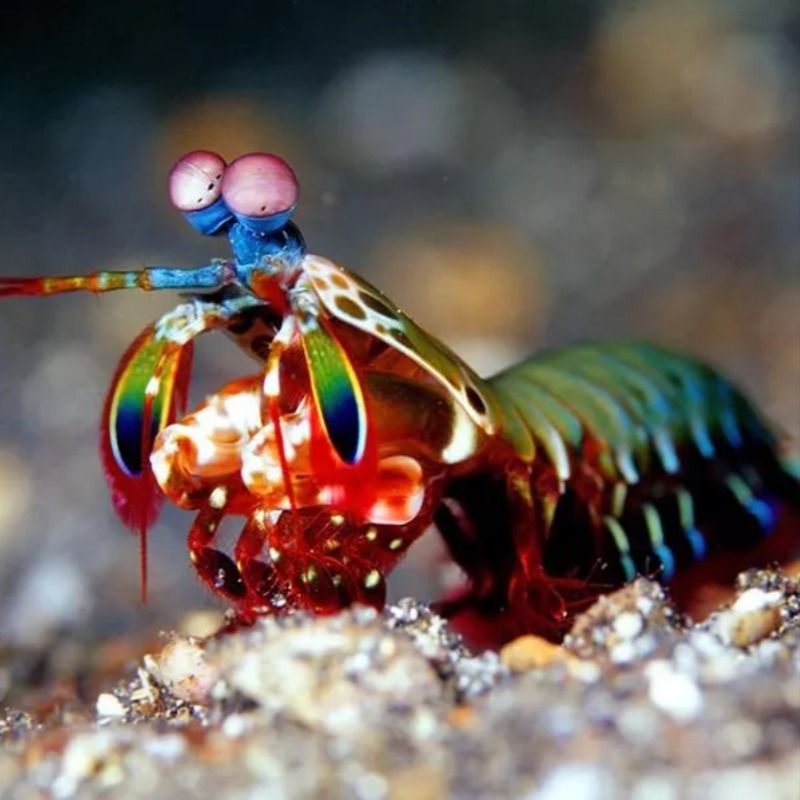
How powerful is a mantis shrimp punch?
Mantis shrimp deliver strikes at approximately 80 km/h (50 mph) with forces up to 1,500 newtons - roughly 1,000 times their body weight. A peacock mantis shrimp weighing just 100 grams can punch with force equivalent to a 22-caliber bullet. The strikes accelerate from rest in under 3 milliseconds and reach accelerations over 10,000 g's (10,000 times Earth's gravity).
The Crustacean That Punches With Light
In a coral reef, a 10-centimeter creature spots a crab wandering too close to its burrow. In 3 milliseconds, faster than a neuron in your brain can fire, the creature's forelimb accelerates from stillness to 80 km/h. It strikes the crab with force 1,000 times its own body weight. The impact produces a flash of light from collapsing water molecules reaching 4,400 degrees Celsius - briefly matching the surface temperature of the sun.
The crab is dead, shell shattered, killed twice. Once by the strike itself. Once by the cavitation bubble that formed and collapsed in the punch's wake, creating a second shock wave that arrived microseconds later.
This is the mantis shrimp - a 10 cm animal that contains some of the most extreme biology found anywhere on Earth.
The Punch
Mantis shrimp divide into two functional groups based on their forelimbs.
Smashers:
Smasher mantis shrimp have club-like forelimbs specialized for breaking hard-shelled prey:
- Strike speed: 80 km/h
- Force: up to 1,500 Newtons
- Acceleration: over 10,000 g's
- Time from rest to impact: under 3 milliseconds
- Prey: snails, crabs, clams, anything with shells
Spearers:
Spearer mantis shrimp have barbed forelimbs for impaling soft prey:
- Faster strikes but less force
- Prey: fish, small shrimp, worms
- Precision over power
The peacock mantis shrimp (Odontodactylus scyllarus), the species most commonly shown in media, is a smasher.
Cavitation
The mantis shrimp punch is so fast it creates cavitation bubbles.
What cavitation is:
When an object moves through water fast enough, the pressure behind it drops low enough that water itself briefly vaporizes, creating vapor bubbles. When these bubbles collapse, they release enormous energy.
In the mantis shrimp strike:
The punch moves fast enough to create cavitation. The bubbles collapse behind the club, generating:
- A secondary shock wave
- Bright flash of light (sonoluminescence)
- Temperatures reaching 4,400°C briefly
- Sound energy equivalent to a small explosion
Practical consequence:
Even if prey dodges the first strike, the cavitation wave arrives microseconds later and still hits. Mantis shrimp strike their prey twice per punch.
Temperatures approaching the sun:
The brief temperature peak during cavitation collapse rivals the surface of the Sun (5,500°C). These temperatures last for nanoseconds and cool immediately, but they are real. A mantis shrimp punch briefly generates solar surface temperatures in a coral reef.
Breaking Aquarium Glass
Mantis shrimp can and do break aquarium glass.
Documented incidents:
- Newport Aquarium: mantis shrimp broke through acrylic panel
- Numerous home aquarists have reported broken tanks
- Professional displays now use reinforced materials
Why:
Aquarium glass is not designed to withstand small-caliber bullet impacts. A peacock mantis shrimp punch delivers comparable force. Repeated strikes can crack or shatter even thick glass.
Precautions:
Aquarium keepers housing mantis shrimp use:
- Thick polycarbonate rather than glass
- Reinforced backing
- Single-occupancy tanks (mantis shrimp are territorial and cannibalistic)
- Secure lids (they can jump)
"Thumb splitters":
Mantis shrimp are sometimes called "thumb splitters" because handlers who mishandle them have suffered severe injuries. A strike to human flesh can break bone or cause deep lacerations.
Alien Vision
Mantis shrimp have the most complex visual system ever discovered in any animal.
Photoreceptor types:
- Humans: 3 photoreceptors (red, green, blue)
- Mantis shrimp: 12-16 photoreceptors
This was long assumed to give mantis shrimp vastly superior color vision. Research has now revealed the truth is more complex.
How it actually works:
Mantis shrimp do not combine their 12-16 photoreceptor signals the way humans combine 3. Instead, they seem to process each photoreceptor output independently - producing what researchers call a "color barcode" rather than a unified color perception.
Their actual color discrimination for similar wavelengths is surprisingly limited compared to humans. They cannot easily tell apart colors that humans distinguish clearly.
What they can see:
Mantis shrimp detect:
- Ultraviolet light (humans cannot)
- Polarized light (humans cannot)
- Circularly polarized light (no other known animal can)
- Infrared wavelengths
- Wide range of color spaces
Independent eyes:
Each mantis shrimp eye has three separate focus regions and moves independently. The eyes can:
- Point in completely different directions
- Focus on different distances simultaneously
- Track different objects at the same time
- Provide 360-degree visual coverage
Why the complex system?
Hypotheses include:
- Rapid object recognition over detailed color discrimination
- Processing speed for quick hunting decisions
- Complex signaling between mantis shrimp
- Detection of transparent prey
- Navigation in varied light conditions
Not Actually Shrimp
Mantis shrimp are not true shrimp despite the name.
Taxonomic position:
- Mantis shrimp: Order Stomatopoda
- True shrimp: Order Decapoda
- Divergence: approximately 400 million years ago
The two groups share general crustacean features (exoskeleton, segmented body, antennae) but differ substantially in detailed anatomy. Mantis shrimp have their own unique body plan.
Diversity:
Approximately 450 species of mantis shrimp exist, with:
- Size range: 2 cm to 38 cm
- Distribution: worldwide in tropical and subtropical waters
- Habitat: coral reefs, sandy bottoms, rocky areas
- Depth range: mostly shallow coastal waters
Hunting and Feeding
Mantis shrimp are active predators with well-developed hunting behavior.
Prey:
- Smashers: snails, crabs, clams, hermit crabs, barnacles
- Spearers: fish, small shrimp, worms, soft invertebrates
- Both: carrion, smaller mantis shrimp
Hunting technique:
Mantis shrimp typically:
- Hide in burrows or crevices
- Watch for prey with their sophisticated eyes
- Strike rapidly when prey comes within range
- Retrieve stunned or dead prey
- Consume inside their burrow
Strike efficiency:
Strike success rates are very high due to:
- Speed (prey cannot react)
- Power (minimal prey escape)
- Cavitation (second strike wave)
- Precision (specialized targeting)
Territorial behavior:
Mantis shrimp defend territories of several square meters around their burrows. Intruders are attacked or chased off. Some species maintain complex territorial networks with other individuals.
Reproduction and Life Cycle
Mantis shrimp reproduction varies by species.
Pair bonds:
Some species form long-term monogamous pairs. A single mated pair may share a burrow for years, cooperate in defense, and raise multiple clutches of eggs together.
Other species are solitary, meeting only briefly for mating.
Eggs:
Females lay eggs in burrows. Parents (usually female, sometimes both) guard eggs until hatching.
Development:
Larval mantis shrimp are planktonic, drifting through open ocean for weeks to months before settling to the bottom and developing adult forms.
Lifespan:
Mantis shrimp live 3-7 years typically, with some larger species reaching 20 years in captivity.
Cultural Impact
Mantis shrimp have become unusually prominent in popular culture.
Internet fame:
The mantis shrimp achieved major internet popularity through:
- The Oatmeal comic "Why the mantis shrimp is my new favorite animal" (2013)
- Viral social media posts about its punch and vision
- Nature documentaries featuring slow-motion strike footage
Research interest:
The extreme biology attracts scientific research into:
- Biomechanics of fast-striking animals
- Material science (mantis shrimp clubs inspire impact-resistant materials)
- Vision systems
- Cavitation phenomena
- Sound production
Military and engineering applications:
Mantis shrimp club structure is inspiring new materials:
- Impact-resistant armor
- Durable materials for aerospace
- Medical implants
- Structural composites
Research labs worldwide study mantis shrimp club nanostructure to develop materials with similar impact resistance.
The Club Nanostructure
Mantis shrimp clubs must withstand the forces they generate.
The engineering problem:
A human arm punching with comparable force would shatter. The mantis shrimp delivers this impact thousands of times per lifetime without damage. How?
The solution:
Research has revealed mantis shrimp clubs have layered nanostructure combining:
Outer layer: extremely hard mineral composite similar to ceramic.
Middle layer: organized chitin fibers arranged in specific patterns that absorb and dissipate impact energy.
Inner layer: flexible cushioning materials that prevent fracture propagation.
Why it matters:
This combination provides hardness for damage (cracking shells) while preventing the club itself from breaking. Engineers have struggled to replicate this structure in synthetic materials.
Research continues on adapting mantis shrimp club design for military armor, aerospace applications, and medical implants that must withstand repeated impacts.
Ecology
Mantis shrimp fill significant ecological roles.
In coral reefs:
They are important predators of:
- Snails (influence snail populations)
- Small crustaceans
- Bivalves
- Some fish
They are also prey for:
- Octopus (rare but documented)
- Larger fish
- Other predators
Ecosystem impact:
In some reef areas, mantis shrimp density significantly shapes invertebrate communities. Their removal can cause cascading effects on prey populations.
Conservation:
Most mantis shrimp species are not currently endangered, though:
- Coral reef degradation affects habitat
- Pollution threatens some populations
- Climate change disrupts reef ecosystems
- Collection for aquarium trade stresses some species
Why the Mantis Shrimp Matters
The mantis shrimp is not just scientifically interesting - it represents something philosophically important.
Many assumptions about what animals can do are wrong. Fast movement has limits, we assumed. Mantis shrimp exceed them. Complex vision requires many photoreceptors, we assumed. Mantis shrimp have many and use them differently. Small size prevents extreme capabilities, we assumed. Mantis shrimp are small and devastating.
Each mantis shrimp strike is a reminder that biology contains solutions humans have not anticipated. Extreme capabilities can hide in small bodies in obvious places. The ocean still contains animals whose biology surprises us when we look closely.
What other extreme animals exist that we have not yet studied closely enough to recognize their capabilities? The mantis shrimp was mostly ignored by research until the 1980s despite being common in coral reefs worldwide. Its full biology is still being uncovered.
The next time you see a mantis shrimp in an aquarium or documentary, consider: you are looking at an animal that punches with light, sees in ways no other creature sees, and hunts with the fastest movements in animal biology. All in a body smaller than your hand.
The Strike Physics in Detail
Sheila Patek and her collaborators at Duke University have been studying mantis shrimp strike biomechanics since the early 2000s. Their high-speed video analysis has shown that the peacock mantis shrimp's smasher claw accelerates at 10,400 g - comparable to the acceleration of a bullet fired from a rifle, but in an animal weighing just over 100 grams [1].
The strike is so fast that it creates cavitation bubbles whose collapse generates a secondary shock wave that can kill prey even if the primary strike misses.
"What the mantis shrimp is doing is not muscle-powered in the usual sense. No muscle can contract fast enough to produce this acceleration. Instead, the animal stores elastic energy in a saddle-shaped structure and releases it in a catapult-like mechanism. The principle is the same as a crossbow or a spring-loaded trap - load slowly, release explosively." - Professor Sheila Patek, Duke University [1]
Strike Kinematics Across Fast-Striking Animals
| Animal | Strike velocity | Acceleration | Strike time |
|---|---|---|---|
| Peacock mantis shrimp (smasher) | 23 m/s | 10,400 g | 2.7 ms |
| Mantis shrimp (spearer) | 5 m/s | 100 g | 4 ms |
| Trap-jaw ant | 64 m/s | 100,000 g | 0.13 ms |
| Snapping shrimp claw | 25 m/s | 8,000 g | 1 ms |
| Rattlesnake strike | 3 m/s | 28 g | 150 ms |
| Praying mantis strike | 0.5 m/s | 8 g | 50 ms |
| Archerfish spit | 5 m/s | N/A | 0.3 ms |
| Chameleon tongue | 4 m/s | 1,500 g | 50 ms |
The Mantis Shrimp Eye
Mantis shrimp vision has been studied extensively at the University of Queensland by Justin Marshall and colleagues. Their compound eyes contain 12 to 16 photoreceptor types (humans have 3), allowing them to detect linearly and circularly polarized light, ultraviolet, and colors across a much wider spectrum than most animals.
"For a long time we assumed that having more photoreceptor types meant better color discrimination. The mantis shrimp eye has forced us to rethink that assumption. They discriminate colors more poorly than humans in behavioral tests despite having four to five times as many photoreceptor types. We now think their visual system works differently - they do rapid color recognition rather than fine discrimination." - Professor Justin Marshall, University of Queensland [2]
Mantis Shrimp Vision
| Feature | Value | Species with similar feature |
|---|---|---|
| Photoreceptor types | 12-16 | None |
| UV sensitivity | Yes (6+ UV types) | Some birds, insects |
| Linear polarization vision | Yes | Some cephalopods, insects |
| Circular polarization vision | Yes | Unique to mantis shrimp |
| Trinocular (3-part) vision in each eye | Yes | Unique to stomatopods |
| Independent eye movement | Yes (360 degrees) | Chameleons |
| Spectral range | 300-720 nm | Exceptional breadth |
Notable Research Findings
- Mantis shrimp are the only animals known to see circularly polarized light. This may allow them to send secret signals to each other that are invisible to predators and prey.
- The spearer mantis shrimp and smasher mantis shrimp represent two different evolutionary strategies. Spearers use sharp, elongated appendages to impale soft prey like fish and worms. Smashers use hardened club-like appendages to crack hard prey like crabs and snails.
- The club of the smasher mantis shrimp is being studied as a model for impact-resistant materials. It has a helicoidal fiber structure that prevents crack propagation. Researchers at UC Riverside have used the design principles to create improved body armor and aerospace components.
- A single peacock mantis shrimp strike produces over 160 pounds of force, with localized pressure approaching 1,500 newtons on an area of a few square millimeters.
- Our research team notes that mantis shrimp are solitary and highly territorial. Fights between mantis shrimp over burrows rarely last more than a few seconds because of the lethality of their strikes.
- Mantis shrimp mating is surprisingly monogamous in many species. Lysiosquillina maculata, the giant zebra mantis shrimp, can form pair bonds lasting up to 20 years - one of the longest monogamous partnerships documented in any invertebrate.
- There are approximately 450 known species of mantis shrimp, with most diversity in the Indo-Pacific. Many species are cryptic and difficult to distinguish morphologically, so the real number of species may be considerably higher.
References
[1] Patek, S. N., Korff, W. L., & Caldwell, R. L. (2004). Deadly strike mechanism of a mantis shrimp. Nature, 428(6985), 819-820. DOI: 10.1038/428819a
[2] Marshall, J., & Arikawa, K. (2014). Unconventional colour vision. Current Biology, 24(24), R1150-R1154. DOI: 10.1016/j.cub.2014.10.025
[3] Cronin, T. W., & Porter, M. L. (2014). The evolution of invertebrate photopigments and photoreceptors. In Evolution of Visual and Non-Visual Pigments (pp. 105-135). Springer.
[4] Weaver, J. C., Milliron, G. W., Miserez, A., et al. (2012). The stomatopod dactyl club: A formidable damage-tolerant biological hammer. Science, 336(6086), 1275-1280.
[5] Thoen, H. H., How, M. J., Chiou, T. H., & Marshall, J. (2014). A different form of color vision in mantis shrimp. Science, 343(6169), 411-413.
Related Articles
- Giant Squid: The Real Kraken
- Crustaceans: The Armored Wonders of the Ocean
- Peregrine Falcon: The Fastest Animal on Earth
Frequently Asked Questions
How powerful is a mantis shrimp punch?
Mantis shrimp deliver strikes at approximately 80 km/h (50 mph) with forces up to 1,500 newtons - roughly 1,000 times their body weight. A peacock mantis shrimp weighing just 100 grams can punch with force equivalent to a 22-caliber bullet. The strikes accelerate from rest in under 3 milliseconds and reach accelerations over 10,000 g’s (10,000 times Earth’s gravity).
The punches are so fast they create cavitation bubbles - temporary vacuum pockets in the water that collapse with enormous energy, producing a secondary strike that hits prey with additional force, light flashes, and temperatures briefly reaching 4,400 degrees Celsius (approaching the surface temperature of the sun). This means mantis shrimp prey is struck twice per punch - once by the claw impact and once by the cavitation collapse.
Even if the prey dodges the first strike, the cavitation wave can still kill it. Mantis shrimp can break aquarium glass with their punches - many aquarium keepers have lost specimens (and tanks) to the destructive capability.
Can mantis shrimp really break aquarium glass?
Yes, mantis shrimp can break aquarium glass and have been documented doing so in multiple well-known cases. Their strikes generate forces equivalent to small-caliber bullets, and thick aquarium glass cannot always withstand repeated impacts. Professional aquarists often house mantis shrimp in specially reinforced tanks with thick plastic or polycarbonate panels instead of glass.
The Newport Aquarium in California lost a specimen that escaped by breaking through the acrylic panel of its tank. Several mantis shrimp species have been observed cracking aquarium glass repeatedly - the shrimp may be attempting to attack objects they see on the other side, may be testing territorial boundaries, or may be trying to escape.
Their forelimbs evolved for smashing hard-shelled prey (snails, crabs, clams) that would seem indestructible to other animals. Glass that cannot withstand snail shells certainly cannot withstand mantis shrimp strikes. This destructive capacity is why mantis shrimp are sometimes called ‘thumb splitters’ - handlers who have been struck report injuries requiring medical attention.
How many colors can mantis shrimp see?
Mantis shrimp have the most complex visual system ever discovered, with 12-16 photoreceptor types compared to humans’ 3 (red, green, blue). However, research has shown their color perception works differently than expected.
Rather than combining signals from multiple photoreceptors into fine color discrimination (as humans do), mantis shrimp seem to process each photoreceptor independently, producing what researchers call a ‘color barcode’ rather than detailed color blending. Their actual color discrimination ability is surprisingly limited compared to humans for similar wavelength comparisons.
However, they can detect ultraviolet light, polarized light (including circularly polarized light, a capability not shared with any other known animal), and infrared wavelengths simultaneously. Their eyes also move independently and can focus on three different distances at once. The evolutionary purpose of this alien vision system is still being studied.
Current hypotheses suggest it is optimized for rapid object identification rather than subtle color discrimination, perhaps helping them hunt and signal to other mantis shrimp quickly in complex reef environments.
Are mantis shrimp actually shrimp?
No, mantis shrimp are not true shrimp. They belong to the order Stomatopoda, a completely separate evolutionary lineage from true shrimp (order Decapoda). The two groups diverged approximately 400 million years ago. Mantis shrimp are classified with their own unique body plan that includes the distinctive raptorial forelimbs used for punching or spearing prey. Approximately 450 species of mantis shrimp exist, ranging from 2 cm to 38 cm in length.
They are divided into two functional groups: ‘smashers’ have club-like forelimbs for hammering hard prey, while ‘spearers’ have barbed forelimbs for impaling softer prey. The peacock mantis shrimp (Odontodactylus scyllarus), the most famous species, is a smasher. Spearers generally strike more quickly (though with less force) because they only need to pierce soft prey.
Both groups have extraordinary forelimb speed, the independent-eye vision, and complex behaviors. Despite being categorized differently, mantis shrimp and true shrimp do share some superficial similarities - both are crustaceans with segmented bodies, antennae, and similar general body plans.
What do mantis shrimp eat?
Mantis shrimp are predators that eat a variety of marine animals depending on species and size. Smashers eat hard-shelled prey including snails, crabs, hermit crabs, clams, barnacles, and bivalves - anything with a shell they can break open. Their powerful strikes easily crack shells that would seem indestructible to other animals. Spearers hunt softer prey including fish, small shrimp, worms, and other invertebrates by stabbing them with barbed forelimbs.
Both types will also eat carrion and smaller mantis shrimp (cannibalism is common). A single mantis shrimp may defend a territory of several square meters around its burrow, ambushing any suitable prey that wanders into range. Some species specialize on specific prey types - certain peacock mantis shrimp populations in Hawaii and Indonesia feed primarily on specific snail species.
They hunt mainly during the day using vision, though they can hunt at night using touch and chemical senses. Adult mantis shrimp consume approximately 10-20 percent of their body weight in prey daily, requiring constant active hunting to maintain their energy-intensive lifestyle.