
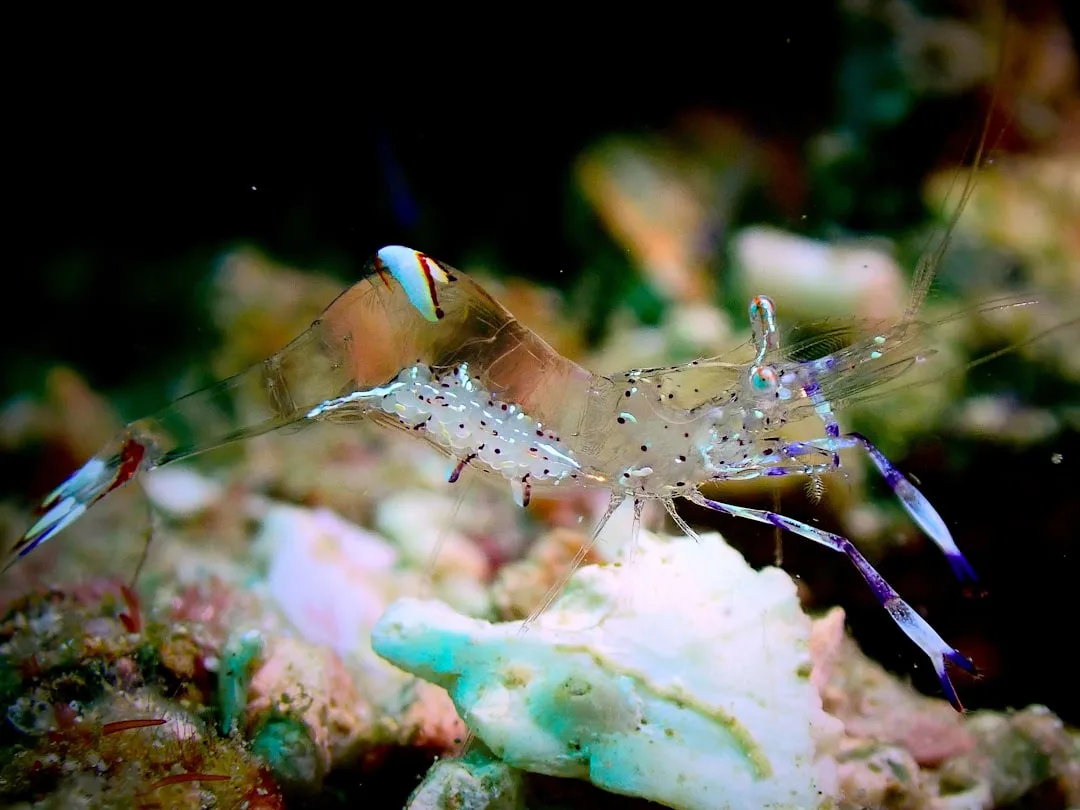
How loud is a pistol shrimp?
Pistol shrimp (family Alpheidae) produce snapping sounds that reach 218 decibels, louder than a gunshot (150 dB), a jet engine (140 dB), or thunder (120 dB). These sounds rival the loudest animal sounds ever measured. The snap comes from a specialized claw that slams shut so rapidly that it creates a cavitation bubble in the water.
Small Animal, Nuclear Snap
A 4-centimeter shrimp sits in a burrow on a coral reef. A small fish swims past. The shrimp's claw snaps shut in under a millisecond. A bubble forms and instantly collapses. Temperature at the collapse point briefly reaches 4,400 degrees Celsius, matching the surface of the sun. A flash of blue light is emitted. A sound wave at 218 decibels propagates outward, louder than a gunshot, louder than a jet engine at takeoff.
The fish is dead. It was never touched by the claw. The shock wave from the collapsing bubble killed it at a distance of 2 centimeters.
This is the pistol shrimp, a family of ~600 species that produce the loudest sounds in the ocean despite their small size.
The Sound Power
Peak measurements:
- Pistol shrimp snap: 218 decibels (at source, underwater)
- Gunshot: 150 decibels
- Jet engine at 30m: 140 decibels
- Thunder: 120 decibels
- Loudness threshold of pain for humans: 130 decibels
Note: underwater decibels are measured on a different reference scale than airborne decibels, but pistol shrimp sounds are genuinely louder than most artillery when converted to comparable scales.
Colony effects:
A single pistol shrimp produces occasional snaps. A colony produces continuous crackling. In some regions, pistol shrimp colonies make so much noise that:
- Navy sonar operators hear it as continuous static
- Submarines hide acoustically behind shrimp colonies
- Fish finders register false readings from shrimp crackle
- Acoustic research instruments get masked by shrimp noise
The Mechanism
How does a 4 cm shrimp produce such extreme sound?
The claw:
Pistol shrimp have one enlarged claw (sometimes up to half the body size). The claw has two parts:
- Pistol-shaped main section: with a socket
- Dactyl: a smaller opposing part that slams into the socket
The snap sequence:
- The shrimp cocks the claw, building up elastic energy in specialized muscles
- Release triggers the dactyl to slam into the socket at 60+ mph
- Water is expelled from the socket at 100+ km/h
- A low-pressure cavitation bubble forms behind the water jet
- The bubble collapses in microseconds
- Extreme heat (4,400°C), light (sonoluminescence), and sound (218 dB) are generated
The actual weapon:
The cavitation shockwave, not the claw, kills prey. A fish 2 cm from a pistol shrimp snap dies from the shockwave without ever being touched.
Sonoluminescence
Pistol shrimp snaps generate brief flashes of light.
What happens:
When the cavitation bubble collapses, gas inside is compressed so rapidly that it reaches extreme temperature and pressure. Some of this energy is emitted as photons, a phenomenon called sonoluminescence.
Temperature:
Estimated peak temperature at bubble collapse: 4,400°C (surface of the Sun is about 5,500°C). The heat exists for nanoseconds before dissipating in water.
Light output:
The light is bluish and extremely brief. High-speed cameras can capture it. The human eye usually cannot because the flash is too short.
Research relevance:
Pistol shrimp cavitation studies have informed:
- Understanding of acoustic cavitation in general
- Nuclear fusion research (cavitation-based energy concentration)
- Underwater propulsion research
- Shock wave applications
Hunting and Defense
Pistol shrimp use their sonic weapon for both hunting and defense.
Hunting:
They ambush small prey, fish, crabs, other crustaceans, that pass their burrow entrance. A single snap kills the target. The shrimp then drags the body into the burrow to eat.
Defense:
Approaching predators get a warning snap. Most predators avoid the distinctive sound. Those that persist face repeated snaps at close range.
Intraspecific combat:
Male pistol shrimp fight over territory and mates. Fights involve mutual snapping until one individual retreats or is disabled.
The Goby Partnership
Many pistol shrimp species live in remarkable symbioses with goby fish.
The arrangement:
A pistol shrimp (nearly blind) digs and maintains a burrow. A goby fish lives in the burrow with the shrimp. The goby has good vision but cannot dig. The shrimp cannot see predators coming.
Together:
- Shrimp digs and maintains burrow
- Goby keeps watch at the entrance
- Shrimp touches goby with antenna continuously (tactile communication)
- Goby flicks tail when predator approaches
- Both retreat into burrow instantly
Lifetime bonds:
Many goby-shrimp pairs stay together for their entire lives, often 3-4 years. They share the burrow, food scraps, and defense.
Species specificity:
Over 100 goby species partner with pistol shrimp. Some partnerships are species-specific, a particular shrimp species will only accept a particular goby species. Others are more flexible.
Obligate partnerships:
Some pistol shrimp species never leave their burrows without a goby partner. If the goby dies, the shrimp may never emerge again.
This is one of the most sophisticated interspecies partnerships documented in the ocean.
Where They Live
Pistol shrimp inhabit warm and tropical coastal waters worldwide.
Distribution:
- Indo-Pacific (greatest diversity)
- Caribbean Sea
- Mediterranean Sea
- Tropical Atlantic
- Red Sea
- Persian Gulf
Habitats:
- Coral reefs
- Rocky shores
- Seagrass beds
- Mangrove forests
- Sandy bottoms
- Crevices in natural and artificial structures
Depth range:
- Most species: 0-50 meters
- Some species: 50-200 meters
- Deep-water species: occasionally deeper
Species Diversity
Approximately 600 pistol shrimp species have been described, with many more likely existing.
Size range:
- Smallest: 2-3 mm (tiny tropical species)
- Average: 3-5 cm
- Largest: up to 8-10 cm
Appearance variations:
- Snapping claw can be left or right (varies by individual)
- Colors range from translucent to bright red/blue/yellow
- Some species have banded patterns
- Most have one oversized claw and one normal claw
Taxonomic challenges:
Many pistol shrimp species look similar. DNA analysis has revealed cryptic species, populations that look identical but don't interbreed. Real species count may be 2-3x the currently described 600.
Military and Scientific Interest
Pistol shrimp have attracted military and scientific interest for their sound.
Submarine concealment:
During World War II, Allied and Axis submarines used pistol shrimp colonies to mask their movements. A submarine motor running inside a shrimp colony's noise range became indistinguishable from shrimp snaps.
Modern submarines still consider shrimp colony locations when planning stealth operations.
Sonar interference:
Naval sonar systems treat pistol shrimp colonies as significant noise sources. Active sonar echoes off shrimp bodies; passive sonar hears their continuous crackle.
Research applications:
Pistol shrimp biomechanics have inspired:
- Cavitation research for propulsion
- Underwater acoustic sources for calibration
- Biomimetic robot designs
- Surgical cavitation techniques (lithotripsy uses similar principles)
Fusion research:
Sonoluminescence, the light from collapsing cavitation bubbles, has been researched for potential use in nuclear fusion. If cavitation could be controlled precisely, the extreme temperatures might trigger fusion reactions. Research continues but practical fusion devices remain theoretical.
Conservation
Most pistol shrimp species are abundant. Specific concerns include:
Coral reef degradation:
Reef-dwelling species face habitat loss from:
- Coral bleaching
- Ocean acidification
- Destructive fishing (dynamite, cyanide)
- Coastal development
Aquarium trade:
Some species are popular in reef aquariums. Captive care requires specific conditions. Unsustainable collection threatens some localized populations.
Climate change:
Warming oceans affect:
- Pistol shrimp reproductive cycles
- Prey availability
- Habitat distribution
- Goby partner species
Most pistol shrimp species remain not threatened globally despite localized concerns.
The Biology of Extreme
What makes pistol shrimp remarkable is not any single feature but the combination.
A small soft-bodied animal has evolved a mechanism that:
- Generates the loudest sound in the ocean
- Reaches the Sun's surface temperature momentarily
- Emits flashes of light
- Kills prey without physical contact
- Works underwater where most weapons fail
- Supports complex partnerships with fish
All in a body smaller than a human thumb. All refined over hundreds of millions of years of crustacean evolution.
Pistol shrimp remind us that biological weapons don't need to be large or complex to be extreme. Sometimes evolution finds a physical principle (in this case, cavitation) and develops it to an extent that human engineering struggles to match.
A pistol shrimp in a reef aquarium is not just an interesting crustacean. It is a miniature cavitation bomb, a tiny acoustic weapon, and a partner in one of the more sophisticated interspecies partnerships on Earth. And there are around 600 different species doing it, across tropical oceans worldwide, at all hours of every day.
If you listen carefully at a coral reef with a hydrophone, you can hear them - a constant crackle of snaps from shrimp you cannot see, each snap briefly creating a star-surface-temperature plasma in the water a few millimeters across.
The Physics of Cavitation
The pistol shrimp snap is not a muscular strike. Our research team finds the detailed physics genuinely remarkable: when the shrimp closes its specialized claw, it expels a high-velocity jet of water. The jet velocity exceeds the cavitation threshold, causing the water immediately behind it to vaporize into a bubble of water vapor at very low pressure. This bubble then collapses violently in microseconds.
The collapse generates three simultaneous effects: a shock wave with peak pressure over 80 kPa, a burst of light (sonoluminescence) from the extreme compression, and a localized temperature spike reaching approximately 4,700 C - close to the surface temperature of the sun. The prey is stunned or killed by the shock wave; the light and heat are byproducts that most biologists were not initially aware existed.
"The pistol shrimp snap was one of the first documented cases of sonoluminescence produced by a biological organism. The fact that a living animal can briefly reach temperatures approaching the sun's surface in a millimeter-scale bubble is one of the more astonishing bits of animal physics. It is a cavitation gun in a two-centimeter shrimp." - Dr. Michel Versluis, University of Twente [1]
Cavitation and Shock-Wave Phenomena
| Property | Value | Comparison |
|---|---|---|
| Peak sound pressure | 218 dB | Louder than a rifle shot (150 dB) |
| Collapse duration | ~1 microsecond | Shorter than most lightning flashes |
| Peak temperature | ~4,700 C | Near sun's surface temperature |
| Peak bubble pressure | ~80 kPa shock wave | Lethal to fish within 4 cm |
| Light emission | Yes (sonoluminescence) | Briefly detectable photon burst |
| Jet velocity | 25 m/s | Sufficient to cross cavitation threshold |
Reef Soundscape Contributions
A 2006 study by Rosa Freeman and colleagues at the University of Technology Sydney used hydrophone arrays to measure the ambient background noise on coral reefs. Snapping shrimp (Alpheus and Synalpheus genera) were identified as the single largest biological contributor to reef noise, producing a constant background crackle that masks other biological sounds and affects marine communication across many species [2].
"The snapping shrimp background is so loud on tropical reefs that it actually interferes with Navy submarine sonar. The US Navy has specifically studied these shrimp because their collective snaps create acoustic cover that can hide vessel signatures or confuse detection equipment." - Dr. Rosa Freeman, University of Technology Sydney [2]
Snapping Shrimp Diversity and Distribution
| Feature | Value |
|---|---|
| Known species | ~600+ |
| Genera | Alpheus, Synalpheus, others |
| Global distribution | Tropical and subtropical oceans |
| Typical habitat depth | 0-30 m (coral reefs, rubble) |
| Typical body length | 3-5 cm |
| Known eusocial species | Several Synalpheus species |
| Estimated population density (reef) | Hundreds per square meter |
Notable Research Findings
- Several Synalpheus species are eusocial, living in colonies with a single reproductive queen similar to termites or ants. This is one of very few cases of eusociality outside of insects. The 1996 discovery by Emmett Duffy was a landmark in understanding the evolution of eusociality.
- Pistol shrimp frequently form symbiotic partnerships with goby fish. The shrimp digs and maintains a burrow; the goby stands guard and alerts the shrimp (through tail contact) when predators approach. This mutualism is one of the best-documented inter-species partnerships on coral reefs.
- If a pistol shrimp loses its snapping claw, the other claw transforms into a snapping claw while the original regrows as a small standard claw. This bilateral reversal is one of the most dramatic examples of plasticity in crustacean appendage development.
- Our research team notes that pistol shrimp are now the subject of biomimetic research for underwater acoustic communication systems. Their snap produces a highly directional sound pulse that could be used for short-range underwater data transmission.
- The eusocial Synalpheus regalis lives in colonies of up to 300 individuals with a single reproductive queen. Non-reproductive shrimp defend the colony and maintain the sponge host. This species is one of the few known cases of eusociality evolving in the ocean.
- Pistol shrimp claws snap asymmetrically. Most species have one enlarged snapping claw and one smaller normal claw. The ratio is typically about 3:1 by volume. If the snapping claw is lost, the remaining claw can transform over several molts into a new snapping claw, a rare case of directed morphological plasticity.
- Industrial noise pollution in harbor areas can mask pistol shrimp sound signals, which has been shown to disrupt the goby-shrimp symbiotic communication. This is one of the few documented cases where marine noise pollution directly interferes with a cross-species partnership.
- The maximum recorded sound pressure from a pistol shrimp snap is 218 decibels. For context, this exceeds the threshold at which sound waves become non-linear and start behaving more like shock waves than acoustic pressure.
- The effective kill radius of a pistol shrimp snap is approximately 4 cm for small fish, making it one of the most efficient close-range weapons in the animal kingdom relative to the attacker's body size.
- Aquarium keepers with pistol shrimp report that the constant clicking is audible through aquarium glass, and concrete walls transmit the sound across rooms. Keeping multiple specimens in one tank requires careful territorial management because individuals engage in vigorous acoustic contests.
References
[1] Versluis, M., Schmitz, B., von der Heydt, A., & Lohse, D. (2000). How snapping shrimp snap: Through cavitating bubbles. Science, 289(5487), 2114-2117. DOI: 10.1126/science.289.5487.2114
[2] Freeman, R., Spurr, L., & Radford, C. (2014). The use of sound to help map the connectivity of coral reef fish populations. Proceedings of Meetings on Acoustics, 22, 010006.
[3] Duffy, J. E. (1996). Eusociality in a coral-reef shrimp. Nature, 381(6582), 512-514. DOI: 10.1038/381512a0
[4] Lohse, D., Schmitz, B., & Versluis, M. (2001). Snapping shrimp make flashing bubbles. Nature, 413(6855), 477-478.
[5] Karplus, I., & Thompson, A. R. (2011). The partnership between gobiid fishes and burrowing alpheid shrimps. In The Biology of Gobies (pp. 559-607). Science Publishers.
Related Articles
- Mantis Shrimp: The Fastest Punch in the Animal Kingdom
- Crustaceans: The Armored Wonders of the Ocean
- Coral Reefs: The Rainforests of the Ocean
Frequently Asked Questions
How loud is a pistol shrimp?
Pistol shrimp (family Alpheidae) produce snapping sounds that reach 218 decibels, louder than a gunshot (150 dB), a jet engine (140 dB), or thunder (120 dB). These sounds rival the loudest animal sounds ever measured. The snap comes from a specialized claw that slams shut so rapidly that it creates a cavitation bubble in the water.
When the bubble collapses, it generates the extreme noise along with a brief flash of light and temperatures reaching 4,400°C (approaching the surface of the sun). The entire snap happens in milliseconds. Pistol shrimp colonies can create so much noise collectively that they interfere with submarine sonar and have been used historically by militaries to hide submarines behind ‘acoustic curtains’ of pistol shrimp colonies.
Despite their power, pistol shrimp are tiny, most species are only 3-5 cm long.
How does a pistol shrimp snap work?
A pistol shrimp’s weapon is a specialized claw with two parts: a pistol-shaped main claw with a plunger mechanism, and a smaller opposing dactyl. When the shrimp cocks the claw, it builds up elastic energy. When released, the dactyl slams into a socket at extreme speed (60+ mph). The impact pushes water out of the socket at over 100 km/h, creating a low-pressure cavitation bubble behind the water jet.
This bubble instantly collapses inward, producing shock waves, extreme heat, flashes of light (sonoluminescence), and the signature loud snap. The collapsing bubble momentarily reaches temperatures of 4,400°C and pressures over 100 atmospheres. The primary weapon is actually the cavitation shockwave, not the claw itself, prey can be killed by the shock wave without any direct claw contact. Individual snaps take only microseconds.
Can pistol shrimp kill humans?
No, pistol shrimp cannot kill humans. While their snap is extraordinarily powerful relative to their size, the shock wave dissipates rapidly in water and poses no danger to humans at distance. A pistol shrimp snap might sting a bare hand if the shrimp snapped directly at contact distance, but it wouldn’t cause serious injury. Their primary prey is small fish and crustaceans that pass close enough to be within the shock wave’s killing range (1-2 cm).
Aquarium hobbyists report that pistol shrimp can startle humans with their loud snaps but pose no health threat. The main risks to humans from pistol shrimp are indirect: the sounds can damage electronic equipment if pistol shrimp are kept near delicate instruments, and large pistol shrimp populations can interfere with acoustic research equipment. Some aquarium keepers have reported pistol shrimp snaps cracking thin aquarium glass, though this is rare.
What is the goby-pistol shrimp symbiosis?
Many pistol shrimp species live in remarkable symbiotic partnerships with goby fish. The nearly-blind pistol shrimp digs and maintains a burrow, while the goby serves as a lookout. The shrimp keeps one antenna touching the goby’s body at all times, and the goby signals with tail flicks when predators approach. The shrimp immediately retreats into the burrow, often pulling the goby along.
The goby benefits by getting a safe burrow it could not dig itself, and the shrimp benefits from early warning of threats. Over 100 species of goby are known to partner with pistol shrimp, a level of specialization suggesting the relationship evolved many times independently. Some goby-shrimp pairs stay together for their entire lives, often 3-4 years.
The partnership is so essential that many pistol shrimp species never leave their burrows without a goby partner to serve as guard. Some deep-water species pair with specific goby species and don’t accept alternatives.
Where do pistol shrimp live?
Pistol shrimp live in warm and tropical coastal waters worldwide, with greatest diversity in the Indo-Pacific. Over 600 species exist in the family Alpheidae. They inhabit coral reefs, rocky shores, seagrass beds, mangroves, and sandy bottoms, anywhere they can dig burrows or find crevices. Most species are small (3-5 cm), live in pairs, and hide in their burrows during the day. They emerge to hunt at dusk or night.
Pistol shrimp are abundant enough that shrimp colonies in some areas create a constant background of snapping sounds audible through ship hulls. Military sonar operators have recorded continuous ‘crackle’ from pistol shrimp colonies that sounds like static or radio interference. Commercial fishermen sometimes report large pistol shrimp populations interfering with fish finder sonar.
The species’ abundance and noise production makes them one of the most acoustically significant groups in the ocean, their total sound output at any moment exceeds that of many larger marine animals combined.