
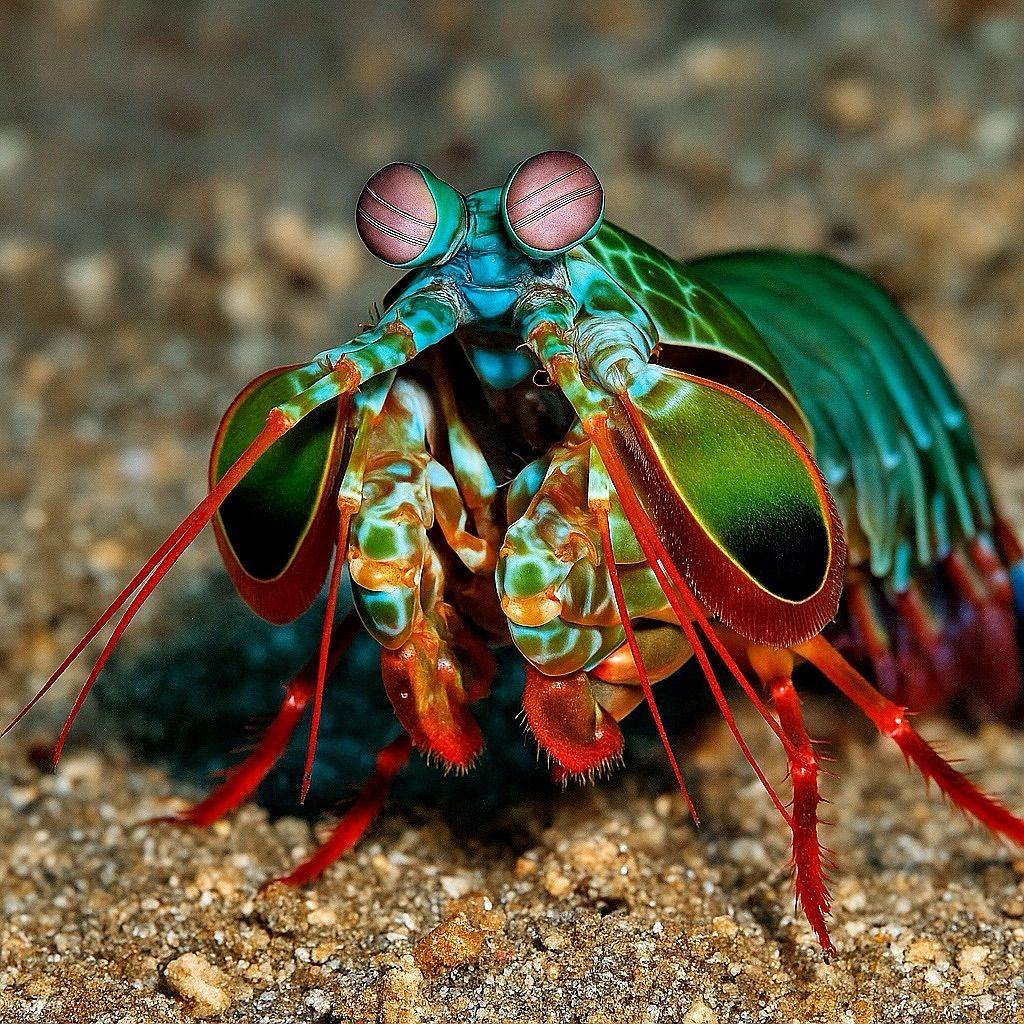
The mantis shrimp is not a shrimp. It is not a mantis either. Odontodactylus scyllarus, the peacock mantis shrimp, belongs to an ancient order of predatory crustaceans - the Stomatopoda - that split from the lineage leading to ordinary shrimp roughly 400 million years ago.
What remains is an animal that punches faster than a bullet fires, sees colours and polarisations that humans cannot imagine, forms long-term monogamous bonds, and routinely destroys reinforced aquariums. If the ocean had a reputation for producing bizarre engineering solutions, the mantis shrimp would be the emblem of that reputation.
This guide covers the biology and ecology of the mantis shrimp with a focus on the most famous species, the peacock mantis shrimp. Expect specifics: millisecond timings, receptor counts, strike velocities, depth ranges, and real-world consequences. This is a reference entry, not a marketing blurb.
Etymology and Classification
The common name 'mantis shrimp' comes from a superficial resemblance to praying mantises - both animals hold folded raptorial limbs in front of the body, ready to strike. The technical order name Stomatopoda is older and more accurate: it means 'mouth-foot' in Greek, a nod to the fact that the animal's powerful limbs are developed from mouthparts rather than ordinary legs.
The peacock mantis shrimp was formally described in 1758 by Linnaeus under the name Cancer scyllarus. The modern binomial Odontodactylus scyllarus was established once zoologists recognised that stomatopods warranted a separate genus and family. Roughly 500 species of mantis shrimp are recognised today, scattered across families including Odontodactylidae (peacock and allies), Gonodactylidae (smaller smashers), Squillidae (most spearers), and Lysiosquillidae (large burrow-dwelling spearers).
Stomatopods diverged from other malacostracan crustaceans in the early Palaeozoic. Fossil forms from the Carboniferous already show the characteristic raptorial limb. In evolutionary terms the mantis shrimp body plan has been running largely unchanged for hundreds of millions of years - a successful design that has outlasted entire geological epochs.
Size and Physical Description
Across the order, adult mantis shrimp range from about 3 centimetres in the smallest species to roughly 38 centimetres in the largest Lysiosquillina maculata - the zebra mantis shrimp. The peacock mantis shrimp sits comfortably in the middle at around 10 to 18 centimetres in body length.
Peacock mantis shrimp:
- Length: 10-18 cm typical, up to 18+ cm in well-fed adults
- Body shape: elongated, flattened dorsoventrally
- Colouration: emerald green carapace, orange and blue accents on legs, red and orange spots on antennae, leopard spots on the telson
- Raptorial appendages: heavy clubs with a folded, spring-loaded mechanism
Body plan:
- Segmented carapace covering the front portion
- Eight thoracic segments, six abdominal segments
- Two pairs of antennae, each pair with distinct sensory roles
- A pair of stalked, independently mobile compound eyes
- Uropods and a telson forming a fan-like tail used for swimming and defence
Mantis shrimp are built like armoured hunters rather than filter feeders or scavengers. Their cuticle is thicker than in most crustaceans, reinforced with calcium carbonate and hydroxyapatite. The raptorial appendage itself contains one of the toughest biological composites known: a helicoidal layered structure of chitin fibres and mineral crystals that resists fracture even after tens of thousands of strikes.
The Fastest Punch on Earth
The peacock mantis shrimp is best known for one thing: the strike. Its second pair of thoracic appendages - the raptorial limbs - are modified into heavy clubs that unfold at ballistic speed.
Strike parameters:
- Peak velocity: ~23 metres per second (measured tip speed in water)
- Acceleration: ~80 g - eighty times the acceleration of gravity
- Strike duration: less than 3 milliseconds from trigger to impact
- Impact force: up to 1,500+ newtons, briefly
- Kinetic energy: comparable to a .22 calibre bullet
The mechanism is mechanical, not muscular. Muscles alone cannot contract fast enough to produce those speeds. Instead the mantis shrimp uses a saddle-shaped spring of mineralised chitin and a latch mechanism similar to a crossbow trigger. The muscles load the spring over a fraction of a second. A small latch holds the limb in place.
Once the latch releases, the stored elastic energy accelerates the club in under 3 milliseconds. This power-amplification system is conceptually identical to the mechanism used by flea jumps and the ballistic tongues of chameleons - life has independently invented the crossbow several times.
Cavitation and Sonoluminescence
Moving a solid object through water at 23 metres per second creates a low-pressure region behind the club. That pressure drop is severe enough to cavitate the water: dissolved gas and water vapour flash out of solution to form a bubble. When that bubble collapses a microsecond later, it releases a secondary shockwave almost as strong as the initial impact. In practice, the prey animal is hit twice per punch: once by the club, once by the collapsing cavitation bubble.
The collapse is extreme. Bubble implosion focuses energy into a microscopic volume. Peer-reviewed measurements suggest temperatures approaching 4,700 degrees Celsius inside a collapsing cavitation bubble - hotter than the surface of the Sun - together with a brief flash of light called sonoluminescence.
Each mantis shrimp punch therefore produces, in the span of a few hundred microseconds, a microscopic shockwave, a microscopic flash of light, and a micro-region of water briefly hotter than molten iron. Biology does not get much weirder.
Why It Matters for Prey
The twin-hit mechanism is devastatingly effective against hard-shelled prey. The first impact cracks the shell; the cavitation shockwave reaches behind the first break and finishes the job. Snails, hermit crabs, true crabs, bivalves, and other reinforced animals are routine food for peacock mantis shrimp. The same strike can break through aquarium glass, which is why experienced hobbyists keep them in reinforced acrylic tanks.
Smashers and Spearers
The ~500 species of stomatopods split cleanly into two mechanical strategies based on the shape of the raptorial appendage.
Smashers. Their raptorial limb ends in a heavy, calcified club with a smooth or slightly ridged striking surface. They hunt hard-shelled prey - snails, crabs, bivalves - and deliver the cavitation-producing strike described above. The peacock mantis shrimp is the most famous smasher.
Spearers. Their raptorial limb is long, narrow, and lined with sharp barbs, like a folded harpoon. Spearers live in sand or mud burrows and ambush soft-bodied prey such as fish, shrimp, and worms by shooting the appendage forward at explosive speed. Spearer strikes are also fast, though not quite at the peak velocities of the smashers, and the focus is on piercing rather than crushing.
Both strategies share the same spring-and-latch power amplification. The difference is purely in the terminal business end of the limb. A smasher strike with a spearer-style appendage would break the harpoon; a spearer strike with a club would fail to penetrate. The two body plans appear to have diverged early in stomatopod evolution and have remained stable ever since.
| Feature | Smashers | Spearers |
|---|---|---|
| Limb shape | Heavy club, calcified | Long, barbed, harpoon-like |
| Prey | Snails, crabs, bivalves | Fish, shrimp, soft-bodied animals |
| Strike pattern | Percussive, generates cavitation | Piercing, ambush-driven |
| Habitat | Reef rubble, rocky substrate | Sand or mud burrows |
| Example species | Odontodactylus scyllarus | Lysiosquillina maculata |
The Most Complex Eyes in the Animal Kingdom
Mantis shrimp eyes are, by any sensible measure, the most complex compound eyes known. Each eye is mounted on an independent stalk and can rotate through roughly 70 degrees on three axes. The two eyes can track different targets simultaneously, an ability almost unique among animals.
Each eye is structurally divided into three bands: a dorsal hemisphere, a ventral hemisphere, and a narrow midband of six rows of ommatidia running across the middle. The midband is the key to stomatopod vision. Each of the six midband rows contains photoreceptors tuned to different wavelengths. Together, the midband provides:
- Up to 16 types of photoreceptor (humans have 3: red, green, blue)
- Sensitivity to ultraviolet light via dedicated UV channels
- Sensitivity to linearly polarised light
- Sensitivity to circularly polarised light - found in very few other animals
- Colour filters layered in front of receptors to sharpen spectral tuning
Because each of the three bands in each eye has its own set of receptors and its own pseudopupil, every single eye is effectively trinocular on its own. A mantis shrimp can judge depth with one eye closed in a way a human cannot.
Hardware Versus Software
The counterintuitive finding is that all this hardware does not translate into sharper colour perception. Controlled behavioural tests show that mantis shrimp are actually worse than humans at discriminating between similar colours. The explanation, proposed by Marshall and colleagues, is that mantis shrimp do not compare wavelengths in the brain the way humans do.
Instead they appear to read colours as hardware matches - the pattern of which receptor types fire - and scan the world rapidly by moving each eye. This swaps computational effort for hardware channels and allows colour decisions to be made in milliseconds, which may matter to an animal that strikes in 3 milliseconds.
Engineering Inspiration
The mantis shrimp eye has driven real engineering. Researchers at the University of Illinois and elsewhere have built polarisation cameras modelled directly on stomatopod ommatidia for use in medical imaging, underwater navigation, and remote sensing. The physical structure of the photoreceptors inspired design improvements in DVD and Blu-ray readers, which depend on precise handling of polarised light.
Habitat and Distribution
Peacock mantis shrimp occupy tropical and subtropical Indo-Pacific waters from East Africa and the Red Sea through Southeast Asia to Guam, southern Japan, and northern Australia. They live at depths between roughly 3 and 40 metres on coral reefs, reef rubble, and hard-bottomed lagoons. The order Stomatopoda as a whole extends into colder and deeper waters, with some species known from below 1,500 metres, but the flashy smashers are a warm-water phenomenon.
Each mantis shrimp lives in a burrow that it digs, widens, or repurposes from existing crevices. The burrow serves as a refuge between hunting excursions, a nursery for developing eggs, and a fixed territorial centre. Individuals tend to maintain the same burrow for months to years, and pair-living species share the burrow with a long-term mate.
Burrow entrances are often decorated or camouflaged with bits of shell, sand, and rubble, and the animal regularly clears out debris with the sweeping motions of its maxillipeds.
Mantis shrimp do not tolerate heavy sedimentation or pollution. Turbid water reduces visual hunting efficiency and clogs gills. Healthy populations are therefore a useful biological indicator of local reef condition.
Diet and Hunting
Mantis shrimp are active carnivores. The exact prey list depends on the individual's raptorial type.
Smasher diet (peacock mantis shrimp):
- Snails and slipper limpets (shell-crushing strike)
- Hermit crabs (striking the borrowed shell)
- True crabs, including armoured species
- Bivalves: clams, mussels, oysters
- Occasional small fish, shrimp, and crustaceans
Spearer diet (most burrow dwellers):
- Small reef fish
- Shrimps, amphipods, and other soft crustaceans
- Polychaete worms
- Larval fish and zooplankton when opportunistic
Smashers hunt actively, leaving their burrow to patrol a small territory and return with prey. A peacock mantis shrimp approaching a large snail will often position the prey precisely with its maxillipeds, align the shell, and deliver two to five rapid strikes until the shell gives way. Spearers are ambush predators: they sit at or just inside the burrow entrance and wait for a passing fish or shrimp to come within striking range, then fire the spear limb in a single explosive motion.
Stomach contents studies confirm that mantis shrimp consume a significant biomass of reef invertebrates. In aquariums they will kill and eat almost any tank-mate, including animals of their own size or larger. Cannibalism occurs in poorly structured captive systems where two mantis shrimp cannot escape line-of-sight of each other.
Reproduction and Life Cycle
Mantis shrimp reproductive biology varies dramatically across the order. Broadly, three patterns are recognised:
- Egg-carrying females. The female carries the egg mass under her tail until hatching. Common in many smasher species.
- Burrow-guarding females. The female guards a clutch cemented to the burrow wall while the male hunts. Common in Lysiosquillidae.
- Biparental care. Both partners share defence and feeding of the burrow and eggs, seen in some Pullosquilla and Nannosquilla species with very long-term monogamy.
Fertilisation is internal in some species and external (with sperm packets transferred to the female) in others. A clutch contains a few hundred to tens of thousands of eggs depending on species and body size. Eggs hatch into planktonic larvae that drift for weeks to months before settling onto the reef. The larval stage is one of the most dangerous phases in mantis shrimp life, with heavy predation and transport loss.
Monogamy and Pair Bonding
Several stomatopod species form long-term monogamous pairs that share a burrow for years - in some documented cases, up to 20 years. Partners recognise each other through chemical cues, visual signals, and characteristic antennae movements.
The benefits of pair-living include improved burrow defence against conspecifics and octopuses, cooperative hunting or prey sharing, and continuous protection of eggs during the female's vulnerable brooding periods. Monogamy is rare in arthropods, and the mantis shrimp case is one of the most striking known examples.
The peacock mantis shrimp itself tends toward seasonal or opportunistic mating rather than decades-long pair bonds, but smaller related species with smaller burrows and higher burrow value are the ones most strongly associated with true lifelong pair fidelity.
Lifespan and Mortality
Lifespan varies with body size and species:
- Small gonodactylid smashers: 3 to 6 years
- Medium stomatopods: 5 to 10 years
- Large species including Odontodactylus scyllarus: 10 to 20 years under favourable conditions
Primary causes of wild mortality include predation during moults (when the exoskeleton is soft and the animal cannot strike effectively), burrow collapse, parasitic infections, and reef habitat loss. Moulting happens several times per year in juveniles and roughly annually in large adults, and during each moult the mantis shrimp seals itself deep in the burrow until the new cuticle has hardened.
Mantis shrimp in well-maintained aquariums often exceed wild lifespans thanks to reliable food, stable temperatures, and protection from predators. They are, however, notoriously hard on their tanks and tankmates.
Conservation Status
Most stomatopod species have not been formally assessed by the IUCN, including the peacock mantis shrimp. There is no evidence of a species-wide decline in Odontodactylus scyllarus. However:
- Coral reef degradation reduces available reef rubble habitat
- Destructive fishing practices (dynamite, cyanide) damage burrow substrate
- The aquarium trade exerts localised collection pressure, mostly for the peacock species
- Several larger spearer species are food fisheries in parts of Southeast Asia and the Mediterranean
- Climate-driven ocean warming and acidification threaten long-term reef viability
The pragmatic view among marine biologists is that mantis shrimp are not currently at risk of extinction, but they are fully dependent on reef health. Reef loss at scale would reduce peacock mantis shrimp populations long before the species itself becomes endangered. Conservation of tropical coral reefs, mangrove-backed lagoons, and low-impact fisheries therefore indirectly protects stomatopods.
Mantis Shrimp and Humans
Humans and mantis shrimp interact along three main axes.
Fisheries and food. Larger spearer species are harvested for human consumption in Japan (where shako is a traditional sushi topping), southern China, Vietnam, the Philippines, Thailand, and parts of the Mediterranean. The meat is firm, sweet, and comparable to lobster.
Aquarium keeping. The peacock mantis shrimp is one of the most spectacular marine aquarium animals available, but it requires careful species-only setups in acrylic or heavy-glass tanks and cannot be safely housed with most other reef inhabitants. Beginner keepers regularly learn the hard way that 'it will eat everything in the tank' is a literal specification.
Scientific and engineering research. Mantis shrimp strike mechanics have inspired impact-resistant materials (the helicoidal composite of the club has been reproduced in synthetic armour designs). Mantis shrimp eyes have inspired polarisation imaging systems used in cancer detection and autonomous navigation. The cavitation dynamics of the strike are studied both for the biology and for applications in fluid engineering.
Contact between humans and mantis shrimp is otherwise limited. The species does not actively attack humans, but bare-handed handling of a peacock mantis shrimp is not advisable: the common nickname 'thumb splitter' is well-earned, and infections from the wounds can be serious.
Why the Mantis Shrimp Matters
The mantis shrimp is a reminder that the most extreme engineering in the animal kingdom is sometimes packed into animals only a few centimetres long.
A peacock mantis shrimp combines a bullet-speed hammer, a multi-spectrum hyperspectral imager, a pair of independent rangefinders, a 400-million-year-old body plan, and in some species a 20-year marriage into one organism that lives in a hole in reef rubble and hunts snails.
For biologists, physicists, optical engineers, and materials scientists it is one of the most scientifically generous animals alive. For anyone watching a reef, it is a flash of impossible colour darting into a burrow before the eye can focus.
Related Reading
- Mantis Shrimp: The Ocean's Most Extreme Predator
- Crustaceans of the Coral Reef
- Animal Eyes: From Pinholes to Compound Vision
- Cavitation in Nature: How Animals Weaponise Bubbles
References
Relevant peer-reviewed sources consulted for this entry include Patek and Caldwell (2005) on strike mechanics in Odontodactylus scyllarus, Cox et al. (2014) on the impact-resistant composite of the dactyl club, Marshall and Oberwinkler (1999) on ultraviolet and polarisation vision, Thoen et al. (2014) on colour discrimination in stomatopods, and Caldwell and Dingle (1976) on pair-bonding behaviour.
Additional information draws on IUCN order-level assessments of Stomatopoda, the World Register of Marine Species, and natural history monographs including Ahyong's revisions of Indo-Pacific stomatopod taxonomy.
Frequently Asked Questions
How powerful is a mantis shrimp's punch?
A peacock mantis shrimp (Odontodactylus scyllarus) accelerates its raptorial appendage at roughly 80 g, reaching peak speeds around 23 metres per second in under 3 milliseconds. That is the fastest recorded punch or strike among animals relative to size. The kinetic energy delivered per strike is comparable to a .22 calibre bullet.
Because the limb moves so fast through water, it also produces cavitation bubbles that collapse and release a secondary shockwave, so the prey is effectively hit twice. Strike force can exceed 1,500 newtons - more than enough to crack crab shells, snail shells, bivalve hinges, and occasionally the glass of unprepared aquariums.
Why do mantis shrimp have such complex eyes?
Mantis shrimp possess up to 16 types of photoreceptor, compared to three in humans. They can see ultraviolet, visible, and both linearly and circularly polarised light. Instead of comparing wavelengths in the brain - the method humans use - mantis shrimp appear to hardware-match light against specific receptors and scan their environment by moving each eye independently.
Counterintuitively, this system is worse than the human brain at distinguishing fine colour differences. The adaptive advantage seems to be speed: mantis shrimp can assess colour, polarisation, and UV signals almost instantly, which is valuable in a predator that strikes in 3 milliseconds. Their eye structure has directly inspired engineering work on polarisation imaging, medical cameras, and improved optical data readers.
What is the difference between smashers and spearers?
The ~500 stomatopod species are divided into two functional camps by the shape of their raptorial appendages. Smashers (including the peacock mantis shrimp, Odontodactylus scyllarus) have a heavy calcified club used to crack the shells of snails, crabs, and bivalves. Their strike is the one that generates cavitation bubbles and extreme acceleration.
Spearers have long, narrow, barbed appendages that shoot forward like spring-loaded harpoons to impale soft-bodied prey such as fish and shrimp. Spearers generally live in sand or mud burrows and ambush passing prey, while smashers prefer reef rubble and actively hunt hard-shelled animals. The two strategies are mechanically different enough that each type has a distinct exoskeleton, muscle layout, and even eye structure.
Where do mantis shrimp live?
Mantis shrimp occur in tropical and subtropical seas worldwide, with peak diversity in the Indo-Pacific. The peacock mantis shrimp ranges from the east coast of Africa through the Red Sea, across Southeast Asia, and into the western Pacific as far as Guam, southern Japan, and northern Australia. They live on coral reefs and reef rubble at depths typically between 3 and 40 metres, occupying burrows they dig themselves or modify from pre-existing holes.
A mantis shrimp will stay faithful to a single burrow for months or years, venturing out to hunt and patrol a small territory before returning. Their reliance on burrows makes them vulnerable to reef destruction and sediment pollution.
Can a mantis shrimp actually break aquarium glass?
Yes, it happens. A peacock mantis shrimp striking directly at a glass panel from a few centimetres away can crack or shatter standard aquarium glass, especially thinner panels or weakened seams. For this reason, experienced keepers house mantis shrimp in aquariums built from reinforced acrylic, which is more resilient to sudden impact, or in thick tempered glass tanks.
Beyond glass, mantis shrimp have also been observed to damage live rock, demolish hermit crab shells meant as tankmates, and kill fish many times their size. Their reputation as ‘aquarium demolishers’ is earned rather than exaggerated.
How long do mantis shrimp live?
Lifespan varies widely across the order. Small species may live only 3 to 4 years, while larger species including Odontodactylus scyllarus regularly reach 10 years in the wild and have been recorded up to roughly 20 years under favourable conditions. Females reproduce multiple times across their adult life, and some species maintain a single mate for most of that period.
Key causes of natural mortality include predation by larger fish and octopuses during moults (when the exoskeleton is soft), parasitic infestations, and burrow collapse. Unlike many crustaceans, mantis shrimp do not appear to have an obvious senescence cliff - well-fed captive individuals often remain active and reproductive to near the end of life.
Are mantis shrimp endangered?
Most of the ~500 stomatopod species have not been formally assessed by the IUCN, including Odontodactylus scyllarus. There is no evidence that the peacock mantis shrimp is currently threatened at a global level. However, habitat pressure is real. Coral reef degradation, dynamite fishing, sediment runoff, and the aquarium trade all affect local populations.
Small-scale fisheries in Southeast Asia and parts of the Mediterranean target larger spearer species for human consumption. The broader risk is indirect: because mantis shrimp depend on healthy reef rubble and burrow-capable substrate, declines in coral ecosystems reduce suitable habitat long before any single species drops to an endangered threshold.
Do mantis shrimp really form monogamous pairs?
Some species do. In Pullosquilla and Nannosquilla, males and females share a burrow for years, jointly defend the territory, and raise successive clutches together. Documented pair bonds have lasted up to 20 years in captive observation. The peacock mantis shrimp tends toward shorter-term mating relationships, but both partners remain mutually aware and may reunite across seasons.
Monogamy is unusual in arthropods and appears to be linked to the high cost of maintaining a good burrow - pair-living improves defence, feeding efficiency, and egg survival. The female carries eggs beneath her tail or guards them inside the burrow, depending on species, while the male hunts and patrols.